Hubbry Logo
K Desktop Environment 2K Desktop Environment 2Main
Open search
K Desktop Environment 2
Community hub
K Desktop Environment 2
logo
8 pages, 0 posts
0 subscribers
Be the first to start a discussion here.
Contribute something
K Desktop Environment 2
from Wikipedia
K Desktop Environment 2
DeveloperKDE
Initial release23 October 2000; 24 years ago (2000-10-23)
Final release
2.2.2 / 21 November 2001; 23 years ago (2001-11-21)
Written inC++ (Qt 2)
Operating systemUnix-like with X11
PredecessorK Desktop Environment 1
SuccessorK Desktop Environment 3
TypeDesktop environment
Websitekde.org

K Desktop Environment 2 was the second series of releases of the K Desktop Environment. There were three major releases in this series.

Major updates

[edit]

K Desktop Environment 2 introduced significant technological improvements compared to its predecessor.[1]

DCOP (Desktop COmmunication Protocol), a client-to-client communications protocol intermediated by a server over the standard X11 ICE library.[1]

KIO, an application I/O library. It is network transparent and can access HTTP, FTP, PoP, IMAP, NFS, SMB, LDAP and local files. Moreover, its design permits developers to "drop in" additional protocols, such as WebDAV, which will then automatically be available to all KDE applications. KIO can also locate handlers for specified MIME types; these handlers can then be embedded within the requesting application using the KParts technology.[1]

KParts, a component object model, allows an application to embed another within itself. The technology handles all aspects of the embedding, such as positioning toolbars and inserting the proper menus when the embedded component is activated or deactivated. KParts can also interface with the KIO trader to locate available handlers for specific MIME types or services/protocols.[1]

KHTML, an HTML 4.0 compliant rendering and drawing engine. It supports many Internet technologies, including JavaScript, Java, HTML 4.0, CSS 2, and SSL for secure communications. It is compatible with Netscape plugins such as Flash. KHTML also has the capacity to embed components within itself using the KParts technology.[1]

K Desktop Environment 2.0

[edit]
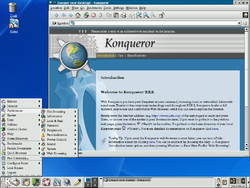
K Desktop Environment 2.0 showing Kandalf with a tip of the day

Konqueror was introduced as web browser, file manager and document viewer.[2] It used KHTML for displaying web pages.[1]

K Desktop Environment 2 also shipped with the initial release of the KOffice suite, consisting of a spreadsheet application (KSpread), a vector drawing application (KIllustrator), a frame-based word-processing application (KWord), a presentation program (KPresenter), and a chart and diagram application (KChart). Native file formats were XML-based. KOffice included a scripting language and the ability to embed individual components within each other using KParts.[1]

K Desktop Environment 2.1

[edit]

The K Desktop Environment 2.1 release inaugurated the media player noatun, which used a modular, plugin design. For development, K Desktop Environment 2.1 was bundled with KDevelop.[3]

K Desktop Environment 2.2

[edit]

The KDE 2.2 release featured up to a 50% improvement in application startup time on Linux systems and increased stability and capabilities for HTML rendering and JavaScript. A number of new plugins were included in Konqueror. KMail received the addition of IMAP support (including SSL and TLS), while KOrganizer got native iCalendar support. Other improvements included a new plugin-based print architecture and a personalization wizard.[4]

KDE Restoration Project

[edit]

After celebrating KDE’s 20th birthday with a re-release of K Desktop Environment 1.1.2 on 14 October 2016,[5] KDE and Fedora contributor Helio Chissini de Castro also did re-releases of Qt2 in October 2017[6] and KDELibs 2.2.2 in December 2017.[7][8]

Release schedule

[edit]
Date[9] Event
2.0
23 October 2000 KDE 2.0 released
5 December 2000 2.0.1 Maintenance release.
2.1
26 February 2001 KDE 2.1 released
27 March 2001 2.1.1 Maintenance release.
30 April 2001 2.1.2 Maintenance release (kdelibs only).
2.2
15 August 2001 KDE 2.2 released
19 September 2001 2.2.1 Maintenance release.
21 November 2001 2.2.2 Maintenance release.
21 December 2017 2.2.2 Restoration re-release.

References

[edit]
Revisions and contributorsEdit on WikipediaRead on Wikipedia
from Grokipedia
The K Desktop Environment 2 ( 2) was the second major release of the desktop environment, a free and open-source for operating systems, launched on October 23, 2000. Built upon the Qt 2.2.1 framework, it represented a near-complete rewrite of its predecessor, KDE 1, with a focus on improved integration, usability, and cross-platform compatibility. Development of KDE 2 began shortly after the 1998 debut of KDE 1, driven by the community's emphasis on enhancing modularity and developer tools to foster a richer of applications. Key milestones included the release of beta versions in early 2000, accompanied by developer conferences such as the KDE Three Beta meeting in July 2000, which refined the codebase for better performance and internationalization. The project shifted its branding to "KDE Desktop" during this phase, underscoring its evolution into a comprehensive desktop solution supported by major distributors like SuSE, , and Mandrakesoft. By launch, KDE 2 was available in 15 languages, with plans for 20 more, and distributed under open-source licenses to encourage widespread adoption. At its core, KDE 2 introduced , a versatile application serving as , , and document viewer, supporting advanced web standards like 4.0, CSS levels 1 and 2, , applets, SSL encryption, and plugins. It also debuted the initial version of KOffice, an integrated office suite featuring KWord for word processing, KSpread for spreadsheets, KPresenter for presentations, KIllustrator for , and KChart for data visualization, all using XML-based native file formats for . Multimedia capabilities were overhauled with the aRts (analog realtime synthesizer) architecture, enabling concurrent audio and video streams in formats such as /2/4, , and . KDE 2 emphasized network transparency through the KIO framework, allowing seamless access to remote resources via protocols including HTTP, FTP, NFS, SMB, and LDAP, which streamlined file operations across local and networked environments. Customization options were expanded significantly, with over 14 visual styles, theme support, configurable key bindings, and multi-language interfaces, making it adaptable to diverse user preferences. For developers, it provided robust tools like DCOP for inter-process communication, KParts for component embedding, XML-based GUI configuration, and the KHTML rendering engine, laying groundwork for future KDE innovations. Despite its advancements, KDE 2 served as a transitional release, paving the way for the more mature KDE 3 in 2002, and remains notable for solidifying KDE's role in the open-source desktop landscape.

Development and Overview

Background and Goals

The (KDE) project was founded on October 14, 1996, by , who announced it on as the "Kool Desktop Environment," aiming to create a consistent, visually appealing desktop environment for systems using the Qt toolkit and C++. The first stable release, KDE 1.0, arrived on July 12, 1998, introducing an integrated desktop with features like the K Desktop and basic application frameworks, but it faced challenges including code quality issues requiring a near-complete rewrite and controversies over Qt's proprietary licensing, which restricted proprietary extensions and raised concerns in the community. These limitations, particularly around stability and licensing compatibility with the GPL, motivated the evolution toward KDE 2 as a more robust successor. Development of KDE 2 focused on addressing these shortcomings by enhancing desktop usability through greater configurability and themeability, promoting modularity for better component reusability via tools like KParts, and integrating internet-enabled features to support emerging web technologies. Key objectives included preparing for a broader application suite, such as the KOffice productivity tools, while improving overall standards compliance and developer productivity to foster a more intuitive and powerful user experience. The project was led by the KDE core team, including founder and contributors from over 30 countries, with planning involving international developer meetings to coordinate efforts. A critical aspect of KDE 2's preparation was the migration to Qt 2, starting with version 2.2.1, which offered improved performance, enhanced features, and fully open-source licensing under the Q Public License (QPL) and GPL, resolving prior compatibility issues and enabling broader adoption. Beta releases began in mid-2000, with early betas like KDE 1.90 in May and subsequent iterations through September, allowing testing of the re-engineered codebase focused on stability and integration. This timeline culminated in the stable KDE 2.0 release on October 23, 2000, marking a significant step forward in creating a modular, internet-aware .

Core Technologies Introduced

KDE 2 introduced the Desktop COmmunication Protocol (DCOP), a lightweight inter-process communication mechanism designed to enable dynamic interactions between desktop components and applications. DCOP operates as a client-to-client protocol mediated by a server over the X11 Inter-Client Exchange (ICE) library, supporting message passing and remote procedure calls. It includes an XML-RPC gateway for broader compatibility and provides bindings for languages such as C, C++, Python, and experimental Java support. This protocol facilitated modularity by allowing KDE applications to query and control each other seamlessly, promoting interoperability without tight coupling. The (KDE Input/Output) system served as a unified protocol for handling file and network access, abstracting operations to support transparent interactions with diverse resources. By implementing I/O in a separate , ensured non-blocking graphical user interfaces without relying on threads, while offering network-protocol transparency for protocols including HTTP, FTP, NFS, SMB, and LDAP, which streamlined file operations across local and networked environments. Its extensible "slave" architecture allowed developers to add support for additional protocols, such as , making it a cornerstone for consistent data access across applications and enhancing overall desktop cohesion. KParts provided a robust component framework for reusable parts, such as viewers and editors, into host applications, thereby fostering a modular application . This object model managed aspects like positioning, menu integration, and service discovery through the KIO trader, which handles types and available services. KParts enabled applications to leverage shared components dynamically, reducing redundancy and improving resource efficiency in the environment. For instance, it allowed capabilities in file managers and office suites, streamlining user workflows. KHTML debuted as a lightweight, standards-compliant rendering engine, supporting 4.0, , applets, CSS-2, SSL, and Netscape-compatible plugins like Flash and . Integrated via KParts, it offered embeddable widget functionality and nascent bidirectional (BiDi) script support for languages such as and Hebrew. KHTML's design emphasized efficiency and compliance, laying groundwork for advanced web rendering in applications while influencing subsequent technologies like . KDE 2's architecture integrated closely with Qt 2, leveraging enhancements such as comprehensive support to enable full across the desktop, including text handling in widgets and rendering engines. Qt 2's refined signal-slot mechanism further supported 's modularity by providing a reliable, type-safe way for objects to communicate events and responses, integral to frameworks like DCOP and KParts for cross-component signaling. These Qt 2 features, including a customizable style engine with multiple widget themes, ensured a cohesive and extensible foundation for KDE 2's interoperable components.

Major Releases

KDE 2.0

KDE 2.0 was released on October 23, 2000, marking the initial stable version following beta precursors such as 1.93 in August 2000. This launch represented a significant evolution from the KDE 1 series, introducing a re-engineered focused on modularity and integration to enhance overall usability on and UNIX systems. The official announcement highlighted KDE 2.0 as a "powerful, modular, Internet-enabled desktop," emphasizing its role in advancing open-source desktop environments through standards-compliant technologies. A key highlight was the debut of , a versatile application serving as both a and , which unified local and remote file handling via the protocol for network-transparent input/output. Konqueror leveraged the rendering engine to support HTML 4.0, CSS levels 1 and 2, , Java applets, SSL encryption, and plug-ins, providing a seamless interface for browsing and document viewing. This design drew on KParts for component embedding, allowing dynamic integration of content within a single window. The release also introduced the initial version of the KOffice suite, positioning it as a free, open-source alternative to proprietary office software like Microsoft Office. Core components included KWord for word processing, KSpread for spreadsheets, KPresenter for presentations, KIllustrator for vector graphics, and KChart for data visualization and diagrams, all utilizing XML-based native file formats to promote interoperability and extensibility. At launch, KDE 2.0 demonstrated improved stability compared to KDE 1, attributed to its modular design that isolated components and reduced system-wide crashes through better error handling and resource management. While specific quantitative benchmarks were not detailed in contemporary reports, the architecture's emphasis on KParts and XML-based GUIs contributed to faster application startup and more reliable operation, establishing a foundation for scalable desktop development.

KDE 2.1

KDE 2.1, released on February 26, 2001, served as the first point release following KDE 2.0, emphasizing refinements to the modular architecture established in the prior version through enhanced application integrations and stability enhancements. This iteration focused on expanding usability for everyday users and developers by introducing specialized tools that leveraged the existing framework and component model, while addressing initial feedback on reliability. The release built on the modularity of KDE 2.0, incorporating new components to streamline multimedia handling and software development workflows without overhauling core infrastructure. A key addition in KDE 2.1 was Noatun, an advanced player designed with a modular plugin architecture to support extensible audio and video playback. Noatun enabled seamless handling of formats such as and Ogg through dedicated plugins, allowing users to customize playback features like visualization and equalization via the aRts sound server. This player marked a significant step in KDE's capabilities, providing a unified interface for media consumption that integrated directly with the . KDE 2.1 also debuted KDevelop, an bundled for the first time with the desktop release, targeting C++ and C programmers with Qt and KDE-specific support. The IDE offered comprehensive project management tools, including an Application Wizard for generating templates tailored to KDE 2 and Qt 2.2 applications, along with built-in debugging via gdb integration for setting breakpoints and inspecting variables. These features facilitated (RAD) by automating common tasks like header generation and setup with CVS, making it accessible for creating KDE-compliant software. Usability saw notable advancements, particularly in desktop navigation and customization, with enhancements to slaves enabling more efficient file operations and search functionalities within , building on the browser's capabilities from KDE 2.0. The KDE Control Center introduced a dedicated Theme Manager module, allowing users to preview and apply icon themes with support for 34x34 pixel sizes featuring alpha channels for shadows and semi-transparency, alongside a new list view of installed slaves for easier protocol management. These changes improved the overall by reducing configuration friction and enhancing visual consistency. In terms of stability, KDE 2.1 incorporated numerous bug fixes to mitigate early issues in KDE 2.0, including resolutions for crashes in during file operations and drag-and-drop interactions, as well as improvements to in-place file renaming and history persistence in the file manager view. Additional fixes addressed memory leaks in components like , contributing to more reliable performance across the desktop, though specific quantitative reductions in memory usage were not detailed in release notes. Overall, these updates enhanced the robustness of the environment for production use.

KDE 2.2

KDE 2.2, released on August 15, 2001, marked the final major update in the KDE 2 series, establishing it as the most stable iteration prior to the shift toward KDE 3 development. This version emphasized refinements that enhanced overall reliability and usability, making it suitable for enterprise deployment through targeted optimizations and expanded standards compliance. Performance gains were a key focus, with application startup times improved by up to 50% on GNU/Linux systems through experimental pre-linking, alongside optimizations in session management and reduced dependencies that contributed to faster session . These changes addressed user feedback on responsiveness, enabling smoother launches for core components like the desktop shell and integrated applications. Konqueror received significant enhancements to its plugin architecture, introducing tools such as the Babelfish translator, image gallery generator, validator, and web archiver, while bolstering stability with history navigation support and garbage collection fixes. DOM support was expanded with extended bindings for CSS and DOM Level 3 features, and KParts integration improved embedding capabilities through enhanced sidebar dockwidgets and view switching options. KMail introduced native IMAP protocol support, including SSL and TLS encryption for secure remote email access, complemented by folder synchronization features that handled large folders more efficiently without blocking other operations. KOrganizer advanced its calendaring capabilities by adopting as the default file format, enabling compliant event sharing, recurring appointments, and active remote calendar synchronization. Accompanying KDE 2.2, the stable release of KOffice 1.1 in late August 2001 refined interoperability with formats, particularly in KWord for document import/export and KSpread for spreadsheet handling, through dedicated filters that supported common file types like .doc and .xls. These updates solidified KOffice's role as a viable open-source alternative for cross-platform document workflows.

Legacy and Restoration

KDE Restoration Project

The Restoration Project for KDE 2 was initiated by and contributor Helio Chissini de Castro in 2016–2017, primarily to resolve compilation and build issues that prevented the original KDE 2 software from running on contemporary distributions with updated toolchains and libraries. This effort built on Castro's earlier work reviving KDE 1 in 2016, extending the preservation of legacy codebases amid growing interest in software archeology and retro-computing. A pivotal achievement was the re-release of KDELibs 2.2.2 on December 21, 2017, hosted on a dedicated GitHub repository, which applied targeted patches to enable successful compilation using the original Qt 2 framework alongside modern glibc versions. These modifications centered on updating the build system from Autotools to CMake while preserving the core codebase intact, allowing users to compile and run essential KDE 2 libraries without altering runtime behavior. The project's scope is deliberately narrow, limited to compatibility-enabling patches that facilitate building on current systems; it explicitly avoids introducing new features, addressing non-build-related bugs, or implementing updates to maintain historical fidelity. For instance, components like the Analog Real-time Synthesizer () are excluded from builds due to unresolved dependencies, and no enhancements beyond basic functionality restoration are pursued. Community engagement has linked the project to wider retro-computing initiatives, with the repositories providing source downloads, detailed build instructions, and open calls for contributions to tackle remaining components such as documentation or additional libraries. Contributors have assisted with specific issues, like Qt 2's ARGB visuals handling via environment variables and parser adaptations, fostering a collaborative environment for enthusiasts. Key technical hurdles overcome include accommodating deprecated X11 dependencies, which remain central to KDE 2's display and window management, and ensuring compatibility with 32-bit library architectures on 64-bit hosts through careful linker configurations. These adaptations address shifts in system libraries since KDE 2.2's original 2001 release, such as glibc's evolution and Qt 2's obsolescence, without compromising the environment's classic features like its and panel customizations.

Impact and Reception

KDE 2 gained significant traction within the ecosystem shortly after its release, becoming the default in major distributions such as SuSE Linux 7.3 and 8.0 by 2001. User engagement was evident through active discussions on mailing lists, where contributors reported growing adoption among hobbyists and early enterprise users, though precise surveys from the era are limited. The series received positive acclaim for its innovative components, particularly the browser, which was praised for its seamless integration of file management and web browsing capabilities, offering a unified interface that enhanced user productivity. KOffice was similarly lauded for providing accessible office tools that rivaled alternatives, making open-source more approachable for non-technical users. This reception fueled KDE's competitive rivalry with , positioning KDE 2 as a feature-rich contender in the desktop environment landscape and contributing to broader interest in Linux desktops. Criticisms of KDE 2 centered on ongoing debates over the Qt toolkit's licensing, which Richard Stallman highlighted as potentially restrictive for free software development despite its GPL compatibility, deterring some purists and slowing adoption in certain communities. Early versions in the 2.x series also faced occasional stability issues, such as crashes in multimedia handling and inconsistent rendering, which were noted in user feedback and addressed in subsequent patches. Additionally, comparisons to lighter window managers like Window Maker underscored KDE 2's higher resource demands, appealing less to users prioritizing minimalism over comprehensive features. In the long term, KDE 2's technologies exerted substantial influence on web rendering and desktop design. The KHTML engine, debuted in Konqueror, served as the foundation for Apple's WebKit, which powered the Safari browser starting in 2003 and later influenced Chromium and other modern engines. Its modular , emphasizing component reusability and via DCOP, informed the evolution of subsequent KDE releases and inspired projects like the , a preservation that retained KDE 2's foundational principles of extensibility. The lessons from KDE 2 directly shaped the transition to KDE 3 in 2002, with developers refining APIs for better developer accessibility and stability, resulting in enhanced support in and overall system robustness that addressed prior shortcomings.

Release Timeline

Major Version Milestones

The major version milestones of the KDE 2 series represented key advancements in development, synchronized with the maturation of the Qt 2 toolkit, which was initially released on June 26, 1999, and supported by the governance structure of e.V., founded on November 27, 1997, to handle legal, financial, and community representation aspects. KDE 2.0 marked the stable debut of the series on October 23, 2000, following several beta releases that tested core components. KDE 2.1 followed as the first refinement iteration, released on February 26, 2001, incorporating feedback to enhance usability and stability. The series concluded with KDE 2.2 on August 15, 2001, serving as the capstone release before planning commenced for 3. These milestones unfolded over approximate 4-6 month intervals between major versions, facilitated by community-driven development cycles that emphasized iterative progress through collaborative contributions.

Minor Updates and Patches

The KDE 2.0 series received its first minor update with the release of version 2.0.1 on December 5, 2000, primarily addressing stability issues including several crashes in , such as those occurring when opening FTP links in the directory tree and various rendering problems. This patch also included fixes for progress windows that failed to disappear and added safeguards against infinite loops in execution within the browser. Subsequent maintenance in the 2.1 series began with 2.1.1 on March 27, 2001, focusing on critical bug fixes, enhanced documentation, and expanded language translations to improve accessibility across multiple locales. Key corrections encompassed crashes related to sidebar deletions and file permission updates, alongside session management issues like persistent splash screens during startup. Shortly after, on April 30, 2001, kdelibs 2.1.2 was issued as a targeted and bug-fix update for the core libraries, resolving vulnerabilities in KDEsu that could expose authentication files and fixing proxy authentication errors in kio_http. The 2.2 series continued stability enhancements with 2.2.1, released on September 19, 2001, which incorporated various KMail improvements in kdenetwork and better handling of IMAP folders with special characters like # or ? in kdebase. These patches aimed to resolve synchronization inconsistencies and networking quirks reported in operations. The final update, 2.2.2 on November 21, 2001, served as a comprehensive service and security release, addressing SSL certificate handling, symlink vulnerabilities in KDM, and potential PAM invocation flaws, while optimizing icon loading and file dialog performance. Throughout these patches, recurring themes emphasized cross-platform compatibility and internationalization. Efforts included networking adjustments for Solaris environments, such as KNode reconnection fixes, and ongoing support for FreeBSD ports to ensure consistent behavior across UNIX variants. Internationalization was bolstered via translation completions in releases like 2.1.1 and 2.0.1, alongside charset support enhancements for languages like Chinese (GBK/GB2312). Official support for the KDE 2 series concluded after 2.2.2, marking it as the last scheduled release before the transition to KDE 3.0, with no further official patches issued. Community-maintained archives, including source tarballs on KDE's FTP mirrors, preserved the for historical and restoration purposes.

References

Add your contribution
Related Hubs
Contribute something
User Avatar
No comments yet.