Hubbry Logo
search
logo
KV6
KV6
current hub
2160087

KV6

logo
Community Hub0 Subscribers
Read side by side
from Wikipedia
KV6 schematic

Key Information

Tomb KV6 in Egypt's Valley of the Kings is the final resting place of the 20th-Dynasty Pharaoh Ramesses IX. However, the archaeological evidence and the quality of decoration it contains indicates that the tomb was not finished in time for Ramesses's death but was hastily rushed through to completion, many corners being cut, following his demise.

It is located in the central part of the Valley. Its unusually wide entrance stands between, and slightly above, those of two other tombs: KV5 and KV55. Running 105 metres into the hillside, the tomb begins with a gate and a shallow descending ramp followed by three successive stretches of corridor. The first of these has four side chambers – two on each side – but none of these are decorated or finished.

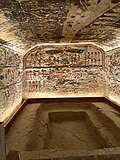
At the end of the corridors come three chambers. The first of these is decorated with the Opening of the mouth ritual, and it is possible that a well shaft would have been dug here had the builders been afforded more time. The second chamber contains four large columns, but neither the cutting nor the decoration work were completed. At the far end of this chamber, a ramp slopes down to the burial chamber, where the pharaoh's sarcophagus was placed (the floor has a rectangular section carved out to accommodate it). The ceiling is vaulted, and is decorated with splendid pictures of the goddess Nut. The side walls show scenes from the Book of Caverns and the Book of the Earth.

The far wall depicts Ramesses on his barque, surrounded by a host of gods. The yellows, dark blues, and blacks used to decorate this chamber are visually striking and unusual among the tomb decorations in the Valley. While the sarcophagus itself has long since vanished, Ramesses IX's mummy was one of those found in the Deir el-Bahri cache (DB320) in 1881.

KV6 has been open since antiquity, as can be seen by the graffiti left on its walls by Roman and Coptic visitors.

[edit]

See also

[edit]

References

[edit]
[edit]
Revisions and contributorsEdit on WikipediaRead on Wikipedia
from Grokipedia
The KV-VI (also known as KV6 or the "Behemoth") is a fictional superheavy tank hoax presented as a Soviet World War II design. It originated as a scale model created by modeler Brian Fowler in 1995 for a science fiction modeling competition, using parts from various tank kits. Fowler posted images and a fabricated backstory online in 1997 on the Track-Link forum, claiming it was a real prototype with three turrets mounting multiple heavy guns, weighing 138 tons, and powered by three V-2 engines. The hoax gained viral spread due to its dramatic, implausible specifications, but no such tank was ever developed or produced by the Soviet Union, and it has been confirmed as fictional by the creator and military historians. The real KV series included designs up to the KV-5, but multi-turreted superheavy tanks like the KV-VI were not pursued due to impracticality.[1]

Origins of the Hoax

Creation of the Scale Model

The KV-VI scale model, a fictional super-heavy tank design, was constructed in 1995 by American modeler Brian Fowler as an imaginative project in the science fiction category of scale modeling. Fowler assembled the model using components sourced from multiple commercial kits, including two Tamiya KV-2 kits for the primary turrets, two Tamiya KV-1E kits for additional hull and superstructure elements, an AER T-38 amphibious tank for auxiliary details, an Italeri BT-5 for lighter vehicle parts, an Italeri Katyusha rocket launcher for ordnance representation, a Zvezda T-60 for minor fittings, and Dragon tracks for the suspension system. The core structure involved welding three KV-series hulls together with epoxy glue, with the central dual-turret pedestal crafted from a repurposed shaving cream lid and various scratch-built additions such as machine guns, ladders, and flamethrower mounts to enhance its elaborate, multi-turreted appearance.[1] Fowler entered the completed model into several International Plastic Modellers' Society (IPMS) competitions, where it was recognized for its creativity in hypothetical and sci-fi categories. It won Best Sci-Fi at the IPMS Buffcon Show in 1996 and took first place at the IPMS National Show in Columbus, Ohio, in 1997, as well as first place in the Hypothetical category at Noreastcon in 1997. These successes highlighted the model's appeal as a playful fusion of historical Soviet tank aesthetics with exaggerated, fictional engineering, rather than any attempt at historical replication.[1][2] Originally intended solely as a lighthearted entry for modeling enthusiasts, the KV-VI was not designed to deceive viewers about real military history; a fabricated backstory was added later for amusement when Fowler shared images online in the late 1990s.[1]

Initial Online Posting and Backstory

In 1997, scale modeler Brian Fowler uploaded photographs of his custom-built KV-VI tank model to the Track-Link online forum, where he accompanied the images with an elaborate invented backstory portraying it as a genuine Soviet super-heavy tank design from World War II.[1] The narrative claimed the KV-VI was hastily assembled in 1941 by welding together the hulls of two KV-1 heavy tanks and one KV-2 self-propelled gun, creating a massive, multi-turreted behemoth intended to counter German advances.[1] Fowler described the vehicle's armament as including multiple turrets mounting 152 mm howitzers, 76.2 mm guns, a 45 mm cannon, machine guns, rockets, and even flamethrowers, emphasizing its overwhelming firepower for breakthrough operations against enemy lines.[1] According to the fabricated history, three prototypes were produced in secret near Moscow between 1941 and 1942 under direct orders from Joseph Stalin, developed by a team led by engineers Kotin and Barykov to serve as an ultimate defensive weapon.[1] These prototypes were allegedly deployed in combat: one was reportedly destroyed by friendly fire during the Battle of Moscow in late 1941, while the other two were either captured by German forces or scrapped after mechanical failures during testing and engagements near Leningrad in 1942.[1] Fowler enhanced the posting with spoof references to nonexistent books, such as Dreadful Din on the Eastern Front, to lend an air of authenticity to the tale.[1] Fowler's intention was purely humorous; he created the backstory as a lighthearted embellishment for his science-fiction-inspired model, which he had entered into modeling competitions like IPMS Buffcon in 1996, hoping the absurdity and fictional citations would clearly signal it as a joke.[1] However, the detailed narrative and realistic appearance of the model led many online viewers to initially interpret it as legitimate lost history, sparking unintended widespread misinterpretation and the hoax's proliferation beyond modeling circles.[1]

Supposed Design and Specifications

Armament Configuration

The KV6, as depicted in the hoax backstory, featured an elaborate multi-turreted armament configuration designed to emphasize overwhelming firepower, drawing from components of existing Soviet tanks like the KV-1, KV-2, and lighter models. The setup included a central main turret mounting dual 152 mm L/20 howitzers for heavy bombardment, flanked by two secondary turrets each armed with a 76.2 mm L/32 anti-tank gun, and a smaller observation tower equipped with a 45 mm Model 1937 gun for close-range support. This triple-turret arrangement, along with additional sponson and cupola mounts, aimed to provide 360-degree coverage and versatility against infantry, armor, and fortifications.[1] Secondary armament in the fictional design incorporated numerous machine guns for anti-personnel defense, including two 12.7 mm DShK heavy machine guns, two 7.62 mm Maxim machine guns, and fourteen 7.62 mm DT machine guns distributed across the hull and turrets. For area suppression, the hoax specified sixteen BM-13 Katyusha rocket launchers mounted on the sides, capable of delivering a salvo of 132 mm unguided rockets, alongside two ATO-41 flamethrowers for close-quarters incendiary attacks with a range of up to 70 meters using standard fuel mixtures. These elements were intended to portray the KV6 as a self-contained "land battleship," though the sheer volume of weaponry highlighted the impracticality of the concept.[1][3] The exaggerated armament was part of the hoax's narrative to create a sense of Soviet engineering excess during World War II, but no prototypes or documentation ever existed to support such a configuration.[1]

Armor, Dimensions, and Mobility

The purported KV-VI tank, as described in the hoax, featured enormous dimensions that underscored its impractical scale: a length of 15.6 meters, width of 3.3 meters, and height of 4.65 meters, making it vastly larger than contemporary Soviet heavy tanks like the KV-1.[1] This super-heavy design weighed 138 tons, a figure that highlighted the hoax's exaggeration of Soviet engineering ambitions during World War II.[1] Armor protection in the fictional KV-VI varied from 7 mm on thinner sections to 160 mm on the thickest parts of the hull and turrets, providing comprehensive coverage but at the cost of added mass.[1] The design emphasized layered steel plating across the superstructure, though no specific sloping on the frontal armor was detailed in the original model descriptions. Mobility was severely limited by the tank's size and weight, with a top road speed of 21 km/h powered by three V-2 engines totaling 600 horsepower, and an operational range of 160 km on roads or 70 km off-road.[1] A crew of 15 was required to operate the complex vehicle, which included specialized features such as wading devices capable of crossing rivers up to 9 feet deep and a removable observation tower for enhanced visibility and fire direction.[1] The hoax specifications revealed inherent impracticalities, including abysmal ground pressure from the 138-ton weight that would cause the tank to bog down in mud or soft terrain, and difficulties in turning due to its excessive length and bulk.[1] Additionally, the massive structure would amplify challenges from armament recoil, potentially stressing the chassis beyond operational limits.[1]

Propagation and Revelation

Viral Spread Online

The KV6 hoax gained significant traction starting in 2008 when it was featured on the April Fools' cover of Boresight magazine, a publication by the Armor Modeling & Preservation Society (AMPS), which presented the fictional tank as a legitimate Soviet design and introduced it to a wider audience of modelers and enthusiasts.[1] This exposure led to an explosion of interest on creative platforms like DeviantArt, where user VonBrrr's detailed 2010 cutaway illustration of the KV-VI, depicting it as a massive land battleship with multiple turrets, amassed over 88,000 views and inspired numerous fan interpretations.[4] Additional fan art, such as Sir-Zora-Crescent's 2013 rendering, further proliferated the concept across online art communities.[1] The hoax spread rapidly through forums and image-sharing sites, including Reddit and military history boards, where photoshopped images—often editing real WWII-era photos like T-28 parades to include the KV-VI—circulated as purported historical evidence, fueling discussions among tank aficionados.[1] By the early 2010s, it had reached non-English-language websites and wikis, particularly in Russian-speaking communities, where false narratives emerged claiming that three prototypes were built and deployed near Moscow and Leningrad during the 1941-1942 Winter Campaign to counter German advances.[1][2] Several factors contributed to its virality: the absence of rigorous source verification in online discussions allowed fabricated backstories to persist, while the allure of a "secret super-weapon" trope—evoking oversized, invincible Soviet machinery straight out of WWII legend—captivated audiences seeking dramatic alternate histories.[1] This dissemination built on the hoax's modest origins in a 1997 scale model posting on Track-Link by modeler Brian Fowler, which included a satirical backstory but was increasingly detached from its fictional context as it propagated.

Confirmation as a Hoax

In the 2010s, scale modeler Brian Fowler publicly clarified that the KV-VI, often referred to as KV6, originated as a humorous sci-fi model he built in 1995 using parts from various Tamiya kits, never intended as a serious historical claim but as a joke entry for modeling competitions.[1] Fowler emphasized that accompanying fake bibliographic references, such as spoof books like "Soviet Superheavy Tanks" by fictional authors, were meant to signal its fictional nature, though he later expressed regret over its unintended viral spread online via forums like DeviantArt.[2] He confirmed in statements to enthusiasts that no real Soviet design matched the model's exaggerated features, underscoring it as a creative fabrication rather than a hoax deliberately meant to deceive.[1] Historians and tank experts have thoroughly debunked the KV6's existence through examination of declassified Soviet archives, which contain no records, blueprints, prototypes, or production documents for such a multi-turreted superheavy tank during World War II.[1] By the early 1940s, Soviet doctrine had shifted away from cumbersome multi-turret designs like the pre-war T-35 due to their vulnerability and logistical burdens, making a 138-ton behemoth implausible amid wartime resource constraints and Joseph Stalin's preference for more practical heavy tanks.[1] Mechanical analyses highlight insurmountable engineering flaws, including the inability to manage recoil from multiple heavy-caliber guns—such as twin 152 mm howitzers and 76 mm cannons—mounted on a single frame without catastrophic structural failure or loss of stability during firing.[1] A crew of just 15 personnel would also be insufficient to operate the proposed 38 weapons systems effectively, further rendering the design unfeasible.[1] Key exposés have solidified the KV6's status as fiction, including Tank Encyclopedia's 2015 article detailing its model origins and archival voids, which drew on Fowler's direct input and modeling community records.[1] More recently, the 2023 YouTube video "The Real KV-6" by Tank Archives traced the meme's backstory while contrasting it with actual Soviet projects, emphasizing the absence of evidence for the viral version and its roots in Fowler's jest.[5] The misconception persisted partly due to confusion with genuine KV-series variants, such as the KV-8 flamethrower tank, whose experimental flamethrower adaptations were occasionally mislabeled as KV6 in early postwar accounts, blending fact with the fictional superheavy narrative.[3]

Historical Context

The Real KV Tank Series

The Kliment Voroshilov (KV) tank series represented a significant advancement in Soviet heavy tank design during the early stages of World War II. Introduced in 1939, the KV-1 was developed from the T-100 prototype, which itself drew on multi-turret concepts from earlier experimental Soviet vehicles like the T-35. The KV-1 proved highly effective during the Winter War of 1939-1940, where its robust armor withstood Finnish anti-tank defenses, including 37mm and 45mm guns, allowing it to support infantry breakthroughs with minimal losses. Key features of the KV-1 included thick sloped armor ranging from 75 to 100 mm in thickness, providing superior protection against contemporary anti-tank weapons, and a main armament of a 76.2 mm ZiS-5 gun capable of firing high-explosive and armor-piercing rounds. Named after Soviet defense commissar Kliment Voroshilov, the tank weighed approximately 45 tons and was powered by a 600-horsepower V-2K diesel engine. Production of the KV-1 reached around 3,000 units by 1942, making it a cornerstone of Soviet armored forces during the initial phases of Operation Barbarossa in 1941, where it often outmatched German Panzer III and IV tanks in direct engagements. The series evolved to address the KV-1's limitations, particularly its slow maximum speed of 35 km/h on roads and persistent mechanical reliability issues, such as transmission failures under field conditions. In 1942, the lighter KV-1S variant was introduced, reducing weight to 42.5 tons through thinner armor and a redesigned hull for improved mobility while retaining the 76.2 mm gun. By 1943, the KV-85 emerged as an interim upgrade, mounting an 85 mm D-5T gun to counter the increasing threat from German heavy tanks like the Tiger I, serving as a direct predecessor to the more advanced IS-2 series. These developments highlighted the KV lineage's role in bridging early-war heavy tank designs to later Soviet successes, though reliability problems ultimately led to its replacement by the IS series in production by mid-1943.

Soviet Heavy Tank Developments During WWII

In the 1930s, Soviet heavy tank development emphasized multi-turret designs inspired by land battleship concepts, with the T-35 serving as a prominent example. This five-turreted heavy tank, produced in limited numbers of 61 vehicles between 1933 and 1939, was intended for breakthrough operations but proved highly unreliable due to mechanical complexities, including overtaxed transmissions and faulty clutches that led to frequent breakdowns rather than combat losses.[6][7][8] Building on this approach, the SMK prototype emerged in 1939 as a twin-turreted heavy tank designed to address some of the T-35's shortcomings, specifically for use in the Winter War against Finland. Developed at the Leningrad Kirov Factory under Josef Kotin, the SMK featured enhanced armor and firepower but was deployed as a single prototype and disabled by Finnish defenses during combat in the Winter War, highlighting ongoing issues with multi-turret coordination and mobility in harsh terrain.[9][10][11] By 1940-1941, Soviet designers shifted toward even larger KV-series heavy tank proposals amid fears of German super-heavy armor, resulting in the KV-4 project (Object 224). This initiative involved over two dozen competing designs from engineers like N.L. Dukhov, envisioning a 70-75 ton vehicle with up to 150 mm frontal armor and a 107 mm ZiS-6 main gun, but none progressed beyond wooden mockups due to escalating resource shortages and the German invasion in June 1941, which halted further development.[12][13][14] Similarly, the KV-5 (Object 225) represented the pinnacle of these super-heavy ambitions, a proposed 100-ton, three-turreted behemoth with up to 180 mm frontal turret armor, 130-150 mm sloped hull frontal armor, and 150 mm side armor, intended as a mobile fortress but abandoned at the blueprint stage for the same logistical and wartime pressures.[15][16] As the war progressed, Soviet heavy tank efforts evolved into more practical designs, with the IS-2 (Joseph Stalin-2) emerging in 1943 as the direct successor to the KV series. Prompted by encounters with German Tiger tanks, the IS-2 incorporated a powerful 122 mm D-25T gun capable of penetrating heavy armor at range, thicker sloped frontal armor up to 120 mm, and improved mobility at around 46 tons, entering production that October with over 2,250 units built by war's end to support breakthrough assaults.[17][18][19] These super-heavy projects were ultimately abandoned due to severe industrial constraints, including limited production capacity strained by the need to relocate factories eastward during the invasion, which prioritized high-volume output of reliable medium tanks like the T-34 over complex, resource-intensive giants. Additionally, the vulnerability of massive, slow-moving vehicles to aerial attacks and anti-tank weapons, combined with logistical challenges such as poor cross-country performance in mud and snow, rendered them impractical in the fluid, combined-arms warfare of the Eastern Front.[20][21][13] The KV-1's early successes in halting German advances during Operation Barbarossa briefly validated heavy tank concepts, but evolving doctrine favored versatile mediums for sustained offensives.[16]

Cultural Impact and Legacy

Despite its status as a confirmed hoax originating from a 1990s scale model by Bryan Fowler, the KV-6 has permeated online media and enthusiast circles through dramatized portrayals that treat it as a legendary Soviet superheavy tank.[1] YouTube videos have played a significant role in amplifying its fictional narrative, often blending mock-historical analysis with animated storytelling. For instance, the 2024 video "The Soviet super tank that defeated Germany - KV-6" by Found And Explained presents a dramatized account of the tank single-handedly repelling German forces, complete with animated reconstructions and exaggerated combat feats, garnering over 400,000 views as an April Fools' Day feature.[22] Similarly, the 2022 episode "Orchestra of Destruction, the KV-6" from ConeOfArc's Fake Tank Friday series dissects the hoax's fabricated design and "combat history," highlighting its absurdity while noting its viral appeal in tank history communities.[23] In fandom spaces and gaming communities, the KV-6 appears as a composite vehicle merging elements of the KV-1 and KV-2 tanks, fueling fan-created content. The HomeAnimations Tanks Wiki describes it as a Soviet superheavy tank assembled from two KV-1s and one KV-2, serving as a central character in the channel's animated series of tank battles inspired by World of Tanks, where it evolves through episodes involving secret laboratories and monstrous transformations.[24] Fan animations on YouTube, such as those compiling KV-6 storylines from HomeAnimations, depict it in epic confrontations, amassing millions of views across playlists.[25] In gaming, it features in unofficial War Thunder modifications, including playable models showcased in gameplay videos like The Gaming Potato's 2018 demonstration of a custom KV-6 superheavy tank, allowing players to experience its over-the-top firepower and mobility challenges in simulated WWII battles.[26][1] Mentions of the KV-6 also surface in hoax compilations and tank enthusiast publications, underscoring its role as a cautionary tale of misinformation. It is included in lists of fabricated WWII vehicles on sites like Tank Encyclopedia, which traces its propagation from online images to enthusiast lore.[1] Publications such as the April Fools' 2008 cover of Boresight magazine featured it prominently, poking fun at superheavy tank myths.[1] The KV-6's cultural appeal lies in its embodiment of exaggerated "what-if" scenarios in WWII armored warfare, frequently juxtaposed with German hoaxes like the Maus and Landkreuzer P. 1000 Ratte in fan discussions and alternate history content.[1] This pairing symbolizes the era's arms race fantasies, inspiring digital art, renders, and debates on impractical superweapons, as seen in DeviantArt illustrations reimagining it as a "Russian Land Battleship."

Model Kits and Replicas

The KV-6, despite being a confirmed hoax, has inspired a niche market for commercial model kits, particularly in the realm of 3D-printed reproductions. These kits are predominantly available in 1/144 scale and utilize photosensitive resin for detailed casting, allowing hobbyists to assemble or display unpainted or finished versions of the fictional super-heavy tank. Listings on platforms like eBay frequently market them as "Soviet KV-6 Heavy Tank" models, often including brief notes on the tank's purported WWII origins to enhance their appeal, with prices typically ranging from $20 to $50 depending on whether they are kits or pre-painted products.[27][28][29] Digital 3D models have further extended accessibility, exemplified by Tim Samedov's "KV-6 Behemoth tank" uploaded to Sketchfab in December 2023, which provides a high-fidelity, downloadable representation suitable for printing or virtual rendering. This model captures the exaggerated multi-turret design derived from viral online images of the hoax, influencing subsequent commercial adaptations.[30] Among hobbyists, custom replicas draw direct inspiration from Bryan Fowler's original 1995 scale model, which combined parts from real KV-series kits to create the Behemoth's absurd configuration for a modeling contest. Enthusiasts in online communities, such as Reddit's r/modelmakers, replicate and modify these designs using similar kitbashing techniques—merging turrets, tracks, and armaments from Soviet tank models—often entering them into sci-fi or alternate-history themed competitions where the KV-6's fictional lore fits seamlessly. These builds perpetuate the hoax within modeling circles by blending speculative history with tangible craftsmanship, sustaining interest long after its online debunking.[1][31]

References

User Avatar
No comments yet.