Hubbry Logo
KV11KV11Main
Open search
KV11
Community hub
KV11
logo
8 pages, 0 posts
0 subscribers
Be the first to start a discussion here.
KV11
KV11
from Wikipedia

Tomb KV11 is the tomb of Pharaoh Ramesses III. It is located in the main valley of the Valley of the Kings. The tomb was originally started by Setnakhte, but abandoned when it unintentionally broke into the earlier tomb of Amenmesse (KV10). Setnakhte was buried in KV14. The tomb KV11 was later restarted and extended and on a different axis for Ramesses III.

Key Information

The tomb has been open since antiquity, and has been known variously as "Bruce's Tomb" (named after James Bruce who entered the tomb in 1768) and the "Harper's Tomb" (due to paintings of two blind harpers in the tomb).

Decoration

[edit]
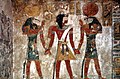
Two blind harpers, painted in the tomb.

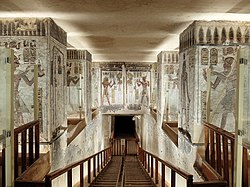
The 188 m (617 ft) long tomb is beautifully decorated.

The second corridor is decorated with the Litany of Re. At the end of this corridor the axis of the tomb shifts. This third corridor is decorated with the Book of Gates and the Book of Amduat, and leads over a ritual shaft, and then into a four-pillared hall. This hall is again decorated with the Book of Gates. A fourth corridor decorated with scenes of the opening of the mouth ceremony leads into a vestibule, with scenes of the Book of the Dead, and then into the burial chamber.

The burial chamber is an eight-pillared hall in which stood the red quartzite sarcophagus (the box of which is now in the Louvre, while its lid is in the Fitzwilliam Museum in Cambridge).[1] This chamber is decorated with Book of Gates, divine scenes and the Book of the Earth. Beyond this is a further set of annexes decorated with the Book of Gates. The outside of the sarcophagus features two scenes from the Amduat.[2]

Study and documentation of the tomb

[edit]

The tomb was first mentioned by an English traveler Richard Pococke in the 1730s, but its first detailed description was given by James Bruce in 1768. Preliminary scientific studies were made by French scholars, who had come to Egypt with Napoleon, and then by, among others, J. F. Champollion, R. Lepsius, and in the 19th century, G. Lefebure.[3] In 1959, the Egyptian Department of Antiquities asked a Polish Egyptologist, Dr. Tadeusz Andrzejewski, to document the tomb. He started work under the auspices of the Polish Centre of Mediterranean Archaeology University of Warsaw but soon died. Twenty years later, the task of completing the documentation was given to Dr. Marek Marciniak.[4] The introduction of martial law in Poland hindered the publication of the results of his study. Since 2017, a German expedition from the Humboldt University and the Egyptian universities in Luxor and Qena work on the site. Apart from documenting the tomb, they also conduct conservation works.[1]

[edit]

References

[edit]
[edit]
Revisions and contributorsEdit on WikipediaRead on Wikipedia
from Grokipedia
KV11, also known as the Tomb of , is an ancient Egyptian royal burial site located in the main wadi of the Valley of the Kings near , constructed during the Twentieth Dynasty around c. 1186–1155 BCE. It ranks as one of the largest and most extensively decorated tombs in the necropolis, spanning approximately 188 meters in length with a complex layout including multiple corridors, side chambers, a four-pillared hall, and a six-pillared burial chamber, originally initiated for Ramesses III's father before being expanded for the pharaoh's interment. The tomb's architecture features a straight axis with an entrance leading through descending corridors to a four-pillared hall (F), and further corridors to the burial chamber (Hall J) with six pillars, where the king's quartzite sarcophagus was housed—now fragmented and dispersed to museums such as the Louvre and Fitzwilliam Museum. Its decorations are exceptionally rich, covering walls and ceilings with vibrant paintings and raised reliefs depicting funerary texts including the Book of Gates, Amduat, Litany of Re, and Book of the Heavenly Cow, alongside scenes of Ramesses III offering to deities, astronomical ceilings, and unique vignettes such as blind harpists and a bakery scene in side chamber Ba. These elements highlight the pharaoh's divine kingship and the elaborate rituals intended to ensure his afterlife journey. Historically significant since antiquity for its accessibility and grandeur—earning nicknames like "Bruce's Tomb" after explorer James Bruce who documented it in 1768—KV11 has endured floods, looting, and tourism, with major damage from Nile inundations in the late 19th and early 20th centuries filling chambers with debris. Modern conservation efforts, led by the Ramesses III Publication and Conservation Project since 2011 under Humboldt University of Berlin in collaboration with Egyptian authorities, involve debris clearance, 3D photogrammetry, reflectance transformation imaging (RTI), and hydrological studies to preserve the site and reconstruct lost decorations using 19th-century archives. Ramesses III's mummy, discovered in a cache at Deir el-Bahri (DB320) in 1881 after relocation during the Third Intermediate Period, reveals evidence of assassination wounds, underscoring the tomb's role in one of ancient Egypt's most dramatic royal narratives.

History and Construction

Background and Ownership

KV11 is the burial tomb of Ramesses III, the second pharaoh of Egypt's 20th Dynasty, who reigned from 1184 to 1155 BCE. The tomb is situated in the East Valley of the Kings, near ancient Thebes (modern Luxor), at coordinates 25°44′23.6″N 32°36′03.9″E. Construction of KV11 was initially planned during the brief reign of Ramesses III's father, Setnakhte, the founder of the 20th Dynasty, who ruled from approximately 1186 to 1184 BCE. Setnakhte abandoned the project after workers inadvertently broke into the nearby KV10, the tomb of the 19th Dynasty pharaoh Amenmesse, necessitating a change in the tomb's axis and location for continuation under his son. Setnakhte was ultimately interred in KV14, leaving KV11 for Ramesses III. Ramesses III ascended the throne amid the turmoil of the , a period of widespread regional instability involving invasions, economic disruption, and climatic challenges across the . His played a crucial role in stabilizing by repelling threats from the in his eighth year and Libyan forces in subsequent campaigns, thereby preserving the kingdom's borders and internal order during a time of existential peril.

Construction Phases

The construction of KV11 began under Setnakhte, the founder of the 20th Dynasty, who initiated the excavation of an initial corridor in the Valley of the Kings. This work was abruptly halted when the corridor unintentionally intersected with the nearby KV10, the tomb of the 19th Dynasty pharaoh , necessitating abandonment of the site to avoid structural compromise. Setnakhte ultimately selected an alternative location for his own burial in KV14. Ramesses III, Setnakhte's son and successor, repurposed and significantly expanded KV11 for his own use, redirecting the axis to circumvent the intrusion into KV10. This extension involved deepening the main corridor to a total length of approximately 188 meters, incorporating additional elements such as a four-pillared hall, a vestibule, and an eight-pillared burial chamber to accommodate the royal interment. The resulting layout adopted a straight-axis design, a hallmark of 20th Dynasty royal tombs that emphasized linear progression symbolizing the pharaoh's journey to the afterlife while allowing for efficient quarrying in the confined valley terrain. Archaeological evidence from KV11 reveals signs of rushed completion toward the end of Ramesses III's reign, including partially excavated side chambers and areas filled with debris, such as those adjacent to the burial chamber, indicating that work accelerated in the final phases to prepare the tomb before the pharaoh's death around 1155 BCE.

Architecture

Overall Layout

KV11 features a simple descending corridor as its entrance, leading directly into a series of interconnected chambers and halls that form a linear progression deep into the rock. The tomb measures a total length of 125 meters (410 feet) along a predominantly straight axis that descends at varying slopes to facilitate the burial's symbolic journey toward the underworld. This design reflects the standard New Kingdom royal tomb architecture, adapted to the local geology of the . The spatial organization begins with an initial corridor initiated during the reign of , 's father, which was subsequently extended by after workers inadvertently broke into the adjacent KV10 tomb. This extended corridor transitions into a four-pillared hall, followed by a vestibule that serves as a transitional space, and culminates in the final eight-pillared chamber where the was placed. Side chambers branch off the main corridors, providing additional storage or ritual spaces, but the primary path maintains a focused, axial flow from entrance to sepulcher. The tomb's orientation was carefully positioned parallel to nearby tombs, including KV10 to the north, with the axis shifted westward during construction to circumvent geological interference and ensure structural integrity. This adjustment preserved the tomb's alignment with the valley's east-west orientation while avoiding overlap with preexisting excavations.

Key Structural Features

KV11 features two prominent pillared halls carved directly from the limestone bedrock of the Valley of the Kings, showcasing advanced engineering techniques typical of Twentieth Dynasty royal tombs. The intermediate hall, known as Chamber F, is a four-pillared space measuring approximately 7.90 meters wide and 9.10 meters long, with a height of 2.74 meters; its pillars support a flat ceiling and were designed to integrate temple-like architectural elements for ritual purposes. Further along, the burial chamber (Chamber J) expands into an eight-pillared hall, spanning 13.86 meters wide, 12.69 meters long, and 6.55 meters high, featuring a vaulted ceiling section that enhances structural stability while accommodating elaborate funerary texts. These halls, excavated from the soft nummulitic limestone, demonstrate precise quarrying and pillar placement to prevent collapse in the unstable bedrock, with the overall tomb layout spanning about 125 meters in length. A key functional element is the well room (Chamber E), a ritual shaft measuring 4.21 meters wide, 3.16 meters long, and 3.19 meters high, intended to symbolically separate the upper world from the netherworld and deter tomb robbers by creating a deceptive barrier. The well itself is partially excavated, with blocking systems originally consisting of rubble and debris to seal access, though these were compromised in antiquity; modern studies highlight how such wells in Ramesside tombs like KV11 served both practical and metaphysical roles in funerary architecture. The was positioned centrally in the eight-pillared burial chamber, crafted from red granite to symbolize eternal protection and durability. The box, weighing approximately 18 tons, is now housed in the Louvre Museum in , while the lid, a seven-ton cartouche-shaped slab depicting the king as , resides in the in . Construction of KV11 involved notable structural adjustments, as the tomb was initially begun for but abandoned after workers inadvertently broke into the nearby KV10, necessitating reinforcements and a redirected axis under to ensure integrity. This mid-project repair included sealing the breach and rerouting corridors (from D to D1 and D2), evidencing adaptive engineering to maintain the tomb's security and alignment with sacred orientations.

Decoration

Iconographic Programs

The iconographic program of KV11 predominantly features New Kingdom funerary texts, emphasizing the pharaoh's journey through the and his eternal renewal. The corridors are adorned with the Litany of Re, a hymn invoking the sun god's 75 manifestations to ensure solar rebirth and divine protection for the deceased king. In the burial chamber and associated spaces, the and the dominate, illustrating the sun god 's nocturnal voyage, the division of the underworld into twelve gates or hours, and the pharaoh's identification with and for resurrection. The decorative scheme exhibits a clear thematic progression, beginning with motifs of solar rebirth and divine invocation in the entrance corridors, which symbolize the king's ascent and union with the . This evolves into scenes of , transformation, and afterlife protection in the deeper chambers, where guardian deities and demons safeguard the against chaos, culminating in his as an eternal ruler merged with the gods. This narrative arc underscores the tomb's role in facilitating Ramesses III's posthumous deification, portraying him as a divine intermediary between the living world and the . The style of decoration consists of detailed, colorful painted reliefs executed in both raised and sunk formats, with life-sized figures of deities, demons, and the king rendered in vibrant blues, reds, and golds to evoke vitality and cosmic order. These reliefs reflect Ramesses III's deification by frequently depicting him in divine postures, offering to or receiving blessings from major gods like and Ra-Horakhty, thereby affirming his status as a god-king. The architectural layout of the tomb, with its sloping corridors and pillared hall, supports this program by providing expansive walls for the unfolding vignettes. Unlike many unfinished royal tombs of the 20th Dynasty, such as those of (KV9) or (), which exhibit rushed or incomplete decorations due to economic decline, KV11 boasts nearly complete coverage of its corridors, chambers, and sarcophagus areas with these texts and scenes, despite some flood damage in the rear sections. This comprehensive execution highlights the tomb's significance as a pinnacle of late New Kingdom , preserving a holistic vision of royal immortality.

Specific Scenes and Texts

In the second corridor (Corridor B) of KV11, the walls are inscribed with the of Re, a comprising 75 invocations to the sun in his various forms, each division featuring presenting offerings such as incense or libations to a , accompanied by hieroglyphic texts extolling the 's attributes and manifestations. The east wall specifically includes the title scene of the , depicting a solar disk, scarab, and ram-headed . This continues into Corridor C, where the ceiling bears additional texts arranged around a central sun disk containing a ram-headed , flanked by protective hawks representing and . The burial chamber (Hall J) contains on its right wall a rendition of the Book of the Earth, a funerary text depicting the sun god's nocturnal journey through the in vertical registers that portray the encircled by a protective serpent, with Re in his Osirian form at the helm, surrounded by deities standing in shrines holding was-scepters or papyrus wands. Key vignettes include the inundation of the primordial waters of and apotropaic demons guarding the passage, emphasizing regeneration and the king's resurrection alongside the sun. Adjacent rooms H and L feature complementary sections with 20 and 16 such deities, respectively, oriented toward the sarcophagus chamber to facilitate the pharaoh's eternal renewal. Ceilings in the corridors and burial chamber incorporate astronomical motifs, including vulture-spread figures of the sky goddess Nut arched overhead, interspersed with , decans, and protective deities to evoke the eternal cosmic order and safeguard the tomb's occupant. Among the tomb's distinctive elements are the blind harper scenes in side chamber Cd on the south wall, portraying seated musicians with harps performing before divine figures or the king, a motif uncommon in royal tombs that led early explorers to dub KV11 the " of the Harpers." Depictions of the royal family, such as the goddess Merit pouring libations in chamber D1 on the south wall, underscore Ramesses III's dynastic continuity and divine favor from Heliopolitan cults.

Burial and Artifacts

Sarcophagus and Mummy

The outer sarcophagus of consisted of a large cartouche-shaped and lid crafted from red granite, serving as the primary container within KV11's burial chamber. The , measuring 3.05 meters in length, 1.5 meters in width, and 1.8 meters in height, and weighing approximately 10 tons, was decorated in sunken relief with protective funerary texts, including excerpts from the Book of What is in the Duat (hours 7 and 8 on the exterior) and the (opening tableau on the interior), along with the king's coronation and birth names. These inscriptions invoked deities such as and , depicted as winged figures, and motifs symbolizing the solar journey and palace façades to safeguard the deceased. The lid, a seven-ton slab also in red granite, portrayed the king mummified as , wearing the crown and holding , adored by , , and protective serpents, with surrounding hieroglyphs proclaiming his divine titles. The ensemble was fragmented in antiquity, likely during tomb robberies, and further dismantled in the early when the coffer was acquired by Henry Salt and sold to the in 1826, while removed the lid in 1817, which reached the in 1823. Recent excavations in KV11 have recovered additional fragments, including pieces of the lid from 2016 and 2019, suggesting possible multiple nested sarcophagi or reuse, though the primary outer structure remains the pair. A replacement anthropoid coffin of (Cairo CG 61021), used for the mummy during its relocation to the Deir el-Bahri cache, has been associated with , but it is not original to the KV11 burial; details on its material and condition are limited due to dispersal. Ramesses III's mummy was relocated during the Third Intermediate Period (c. 1069–664 BC) by high priests to the protective at Deir el-Bahri (DB320), alongside other royal remains, to shield them from widespread tomb plundering. The cache was discovered on 6 July 1881 by Émil Brugsch Bey of the Egyptian Antiquities Service, following reports from local antiquities dealers of the Abd al-Rasul family. The mummy, labeled No. 9 in the cache, was found well-preserved in linen wrappings within a plain wooden coffin, exhibiting the king's tall stature (about 1.68 meters) and robust build typical of New Kingdom royalty. Partial unwrapping on 1 June 1886 by Gaston Maspero revealed fine white linen bandages and amulets, but no original inner coffins or jewelry remained. The remains are now displayed in the in (inventory CG 61083). Forensic examination, including computed scans conducted in 2012, confirmed the mummy's excellent preservation, with intact skin, hair (including a plaited ), and no significant postmortem damage beyond the wrappings. Notably, a 70 mm horizontal incision across the throat, penetrating to the and severing the trachea and major blood vessels, indicates death by sharp blade, aligning with historical records of the (c. 1155 BC), where Queen Tiy and accomplices plotted the king's . This wound, absent embalming inconsistencies, rules out postmortem causes like mummification error. Associated with the burial were four calcite canopic jars containing the king's viscera, protected by stoppers carved as the heads of the (Imsety, Hapi, Duamutef, and Qebehsenuef), inscribed with spells from Chapter 151 of the to ensure organ regeneration in the ; fragments were recovered from KV11, dispersed to institutions like the . Over 100 shabtis, small or bronze servant figures inscribed with Spell 6 from the to perform labor for the king, accompanied the mummy, including a bronze example now in the Oriental Museum at , attesting to the elaborate funerary provisioning despite later disruptions.

Associated Finds

Excavations and conservation efforts in KV11 have revealed a limited array of secondary artifacts and , primarily due to the tomb's exposure and ancient disturbances. Among the funerary furniture recovered are fragments of wooden figures intended to serve the king in the , including a preserved example inscribed with Ramesses III's cartouches, now housed in the (Inv. No. AF 425). These , typically mummiform and equipped with agricultural tools, represent standard New Kingdom burial equipment, though few intact specimens remain from the original deposit. Inscribed items include these ushabti figures bearing the pharaoh's royal names, discovered in the burial chamber and side areas during modern clearances; no additional stelae or amulets have been documented from the peripheral chambers beyond those associated with the central burial. Pottery and daily use items provide evidence of ritual deposits, such as scattered sherds of faience vessels and linen fragments found in the burial hall (J), likely remnants of offerings or wrapping materials used in funerary rites. These materials, including potential beer jar fragments indicative of libation rituals, were unearthed in disturbance pits, underscoring the tomb's role in ongoing cultic activities post-burial. Ongoing conservation by the Ramesses III Publication and Conservation Project has yielded further insights into scattered artifacts as of 2025, including additional small finds from clearance efforts. The tomb's history of is evident from its openness since antiquity, with ancient robbers targeting portable valuables, leaving only scattered and burnt remnants of the original assemblage. Minimal intact finds survive, as confirmed by sondages revealing secondary interments and flood-deposited debris that further scattered artifacts.

Exploration and Study

Early Documentation

The tomb of , designated KV11, has been accessible since antiquity and was frequented by ancient tourists, as evidenced by surviving Greek and Coptic graffiti on its walls. The first modern to the tomb appears in the travel account of English scholar Richard Pococke, who visited in the 1730s and included it among the Valley of the Kings sites in his 1743 A Description of the East, marking the onset of European scholarly interest. In 1768, Scottish explorer conducted the first detailed modern exploration of KV11, penetrating deep into its corridors and dubbing it "Bruce's Tomb" in his subsequent writings; he produced sketches of notable scenes, including the prominent depictions of blind harpers in the second corridor, which later inspired the alternative name "Tomb of the Harpers" or "Harper's Tomb." Bruce's 1790 publication Travels to Discover the Source of the provided the earliest extensive descriptions and illustrations, though his drawings idealized the harper figures and overestimated certain dimensions, such as the burial chamber. The Napoleonic expedition of 1798–1799 brought systematic scholarly attention through its team of French artists and scientists, who meticulously documented KV11's layout, decorations, and inscriptions during visits to the Valley of the Kings; their detailed engravings, including the harper scenes, were published in the monumental Description de l'Égypte (Volume II, 1809–1829), establishing a foundational visual record for future studies. During the 19th century, further advancements in epigraphic recording occurred with the work of Jean-François Champollion in the 1820s, who, following his decipherment of hieroglyphs, produced tracings and textual analyses of KV11's walls in his Notices descriptives (published posthumously in 1882), focusing on scenes like divine assemblies and offering rituals to aid in understanding royal funerary iconography. Complementing this, Prussian scholar Karl Richard Lepsius led expeditions in the 1840s, resulting in precise facsimiles of inscriptions and reliefs from KV11 included in his comprehensive Denkmäler aus Aegypten und Aethiopien (1849–1859), which highlighted the tomb's astronomical ceilings and judgment scenes while noting early signs of deterioration from flooding. These efforts by Champollion and Lepsius shifted documentation toward philological accuracy, influencing subsequent Egyptological interpretations of the tomb's religious and historical significance.

Modern Conservation Efforts

In the mid-20th century, the Polish Centre of Mediterranean Archaeology (PCMA) initiated a comprehensive documentation project in KV11 as part of a Polish-Egyptian archaeological mission. Starting in 1959, Tadeusz Andrzejewski led efforts to photograph and draw the tomb's decorations, including detailed copies of texts from the in the sarcophagus chamber. Andrzejewski's work, which emphasized high-fidelity reproductions of the wall paintings and architectural features, was cut short by his death in 1961, but the project resumed in the late 1970s under Marek Marciniak, who completed additional drawings and photographic surveys through 1980. Founded in 2016 with development beginning in 2011, the Publication and Conservation Project, a collaboration between and the Egyptian Ministry of Tourism and Antiquities (with teams from and ), has focused on digital documentation, material analysis, and structural preservation of the tomb. The initiative employs to create detailed 3D models of the entire 180-meter corridor system, enabling virtual access and precise monitoring of degradation. Pigment analysis using has identified original materials like and , guiding targeted restoration to prevent further fading from environmental exposure. Structural efforts include stabilizing bedrock cracks via geo-archaeological surveys and injecting consolidants into flaking plaster, addressing risks from seismic activity and water infiltration. As of 2023-2024, the project completed excavations in side rooms H and I (as reported in the fifth progress report) and implemented the third phase of preventive conservation, including stabilizing cracks in the burial chamber pillars. Conservation in KV11 faces ongoing challenges from high tourist traffic, which causes abrasion to wall surfaces and elevated levels, accelerating deterioration. fluctuations, exacerbated by modern ventilation systems and flooding, promote salt and microbial growth on paintings, while bat accumulation introduces acidic and health risks from associated fungi. Recent efforts (2023-2024) have included advanced monitoring for seismic activity and targeted treatments for microbial growth to address these threats. Project teams have implemented measures like installing protective glass panels over vulnerable sections, constructing elevated walkways to reduce direct contact, and conducting regular guano removal with non-abrasive methods to mitigate these issues.

References

Add your contribution
Related Hubs
User Avatar
No comments yet.