Hubbry Logo
KalaviṅkaKalaviṅkaMain
Open search
Kalaviṅka
Community hub
Kalaviṅka
logo
8 pages, 0 posts
0 subscribers
Be the first to start a discussion here.
Kalaviṅka
Kalaviṅka
from Wikipedia
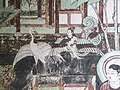
Karyōbinga in a depiction of the Amitabha Sutra

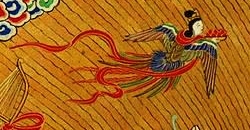
Kalaviṅka (Sanskrit: कलविंक kalaviṅka; Pali: karavika; Chinese: 迦陵頻伽 Jiālíngpínqié;[1] Japanese: 迦陵頻伽, romanizedKaryōbinga,[2] Korean: 가릉빈가;[3] Vietnamese: Ca Lăng Tần Già; Burmese: ကရဝိက် karawik; Thai: การเวก, Malay: karawek) is a fantastical immortal creature in Buddhism, with a human head and a bird's torso, with long flowing tail.[4]

The kalaviṅka is said to dwell in the Western pure land and is reputed to preach the Dharma with its fine voice.[4] It is said to sing while still unhatched within its eggshell.[citation needed] Its voice is a descriptor of the Buddha's voice. In the Japanese text, it goes by various titles such as myōonchō (妙音鳥, "exquisite sounding bird"),[5] kōonchō (好音鳥, "goodly sounding bird")[5] among others.

Edward H. Schafer notes that in East Asian religious art the Kalaviṅka is often confused with the Kinnara, which is also a half-human half-bird hybrid mythical creature, but that the two are actually distinct and unrelated.[6]

Depictions

[edit]

In Burmese art

[edit]
The Karaweik barge in Yangon.

The karaweik is commonly used as a motif in traditional Burmese royal barges. The Karaweik located on Yangon's Kandawgyi Lake is an iconic reproduction of the karaweik royal barge.

In Burmese art, the karaweik is depicted as a bird, rather than a bird with a human head.

In Chinese art

[edit]

In Chinese mural art, it is portrayed as a human-headed, bird-bodied being.[citation needed] In the murals of Dunhuang (敦煌) they appear as figures both dancing and playing music.[citation needed]

In Japanese art

[edit]
Karyōbinga, panels on octagonal platform. Chūson-ji
Kalaviṅka and jīvam-jīvaka(Two Headed Bird)

A well-known example is the pair of kalaviṅka carved in openwork (sukashibori) onto a Buddhist hanging ornament called the keman, used in the golden hall of Chūson-ji temple in Iwate Prefecture. The kalaviṅka from this ornament was commemorated on a 120-yen definitive stamp issued Nov. 1, 1962.[7] The pose and general appearance of this piece are similar to the ones seen on the octagonal pedestal of the same temple (pictured right).

  • In another keman from the Tokugawa period (see keman page), the creatures stand more bipedally erect and hence more humanlike.
  • In the ancient courtly dance performance Gagaku - karyobin (迦陵頻) is the name of dance expressive of the kalaviṅka, and is danced in pair with the kochō (胡蝶), a dance of butterfly motif. The paired dancing is called tsugai-mai (番舞).
  • A kalaviṅka painting by the brushstrokes of Hasegawa Tōhaku resides in Daitoku-ji (Kyoto), inside the Kinmōkaku (金毛閣) erected by tea-master Sen no Rikyū.
  • Painted on the ceiling of Tōfuku-ji's Sanmon gate (Kyoto).
  • Painted on the ceiling of Myōshin-ji's Sanmon gate (Kyoto), normally not open to the public.
  • The Mizusawa Kannon [ja] at 214 Mizusawa, in the former city of Ikaho, Gunma, Main Hall, front right ceiling, painting of a heavenly woman with eagle-like talons, anonymous.
  • Kawakami Sadayakko (Sada Yacco), billed as the first overseas Japanese actress, late in her life, built a villa located at Unumahōshakujichō, Kagamihara, Gifu. The villa was christened Banshōen (萬松園) by Itō Hirobumi, and the room with the Buddhist altar has a ceiling painting of kalaviṅka, which may be peered from outside (but access to premises only on Tuesday mornings).

In Tangut art

[edit]

The Kalaviṅka is a common feature of Tangut art created during the Western Xia period (1038–1227).

In Hinduism

[edit]

Kalavinka was born from one of the head of Vishvaroopacharya who was beheaded by Indra. Indra was angry when Vishwaroopacharya was found to be praying for demons instead of gods. Indra cut his three heads which respectively became Kalavinka, Kapinjala, and Tittiri (all birds)[8]

[edit]
(Manga)
(Novels)
(Music)
(Cycling)
  • The Tokyo-based Tsukumo Cycle Sports's brand is Kalavinka. Many of the bikes feature the Karyōbinga kanji as well as a head badge which features the image of the karyoubinga with the head of a bodhisattva bosatsu and the winged body of a bird.[11]

See also

[edit]

References

[edit]
[edit]
Revisions and contributorsEdit on WikipediaRead on Wikipedia
from Grokipedia
The Kalaviṅka (Sanskrit: कलविङ्क), also known as the kalavinka or karyōbinga in Japanese, is a mythical celestial bird in Buddhist cosmology, depicted with the head and arms of a human or bodhisattva, the body of a bird, and long, flowing tail feathers resembling those of a phoenix. Renowned for its extraordinarily beautiful song—said to be the most melodious among all birds, surpassing even the cuckoo, and audible from within the egg before hatching—it symbolizes the profound voice of the Buddha and the preaching of the Dharma. Inhabiting pure lands such as the Western Paradise (Sukhavati) of Amitabha Buddha, the kalaviṅka's call is believed to inspire enlightenment and represent the rewards of a holy life devoted to Buddhist practice. Originating in Indian mythology and transmitted through Buddhist scriptures like the Mahāprajñāpāramitāśāstra and the Lotus Sutra, the kalaviṅka embodies the superiority of the Bodhisattva's teachings, with its voice likened to the eloquence of enlightened discourse that delights devas and humans alike. In artistic representations across Asia, from ancient Indian carvings to East Asian temple sculptures and murals—such as those at the Yeongamsa Temple site in Korea—it is often shown dancing, playing celestial instruments, or singing hymns of scripture, highlighting its role as a divine messenger of paradise. The creature's etymology derives from Sanskrit roots meaning "low tone" or "chirp," evoking its enchanting vocalizations, though it transcends literal birds to signify spiritual harmony and the allure of nirvana. In Tibetan and Chinese Buddhist traditions, it appears in poetry and rituals as an analogy for the Buddha's words, underscoring themes of impermanence and beauty in samsara.

Etymology and Origins

Linguistic Roots

The term "kalaviṅka" is a word referring to a sparrow or proverbial for its enchanting voice in ancient . This underscores its as a melodious . In , the term appears as "karavīka" or "karavika," a that blends phonetic elements of the form while maintaining the reference to the known for its soothing call. Early attestations occur in of the , such as the , dating to around the 5th century BCE, where it symbolizes clear and melodious speech akin to that of enlightened beings. As Buddhism spread to East Asia, the term underwent phonetic adaptations reflecting local linguistic conventions. In Chinese, it became "jiālíngpínjiā" (迦陵頻伽), a direct transliteration emphasizing the bird's wondrous song, first appearing in translations of sutras during the Tang dynasty (618–907 CE). In Japanese, it evolved into "karyōbinga" (迦陵頻伽), alongside semantic renderings like "myōonchō" (妙音鳥, "wondrous voice bird"), highlighting the auditory symbolism in Heian-period (794–1185 CE) Buddhist literature. Korean adaptations include "gareungbingga" (가릉빈가), preserving the phonetic core while integrating into native Buddhist terminology by the Goryeo dynasty (918–1392 CE). These shifts often amplified the semantic focus on the bird's voice as a metaphor for dharma transmission, diverging slightly from the original ornithological reference.

Mythological Background

The kalaviṅka originates in ancient Indian traditions as a divine bird associated with celestial realms, with roots traceable to post-Vedic texts where it is depicted as sparrow-like creatures emerging from mythological figures, symbolizing purity and ethereal beauty. In these early narratives, the kalaviṅka embodies a heavenly songbird inhabiting mountainous or divine spaces, possibly drawing from the Sanskrit term for a cuckoo or sparrow with an exceptionally melodious voice that surpasses all other birds. This portrayal links it to broader motifs of immortal avian beings in Indian lore, though its fully fantastical form emerges more prominently in later adaptations. The creature's transmission into occurred through early sutras, where it was integrated as an inhabitant of , the Western Pure Land presided over by Amitabha , enhancing depictions of the realm's harmonious and enlightened environment. One of the earliest textual mentions appears in the (c. 1st century CE), describing a voice "sweet as the kalaviṅka bird" in praise of , positioning the kalaviṅka as a symbol of sublime proclamation. It also features in the Amitabha Sutra and Mahāprajñāpāramitā Sūtra, reinforcing its role amid the Pure Land's musical avian chorus. Distinct from the , half-human half-bird musicians of Hindu and early known for love and garland offerings—as seen in Sanchi and Ajanta reliefs—the kalaviṅka emphasizes a unique preaching function, using its exquisite voice to expound Buddhist teachings directly. This differentiation highlights its evolution as a specialized of doctrinal transmission rather than mere celestial entertainment. By the 7th century CE, the kalaviṅka's imagery had spread via exchanges, appearing in Chinese at sites like , marking a key milestone in its adaptation across Asian traditions.

Description and Role in Buddhism

Physical Characteristics

The Kalaviṅka is a mythical creature in Buddhist tradition characterized by its hybrid anatomy, combining a human head and upper torso—typically depicted as that of a serene female—with the lower body, wings, and long flowing tail feathers of a bird. This form emphasizes its role as a vocal messenger, with the humanoid features centered on the head to convey expression through song. A distinctive variation in its lore involves the ability to produce beautiful song from within the egg prior to hatching, a trait that highlights its innate vocal prowess. Its voice is renowned for its exquisite quality, described as surpassing the melody of all other birds and capable of resounding clearly even from the unhatched state. In artistic and textual depictions, the Kalaviṅka often features stretched wings, slender curly tails, and elaborate crowns adorning the head, with plumage rendered in iridescent hues such as gold, white, or multicolored patterns to evoke its otherworldly elegance. It resides in the Sukhāvatī pure land, where such attributes contribute to the realm's auditory splendor. Unlike the eagle-like Garuda, which exhibits more predatory avian traits with minimal humanoid emphasis, the Kalaviṅka's anatomy prioritizes vocal expression through pronounced human upper features.

Symbolic Significance

In Buddhist teachings, the kalaviṅka serves as a profound for the voice of the , its enchanting song embodying the Buddha's teachings and proclaiming essential doctrines such as the five roots of good and the . These birds sing melodiously six times daily and nightly and are manifested by Amitāyus Buddha himself. This auditory expression is said to occur even while the bird remains unhatched within its eggshell, symbolizing the accessibility of enlightenment to all beings regardless of their state of realization, thus illustrating the universality of the Dharma's reach. As a resident of Sukhāvatī, the Western Pure Land, the kalaviṅka is closely associated with purity and the promise of rebirth in higher realms, manifested by Buddha himself to aid in the dissemination of the and foster of the , , and Saṅgha. Its presence among other celestial birds in this paradise underscores the land's idyllic spiritual environment, free from the influences of evil karma, and highlights the efficacy of devotional practices toward for attaining such rebirth. The kalaviṅka embodies broader motifs in Mahāyāna traditions, including the inherent in transience—its fleeting yet sublime song evoking the impermanent nature of sensory joys while guiding toward eternal —and the between and divine realms, reflected in its hybrid form with a enabling expressive preaching. This creature also represents the auditory spread of , where its voice, likened to the Buddha's own, harmonizes natural with profound spiritual resonance, enhancing and meditative visualizations of the Pure Land. In , the kalaviṅka's unhatched song carries theological weight, paralleling the practitioner's faith and devotion that yield spiritual benefits without requiring complete enlightenment in this life, much like how the bird's voice inspires without emerging into full form. This interpretation emphasizes reliance on Amitābha's vow, where even nascent aspiration can lead to rebirth and ultimate awakening in Sukhāvatī.

Textual References

In Buddhist Scriptures

The kalaviṅka appears in the Mahāprajñāpāramitāśāstra (chapter XLIII), an early Mahāyāna commentary attributed to Nāgārjuna and translated by , where it is described as a mythical bird with an extraordinarily beautiful voice, symbolizing the eloquence of the and the purity of enlightened speech. The kalaviṅka appears in the Saddharmapuṇḍarīka Sūtra () as a metaphor for the sublime quality of the 's voice. In Chapter 7, "The Parable of the Phantom City," the Great Brahmas from the southeast praise the ancient Mahābhijñājñānābhibhū, describing his voice as "as beautiful as the kalaviṅka ’s," emphasizing its compassionate resonance that comforts sentient beings. This simile underscores the kalaviṅka's melodious call as emblematic of the 's alluring purity. Additionally, in Chapter 19, "The Benefits of the Teacher of the Law," the kalaviṅka is referenced among natural sounds heard by those with supernaturally purified ears, such as its cries in mountains and valleys, illustrating enhanced perception without attachment as a merit of upholding the . In the Avataṃsaka Sūtra (Flower Adornment Sutra), the kalaviṅka features in descriptions of celestial realms and teaching methods. Chapter 12 depicts bodhisattvas employing "exquisitely marvelous sounds of the kalaviṅka bird" to adapt to diverse mental dispositions and expound the effectively. The bird's call also evokes the harmonious ambiance of divine domains, as in the where sounds resemble the kalaviṅka's song, akin to thunder, enhancing the spiritual purity of these paradisiacal settings. These references portray the kalaviṅka as an auditory symbol of enlightened communication within the sutra's vast of buddha-lands. The Sukhāvatīvyūha Sūtra (Sutra on the Land of Bliss), a foundational Mahāyāna text, integrates the kalaviṅka into the depiction of Amitābha's Pure Land. In the Smaller Sukhāvatīvyūha, it is listed among eight kinds of wonderful birds—alongside swans, peacocks, parrots, śakuns, and others—that inhabit the realm, their soothing voices proclaiming the non-retrograde four times daily to inspire beings toward liberation. This role highlights the kalaviṅka's function in Mahāyāna , where such birds serve as manifestations of the buddha's wisdom, aiding rebirth and practice in the paradise. References to the kalaviṅka evolved across Mahāyāna scriptures, with early formulations in Indic texts gaining elaboration in Chinese translations during the (7th–9th centuries CE), such as those by Śikṣānanda for the Avataṃsaka and for the Sukhāvatīvyūha. While no direct mentions appear in the Pāli Canon of Theravāda traditions, the motif's development in Mahāyāna emphasizes its voice as a vehicle for meditative visualization and propagation, as interpreted in later commentaries linking it to cultivation.

In Hindu Texts

In Hindu scriptures, the kalaviṅka is depicted as a bird, typically identified as a sparrow (Passer domesticus), emerging from a mythological of divine conflict and transformation. The primary appears in the Bhāgavata Purāṇa (Canto 6, Chapter 9, Verse 5), where , king of the gods, slays Viśvarūpa, the three-headed son of Tvaṣṭṛ and priest of the demons. To atone for the brahminicide, the severed heads transform: the one intended for drinking wine becomes a kalaviṅka, symbolizing a punitive rebirth into avian form. This event underscores themes of curse and consequence, with the kalaviṅka's chirping voice evoking a lingering echo of the priest's forbidden indulgences. The tale traces its roots to Vedic lore, particularly the Ṛgveda (10.8), which describes smiting the three heads of Tvaṣṭṛ's son in battle, liberating divine cattle from captivity. While the hymn does not detail the bird transformation, later Puranic expansions link the kalaviṅka to divine avian motifs in Vedic hymns, portraying it as a type of associated with celestial events and natural order rather than overt . In broader Puranic traditions, it symbolizes a form of cursed existence, born from the sin of slaying a , contrasting with notions of eternal purity. Distinct from its Buddhist adaptations, the Hindu kalaviṅka lacks anthropomorphic features or roles in preaching ; its origin is more punitive, arising from Indra's curse-laden act, with emphasis on its song as an expression of subdued devotion to deities like Viṣṇu in natural settings. Sparse references in epics such as the Mahābhārata depict it as a forest-dwelling , occasionally noted in descriptions of wilderness omens or avian assemblages. This shared Indian mythological foundation later influenced Buddhist interpretations through cultural transmission.

Artistic Depictions

In Chinese and Central Asian Art

In Chinese Buddhist art, the earliest depictions of the kalaviṅka appear in the murals of the at , dating from the (7th–10th centuries CE). These images often portray the kalaviṅka as a human-bird hybrid engaged in dynamic dancing poses alongside musicians, with human heads adorned in jewels and expansive wings emphasizing graceful movement. Such representations served as decorative elements in cave temple iconography, aiding Pure Land visualization practices by evoking the paradisiacal realms described in sutras like the . By the Western Xia period (11th–13th centuries CE), kalaviṅka imagery evolved in Tangut art, appearing in stone carvings and architectural ornaments at imperial tombs, such as those at the Xixia Mausoleum. These works frequently show paired male and female forms, reflecting that blended Indian prototypes with local Central Asian motifs, including Tibetan esoteric influences. Manuscripts from the period, including border designs in Tangut , further incorporated kalaviṅka figures as ornamental guardians. Stylistically, these Central Asian and Chinese adaptations feature elongated tails and floral backgrounds symbolizing paradisiacal abundance, marking a shift from the more humanoid Indian prototypes toward greater avian emphasis in form and posture. This evolution underscores the kalaviṅka's role in broader and , where it contributed to meditative visualizations of enlightened realms amid the multicultural exchanges along the .

In Japanese Art

In Japanese art, depictions of the kalaviṅka, known locally as karyōbinga, emerged from Chinese imports during the 9th century CE, particularly through the transmission of Esoteric Buddhism by figures like Kūkai, who integrated the motif into mandala designs and temple iconography. These hybrid beings, symbolizing celestial harmony, evolved into more anthropomorphic forms with serene, bodhisattva-like human heads, elongated bird bodies, and flowing tail feathers, often rendered in gold leaf or lacquer to evoke ethereal grace. This adaptation reflected Japan's insular refinement of continental influences, briefly echoing Dunhuang cave styles via Silk Road trade routes. Temple carvings and paintings prominently feature karyōbinga as musical attendants in Buddhist ensembles. At Chūson-ji Temple in , the 12th-century Golden Hall (Konjikidō) includes engraved decorations and a gilt-bronze keman ornament portraying the kalaviṅka with a human head, bird body, and flowing robes, holding floral garlands amid paradise motifs; this piece, designated a , exemplifies Heian-period opulence. In Zen temples, ceiling paintings at Tōfuku-ji's gate () depict karyōbinga in dynamic flight, scattering petals and playing instruments, while a kalaviṅka painting by Hasegawa Tōhaku appears in Daitoku-ji's Kinmōkaku, emphasizing their role in venerating enlightened figures. Depictions also appear in the nimbus of the wooden bodhisattva statues at Byōdō-in Temple (1053 CE), featuring the beings amid cloud motifs and underscoring their integration into Pure Land aesthetics. In , karyōbinga inspired representations in , the imperial court music and bugaku dance introduced from in the 8th-9th centuries and formalized by the . Dancers embodied the beings as winged performers in rituals at the Imperial Palace, symbolizing paradise's melodies during festivals and ceremonies like the Spring and Autumn Garden Parties; these evolved into elements of , such as ornate costumes and props evoking the kalaviṅka's song, as seen in the bugaku dance "Karyobin." The motif's cultural significance persisted into modern times, as seen in the 1962 120-yen commemorating the Chūson-ji keman, highlighting its enduring role in national heritage. Influenced by Esoteric traditions, these depictions often integrated karyōbinga into broader mandalas, portraying them with gentle expressions and harmonious poses to convey dharma's beauty.

In Southeast Asian Art

In Burmese art, the Kalaviṅka, locally known as the , serves as a prominent motif in royal regalia and , embodying auspicious omens and protective symbolism derived from its mythical role as a melodious-voiced in Buddhist lore. A quintessential example is the Palace on ’s Kandawgyi Lake, constructed in 1972–1974 as a replica of the Pyi Gyi Mon from the (1752–1885 CE), featuring a gilded of the human-headed at the prow to safeguard the vessel and its occupants during ceremonial processions. This depiction highlights the creature's adaptation in Buddhist traditions, where it blends with local motifs to signify royal authority and divine favor, often appearing in militaristic contexts as a guardian on boat prows to ward off threats at sea. The historical evolution of Karaweik representations in Burmese art reflects early influences from Indian Buddhist , evolving into more elaborate forms by the Konbaung period in decorations and as symbols of and . Textile arts further employ the motif, with Karaweik figures frequently paired with lotus blooms in embroidered royal garments and tapestries, symbolizing purity and enlightenment while distinguishing Southeast Asian portrayals through their functional, nautical guardianship roles rather than purely paradisiacal themes seen in other regions. In Thai art, kalaviṅka appear in temple murals and carvings at sites like in , often as celestial musicians in paradise scenes from the and Buddhist narratives. Similarly, in Cambodian Angkorian art, such as at (12th century CE), hybrid bird-human figures inspired by kalaviṅka adorn bas-reliefs depicting divine assemblies, blending Hindu-Buddhist iconography.

Modern Interpretations

In Literature and Media

In modern literature, the kalaviṅka, known for its divine song symbolizing enlightenment in Buddhist cosmology, appears as a metaphor for ethereal beauty and transience. For instance, in the 2024 flash fiction "In the Paradise of the Pure Land" by Marie Brennan, a karyōbinga serves as a central figure in a narrative exploring rebirth and celestial harmony within a Pure Land setting. Manga and anime have reimagined the kalaviṅka as spirit guides or hybrid beings in Buddhist-infused fantasy. In the Korean manhwa (2007–present), Kalavinka is a prominent character from the clan, depicted as a young girl with transcendent powers, drawing on Goguryeo-era myths of human-bird hybrids to explore themes of family and destiny in a mythological world. Japanese blend Buddhist iconography with romantic adventure to symbolize divine intervention and beauty, extending influences from ancient Korean myths, where human-faced birds like the parallel the kalaviṅka as omens of fortune. In and , the kalaviṅka inspires soundscapes evoking paradise. Japanese performances feature the "Karyōbin" , a bugaku piece representing the creature's graceful flight and song, integrated into modern soundtracks for animations depicting heavenly realms, such as in 21st-century Buddhist-themed shorts. The ensemble Karyōbinga Shōmyō Kenkyūkai, founded in 1980, revives this through ritual chanting by Shingon priests, blending traditional melodies with contemporary recordings to convey the kalaviṅka's voice as a bridge to enlightenment. Post-World War II media traces a thematic evolution of the kalaviṅka from purely sacred icons to romantic and ecological symbols, reflecting Japan's cultural reconstruction. In fantasy narratives, its song shifts from doctrinal preaching to metaphors of lost harmony and environmental renewal, as seen in manhwa and manga where hybrid forms guide protagonists through moral dilemmas amid modernization. This reinterpretation aligns with broader adaptations in global media, emphasizing resilience and beauty amid change.

In Contemporary Culture

In contemporary culture, the Kalaviṅka motif has been revived in commercial branding, particularly in , where Tsukumo Cycle Sports adopted "Kalavinka" as the name for its custom frames starting in the mid-1970s. The brand draws on the mythical bird's association with swift flight and melodious song to symbolize speed and elegance in , with many frames featuring the Karyōbinga and imagery of the creature's head. Modern have embraced the Kalaviṅka through revivals of Dunhuang-style classical , gaining widespread popularity in interpretations since the . These performances, such as those by the , feature dancers in flowing costumes that mimic the hybrid figures from cave murals, incorporating illusionistic leaps and synchronized movements to evoke the bird's ethereal grace and musical essence. The gained viral attention online in 2024-2025, with videos amassing millions of views for their dreamlike illusions inspired by ancient murals. In global art, contemporary installations have incorporated the Kalaviṅka into cross-cultural explorations of bird mythology and human spirituality.

References

Add your contribution
Related Hubs
User Avatar
No comments yet.