
Recent from talks
Kandahar Bilingual Rock Inscription
Knowledge base stats:
Talk channels stats:
Members stats:
Kandahar Bilingual Rock Inscription
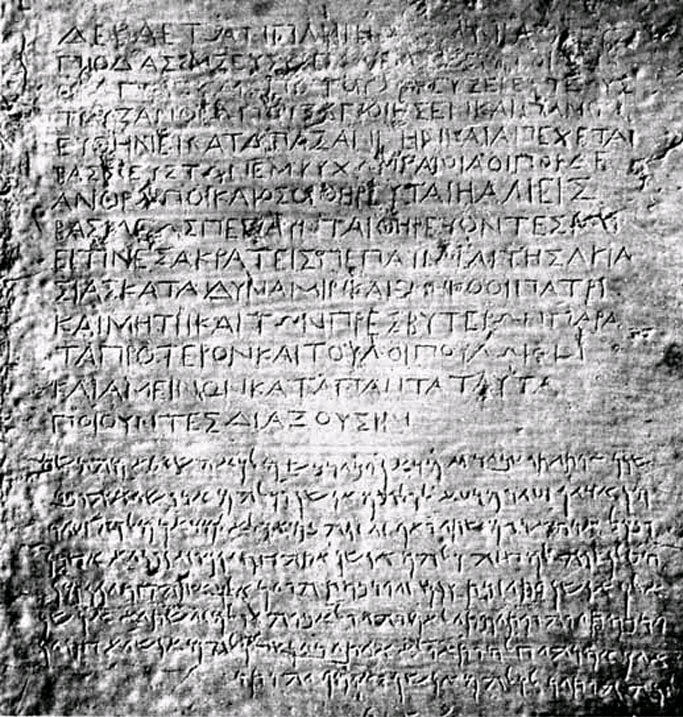
The Kandahar Bilingual Rock Inscription, also known as the Kandahar Edict of Ashoka and less commonly as the Chehel Zina Edict, is an inscription in the Greek and Aramaic languages that dates back to 260 BCE and was carved by the Mauryan emperor Ashoka (r. 268–232 BCE) at Chehel Zina, a mountainous outcrop near Kandahar, Afghanistan. It is among the earliest-known edicts of Ashoka, having been inscribed around the 8th year of his reign (c. 260 BCE), and precedes all of his other inscriptions, including the Minor Rock Edicts and Barabar Caves in India and the Major Rock Edicts. This early inscription was written exclusively in the Greek and Aramaic languages. It was discovered below a 1-metre (3.3 ft) layer of rubble in 1958 during an excavation project around Kandahar, and is designated as KAI 279.
It is sometimes considered to be a part of Ashoka's Minor Rock Edicts (consequently dubbed "Minor Rock Edict No. 4"), in contrast to his Major Rock Edicts, which contain portions or the totality of his edicts from 1–14. The Kandahar Edict of Ashoka is one of only two ancient inscriptions discovered in Afghanistan that contain Greek writing, with the other being the Kandahar Greek Inscription, which is written exclusively in the Greek language. Chehel Zina, the mountainous outcrop where the edicts were discovered, makes up the western side of the natural bastion of the ancient Greek city of Alexandria Arachosia as well as the Old City of modern-day Kandahar.
The edict remains on the mountainside that it was discovered on. According to the Italian archaeologist Umberto Scerrato, "the block lies at the eastern base of the little saddle between the two craggy hills below the peak on which the celebrated Cehel Zina of Babur are cut". A cast of the inscription is present in the National Museum of Afghanistan in Kabul. In the Kandahar Edict, Ashoka, a patron of Buddhism, advocates the adoption of piety (using the Greek-language term Eusebeia for the Indian concept of Dharma) to the Greek community of Afghanistan.
Greek communities lived in the northwest of the Mauryan empire, currently in Afghanistan, notably ancient Greco-Bactria near the Afghan Region of Badakhshan, and in the region of Arachosia, nowadays in Southern Afghanistan, following the conquest and the colonization efforts of Alexander the Great around 323 BCE. These communities therefore seem to have been still significant in the area of Afghanistan during the reign of Ashoka, about 70 years after Alexander.
Ashoka proclaims his faith, 10 years after the violent beginning of his reign, and affirms that living beings, human or animal, cannot be killed in his realm. In the Hellenistic part of the Edict, he translates the Dharma he advocates by "Piety" εὐσέβεια, Eusebeia, in Greek. The usage of Aramaic reflects the fact that Aramaic (the so-called Official Aramaic) had been the official language of the Achaemenid Empire which had ruled in those parts until the conquests of Alexander the Great. The Aramaic is not purely Aramaic, but seems to incorporate some elements of Iranian. According to D.D.Kosambi, the Aramaic is not an exact translation of the Greek, and it seems rather that both were translated separately from an original text in Magadhi, the common official language of India at the time, used on all the other Edicts of Ashoka in Indian language, even in such linguistically distinct areas as Kalinga. It is written in Aramaic alphabet.
This inscription is actually rather short and general in content, compared to most Major Rock Edicts of Ashoka, including the other inscription in Greek of Ashoka in Kandahar, the Kandahar Greek Edict of Ashoka, which contains long portions of the 12th and 13th edicts, and probably contained much more since it was cut off at the beginning and at the end.
The proclamation of this Edict in Kandahar is usually taken as proof that Ashoka had control over that part of Afghanistan, presumably after Seleucos had ceded this territory to Chandragupta Maurya in their 305 BCE peace agreement. The Edict also shows the presence of a sizable Greek population in the area, but it also shows the lingering importance of Aramaic, several decades after the fall of the Achaemenid Empire. During the same epoch, the Greeks were firmly established in the newly created Greco-Bactrian kingdom under the reign of Diodotus I, and particularly in the border city of Ai-Khanoum, not far away in the northern part of Afghanistan.
According to Sircar, the usage of Greek in the Edict indeed means that the message was intended for the Greeks living in Kandahar, while the usage of Aramaic was intended for the Iranian populations of the Kambojas.
Hub AI
Kandahar Bilingual Rock Inscription AI simulator
(@Kandahar Bilingual Rock Inscription_simulator)
Kandahar Bilingual Rock Inscription
The Kandahar Bilingual Rock Inscription, also known as the Kandahar Edict of Ashoka and less commonly as the Chehel Zina Edict, is an inscription in the Greek and Aramaic languages that dates back to 260 BCE and was carved by the Mauryan emperor Ashoka (r. 268–232 BCE) at Chehel Zina, a mountainous outcrop near Kandahar, Afghanistan. It is among the earliest-known edicts of Ashoka, having been inscribed around the 8th year of his reign (c. 260 BCE), and precedes all of his other inscriptions, including the Minor Rock Edicts and Barabar Caves in India and the Major Rock Edicts. This early inscription was written exclusively in the Greek and Aramaic languages. It was discovered below a 1-metre (3.3 ft) layer of rubble in 1958 during an excavation project around Kandahar, and is designated as KAI 279.
It is sometimes considered to be a part of Ashoka's Minor Rock Edicts (consequently dubbed "Minor Rock Edict No. 4"), in contrast to his Major Rock Edicts, which contain portions or the totality of his edicts from 1–14. The Kandahar Edict of Ashoka is one of only two ancient inscriptions discovered in Afghanistan that contain Greek writing, with the other being the Kandahar Greek Inscription, which is written exclusively in the Greek language. Chehel Zina, the mountainous outcrop where the edicts were discovered, makes up the western side of the natural bastion of the ancient Greek city of Alexandria Arachosia as well as the Old City of modern-day Kandahar.
The edict remains on the mountainside that it was discovered on. According to the Italian archaeologist Umberto Scerrato, "the block lies at the eastern base of the little saddle between the two craggy hills below the peak on which the celebrated Cehel Zina of Babur are cut". A cast of the inscription is present in the National Museum of Afghanistan in Kabul. In the Kandahar Edict, Ashoka, a patron of Buddhism, advocates the adoption of piety (using the Greek-language term Eusebeia for the Indian concept of Dharma) to the Greek community of Afghanistan.
Greek communities lived in the northwest of the Mauryan empire, currently in Afghanistan, notably ancient Greco-Bactria near the Afghan Region of Badakhshan, and in the region of Arachosia, nowadays in Southern Afghanistan, following the conquest and the colonization efforts of Alexander the Great around 323 BCE. These communities therefore seem to have been still significant in the area of Afghanistan during the reign of Ashoka, about 70 years after Alexander.
Ashoka proclaims his faith, 10 years after the violent beginning of his reign, and affirms that living beings, human or animal, cannot be killed in his realm. In the Hellenistic part of the Edict, he translates the Dharma he advocates by "Piety" εὐσέβεια, Eusebeia, in Greek. The usage of Aramaic reflects the fact that Aramaic (the so-called Official Aramaic) had been the official language of the Achaemenid Empire which had ruled in those parts until the conquests of Alexander the Great. The Aramaic is not purely Aramaic, but seems to incorporate some elements of Iranian. According to D.D.Kosambi, the Aramaic is not an exact translation of the Greek, and it seems rather that both were translated separately from an original text in Magadhi, the common official language of India at the time, used on all the other Edicts of Ashoka in Indian language, even in such linguistically distinct areas as Kalinga. It is written in Aramaic alphabet.
This inscription is actually rather short and general in content, compared to most Major Rock Edicts of Ashoka, including the other inscription in Greek of Ashoka in Kandahar, the Kandahar Greek Edict of Ashoka, which contains long portions of the 12th and 13th edicts, and probably contained much more since it was cut off at the beginning and at the end.
The proclamation of this Edict in Kandahar is usually taken as proof that Ashoka had control over that part of Afghanistan, presumably after Seleucos had ceded this territory to Chandragupta Maurya in their 305 BCE peace agreement. The Edict also shows the presence of a sizable Greek population in the area, but it also shows the lingering importance of Aramaic, several decades after the fall of the Achaemenid Empire. During the same epoch, the Greeks were firmly established in the newly created Greco-Bactrian kingdom under the reign of Diodotus I, and particularly in the border city of Ai-Khanoum, not far away in the northern part of Afghanistan.
According to Sircar, the usage of Greek in the Edict indeed means that the message was intended for the Greeks living in Kandahar, while the usage of Aramaic was intended for the Iranian populations of the Kambojas.
Recent media