


Community hub
Recent from talks
Contribute something
Nothing was collected or created yet.
Lamia
View on Wikipedia
Lamia (/ˈleɪmiə/ ⓘ; Ancient Greek: Λάμια, romanized: Lámia), in ancient Greek mythology, was a child-eating monster and, in later tradition, was regarded as a type of night-haunting spirit or "daimon".
In the earliest myths, Lamia was a beautiful queen of ancient Libya who had an affair with Zeus and gave birth to his children. Upon learning of this, Zeus's wife Hera robbed Lamia of her children, either by kidnapping them and hiding them away, killing them outright, or forcing Lamia to kill them.[1] The loss of her children drove Lamia insane, and she began hunting and devouring others' children.[2] Either because of her anguish or her cannibalism, Lamia was transformed into a horrific creature. Zeus gifted Lamia the power of prophecy and the ability to take out and reinsert her eyes, possibly because Hera cursed her with insomnia or the inability to close her eyes.[3]
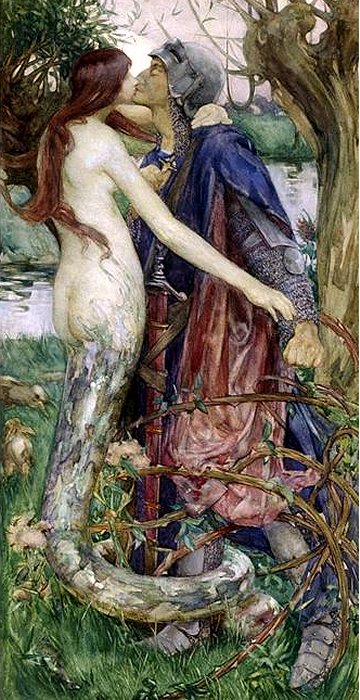
The lamiai (Ancient Greek: λάμιαι, romanized: lámiai) also became a type of phantom, synonymous with the empusai who seduced young men to satisfy their sexual appetite and fed on their flesh afterward. An account of Apollonius of Tyana's defeat of a lamia-seductress inspired the poem "Lamia" by John Keats.
Lamia has been ascribed serpentine qualities, which some commentators believe can be firmly traced to mythology from antiquity; they have found analogues in ancient texts that could be designated as lamiai, which are part-snake beings. These include the half-woman, half-snake beasts of the "Libyan myth" told by Dio Chrysostom, and the monster sent to Argos by Apollo to avenge Psamathe, daughter of King Crotopos.
In previous centuries, Lamia was used in Greece as a bogeyman to frighten children into obedience, similar to the way parents in Spain, Portugal and Latin America used the Coco.
Etymology
[edit]A scholiast to Aristophanes claimed that Lamia's name derived from her having a large throat or gullet (λαιμός; laimós).[5] Modern scholarship reconstructs a Proto-Indo-European stem *lem-, "nocturnal spirit", whence also comes lemures.[6]
Classical mythology
[edit]Aristotle's Nicomachean Ethics (vii.5) refers to the lore of some beastly lifeform in the shape of a woman, which tears the bellies of pregnant mothers and devours their fetuses. An anonymous commentator on the passage states this is a reference to the Lamia, but muddlingly combines this with Aristotle's subsequent comments and describes her as a Scythian of the Pontus (Black Sea) area.[7][8]
According to one myth, Hera deprived Lamia of the ability to sleep, making her constantly grieve over the loss of her children, and Zeus provided relief by endowing her with removable eyes. He also gifted her with a shapeshifting ability in the process.[9][10]
De-mythologized
[edit]Diodorus Siculus (fl. 1st century BC) gave a de-mythologized account of Lamia as a queen of Libya who ordered her soldiers to snatch children from their mothers and kill them, and whose beauty gave way to bestial appearance due to her savageness. The queen, as related by Diodorus, was born in a cave.[1][11] Heraclitus Paradoxographus (2nd century) also gave a rationalizing account.[12]
Diodorus's rationalization was that the Libyan queen in her drunken state was as if she could not see, allowing her citizens free rein for any conduct without supervision, giving rise to the folk myth that she places her eyes in a vessel.[1] Heraclitus's euhemerized account explains that Hera, consort of Zeus, gouged the eyes out of the beautiful Lamia.[13]
Genealogy
[edit]Lamia was the daughter born between King Belus of Egypt and Lybie, according to one source.[a][9][14]
According to the same source, Lamia was taken by Zeus to Italy, and that Lamos, the city of the man-eating Laestrygonians, was named after her.[9] A different authority remarks that Lamia was once queen of the Laestrygonians.[17][b][c]
Aristophanes
[edit]Aristophanes wrote in two plays an identically worded list of foul-smelling objects which included the "Lamia's testicles", thus making Lamia's gender ambiguous.[19][d] This was later incorporated into Edward Topsell's 17th-century envisioning of the lamia.[20]
It is somewhat uncertain if this refers to the one Lamia[21] or to "a Lamia" among many, as given in some translations of the two plays;[22] a generic lamia is also supported by the definition as some sort of a "wild beast" in the Suda.[23]
Hellenistic folklore
[edit]As children's bogey
[edit]The "Lamia" was a bogeyman or bugbear term, invoked by a mother or a nanny to frighten children into good behavior.[15][24] Such practices are recorded by the 1st century Diodorus,[1] and other sources in antiquity.[9][25]
Numerous sources attest to the Lamia being a "child-devourer", one of them being Horace.[26] Horace in Ars Poetica cautions against the overly fantastical: "[nor should a story] draw a live boy out of a Lamia's belly".[e][27] Lamia was in some versions thus seen as swallowing children alive, and there may have existed some nurse's tale that told of a boy extracted alive out of a Lamia.[28]
The Byzantine lexicon Suda (10th century) gave an entry for lamía, with definitions and sources much as already described.[29] The lexicon also has an entry under mormo (Μορμώ), stating that Mormo and the equivalent μορμολυκεῖον mormolykeion[f] are called lamía, and that all these refer to frightful beings.[30][31][32]
"Lamia" has as synonyms "Mormo" and "Gello" according to the scholia to Theocritus.[17]
Other bogeys have been listed in conjunction with "Lamia", for instance, the Gorgo (ἡ Γοργώ), the eyeless giant Ephialtes, a Mormolyce (μορμολύκη named by Strabo.[33]
As a seductress
[edit]In later classical periods, around the 1st century A. D.,[34] the conception of this Lamia shifted to that of a sultry seductress who enticed young men and devoured them.[35][34]
Apollonius of Tyana
[edit]A representative example is Philostratus's novelistic biography Life of Apollonius of Tyana.[35]
It purports to give a full account of the capture of "Lamia of Corinth" by Apollonius, as the general populace referred to the legend.[37] An apparition (phasma φάσμα[38][g]) which in the assumed guise of a woman seduced one of Apollonius's young pupils.
Here, Lamia is the common vulgar term and empousa the proper term. For Apollonius in speech declares that the seductress is "one of the empousai, which most other people would call lamiai and mormolykeia".[40][36] The use of the term lamia in this sense is however considered atypical by one commentator.[41]
Regarding the seductress, Apollonius further warned, "you are warming a snake (ophis) on your bosom, and it is a snake that warms you".[42][38] It has been suggested from this discourse that the creature was therefore "literally a snake".[43][h] The empousa admits in the end to fattening up her victim (Menippus of Lycia) to be consumed, as she was in the habit of targeting young men for food "because their blood was fresh and pure".[36] The last statement has led to the surmise that this lamia/empusa was a sort of blood-sucking vampiress.[44]
Another aspect of her powers is that this empusa/lamia is able to create an illusion of a sumptuous mansion, with all the accoutrements and even servants. But once Apollonius reveals her false identity at the wedding, the illusion fails her and vanishes.[38]
Lamia the courtesan
[edit]A longstanding joke makes a word play between Lamia the monster and Lamia of Athens, the notorious hetaira courtesan who captivated Demetrius Poliorcetes (d. 283 BC). The double-entendre sarcasm was uttered by Demetrius's father, among others.[i][45][46] The same joke was used in theatrical Greek comedy,[47] and generally.[48] The word play is also seen as being employed in Horace's Odes, to banter Lucius Aelius Lamia the praetor.[j][49]
Golden Ass
[edit]In Apuleius's The Golden Ass[k] appear two Thessalian "witches",[l] Meroe and her sister Panthia, who are called lamiae in one instance.[52][53][m][n]
Meroe has seduced a man named Socrates, but when he plots to escape, the two witches raid his bed, thrust a knife in the neck to tap the blood into a skin bag, eviscerate his heart, and stuff the hole back with sponge.[56]
Some commentators, despite the absence of actual blood-sucking, find these witches to share "vampiric" qualities of the lamiae (lamiai) in Philostratus's narrative, thus offering it up for comparison.[57]
Kindreds
[edit]Lamia's possible kindred kind appear in Classical works, but may be known by other names except for isolated instance which calls it a lamia. Or they may be simply unnamed or differently named. And those analogues that exhibit a serpentine form or nature have been especially noted.
Poine of Argos
[edit]One such possible lamia is the avenging monster sent by Apollo against the city of Argos and killed by Coroebus. It is referred to as Poine or Ker[58] in classical sources, but later in the Medieval period, one source does call it a lamia (First Vatican Mythographer, c. 9th to 11th century).[59][60]
The story surrounds the tragedy of the daughter of King Crotopus of Argos named Psamathe, whose child by Apollo dies and she is executed for suspected promiscuity. Apollo as punishment then sends the child-devouring monster to Argos.
In Statius' version, the monster had a woman's face and breasts, and a hissing snake protruding from the cleft of her rusty-colored forehead, and it would slide into children's bedrooms to snatch them.[61] According to a scholiast to Ovid, it had a serpent's body carrying a human face.[62]
In Pausanias's version, the monster is called Poinē (ποινή), meaning "punishment" or "vengeance", but there is nothing about a snake on her forehead.[63][64]
One evidence this may be a double of the Lamia comes from Plutarch, who equates the word empousa with poinē.[65]
Libyan myth
[edit]A second example is a colony of man-eating monsters in Libya, described by Dio Chrysostom. These monsters had a woman's torso and beastly hands, and "all the lower part was snake, ending in the snake's baleful head".[66][67][o] The idea that these creatures were lamiai seems to originate with Alex Scobie (1977),[69] and to be accepted by other commentators.[70]
Middle Ages
[edit]By the Early Middle Ages, lamia (pl. lamiai or lamiae) was being glossed as a general term referring to a class of beings. Hesychius of Alexandria's lexicon (c. 500 A.D.) glossed lamiai as apparitions, or even fish.[p][12] Isidore of Seville defined them as beings that snatched babies and ripped them apart.[12]
The Vulgate used "lamia" in Isaiah 34:14 to translate "Lilith" of the Hebrew Bible.[71] Pope Gregory I (d. 604)'s exegesis on the Book of Job explains that the lamia represented either heresy or hypocrisy.[71]
Christian writers also warned against the seductive potential of lamiae. In his 9th-century treatise on divorce, Hincmar, archbishop of Reims, listed lamiae among the supernatural dangers that threatened marriages, and identified them with geniciales feminae,[72] female reproductive spirits.[73]
Interpretations
[edit]

This Lamia of Libya has her double in Lamia-Sybaris of the legend around Delphi, both indirectly associated with serpents. Strong parallel with the Medusa has also been noted. These, and other considerations have prompted modern commentators to suggest she is a dragoness.[74][75]
Another double of the Libyan Lamia may be Lamia, daughter of Poseidon. Lamia by Zeus gave birth to a Sibyl according to Pausanias, and this would have to be the Libyan Lamia, yet there is a tradition that Lamia the daughter of Poseidon was the mother of a Sibyl.[76] Either one could be Lamia the mother of Scylla mentioned in the Stesichorus (d. 555 BC) fragment, and other sources.[78][79] Scylla is a creature depicted variously as anguipedal or serpent-bodied.
Identification as a serpent-woman
[edit]Diodorus Siculus (fl. 1st century BC), for instance, describes Lamia of Libya as having nothing more than a beastly appearance.[1] Diodorus, Duris of Samos and other sources which comprise the sources for building an "archetypal" picture of Lamia do not designate her as a dragoness, or give her explicit serpentine descriptions.[80]
In the 1st-century Life of Apollonius of Tyana the female empousa-lamia is also called "a snake",[38] which may seem to the modern reader to be just a metaphorical expression, but which Daniel Ogden insists is a literal snake.[43] Philostratus's tale was reworked by Keats in his poem Lamia,[81] where it is made clear she bears the guise of a snake, which she wants to relinquish in return for human appearance.
Modern commentators have also tried to establish that she may have originally been a dragoness, by inference.[82][83] Daniel Ogden argues that one of her possible reincarnations, the monster of Argos killed by Coroebus had a "scaly gait", indicating she must have had an anguipedal form in an early version of the story,[84] although the Latin text in Statius merely reads inlabi (declension of labor) meaning "slides".[61]
One of the doubles of Lamia of Libya is the Lamia-Sybaris, which is described only as a giant beast by Antoninus Liberalis (2nd century).[85][86] It is noted that this character terrorized Delphi, just as the dragon Python had.[86]
Close comparison is also made with the serpentine Medusa. Not only is Medusa identified with Libya, she also had dealings with the three Graeae who had the removable eye shared between them. In some versions, the removable eye belonged to the three Gorgons, Medusa and her sisters.[87]
Hecate
[edit]Some commentators have also equated Lamia with Hecate. The basis of this identification is the variant maternities of Scylla, sometimes ascribed to Lamia (as already mentioned), and sometimes to Hecate.[88][79] The identification has also been built (using transitive logic) since each name is identified with empousa in different sources.[43][90]
Stench of a lamia
[edit]A foul odor has been pointed out as a possible common motif or attribute of the lamiai. The examples are Aristophanes's reference to the "lamia's testicles", the scent of the monsters in the Libyan myth which allowed the humans to track down their lair, and the terrible stench of their urine that lingered in the clothing of Aristomenes, which they showered upon him after carving out his friend Sophocles's heart.[91]
Mesopotamian connection
[edit]Lamia may originate from the Mesopotamian demoness Lamashtu.[92]
Modern age
[edit].jpg)
Renaissance writer Angelo Poliziano wrote Lamia (1492), a philosophical work whose title is a disparaging reference to his opponents who dabble in philosophy without competence. It alludes to Plutarch's use of the term in De curiositate, where the Greek writer suggests that the term Lamia is emblematic of meddlesome busybodies in society.[93] Worded another way, Lamia was emblematic of the hypocrisy of such scholars.[94]
From around the mid-15th century into the 16th century, the lamia came to be regarded exclusively as witches.[95]
Bestiary
[edit]
In Edward Topsell's History of Four-footed Beasts (1607), the lamia is described as having the upper body (i.e., the face and breasts) of a woman, but with goatlike hind quarters with large and filthy "stones" (testicles) that smell like sea-calves, on authority of Aristophanes. It is covered with scales all over.[20]
Adaptations
[edit]John Keats's "Lamia" in his Lamia and Other Poems is a reworking of the tale in Apollonius's biography by Philostratus, described above. In Keats's version, the student Lycius replaces Menippus the Lycian. For the descriptions and nature of the Lamia, Keats drew from Burton's The Anatomy of Melancholy.[96] August Enna wrote an opera called Lamia.[34]
A Lamia appears in the 1914 story "An Episode of Cathedral History" by M. R. James.
English composer Dorothy Howell composed a tone poem Lamia which was played repeatedly to great acclaim under its dedicatee Sir Henry Wood at the London Promenade concerts in the 1920s. It has been recorded more recently by Rumon Gamba conducting the BBC Philharmonic Orchestra for Chandos Records in a 2019 release of British tone poems.
The 1982 novel Lamia by Tristan Travis sees the mythological monster relocated to 1970s Chicago, where she takes bloody vengeance on sex offenders while the cops try to figure out the mystery.[97]
Lamia, also known as Ramia, also appears as a boss in the Nintendo DS action role-playing game Deep Labyrinth.[98]
Lamia is the main antagonist in the 2009 horror movie Drag Me to Hell. In the film, Lamia is described as "the most feared of all Demons" and having the head and hooves of a goat. A gypsy curse associated with him has Lamia torment the victim for three days before having its minions drag them into Hell to burn in its fires for all eternity.
A Lamia appears in the BBC series Merlin in series 4. Described as having the blood of both woman and serpent, she draws the life out of men through a kiss in her seductress form before turning into a serpent-like creature. She is killed by Prince Arthur.
Lamia appears as an antagonist in Rick Riordan's The Demigod Diaries, appearing in its fourth short story "The Son of Magic". She is depicted as the daughter of Hecate and as having glowing green eyes with serpentine slits, shriveled-up hands with lizard-like claws on them, and crocodile-like teeth.
In the manga and anime Monster Musume, the character Miia is a lamia. The main character of Dropkick on My Devil!, Jashin-chan, is also a lamia.
In Gerald Brom's Lost Gods, Lamia serves as the primary antagonist, depicted as an ancient succubus who prolongs her life by drinking the blood of her children and grandchildren.
Lamias are featured in the progressive rock album The Lamb Lies Down on Broadway by Genesis on the track "The Lamia". They are depicted as female creatures with "snake-like" bodies and seduce the protagonist Rael in an attempt to devour him, but as soon as they "taste" Rael's body, the blood that enters the lamias' bodies causes their death.
Lamia is mentioned several times in the Iron Maiden song "Prodigal Son" from their 1981 album Killers. The band often refer to mythology and mythical beasts in their compositions.
The American TV series Raised by Wolves features a character named Lamia, an android mother, who has removable eyes and the ability to shapeshift.[99]
The 2024 British fantasy TV series Domino Day, set in modern-day Manchester, features Siena Kelly as the titular lead character, a witch who feeds on the energy of her dating-app hook-ups. She eventually realizes that she is actually a lamia.[100]
Modern folk traditions
[edit]In modern Greek folk tradition, the Lamia has survived and retained many of her traditional attributes.[101] John Cuthbert Lawson remarks "the chief characteristics of the Lamiae, apart from their thirst for blood, are their uncleanliness, their gluttony, and their stupidity".[102] The contemporary Greek proverb, "της Λάμιας τα σαρώματα" ("the Lamia's sweeping"), epitomises slovenliness;[102] and the common expression, "τό παιδί τό 'πνιξε η Λάμια" ("the child has been strangled by the Lamia"), explains the sudden death of young children.[102]
Later traditions referred to many lamiae; these were folkloric monsters similar to vampires and succubi that seduced young men and then fed on their blood.[103]
Fine arts
[edit]
In a 1909 painting by Herbert James Draper, the Lamia who moodily watches the serpent on her forearm appears to represent a hetaera. Although the lower body of Draper's Lamia is human, he alludes to her serpentine history by draping a shed snakeskin about her waist. In Renaissance emblems, Lamia has the body of a serpent and the breasts and head of a woman, like the image of hypocrisy.[citation needed]
See also
[edit]Explanatory notes
[edit]- ^ Making her the granddaughter of Poseidon. Lybie is a personification of Libya.
- ^ The same scholium states that Mormo and Gello are equivalent to Lamia, therefore by transference Mormo is queen of the Laestrygonians, hence: Stannish & Doran (2013), p. 118.
- ^ Horace makes a related joke, referring to the aforementioned Lucius Aelius Lamia the praetor as "Lamus", in this instance regarded as the founding figure of the city of the Laestrygonians.[18]
- ^ This prompted Henderson (1998) to "humorlessly infer" that the Lamia must have been a hermaphrodite. Ogden (2013a), p. 91, note 117.
- ^ Neu pransae Lamiae vivum puerum extrahat alvo (v. 340). Alexander Pope translates the line: Shall Lamia in our sight her sons devour, /and give them back alive the self-same hour?
- ^ Begins with lower case
- ^ This phasma is a more "generic term for creatures".[39]
- ^ Keats's reworking makes this Lamia have serpent form for certain, which she wants to lose.
- ^ Demetrius's father Antigonus and Demochares of Soli.
- ^ Grandfather of his namesake, the consul Lucius Aelius Lamia (d. 33 CE).
- ^ Or Metamorphoses, thus abbreviated "Apu. Met."
- ^ They are not strictly speaking "witches", but they are referred to as such by convention.[50] In the Latin text, Meroe is referred to as a saga, a wise woman or soothsayer.[51]
- ^ It has been cautioned that there may not be great import in the label "lamiae" here beyond derogatory insult,[48] and Apuleius uses the label rather indescriminately elsewhere.[54]
- ^ The Elizabethan translator William Adlington rendered lamiae as "hags".[55]
- ^ Incidentally, Dio in Oration 37 quotes a Sibyl's song in which the Sibyl (Libyan Sibyl) identifies her mother as Lamia (daughter of Poseidon).[68]
- ^ Aristotle says there is a shark called "lamia".Resnick & Kitchell (2007), p. 83
- ^ Note the snakeskin wrapped around her arm and waist.
- ^ Lamia has human legs and a snakeskin around her waist. There is also a small snake on her right forearm.
References
[edit]Citations
[edit]- ^ a b c d e Diodorus Siculus (fl. 1st century BC), Library of History XX.41, quoted by Ogden (2013b), p. 98
- ^ Duris of Samos (d. 280 B. C.), Libyca, quoted by Ogden (2013b), p. 98
- ^ Bell, Robert E., Women of Classical Mythology: A Biographical Dictionary (New York: Oxford UP, 1991), s.v. "Lamia" (drawing upon Diodorus Siculus 22.41; Suidas "Lamia"; Plutarch "On Being a Busy-Body" 2; Scholiast on Aristophanes' Peace 757; Eustathius on Odyssey 1714).
- ^ West, David R. (1995), Some cults of Greek goddesses and female daemons of Oriental origin, Butzon & Bercker, p. 293, ISBN 9783766698438
- ^ Scholiast on Wasps, 1035.[4]
- ^ Polomé, Edgar C.; Adams, Douglas Q. (1997). "Spirit". In Mallory, J. P.; Adams, Douglas Q. (eds.). Encyclopedia of Indo-European Culture. Taylor & Francis. p. 538.
- ^ Aristotle, Nicomachean Ethics 1148b.
- ^ Fisher, Elizabeth A. (2009), "The Anonymous Commentary on Nicomachean Ethics VII: Language, Style and Implications", in Barber, Charles E.; Jenkins, David Todd (eds.), Medieval Greek Commentaries on the Nicomachean Ethics, Brill, pp. 147–148, ISBN 978-9004173934
- ^ a b c d e Scholium from the Byzantine-Hellenistic period to Aristophanes, Peace 758, quoted by Ogden (2013b), p. 98
- ^ Bell, Robert E. (1993), Women of Classical Mythology, drawing upon Diodorus Siculus XX.41; Suidas 'Lamia'; Plutarch 'On Being a Busy-Body' 2; Scholiast on Aristophanes's Peace 757; Eustathius on Odyssey 1714)
- ^ Bekker, Immanuel, ed., Diodorus Siculus, Bibliotheca Historica XX.41
- ^ a b c Ogden (2013b), p. 99.
- ^ Heraclitus Paradoxographus (2nd century) De Incredibilibus 34, quoted by Ogden (2013b), p. 98
- ^ Diodorus Siculus, 20.41.3-6, Scholia to Aristophanes, Wasps 1035; Commentary 37 to Heraclitus the Allegorist
- ^ a b Ogden (2013b), p. 98.
- ^ Johnston, Sarah Iles, ed. (2013). Restless Dead: Encounters Between the Living and the Dead in Ancient Greece. Univ of California Press. p. 174. ISBN 9780520280182.
- ^ a b Scholium to Theocritus Idylls 15.40.[15][16]
- ^ Mulroy, D. (1994), Horace's Odes and Epodes, University of Michigan Press, p. 86, ISBN 978-0472105311
- ^ Aristophanes, The Wasps, 1035; Peace 758, cited by Ogden (2013a), p. 91, note 117.
- ^ a b Topsell, Edward (1607), "Of the lamia, The historie of foure-footed beastes.
- ^ viz. Scholia to the passages whose annotations refer to her,[9]
- ^ "a Lamia's groin" (Benjamin Bickley Rogers, 1874), "a foul Lamia's testicles" (Athenian Society, 1912), "sweaty Crotch of a Lamia" (Paul Roche, 2005).
- ^ "Lamia", Suda On Line, tr. David Whitehead. 27 May 2008
- ^ Leinweber (1994), "Witchcraft and Lamiae in 'The Golden Ass'" Folklore 105, p. 77.
- ^ Tertullian, Against Valentinius (ch. iii)
- ^ Ogden (2013a), pp. 90–91, note 114.
- ^ Kilpatrick, Ross Stuart (1990). The Poetry of Criticism: Horace, Epistles II and Ars Poetica. University of Alberta. p. 80. ISBN 9780888641465.
- ^ Member of the university (1894). A literal Translation of Horace's Art of Poetry. With explanatory notes. Cambridge: J. Hall. p. 22.
- ^ "Lamia", Suda On Line, tr. David Whitehead. 1 April 2008
- ^ Suidas (1834), Gaisford, Thomas (ed.), Lexicon: post Ludolphum Kusterum ad codices manuscriptos. K - Psi, vol. 2, Typographeo Academico, p. 2523: "Μορμώ: λέγεται καὶ Μορμώ, Μορμοῦς, ὡς Σαπφώ. καὶ Μορμών, Μορμόνος. Ἀριστοφάνης: ἀντιβολῶ σ', ἀπένεγκέ μου τὴν Μορμόνα. ἄπο τὰ φοβερά: φοβερὰ γὰρ ὑπῆρχεν ἡ Μορμώ. καὶ αὖθις Ἀριστοφάνης: Μορμὼ τοῦ θράσους. μορμολύκειον, ἣν λέγουσι Λαμίαν: ἔλεγον δὲ οὕτω καὶ τὰ φοβερά. λείπει δὲ τὸ ὡς, ὡς Μορμώ, ἢ ἐπιρρηματικῶς ἐξενήνεκται, ὡς εἰ ἔλεγε, φεῦ τοῦ θράσους".
- ^ Ogden (2013a), p. 91, note 114
- ^ "Mormo", Suda On Line, tr. Richard Rodriguez. 11 June 2009.
- ^ Hamilton, H.C.; Falconer, W. edd., Strabo, Geography I.2.8
- ^ a b c Skene, Bradley (2016). "Lamia". The Ashgate Encyclopedia of Literary and Cinematic Monsters. Routledge. pp. 369–370. ISBN 9781317044260.
- ^ a b Schmitz, Leonhard (1873), Smith, William (ed.), "La'mia", A Dictionary of Greek and Roman biography and mythology, vol. 2, London: John Murray, pp. 713–714 Perseus Project "La'mia".
- ^ a b c Philostratus (1912). "25". In Honour of Apollonius of Tyana. Vol. 2. Translated by Phillimore, J. S. Clarendon Press. pp. 24–26.
- ^ This is given in the concluding paragraph of the chapter, Vit. Apollon. 4.25. Phillimore tr., p. 26.[36]
- ^ a b c d e Philostratus, Life of Apollonius 4.25, quoted by Ogden (2013a), pp. 106–107.
- ^ a b Felton (2013), p. 232, n15.
- ^ In Greek: "μία τῶν ἐμπουσῶν ἐστιν, ἃς λαμίας τε καὶ μορμολυκίας οἱ πολλοὶ ἡγοῦνται", Vit. Apollon. 4.25. Where Felton gives "mormolyces",[39] Ogden "renders as "bogey".[38]
- ^ Stoneman, Richard (1991). "Vampire". Greek Mythology: An Encyclopedia of Myth and Legend. Aquarian Press. pp. 178–179. ISBN 9780850309348.: "Lamia (not the usual application of this term)".
- ^ Ogden (2013a), p. 90.
- ^ a b c Ogden (2013b), p. 107.
- ^ Schmitz, Leonhard (1849), Smith, William (ed.), "Lamia", A Dictionary of Greek and Roman biography and mythology, vol. 2, London: John Murray, pp. 713–714 Perseus Project "La'mia (2)".
- ^ Kapparis, Konstantinos (2017), Prostitution in the Ancient Greek World, Walter de Gruyter GmbH & Co KG, p. 118, ISBN 9783110557954
- ^ Plutarch, Demetrius 19, Perrin, Bernadotte, ed.
- ^ Kapparis (2017), p. 118, citing Lamia O'Sullivan, Lara (2009), pp. 53–79, esp. p. 69
- ^ a b Stannish & Doran (2013), p. 117:"This is a pejorative expression, not a formal classification, but it is still meaningful"; "..labeling of a dangerous woman as a lamia was not uncommon.. Aelian records.. a notorious prostitute.. (Miscellany 12.17, 13.8)".
- ^ Griffiths, Alan (2002), "The Odes: Just where do you draw the line?", Traditions and Contexts in the Poetry of Horace, Cambridge University Press, p. 72, ISBN 9781139439312
- ^ Frangoulidis, Stavros (2008). Witches, Isis and Narrative: Approaches to Magic in Apuleius' "Metamorphoses". Walter de Gruyter. p. 116. ISBN 9783110210033.
- ^ Apul. Met.1.8
- ^ Apul. Met. 1.17. Leinweber (1994), p. 78: "Admittedly, Apuleius' use of the term "Lamiae" is an isolated occurrence. Elsewhere, Meroe and her sister are referred to as witches or sorcerer".
- ^ Leinweber (1994), pp. 77, 79–81.
- ^ Cupid refers to Psyche's sisters as Lamiae, Apul. Met. 5. 11(Stannish & Doran (2013), p. 117, note 26)
- ^ [Apuleius] (1989), Metamorphoses, Harvard University Press
- ^ Apul. Met. 1.12–17 (in Latin)
- ^ Stannish & Doran (2013), pp. 115–118.
- ^ Greek Anthology 7.154, cited by Pache (2004), pp. 72–73
- ^ Pache (2004), p. 70.
- ^ Ogden (2013a), p. 87.
- ^ a b Statius, Thebaid, I. 562–669, quoted by Ogden (2013b), pp. 100–102; Latin text: Thebais I; Bailey, D. R. Shackleton tr. (2003) Thebaid, Book I.
- ^ Fontenrose (1959), p. 104.
- ^ Ogden (2013a), p. 102.
- ^ Pausanias, translated by Jones, W.H.S.; Ormerod, H.A., Description of Greece, 1. 43. 7 - 8
- ^ Plutarch, Moralia 1101c, cited by Ogden (2013b), p. 107.
- ^ Dio Chrysostom, Orations, 5.1, 5–27, quoted by Ogden (2013b), pp. 103–104
- ^ Cohoon, J. W. tr., ed. Orations 5 (Loeb Classics).
- ^ Crosby, Henry Lamar ed., tr., Orations 37.13 (Loeb Classics).
- ^ Scobie, Alex (1977), "Some Folktales in Graeco-Roman and Far Eastern Sources", Philologus, 121: 1–23, doi:10.1524/phil.1977.121.1.1, S2CID 201808604, cited by Resnick & Kitchell (2007), p. 82
- ^ Felton (2013), pp. 231–232.
- ^ a b Lea, Henry Charles (1986) [1939], Materials toward a History of Witchcraft, vol. 1, AMS Press, p. 110, ISBN 9780404184209
- ^ Hincmar, De divortio Lotharii ("On Lothar's divorce"), XV Interrogatio, MGH Concilia 4 Supplementum, 205, as cited by Bernadotte Filotas, Pagan Survivals, Superstitions and Popular Cultures in Early Medieval Pastoral Literature (Pontifical Institute of Mediaeval Studies, 2005, p. 305.
- ^ In his 1628 Glossarium mediae et infimae latinitatis, Du Cange made note of the geniciales feminae, and associated them with words pertaining to generation and genitalia; entry online. Archived 2011-07-21 at the Wayback Machine
- ^ Ogden (2013b), p. 105.
- ^ Fontenrose (1959), p. 44, as the female counterpart of the Python, also of Delphi; and passim.
- ^ Fontenrose (1959), p. 107.
- ^ a b Cook, Erwin F. (2006), The Odyssey in Athens: Myths of Cultural Origins, Cornell University Press, p. 89, ISBN 0801473357
- ^ Campbell, David A., ed. (1991), Stesichorus, Frag 220, translated by Campbell, David A., Harvard University Press, ISBN 9780674995253, p. 133, and note 2. This fragment = Scholios on Apollonius Rhodius 4.828.[77]
- ^ a b While Odyssey 12.124 itself says Scylla's mother was Crataeis, its scholiast mentions the non-Homeric tradition that Lamia was her mother.[77]
- ^ Ogden (2013b), pp. 98, 99, 105: "Nothing here explicitly declares.. a serpentine element" (Duris and Scholium), p. 98; "nothing here, again, speaks directly of a serpentin nature" (Diodorus and Heraclitus Paradoxographus), p. 98.
- ^ Stoneman (1991), pp. 178–179 "Vampire"
- ^ Ogden (2013b), p. 102: "This is not to say that the notion of an archetypal Lamia preceded the notion of lamiai as a category of monster".
- ^ Fontenrose (1959).
- ^ Ogden (2013b), pp. 97, 102.
- ^ Antoninus Liberalis (2nd century), Metamorphoses 8, paraphrasing Nicander, 2nd century B.C., quoted by Ogden (2013b), p. 105
- ^ a b Fontenrose (1959), pp. 44–45.
- ^ Fontenrose (1959), pp. 284–287.
- ^ Odyssey 12.124 and scholia, noted by Karl Kerenyi, Gods of the Greeks 1951:38 note 71.
- ^ Scholia to Aristophanes, Frogs 393: Rutherford, Willam G., ed. (1896), Scholia Aristophanica, vol. 1, London: Macmillan, pp. 312–313
- ^ Philostratus's biography identified empousa with lamia, as already given. Empusa is equated with Hecate in a fragment of Aristophanes's lost play, Tagenistae.[89]
- ^ Ogden (2013a), p. 91.
- ^ Ogden (2013b), p. 97.
- ^ Candido, Igor (2010), Celenza, Christopher S. (ed.), "The Role of the Philosopher in Late Quattrocento Florence: Poliziano's Lamia and the Legacy of the Pico-Barbaro Epistolary Controversy", Angelo Poliziano's Lamia: Text, Translation, and Introductory Studies, BRILL, p. 106
- ^ Fernández-Armesto, Felipe (2011), 1492: The Year Our World Began, A&C Black, p. 129, ISBN 9781408809501
- ^ Brauner, Sigrid (2001). Fearless Wives and Frightened Shrews: The Construction of the Witch in Early Modern Germany. University of Massachusetts Press. p. 123. ISBN 9781558492974.
- ^ Keats made a note to this effect at the end of the first page in the fair copy he made: see William E. Harrold, "Keats' 'Lamia' and Peacock's 'Rhododaphne'". The Modern Language Review 61.4 (October 1966:579–584). p. 579 and note with bibliography on this point.
- ^ "Lamia".
- ^ Deep Labyrinth Instruction Booklet. Atlus. 2002. p. 34. Retrieved November 25, 2022.
- ^ "Raised by Wolves: Mother's Real Name Has TERRIFYING Implications". CBR. 2020-09-03. Retrieved 2021-01-04.
- ^ "Domino Day episode 2 recap: Domino meets the coven". WhatToWatch. 2024-02-01. Retrieved 2024-02-04.
- ^ Lamia receives a section in Georgios Megas and Helen Colaclides, Folktales of Greece (Folktales of the World) (University of Chicago Prtes) 1970.
- ^ a b c Lawson, Modern Greek Folklore and Ancient Greek Religion: A Study in Survivals (Cambridge University Press) 1910:175ff.
- ^ Jøn, A. Asbjørn (2003). "Vampire Evolution". METAphor (August): 19–23.
General and cited references
[edit]- Felton, D. (2013). "Apuleius' Cupid Considered as a Lamia (Metamorphoses 5.17–18)". Illinois Classical Studies. 38: 229–244. doi:10.5406/illiclasstud.38.0229. JSTOR 10.5406/illiclasstud.38.0229.
- Fontenrose, Joseph Eddy (1959). Python: A Study of Delphic Myth and Its Origins. University of California Press. ISBN 9780520040915.
{{cite book}}: ISBN / Date incompatibility (help) - Graves, Robert (1955). "Lamia". Greek Myths. London: Penguin. pp. 205–06. ISBN 978-0-14-001026-8.
{{cite book}}: ISBN / Date incompatibility (help) - Kerényi, Karl (1951), The Gods of the Greeks pp 38–40. Edition currently in print is Thames & Hudson reissue, February 1980, ISBN 0-500-27048-1.
- Leinweber, David Walter (1994). "Witchcraft and Lamiae in 'The Golden Ass'". Folklore. 105 (1–2): 77–82. doi:10.1080/0015587X.1994.9715875. JSTOR 1260631.
- Ogden, Daniel (2013-02-28). Drakon: Dragon Myth and Serpent Cult in the Greek and Roman Worlds. Oxford University Press. ISBN 9780199557325.
- Ogden, Daniel (2013-05-30). "10 Lamia, Slain by Eurybatus and Others". Dragons, Serpents, and Slayers in the Classical and Early Christian Worlds: A Sourcebook. Oxford University Press. pp. 99–. ISBN 9780199925117. ISBN 0199323747
- Pache, Corinne Ondine, ed. (2004). "Linos and Demophone". Baby and Child Heroes in Ancient Greece. University of Illinois Press. pp. 66–77. ISBN 9780252029295.
- Resnick, Irven M.; Kitchell, Kenneth F. Jr. (2007). "The Sweepings of Lamia: Transformations of the Myths of Lilith and Lamia". Religion, Gender, and Culture in the Pre-Modern World. Springer. pp. 77–105. ISBN 9780230604292.
- Stannish, Steven M.; Doran, Christine M. (2013). "Magic and Vampirism in Philostratus' Life of Apollonius of Tyana and Bram Stoker's Dracula". Preternature: Critical and Historical Studies on the Preternatural. 2 (2): 113–138. doi:10.5325/preternature.2.2.0113. ISBN 9780520040915. JSTOR 10.5325/preternature.2.2.0113. S2CID 191692706.
External links
[edit] Media related to Lamia (mythology) at Wikimedia Commons

.jpg)
.jpg)

Lamia
View on GrokipediaEtymology and Origins
Etymology
The name Lamia (Λάμια) in ancient Greek derives primarily from the word laimos (λαιμός), meaning "throat" or "gullet," evoking imagery of swallowing or devouring that aligns with the mythological figure's association with consuming children.[6] This etymological link is attested in classical sources, such as Aristophanes' Wasps (1035), where a scholiast explains the name as stemming from laimos due to her ravenous habits, emphasizing the phonetic and semantic connection to voracity. Modern philological analysis considers laimos likely of Pre-Greek substrate origin, with uncertain connections to Indo-European roots related to gaping or opening wide.[7] Possible connections also exist to earlier Homeric-era usage of lamia as a term for a shark or large sea monster, denoting a predatory marine creature known for its voracious appetite, as seen in interpretations of epic fragments and glosses on Homeric texts like the Odyssey.[8] This aquatic connotation may prefigure the later monstrous depictions, blending maritime peril with humanoid horror, though the exact Homeric attestation remains debated among classicists as a common noun rather than a proper name.[1] Etymological ties to Semitic roots have been proposed by scholars, particularly linking Lamia to the Akkadian demon Lamashtu (Sumerian Dimme or Kamadme), a child-stealing entity whose name means "she who erases," derived from pašāṭu "to erase," suggesting a cultural and linguistic borrowing via Near Eastern influences on Greek mythology during the Archaic period. This connection extends to Hebrew lilit (לִילִית), denoting night spirits or demons derived from Akkadian līlītu ("night wind" or "spirit of the night"), part of a broader Proto-Semitic root layl- meaning "night," which parallels the nocturnal, seductive aspects of lamia figures; however, while mythological parallels are strong, direct phonetic derivation remains speculative, likely representing syncretism rather than pure linguistic descent.[9] Linguistic analysis highlights how Greek lamia could adapt Semitic lamaštu through intermediary Anatolian or Levantine trade routes, transforming a specific Mesopotamian demon into a generalized Greek bogey.[10] Over time, the term evolved from a singular proper name referring to the Libyan queen-turned-monster in Herodotus and other early accounts to the plural lamiai (Λαμιαί), denoting a class of vampiric or child-devouring spirits in Hellenistic and Roman folklore, as evidenced in texts like Philostratus' Life of Apollonius of Tyana.[6] This shift reflects a folkloric generalization, where the archetype proliferated into a generic type of female daemon, influencing later European demonology.Pre-Classical Connections
The figure of Lamia finds its earliest associations in Libyan mythology as a native queen or deity, with traditions likely predating the Greek colonization of North Africa around the seventh century BCE. Ancient accounts portray her as a ruler of Libya, a region encompassing modern-day Libya and parts of surrounding areas, where she embodied both regal authority and supernatural power, possibly as a local goddess tied to the land's fertility and dangers. This pre-Hellenic characterization suggests that Greek mythographers adapted an indigenous Libyan archetype when incorporating Lamia into their narratives.[11][1] Possible roots of the Lamia figure extend to Minoan and Phoenician serpent-goddess traditions, reflected in archaeological evidence from Libyan sites that demonstrate widespread snake veneration in pre-Greek North Africa. Minoan Crete, with its iconic snake-handling goddess figurines from around 1600 BCE, exemplifies a broader Aegean cult of chthonic female deities associated with renewal and the underworld, motifs that parallel Lamia's serpentine traits. Phoenician influences, through their North African colonies like those in Cyrenaica from the ninth century BCE, introduced similar iconography of protective serpent women, as seen in artifacts blending Semitic and local styles. In Libya, excavations at Slonta reveal Bronze Age and pre-Hellenic rock carvings of massive snake figures with human elements, dating to at least the fourth century BCE and indicative of indigenous serpent cults among Berber peoples, potentially serving as precursors to Lamia's hybrid form.[12] Early depictions in North African folklore portray Lamia-like entities as protective yet vengeful spirits, often linked to sacred landscapes and tribal rituals. Among the ancient Psylli people of Libya, known for their resistance to snake venom, serpentine beings functioned as guardians of oases and caves, offering fertility blessings to the worthy while inflicting retribution on violators through illness or misfortune. These spirits, embedded in Berber oral traditions predating Greek contact, combined nurturing aspects—such as aiding childbirth—with destructive vengeance, mirroring Lamia's dual role as a mother figure turned devourer. Archaeological contexts at sites like Slonta, with its grotto sanctuary featuring snake reliefs and offering wells, support this view of pre-classical North African serpent spirits as ambivalent protectors.[12][13] Additionally, the name Lamia exhibits possible Semitic etymological ties to Mesopotamian demons like Lamashtu, a child-afflicting entity whose lore may have reached North Africa via Levantine routes.[14]Classical Mythology
Core Narrative
In classical Greek mythology, Lamia was originally depicted as a beautiful queen of Libya who became the lover of the god Zeus, bearing him several children. This affair provoked the jealousy of Zeus's wife Hera, who, in retaliation, either killed or abducted Lamia's offspring, plunging the queen into profound grief and madness.[1][15] In her madness from grief, Lamia asked Hera to remove her eyes, which Hera did; unable to see her children again without them, Lamia requested aid from Zeus, who granted her the ability to remove and reinsert her eyes at will, providing respite from her torment, though this disfigurement further marked her transformation into a monstrous figure. According to the historian Duris of Samos, this disfigurement stemmed directly from her bereavement rather than an inherent monstrosity, emphasizing the personal tragedy behind her altered form.[16][17] In her vengeful rage, Lamia turned against other children, devouring them as a daemon or night-haunting spirit to assuage her envy of happy mothers—a role detailed by Diodorus Siculus, who describes her face gradually assuming a bestial aspect from her savage acts. She was sometimes identified as a daughter of Poseidon or Belus, tying her origins to divine or royal lineages.[15][1] The core narrative underscores themes of divine jealousy, as Hera's wrath exemplifies the punitive fickleness of the gods, and maternal grief, portraying Lamia's monstrous evolution as a tragic consequence of irreparable loss rather than innate evil.[1][15]Genealogy
In classical Greek mythology, Lamia's parentage exhibits variants across ancient sources. Stesichorus and Pausanias identify her as the daughter of the sea god Poseidon, emphasizing her aquatic and divine origins. In contrast, Diodorus Siculus describes her as the daughter of Belus, the legendary king of Libya and son of Poseidon and Libya, situating her within a royal Libyan lineage. As queen of Libya, Lamia engaged in an affair with Zeus, producing multiple children whose fate became central to her mythic transformation. Hera, enraged by the liaison, either slew these offspring or abducted them, depriving Lamia of her progeny and cursing her with insatiable hunger. Specific children attributed to her union with Zeus include the prophetess Sibyl Herophile, noted by Pausanias as a Libyan figure of oracular renown. In certain accounts, the sea monster Skylla is also reckoned among these children, though other traditions assign Skylla a different parentage. Lamia's genealogy connects her to prominent Libyan mythic elements, including descent from Belus, who ruled over regions associated with tribes like the Garamantes in North African lore. Her role as mother of the Sibyl further ties her to Libyan prophetic traditions, blending divine and terrestrial lineages. Within broader Libyan and Theban mythic frameworks, Lamia embodies a pivotal node in genealogies exploring themes of mortal-divine intermingling and Hera's interventions, often paralleling tales of other Libyan royals and oracles.Aristophanic References
In Aristophanes' comedy Peace (produced in 421 BCE), Lamia appears in the parabasis as part of a scathing attack on the demagogue Cleon, where the chorus describes him as possessing "the unwashed testicles of Lamia" alongside other repulsive traits like the stench of a seal and the rump of a camel (Aristophanes, Peace 758). This portrayal depicts Lamia as a grotesque, foul-smelling monster, emphasizing her monstrous and unclean nature through comedic hyperbole. The reference underscores her association with gluttony, derived from her name's etymology linked to laimos (gullet), evoking her insatiable devouring of children in the underlying myth. A nearly identical insult recurs in Wasps (produced in 422 BCE), where the chorus again lambasts Cleon with the phrase "the unwashed testicles of Lamia" during the parabasis (Aristophanes, Wasps 1035). Here, Lamia is further invoked as a bogey figure to frighten children, appearing in the drunken songs of the symposium scene, including a ribald tale of "farting Lamia" that exaggerates her terrifying and bodily grotesque qualities (Aristophanes, Wasps 1177). These comedic distortions amplify her role as a child-devouring terror, blending horror with vulgar humor to mock political foes while drawing on popular folklore.[18] Through these portrayals, Aristophanes contributed to popularizing Lamia as a folkloric horror in fifth-century BCE Athens, transforming her mythic origins as a vengeful child-eater into a versatile symbol of monstrous appetite and fear used both in satire and parental warnings. The repeated emphasis on her foulness and gluttonous habits reinforced her status as an early literary demon, influencing audience perceptions of her as a ubiquitous threat in everyday tales.[19]Hellenistic and Roman Folklore
As Children's Bogey
In Hellenistic Greek folklore, the figure of Lamia underwent a significant transformation from a singular mythological monster to a class of plural entities known as lamiai, depicted as night-haunting daimones that specialized in stealing and devouring children.[20] This shift is evident in accounts where lamiai prowl in the darkness, targeting vulnerable young ones as a means of perpetuating terror and enforcing parental discipline.[21] Primary sources from the period, such as Diodorus Siculus, describe Lamia as a grief-stricken queen who, driven mad, wandered Libya snatching children from their mothers due to envious hatred, laying the groundwork for her evolution into a more diffuse folkloric threat of plural lamiai during the Hellenistic era.[2][1] The lamiai were particularly associated with harming unbaptized infants and young children, often portrayed as emerging at night to abduct them from homes or while they slept outdoors, reflecting anxieties about infant mortality and the fragility of early life in ancient society.[20] Ancient sources recount how the mere invocation of "Lamia" was used by nurses to quiet unruly children, underscoring her role as a bogeyman whose gruesome appetites—devouring flesh and blood—served as a cautionary specter.[21] This imagery of sudden, invisible seizures at night amplified the horror, positioning lamiai as relentless predators who could bypass household barriers unless countered by specific defenses. To safeguard against lamiai, Greek households employed a range of protective amulets and rituals, drawing from broader apotropaic traditions aimed at warding off child-harming daimones. Common practices included inscribing amulets with incantations or symbols—such as those invoking protective deities or using materials like hyena eyes and ass's hide—to repel these entities, as documented in Hellenistic magical texts for similar threats.[20] Rituals often involved chanted spells recited over sleeping children or the placement of phylacteries at doorways and bedsides, ensuring the home's sanctity against nocturnal incursions; these measures were integral to daily childcare, blending folklore with practical magic.[1] The lamiai share striking parallels with other bogey figures in Greek folklore, such as Gello (or gelloudes) and Mormo (or mormones), forming a constellation of female daimones fixated on infant harm and maternal disruption. Like the lamiai, Gello was believed to strangle newborns and cause miscarriages, prompting similar amulet-based protections, while Mormo was invoked to frighten children through tales of shape-shifting terror.[20] This interconnected "family" of bogeys highlights a Hellenistic cultural pattern where such entities embodied collective fears of untimely death, with lamiai distinguished by their serpentine, vampiric undertones yet unified in their role as tools for parental admonition.[21]As Seductress
In Hellenistic and Roman folklore, Lamia was reimagined as a vampire-like temptress who preyed on adult men, contrasting her earlier role as a child-devouring bogey. This depiction emphasized her as a night-haunting daemon capable of shapeshifting to ensnare victims through erotic allure, often appearing in tales as a phantom that exploited male desires for love and luxury.[22] Central to this portrayal was Lamia's transformation into a hybrid being—half beautiful woman and half serpent—endowed with hypnotic beauty to deceive and captivate. Cursed by Hera for her affair with Zeus, she was altered into this serpentine form, yet retained the ability to assume an enchanting human guise, such as a wealthy Phoenician woman with illusory riches and servants. This deceptive allure allowed her to seduce young men, drawing them into relationships promising eternal pleasure and fidelity.[23][24] Her modus operandi involved luring handsome youths, fattening them with sensual indulgences before draining their blood or devouring their flesh to sustain her existence. In one key account, she targeted the 25-year-old Lycian Menippus, whom she met on the road to Cenchreae and convinced to wed her amid lavish illusions; only the intervention of Apollonius of Tyana revealed her true nature, prompting her admission: "She admitted that she was a vampire, and was fattening up Menippus with pleasures before devouring his body." Lamia and her kin, the empusae, were lustful daimones devoted to the "delights of Aphrodite," embodying insatiable erotic hunger that mirrored broader myths of seductive spirits preying on human vitality.[23][25] This psychological allure was symbolized by Lamia's unclosed or removable eyes, a curse from Hera inducing eternal insomnia that prevented repose and fueled her voracious desires. Zeus granted her the ability to extract her eyes for brief sleep, yet this trait underscored her relentless vigilance and unquenchable longing, making her a metaphor for desire that never slumbers.[26]Key Accounts
In the Life of Apollonius of Tyana, composed by Philostratus in the early third century CE, a prominent narrative depicts the sage Apollonius exorcising a lamia who had ensnared a young man named Menippus in Corinth. The story recounts how Menippus, a 25-year-old Lycian philosopher, encounters a wealthy and alluring Phoenician woman on the road to Cenchreae; she professes her love, promises him luxury, and invites him to her opulent estate, leading to plans for their marriage the next day. Suspecting supernatural deception, Apollonius confronts Menippus, declaring the woman a "serpent" and a lamia whose true intent is to fatten and devour him for sustenance. At the wedding banquet, Apollonius shatters the illusion: the lavish hall, servants, and goblets vanish into thin air, leaving only the bride, who confesses her vampiric nature as one of the "empusa, mormo, or whatever else" that preys on young men by assuming seductive forms. Overcome by the exposure, the lamia dissolves into a mere coil of serpent skin, thus saving Menippus from consumption.[27] This tale, framed as part of Apollonius' biography and drawing on earlier oral traditions, portrays the lamia as a shape-shifting seductress whose beauty masks a predatory, life-draining essence, emphasizing themes of philosophical discernment against illusion. Philostratus presents it as a demonstration of Apollonius' divine insight, akin to exorcisms of demons, and notes the public's limited knowledge of the event's details.[28] Apuleius' Metamorphoses, known as The Golden Ass and written in the late second century CE, features lamiae as nocturnal witches capable of shape-shifting to perpetrate their sorcery, blending folklore with satirical narrative. In one episode set in Thessaly, a region notorious for witchcraft, the guard Thelyphron recounts hiring himself to watch a corpse overnight to prevent lamiae—depicted as women who transform into dogs, birds, flies, or mice—from mutilating it for magical ingredients; these witches use spells to induce sleep in guardians, but a naming mishap leads to Thelyphron losing his nose and ears, replaced with wax prosthetics. Later, Lucius witnesses the witch Pamphile, explicitly linked to lamia-like practices in contemporary folklore, applying an ointment of herbs, feathers, and corpse blood while invoking Hecate to metamorphose into an owl for nocturnal flights, highlighting their fluid, animalistic transformations driven by desire or malice.[29][30] Scholarly analysis confirms Apuleius' witches embody the lamia archetype, syncretizing Greek daimonic lore with Roman magical traditions to evoke terror through bodily violation and illusion.[31] In his orations, particularly the Sacred Tales of the second century CE, Aelius Aristides attributes chronic illnesses to assaults by lamiai-like daimons, portraying them as spectral disease-bringers who torment the body as punishment or affliction. Aristides describes his protracted sufferings—fever, ulcers, and weakness—as orchestrated by these entities, which he likens to empusae or night-haunting spirits that infiltrate the flesh to induce wasting and pain, only relieved through divine intervention by Asclepius. This personal testimony frames lamiai not merely as folkloric monsters but as agents of somatic torment, reflecting Hellenistic medical and religious views of daimonic etiology in illness.[32]Related Figures
Poine and Empusae
In Greek mythology, Poine was a monstrous drakaina, or she-dragon, embodying retribution and vengeance, particularly associated with the city of Argos where she was summoned by Apollo to punish the Argives for the murder of his son Linos.[33] As described in ancient accounts, Poine emerged from the underworld to terrorize the populace by snatching and devouring infants, mirroring the child-killing motif central to Lamia's legend as a vengeful mother turned monstrous devourer.[33] This connection underscores Poine as a kindred spirit to Lamia, both representing divine retribution manifested through infanticide, with Poine's rampage ending only when she was slain by the hero Koroibos, after which Argos suffered a plague until sacrificial rites appeased the gods.[33] The empusae, spectral female daimones in ancient Greek folklore, served as shape-shifters dispatched by the goddess Hecate to torment travelers, often appearing as alluring women to seduce and consume their victims.[5] Lamia is frequently portrayed as their archetypal leader or a variant form, grouping her with the empusae and similar entities like the mormolykeiai as vampiric specters that blurred the lines between seduction and horror.[5] These beings shared grotesque attributes, including one leg of bronze and another resembling a donkey's, hair that blazed like flame, and a propensity for drinking blood while devouring flesh, evoking the monstrous allure attributed to Lamia herself.[5] While the empusae primarily targeted lone wanderers on remote roads, luring them into fatal embraces under Hecate's command, Lamia's role diverged toward a more domestic predation, focusing on children and households in a vengeful echo of her own lost offspring.[5] This distinction highlights their kinship as chthonic female monsters yet differentiates their spheres of terror: the empusae as nocturnal predators of the transient, versus Lamia's entrenched hauntings of familial spaces.[5] Ancient sources, such as Philostratus, further intertwine these figures by equating empusae with lamiae in tales of illusory beauty masking voracious hunger.[5]Libyan Variants
In Libyan traditions, Lamia is depicted as a beautiful queen of ancient Libya, a figure rooted in local North African lore that was later incorporated into Greek mythology. According to Diodorus Siculus, she was the daughter of Belus (a Libyan king identified with the sea god Poseidon) and ruled as a prominent royal, whose affair with Zeus resulted in children that Hera destroyed out of jealousy, driving Lamia to madness and vengeance. This narrative portrays her as a tragic sovereign rather than a primordial monster, highlighting her indigenous Libyan identity before the Greek overlay transformed her into a child-devouring daemon.[2]Medieval Developments
Folklore Evolution
In medieval European folklore, Lamia underwent a significant transformation from her classical Greek origins as a child-devouring daemon into a witch-like figure, particularly in Byzantine and Western Christian narratives. In Byzantine texts, she was reinterpreted through a Christian lens, often merged with demonic entities like Lilith, portraying her as a night-flying spirit that preyed on infants, reflecting anxieties over maternal sins and nocturnal evils.[34] Western medieval encyclopedists, such as Vincent of Beauvais in his Speculum Historiale (13th century) and Bartholomeus Anglicus in De proprietatibus rerum (c. 1240), depicted Lamia as a hybrid monster with equine features, embodying sorcery and malice, which facilitated her integration into emerging witch stereotypes.[34] By the late 15th century, inquisitorial works like Ulrich Molitor's De lamiis et pythonicis mulieribus (1489) explicitly equated lamiae with witches, solidifying her role in demonological discourse.[35][36] Lamia's folklore further evolved through associations with succubi and night hags in 12th- to 15th-century grimoires and natural histories, where she was cast as a seductive demon that oppressed sleepers. Gervase of Tilbury's Otia Imperialia (c. 1215) references lamiae as ethereal beings that either sexually assaulted men or weighed upon their chests during sleep, akin to succubi draining vitality through nocturnal encounters.[34] Similarly, Thomas Cantimpratensis' Liber de natura rerum (c. 1230–1240) links her to Lilith and night hags, portraying lamiae as invisible spirits that strangled infants in cradles or induced nightmares, blending her classical infanticidal traits with Christian demonology of incubi and succubi.[34] These depictions in scholastic compilations and demonological tracts emphasized her as a tempter of lustful desires, often invoked to explain sleep paralysis or erotic dreams as diabolical visitations.[34] In moral tales of the period, Lamia served as a cautionary archetype warning against lust and infanticide, her cursed transformation symbolizing divine retribution for illicit passions. Christianized retellings amplified her story—originally a queen punished by Hera for her affair with Zeus—as a parable of Hera's jealousy recast as God's judgment on female sexuality, urging chastity to avoid monstrous fates.[34] Her habit of devouring children was invoked in sermons and exempla to deter mothers from neglecting or harming offspring, portraying lamiae as embodiments of maternal betrayal and the perils of unchecked envy or desire.[34] This moral framework persisted in oral traditions, where tales of lamia-like figures reinforced communal values against familial violence. Regional variations in Slavic and Italian folklore adapted Lamia into localized entities, emphasizing her vampiric and nocturnal aspects. In Slavic traditions, she connected to nightmare figures like the mora, reflecting shared motifs of nocturnal oppression.[34] Italian folklore associated lamia with strega or striges, evolving from demonic to human witches by the late Middle Ages.[34] These variants, transmitted orally, highlighted her as a bogey to enforce social norms, briefly recalling her Hellenistic role as a children's terror without altering her medieval demonic evolution.[34]Hecate Associations
No critical errors were identified that require rewriting this subsection, but associations with Hecate are primarily ancient Greek and late antique, as covered in earlier sections of the article; medieval sources do not substantiate direct continuations of these links in demonology or witchcraft trials.Interpretations
Serpent-Woman Identity
The iconographic origins of Lamia as a serpent-woman hybrid trace back to classical Greek vase paintings from around 500 BCE, where she is depicted with the upper body of a woman and the lower body of a serpent, often portrayed as hairy and menacing with exaggerated features like large breasts, talons, and fangs.[37] One notable Attic black-figure lekythos attributed to the Beldam Painter shows a naked Lamia bound to a palm tree, tormented by satyrs, emphasizing her monstrous femininity through elements such as pubic hair or phallic imagery that hint at hermaphroditic traits.[37] These early representations, found on pottery from the Archaic period, establish Lamia as a chimerical figure blending human allure with reptilian threat, serving as a visual caution against unchecked desire.[37] Over time, Lamia's depiction evolved in Roman-era texts toward more pronounced serpentine and vampiric qualities, though specific examples in Roman art, such as mosaics, are rare or undocumented.[37] By the medieval period, bestiaries presented varying depictions of Lamia; while some retained the classical hybrid form of a woman's upper body and serpentine tail, others, such as the encyclopedias of Thomas of Cantimpré, described her as a large, cruel forest-dweller that emerges at night to break trees in rage, without composite features.[38] This variation in medieval illuminated manuscripts amplified her bestial aspects, transforming her into a symbol of insatiable cruelty while retaining elements for moral allegory in some traditions.[38] Symbolically, Lamia's serpent-woman form underscores her chthonic connections to the earth and underworld, evoking the serpent's archetypal role in cycles of death and renewal, as her transformative curse represents a grim rebirth from mortal queen to eternal monster.[39] This earthy, subterranean tie contrasts sharply with her devouring role, where she embodies destructive hunger that disrupts life's continuity, positioning her as a paradoxical figure of both generative potential and consumption in Greek mythological iconography.[39] Recent art historical analyses from 2023 highlight gender fluidity in Lamia's depictions, interpreting her hermaphroditic or shape-shifting traits—such as phallic elements in vase art or mutable forms in later traditions—as reflections of ancient anxieties about female agency and non-binary monstrosity, challenging binary gender norms through her hybrid morphology.[40] These studies emphasize how her evolving iconography across Greco-Roman periods served to police gender boundaries while revealing cultural fascinations with fluid identities in monstrous females.[41]Symbolic Attributes
Lamia's unclosable eyes, a curse inflicted by Hera to ensure perpetual wakefulness, symbolize eternal vigilance and the unrelenting trauma of maternal bereavement. This affliction prevented Lamia from closing her eyes or sleeping, forcing her to constantly relive the loss of her children slain by the jealous goddess, thereby embodying unending grief and psychological torment.[42][43] The foul stench attributed to Lamia in ancient Greek literature, notably in Aristophanes' Peace and Wasps where her "testicles" are invoked as an emblem of repugnant odor, represents moral and physical corruption as well as connections to the chthonic underworld. This attribute persisted in medieval texts, reinforcing her image as a harbinger of decay and infernal influence, distinguishing her from more ethereal mythological figures.[44][45] Lamia's insatiable thirst for blood, manifested in her devouring of children, serves as a metaphor for unquenched maternal rage and vengeful envy stemming from her own thwarted motherhood. This compulsion transforms personal sorrow into predatory retribution, highlighting the destructive potential of unresolved loss in ancient narratives.[43][42] From a psychological perspective, Lamia embodies aspects of postpartum anxiety and the profound distress of miscarriage or infertility, where grief manifests as obsessive envy and harmful impulses toward others' offspring. Modern feminist critiques interpret her myth as a patriarchal cautionary tale against female autonomy and desire, portraying the punishment of a woman who dared consort with Zeus as a symbol of societal control over non-conforming motherhood.[43][42]Mesopotamian Links
The figure of Lamia in Greek mythology exhibits striking parallels with Lamashtu, the Assyrian demoness known for her hybrid form—typically depicted with a lion's head, donkey's teeth and body, bird's talons, and serpentine elements—and her predation on infants and pregnant women, whom she would strangle, devour, or abduct to nurse with her poisonous milk.[46] Lamashtu's malevolent activities, including causing miscarriages and infant mortality, mirror Lamia's role as a child-devouring monster, suggesting a direct conceptual borrowing in the motif of a vengeful female entity targeting the vulnerable, likely transmitted through Near Eastern cultural exchanges during the Orientalizing period (c. 8th–7th centuries BCE).[46] This connection is further evidenced by the phonetic similarity between the names "Lamia" and "Lamashtu," as noted in comparative mythological studies.[47] Greek conceptions of Lamia also show influence from Babylonian lilû (or lilitu for the female variant), spectral wind spirits that haunted the night, seduced men, and harmed children through illness or abduction, transmitted likely via ancient trade routes connecting the Near East to the Aegean world.[48] These demons, often invisible or shape-shifting, parallel the lamia as nocturnal, seductive entities who prey on youth, with the Greek adaptation emphasizing the child-eating aspect over the Mesopotamian focus on demonic possession.[49] Shared motifs of jealous goddesses and infant predation appear in Sumerian texts, where precursors to Lamashtu, such as the dimme spirits, embody divine envy toward human fertility, leading to acts of snatching newborns or afflicting mothers—echoing Lamia's transformation from a mortal queen cursed by Hera's jealousy into a monstrous predator.[50]Modern Representations
Literature and Bestiaries
In John Keats's 1819 narrative poem Lamia, the titular figure is reimagined as a serpent-woman who transforms into a beautiful maiden to pursue a romance with the philosopher Lycius, only for their love to unravel tragically under the scrutiny of rationalism.[51] The work draws from ancient sources like Philostratus but infuses the tale with philosophical undertones, exploring tensions between illusion, desire, and empirical reality, where Lamia's enchanted world collapses, symbolizing the fragility of romantic idealism against Apollonian reason.[52] Critics have noted its tragic romance structure, with Lamia's suffering evoking sympathy and highlighting Keats's ambivalence toward love as both enchanting and destructive.[53] Entries on Lamia appear in 16th- and 17th-century bestiaries that blend classical mythology with emerging natural history, treating her as a hybrid creature to illustrate moral and zoological curiosities. Conrad Gesner's Historia Animalium (1551–1558) incorporates mythical beasts like the lamia among its encyclopedic descriptions of animals, drawing from ancient texts to categorize her as a serpentine monster capable of shape-shifting and devouring children, thus merging fable with observational science.[54] Edward Topsell, heavily reliant on Gesner, expanded this in his 1658 The History of Four-Footed Beasts and Serpents, portraying the lamia as a fairy-like enchantress with a woman's face and serpentine body, who seduces men and consumes infants, using woodcut illustrations to visualize her as a cautionary hybrid between folklore and anatomy.[55] These depictions reflect the era's effort to rationalize myths within a proto-scientific framework, attributing her traits to natural deformities or exotic species while preserving allegorical warnings against lust and deception.[56] In 19th-century Gothic novels, lamiae evolved into vampiric seductresses, embodying fears of female sexuality and the supernatural, with Keats's poem serving as a key precursor. Figures like the lamia influenced portrayals of blood-drinking enchantresses, as seen in Sheridan Le Fanu's Carmilla (1872), where the titular vampire shares Lamia's traits of hypnotic allure, shape-shifting, and predatory femininity, preying on young women in a tale laced with erotic undertones.[57] This fusion marked lamiae as archetypal vampires in Gothic literature, symbolizing the era's anxieties over gender inversion and moral corruption, with Carmilla explicitly echoing the serpentine, devouring nature of the myth to critique Victorian repression.[58] Recent scholarly analyses, particularly from 2024 onward, have reframed Lamia through an eco-feminist lens, interpreting her serpentine form as a symbol of marginalized connections between women and nature against patriarchal domination. In examinations of Keats's Lamia, her monstrosity is recast as a transspecies embodiment of jouissance and ecological resistance, challenging anthropocentric and gendered binaries that equate female bodies with devouring wilderness.[59] These readings highlight Lamia's transformation as an act of eco-feminist agency, linking her to broader narratives of environmental vengeance and the subversion of myths that demonize women's affinity with the natural world.[60]Media Adaptations
In the 2020 HBO Max science fiction series Raised by Wolves, the android known as Mother is revealed to have the designation Lamia, drawing directly from the mythological figure's lore as a child-devouring monster to underscore her protective yet destructive maternal instincts as a Necromancer warrior unit.[61][62] This portrayal reimagines Lamia as an artificial intelligence entity capable of extreme violence, including the slaughter of human threats to her charges, blending ancient horror with futuristic themes of creation and loss.[63] Lamia appears frequently in video games as a seductive yet deadly antagonist or enemy type, often embodying her serpentine and monstrous traits. In the Final Fantasy series, she debuts as an enemy in Final Fantasy IV (1991) and recurs across titles like Final Fantasy XI and Final Fantasy Crystal Chronicles, typically as a spell-casting foe with illusionary or enchanting abilities that lure players into traps.[64] Similarly, in Might & Magic: Heroes VI (2011), Lamia serves as a playable hero unit, a succubus-like demon commander leading infernal armies, highlighting her evolution into a strategic, alluring force in fantasy role-playing mechanics.[65] Horror films have adapted Lamia to emphasize her seductress trope, portraying her as a vengeful supernatural entity. The 2023 Turkish supernatural thriller Hüddam 3: Lamia centers on a demonic servant named Lamia who ensnares a man in a fatal pact, leading to suicide and haunting his family, with the creature manifesting as a manipulative, bloodthirsty spirit that preys on human weaknesses.[66] This indie-style production, part of the Hüddam franchise, amplifies Lamia's mythological role as a deal-making demon, using body horror and psychological terror to depict her inescapable curse.[67] In comics, Lamia features as a vampiric or monstrous villain, often tied to themes of monstrous femininity and eternal hunger. In DC Comics' Suicide Squad #57 (1991), Lamia appears as a blood-drinking empusa from the Underworld, a seductive killer allied with ancient evils, showcasing her as a cruel, illusion-wielding predator.[68] Marvel Comics introduces her in X-Men: Curse of the Mutants (2010) as an ancient vampire priestess from Atlantis, a high-ranking servant of the first vampire lord who slaughters thousands, reinterpreting her as a sophisticated, rage-fueled immortal with ties to biblical and Atlantean lore.[69] Anime adaptations frequently explore Lamia through "monster girl" archetypes, blending horror with ecchi comedy to probe themes of otherness and desire. In Monster Musume: Everyday Life with Monster Girls (2015), the lamia Miia is a central character, an all-female snake-woman species known for abducting human males for reproduction, portrayed as affectionate yet dangerously possessive, subverting the monster's terror into relatable domestic chaos.[70] Dropkick on My Devil! (2018) features Jashin-chan, a lamia-like demon with serpentine traits, as a comedic antagonist who schemes harmfully but fails spectacularly, using her form to satirize monstrous femininity in a supernatural slapstick narrative.[70]Folk Traditions and Art
In rural Greek communities, Lamia endures in folk tales as a malevolent night-haunting daemon who preys on children, serving as a cautionary figure to deter wandering after dark. Mothers invoke her image to warn offspring against straying into shadows or forests, where she is said to lurk and devour the unwary, echoing ancient myths but adapted to local oral traditions that emphasize vigilance and obedience.[71][14] Similar motifs appear in Italian rural narratives, particularly in southern regions, where Lamia-like entities—often depicted as seductive yet voracious witches—feature in stories cautioning against nocturnal escapades and encounters with strangers. These tales blend classical Greek influences with local superstitions, portraying her as a shape-shifting specter who ensnares the careless in remote villages.[42] Artistic representations of Lamia from the late 19th century onward romanticized her as a tragic, alluring figure rather than a mere horror. John William Waterhouse's 1905 oil painting Lamia, inspired by John Keats's poem, depicts her as a serpentine beauty shedding her skin beside a lake, symbolizing transformation and forbidden desire, with the knight's armor grounding the scene in medieval fantasy. This Pre-Raphaelite-influenced work humanizes her sorrowful gaze, shifting focus from monstrosity to ethereal seduction.[72][73] In contemporary fine arts, Lamia inspires sculptures and installations that probe themes of maternal trauma and hybrid identity. Olivia Moélo's 2013 assemblage Lamia, composed of suspended woolen breasts in vibrant hues, evokes the nurturing yet devouring aspects of the maternal monster, inviting reflection on bodily fragmentation and loss. More recent exhibits, such as the 2024 "Myths of Mothers and Other Monsters" by Hannah Kindler and Milena Naef, feature textile works and hybrid forms exploring women's mythic roles as both creators and destroyers to address intergenerational pain and societal fears of motherhood.[74][75] Basque folklore presents Lamia (or Lamiak) as water nymphs with human upper bodies and animal lower limbs, such as duck or goat feet, who inhabit rivers and caves while combing their golden hair. Unlike the predatory Greek Lamia, these variants are often benevolent builders or tricksters, though contemporary retellings occasionally blend the namesake's Greek roots—via Latin transmission—to infuse elements of danger or seduction, reflecting cultural exchanges in modern storytelling.[76][77]References
- https://en.wiktionary.org/wiki/%CE%BB%CE%B1%CE%B9%CE%BC%CF%8C%CF%82