



Community hub
Recent from talks
Knowledge base stats:
Talk channels stats:
Members stats:
Kidney failure
Kidney failure, also known as renal failure or end-stage renal disease (ESRD), is a medical condition in which the kidneys can no longer adequately filter waste products from the blood, functioning at less than 15% of normal levels. Kidney failure is classified as either acute kidney failure, which develops rapidly and may resolve; and chronic kidney failure, which develops slowly and can often be irreversible. Symptoms may include leg swelling, feeling tired, vomiting, loss of appetite, and confusion. Complications of acute and chronic failure include uremia, hyperkalemia, and volume overload. Complications of chronic failure also include heart disease, high blood pressure, and anaemia.
Causes of acute kidney failure include low blood pressure, blockage of the urinary tract, certain medications, muscle breakdown, and hemolytic uremic syndrome. Causes of chronic kidney failure include diabetes, high blood pressure, nephrotic syndrome, and polycystic kidney disease. Diagnosis of acute failure is often based on a combination of factors such as decreased urine production or increased serum creatinine. Diagnosis of chronic failure is based on a glomerular filtration rate (GFR) of less than 15 or the need for renal replacement therapy. It is also equivalent to stage 5 chronic kidney disease.
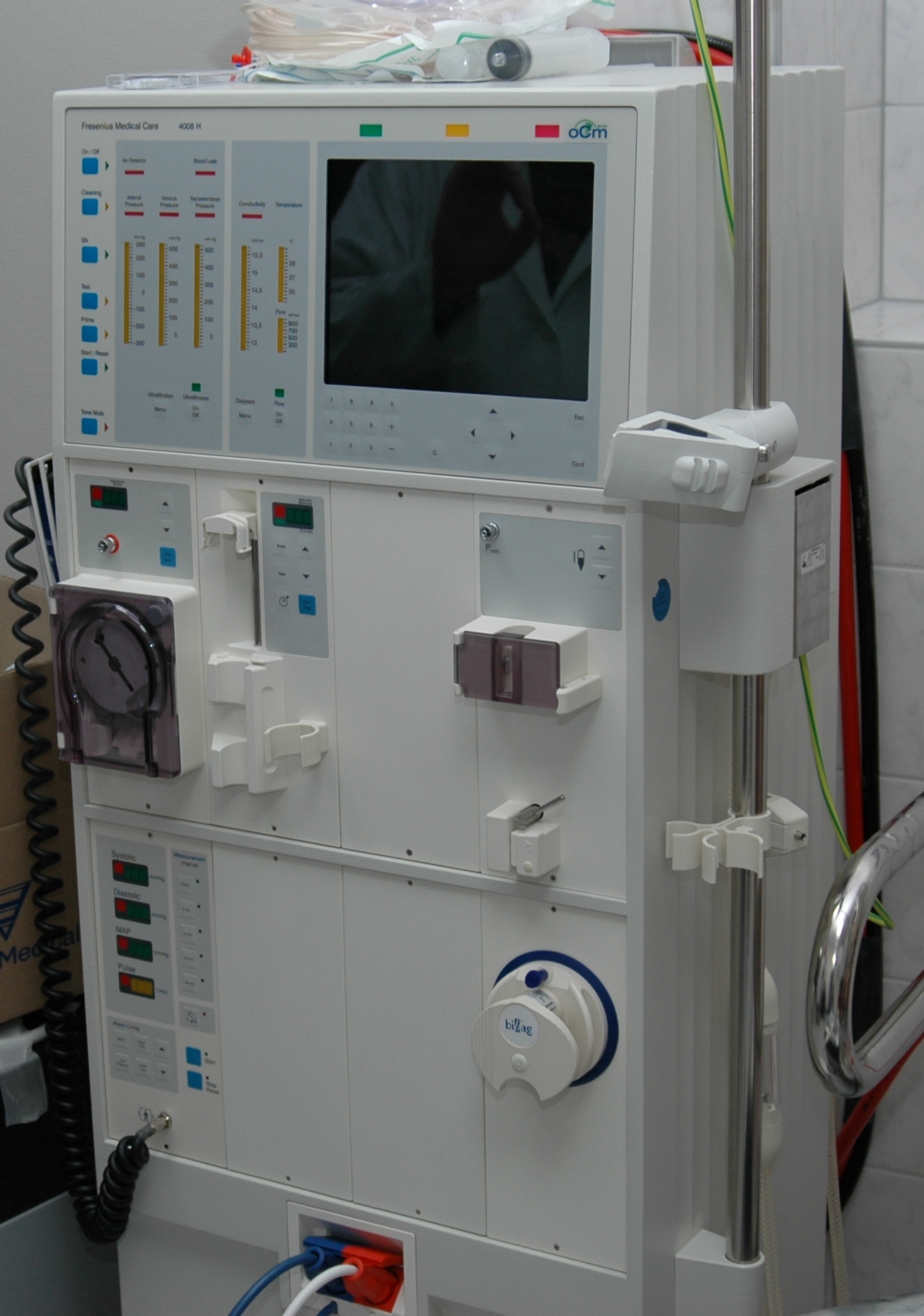
Treatment of acute failure depends on the underlying cause. Treatment of chronic failure may include hemodialysis, peritoneal dialysis, or a kidney transplant. Hemodialysis uses a machine to filter the blood outside the body. In peritoneal dialysis specific fluid is placed into the abdominal cavity and then drained, with this process being repeated multiple times per day. Kidney transplantation involves surgically placing a kidney from someone else and then taking immunosuppressant medication to prevent rejection. Other recommended measures from chronic disease include staying active and specific dietary changes. Depression is also common among patients with kidney failure, and is associated with poor outcomes including higher risk of kidney function decline, hospitalization, and death. A recent PCORI-funded study of patients with kidney failure receiving outpatient hemodialysis found similar effectiveness between nonpharmacological and pharmacological treatments for depression.
In the United States, acute failure affects about 3 per 1,000 people a year. Chronic failure affects about 1 in 1,000 people with 3 per 10,000 people newly developing the condition each year. In Canada, the lifetime risk of kidney failure or end-stage renal disease (ESRD) was estimated to be 2.66% for men and 1.76% for women. Acute failure is often reversible while chronic failure often is not. With appropriate treatment many with chronic disease can continue working.
Kidney failure can be divided into two categories: acute kidney failure or chronic kidney failure. The type of renal failure is differentiated by the trend in the serum creatinine; other factors that may help differentiate acute kidney failure from chronic kidney failure include anemia and the kidney size on sonography as chronic kidney disease generally leads to anemia and small kidney size.
Acute kidney injury (AKI), previously called acute renal failure (ARF), is a rapidly progressive loss of renal function, generally characterized by oliguria (decreased urine production, quantified as less than 400 mL per day in adults, less than 0.5 mL/kg/h in children or less than 1 mL/kg/h in infants); and fluid and electrolyte imbalance. AKI can result from a variety of causes, generally classified as prerenal, intrinsic, and postrenal. Many people diagnosed with paraquat intoxication experience AKI, sometimes requiring hemodialysis. The underlying cause must be identified and treated to arrest the progress, and dialysis may be necessary to bridge the time gap required for treating these fundamental causes.[citation needed]
Chronic kidney disease (CKD) can also develop slowly and, initially, show few symptoms. CKD can be the long term consequence of irreversible acute disease or part of a disease progression.[citation needed] CKD is divided into 5 different stages (1–5) according to the estimated glomerular filtration rate (eGFR). In CKD1, eGFR is normal and in CKD5 eGFR has decreased to less than 15 ml/min.
Acute kidney injuries can be present on top of chronic kidney disease, a condition called acute-on-chronic kidney failure (AoCRF). The acute part of AoCRF may be reversible, and the goal of treatment, as with AKI, is to return the person to baseline kidney function, typically measured by serum creatinine. Like AKI, AoCRF can be difficult to distinguish from chronic kidney disease if the person has not been monitored by a physician and no baseline (i.e., past) blood work is available for comparison.[citation needed]
Hub AI
Kidney failure AI simulator
(@Kidney failure_simulator)
Kidney failure
Kidney failure, also known as renal failure or end-stage renal disease (ESRD), is a medical condition in which the kidneys can no longer adequately filter waste products from the blood, functioning at less than 15% of normal levels. Kidney failure is classified as either acute kidney failure, which develops rapidly and may resolve; and chronic kidney failure, which develops slowly and can often be irreversible. Symptoms may include leg swelling, feeling tired, vomiting, loss of appetite, and confusion. Complications of acute and chronic failure include uremia, hyperkalemia, and volume overload. Complications of chronic failure also include heart disease, high blood pressure, and anaemia.
Causes of acute kidney failure include low blood pressure, blockage of the urinary tract, certain medications, muscle breakdown, and hemolytic uremic syndrome. Causes of chronic kidney failure include diabetes, high blood pressure, nephrotic syndrome, and polycystic kidney disease. Diagnosis of acute failure is often based on a combination of factors such as decreased urine production or increased serum creatinine. Diagnosis of chronic failure is based on a glomerular filtration rate (GFR) of less than 15 or the need for renal replacement therapy. It is also equivalent to stage 5 chronic kidney disease.
Treatment of acute failure depends on the underlying cause. Treatment of chronic failure may include hemodialysis, peritoneal dialysis, or a kidney transplant. Hemodialysis uses a machine to filter the blood outside the body. In peritoneal dialysis specific fluid is placed into the abdominal cavity and then drained, with this process being repeated multiple times per day. Kidney transplantation involves surgically placing a kidney from someone else and then taking immunosuppressant medication to prevent rejection. Other recommended measures from chronic disease include staying active and specific dietary changes. Depression is also common among patients with kidney failure, and is associated with poor outcomes including higher risk of kidney function decline, hospitalization, and death. A recent PCORI-funded study of patients with kidney failure receiving outpatient hemodialysis found similar effectiveness between nonpharmacological and pharmacological treatments for depression.
In the United States, acute failure affects about 3 per 1,000 people a year. Chronic failure affects about 1 in 1,000 people with 3 per 10,000 people newly developing the condition each year. In Canada, the lifetime risk of kidney failure or end-stage renal disease (ESRD) was estimated to be 2.66% for men and 1.76% for women. Acute failure is often reversible while chronic failure often is not. With appropriate treatment many with chronic disease can continue working.
Kidney failure can be divided into two categories: acute kidney failure or chronic kidney failure. The type of renal failure is differentiated by the trend in the serum creatinine; other factors that may help differentiate acute kidney failure from chronic kidney failure include anemia and the kidney size on sonography as chronic kidney disease generally leads to anemia and small kidney size.
Acute kidney injury (AKI), previously called acute renal failure (ARF), is a rapidly progressive loss of renal function, generally characterized by oliguria (decreased urine production, quantified as less than 400 mL per day in adults, less than 0.5 mL/kg/h in children or less than 1 mL/kg/h in infants); and fluid and electrolyte imbalance. AKI can result from a variety of causes, generally classified as prerenal, intrinsic, and postrenal. Many people diagnosed with paraquat intoxication experience AKI, sometimes requiring hemodialysis. The underlying cause must be identified and treated to arrest the progress, and dialysis may be necessary to bridge the time gap required for treating these fundamental causes.[citation needed]
Chronic kidney disease (CKD) can also develop slowly and, initially, show few symptoms. CKD can be the long term consequence of irreversible acute disease or part of a disease progression.[citation needed] CKD is divided into 5 different stages (1–5) according to the estimated glomerular filtration rate (eGFR). In CKD1, eGFR is normal and in CKD5 eGFR has decreased to less than 15 ml/min.
Acute kidney injuries can be present on top of chronic kidney disease, a condition called acute-on-chronic kidney failure (AoCRF). The acute part of AoCRF may be reversible, and the goal of treatment, as with AKI, is to return the person to baseline kidney function, typically measured by serum creatinine. Like AKI, AoCRF can be difficult to distinguish from chronic kidney disease if the person has not been monitored by a physician and no baseline (i.e., past) blood work is available for comparison.[citation needed]