



Community hub
Recent from talks
Contribute something
Nothing was collected or created yet.
Kinetic diameter
View on WikipediaKinetic diameter is a measure applied to atoms and molecules that expresses the likelihood that a molecule in a gas will collide with another molecule. It is an indication of the size of the molecule as a target. The kinetic diameter is not the same as atomic diameter defined in terms of the size of the atom's electron shell, which is generally a lot smaller, depending on the exact definition used. Rather, it is the size of the sphere of influence that can lead to a scattering event.[1]
Kinetic diameter is related to the mean free path of molecules in a gas. Mean free path is the average distance that a particle will travel without collision. For a fast moving particle (that is, one moving much faster than the particles it is moving through) the kinetic diameter is given by,[2]
- where,
- d is the kinetic diameter,
- r is the kinetic radius, r = d/2,
- l is the mean free path, and
- n is the number density of particles

However, a more usual situation is that the colliding particle being considered is indistinguishable from the population of particles in general. Here, the Maxwell–Boltzmann distribution of energies must be considered, which leads to the modified expression,[3]
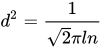
List of diameters
[edit]The following table lists the kinetic diameters of some common molecules;
| Molecule | Molecular mass |
Kinetic diameter (pm) |
ref | |
|---|---|---|---|---|
| Name | Formula | |||
| Hydrogen | H2 | 2 | 289 | [2] |
| Helium | He | 4 | 260 | [4] |
| Methane | CH4 | 16 | 380 | [2] |
| Ammonia | NH3 | 17 | 260 | [5] |
| Water | H2O | 18 | 265 | [2] |
| Neon | Ne | 20 | 275 | [5] |
| Acetylene | C2H2 | 26 | 330 | [5] |
| Nitrogen | N2 | 28 | 364 | [2] |
| Carbon monoxide | CO | 28 | 376 | [4] |
| Ethylene | C2H4 | 28 | 390 | [4] |
| Nitric oxide | NO | 30 | 317 | [4] |
| Oxygen | O2 | 32 | 346 | [2] |
| Hydrogen sulfide | H2S | 34 | 360 | [4] |
| Hydrogen chloride | HCl | 36 | 320 | [5] |
| Argon | Ar | 40 | 340 | [5] |
| Propylene | C3H6 | 42 | 450 | [4] |
| Carbon dioxide | CO2 | 44 | 330 | [2] |
| Nitrous oxide | N2O | 44 | 330 | [4] |
| Propane | C3H8 | 44 | 430 | [4] |
| Sulfur dioxide | SO2 | 64 | 360 | [5] |
| Chlorine | Cl2 | 70 | 320 | [5] |
| Benzene | C6H6 | 78 | 585 | [6] |
| Hydrogen bromide | HBr | 81 | 350 | [5] |
| Krypton | Kr | 84 | 360 | [5] |
| Xenon | Xe | 131 | 396 | [5] |
| Sulfur hexafluoride | SF6 | 146 | 550 | [5] |
| Carbon tetrachloride | CCl4 | 154 | 590 | [5] |
| Bromine | Br2 | 160 | 350 | [5] |
Dissimilar particles
[edit]Collisions between two dissimilar particles occur when a beam of fast particles is fired into a gas consisting of another type of particle, or two dissimilar molecules randomly collide in a gas mixture. For such cases, the above formula for scattering cross section has to be modified.
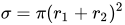
The scattering cross section, σ, in a collision between two dissimilar particles or molecules is defined by the sum of the kinetic diameters of the two particles,
- where.
- r1, r2 are, half the kinetic diameter (ie, the kinetic radii) of the two particles, respectively.
We define an intensive quantity, the scattering coefficient α, as the product of the gas number density and the scattering cross section,

The mean free path is the inverse of the scattering coefficient,
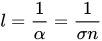
For similar particles, r1 = r2 and,
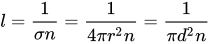
as before.[7]
References
[edit]Bibliography
[edit]- Breck, Donald W., "Zeolite Molecular Sieves: Structure, Chemistry, and Use", New York: Wiley, 1974 ISBN 0471099856.
- Freude, D., Molecular Physics, chapter 2, 2004 unpublished draft, retrieved and archived 18 October 2015.
- Ismail, Ahmad Fauzi; Khulbe, Kailash; Matsuura, Takeshi, Gas Separation Membranes: Polymeric and Inorganic, Springer, 2015 ISBN 3319010956.
- Joos, Georg; Freeman, Ira Maximilian, Theoretical Physics, Courier Corporation, 1958 ISBN 0486652270.
- Li, Jian-Min; Talu, Orhan, "Effect of structural heterogeneity on multicomponent adsorption: benzene and p-xylene mixture on silicalite", in Suzuki, Motoyuki (ed), Fundamentals of Adsorption, pp. 373-380, Elsevier, 1993 ISBN 0080887724.
- Matteucci, Scott; Yampolskii, Yuri; Freeman, Benny D.; Pinnau, Ingo, "Transport of gases and vapors in glassy and rubbery polymers" in, Yampolskii, Yuri; Freeman, Benny D.; Pinnau, Ingo, Materials Science of Membranes for Gas and Vapor Separation, pp. 1-47, John Wiley & Sons, 2006 ISBN 0470029048. ئئ
Kinetic diameter
View on Grokipedia| Gas | Kinetic Diameter (Å) | Source |
|---|---|---|
| He | 2.6 | [1] |
| H₂ | 2.9 | [3] |
| Ar | 3.4 | [1] |
| O₂ | 3.46 | [4] |
| N₂ | 3.64 | [1] |
| CO₂ | 3.3 | [1] |
| CH₄ | 3.8 | [4] |
| Kr | 3.80 | [2] |
| Xe | 3.96 | [2] |
Definition and Theory
Definition
The kinetic diameter of a molecule is defined as the effective diameter in a hard-sphere model, representing the size that governs the probability of intermolecular collisions in a gas.[1] In this model, molecules are approximated as rigid spheres, where the kinetic diameter quantifies the characteristic length scale for binary collisions, influencing transport properties such as diffusion and viscosity.[6] Within the kinetic theory of gases, the kinetic diameter expresses the likelihood of collisions by determining the collision cross-section, given by , where is the effective area presented by one molecule to another during encounters.[1] This cross-section arises from considerations of the mean free path , the average distance a molecule travels between collisions, which is inversely proportional to (with as the number density), allowing the kinetic diameter to be calibrated to match experimental viscosity data.[6] The parameter thus captures the dynamic interaction geometry under thermal motion, rather than static equilibrium structures. Unlike the physical diameter, which might refer to a geometric or crystallographic measure, the kinetic diameter accounts for molecular shape, orientation, and transient interactions during high-speed collisions in dilute gases, providing an effective size optimized for predictive accuracy in kinetic processes.[1] It is typically expressed in angstroms (), on the order of 2–6 for common gas molecules, emphasizing its role in modeling collision-dominated transport.[1]Theoretical Foundation
The kinetic diameter concept emerges from the foundational hard-sphere model in the kinetic theory of gases, pioneered by James Clerk Maxwell and Ludwig Boltzmann in the mid-to-late 19th century. In this model, gas molecules are idealized as rigid, impenetrable spheres of diameter that interact solely through elastic binary collisions, neglecting intermolecular attractions at larger distances. This simplification allows for the derivation of macroscopic transport phenomena from microscopic dynamics, where the collision cross-section determines the probability of encounters between molecules. Maxwell's 1860 analysis introduced finite molecular size to resolve discrepancies in pressure and viscosity calculations for ideal gases, marking a shift from point-particle assumptions.[7] The Boltzmann equation formalizes this model by governing the time evolution of the one-particle velocity distribution function , incorporating a collision integral that explicitly depends on the molecular diameter . For hard spheres, the collision term captures the loss and gain of particles due to elastic scattering, with the differential cross-section derived from the geometry of spheres of diameter . This equation underpins the calculation of transport coefficients via the Chapman-Enskog perturbation expansion, linking to properties such as shear viscosity and self-diffusion coefficient , where is molecular mass, is number density, is Boltzmann's constant, and is temperature. These expressions highlight how the kinetic diameter governs momentum and mass transfer in dilute gases.[8] A key illustration of the kinetic diameter's role is its appearance in the mean free path , the average distance a molecule travels between collisions, which scales inversely with and directly influences gas-phase behavior such as effusion rates and reaction kinetics. Larger values lead to shorter , increasing collision frequency and altering transport efficiency. While the original hard-sphere framework assumed spherical symmetry, early 20th-century refinements by Boltzmann and subsequent workers extended it to account for non-spherical effects in denser or adsorbed phases. Notably, in adsorption studies, Donald W. Breck adapted these principles for zeolite pore diffusion, defining effective kinetic diameters to predict molecular sieving based on collision dynamics in confined geometries.[9]Determination Methods
Experimental Determination
Experimental determination of kinetic diameter relies on measuring gas transport properties in controlled conditions, such as viscosity in bulk gases or diffusion and adsorption in porous materials, to infer the effective molecular size under collision-dominated dynamics. These methods apply kinetic theory to relate observable transport coefficients to the collision diameter, providing empirical values that reflect the molecule's effective size during rapid interactions. Viscosity measurements offer a direct bulk-gas approach, while diffusion and adsorption experiments in microporous media like zeolites probe size-selective behavior at near-molecular scales.[10] Viscosity measurements derive the kinetic diameter from the gas's resistance to shear flow, using the Chapman-Enskog theory, which models dilute gases as hard spheres undergoing binary collisions. The dynamic viscosity is given by where is the molecular mass, is Boltzmann's constant, is temperature, and is the kinetic diameter. Rearranging this equation allows to be calculated from experimentally measured at known and . For nitrogen, viscosity data yield a kinetic diameter of 3.64 Å, consistent with values obtained under standard conditions.[10][10] Diffusion experiments in porous media, such as zeolites, determine kinetic diameter by observing how molecular size affects transport through narrow channels, often in the Knudsen regime where molecule-wall collisions dominate over molecule-molecule interactions. In this regime, the Knudsen diffusivity is expressed as with as the pore diameter; however, when the molecular size approaches , diffusivity decreases due to steric hindrance or exclusion, allowing to be inferred from the onset of restricted diffusion or zero uptake. For instance, in zeolite 5A with pores around 4.3 Å, molecules smaller than this threshold diffuse freely, while larger ones show reduced rates, verifying sizes like nitrogen's 3.64 Å through comparisons with helium (2.6 Å), which exhibits unimpeded diffusion in the same structure.80236-6)80236-6)[11] Adsorption isotherms in molecular sieves provide another empirical route by matching the extent of uptake to molecular size, as sieving effects cause sharp drops in adsorption capacity when the kinetic diameter exceeds the effective pore aperture. Isotherms are measured gravimetrically or volumetrically at varying pressures and temperatures, with the critical diameter inferred from the pressure or temperature where uptake transitions from full to partial or none, reflecting the energy barrier for entry. This method has been used to refine kinetic diameters for gases like oxygen and nitrogen by correlating isotherm shapes in tailored sieves, such as carbon molecular sieves with tunable ultramicropores.[11][11] These experimental approaches are often validated computationally by simulating transport coefficients and comparing them to measured values, ensuring consistency across methods.[10]Computational Methods
Quantum mechanical methods provide a rigorous, ab initio approach to computing kinetic diameters by examining the electron density distribution of molecules. The effective collision diameter is determined from the cross-sectional area of iso-surfaces of the total electron density at a low, fixed density threshold (e.g., 0.001 a.u.), which delineates the molecular "surface" relevant for intermolecular collisions. This technique captures quantum effects in the electron cloud, yielding values that align closely with empirical kinetic diameters for small gaseous molecules; for instance, the computed diameter for H₂ is 2.89 Å. Molecular dynamics simulations enable the estimation of kinetic diameters through direct modeling of gas-phase molecular interactions. Trajectories of colliding molecules are generated using accurate ab initio-derived potential energy surfaces, allowing extraction of hard-sphere equivalent collision cross-sections from scattering angles and impact parameters. These cross-sections, averaged over numerous collision events, provide effective diameters particularly suited for diatomic species like N₂ and O₂, accounting for rotational and vibrational influences in nonequilibrium conditions.[12] Empirical correlations offer practical approximations for kinetic diameters of spherical molecules based on thermodynamic or potential parameters. One common method uses the critical molar volume (in cm³/mol) to estimate , derived from kinetic theory relations linking molecular size to experimental critical properties. Alternatively, Lennard-Jones parameters provide estimates where the collision diameter closely approximates the finite-distance parameter for nonpolar gases, facilitating quick assessments without full simulations.[13] For non-spherical molecules, effective kinetic diameters are obtained by averaging collision dimensions over molecular orientations to yield a mean value applicable in diffusion models. This involves constructing a geometrical representation from internuclear distances and van der Waals atomic radii, then computing orientationally averaged diameters for configurations like linear, pyramidal, or tetrahedral structures, ensuring the effective size reflects isotropic gas-phase behavior.[14] Such computational approaches are often validated against experimental gas viscosity data to confirm their predictive accuracy for collision dynamics.Tabulated Kinetic Diameters
Values for Common Molecules
The kinetic diameters for a selection of common gases and vapors, as compiled in Breck's foundational reference on zeolite molecular sieves, serve as a benchmark dataset for adsorption and separation studies. These values, in angstroms (Å), reflect the effective molecular cross-sections relevant to diffusion processes and are typically referenced under standard conditions of 298 K and 1 atm.[15] The following table summarizes kinetic diameters for representative molecules, including light gases, noble gases, and hydrocarbons:| Molecule | Formula | Kinetic Diameter (Å) |
|---|---|---|
| Helium | He | 2.60 |
| Hydrogen | H₂ | 2.89 |
| Oxygen | O₂ | 3.46 |
| Argon | Ar | 3.40 |
| Nitrogen | N₂ | 3.64 |
| Carbon dioxide | CO₂ | 3.30 |
| Methane | CH₄ | 3.80 |
| Krypton | Kr | 3.60 |
| Ethylene | C₂H₄ | 3.90 |
| Ethane | C₂H₆ | 4.00 |
| Xenon | Xe | 3.96 |
| Propane | C₃H₈ | 4.30 |