


Community hub
Recent from talks
Contribute something
Nothing was collected or created yet.
| Kroz | |
|---|---|
 Screenshot | |
| Developer | Scott Miller |
| Publisher | Apogee Software |
| Designer | Scott Miller |
| Platform | MS-DOS |
| Release | 1987 |
| Genre | Roguelike |
| Mode | Single-player |
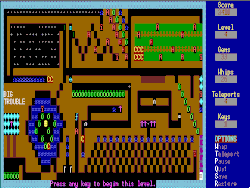
Kroz is a series of Roguelike video games created by Scott Miller for IBM PC compatibles. The first episode in the series, Kingdom of Kroz, was released in 1987 as Apogee Software's first game. It was also published on Big Blue Disk #20. Kroz introduced the scheme of the first episode being free and charging money for additional episodes, a technique which defined the business model for Apogee and was adopted by other MS-DOS shareware publishers.[1]
The games were discontinued in 1999. In March 2009, the whole Kroz series was released as freeware by Apogee, and the source code was released as free software under the GPL-2.0-or-later license.[2]
Gameplay
[edit]The object of the game is to survive numerous levels of attacking monsters and ultimately find the priceless Magical Amulet of Kroz. The player character collects gems as they go; each time a monster touches them, they lose a gem and the monster dies. The character's main defense consists of whips which can be used to kill monsters and destroy certain walls, but each whip can only be used once. Some levels are generated randomly; these tend to be rather chaotic, and essentially consist of a mad dash through waves of attacking enemies to pick up valuable objects and/or escape to the stairway. A major part of the game is careful conservation of gems and whips; sometimes it is better to allow an enemy to take a gem rather than use valuable whips that will be needed to break down walls blocking the exit.
Development
[edit]The Kroz games were inspired by an earlier dungeon crawling game, Rogue. Scott Miller tried to create a game that had some of the elements of Rogue, but with less randomness and more reliance on the abilities of the player than on luck.[3] Miller, fond of including backwards words in his games, came up with the name by spelling Zork backwards.[3]
Kingdom of Kroz was written in Turbo Pascal 3.0. Later games in the series were written in Turbo Pascal 5.0. The game was implemented entirely in the 80×25 16 color CGA text mode[1] of IBM PC compatibles, using various characters in the computer's character set, as well as different colors, to present a "graphical" environment. The game uses ASCII characters, as well as some extended ASCII graphical characters from the original IBM PC character set, to represent the player character, walls, monsters and items.
Releases
[edit]The game was originally distributed as shareware. It was later expanded to consist of seven episodes, with only the first episode distributed as shareware, and the rest available commercially. The episodes are:
| Collection | Episode | Release | Levels | Notes |
|---|---|---|---|---|
| Original Kroz trilogy | #1 Kingdom of Kroz | 1987 | 25 |
|
| #2 Caverns of Kroz | 1988 | 40 |
| |
| #3 Dungeons of Kroz | 1989 | 30 |
| |
| Super Kroz Trilogy | #4 Return to Kroz | 1990 | 20 |
|
| #5 Temple of Kroz | 1990 | 20 | a.k.a. Valley of Kroz | |
| #6 The Final Crusade of Kroz | 1990 | 25 |
| |
| N/A | #7 The Lost Adventures of Kroz | 1990 | 75 | |
| N/A | #8 The Underground Empire of Kroz | Cancelled | N/A | Planned to be released in March 1991. |
The first two games in the series, Caverns of Kroz and Dungeons of Kroz, were originally published in the disk magazine I.B.Magazette in 1987.[4] The third game, Kingdom of Kroz, was sent in 1987 to the disk magazine Big Blue Disk as a submission for a contest they were having, where it was published in 1988.[5] The other two games were also published later on Big Blue Disk, in 1989.[6][7]
At the same time, Miller, looking for other avenues to distribute his games, turned to the shareware model.[8][9] Shareware was distributed freely through bulletin board systems (BBS), where the boards' users made voluntary donations. Since shareware was not very profitable at the time, Miller developed a variation of the shareware model, dubbed the "Apogee model", in which only a fraction of the game would be made available to play for free on BBS. The game, upon completion, would display Miller's mailing address to the player and ask them to contact him to pay for that game, which would allow them to buy the rest of the game's "episodes".[8] He applied this model to the Kroz trilogy by sharing only Kingdom of Kroz over BBS while retaining the other two for sale.[8][10] This shareware version of Kingdom of Kroz was the first game to bear the name of Miller's one-man company, Apogee Software Productions.[10] The game proved successful, with checks sent to Miller amounting to roughly US$80,000–US$100,000 and him receiving between US$100 and US$500 every single day.[10]
Return to Kroz, originally called Castle of Kroz, was initially published in Big Blue Disk in 1990,[11] before becoming the shareware episode of the second trilogy of Kroz games, the Super Kroz Trilogy.
In 1990, an enhanced version of Kingdom of Kroz was released as Kingdom of Kroz II, which became the shareware episode of the series as a whole. Kingdom of Kroz II was different from the original version, and incorporated 21 different levels, many of them from later games in the series, especially from The Lost Adventures of Kroz. The original Kingdom of Kroz I stopped being distributed as shareware, but was still available commercially, and was then marketed as the third episode in the series, with episodes two and three moving up one place. For a time, the series consisted of seven commercial episodes (including the original Kingdom of Kroz I), plus an enhanced version of one of them (Kingdom of Kroz II) distributed as shareware. During this time, to be able to buy the commercial episodes, the shareware episode had to be registered first.
In 1991, the other two episodes of the first trilogy were enhanced to their "II" versions, and the original Kingdom of Kroz I stopped being available, being replaced by its enhanced version.
Source code
[edit]At one point the source code for Kingdom of Kroz could be purchased for $190, Return to Kroz for $350 and The Lost Adventures of Kroz for $950. Later the source code of Kingdom of Kroz II was for sale for $400, Return to Kroz for $300 and The Lost Adventures of Kroz for $500. By 2009, the source code was released under the GPL-2.0-or-later license.[2]
Reception
[edit]| Publication | Score |
|---|---|
| Shareware Magazine |  (Kroz 1)[3] (Kroz 1)[3] |
| Publication | Award |
|---|---|
| Big Blue Disk | 2nd Place CodeQuest '87, IBM PC compatible division (Kingdom of Kroz)[3][5] |
The original Kingdom of Kroz game took top honors in the game category in Big Blue Disk's CodeQuest '87 programming contest in 1988, and came out number two overall.[4][5][3]
Legacy
[edit]The Kroz concept, including the text mode implementation, was cloned by Potomac Computer Systems for the ZZT games, which also used the same shareware business model. The company later became Epic Games.
References
[edit]- ^ a b Hague, James (8 February 1999). "Gimme Your Money: A Half-Baked History of Shareware". Loonygames. Archived from the original on 23 February 2020. Retrieved 10 March 2020.
- ^ a b "Several old games released as Freeware". 3D Realms. Retrieved 26 March 2009.
- ^ a b c d e "Shareware Game: Kingdom of Kroz". 15 November 1993. Retrieved 4 November 2017.
- ^ a b "The Apogee FAQ - The Kroz Series". RinkWorks. 30 September 2005. Retrieved 11 March 2020.
- ^ a b c "Big Blue Disk #20". Softdisk. June 1988. Retrieved 11 March 2020.
- ^ "Big Blue Disk #29". Softdisk. March 1988. Retrieved 11 March 2020.
- ^ "Big Blue Disk #35". Softdisk. September 1988. Retrieved 11 March 2020.
- ^ a b c Plante, Chris (26 October 2017). "Apogee: Where Wolfenstein got its start". Polygon. Retrieved 1 March 2020.
- ^ Edwards, Benj (21 August 2009). "20 Years Of Evolution: Scott Miller And 3D Realms, Page 2 of 10". Gamasutra. Archived from the original on 9 May 2012. Retrieved 11 March 2020.
- ^ a b c Edwards, Benj (21 August 2009). "20 Years Of Evolution: Scott Miller And 3D Realms, Page 4 of 10". Gamasutra. Archived from the original on 9 May 2012. Retrieved 11 March 2020.
- ^ "Big Blue Disk #47". Softdisk. August 1990. Retrieved 14 March 2020.
External links
[edit]Gameplay
Core mechanics
Kingdom of Kroz is a real-time action-adventure game where players navigate single-screen dungeon rooms using keyboard controls for eight-directional movement, including diagonals via arrow keys or alternatives like the numpad.[3][7] The player character, represented by an ASCII smiley face, moves one space at a time, and holding keys can lead to rapid unintended movement into hazards, requiring precise, tap-based input to maneuver around obstacles and enemies.[3] Monster movement occurs continuously in real-time, influenced by their type, CPU speed, and environmental factors, creating a dynamic pace where players must react quickly rather than plan turns.[7] Combat relies on a limited supply of whips, activated by the 'W' key, which destroy enemies or breakable objects like walls and boulders from one space away, consuming one whip unit per use.[7] Players can also employ environmental tactics, such as luring enemies into crumbling walls or pits for indirect kills, to conserve whips, as direct confrontation is often inefficient given the enemies' numbers and speeds.[3] Contact with enemies deducts gems from the player's health pool—red enemies remove 1 gem, green remove 2, and blue remove 3—with blue variants being the fastest and most aggressive, pursuing in rectilinear or 45-degree patterns without avoiding obstacles.[7] Enemies, depicted as ASCII letters with umlauts (e.g., red 'r', green 'g', blue 'b'), destroy collected items like gems or spells upon collision and often outnumber the player's capacity to eliminate them, emphasizing evasion over elimination.[3] Core items include gems, which serve as both currency and hit points (starting number varying by difficulty level, e.g., 10 for Novice), collected singly or in pouches/chests yielding 2–25.[8][7] Keys unlock doors blocking progress, and rare teleport scrolls ('T' key) enable random relocation to escape threats.[7] Hazards such as lava pits (causing 10 gem loss and spreading over time), instant-death pits, and traps (e.g., monster-spawning or wall-closing) add risk to navigation, while breakable walls and boulders can be manipulated for path-clearing or enemy disposal.[3] The game's ASCII art style, with symbols like club signs for trees and hearts for health, combined with PC speaker beeps for actions and collisions, reinforces its minimalist yet tactical dungeon-crawling focus.[3]Level progression and objectives
In the Kroz series, gameplay progresses linearly through a series of dungeon levels, with each level consisting of a single, real-time navigable screen rendered in ASCII text mode. The core objective per level is to locate and descend the stairs to the subsequent level while surviving environmental hazards, collecting essential resources, and neutralizing or evading monsters. This descent mechanic emphasizes puzzle-solving and resource management, as players must clear paths blocked by objects like trees, walls, or doors using limited tools.[3] Players begin each episode with adjustable skill levels—such as Novice, Apprentice, or Expert—that determine starting resources, including gems (serving as hit points, typically starting at 10 for Novice) and whips (a primary weapon limited to 10 per level, which regenerate upon descending stairs). Progression involves strategic use of these alongside other items: keys unlock doors (often requiring multiple per level), teleport scrolls enable repositioning (limited to three per level), and treasures like gem pouches or chests replenish health to sustain longer runs. Monsters deplete gems upon contact, and failure to reach the stairs before health reaches zero results in a level restart, though score is preserved based on remaining resources.[7][8] Across the seven main episodes, level counts vary to increase challenge depth, with earlier titles like Kingdom of Kroz featuring 25 levels and later ones like The Lost Adventures of Kroz expanding to 75, totaling over 200 levels series-wide. Later episodes introduce additional mechanics like teleporters, multiple characters, and larger levels for varied puzzle-solving.[4][9] The ultimate objective in each episode is to retrieve a specific quest artifact—such as the Amulet of Kroz—located on the final level, after which the game concludes with a score calculated from unspent resources. Episodes build progressively in complexity, introducing new obstacles like crumbling floors or time-freezing spells, but maintain consistent downward progression without branching paths or backtracking.[3]Development
Inspiration and design
The Kroz series drew primary inspiration from the 1980 dungeon crawler Rogue, a game that Scott Miller enjoyed playing but found frustrating due to its procedural generation and heavy dependence on random chance for progression. To counter this, Miller opted for hand-crafted, fixed level designs in Kroz, prioritizing player skill, foresight, and puzzle-solving mechanics over luck-based elements. This shift aimed to create a more predictable yet challenging experience, where every room and obstacle was intentionally placed to test strategic decision-making.[4][3] The series title itself nods to another influential work: Infocom's text adventure Zork, with "Kroz" simply being "Zork" spelled backwards, reflecting Miller's early fascination with narrative-driven exploration games. Additional design influences included strategy titles like M.U.L.E. and Archon for their blend of resource management and tactical combat, as well as platformers such as Spelunker for environmental hazards and precision navigation. These elements converged in Kroz to form a hybrid genre—arcade-like action within a roguelike framework—but stripped of permadeath and randomness to emphasize replayable mastery.[4] Core design choices centered on a minimalist, text-mode aesthetic using ASCII characters to render the game world on MS-DOS systems, where rooms appeared as single-screen grids filled with symbols representing terrain, enemies, and items. The protagonist, depicted as a simple smiley face, wielded a "whip" to destroy obstacles like trees (shown as club symbols) or monsters, while collecting gems served as both currency and hit points, enforcing strict resource conservation. Real-time movement added tension, with fast-pursuing foes and crumbling walls requiring quick reflexes alongside long-term planning, such as mapping safe paths or timing attacks to avoid traps. This approach not only fit the hardware limitations of 1980s PCs but also amplified the puzzle focus, turning each level into a self-contained riddle of survival and escape.[3][4]Technical implementation
The Kingdom of Kroz series was programmed in Turbo Pascal, with the initial episode using version 3.0 and subsequent entries employing version 5.0.[5][10] The games were developed for MS-DOS on IBM PC compatibles, leveraging the platform's standard hardware without reliance on advanced peripherals. Originally, the source code for Kingdom of Kroz was available for purchase at $190, reflecting the era's practices for educational or modification purposes.[5] Graphically, the series utilized text mode in an 80×25 character display, rendering all elements through the IBM PC's extended ASCII character set rather than bitmap graphics.[11] This approach employed four-color CGA palette support for basic differentiation, such as coloring monsters by aggression level (e.g., red for less aggressive, blue for more), while avoiding EGA compatibility due to limited hardware adoption in 1987.[12] The player avatar was depicted as a smiley face (ASCII 1 or 2), trees as club symbols, and teleporters as upward arrows, creating a minimalist yet functional roguelike aesthetic.[5] Input was handled via keyboard, primarily the arrow keys or numeric keypad for directional movement, including diagonal options to evade hazards.[5] The core game loop implemented synchronous mechanics: the program awaited player input before updating the entire scene, including monster movements and environmental changes, which gave the experience a real-time feel despite its discrete, input-driven nature.[7] This primitive timing—essentially pausing for keypresses before advancing all entities—ensured responsive play on period hardware without complex interrupts.[7] Audio consisted solely of PC speaker beeps, triggered for actions like movement or item collection, with no support for sound cards at launch.[5] Levels were pre-designed mazes stored in code, avoiding procedural generation to emphasize puzzle-solving over randomness, a deliberate choice to make completion reliable for skilled players.[4] In March 2009, Apogee Software released the full series as freeware, including the source code under the GPL-2.0-or-later license, enabling modern ports and analysis via emulators like DOSBox.[6]Releases
Episode releases
The Kingdom of Kroz series, developed by Scott Miller and published by Apogee Software, consisted of seven episodic releases spanning from 1987 to 1990, following the shareware model where the first episode was free and subsequent ones required purchase. The initial three episodes formed "The Kroz Trilogy," while episodes four through six comprised "The Super Kroz Trilogy," with the seventh serving as a concluding installment. These games were distributed primarily through Apogee's mail-order system and appeared in magazines like Softdisk's Big Blue Disk.[13][4] The series began with the release of the first episode in late 1987, marking Apogee's formal entry into shareware publishing. Subsequent episodes expanded on the core gameplay with additional levels, items, and challenges. Some episodes were released under alternate titles for different distributions, such as Return to Kroz also appearing as Shrine of Kroz or Castle of Kroz, and Temple of Kroz as Valley of Kroz. A planned eighth episode, The Underground Empire of Kroz, was announced for 1991 but never materialized.[13][4] The following table summarizes the episodes and their original release years:| Episode | Title | Release Year | Levels |
|---|---|---|---|
| 1 | Kingdom of Kroz | 1987 | 25 |
| 2 | Caverns of Kroz | 1988 | 40 |
| 3 | Dungeons of Kroz | 1989 | 30 |
| 4 | Return to Kroz | 1990 | 50 |
| 5 | Temple of Kroz | 1990 | 50 |
| 6 | The Final Crusade of Kroz | 1990 | 50 |
| 7 | The Lost Adventures of Kroz | 1990 | 75 |