


Community hub
Recent from talks
Contribute something
Nothing was collected or created yet.
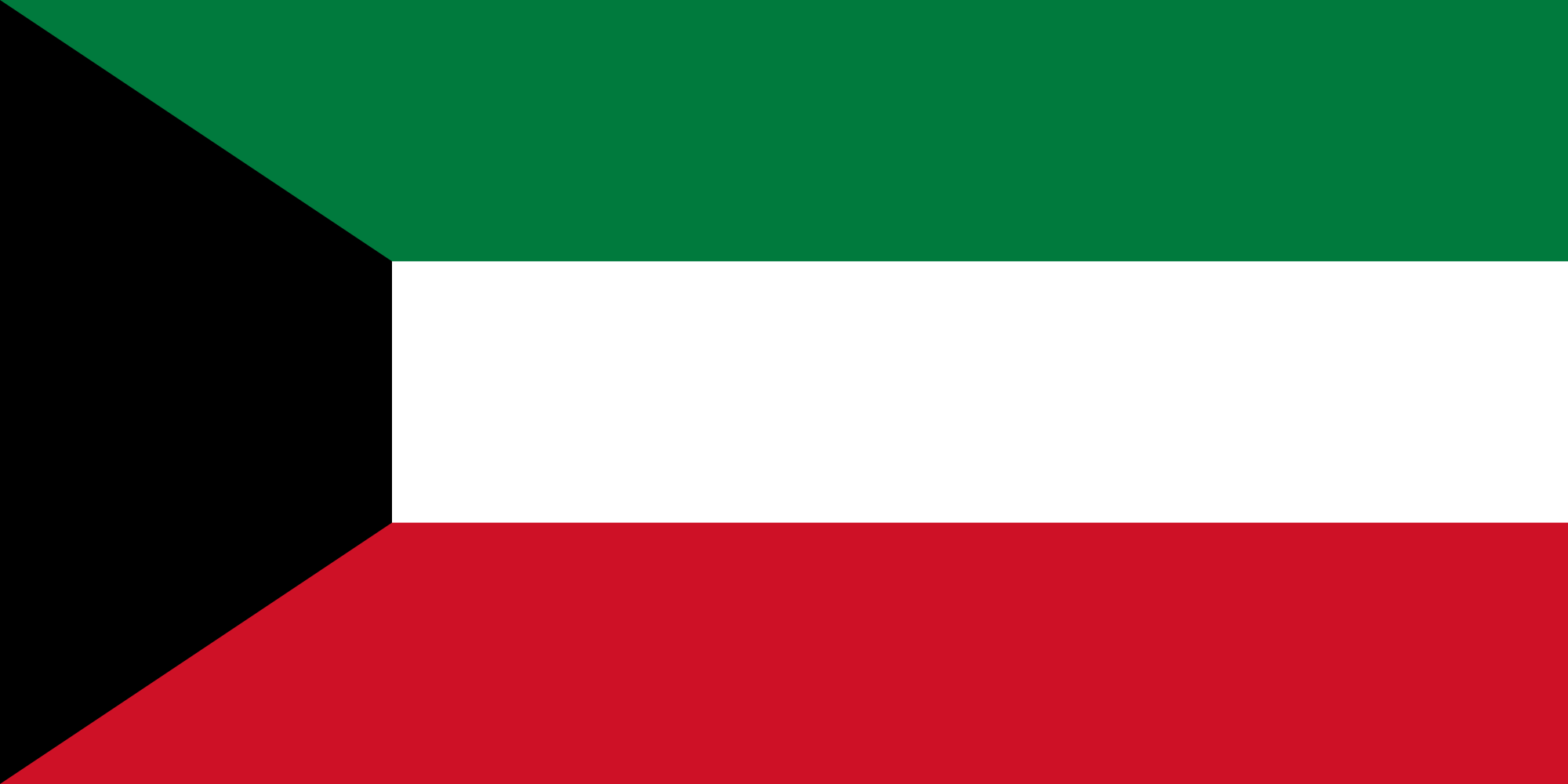
Flag of Kuwait
View on Wikipedia
 | |
| Alam Baladii, Derti | |
| Use | Civil and state flag, national ensign     |
|---|---|
| Proportion | 1:2 |
| Adopted | 7 September 1961 Officially hoisted 24 November 1961 |
| Design | A horizontal triband of green, white and red; with a black trapezium based on the hoist side. |

The flag of Kuwait (Arabic: علم الكويت) was adopted on 7 September 1961, and officially hoisted 24 November 1961. Before 1961, the flag of Kuwait was red and white, like those of other Arab states of the Persian Gulf at the time, with the field being red and words or charges being written in white. It is the only national flag featuring an acute trapezium.
When the Utub settled in Kuwait, Kuwaiti ships were flying a flag common on the western coast of the Persian Gulf, a red flag with a serrated white ribbon added near the mast, similar to the current Bahrain flag, and was called the Sulaimi flag. This flag was raised in the rule of Sheikh Sabah I bin Jaber in 1752 and was used to 1871.
During the period of Ottoman rule in Kuwait, the Ottoman flag, red with a white crescent and star, was used. This flag was retained after the country became a British protectorate in the Anglo-Kuwaiti Agreement of 1899.
In 1903, Lord Curzon, the British Viceroy and Governor-General of India visited Kuwait, and Sheikh Mubarak Al-Sabah received him and raised a red flag with white words, توكلنا على الله (We trust in God) in Arabic writing. This avoided the diplomatic faux pas, given Kuwait was under British protection, of raising the Ottoman flag.
Two different flag designs were proposed but not adopted in the period after this. The first proposal in 1906, a red flag with white Western letters spelling (KOWEIT) and the second in 1913, the Ottoman flag but the word كويت (Kuwayt) in Arabic writing as a canton.[1][2]
The Ottoman flag kept being used until the First World War, when friendly-fire incidents with the British in 1914 during the Mesopotamian campaign around the river Shatt al-Arab occurred due to Kuwait and the enemy Ottomans both using the same flag. Because of this Kuwait adopted a new flag, red with كويت (Kuwait) in Arabic writing.[3][1][2] This flag was in use until 1921, when Sheikh Ahmad Al-Jaber Al-Sabah added the Shahada to the flag.[4][1][2] This version was in use until 1940, when he also added a stylized falcon's claw to the flag.[1][2] These flags were also depicted on the Emblems of Kuwait. The red flag remained the national flag of Kuwait until the adoption of the current one in September 1961. The present flag is in the Pan-Arab colours, but each colour is also significant in its own right.
| Scheme | Textile colour |
|---|---|
| Red | The Hashemite dynasty, symbolizes the blood on the swords of Muslim warriors. |
| White | The Umayyad dynasty, symbolizes purity and noble deeds. |
| Green | The Fatimid dynasty or Rashidun Caliphate, represents the fertile land of Arabia. |
| Black | The Abbasid dynasty, represents the defeat of enemies in battle. |
The colours' meaning came from a poem by Safi al-Din al-Hilli:
- White are our deeds
- Black are our battles
- Green are our lands
- Red are our swords
Rules of hanging and flying the flag:
- Horizontally: The green stripe should be on top.
- Vertically: The red stripe should be on the left side of the flag.

In 2005, it became the design of the world's largest kite at a size of 1019 square metres. It was made in New Zealand by Peter Lynn, launched to the public for the first time in 2004 in the United Kingdom, officially launched in Kuwait in 2005, and has not been surpassed since.
The flag can also appear to resemble the corner of a room, with the green and red being the ceiling and floor, and mismatched black and white walls.
Construction sheet
[edit]-
 Flag construction sheet
.svg)
Standard of the Emir
[edit] | This section needs additional citations for verification. (December 2024) |
The current Emir of Kuwait has a personal royal standard, which is the national flag with a yellow crown on the green stripe.
-

 Standard of the Emir 1921–1940
 -
 Standard of the Emir 1940–1956
 -
 Standard of the Emir 1956–1961
 -
 Standard of the Emir 1961–present
.svg)

.svg)
.svg)

Historical flags of Kuwait
[edit] | This section needs additional citations for verification. (December 2024) |
-

-

-

-

-

 1906 proposal
(not adopted) -
 1913 proposal
(not adopted) -

 1914–1921
 -

-
 1921–1940
 -
 1940–1961
 -
 Maritime Ensign
1956–1961
Only used at sea -
 Flag used during the Iraqi occupation of Kuwait (1990)
 -

 1961–present


.svg)
.svg)
.svg)
.svg)

.svg)
.svg)
.svg)
.svg)
.svg)

.svg)
See also
[edit]References
[edit]- ^ a b c d Hubert de Vries (2018) [2011]. "KUWAIT دولة الكويت". hubert-herald.nl. Retrieved 10 January 2019.
- ^ a b c d Mello Luchtenberg. "Kuwait". vexilla-mundi.com. Retrieved 10 January 2019.
- ^ Nunn, Wilfred (1932). Tigris Gunboats: The Forgotten War in Iraq, 1914-1917. Naval Institute Press. p. 33. ISBN 978-1861763082.
{{cite book}}: ISBN / Date incompatibility (help) - ^ Farkas Al-Rashoud, Claudia (1993). Kuwait's Age of Sail : Pearl Divers, Sea Captains, and Shipbuilders Past and Present. Husain Mohammed Rafie Marafie. ASIN B000E4QEN4.


Flag of Kuwait
View on GrokipediaDesign and Symbolism
Physical Description
The national flag of Kuwait consists of a horizontal rectangle in the proportions 1:2, divided into three equal horizontal stripes of green at the top, white in the center, and red at the bottom.[5] A black trapezoid is situated at the hoist, with its base along the hoist edge equal in length to the flag's height and its opposite side parallel but shorter, protruding into the three stripes.[5][6] The design elements are arranged such that the black trapezoid overlays the hoist portions of the green, white, and red stripes, creating a distinctive silhouette that tapers toward the fly end.[6] This configuration ensures the flag maintains its horizontal orientation when flown, with the trapezoid distinguishing the hoist from the fly.[6]Color Meanings and Historical Associations
The colors of the Kuwaiti flag—black, white, red, and green—constitute the Pan-Arab colors, which trace their origins to the flag of the Arab Revolt adopted on June 10, 1916, by Sharif Hussein bin Ali during the uprising against Ottoman rule in World War I.[7] These colors historically evoke the banners of successive Islamic caliphates that shaped Arab identity: black linked to the Abbasid Caliphate (750–1258 CE), representing conquest and scholarly achievement; white to the Umayyad Caliphate (661–750 CE), denoting purity and administrative expansion; red to the Hashemite lineage, symbolizing martial valor and descent from the Prophet Muhammad; and green to the Fatimid Caliphate (909–1171 CE), signifying prosperity and religious legitimacy under Shi'a Ismaili rule.[7] This dynastic association underscores a shared Arab heritage rather than uniquely Kuwaiti motifs, reflecting broader nationalist aspirations post-Ottoman collapse.[8] In Kuwaiti usage, the colors' meanings align with traditional interpretations derived from a 13th-century poem attributed to Safi al-Din al-Hilli, which portrays white as emblematic of virtuous deeds, black of endured battles, green of verdant fields, and red of bloodied swords in defense of the homeland.[9] Local renderings emphasize practical symbolism tied to Kuwait's arid environment and history of tribal conflict: the black trapezoid on the hoist side signifies decisive victories over adversaries, such as Bedouin incursions or imperial threats; the green upper stripe evokes fertile oases and agricultural potential amid desert expanses; white denotes purity, peace, and honorable conduct; while red represents sacrificial bloodshed for sovereignty.[10] These associations gained prominence upon the flag's formal adoption on November 7, 1961, coinciding with Kuwait's independence from British protection, thereby linking the design to assertions of autonomy against external domination, including the Ottoman suzerainty nominally ended in 1899 and British advisory influence until 1961.[6] The Pan-Arab palette's integration into Kuwait's flag, distinct from earlier local variants like the Al-Sabah family's plain red banner used until the early 20th century, facilitated alignment with regional solidarity movements, such as those post-1916 Revolt, without supplanting Kuwait's monarchical traditions.[6] Empirical vexillological analysis confirms no evidence of pre-1916 Kuwaiti flags employing this exact tetrachrome scheme, underscoring the colors' exogenous adoption for symbolic potency rather than indigenous invention.[6] Variations in interpretation, such as equating green solely with Islamic piety or red with Hashimite bloodlines, persist in popular discourse but lack primary archival substantiation beyond the caliphal framework.[11]Technical Specifications
Proportions and Construction Details
The flag of Kuwait adheres to a standard vexillological proportion of 1:2, with the hoist-side width to fly-side length ratio being 1:2, as stipulated in Article 1 of Law No. 26 of 1961.[6][12] The design comprises three equal horizontal stripes, each occupying one-third of the hoist width: green atop, white centrally, and red below. A black trapezoid occupies the hoist side, featuring a major base equivalent to the full hoist width along the staff, a minor base matching the white stripe's width (one-third of the hoist), and a height extending one-quarter of the flag's overall length toward the fly.[13] These specifications ensure precise replication in official manufacturing, with the trapezoid's geometry providing a distinctive silhouette while the stripes maintain uniform division across the remaining field.[13][14]Historical Development
Pre-20th Century Flags
The traditional flag of Kuwait before the late 19th century consisted of a plain red field, a design common among seafaring Arab tribes in the Persian Gulf and reflective of maritime heritage dating back to the region's pearling and trading economy. This unadorned red banner served as the sheikhdom's primary ensign from its establishment around 1716 by the Utub tribal migration under the Al-Sabah family until 1899, without added symbols, inscriptions, or embellishments.[15] The Al-Sulami flag, associated with the influential Al Bin Ali tribe allied in the Utub confederation, is recorded as a variant used specifically from circa 1746 to 1871 during the early rule of Sheikh Sabah I bin Jaber (r. 1752–1762), potentially featuring tribal motifs though often depicted as solid red.[16] From 1871 onward, following the Ottoman Empire's Al-Hasa Expedition that imposed nominal suzerainty over Kuwait, local dhows and trading vessels flew the Ottoman naval flag—a red field bearing a central white crescent moon enclosing a five-pointed star, standardized in 1844—to circumvent punitive customs duties levied on non-Ottoman ships in British-controlled ports like Bombay, thereby securing economic advantages through feigned imperial affiliation.[10] This pragmatic maritime adoption persisted despite limited actual Ottoman administrative control, which effectively waned by 1899 when Sheikh Mubarak Al-Sabah aligned with Britain, while the plain red flag remained in use for territorial and ceremonial purposes until formal changes in 1899.[15][17]20th Century Evolution and Pre-Independence Variants
In the early 1900s, Kuwait's flag transitioned from a plain red field, used prior to 1899, to variants incorporating white Arabic inscriptions to assert distinct identity amid regional similarities and Ottoman oversight. Following the 1899 Anglo-Kuwaiti agreement establishing British protection under Sheikh Mubarak Al-Sabah, the flag was modified to include the word "Kuwait" in white script, often alongside a white crescent moon and five-pointed star on a red background, aiding maritime recognition for Kuwaiti vessels.[18] By 1909, the crescent and star were enlarged, with the script repositioned to the top right, though these elements persisted only briefly due to design overlaps with other Gulf states.[18] A 1903 variant, employed during British Viceroy Lord Curzon's visit from November 28 to 30, featured a red field with prominent white elements, including script and possibly symbolic motifs, to signal Kuwait's semi-autonomous status under British influence.[15] In 1906, a proposal for a red flag with white Western lettering spelling "KOWEIT" was considered but rejected, favoring Arabic script to preserve cultural authenticity.[15] By 1914, amid World War I and Kuwait's formal British protectorate status, confusion with the Ottoman red-flag-with-crescent design prompted further evolution; the crescent and star were removed, replaced by a large white vertical stripe at the hoist and enlarged "Kuwait" script in white on the red field.[15][18] This 1915 design, with variants incorporating the vertical Shahada ("There is no god but God"), remained in use until 1956, including a 1920 iteration at the Battle of Jahra that added phrases like "Bismillah" and "La ilaha illallah" for religious emphasis during conflict with Wahhabi forces.[15] In the 1940s, under Sheikh Ahmad Al-Jaber Al-Sabah, variants adopted a triangular red form with a white serrated or wavy hoist stripe and Islamic inscriptions, reflecting heightened national consciousness and adaptation for display on poles or ships.[10] On January 22, 1956, a formalized pre-independence flag was established: a scarlet red field with a narrow white vertical wavy stripe at the hoist, centered white "Kuwait" script, and the Shahada, available in rectangular or triangular cuts with or without additional dynastic elements like the Sabah logo.[15][18] These changes prioritized distinguishability from neighbors like Bahrain and Saudi Arabia, driven by practical needs for trade, diplomacy, and defense rather than standardized protocol, as Kuwait lacked full sovereignty until 1961.[15] Concurrently, the Emir's standards evolved separately—red-white from 1921–1940, incorporating the Sabah emblem by 1940–1956, and formalized with the 1956 national elements until 1961—but served ceremonial roles distinct from the state flag.[15]Adoption of the Current Flag
Following Kuwait's attainment of independence from British protection on June 19, 1961, the ruling authorities promulgated Law No. 18 of 1961 on September 7, 1961, establishing the current national flag design to symbolize the new sovereign state.[1] [6] This legislation replaced the prior plain red flag, which had been in use as a traditional emblem of the Al-Sabah sheikhdom under protectorate status.[6] The new flag incorporated horizontal stripes of green, white, and red—reflecting Pan-Arab heritage—with a black trapezoid along the hoist side, evoking the black banner raised during the 1920 Battle of Jahra against Wahhabi forces.[19] [20] The flag was officially hoisted for the first time on November 24, 1961, marking its formal introduction in state ceremonies and on government buildings.[6] [21] An amendment to certain provisions of Law No. 18 followed on November 18, 1961, refining regulatory aspects without altering the core design.[1] This adoption aligned with broader efforts to codify national symbols post-independence, including the constitution approved earlier that year, emphasizing Kuwait's distinct identity amid regional Arab nationalism.[6]Variants and Standards
Standard of the Emir
The Standard of the Emir of Kuwait serves as the personal flag of the reigning Emir, who holds the position of head of state in the constitutional monarchy. It consists of the national flag—three horizontal stripes of green, white, and red with a black trapezoid at the hoist—defaced with a golden crown centered on the upper green stripe. The design maintains the national flag's 1:2 proportions. This standard symbolizes the Emir's authority and is flown at official residences, during state visits, and on vehicles accompanying the Emir.[22] Adopted following Kuwait's independence from British protection on June 19, 1961, the current standard replaced earlier variants that predated the modern national flag. Prior designs included a red field with white Islamic inscriptions, such as the Shahada vertically in the hoist and the word "Kuwait" horizontally in the fly, used from 1956 to 1961. An earlier version from 1940 to 1956 featured a similar red background but with adjusted proportions. These pre-independence standards reflected Kuwait's status as a sheikhdom under British influence, emphasizing Islamic elements over the pan-Arab colors later incorporated into the national flag.[22] The golden crown, denoting royal sovereignty, distinguishes the Emir's standard from the plain national flag and other state variants. Its continued use is evidenced in official settings, including ceremonies honoring recent Emirs like Sheikh Nawaf al-Ahmad al-Jaber al-Sabah in 2023. The standard's design aligns with Kuwaiti protocol, where it takes precedence over other flags in the Emir's presence, underscoring the Al Sabah family's hereditary rule established since the 18th century.[22][23]Usage, Protocol, and Regulations
Official Protocols and Etiquette
The Kuwaiti national flag is hoisted on government buildings, the Emir's residences, Kuwaiti embassies and consulates abroad, and Kuwaiti-registered ships as stipulated by Article 2 of Law No. 26 of 1961.[19] On public buildings, it is raised during official feasts and designated instances from sunrise until sundown, per Article 3 of the same law.[19] Private buildings are permitted to display the flag during public or private feasts under amendments introduced by Law No. 31 of 1961.[19] The flag is flown at half-mast during periods of official mourning declared by the government, as required by Article 4 of Law No. 26 of 1961; for instance, following the death of Emir Sheikh Nawaf Al-Ahmad Al-Jaber Al-Sabah in December 2023, flags were lowered for 40 days nationwide.[19][24] Diplomatic missions abroad observe half-masting for both Kuwaiti national mournings and those proclaimed by the host country.[19] When multiple flags are displayed, the Kuwaiti flag takes precedence in position and height over others, consistent with standard diplomatic protocol adapted to national law. Proper orientation mandates the green stripe uppermost when flown horizontally and the black trapezoid adjacent to the hoist (left side) when displayed vertically.[25] Etiquette prohibits misuse, including hoisting a torn, soiled, or faded flag; employing it for commercial purposes; or attaching it permanently in a manner that disrespects its form, with violations punishable by up to three months' imprisonment or a fine of 10 Kuwaiti dinars under Law No. 31 of 1961.[19] Amendments via Decree-Law No. 73 of 2025, effective June 2025, impose stricter penalties—up to six months' imprisonment and fines of 1,000 to 2,000 Kuwaiti dinars—for displaying the flag in an inappropriate condition, using it on clothing or vehicles without authorization, or raising unauthorized foreign flags at events, aiming to safeguard national symbolism.[26][27] During national celebrations like National Day on February 25, municipal authorities enforce rules against tattered flags or their use as drapery, clothing, or table coverings to maintain reverence.[4]Recent Legal Amendments and Enforcement
In June 2025, Kuwait issued Decree-Law No. 73 amending Law No. 26 of 1961, which governs the national flag, to impose stricter regulations on flag displays and introduce penalties for unauthorized uses aimed at preserving national unity.[26][28] The amendments prohibit raising foreign national flags without prior official permission on regular days, public holidays, or private events, with violators facing up to six months imprisonment and fines ranging from 1,000 to 2,000 Kuwaiti dinars (KD).[29][30] Additional provisions ban the display of symbols or emblems representing religious, sectarian, social, or tribal groups, carrying harsher penalties of up to three years imprisonment and fines from 2,000 to 10,000 KD, with repeat offenses potentially doubling sanctions.[31][30] The law also criminalizes hoisting the Kuwaiti flag in a torn, worn, or degraded state, or affixing it to inappropriate objects such as vehicles or commercial products without authorization, punishable by up to one year in prison and fines of 300 to 2,000 KD.[26][32] These changes, approved by the cabinet in May 2025 and enacted on June 8, 2025, extend enforcement to private and public occasions, emphasizing the flag's role as a symbol of state sovereignty over divisive or external influences.[27][28] Prior to the amendments, Law No. 26/1961 focused primarily on protocols for the national flag's design and official usage, with limited explicit penalties for misuse; the updates formalize proactive measures against perceived threats to national cohesion, though specific enforcement actions post-enactment remain unreported as of October 2025.[31][26]Political and Cultural Significance
Role in National Identity and Pan-Arabism
The flag of Kuwait, adopted in 1961 upon the country's independence from British protection, stands as a primary emblem of national sovereignty and unity, evoking pride among citizens during commemorations such as National Day on February 25 and Liberation Day on February 26.[10] Its display in public spaces, official ceremonies, and private homes reinforces a collective Kuwaiti identity rooted in maritime heritage, Islamic values, and resilience against external threats, serving as a visual anchor for shared historical narratives post-independence.[33] This role intensified after the 1990–1991 Iraqi invasion, where the flag symbolized resistance and restoration of legitimacy under the Al Sabah dynasty, though such episodes highlight its function more in conflict contexts.[20] The flag's design incorporates the Pan-Arab colors—black, white, green, and red—drawn from the 1916 Arab Revolt banner against Ottoman rule, signaling Kuwait's historical alignment with broader Arab solidarity and anti-colonial struggles.[8] These hues, shared with flags of Jordan, Palestine, Sudan, and the United Arab Emirates, reflect Kuwait's participation in Arab League initiatives since joining on July 6, 1961, and financial support for pan-Arab causes like Palestinian aid in the 1960s and 1970s, yet the trapezoidal black field and serrated separator impart a distinct national character, prioritizing Kuwaiti exceptionalism over subsumption into supranational Arab unity.[34] While evoking pan-Arab ideals of independence, the flag's adoption amid regional tensions—such as Nasserist republicanism—underscored Kuwait's cautious embrace of nationalism, favoring monarchical stability and Gulf-specific alliances like the 1981 Gulf Cooperation Council formation over radical unification.[3] This duality positions the flag as a bridge between local identity and Arab kinship, without endorsing ideologies that historically threatened Gulf monarchies.[17]Involvement in Conflicts and Resistance Movements
During the Iraqi invasion of Kuwait on August 2, 1990, and the subsequent seven-month occupation, Iraqi forces replaced official Kuwaiti symbols, including the national flag, with the Iraqi flag across government buildings and public spaces, treating Kuwait as Iraq's 19th province..png) Displaying the Kuwaiti flag became an act of defiance by local resistance groups, who viewed it as a emblem of sovereignty amid widespread sabotage, intelligence gathering, and armed skirmishes against occupiers.[35] The underground Kuwaiti resistance, comprising former police, soldiers, and civilians, coordinated over 1,000 operations, with the flag's colors—green for fertile lands, white for pure deeds, red for blood shed in defense, and black for decisive battles—reinforcing national resolve against annexation.[36] Exile-based efforts amplified the flag's role in global resistance propaganda. The "Free Kuwait" campaign, launched by Kuwaiti royals and supporters in the United States and Europe, incorporated the flag's exact pan-Arab colors into logos and posters to symbolize liberation and rally international support, appearing on stickers, banners, and media materials distributed to highlight Iraqi atrocities.[36] This psychological warfare initiative, active from August 1990, drew on the flag's historical ties to Arab unity while underscoring Kuwait's distinct identity, contributing to UN resolutions and coalition military buildup. Children's drawings from the period, collected post-occupation, frequently depicted the flag alongside invasion memories, evidencing its embedding in collective trauma and defiance.[37] Following the coalition's ground offensive on February 24, 1991, and Kuwait's liberation by February 27, the flag's hoisting signified victory and restoration. Kuwaiti civilians and returning officials raised it atop key sites like the seaside palace and embassy compounds, often amid spontaneous celebrations involving waving thousands of flags in Kuwait City streets.[38] This act, performed under allied protection, marked the end of occupation and the flag's transition from covert resistance icon to overt emblem of reclaimed independence, with annual commemorations since reinforcing its association with resilience against aggression.[39]References
- https://commons.wikimedia.org/wiki/File:Flag_of_Kuwait_(construction_sheet).svg
- https://commons.wikimedia.org/wiki/File:Flag_of_Kuwait_Al-Sulami_1746-1871.jpg