Hubbry Logo
Flag of Saudi ArabiaFlag of Saudi ArabiaMain
Open search
Flag of Saudi Arabia
Community hub
Flag of Saudi Arabia
logo
8 pages, 0 posts
0 subscribers
Be the first to start a discussion here.
Contribute something
Flag of Saudi Arabia
from Wikipedia

Kingdom of Saudi Arabia
The Green Banner (Arabic: الخفاق الاخضر, romanizedal-Khafaq al-Akhdar)[1]
UseState and war flag, state and naval ensign Small vexillological symbol or pictogram in black and white showing the different uses of the flagSmall vexillological symbol or pictogram in black and white showing the different uses of the flagReverse side is congruent with obverse side Design has no element that can be rotated
Proportion2:3
Adopted15 March 1973; 52 years ago (1973-03-15)
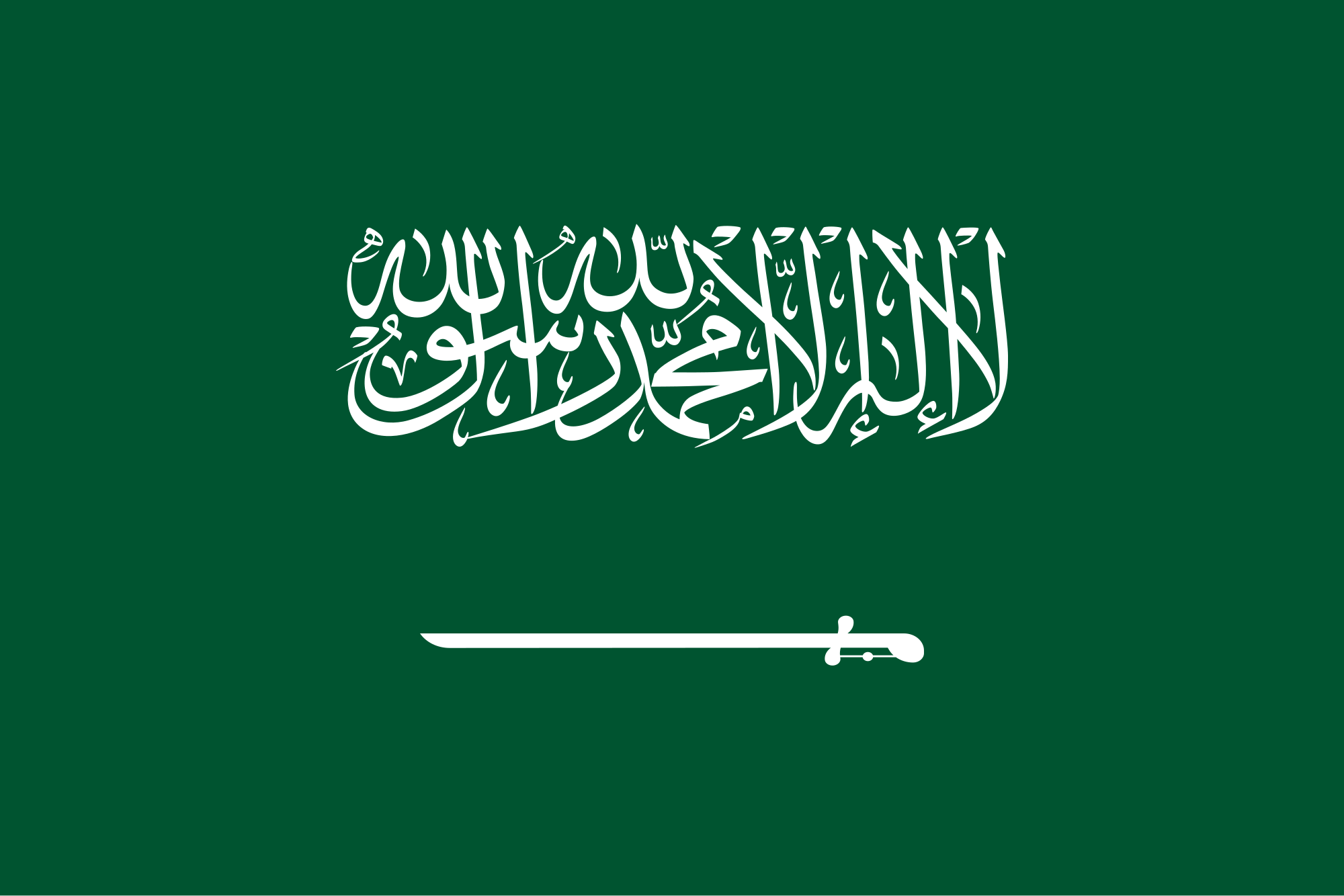
DesignA green field with the Shahada (the Islamic creed) written in the Thuluth script in white above a horizontal sword, having its tip pointed to the left.
Designed byHafiz Wahba[2] and Saleh al-Mansouf[3]

The national flag of Saudi Arabia[a] is a green background with Arabic inscription and a sword in white. The inscription is the Islamic creed, or shahada: "There is no deity but God; Muhammad is the Messenger of God". The current design has been used by the government of Saudi Arabia since 15 March 1973.

Design

[edit]

The Arabic inscription on the flag, written in the calligraphic Thuluth Script, is the shahada or Islamic declaration of faith:

لَا إِلٰهَ إِلَّا الله مُحَمَّدٌ رَسُولُ الله
lā ʾilāha ʾillā-llāh, muḥammadun rasūlu-llāh
'There is no god but God; Muhammad is the Messenger of God.'[4]

The flag's green represents Islam, and the sword stands for safety and justice.[5]

The flag is manufactured with identical obverse and reverse sides, to ensure the shahada reads correctly, from right to left, from either side. The sword also points to the left on both sides, in the direction of the script.[6]

The usual color of the flag's green was approximated by Album des pavillons as Pantone 330 C, while the color used on flags at United Nations is approximately Pantone 349. At the 2012 London Olympics, Pantone 355 was used.[7]

Construction sheet and color shades

[edit]
Colors scheme Green White Construction sheet

Pantone (Fabric)

19-6026 TCX 240/240/236
Pantone 3425C White

RGB

0/84/48 240/240/236
Hexadecimal #005430 #FFFFFF
CMYK 89/15/97/56 0/0/2/6
Sources [8]

Use

[edit]
The flag of Saudi Arabia is never flown at half-mast as a sign of respect towards the holiness of the shahada, the sacred creed depicted on the flag.

Because the shahada is considered holy, the flag is not normally used on T-shirts or other items. Saudi Arabia protested against its inclusion on a planned football to be issued by FIFA, bearing all the flags of the participants of the 2002 FIFA World Cup. Saudi Arabian officials said that abusing the shahada was completely unacceptable and sacrilegious. Similarly, an attempt by the U.S. military to win favour with children of the Khost Province of Afghanistan by distributing footballs adorned with flags, including that of Saudi Arabia, ended in demonstrations.[9]

The flag is never lowered to half-mast as a sign of mourning because lowering it would be considered blasphemous and desecrating.[10] Similarly, the flags of Afghanistan and Somaliland also never at half-mast, and neither is the flag of Iraq because it bears the takbir.[11]

The normal flag cannot be hoisted vertically according to Saudi legislation. Special vertical flags are manufactured where both the inscription (the creed) and the emblem (the sword) are rotated, although this is rare, as most Arab countries traditionally do not hoist flags vertically.

History

[edit]
flag (hanging)Flag can be hoisted vertically only

The precursor states to Saudi Arabia were Nejd and Hejaz. The state flag of Nejd followed today's Saudi flag pattern very closely. The state of Hejaz followed the patterns seen in countries like Palestine and Sudan. Caliphs such as Rashiduns, Umayyads and Abbasids used different colors, inscriptions and symbols. After the Siege of Baghdad in 1258, the primary caliphate became the Mamluk Sultanate. In 1517, the Ottomans invaded Egypt and inherited Hejaz and ruled it until the Arab Revolt (1916–18). From 1902 until 1921 a different Arabic inscription was used. One of the primary opponents to the Saudis was the Emirate of Jabal Shammar of the Al Rashid family in the north of the peninsula, until their defeat in 1921.

The Al Saud, the ruling family of Saudi Arabia, has long been closely related with Muhammad ibn Abd al-Wahhab. He and the people who followed him, since the 18th century, had used the shahada on their flags.[12] In 1921, Abdulaziz Abdulrahman Al-Saud, leader of the Al Saud and the future founder of the Kingdom of Saudi Arabia, added a sword to this flag.[12] Variants with two swords and/or a white vertical stripe at the hoist were frequently used. By 1938, the flag had basically assumed its present form, except the sword had a different design (with a more curved blade) and it, along with the shahada above, took up more of the flag's space.

The design of the flag was not standardized prior to 15 March 1973 when its use became official.[13]

Royal Standard

[edit]
King Salman of Saudi Arabia and Saudi Foreign Minister Adel al-Jubeir meet with U.S. Secretary of State John Kerry in September 2015.

The Royal Standard consists of a green flag, with an Arabic inscription and a sword featured in white, and with the national emblem embroidered in gold in the lower right canton of the year 1973.

The script on the flag is written in the Thuluth script. It is the shahada or Islamic declaration of faith:

لَا إِلٰهَ إِلَّا الله مُحَمَّدٌ رَسُولُ الله
lā ʾilāha ʾillā-llāh, muhammadun rasūlu-llāh
There is no god but God; Muhammad is the Messenger of God[14]

See also

[edit]

Notes

[edit]

References

[edit]
[edit]
Revisions and contributorsEdit on WikipediaRead on Wikipedia
from Grokipedia
The flag of Saudi Arabia is a rectangular green banner with the —"There is no God but ; is the Messenger of "—inscribed in white script centered above a horizontal sword with its handle oriented toward the hoist side. Its proportions are such that the height is two-thirds of the length, establishing a 2:3 ratio. The green field signifies growth and fertility, while the white elements denote purity and peace. The design traces its origins to the establishment of the First Saudi State in 1727, initially as a banner bearing the , and evolved through variations including crossed swords under King Abdulaziz before settling on the current form. King Abdulaziz formally adopted this configuration on March 11, 1937 (27 Dhul-Hijjah 1355 AH), with detailed specifications codified by royal decree in 1973. The affirms the core of faith, central to Wahhabi doctrine that underpins the kingdom's foundation, and the sword represents justice, security, and the defense of Islamic principles. As a , the flag embodies , unity, and monotheism, reflecting the Al Saud dynasty's role in unifying the . It is never flown at half-mast, a practice rooted in respect for the sacred inscription, which precludes any inversion or degradation, underscoring the primacy of religious observance in state protocol. March 11 is observed as National Flag Day, instituted by royal decree to commemorate the 1937 adoption and reinforce civic devotion to these values. Usage guidelines mandate proper folding to display the uppermost and prohibit contact with the ground, emphasizing its enduring role as an emblem of dignity and national identity.

Design

Elements and Layout

The flag of Saudi Arabia consists of a uniform green field overlaid with two white elements centered horizontally and vertically: the inscription positioned above a horizontal . The , the foundational Islamic testimony of faith—"Lā ʾilāha ʾillā Llāh, Muḥammadur rasūl Llāh" (There is no deity but ; Muhammad is the Messenger of )—is rendered in the style of . The , depicted unsheathed and parallel to the inscription, has its handle directed toward the fly end and its point toward the hoist, ensuring the blade orients toward the staff side when viewed from the obverse. This layout places the base of the Shahada's script aligned with the midpoint of the combined drawing area encompassing both elements, with the sword's length measuring three-quarters that of the inscription. The design ensures the elements occupy a central zone equivalent to the flag's sectional divisions, maintaining and prominence without bordering or additional motifs. Flags are constructed such that the sword's point consistently faces the viewer's left from either side, necessitating mirrored reverses for the inscription and sword orientation.

Specifications and Proportions

The national flag of Saudi Arabia is rectangular, with its width equal to two-thirds of its length, corresponding to a 2:3 ratio between hoist and fly dimensions, as established by Royal Decree No. (M/3) dated 10/02/1393 AH (15/03/1973 AD). Standard sizes for the flag include 100 cm width by 150 cm length for primary national use, alongside smaller variants such as 80 cm by 120 cm and 20 cm by 30 cm to maintain proportionality. The white Shahada inscription in Thuluth calligraphy and the accompanying unsheathed sword are centered horizontally and vertically within the green field; the sword's length measures three-quarters of the Shahada's horizontal span, with its handle positioned toward the lower right and aligned parallel to the inscription. The elements occupy a central area divided equally in both vertical and horizontal sections relative to their bounding rectangle.

Color Standards

The colors of the flag of Saudi Arabia are stipulated in the Law of the Flag, promulgated by Royal Decree M/45 on February 4, 1973, which designates the field as and the inscription along with the as white. The decree provides no further chromatic specifications, such as exact hues, matches, or RGB/CMYK equivalents, permitting practical variations in manufacturing while maintaining the traditional deep associated with Islamic . In vexillological practice and digital reproductions, the green field is commonly rendered as Pantone 355 (PMS 355) or Pantone 3425 C, approximating RGB values of (0, 84, 48) or hexadecimal #005430, to evoke the shade's symbolic ties to prosperity and the Prophet Muhammad's standard. The white elements employ pure white (RGB 255, 255, 255; hexadecimal #FFFFFF), ensuring high contrast against the green background for legibility of the Thuluth-script Shahada and the sword's form. Flag production adheres to these approximations to achieve uniformity, though official Saudi guidelines emphasize proportional accuracy over rigid colorimetry, as confirmed in state-maintained resources.

Symbolism

Islamic Foundations

The , inscribed in white calligraphy across the green field of the Saudi Arabian flag, constitutes the primary Islamic element, declaring Lā ʾilāha ʾillā -llāh, Muḥammadur rasūlu -llāh ("There is no deity but ; Muhammad is the Messenger of "). This testimony of faith encapsulates tawḥīd, the indivisible oneness of , which Islamic theology positions as the bedrock of and the rejection of , as emphasized in 112:1–4. The inscription's placement and prominence reflect the kingdom's foundational commitment to this doctrine, originating from the 18th-century alliance between the Al Saud family and , whose reformist movement sought to purify Islamic practice by centering it on the Shahada's implications for creed and conduct. The background draws from longstanding Islamic associations with the color, referenced in traditions linking it to the Muhammad's attire and banners, as well as Quranic depictions of paradise with green imagery (e.g., 76:21, describing silk garments of kharq green). This choice aligns with broader Muslim , where green signifies vitality, prosperity under divine favor, and the ummah's unity, avoiding figurative representation to comply with aniconic principles prevalent in Sunni that prohibit . Empirical observation of pre-modern Islamic flags, such as those of the derivatives, corroborates green's recurrent use for religious symbolism rather than secular motifs. Beneath the Shahada, a horizontal sword hilt-up symbolizes ʿadl (justice), a cardinal Islamic virtue mandated in Quran 4:135 ("O you who have believed, be persistently standing firm in justice, witnesses for Allah") and enacted through ḥudūd penalties and equitable governance. While the sword's specific form evokes the Al Saud's martial legacy in unifying the under Wahhabi governance from 1902 onward, its Islamic underpinning lies in prophetic traditions equating just rule with the "sword of truth" against oppression, ensuring the flag's design integrates faith-derived authority without anthropomorphic depiction. Official Saudi interpretations affirm this as reinforcing security through adherence, distinguishing the banner from non-Islamic emblems.

National and Royal Emblems

The Shahada, inscribed in white Thuluth script on the green field of the flag, serves as the primary national emblem of Saudi Arabia, declaring "Lā ʾilāha ʾillā -llāh, Muḥammadur rasūlu -llāh" (There is no god but God; Muhammad is the Messenger of God). This testimony of faith encapsulates the kingdom's constitutional foundation, where the Quran and Sunnah constitute the state's governance framework, as stipulated in Article 1 of the Basic Law of 1992. The placement and purity of its white coloration emphasize unwavering commitment to Islamic monotheism (tawhid), positioning the emblem as a perpetual affirmation of national identity rooted in religious orthodoxy rather than secular nationalism. Beneath the Shahada, a single horizontal sword in white outline represents the royal emblem, symbolizing the authority of the Al Saud dynasty to uphold justice (adl) and security (aman). Official Saudi interpretations describe the sword as denoting the enforcement of Sharia principles and the resolution of tribal conflicts that preceded unification, with its upward-pointing orientation toward the Shahada illustrating the monarchy's role in safeguarding faith-based order. This element draws from the broader royal iconography, akin to the crossed swords in the national coat of arms adopted circa 1950, which commemorate the 1926 union of Nejd and Hejaz under Abdulaziz Al Saud, evoking martial resolve and dynastic legitimacy without explicit heraldic elaboration in flag protocols. The integration of these emblems on the flag underscores a causal linkage between national sovereignty—grounded in Islamic doctrine—and , where the sword's presence ensures interpretive fidelity to the through state power, a design choice formalized in the royal decree standardizing the banner for all state entities. Unlike variant standards for the armed forces, which incorporate the full , the distills these to a unitary composition, prioritizing symbolic economy over decorative multiplicity.

Debated Interpretations

The sword depicted on the flag has been officially interpreted by Saudi authorities as symbolizing , strength, , and the defense of Islamic principles, with its hilt positioned beneath and pointing toward the to denote protection of the faith. This aligns with pre-Islamic Arab cultural associations of swords with bravery, , and , extended post-unification to represent the Al Saud dynasty's role in establishing security and resolving tribal conflicts. However, critics have debated this as overly militaristic, proposing its removal in on grounds that it evokes rather than mere resolve, a view rejected by opponents who emphasized its representation of equitable enforcement rather than . Interpretations linking the sword to Wahhabi doctrine portray it as the martial complement to religious authority, embodying the 18th-century pact between and Muhammad bin Saud, where military conquest enforced doctrinal purity and expansion. This perspective underscores causal ties between the flag's elements and the kingdom's theocratic foundations, with the sword signifying strict application of , including punitive measures, rather than abstract justice alone. Such readings contrast with secular critiques viewing the combined and sword as promoting intolerance, especially amid comparisons to jihadist banners, though Saudi green distinguishes it from black variants used by groups like . Amid Saudi Arabia's Vision 2030 reforms, which have introduced entertainment sectors contributing to a projected $23 billion GDP by 2030, debates have intensified over the flag's overtly religious symbolism clashing with liberalizing events like concerts and beauty pageants. Proponents of change argue the Shahada's display in profane contexts—such as a contestant in revealing attire holding the flag—dishonors its sanctity and misaligns with global Muslim reverence, urging redesign to accommodate modernization without diluting . Defenders, including scholars like Dr. Ahmed Al-Zilay, counter that the flag's Islamic core remains integral to , advocating dignified usage protocols over alteration, as it balances with without necessitating symbolic overhaul. These contentions highlight tensions between empirical modernization metrics and immutable doctrinal realism, with no formal changes enacted as of 2025.

Historical Development

Pre-Unification Banners

Prior to the formal unification of the on September 23, 1932, the Al Saud family and their allies in Nejd employed plain green banners as military and emblematic standards, a tradition tracing back to the First Saudi State established in 1744 through the alliance between Muhammad ibn Saud and . These banners, often made from silk or wool, featured white inscriptions of core Islamic declarations such as "There is no god but Allah" (part of the ), reflecting the Wahhabi emphasis on (monotheism) and serving as rallying symbols during tribal conflicts and expansions. The green color, drawn from prophetic traditions associating it with paradise and the Prophet Muhammad's cloak, underscored religious legitimacy rather than secular nationalism, with banners typically rectangular and devoid of additional emblems like swords, which were absent until later standardizations. Following ibn Saud's recapture of on January 15, 1902, which initiated the Third Saudi State (also known as the from 1913), these green banners continued in use by his irregular forces and regular troops during campaigns against rivals such as the Rashidis of Ha'il, conquered in 1921. Banner-bearers, a hereditary role within loyal tribes, carried these standards into battle to denote command units, with inscriptions sometimes including Quranic verses to invoke divine favor and ; historical accounts note their facilitated quick production and recognition in . By the phase (1921–1926), the design remained consistent, a solid green field with centralized white thuluth-script , distinguishing Al Saud forces from opponents like the Ottoman-backed Sharifian banners in . In the conquered Hejaz region (1925), the pre-existing Hashemite flags—horizontal tricolors of black, white, and green with a hoist , derived from the 1916 —were supplanted by Nejdi green standards to assert Al Saud dominance and suppress pan-Arab symbolism associated with Sharif Hussein bin Ali. This transition, formalized in the Kingdom of Hejaz and Nejd (1926–1932), retained the green banner with but occasionally incorporated a white fly-end stripe for administrative distinction, though primary military use adhered to the unadorned Nejdi variant. These pre-unification banners laid the foundational design for the post-1932 , prioritizing religious uniformity over regional diversity amid Ibn Saud's consolidation of disparate tribal loyalties through conquests totaling over 1 million square kilometers by 1932.

Unification and Adoption (1902–1934)

In January 1902, Abdulaziz ibn Saud recaptured from the , initiating the unification campaigns of what would become ; his forces employed a traditional banner inscribed with the (the of faith: "There is no god but God; Muhammad is the Messenger of God") in white script, reflecting Wahhabi heritage and serving as a symbol of religious legitimacy during early conquests in . This design drew from precedents in the earlier Saudi states, emphasizing and alliance with the Wahhabi movement, though exact proportions varied as flags were often hand-crafted for use. By 1913, following the conquest of al-Ahsa and establishment of the , the banner evolved to include the centrally placed above two crossed swords, denoting martial prowess and the consolidation of eastern territories under Al Saud rule. In 1921, upon proclaiming the , modified the design by replacing the crossed swords with a single horizontal sword beneath the , symbolizing unified authority, justice, and the decisive enforcement of ; this version accompanied further expansions, including the defeat of the rebels at the in 1929. The green field evoked the Prophet Muhammad's standard, while the sword underscored the causal role of military consolidation in . The conquest of in December 1925 supplanted the Hashemite flags—white with a red triangle and seven-pointed star—used under Sharif Hussein, integrating western provinces into Al Saud control and extending the Nejdi banner's dominance. In 1926, the dual was formed, retaining the sword-bearing flag for official purposes amid ongoing rivalries, such as with the Idrisid state in until its annexation in 1930. On September 18, 1932 (23 September by Gregorian reckoning), proclaimed the unified , formally adopting the green flag with and single sword as the , marking the culmination of three decades of territorial unification through conquest and alliances; this version, though not yet standardized in dimensions, became the state's primary identifier. Minor variations persisted into the early , including script orientation, but the core elements solidified post-unification to project and Islamic orthodoxy.

Standardization and Amendments (1973–Present)

![Flag construction sheet showing proportions and elements of the Saudi Arabian flag](./assets/Flag_of_Saudi_Arabia_constructionsheetconstruction_sheet The Law of the Flag of the Kingdom of was enacted via Royal Decree No. M/3 on 10/2/1393 AH, corresponding to 15 , establishing formal specifications for the national flag's design, proportions, and construction. This legislation defined the flag as rectangular with a width equaling two-thirds of its length, featuring a uniform green field overlaid with the white inscription in script centered horizontally and a white hilt positioned below the text, oriented horizontally with its blade pointing to the hoist side. The decree reduced the 's size to occupy precisely one-eighth of the flag's total area, compared to larger proportions in prior variants, and specified the sword as straight-bladed for uniformity in official production. These amendments resolved inconsistencies in earlier flags, such as variations in inscription scale and sword curvature observed from to , ensuring reproducible standards across state institutions, military units, and civil ensigns. The 1973 law also outlined construction guidelines, including precise positioning: the sword hilt's center aligned 15% from the hoist and 30% from the bottom, with the blade extending to span the flag's width minus margins. No substantive alterations have occurred since, maintaining the 1973 configuration as the enduring standard amid evolving protocols for display and manufacturing. In 2022, discussions emerged regarding potential revisions to the governing decree, including interpretations of the Shahada's phrasing, but these pertained to legal framing rather than visual elements and did not result in amendments to the flag's appearance. Subsequent updates, such as the 2023 royal decree designating 15 March as Saudi Flag Day, focused on ceremonial observance without altering specifications. The flag's codified form continues to embody , with enforcement emphasizing adherence to dimensions in public and diplomatic contexts.

Protocols and Usage

Official Display Rules

The flag of Saudi Arabia must be hoisted from sunrise until sunset on designated occasions, including Fridays and official holidays, on government buildings, public institutions, and diplomatic missions. In 2020, the Ministry of Interior mandated that all state, private, and public entities hoist the flag over their buildings in accordance with updated protocols, emphasizing consistent national display. The flag is raised to the peak of the mast unless specific royal orders dictate half-masting for mourning, as half-masting is prohibited otherwise due to the flag's religious significance containing the . Orientation and positioning require the flag to be displayed horizontally, with the hoist side to the left when viewed from the front; vertical hoisting is explicitly prohibited to preserve the proper alignment of the inscription and sword emblem. It must never be flown upside down, as this constitutes , and should be allowed to wave freely without being tied, knotted, or restricted in movement to avoid creasing or damage. The flag cannot touch the ground, floor, water, or any adjacent surface during handling or display, and flagpoles must adhere to high safety standards with periodic maintenance to prevent hazards. When displayed alongside other flags, the Saudi flag occupies the position of honor: at the center for an odd number of flags or to the right (observer's left) for an even number, in line with international courtesy while prioritizing national precedence; in processions, it is placed in the middle or to the right based on the direction of movement. On vessels, the flag is hoisted at the or peak during port entry/exit and when passing other ships, from sunrise to sunset. Worn or damaged flags must be replaced immediately and disposed of through controlled burning by authorized entities, ensuring no improper degradation occurs. These rules, rooted in Royal Decree No. M/3 of 1973 and subsequent clarifications, enforce respect for the flag's Islamic and national symbolism, with violations subject to penalties under the 2025 Flag Law updates.

Etiquette and Prohibitions

The Saudi Arabian national must be raised from sunrise until sunset on and public institutions, including during weekends and official holidays. When displayed alongside foreign flags, it occupies the position of honor, positioned to the right if alone with one other flag or at the center (for an odd number of flags) or center-right (for an even number). In ceremonial contexts, the flag is hung horizontally at a above attendees or raised on flagpoles, ensuring it flies freely without being fixed or tied to restrict movement. are required to salute the flag during parades or when it is raised or lowered. On vessels, it is hoisted at the mast from sunrise to sunset, or continuously in and during port entries. Proper handling emphasizes reverence, given the flag's inscription of the Shahada, the Islamic declaration of faith, which elevates any misuse to an act of potential blasphemy. The flag must never touch the ground, water, or any inferior surface, and it should not be raised upside down or in a faded or damaged condition. Worn or unfit flags are to be destroyed by burning under the supervision of the responsible authority. Vertical display is prohibited, as is any alteration such as adding slogans, drawings, decorations to edges, or other markings, except for the emblem of the Custodian of the Two Holy Mosques where specified. Prohibitions extend to commercial and disrespectful uses under the Law of the Flag, enacted by Royal Decree No. M/3 on March 15, 1973. The flag cannot be employed as a , in advertisements, or for any unapproved commercial purpose. It is never flown at , reflecting the sanctity of its religious content. Public acts of dropping, destroying, defiling, or insulting the flag out of hatred or contempt are criminalized, punishable by up to one year in prison, a fine of up to 3,000 Saudi riyals, or both. These rules, reinforced by Ministry of Interior guidelines as recently as March 2025, ensure the flag's treatment aligns with national and religious dignity.

National and Ceremonial Observances

The national flag of holds a central role in Saudi Flag Day, observed annually on March 11 as a established by royal decree in 2023 to commemorate the adoption of the flag's design. On this day, the flag is prominently displayed across government buildings, public institutions, and streets from sunrise to sunset, symbolizing national unity, (the oneness of ), and the Islamic foundations of the state. Ceremonies include flag-raising events, educational programs on the flag's and specifications, and public gatherings emphasizing , with decorations and illuminations featuring the green and white colors. During on September 23, which marks the 1932 proclamation of the Kingdom of under King Abdulaziz, the is extensively hoisted in nationwide celebrations. Government entities, streets, buildings, and neighborhoods are adorned with thousands of flags—such as over 26,000 decorative elements in the Eastern Region in 2025—alongside military parades showcasing disciplined flag salutes and processions. Participants wear green and white attire, and official events feature speeches, , and anthem recitals where attendees stand facing the flag, reinforcing its role as a of unification and state formation. In broader ceremonial contexts, the flag is raised daily at facilities per the 2025 Flag Law, which mandates its display from sunrise to sunset, and is saluted by during parades or when it passes in official processions. It is positioned centrally or on the right in processions, hung horizontally above attendees in conference halls, and honored with standing ovations during performances at state events, underscoring protocols of respect and prohibition against misuse. These practices extend to royal and diplomatic ceremonies, where the flag accompanies the Custodian of the Two Holy Mosques' standard, emphasizing its enduring significance in affirming sovereignty and Islamic identity.

Royal Standard

The Royal Standard of the King of is a variant of the , featuring a green field with the inscription and a in white, augmented by the —two crossed swords surmounted by a palm tree—embroidered in and silver threads in the lower hoist canton. This design distinguishes it from the standard , which lacks the added emblem. The emblem's palm tree symbolizes growth and prosperity, while the crossed swords represent justice and military strength, elements rooted in Saudi state since the unification era. Adopted via Cabinet Decision 101 on 8 March 1973 and confirmed by royal decree on 15 March 1973, the current form standardized the royal variant amid broader flag protocols established post-unification. Earlier iterations trace to at least 1939, when a simpler version with two swords appeared in royal representations, evolving by the to incorporate the palm motif in a roughly 1:1 ratio before alignment with the national flag's proportions. Historical depictions, such as those from 1955–1958, confirm the emblem's placement and metallic threading for regal distinction. Usage is restricted exclusively to the reigning , flown at palaces, during processions, and on vehicles or conveying the , underscoring monarchical authority within the absolute 's structure. The Crown Prince employs a parallel standard with the in rather than , maintaining hierarchical differentiation. Unlike the , which adheres to a 2:3 and standard dimensions of 120 by 90 cm, royal standards historically favored larger sizes, such as 250 by 230 cm in 1961 specifications, though exact current dimensions remain protocol-internal.

Governmental and Military Flags

The of serves as the primary standard for governmental entities, mandated by the Law of the Flag to be hoisted daily on all , ministries, and institutions, including during weekends. No distinct personal or departmental flags for non-royal officials, such as ministers or provincial governors, are prescribed in official regulations, with the fulfilling ceremonial and representational roles across administrative functions. Military flags incorporate elements of the national design alongside branch-specific emblems, typically featuring the palm tree and crossed swords of the Saudi coat of arms. The overarching Royal Saudi Armed Forces flag comprises five horizontal stripes in sand yellow, light blue, navy blue, dark green, and grey, with the positioned in the upper hoist corner and the armed forces emblem centered on a white disc in the fly. A variant for the Chief of General Staff adds two white crossed swords on the grey lower hoist stripe to this base design. Branch-specific flags follow a pattern of a field color symbolizing the service, the in the canton, and the respective emblem in the fly. The Royal Saudi Navy employs the as its primary ensign for warships, supplemented by a jack, masthead pennant, and flag that include naval-specific motifs such as anchors or fleet emblems on white or blue grounds. The Royal Saudi Air Force flag uses a field to evoke , with the air force emblem—depicting wings and a star—integrated alongside the canton. The Royal Saudi Land Forces and Air Defense Forces adopt dark green fields mirroring the national color, augmented by ground or emblems. Specialized units maintain analogous variants: the Saudi Royal Guard flag is mint green with the guard's emblem in the fly, reflecting its protective mandate; the flag is yellow with a blue lower stripe and border-specific insignia, emphasizing territorial security. These designs, standardized post-1973 national flag adoption, prioritize unity with the Shahada-bearing green banner while denoting operational roles.

Reception and Controversies

Domestic Significance

The flag of Saudi Arabia holds profound domestic significance as the foremost emblem of , Islamic faith, and the legitimacy of the Al Saud monarchy's rule. Its green field represents the Islamic creed, while the white inscription—"There is no god but God; is the Messenger of God"—affirms (the oneness of God) as the foundational principle of the state, and the crossed sword beneath symbolizes justice enforced through law. This design, standardized in 1973 under Royal Decree No. M/3 dated 10/02/1393 AH (15/03/1973 AD), underscores the kingdom's identity as an founded on religious orthodoxy rather than secular . Within Saudi society, the flag is revered as a sacred banner that embodies collective pride and solidarity, never flown at due to its religious sanctity and role as a perpetual symbol of resilience and glory. It is hoisted on public buildings, schools, and homes during national events, reinforcing loyalty to the crown and the unity achieved under King Abdulaziz Al Saud's unification campaigns from 1902 to 1934. Saudi Flag Day, observed annually on since its designation by royal order, features widespread displays, educational programs, and ceremonies to instill patriotism and highlight the flag's ties to the nation's history and civilizational heritage. Legal protections further elevate the flag's status, treating it as an inviolable national and religious symbol. The Law of the Flag prohibits its vertical hoisting, commercial exploitation, or any use that could degrade its dignity, with violations—such as or misuse in trademarks—punishable by up to one year in or fines. These statutes, enforced by the Ministry of Interior and public prosecution, reflect the flag's integration into Saudi cultural norms, where its display signifies devotion to and the enforcement of divine justice, distinguishing the kingdom's identity from Western democratic symbols.

International Views and Criticisms

The Saudi Arabian flag's inclusion of the and a has prompted international commentary on its embodiment of the kingdom's theocratic elements, with some observers linking it to restrictive governance practices. , in critiquing tributes to Saudi leaders, highlighted the regime's record of suppressing dissent, executions, and discrimination against religious minorities and women, implicitly associating such honors with symbols like the flag that prioritize Islamic doctrine over universal norms. Similar backlash occurred in 2015 when the government lowered flags at for King Abdullah's death, prompting MPs to decry it as an "extraordinary misjudgment" given Saudi Arabia's documented use of flogging, beheadings, and curbs on free expression. Critics argued this overlooked empirical evidence of systemic abuses, including over 80 executions in 2014 alone under Abdullah's rule. The flag's sword, officially denoting justice and the Al Saud dynasty's unification efforts, has faced interpretive criticism abroad as evoking state violence, particularly amid Saudi Arabia's high execution rates—1,012 since 1985 per data—and reliance on for non-lethal offenses like or sorcery. A 2021 domestic proposal to remove it for modernization, reported by MEMRI, drew international attention as a potential signal of under Vision 2030, though defenders emphasized its representation of strength rather than aggression, and it was not adopted. Diplomatic frictions arise from the flag's sacred status, prohibiting half-masting or vertical hoisting to avoid desecrating the , which contrasts with global mourning protocols. protested the 2006 soccer balls featuring its flag, citing risks of the inscription being "kicked" as blasphemous, mirroring Afghan clerical objections and underscoring cultural clashes with secular international norms. In 2023, a fashion designer's miniskirt printed with the flag design ignited online fury, with the designer apologizing for unwittingly offending Islamic sensibilities, highlighting tensions between Western artistic expression and the flag's inviolable religious connotation. Such incidents reflect broader critiques from outlets like of 's export of via flag-bearing diplomacy, funding over 1,500 mosques worldwide tied to conservative curricula.

References

Add your contribution
Related Hubs
Contribute something
User Avatar
No comments yet.