



Community hub
Recent from talks
Knowledge base stats:
Talk channels stats:
Members stats:
London and South Western Railway
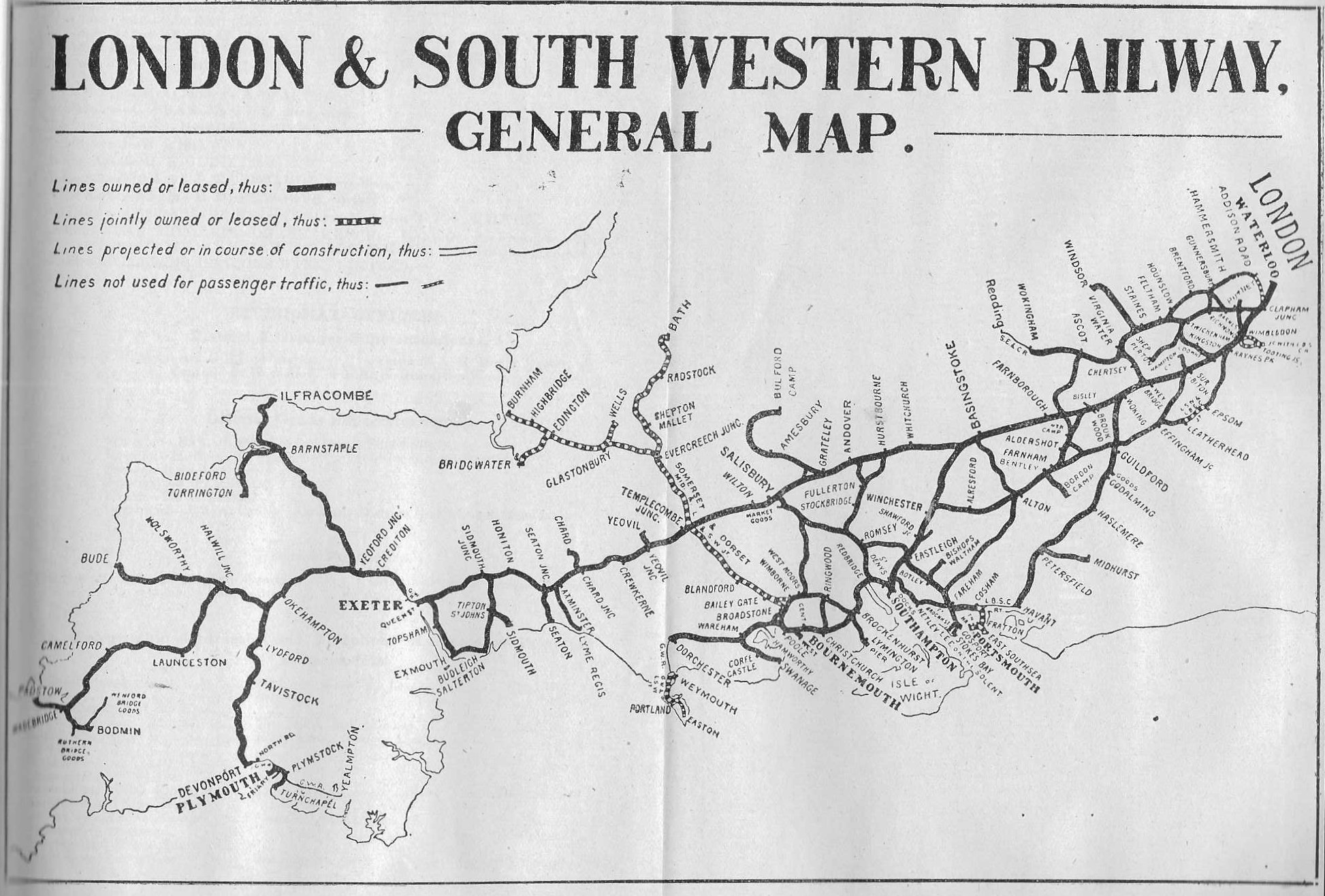
The London and South Western Railway (LSWR, sometimes written L&SWR) was a railway company in England from 1838 to 1922. Originating as the London and Southampton Railway, its network extended to Dorchester and Weymouth, to Salisbury, Exeter and Plymouth, and to Padstow, Ilfracombe and Bude. It developed a network of routes in Hampshire, Surrey and Berkshire, including Portsmouth and Reading.
The LSWR became famous for its express passenger trains to Bournemouth and Weymouth, and to Devon and Cornwall. Nearer London it developed a dense suburban network and was pioneering in the introduction of a widespread suburban electrified passenger network. It was the prime mover of the development of Southampton Docks, which became an important ocean terminal as well as a harbour for cross channel services and for Isle of Wight ferries. Although the LSWR's area of influence was not the home of large-scale heavy industry, the transport of goods and mineral traffic was a major activity, and the company built a large marshalling yard at Feltham. Freight, docks and shipping business provided almost 40 per cent of turnover by 1908. The company handled the rebuilding of London Waterloo station as one of the great stations of the world, and the construction of the Waterloo & City line, giving access to the City of London. The main line was quadrupled and several of the junctions on it were given grade-separation. It pioneered the introduction of power signalling. In the Boer War its connections at Aldershot, Portland, and on Salisbury Plain, made it a vital part of the war effort, and later during the First World War it successfully handled the huge volume of traffic associated with bringing personnel, horses and equipment to the English channel ports, and the repatriation of the injured. It was a profitable company, paying a dividend of 5% or more from 1871.
Following the Railways Act 1921 the LSWR amalgamated with other railways to create the Southern Railway, on 1 January 1923, as part of the grouping of the railways. It was the largest constituent: it operated 862 route miles, and was involved in joint ventures that covered a further 157 miles. In passing its network to the new Southern Railway, it showed the way forward for long-distance travel and outer-suburban passenger operation, and for maritime activity. The network continued without much change through the lifetime of the Southern Railway, and for some years following nationalisation in 1948. In Devon and Cornwall the LSWR routes duplicated former Great Western Railway routes, and in the 1960s they were closed or substantially reduced in scope. Some unsuccessful rural branch lines nearer the home counties closed too in the 1960s and later, but much of the LSWR network continues in busy use to the present day.
The London and South Western Railway arose out of the London and Southampton Railway (L&SR), which was promoted to connect Southampton to the capital; the company envisaged a considerable reduction in the price of coal and agricultural necessities to places served, as well as imported produce through Southampton Docks, and passenger traffic.
Construction probably started on 6 October 1834 under Francis Giles, but progress was slow. Joseph Locke was brought in as engineer, and the rate of construction improved; the first part of the line opened to the public between Nine Elms and Woking Common on 21 May 1838, and it was opened throughout on 11 May 1840. The terminals were at Nine Elms, south of the River Thames and a mile or so southwest of Trafalgar Square, and a terminal station at Southampton close to the docks, which were also directly served by goods trains.
The railway was immediately successful, and road coaches from points further west altered their routes so as to connect with the new railway at convenient interchange points, although goods traffic was slower to develop.
The London and Southampton Railway promoters had intended to build a branch from Basingstoke to Bristol, but this proposal was rejected by Parliament in favour of the competing route proposed by the Great Western Railway. The parliamentary fight had been bitter, and a combination of resentment and the commercial attraction of expanding westwards remained in the company's thoughts.
A more immediate opportunity was taken up, of serving Portsmouth by a branch line. Interests friendly to the L&SR promoted a Portsmouth Junction Railway, which would have run from Bishopstoke (Eastleigh) via Botley and Fareham to Portsmouth. However antagonism in Portsmouth—which considered Southampton a rival port—at being given simply as branch and thereby a roundabout route to London, killed the prospects of such a line. Portsmouth people wanted their own direct line, but in trying to play off the L&SR against the London and Brighton Railway they were unable to secure the committed funds they needed.
Hub AI
London and South Western Railway AI simulator
(@London and South Western Railway_simulator)
London and South Western Railway
The London and South Western Railway (LSWR, sometimes written L&SWR) was a railway company in England from 1838 to 1922. Originating as the London and Southampton Railway, its network extended to Dorchester and Weymouth, to Salisbury, Exeter and Plymouth, and to Padstow, Ilfracombe and Bude. It developed a network of routes in Hampshire, Surrey and Berkshire, including Portsmouth and Reading.
The LSWR became famous for its express passenger trains to Bournemouth and Weymouth, and to Devon and Cornwall. Nearer London it developed a dense suburban network and was pioneering in the introduction of a widespread suburban electrified passenger network. It was the prime mover of the development of Southampton Docks, which became an important ocean terminal as well as a harbour for cross channel services and for Isle of Wight ferries. Although the LSWR's area of influence was not the home of large-scale heavy industry, the transport of goods and mineral traffic was a major activity, and the company built a large marshalling yard at Feltham. Freight, docks and shipping business provided almost 40 per cent of turnover by 1908. The company handled the rebuilding of London Waterloo station as one of the great stations of the world, and the construction of the Waterloo & City line, giving access to the City of London. The main line was quadrupled and several of the junctions on it were given grade-separation. It pioneered the introduction of power signalling. In the Boer War its connections at Aldershot, Portland, and on Salisbury Plain, made it a vital part of the war effort, and later during the First World War it successfully handled the huge volume of traffic associated with bringing personnel, horses and equipment to the English channel ports, and the repatriation of the injured. It was a profitable company, paying a dividend of 5% or more from 1871.
Following the Railways Act 1921 the LSWR amalgamated with other railways to create the Southern Railway, on 1 January 1923, as part of the grouping of the railways. It was the largest constituent: it operated 862 route miles, and was involved in joint ventures that covered a further 157 miles. In passing its network to the new Southern Railway, it showed the way forward for long-distance travel and outer-suburban passenger operation, and for maritime activity. The network continued without much change through the lifetime of the Southern Railway, and for some years following nationalisation in 1948. In Devon and Cornwall the LSWR routes duplicated former Great Western Railway routes, and in the 1960s they were closed or substantially reduced in scope. Some unsuccessful rural branch lines nearer the home counties closed too in the 1960s and later, but much of the LSWR network continues in busy use to the present day.
The London and South Western Railway arose out of the London and Southampton Railway (L&SR), which was promoted to connect Southampton to the capital; the company envisaged a considerable reduction in the price of coal and agricultural necessities to places served, as well as imported produce through Southampton Docks, and passenger traffic.
Construction probably started on 6 October 1834 under Francis Giles, but progress was slow. Joseph Locke was brought in as engineer, and the rate of construction improved; the first part of the line opened to the public between Nine Elms and Woking Common on 21 May 1838, and it was opened throughout on 11 May 1840. The terminals were at Nine Elms, south of the River Thames and a mile or so southwest of Trafalgar Square, and a terminal station at Southampton close to the docks, which were also directly served by goods trains.
The railway was immediately successful, and road coaches from points further west altered their routes so as to connect with the new railway at convenient interchange points, although goods traffic was slower to develop.
The London and Southampton Railway promoters had intended to build a branch from Basingstoke to Bristol, but this proposal was rejected by Parliament in favour of the competing route proposed by the Great Western Railway. The parliamentary fight had been bitter, and a combination of resentment and the commercial attraction of expanding westwards remained in the company's thoughts.
A more immediate opportunity was taken up, of serving Portsmouth by a branch line. Interests friendly to the L&SR promoted a Portsmouth Junction Railway, which would have run from Bishopstoke (Eastleigh) via Botley and Fareham to Portsmouth. However antagonism in Portsmouth—which considered Southampton a rival port—at being given simply as branch and thereby a roundabout route to London, killed the prospects of such a line. Portsmouth people wanted their own direct line, but in trying to play off the L&SR against the London and Brighton Railway they were unable to secure the committed funds they needed.