


Community hub
Recent from talks
Contribute something
Nothing was collected or created yet.
Reschensee
View on WikipediaReschensee (German: [ˈʁɛʃn̩ˌzeː] ⓘ; Austrian German pronunciation: [ˈrɛʃn̩ˌseː]; Italian: Lago di Resia [ˈlaːɡo di ˈrɛːzja]) or Lake Reschen is an artificial lake in the western portion of South Tyrol, Italy, approximately 2 km (1 mi) south of the Reschen Pass, which forms the border with Austria, and 3 km (2 mi) east of the mountain ridge forming the border with Switzerland. With its capacity of 120 million m3 (97,000 ac·ft) it is the largest lake in the province. Its surface area of 6.6 km2 (2.5 sq mi) makes it also the largest lake above 1,000 m (3,300 ft) in the Alps.[1] It is fed by the Adige, Rojenbach and Karlinbach and drained by the Adige.
Key Information


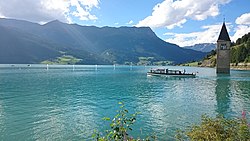
The lake is famous for the steeple of a submerged 14th-century church; when the water freezes, this can be reached on foot. A legend says that during winter one can still hear church bells ring. In reality the bells were removed from the tower on July 18, 1950, a week before the demolition of the church nave and the creation of the lake.
Origins
[edit]Plans for a smaller (5 m deep) artificial lake date from 1920. In July 1939, the Montecatini company (now Edison Energia) introduced a new plan for a 22 m (72 ft)-deep lake, which would unify two natural lakes (Reschensee and Mittersee) and submerge several villages, including Graun and part of Reschen. The creation of the dam started in April 1940 pursuant to this second plan but, due to the war and local resistance, did not finish until July 1950.

In 1947 Montecatini received 30 million Swiss francs from the Swiss company Elektrowatt for the construction of the dam (in exchange for 10 years of seasonal electricity), paradoxically after the population of Splügen had voted against the company's plans to build a dam that would have submerged that Swiss village. Graun's population did not have such success, despite the willing ear of Antonio Segni who later became Italy's prime minister. In total 163 homes and 523 hectares (1,290 acres) of cultivated land were submerged.
Climate
[edit]| Climate data for Reschensee/San Valentino alla Muta, elevation 1,461 m (4,793 ft), (1991–2020) | |||||||||||||
|---|---|---|---|---|---|---|---|---|---|---|---|---|---|
| Month | Jan | Feb | Mar | Apr | May | Jun | Jul | Aug | Sep | Oct | Nov | Dec | Year |
| Mean daily maximum °C (°F) | 1.5 (34.7) |
2.8 (37.0) |
6.4 (43.5) |
9.8 (49.6) |
14.3 (57.7) |
18.1 (64.6) |
20.5 (68.9) |
20.2 (68.4) |
16.4 (61.5) |
11.7 (53.1) |
5.7 (42.3) |
2.2 (36.0) |
10.8 (51.4) |
| Daily mean °C (°F) | −2.9 (26.8) |
−2.1 (28.2) |
1.5 (34.7) |
5.0 (41.0) |
9.5 (49.1) |
12.8 (55.0) |
15.1 (59.2) |
15.0 (59.0) |
11.5 (52.7) |
7.4 (45.3) |
1.9 (35.4) |
−1.6 (29.1) |
6.1 (43.0) |
| Mean daily minimum °C (°F) | −7.3 (18.9) |
−7.1 (19.2) |
−3.4 (25.9) |
0.1 (32.2) |
4.7 (40.5) |
7.6 (45.7) |
9.7 (49.5) |
9.7 (49.5) |
6.7 (44.1) |
3.1 (37.6) |
−1.9 (28.6) |
−5.3 (22.5) |
1.4 (34.5) |
| Average precipitation mm (inches) | 30 (1.2) |
26 (1.0) |
25 (1.0) |
31 (1.2) |
49 (1.9) |
66 (2.6) |
77 (3.0) |
94 (3.7) |
48 (1.9) |
39 (1.5) |
40 (1.6) |
31 (1.2) |
556 (21.8) |
| Source: Istituto Superiore per la Protezione e la Ricerca Ambientale (precipitation 1951–1980)[2] | |||||||||||||
References
[edit]- ^ Schweizerischer Wasserwirtschaftsverband, Wasser- und Energiewirtschaft, Vol. 43-44, p.115
- ^ "Valori climatici normali di temperatura e precipitazione in Italia" (PDF). Istituto Superiore per la Protezione e la Ricerca Ambientale. Retrieved 28 June 2024.
External links
[edit]
| International | |
|---|---|
| National | |

Reschensee
View on GrokipediaGeography
Location and Physical Characteristics
Reschensee, known in Italian as Lago di Resia, is located in the municipality of Curon Venosta (Graun im Vinschgau) in the western part of South Tyrol, Italy. Situated in the Vinschgau Valley (Val Venosta), it lies near the Austrian border at the Reschen Pass, approximately 80 kilometers northwest of Bolzano. The lake occupies a glacial basin at an elevation of 1,498 meters above sea level.[1][8] The reservoir covers a surface area of 6.6 square kilometers, extending about 6 kilometers in length and 1 kilometer in maximum width. Its shoreline measures roughly 15 kilometers, accessible via a promenade suitable for hiking and cycling. The maximum depth reaches 28 meters, with a total water volume of approximately 120 million cubic meters.[9][10][11] Reschensee is primarily fed by the upper Adige River (Etsch), along with tributaries such as the Rojenbach and Karlinbach streams. The Adige serves as the outlet, flowing southward from the dam. As an artificial lake formed by damming, its physical features reflect both natural glacial origins and engineering modifications for hydroelectric purposes.[1][8]Hydrology and Water Management
The Reschensee functions as a regulated reservoir with a surface area of 620 hectares, maximum depth of 32.5 meters, and usable storage volume of 116 million cubic meters at an elevation of 1,498 meters above sea level.[11] Inflows derive mainly from the upper Etsch (Adige) River and its alpine tributaries, including the glacier-influenced Karlinbach, which periodically elevates turbidity levels due to sediment load from snowmelt and glacial runoff.[11] Supplementary inflows occur via pumping from the adjacent Haidersee to augment storage during low-precipitation periods.[12] Outflows are controlled by a 31.5-meter-high, 467-meter-long earthfill dam constructed in 1949, which impounds the valley and merges former natural lakes including Reschensee and Mittersee.[12] Water releases feed the Adige River downstream while diverting volumes through a 12-kilometer pressure tunnel to the Glurns peak-load hydroelectric plant, followed by an equalization basin before rejoining tributaries like the Punibach.[12] This system also supports run-of-river generation at the Kastelbell facility.[12] Management falls under the South Tyrol Province's Ufficio Idrologia e Dighe, which oversees 117 dams including Reschensee through regular monitoring of water levels via piezometers, drainage systems, and remote sensors, with inspections conducted one to two times annually.[13] Levels are modulated for hydroelectric optimization, agricultural frost protection via irrigation sprinkling, and flood control—preemptively reduced during high-precipitation forecasts to accommodate inflows—though sustained withdrawals impose hydrological stress, contributing to fluctuations and occasional full drawdowns for infrastructure maintenance.[13][11][12]History
Pre-20th Century Development
The basin of present-day Reschensee originated as a post-glacial depression in the upper Vinschgau Valley following the retreat of Würm glaciation around 10,000 BCE, forming small natural lakes amid morainic deposits that shaped the alpine landscape.[8] Human activity in the broader Vinschgau, including the Reschen area, emerged during the Late Neolithic (ca. 3500–2200 BCE), evidenced by agro-pastoral settlements such as Latsch, where communities cultivated hulled barley (Hordeum vulgare), emmer wheat, and legumes while herding sheep, goats, and cattle—practices contemporaneous with and linked to the Ötzi iceman's cultural milieu in the same valley system.[14] These early inhabitants exploited mid-altitude resources for subsistence, with pollen and macrobotanical remains indicating integrated farming and transhumance suited to the valley's harsh terrain. Bronze Age (ca. 2200–800 BCE) presence is attested through Laugen-Melaun culture artifacts in the Vinschgau, including ceramics and metal tools tied to regional copper exploitation, facilitating trade over passes like Reschen.[15] By the Iron Age (ca. 800 BCE–15 BCE), Rhaeto-Celtic groups, such as the Venostes tribe from which "Vinschgau" derives, dominated the upper valley, engaging in fortified hill settlements and pastoralism; their incorporation into the Roman Empire occurred in 15 BCE via Drusus and Tiberius's campaigns, integrating the region into Raetia province with the Reschen Pass serving as a secondary alpine route for military and commerce, though no major via like Claudia Augusta was constructed directly through the valley.[16] Post-Roman, the area fell under Ostrogothic, Lombard, and Frankish rule by the 6th–8th centuries CE, with Carolingian influences promoting Christianization and feudal agriculture. Medieval development solidified around 1000–1300 CE, as the Vinschgau became part of the County of Tyrol under Habsburg precursors; villages like Reschen and Graun arose on stable foundations, supporting hay meadows, viticulture on slopes, and lake-edge fishing in the modest natural bodies of water—Reschensee proper being a shallow, elongated lake supplemented by adjacent ponds. Graun's parish church, constructed starting in 1355, underscores ecclesiastical consolidation, with the tower's Gothic style reflecting local stone masonry and regional patronage. Economic reliance on transalpine herding and tolls at the pass persisted, with the valley's isolation preserving Germanic dialects amid Italianate borders.[17][2] By the 19th century, under Austrian Tyrol, the lakes remained unregulated, integral to small-scale milling and irrigation for barley and apple orchards, though prone to seasonal fluctuations without modern controls.[18]Damming Project and Village Submersion (1920s–1950s)
The damming project at Reschensee was initiated by the Italian industrial conglomerate Montecatini in 1939 to construct a 22-meter-high dam for hydroelectric power generation, merging existing lakes and creating a larger reservoir.[2] Construction commenced in April 1940 but faced significant delays due to World War II and local opposition.[19] In 1947, Montecatini secured funding from the Swiss firm Elektrowatt, receiving 30 million Swiss francs in exchange for seasonal energy supplies over a decade. Postwar resumption led to the dam's completion between 1947 and 1949, with the structure designed to raise water levels substantially.[1] The project culminated in July 1950 with the reservoir's filling, submerging the historic village of Graun (also known as Curon or Alt-Graun) entirely and portions of nearby Resia, displacing approximately 150 families who had to relocate to new settlements.[3] Local residents mounted fierce protests against the flooding, including organized resistance and a failed petition for papal intervention led by the parish priest, but authorities proceeded despite these objections to prioritize energy production.[20] Over 160 homes were lost, transforming the valley's landscape and erasing much of the medieval village fabric, though the 14th-century bell tower of Graun's church was preserved partially above water as a visible remnant.[4] This submersion unified Lake Resia with adjacent bodies of water, expanding the reservoir to about 660 hectares with a maximum depth of 28 meters, facilitating downstream hydroelectric utilization.[1]Post-Construction Changes
Following the completion of the dam in July 1950, the residents of Graun (Curon) and parts of Reschen were displaced, with approximately 150 families relocating to a newly constructed village built on higher ground above the reservoir's shoreline.[4][3] Some inhabitants chose to remain in the area despite the upheaval, while the original structures were largely demolished prior to flooding.[4] Operational management of the reservoir for hydroelectric power generation introduced seasonal and demand-driven water level fluctuations, altering the lake's natural hydrology and causing the 14th-century church tower of Graun to periodically emerge more prominently above the surface during low-water periods.[8] These variations, controlled by the dam's operators, have enabled occasional full or partial exposures of submerged ruins for maintenance purposes, such as in 2021 when the lake was drained to repair infrastructure, revealing foundations of the medieval village for the first time in over 70 years.[5][21] Similar draining occurred in 2024, when water levels were lowered drastically from March to June to relocate and secure a nearby state highway and cycle path for safety reasons, costing around 20 million euros and allowing temporary access to the site before refilling.[8] The partially submerged church tower was designated a protected historical artifact post-construction, transforming it into a symbol of the valley and a focal point for tourism, which spurred economic development in the region through visitor attractions, boat tours, and cultural narratives tied to the site's history.[2] This shift has preserved local folklore and collective memory of the displacement amid the prioritization of energy infrastructure, though no major legal reversals or restorations of the submerged areas have occurred.[21]Climate and Ecology
Climatic Conditions
The Reschensee region, situated at an elevation of approximately 1,508 meters in the Upper Vinschgau Valley, experiences a cold continental alpine climate characterized by significant seasonal temperature variations, prolonged winters, and relatively low precipitation compared to surrounding higher Alpine areas. Average annual temperatures hover around 0.2°C, with extremes ranging from below -10°C in winter to occasional summer highs near 20°C.[22] Winters are harsh, with January mean highs of -5°C and lows of -13°C, often accompanied by heavy snowfall that supports regional winter sports but can lead to lake ice cover lasting several months.[23] Summers are cool and short, with July averages reaching highs of about 15°C and lows around 5°C, moderated by the lake's thermal inertia and frequent afternoon thunderstorms. Precipitation totals approximately 1,065 mm annually, predominantly as snow from November to April, with drier conditions in the rain-shadowed valley fostering a relatively arid microclimate conducive to agriculture in lower adjacent areas.[22] The area benefits from high insolation, with up to 300 sunny days per year typical of South Tyrol's inner Alpine valleys, though strong westerly winds, including foehn effects, can exacerbate temperature fluctuations and evaporation from the lake surface.[24]| Month | Avg. High (°C) | Avg. Low (°C) | Precipitation (mm) |
|---|---|---|---|
| January | -5 | -13 | 51 |
| February | -4 | -12 | 53 |
| March | -1 | -9 | 61 |
| April | 3 | -5 | ~50 |
| May | 7 | 0 | ~70 |
| June | 10 | 3 | ~80 |
| July | 13 | 5 | ~90 |
| August | 12 | 5 | ~90 |
| September | 9 | 2 | ~70 |
| October | 5 | -2 | ~60 |
| November | 0 | -6 | ~60 |
| December | -3 | -11 | ~50 |
Environmental Impacts and Biodiversity
The construction of the Reschensee dam between 1943 and 1950 submerged approximately 120 hectares of valley floor, including agricultural lands and the village of Graun, resulting in the permanent loss of terrestrial habitats such as meadows and forests that supported local flora and fauna typical of alpine valleys. This anthropogenic transformation unified smaller natural lakes and created a 6.6 square kilometer reservoir at 1,498 meters elevation, shifting the ecosystem from predominantly terrestrial to aquatic while introducing sediment deposition and altered nutrient dynamics from flooded organic matter. Hydropower operations have since imposed artificial water level fluctuations, with amplitudes up to several meters annually, which disrupt shoreline stability and exacerbate erosion, potentially reducing suitable habitats for riparian species.[25] These fluctuations, driven by seasonal storage for electricity generation and occasional drawdowns for maintenance—as seen in 2021 when the lake was partially drained to 40% capacity for dam repairs—can lead to fish and invertebrate stranding, temporary dewatering of littoral zones, and stress on aquatic communities through rapid changes in wetted area and oxygen levels. In alpine reservoirs like Reschensee, such hydropeaking-related effects downstream in the Adige River contribute to broader ecological stressors, including impaired macroinvertebrate drift, reduced fish recruitment, and shifts in periphyton growth, though site-specific mitigation remains limited. The Adige catchment's overall chemical status is classified as good, with low nutrient and pollutant loads in upstream areas, supporting oligotrophic conditions conducive to cold-water species but vulnerable to hydrological alterations from multiple dams.[26][27][28] Biodiversity in Reschensee reflects its managed reservoir status, hosting introduced rainbow trout (Oncorhynchus mykiss) alongside native perch (Perca fluviatilis) and northern pike (Esox lucius), which sustain a local fishery but indicate potential shifts from pre-dam assemblages dominated by rheophilic alpine stream species. The lake's expanse provides foraging habitat for waterbirds, though fluctuating levels limit emergent vegetation and breeding sites for shore-nesting species. As a geographic barrier at high elevation, Reschensee restricts dispersal and gene flow for terrestrial invertebrates, evidenced by genetic differentiation in the European cockchafer (Melolontha melolontha) populations separated by the lake and Resia Pass, underscoring fragmented alpine connectivity. Overall, while the reservoir enhances regional water security, its ecological footprint prioritizes energy production over natural variability, with biodiversity adapted yet constrained by operational demands.[1][29]Engineering and Hydroelectric Utilization
Dam Structure and Technical Specifications
The Reschensee Dam, also known as the Diga di Resia, is an earth embankment structure constructed to form the artificial Lake Resia basin in South Tyrol, Italy. Completed in 1950, the dam unifies the former lakes of Resia, Graun, and Epicurano into a single reservoir for hydroelectric purposes.[30] The dam features a height of 31.5 meters above the foundation and a crest length of 467 meters. Its design as an earthen embankment provides stability through compacted earth materials, typical for such alpine reservoirs where rockfill alternatives may be less feasible due to local geology.[30] Key technical specifications include a useful storage volume of 116 million cubic meters, supporting water management for downstream power generation. The crest elevation aligns with the lake's maximum water level at approximately 1,501 meters above sea level, enabling regulation of inflows from the Adige River tributaries.[30][31]| Specification | Value |
|---|---|
| Type | Earth embankment dam |
| Height | 31.5 m |
| Crest length | 467 m |
| Storage volume | 116 million m³ |
| Completion year | 1950 |