



Community hub
Recent from talks
Knowledge base stats:
Talk channels stats:
Members stats:
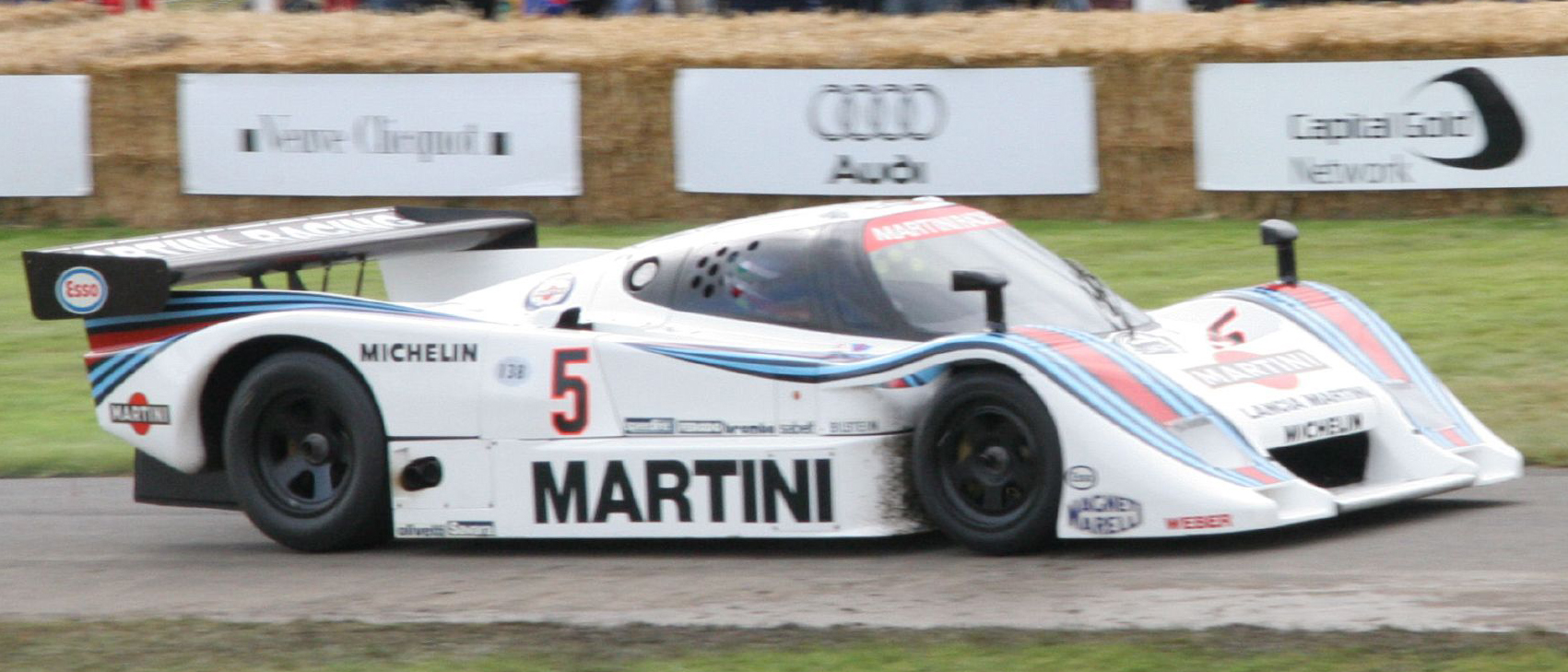
Lancia LC2
The Lancia LC2 (sometimes referred to as the Lancia-Ferrari) was a series of racing cars built by Italian automobile manufacturer Lancia and powered by engines built by their sister company Ferrari. They were part of Lancia's official factory-backed effort in the World Sportscar Championship from 1983 to 1986, although they continued to be used by privateer teams until 1991. They were also the company's first car meeting the FIA's new Group C regulations for sports prototypes.
More powerful than their primary competition, the Porsche 956s, the LC2s were able to secure multiple pole positions during their three and a half seasons with the factory Martini Racing squad. However, deficiencies in reliability and fuel consumption hampered the LC2s' efforts for race wins against the Porsches. LC2s earned three race victories over their lifetimes in the hands of Italian drivers Teo Fabi, Riccardo Patrese, Alessandro Nannini, and Mauro Baldi, as well as German Hans Heyer and Frenchman Bob Wollek.
In 1982, the new Group C regulations were introduced to the World Championship. This rule set required teams to use coupé-style cars that had to be able to meet a fuel economy standard mandated at 100 kilometres (62.1 mi) for every 60 litres (16 US gal) of fuel. The Lancia LC1, which had been built to the older Group 6 regulations, initially competed in 1982, but had to be replaced in order for Lancia to earn constructors' points in the World Championship, now open to Group C cars only in 1983. Besides the fact that the LC1 had an open-cockpit, the turbocharged straight-four Lancia engine it had used was not capable of achieving the fuel economy necessary in the new Group C regulations, requiring Lancia to also seek a new powerplant. Under the direction of Cesare Fiorio, Lancia began to work on the LC1's replacement.
Lancia lacked a production engine large enough to base a racing engine on, leaving the company to turn to outside sources. Since Lancia were owned by the Fiat Group, they were able to seek the assistance of fellow Fiat company Ferrari. Ferrari allowed Lancia to adapt the new naturally aspirated 3.0 litres (183 cu in) four valve V8 which had been introduced in the Ferrari 308 GTBi QV in 1982. The development of the engine was assigned by Enzo Ferrari to Nicola Materazzi, then Chief Engineer in the Racing Department. The development was done in parallel with that of the F114B powering the GTO and both engines were intended with high duty in mind, with one difference being that the GTO engine would use IHI turbos for the road. The basic engine architecture was heavily redesigned for racing purposes and the engine was reduced in capacity to 2.6 litres (159 cu in) and two KKK turbochargers were added to help the engine provide the fuel economy and power necessary. The specific engine displacement was chosen because of the possibility of using the same engine in the North American CART series. The engine was initially connected to a Hewland five-speed manual gearbox, which was replaced by an Abarth-cased unit in 1984.
Design work on the chassis was split between Italian specialist racing car manufacturers Abarth and Dallara, the latter of which built the aluminium monocoque and the kevlar and carbon fibre bodywork in their factory. The LC2 featured a large intake for the radiators in the center of the nose of the car just as the LC1 had, unlike the contemporary Porsche 956s which drew all their air from behind and to the sides of the cockpit. This air was also directed through the side bodywork to feed the intercoolers for the turbochargers. Inlets for the rear brake cooling ducts were also integrated onto the side bodywork of the car, immediately behind the doors. At the rear, a pontoon-style design was adapted to the fenders with the large wing bridging across the pontoons. The rear diffusers exited between the pontoons and underneath the wing.
The LC2s were modified over their lifetime, with a multitude of modifications being made each season to the cars' aerodynamics, including adapting brake duct inlets beneath the headlights. The Ferrari V8 was modified in 1984, bringing the displacement back up to 3.0-litres in an attempt to increase reliability and horsepower while improved engine electronics from Magneti Marelli allowed the larger engine to use the same amount of fuel as the previous version. The engine developed just under 840 HP at 9000 rpm with massive 800 lb.-ft. at 4800 rpm, the twin KKK turbos were running at 3.0 bar boost and would start pulling from 3000 rpm. In total, seven LC2s were built under the direction of Lancia, while a further two were built for Gianni Mussato without official backing after the program had ended.
After the program had ended, Abarth acquired an LC2 and fitted it with the 3.5-litre Alfa Romeo Tipo 1035 V10 engine from the Alfa Romeo 164 Procar, and developed it under the project name SE047. The SE047 was an early development of the Alfa Romeo SE 048SP project in 1988. The SE047's engine was ultimately not utilized in the later stages of the SE 048SP development.
The LC2s made their debut at the beginning of the 1983 season, being run under the Martini Racing name and painted in the Martini & Rossi colours, as well as initially using Italian Pirelli radial tyres. The first race of the season was also Lancia's home event, the 1000 km of Monza. The LC2 proved more powerful than the 956s, taking the pole position by nearly a second over Joest Racing's 956. However tyre problems took the leading Lancia out of the lead of the race, and the second team car finished twelve laps behind the winning 956.
Hub AI
Lancia LC2 AI simulator
(@Lancia LC2_simulator)
Lancia LC2
The Lancia LC2 (sometimes referred to as the Lancia-Ferrari) was a series of racing cars built by Italian automobile manufacturer Lancia and powered by engines built by their sister company Ferrari. They were part of Lancia's official factory-backed effort in the World Sportscar Championship from 1983 to 1986, although they continued to be used by privateer teams until 1991. They were also the company's first car meeting the FIA's new Group C regulations for sports prototypes.
More powerful than their primary competition, the Porsche 956s, the LC2s were able to secure multiple pole positions during their three and a half seasons with the factory Martini Racing squad. However, deficiencies in reliability and fuel consumption hampered the LC2s' efforts for race wins against the Porsches. LC2s earned three race victories over their lifetimes in the hands of Italian drivers Teo Fabi, Riccardo Patrese, Alessandro Nannini, and Mauro Baldi, as well as German Hans Heyer and Frenchman Bob Wollek.
In 1982, the new Group C regulations were introduced to the World Championship. This rule set required teams to use coupé-style cars that had to be able to meet a fuel economy standard mandated at 100 kilometres (62.1 mi) for every 60 litres (16 US gal) of fuel. The Lancia LC1, which had been built to the older Group 6 regulations, initially competed in 1982, but had to be replaced in order for Lancia to earn constructors' points in the World Championship, now open to Group C cars only in 1983. Besides the fact that the LC1 had an open-cockpit, the turbocharged straight-four Lancia engine it had used was not capable of achieving the fuel economy necessary in the new Group C regulations, requiring Lancia to also seek a new powerplant. Under the direction of Cesare Fiorio, Lancia began to work on the LC1's replacement.
Lancia lacked a production engine large enough to base a racing engine on, leaving the company to turn to outside sources. Since Lancia were owned by the Fiat Group, they were able to seek the assistance of fellow Fiat company Ferrari. Ferrari allowed Lancia to adapt the new naturally aspirated 3.0 litres (183 cu in) four valve V8 which had been introduced in the Ferrari 308 GTBi QV in 1982. The development of the engine was assigned by Enzo Ferrari to Nicola Materazzi, then Chief Engineer in the Racing Department. The development was done in parallel with that of the F114B powering the GTO and both engines were intended with high duty in mind, with one difference being that the GTO engine would use IHI turbos for the road. The basic engine architecture was heavily redesigned for racing purposes and the engine was reduced in capacity to 2.6 litres (159 cu in) and two KKK turbochargers were added to help the engine provide the fuel economy and power necessary. The specific engine displacement was chosen because of the possibility of using the same engine in the North American CART series. The engine was initially connected to a Hewland five-speed manual gearbox, which was replaced by an Abarth-cased unit in 1984.
Design work on the chassis was split between Italian specialist racing car manufacturers Abarth and Dallara, the latter of which built the aluminium monocoque and the kevlar and carbon fibre bodywork in their factory. The LC2 featured a large intake for the radiators in the center of the nose of the car just as the LC1 had, unlike the contemporary Porsche 956s which drew all their air from behind and to the sides of the cockpit. This air was also directed through the side bodywork to feed the intercoolers for the turbochargers. Inlets for the rear brake cooling ducts were also integrated onto the side bodywork of the car, immediately behind the doors. At the rear, a pontoon-style design was adapted to the fenders with the large wing bridging across the pontoons. The rear diffusers exited between the pontoons and underneath the wing.
The LC2s were modified over their lifetime, with a multitude of modifications being made each season to the cars' aerodynamics, including adapting brake duct inlets beneath the headlights. The Ferrari V8 was modified in 1984, bringing the displacement back up to 3.0-litres in an attempt to increase reliability and horsepower while improved engine electronics from Magneti Marelli allowed the larger engine to use the same amount of fuel as the previous version. The engine developed just under 840 HP at 9000 rpm with massive 800 lb.-ft. at 4800 rpm, the twin KKK turbos were running at 3.0 bar boost and would start pulling from 3000 rpm. In total, seven LC2s were built under the direction of Lancia, while a further two were built for Gianni Mussato without official backing after the program had ended.
After the program had ended, Abarth acquired an LC2 and fitted it with the 3.5-litre Alfa Romeo Tipo 1035 V10 engine from the Alfa Romeo 164 Procar, and developed it under the project name SE047. The SE047 was an early development of the Alfa Romeo SE 048SP project in 1988. The SE047's engine was ultimately not utilized in the later stages of the SE 048SP development.
The LC2s made their debut at the beginning of the 1983 season, being run under the Martini Racing name and painted in the Martini & Rossi colours, as well as initially using Italian Pirelli radial tyres. The first race of the season was also Lancia's home event, the 1000 km of Monza. The LC2 proved more powerful than the 956s, taking the pole position by nearly a second over Joest Racing's 956. However tyre problems took the leading Lancia out of the lead of the race, and the second team car finished twelve laps behind the winning 956.