



Community hub
Recent from talks
Contribute something
Nothing was collected or created yet.
Scale parameter
View on Wikipedia | This article needs additional citations for verification. (December 2009) |
In probability theory and statistics, a scale parameter is a special kind of numerical parameter of a parametric family of probability distributions. The larger the scale parameter, the more spread out the distribution.
Definition
[edit]If a family of probability distributions is such that there is a parameter s (and other parameters θ) for which the cumulative distribution function satisfies

then s is called a scale parameter, since its value determines the "scale" or statistical dispersion of the probability distribution. If s is large, then the distribution will be more spread out; if s is small then it will be more concentrated.


If the probability density exists for all values of the complete parameter set, then the density (as a function of the scale parameter only) satisfies where f is the density of a standardized version of the density, i.e. .


An estimator of a scale parameter is called an estimator of scale.
Families with Location Parameters
[edit]In the case where a parametrized family has a location parameter, a slightly different definition is often used as follows. If we denote the location parameter by , and the scale parameter by , then we require that where is the CDF for the parametrized family.[1] This modification is necessary in order for the standard deviation of a non-central Gaussian to be a scale parameter, since otherwise the mean would change when we rescale . However, this alternative definition is not consistently used.[2]





Simple manipulations
[edit]We can write in terms of , as follows:


Because f is a probability density function, it integrates to unity:

By the substitution rule of integral calculus, we then have

So is also properly normalized.
Rate parameter
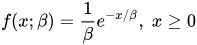
[edit]Some families of distributions use a rate parameter (or inverse scale parameter), which is simply the reciprocal of the scale parameter. So for example the exponential distribution with scale parameter β and probability density could equivalently be written with rate parameter λ as

Examples
[edit]- The uniform distribution can be parameterized with a location parameter of and a scale parameter .
- The normal distribution has two parameters: a location parameter and a scale parameter . In practice the normal distribution is often parameterized in terms of the squared scale , which corresponds to the variance of the distribution.
- The gamma distribution is usually parameterized in terms of a scale parameter or its inverse.
- Special cases of distributions where the scale parameter equals unity may be called "standard" under certain conditions. For example, if the location parameter equals zero and the scale parameter equals one, the normal distribution is known as the standard normal distribution, and the Cauchy distribution as the standard Cauchy distribution.


Estimation
[edit]A statistic can be used to estimate a scale parameter so long as it:
- Is location-invariant,
- Scales linearly with the scale parameter, and
- Converges as the sample size grows.
Various measures of statistical dispersion satisfy these. In order to make the statistic a consistent estimator for the scale parameter, one must in general multiply the statistic by a constant scale factor. This scale factor is defined as the theoretical value of the value obtained by dividing the required scale parameter by the asymptotic value of the statistic. Note that the scale factor depends on the distribution in question.
For instance, in order to use the median absolute deviation (MAD) to estimate the standard deviation of the normal distribution, one must multiply it by the factor where Φ−1 is the quantile function (inverse of the cumulative distribution function) for the standard normal distribution. (See MAD for details.) That is, the MAD is not a consistent estimator for the standard deviation of a normal distribution, but 1.4826... × MAD is a consistent estimator. Similarly, the average absolute deviation needs to be multiplied by approximately 1.2533 to be a consistent estimator for standard deviation. Different factors would be required to estimate the standard deviation if the population did not follow a normal distribution.

See also
[edit]References
[edit]- ^ Prokhorov, A.V. (7 February 2011). "Scale parameter". Encyclopedia of Mathematics. Springer. Retrieved 7 February 2019.
- ^ Koski, Timo. "Scale parameter". KTH Royal Institute of Technology. Retrieved 7 February 2019.
General references
[edit]- "1.3.6.4. Location and Scale Parameters". National Institute of Standards and Technology. Retrieved 2025-03-17.
Further reading
[edit]- Mood, A. M.; Graybill, F. A.; Boes, D. C. (1974). "VII.6.2 Scale invariance". Introduction to the theory of statistics (3rd ed.). New York: McGraw-Hill.


Scale parameter
View on GrokipediaDefinition and Mathematical Formulation
Core Definition
In probability theory and statistics, a scale parameter is a positive real number θ > 0 that governs the dispersion or spread of a probability distribution, effectively stretching or compressing the distribution along the horizontal axis while preserving its overall shape.[8] For a random variable with probability density function , the scaled random variable has the transformed density function given by where the factor ensures the density integrates to 1, maintaining the probabilistic normalization.[8] This transformation highlights how the scale parameter adjusts the variability: larger values of θ widen the distribution, increasing moments like the variance, while smaller values contract it.[6] The scale parameter is distinct from other types of parameters in distribution families. A location parameter μ shifts the entire distribution horizontally without altering its shape or spread, such as translating the support from one interval to another.[9] In contrast, a shape parameter modifies the fundamental form or asymmetry of the density, potentially changing skewness or the presence of tails, but does not simply rescale.[9] Scale parameters thus provide a multiplicative adjustment to the variable's magnitude, independent of these shifts or form changes. Many standard probability distributions are initially formulated in a normalized form with θ = 1, where the spread is fixed (often to unit variance or a specific range), and then generalized by incorporating a scale parameter to model varying levels of dispersion in real-world data.[6] This approach facilitates theoretical analysis and parameter estimation by separating the effects of scaling from location or shape. To illustrate intuitively, consider the uniform distribution on the interval (0, θ), assuming basic familiarity with probability density functions. Here, θ acts as the scale parameter, directly setting the length of the interval and thus controlling the variability: the density is constant at 1/θ over (0, θ), so larger θ spreads the probability mass over a wider range, increasing the variance from 0 (degenerate case) to θ²/12.[10] This example demonstrates how scaling intuitively adjusts the "width" of the distribution without shifting its position or changing its flat shape.Properties of Scale Parameters
Scale parameters exhibit invariance under affine transformations of the random variable, specifically remaining scales when the variable is multiplied by a positive constant. This property ensures that the standardized form of the distribution—obtained by dividing the variable by the scale parameter—is unchanged under such scalings, preserving the shape of the probability density function.[1] The effect of a scale parameter on the moments of a distribution is multiplicative according to the power of the moment. For a random variable with standard moments , the scaled variable has moments , where is the scale parameter. In particular, the variance scales quadratically, as . More generally, for a distribution with scale parameter relative to a standard form , the variance satisfies , highlighting how the scale controls the spread without altering higher-order shape characteristics.[6] Scale parameters are unique in their parameterization due to their identifiability and requirement to be positive real numbers, ensuring a one-to-one correspondence with the dispersion of the distribution within the parametric family. This positivity constraint avoids singularities in the density function and facilitates estimation, often leading to reparameterizations for interpretability, such as using the standard deviation as the scale parameter in the normal distribution, where the density is .[1] The concept of scale parameters was introduced in early 20th-century statistics by Karl Pearson, who developed the standard deviation as a measure of dispersion in his work on regression and variation around 1893–1895. In hypothesis testing, scale invariance ensures that test statistics for comparing dispersions, such as the F-test for equality of variances, remain unaffected by multiplicative changes in measurement units, enhancing robustness across different scales of data. This property is crucial in high-dimensional settings, where scale-invariant tests often outperform non-invariant alternatives by maintaining power under heteroscedasticity.[11][12]Parameter Relationships
Location-Scale Families
A location-scale family is a class of probability distributions parametrized by a location parameter and a scale parameter , obtained by applying an affine transformation to a base (or standard) distribution. Specifically, if follows the standard distribution with density , then the random variable belongs to the location-scale family associated with the distribution of . This framework captures shifts in location (via ) and stretches or compressions in scale (via ), while preserving the shape of the base distribution.[13][14] The probability density function of in a location-scale family is given by for , assuming the base distribution is continuous. Key properties include closure under affine transformations: if follows the family, then (with ) also belongs to the same family, with updated parameters and . Additionally, shape-dependent characteristics such as skewness and kurtosis remain invariant, while moments scale predictably (e.g., and ). The standard form, with and , serves as a reference for deriving properties of any member distribution.[13][15] Prominent examples of location-scale families include the normal distribution (standard base: standard normal), the Cauchy distribution (standard base: standard Cauchy), and the logistic distribution (standard base: standard logistic), each allowing flexible modeling of central tendency and dispersion while retaining their characteristic tails and symmetry. These families are important in statistics because they enable standardization of data across different units or scales, facilitating comparative inference and hypothesis testing without altering the underlying distributional form. For instance, transforming observations to the standard scale simplifies the computation of test statistics and confidence intervals.[13][7] In computational contexts, location-scale families offer significant advantages for simulation and Monte Carlo methods. Random variates can be generated efficiently by first sampling from the standard base distribution—often using well-optimized algorithms—and then applying the simple affine transformation , which avoids the need for complex rejection sampling or inversion techniques tailored to each parameter set. This approach enhances scalability in Monte Carlo integration, where expectations or integrals are evaluated by standardizing to the base form, reducing variance and computational overhead in high-dimensional or repeated simulations. Such efficiencies underpin applications in Bayesian inference and risk analysis, where rapid generation of diverse scenarios is essential.[16][17]Relation to Rate Parameters
In probability distributions, particularly those modeling waiting times or lifetimes, the rate parameter is defined as the reciprocal of the scale parameter , such that . This inverse relationship is fundamental in distributions like the exponential, where the scale parameter represents the characteristic time or mean lifetime, and the rate parameter denotes the hazard or failure rate per unit time.[18]/14%3A_The_Poisson_Process/14.02%3A_The_Exponential_Distribution) The choice between scale and rate parameterization influences interpretive focus: the scale parameter is preferred when emphasizing dispersion, as it directly relates to the standard deviation (equal to in the exponential case), while the rate parameter is used to highlight event intensity, such as occurrences per unit time in processes like radioactive decay or customer arrivals.[19] For the exponential distribution, this duality is evident in the probability density function, which can be written equivalently as or with .[18]/14%3A_The_Poisson_Process/14.02%3A_The_Exponential_Distribution) Reparameterization from scale to rate affects the likelihood function's form—for instance, the log-likelihood involves terms linear in rather than —and alters interpretive nuances, with rate often favored in Poisson processes where directly quantifies the average event rate.[18] The rate parameterization gained prominence in reliability engineering during the mid-20th century, particularly post-1950s, as the field formalized amid military and aerospace demands for modeling constant failure rates in electronic components.[20][21] This shift aligned with the exponential distribution's role in survival analysis, where as failure rate provided intuitive links to system dependability.[22] Software implementations reflect these preferences, potentially leading to interoperability challenges; R's core statistical functions (e.g.,dexp) parameterize the exponential distribution by rate , defaulting to mean , whereas Python's SciPy expon uses scale as the primary parameter.[23][24]