


Community hub
Recent from talks
Contribute something
Nothing was collected or created yet.
Larz Anderson
View on Wikipedia
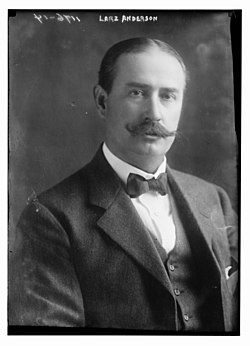
Larz Anderson (August 15, 1866 – April 13, 1937) was an American diplomat and bon vivant. He served as second secretary at the United States Legation to the Court of St James's, London; as first secretary and later chargé d'affaires at the United States Embassy in Rome; as United States Minister to Belgium; and then briefly as the Ambassador to Japan. He also unsuccessfully sought appointment as Ambassador to Italy.
Key Information


Life
[edit]Early life
[edit]Anderson was the son of Brevet Major General Nicholas Longworth Anderson and Elizabeth Coles Kilgour Anderson. He was born in Paris on August 15, 1866,[1] while his Cincinnati, Ohio, parents, who had married on March 28, 1865, were on their planned year-long honeymoon, which was extended six months due to the birth of their son.[2] He was the great-grandson of Lieutenant Richard Clough Anderson Sr., who served in the American Revolution. He was also the grandnephew of Brigadier General Robert Anderson, who defended Fort Sumter at the beginning of the American Civil War.
Anderson attended Phillips Exeter Academy in Exeter, New Hampshire, before attending Harvard College.[1] At Harvard, he was a member of the Hasty Pudding Club, the A.D. Club, the Institute of 1770, Alpha Delta Phi, and Delta Kappa Epsilon. After graduating in 1888, Anderson set out on a year-and-a-half grand tour that included his first visit to Japan.[1] When he returned to the U.S., Anderson attended Harvard Law School for two semesters during the 1890–91 academic year.
Diplomatic career
[edit]
In June 1891, after Anderson had dropped out of Harvard Law School, his father interceded with his 1858 Harvard classmate Robert Todd Lincoln, son of President Abraham Lincoln, who was then serving as the U.S. minister to the Court of St. James's in London. Lincoln offered Anderson the job of second secretary of the American legation in London.[3] In 1894, after three years in London, Anderson was appointed first secretary of the American embassy in Rome and then, in 1897, served for several months as chargé d'affaires, until he resigned to return to the U.S. for his wedding to Isabel Weld Perkins.[1] His resignation was at the time controversial, and American newspapers reported on his months-long efforts to be released from his post by the U.S. Department of State.[4][5]
Anderson returned to the diplomatic corps in 1911 as United States Minister to Belgium, serving from November 18, 1911 until November 15, 1912, when he was appointed Ambassador to Japan. He held this post as a fully accredited and confirmed American ambassador for only one day, March 3, 1913, though he was in Japan from December 28, 1912, until his return to the United States on March 16, 1913. He resigned when the Republican administration of William Howard Taft was replaced by the Democratic administration of Woodrow Wilson.[6][7] The exact reasons for his resignation and departure from Japan are not clear. One American newspaper reported that he left his Tokyo post "because the Japanese government had declined to receive him."[8]
When Anderson was appointed Minister to Belgium, he had an elaborate diplomatic uniform made for himself in London by the firm of Davies & Son, tailors to British royalty. Though he was famously photographed and painted wearing it, he never wore the elaborate, custom-made quasi-military uniform in public, once writing in his journal that the "Diplomatic uniform is in the dress of a minister of the 'first-class' (which I am) and is the one which I do not wear."[9] Some have claimed based on the photograph that Anderson's uniform was one of the few worn by an American diplomat since the early 1800s, but a public law dating to 1867 prohibited diplomats from wearing any uniform not approved by Congress, and Anderson observed that law.[10] In 1937, President Franklin Roosevelt proscribed American diplomats from wearing any uniform. Anderson's uniform is on display at Larz Anderson House.
Though it has often been said that he "retired from the diplomatic corps" after leaving Japan, he remained open to another assignment. In 1923 he actively though unsuccessfully sought nomination as U.S. Ambassador to Rome under President Calvin Coolidge.[11] He later recalled that he was "the first American to rise all the way through the diplomatic ranks from the lowest position to the highest." Anderson and his wife, Isabel, spent the next twenty-five years traveling extensively at home and abroad; collecting memorabilia and decorative arts; expanding the mansion and gardens of their summer home "Weld" in Brookline, Massachusetts, now the Larz Anderson Park; funding the construction of the Anderson Memorial Bridge across the Charles River in Boston and Cambridge, Massachusetts; and funding the construction and interior decoration of the Lady Chapel of the Washington National Cathedral.
According to sources cited by his biographer, Anderson's diplomatic record was an embarrassment to President William Howard Taft; the Senate Foreign Relations Committee refused to confirm him as United States Ambassador to Japan in 1913 even after he had assumed his post there. Richard W. Leopold, reviewing a volume of Anderson's letters, wrote that they contained "little of value":
Comments on those vital economic, social, and intellectual forces that shape foreign policy are wholly absent. Anderson seems to have been blissfully unaware of or unconcerned with the factors making for Anglo-American friendship in the early [eighteen]-nineties. His diaries shed no new light on Italian-American relations during the same decade. Although he was at Brussels just before the World War and at Tokyo in a critical moment in Far Eastern affairs, Anderson recorded nothing of importance. Instead, his pages are devoted solely to royal receptions, embassy parties, and other trivialities that are merely the trappings of diplomatic life.[12]
George E. Mowry wrote that Anderson "never allowed his official duties to interfere with his lengthy and verbose unofficial reporting of society's meaningless activities ... If the selections published are a true sample of the bulk of the writings that Mr. Anderson chose to preserve for posterity, they say little for the author and as little for the government that hired him for responsible positions."[13]
Military service
[edit]In 1898, he registered to serve with the U.S. Volunteers during the Spanish–American War. He was commissioned May 12 as a captain and served for four months as an assistant adjutant general at Camp Alger in northern Virginia.[1] He later received the Spanish War Service Medal, awarded to all who served on active duty in the United States Army anytime between 20 April 1898 and 11 April 1899 who were not deployed to a combat zone. During his service, he rode a famous horse, "Soldier Boy," that had once been owned by Buffalo Bill Cody, and was immortalized by Mark Twain in his novel "A Horse's Tail." Twain called Soldier Boy "a wonder of a horse" with "a reputation which is as shining as his own silken hide."[14][15]
Marriage to Isabel Weld Perkins
[edit]In 1896, while serving as First Secretary at the United States Embassy in Rome, Italy, Anderson met Isabel Weld Perkins, a young debutante from Boston who was then on her grand tour of Europe, Egypt, and the Holy Land. Their mutual friend Maud Howe Elliott introduced them to each other on the roof of her home, the Villa Rusticucci in Rome.[16] Both Larz and Isabel's families established themselves in America before the American Revolution. The Anderson family had arrived in Jamestown 1634; and the Welds in the Massachusetts Bay Colony in 1632. The Anderson family's wealth was primarily in land and real estate holdings in the midwest, but their resources did not compare to those of the Weld Family.
In 1881, when Isabel was five years old, she inherited slightly more than 5 million dollars from her grandfather, William Fletcher Weld.[17] Her inheritance was held in a trust for her until her twenty-fifth birthday.
Larz and Isabel were married at Arlington Street Church in Boston on June 10, 1897,[1] and they embarked on a life of luxury combined with public service and adventure. They traveled widely across the world as well as through North America, visiting five continents and becoming among the first Westerners to visit countries such as Tibet and Nepal. No children were born to the marriage. Isabel authored several books, including a history of the Weld shipping enterprise, Under the Black Horse Flag.
Memberships
[edit]Anderson was admitted to the Maryland Society of the Cincinnati in 1894, following the death of his father. He was eligible for membership in the Society of the Cincinnati by virtue of being the great grandson of Lieutenant Colonel Richard Clough Anderson of Virginia, one of the founding members of the organization. Normally, members of the Society join the Society of the state from which their ancestor served. In Anderson's case, the Virginia Society was inactive and 1894 and would not be revived until 1896.
Anderson was a loyal member of the Society and had various motifs based on the Society's insignia incorporated into the decoration of their Washington mansion, Anderson House, along with those of other organizations he was connected with. After his death, Isabel Anderson donated Anderson House to the Society. It now serves as its international headquarters.
By right of his father's service in the Union Army, Anderson was elected as a Hereditary Companion of the Massachusetts Commandery of the Loyal Legion on February 1, 1903. He was assigned insignia number 9997.
He was also a member of several other hereditary and patriotic organizations, including the Sons of the Revolution and the Naval and Military Order of the Spanish War.
Because of his diplomatic service, Anderson was invested with the Order of Saints Maurice and Lazarus (Italy), the Order of the Crown (Italy), the Order of the Rising Sun (Japan), and the Order of the Crown (Belgium).
Anderson's religious affiliation was Episcopalian.
Death
[edit]Anderson died in White Sulphur Springs, West Virginia, and was interred at Washington National Cathedral,[18] where his remains rest in the St. Mary Chapel with those of his wife. The Andersons had no children.
Racism and antisemitism
[edit]Anderson's diaries and journals often expressed virulent racism and anti-Semitism. During a 1907 vacation in Florida aboard his houseboat, he wrote:
Some darkey singers I had engaged to sing my Isabel to sleep simply failed to materialize (one white citizen who was standing gazing at us, to whom I spoke of my disappointment at their failure, said the only way to get a nigger to do anything was to get the police to 'ask' him to do it) – so I'll ask police aid the next time I want a concert.[19]
Visiting Prague in 1906, Anderson wrote of "narrow, winding, dirty, smelly streets with hooknosed Jews peering out of cellar doors."[20] He also blamed a string of Harvard football losses on the fact that coach Arnold Horween was Jewish.[21]
Homes and collections
[edit]
Anderson Memorial Bridge, connecting Boston and Cambridge, Massachusetts, is often called "Larz Anderson Bridge"; in fact it was built by Anderson in memory of his father Nicholas Longworth Anderson.
Anderson House
[edit]Between 1902 and 1905, the Andersons built a Beaux Arts mansion in the fashionable Dupont Circle neighborhood of Washington, D.C. Known as Anderson House, the mansion was the couple's winter residence during the Washington social season, which generally extended from New Year's Day through Easter. After Larz's death, Isabel Anderson donated Anderson House in 1938 to the Society of the Cincinnati, of which Anderson was a member, and it now serves as its national headquarters.
New Hampshire
[edit]After her father's death Isabel Anderson purchased her father's birthplace in Contoocook, New Hampshire, a village of Hopkinton. She occasionally stayed in the house, but preferred her own small, rustic summer camp in a rural area of southern New Hampshire that she used as a writing retreat and for visits with her relatives.[22] The Perkins house has since been sold and divided into eight apartments and is now known as Perkins Manor.[23]
Weld
[edit]In 1898, the Andersons came into the possession of 64 acres (26 hectares) near the outskirts of Boston that had been in Isabel's family since the mid-19th century. Isabel named the property Weld in honor of her grandfather William Fletcher Weld and the estate became the Andersons' home for summers and Christmas holidays for the next forty years. At the time they acquired the property, it included a shingle-style summer home that had been built in 1881 by Boston architect Edmund M. Wheelwright for Isabel's cousin William Fletcher Weld II.
The Andersons added gardens, landscaping, a large kitchen garden including a greenhouse and outbuildings, a tennis court, and a small pond to the estate. Over time, the couple acquired an additional 7 acres (2.8 ha) of adjacent land, where Larz built three smaller mansions that were used as guest housing and storage. In 1914-16, after his return from diplomatic service abroad, Larz engaged the firm of Little & Browne to more than double the size of the mansion. Larz directed that architectural design elements from Lulworth Castle, an ancestral home associated with the Roman Catholic branch of the Weld family, be incorporated into the structure. Isabel willed the estate, including all land and buildings, to the Town of Brookline after her death in 1948 and it is now Larz Anderson Park.[24]
Auto Collection
[edit]The Andersons had assembled an extraordinary collection of horse-drawn carriages, sleighs and vintage motorcars. In donating these along with the property, Isabel Anderson stipulated in her will that these be known as the "Larz Anderson Collection." Fourteen of the original thirty-two vehicles remain in the collection and are still on display as part of the Larz Anderson Auto Museum, the oldest collection of motorcars in the United States. The collection is housed in the stable of the Weld Estate in Brookline, Massachusetts.[25]
Bonsai Collection
[edit]After Larz's death, Isabel donated 30 of their bonsai to the Arnold Arboretum of Harvard University, along with the funds necessary to build a shade house for their display. Following her death, the remaining nine plants were donated to the arboretum, including an 80-year-old hinoki cypress that had been given to the Andersons by the Imperial Household shortly before they left Japan for the last time.[26]
The BC Eagle
[edit]During the time they were in Tokyo, Japan, the garden of the American Embassy was adorned with a gilded bronze eagle sculpture which stood in front of the structure.[27] The Andersons brought the eagle back to the United States and it remained on their Brookline property until 1954, when it was donated to Boston College and installed on the lawn in front of the university's Alumni House [28] before being relocated to a place of prominence on Linden Lane, in front of the university's iconic Gasson Tower. It is now considered synonymous with the "BC Eagle", the university's mascot.[29]
References
[edit]- ^ a b c d e f Marquis Who's Who, Inc. Who Was Who in American History, the Military. Chicago: Marquis Who's Who, 1975. P. 11 ISBN 0837932017 OCLC 657162692
- ^ Stephen T. Moskey, Larz and Isabel Anderson: Wealth and Celebrity in the Gilded Age, Bloomington, IN: iUniverse, 2016, p. 6.ISBN 978-1-4917-8874-5 OCLC 946482599
- ^ Stephen T. Moskey, Larz and Isabel Anderson: Wealth and Celebrity in the Gilded Age, Bloomington, IN, 2016, pp. 23-24.
- ^ "Wish to Get Out of Office. A Secretary of Embassy Wants to Come Home to Get Married," New York Times, March 25, 1897.
- ^ "Offices and Office-Seekers," Washington Post, March 27, 1897, p. 6.
- ^ Larz Anderson Diplomatic Personnel File. Applications and Recommendations for Appointment to Consular and Diplomatic Services, 1901–1924. Taft, box 5. Record Group 59. National Archives and Records Administration, College Park, MD.
- ^ Stephen T. Moskey, Larz and Isabel Anderson: Wealth and Celebrity in the Gilded Age, Bloomington, IN, 2016, pp. 195–203.
- ^ "Envoy Coming Home," Washington Post, March 16, 1913, p. 12.
- ^ Larz Anderson, A Mission to Belgium. Legation in the Palais d'Assche–Volume 1. Courts and Customs and Contretemps in Brussels [1911–1912], Washington, DC, Archives of the Society of the Cincinnati, Acc. No. MSS L2004G19 v. 16, pp.216–17.
- ^ Statutes at Large, Fortieth Congress, Session I, Res. 15, approved 27 March 1867, p. 23.
- ^ Larz Anderson letter to Charles Evans Hughes, October 12, 1923. Applications and Recommendations for Appointment to Consular and Diplomatic Services, 1901–1924. Coolidge, Box 5. Record Group 59. National Archives and Records Administration, College Park, MD.
- ^ Richard W. Leopold, "Review of Larz Anderson: Letters and Journals of a Diplomat, by Isabel Anderson.: New England Quarterly 13:4 (1940): 731–33.
- ^ George E. Mowry, "Review of Larz Anderson: Letters and Journals of a Diplomat," Mississippi Valley Historical Review 28:1 (1941): 116–17.
- ^ Larz Anderson,Letters and Journals of a Diplomat, edited by Isabel Perkins, New York, NY, 1940, p. 162.
- ^ Mark Twain, A Horse's Tale, New York, NY, 1906, p.24.
- ^ Maud Howe Elliott, John Elliott: The Story of an Artist, Boston, MA: Houghton Mifflin, 1930, p. 94.
- ^ Stephen T. Moskey, Larz and Isabel Anderson: Wealth and Celebrity in the Gilded Age, Bloomington, IN: iUniverse.com, 2016, p. 36-37.
- ^ Kestenbaum, Lawrence. "The Political Graveyard: Index to Politicians: Anderson, K to N".
- ^ Moskey, Larz and Isabel Anderson: Wealth and Celebrity in the Gilded Age, p. 148.
- ^ Moskey, op. cit., p. 148-149.
- ^ Moskey, op. cit., p. 149.
- ^ Stephen T. Moskey, Larz and Isabel Anderson: Wealth and Celebrity in the Gilded Age, Bloomington, IN, 2016, pp. 127-133.
- ^ "Perkins Manor". Archived from the original on October 13, 2006.
- ^ Stephen T. Moskey, Larz and Isabel Anderson: Wealth and Celebrity in the Gilded Age, p. 36-37.
- ^ Larz Anderson Auto Museum Archived 2006-07-15 at the Wayback Machine
- ^ Larz Anderson Bonsai Collection at Arnold Arboretum Archived 2006-12-06 at the Wayback Machine
- ^ "The PDF Walking Tour Guide Archived 2007-09-28 at the Wayback Machine published by the Larz Anderson Auto Museum notes "The bronze eagle that perched on a stone plinth in the garden may reference the Anderson family's military service. In Japan, the eagle is a Guardian [sic], warding off evil spirits. In this county, the eagle is used as a symbol of the United States. It is also the symbol of the Society of the Cincinnati, of which Larz was a member."
- ^ Boston College Website: The BC Eagle Archived 2006-09-09 at the Wayback Machine
- ^ Donovan, Charles F. History of Boston College: From the Beginnings to 1990; University Press of Boston College, September 1990, p. 266
Bibliography
[edit]- Isabel Anderson, ed., Larz Anderson: Letters and Journals of a Diplomat (New York: Fleming H. Revell, 1940).
- Isabel Anderson, Under the Black Horse Flag (Boston: Houghton Mifflin, 1926).
- Larz Anderson, “Since Thirty Years.” In: America to Japan: A Symposium of Papers by Representative Citizens of the United States on the Relations between Japan and America and on the Common Interests of the Two Countries, edited by Lindsay Russell (New York: G. P. Putnam's Sons, 1915): 76-80.
- Peter Del Tredici: "Early American Bonsai: The Larz Anderson Collection of the Arnold Arboretum", Arnoldia (Summer 1989).
- Stephen T. Moskey, Larz and Isabel Anderson: Wealth and Celebrity in the Gilded Age (Bloomington, IN: iUniverse, 2016) ISBN 978-1-4917-8874-5 OCLC 946482599.
| Resident Minister | |
|---|---|
| Envoy Extraordinary and Minister Plenipotentiary | |
| Ambassador Extraordinary and Plenipotentiary | |


| Chargé d'Affaires |  | |
|---|---|---|
| Minister Resident | ||
| Envoy Extraordinary and Minister Plenipotentiary | ||
| Ambassador Extraordinary and Plenipotentiary | ||

| International | |
|---|---|
| National | |
| Other | |

Larz Anderson
View on GrokipediaEarly Life and Ancestry
Birth and Family Background
Larz Anderson was born on August 15, 1866, in Paris, France, during his parents' honeymoon trip abroad.[2][5][4] He was the son of Brevet Major General Nicholas Longworth Anderson (1838–1892), a Union Army officer who rose to prominence during the American Civil War, and Elizabeth Coles Kilgour (1843–1917), a member of Cincinnati's social elite whose family held significant influence in the city's early development.[2][6] The Andersons returned to Cincinnati, Ohio, shortly after his birth, where Larz was raised amid the privileges of a wealthy industrial family; Cincinnati served as the base for the Anderson lineage, which had built fortunes through real estate, banking, and manufacturing.[3][7] The Anderson family traced its American origins to English settlers who arrived at Jamestown, Virginia, in 1634, establishing a lineage that intertwined with key figures in frontier expansion and civic leadership.[8] Larz's paternal great-grandfather, Nicholas Longworth (1782–1863), epitomized this success as Cincinnati's first millionaire, amassing wealth primarily through vineyard cultivation and property investments that shaped the city's growth into a major Midwestern hub.[5][7] This heritage of military service, entrepreneurship, and social standing provided Anderson with early exposure to transatlantic connections and elite networks, influencing his later diplomatic pursuits.[2]Childhood and Upbringing
Larz Anderson was born on August 15, 1866, in Paris, France, while his parents, American citizens Nicholas Longworth Anderson—a brevet major general who served in the Union Army during the Civil War—and Elizabeth Coles Kilgour, a Cincinnati socialite, were traveling abroad shortly after their marriage.[5][8] The Anderson family descended from early American elites, with wealth tracing back to Lt. Col. Richard Clough Anderson, a Revolutionary War officer and great-grandfather whose post-war land grants in Kentucky formed the basis of the family's fortune; Richard Clough Anderson was also an original member of the Society of the Cincinnati.[2] Raised primarily in Cincinnati, Ohio, amid the city's affluent circles, Anderson experienced a privileged childhood shaped by his father's military legacy and the family's social prominence.[9][2] In approximately 1881, at age 15, the family moved to Washington, D.C., where they occupied a residence at 16th and K Streets, designed by noted architect Henry Hobson Richardson.[2] Anderson had a younger sister, Elsie, and grew up in an environment emphasizing patriotic service, with multiple relatives having contributed to American military and civic endeavors.[2] This upbringing, rooted in established wealth and historical ties to the nation's founding, instilled values of duty and refinement that later influenced his diplomatic career.[2]Education and Early Career
Harvard Education
Larz Anderson entered Harvard College in the fall of 1884, following his graduation from Phillips Exeter Academy that year.[9] He completed the standard undergraduate curriculum, which emphasized classical studies, rhetoric, and composition, and received his Bachelor of Arts degree in June 1888.[2][5] As part of Harvard's English department requirements during his time there, Anderson submitted weekly essays for courses like English 12, spanning from February 1885 to June 1887; these "daily themes" honed analytical writing skills central to the era's liberal arts education.[10] His academic record reflected the privileges of his family's wealth and connections, though specific grades or honors are not prominently documented in available records.[8] After a year-and-a-half grand tour of Europe post-graduation, Anderson enrolled in Harvard Law School for the 1890–1891 academic year.[11] He attended for two semesters but withdrew in spring 1891 without earning a degree, opting instead for a diplomatic path facilitated by family influence.[12][11] This brief legal studies stint aligned with common trajectories for scions of elite families seeking professional credentials before public service, though Anderson's disinterest in sustained academic rigor foreshadowed his aversion to conventional careers.[11]
Initial Diplomatic Entry
Larz Anderson entered the United States diplomatic service in 1891, shortly after withdrawing from Harvard Law School following one year of study.[13] His appointment as second secretary to the American legation in London was facilitated by family connections, including the influence of his father, Charles Anderson, and Ambassador Robert Todd Lincoln, son of President Abraham Lincoln.[5][9] This position marked the beginning of his career in foreign service under President Benjamin Harrison's administration.[14] During his tenure in London from 1891 to 1894, Anderson handled junior diplomatic duties, including assisting with protocol, correspondence, and entertaining visiting American dignitaries at the legation, which later became the embassy.[15][16] National Archives records confirm his role as second secretary starting around July 27, 1891.[17] The posting provided Anderson with exposure to international affairs and British society, aligning with his social background and preparing him for subsequent advancements.[18] In 1894, Anderson was promoted and transferred to the American embassy in Rome as first secretary, signaling early recognition of his capabilities within the diplomatic corps.[5] This initial phase of service established the foundation for his later roles, though he temporarily left diplomacy after 1897 before returning in 1911.[13]Diplomatic Service
Key Postings and Promotions
Anderson entered the United States diplomatic service in 1891 as second secretary of the legation to the Court of St. James's in London, where he served until 1894.[2][18] In that year, he received a promotion to first secretary at the United States embassy in Rome, Italy, and later acted as chargé d'affaires there until 1897.[5] After resigning from the diplomatic corps in 1897 to pursue private business and political ambitions, Anderson returned to service in 1911 under President William Howard Taft. He was appointed envoy extraordinary and minister plenipotentiary to Belgium on August 12, 1911, presenting credentials on November 18, 1911, and serving until his mission terminated on December 1, 1912.[1] In a further promotion, Anderson was commissioned during a Senate recess as ambassador extraordinary and plenipotentiary to Japan on November 14, 1912, with formal confirmation leading to recommissioning on March 1, 1913; he presented credentials on February 1, 1913, but departed Japan on March 15, 1913, following the inauguration of President Woodrow Wilson, whose Democratic administration did not retain Republican appointees.[1][19] This brief tenure marked the pinnacle of his diplomatic promotions, after which he retired from active service but continued to refer to himself as "Ambassador Anderson."[2]Ambassadorships to Belgium and Japan
Anderson was appointed Envoy Extraordinary and Minister Plenipotentiary to Belgium on August 12, 1911, following a period away from active diplomatic service.[1] He presented his credentials to the Belgian government on November 18, 1911, and held the position until December 1, 1912.[1] During this tenure, which preceded the outbreak of World War I by nearly two years, Anderson managed routine diplomatic relations between the United States and Belgium, including commercial and consular matters, though no major crises or specific negotiations are prominently recorded in official diplomatic records under his direct oversight.[1] He commissioned a formal diplomatic uniform for the posting in 1911, reflecting the era's emphasis on ceremonial protocol in European courts.[20] On November 14, 1912, Anderson received a promotion to Ambassador Extraordinary and Plenipotentiary to Japan, marking the pinnacle of his career under President William Howard Taft's Republican administration.[1] His initial commission occurred during a Senate recess, with formal recommissioning on March 1, 1913, following Senate confirmation.[1] Anderson presented credentials to Japanese authorities on February 1, 1913, but his ambassadorship lasted only until March 15, 1913, when he departed Japan.[1] The brevity stemmed from the March 4, 1913, inauguration of Democratic President Woodrow Wilson, prompting Anderson's resignation as a political appointee loyal to the prior administration—a common practice for such high-level diplomatic roles at the time.[1][21] He sailed from Yokohama aboard the SS Manchuria with his wife, Isabel, returning to the United States without notable incidents or policy achievements documented in his short term, amid ongoing U.S.-Japan relations focused on trade and naval agreements like the recently expired Gentlemen's Agreement of 1907.[21] This concluded his active diplomatic career, after which he did not seek further government postings.[1]Military Involvement
Spanish-American War Service
In 1898, at the outset of the Spanish-American War, Larz Anderson volunteered for military service with the United States Volunteers and received a commission as a captain in the U.S. Army.[22] His role involved administrative duties rather than frontline combat, reflecting the organizational demands of mobilizing volunteer forces during the conflict.[4] Anderson was assigned as Assistant Adjutant General of the Second Army Corps, a position that entailed coordinating staff operations, record-keeping, and logistical support under the corps command structure.[4] [23] This service lasted approximately four months, aligning with the rapid U.S. campaign in Cuba and Puerto Rico, after which he returned to civilian pursuits.[22] For his active-duty participation between April 20, 1898, and the war's conclusion, Anderson later qualified for the Spanish War Service Medal, a retroactive recognition awarded to veterans of that era's U.S. Army service.[24] During this period, he also joined the Society of the Cincinnati, a hereditary organization honoring Revolutionary War descendants, underscoring his family's longstanding military tradition.[23]World War I Contributions
During World War I, Larz Anderson supported the Allied war effort through his Washington residence, Anderson House, which served as a venue for diplomatic and military coordination. In June 1917, shortly after the United States entered the conflict, Anderson hosted meetings of the Belgian War Commission—comprising high-ranking Belgian military officers, diplomats, and officials—at his Dupont Circle mansion. These gatherings facilitated discussions with American counterparts, including State Department personnel and U.S. military representatives, on matters of aid, strategy, and support for the occupied Kingdom of Belgium, where Anderson had previously served as U.S. minister from 1911 to 1912.[25] The commission presented Anderson and his wife with autographed photographs in recognition of their hospitality, highlighting the residence's role in wartime diplomacy.[2] Anderson's contributions extended to broader relief initiatives, drawing on his prior diplomatic ties to Belgium and his family's tradition of patriotic service. He participated in World War I relief activities, aligning with efforts to assist Allied nations and American troops, though his involvement emphasized logistical and social support rather than frontline duty. At age 51 upon U.S. entry into the war, Anderson did not return to active military service, unlike his earlier commission as a captain during the Spanish-American War, but his hosting and networking aided transatlantic solidarity.[2][1]Personal Life
Marriage to Isabel Weld Perkins
Larz Anderson met Isabel Weld Perkins in Rome in 1896, where he was serving at the American embassy and she was undertaking a grand tour of Europe.[2] Their courtship, which began that year, lasted eighteen months and reflected the social circles of prominent American families—Anderson from Cincinnati's elite with ties to Revolutionary War heritage, and Perkins from Boston's established Weld lineage.[2] The couple married on June 10, 1897, at noon in Boston's Arlington Street Church, a venue befitting Isabel's native city's traditions.[26] The ceremony drew Boston luminaries, including Massachusetts Governor Roger Wolcott, underscoring the unions' social prominence.[26] The wedding reception occurred at the Perkins family home on 123 Commonwealth Avenue and her aunt's adjacent residence, highlighting the event's scale within Back Bay's Gilded Age elite.[27] Following the wedding, Anderson and Perkins honeymooned extensively in East Asia, a journey that sparked their lifelong interest in Japanese decorative arts and global collecting.[2] Their childless marriage, enduring until Larz's death in 1937, was marked by shared pursuits in diplomacy, philanthropy, and travel, with Isabel's inherited wealth from the Weld and Perkins families enabling an opulent lifestyle across residences in Washington, D.C., Brookline, Massachusetts, and New Hampshire.[2][9]Social Memberships and Interests
Anderson was a member of the Society of the Cincinnati, an organization of descendants of Continental Army officers, through his great-grandfather Lieutenant Colonel Richard Clough Anderson of the Revolutionary War.[2] He also belonged to the Sons of the American Revolution, the Military Order of the Loyal Legion of the United States (in right of his father, Civil War General Nicholas Longworth Anderson), and the Order of the Spanish-American War, reflecting his family's military heritage and his own service in 1898.[2] Additionally, he was affiliated with the Alibi Club, an exclusive Washington gentlemen's club founded in 1884, to which he donated architectural drawings preserved in its collection.[28] Beyond formal affiliations, Anderson pursued diverse personal interests shaped by his global experiences and era's innovations. He developed a passion for automobiles, amassing one of the earliest private collections in the United States, beginning with a 1899 Winton Runabout and eventually including over 30 vehicles stored at his Brookline estate.[2] [9] His hobbies extended to aviation, theater attendance, and acquiring art and artifacts encountered during diplomatic postings, including Native American pottery and textiles displayed in his residences.[2] [8] Anderson also engaged in World War I relief initiatives, supporting humanitarian efforts amid his patriotic commitments.[2]Properties and Collections
Principal Residences
The Andersons maintained two principal residences: the estate known as Weld in Brookline, Massachusetts, which served as their primary summer home, and Anderson House in Washington, D.C., used as a winter residence to support Larz Anderson's diplomatic entertaining. In 1899, shortly after their 1897 marriage, Larz and Isabel Anderson purchased the 64-acre Weld estate in Brookline from her cousin William Weld, originating from land assembled by Isabel's grandfather William Fletcher Weld between 1841 and 1881.[29] [30] The couple expanded the property into a prominent country estate, naming it Weld in honor of her grandfather and commissioning landscape architect Charles A. Platt to design formal gardens in 1901, which influenced early 20th-century American landscaping.[9] [31] They utilized the estate for extensive entertaining, philanthropy, and hosting guests across social classes, reflecting Isabel's commitment to openness despite their elite status.[9] Following Larz's death in 1937, Isabel retired to Weld, continuing these activities until her death in 1948, after which she bequeathed the land to the Town of Brookline, transforming it into the public Larz Anderson Park.[9] Anderson House, situated at 2118 Massachusetts Avenue, NW, on Embassy Row, was built from 1902 to 1905 as the Andersons' winter home, costing $750,000.[32] Boston architects Arthur Little and Herbert Browne designed the 50-room Beaux-Arts mansion with opulent interiors featuring carved wood paneling, gilded ceilings, marble floors, ornate ironwork, and advanced conveniences such as electricity, central heating, telephones, and two elevators; it also included a walled garden, tennis court, and three-story carriage house.[32] Conceived to advance Larz's diplomatic prospects, the residence hosted seasonal events from New Year's to Easter, including diplomatic receptions, dinners, concerts, and gatherings for figures like Presidents Taft and Coolidge, General Pershing, and members of the Vanderbilt family, while displaying the couple's art and artifacts.[32] The Andersons occupied it until Larz's death in 1937, after which Isabel transferred ownership to the Society of the Cincinnati in 1939, preserving it as a historic house museum.[32]Automotive and Maritime Collections
Larz and Isabel Anderson assembled one of the earliest private automobile collections in the United States, beginning with the acquisition of a 1899 Winton 4-horsepower Runabout, recognized as the second automobile registered in Massachusetts.[33] Over the subsequent decades, until Isabel's death in 1948, the couple expanded the holdings to 32 motorcars alongside horse-drawn carriages, reflecting their enthusiasm for emerging automotive technology during international postings and domestic travels.[33] Notable vehicles included early steamers, electrics, and gasoline-powered models from manufacturers such as Winton, Fiat, and Mercedes, used for both practical transport and leisure motoring across Europe and America.[34] Following Isabel Anderson's death on November 24, 1948, the collection—comprising approximately 14 surviving automobiles from the original 32—was bequeathed to the Veteran Motor Car Club of America (VMCCA), which established the Larz Anderson Auto Museum in the carriage house of their Brookline estate, now Larz Anderson Park.[33] [35] This repository, opened to the public in 1950, preserves the vehicles as a testament to pioneering American auto culture, with the 1899 Winton serving as a centerpiece exemplifying transitional horseless carriage design.[33] The Andersons' maritime engagements centered on chartered vessels rather than extensive ownership, including the steam-powered houseboat Roxana, rented in early 1906 for East Coast explorations from New York marinas, and the yacht Virginia, chartered for an open-ocean voyage amid inclement weather.[36] [37] Isabel Anderson chronicled such experiences in her 1930 publication A Yacht in Mediterranean Seas, drawing from Mediterranean charters that informed her travelogues and reflected a personal affinity for seafaring amid diplomatic sojourns.[38] Their tangible maritime holdings included scale models and nautical artifacts, such as a large gaff-rigged pond yacht measuring 60 inches long by 10 inches wide by 82 inches high, with planked varnished hull and brass mounts, auctioned from the Brookline estate in 2008.[39] Additional items, including a scale model of the presidential steam yacht Mayflower (20th century, 50 x 15 x 58 inches) and other ship models, surfaced in marine auctions held at the Larz Anderson Auto Museum venue, indicating a curated interest in maritime replicas alongside broader artifact accumulations from global travels.[40] These elements complemented Isabel's inspirational sailing off Florida's coast around 1907, which spurred her 1909 children's book The Great Sea Horse.[26]Art and Artifact Collections
Larz and Isabel Anderson assembled a diverse collection of fine and decorative arts, emphasizing European furnishings, Asian decorative objects, and Native American handicrafts acquired during their global travels and diplomatic postings. European acquisitions included English paintings and French furniture, selected to complement the Beaux-Arts interiors of their Washington residence, Anderson House.[41] Asian pieces, particularly from Japan, formed a core of the holdings, reflecting the couple's affinity for Meiji-era aesthetics developed during Larz's ambassadorship there from 1912 to 1914 and earlier visits.[42] The Andersons' Japanese collection encompassed porcelain, ivories, lacquerware, and folding screens, with initial purchases made on their 1897 honeymoon trip, when they documented acquisitions in personal photograph albums.[43] These items were integrated into domestic displays at Anderson House, blending Eastern motifs with Western architecture to create eclectic vignettes. Later diplomatic sojourns reinforced this focus, yielding artifacts that highlighted Japan's cultural export during the Meiji period's international opening.[44] Domestically, the couple curated Native American objects, including Zuni pottery, Southwest weavings, and other handicrafts from trips to the American Southwest around 1911. An inventory from that year classified these as "art objects," distinguishing them from mere ethnological specimens and positioning them alongside European and Asian works in Anderson House exhibitions.[8] This approach treated indigenous creations as aesthetically comparable to global fine arts, though contemporary critiques note the Andersons' framing reflected Gilded Age collector tastes rather than indigenous cultural contexts. Upon Larz's death in 1937 and Isabel's in 1948, the intact collection—excluding automobiles and certain properties—was bequeathed to the Society of the Cincinnati, where it remains on view at Anderson House alongside Revolutionary War-era artifacts.[32] The bequest preserved over 1,000 items, prioritizing aesthetic and historical display over dispersal, and continues to inform studies of early 20th-century American cosmopolitan collecting.[10]Writings and Views
Published Works and Diaries
Larz Anderson maintained extensive personal journals and diaries documenting his diplomatic career, travels, and observations from the 1890s through the 1930s. These records, preserved in 38 typescript volumes, detail his postings in countries such as Belgium, Brazil, Japan, and Italy, alongside accounts of daily life, social engagements, and international events.[12] Anderson did not publish any books during his lifetime, though his writings included personal correspondence and illustrated sketches incorporated into later compilations.[45] In 1940, three years after Anderson's death, his wife Isabel Anderson edited and published a selection of his letters and journals as Larz Anderson: Letters and Journals of a Diplomat through Fleming H. Revell Company in New York.[46] The 672-page volume features illustrations by Anderson and a foreword by Charles Francis Adams, focusing on excerpts from his diplomatic correspondence and private reflections spanning his early career to retirement.[47]Perspectives on Race, Society, and Immigration
Anderson's private journals and writings reveal a paternalistic perspective on racial hierarchies, particularly regarding Native Americans, whom he romanticized as "simple people" best preserved in their traditional ways rather than subjected to modern assimilation efforts. In his 1926 travelogue Yachting on Land and on Sea, he criticized U.S. government policies aimed at educating Indigenous populations, asserting that such interventions made Native Americans "impudent and good-for-nothing" and advocating instead that they "so much prefer to be left alone."[8] He expressed concern that infrastructure projects, such as dams, and the arrival of "degrading workingmen" would erode Native societies, reflecting a view of Indigenous peoples as vulnerable to external, particularly immigrant, influences that disrupted their cultural isolation.[8] Regarding specific Native groups, Anderson deemed the Pueblo Indians "the most civilized of their race," praising their pottery and textiles for artistic value while describing them as "picturesque" inhabitants of a "wonderland."[8] This assessment aligned with a broader elite outlook of the era, which appreciated Indigenous artifacts as exotic collectibles but upheld a sense of cultural superiority, evidenced by the Andersons' acquisition of Zuni pottery, jewelry, and weavings during travels in the American Southwest between 1903 and 1927.[8] His wife's accounts echoed this, portraying Zuni people as "self-respecting" yet "unspoiled" by commerce, underscoring a shared romanticization that prioritized preservation over integration or equality.[8] On broader societal matters, Anderson's diplomatic journals chronicled interactions with diverse foreign elites and masses, often contrasting refined upper-class circles—familiar from his postings in Belgium, Japan, and elsewhere—with what he perceived as coarser elements of immigrant or working-class influxes.[44] While no public endorsements of U.S. immigration policy are documented, his aversion to "degrading" laborers encroaching on Native lands suggests a restrictive stance toward unrestricted migration, consistent with Progressive-era concerns among American aristocrats about demographic shifts diluting national stock.[8] Analyses of his travel journals further note recurrent racial prejudices and antisemitic tropes, such as derogatory references to Jews, reflecting unfiltered personal biases unmitigated by diplomatic decorum.[48] These views, drawn from typescript volumes spanning his career, highlight a worldview shaped by Gilded Age hierarchies, prioritizing cultural preservation for "inferior" races while safeguarding elite Anglo-American society.[12]Philanthropy and Legacy
Donations and Bequests
Upon Larz Anderson's death on December 30, 1937, his widow Isabel Anderson inherited their shared estate and promptly donated their Washington, D.C., residence—Anderson House, a 50-room Beaux-Arts mansion completed in 1905—along with its original furnishings, art collections, and library to the Society of the Cincinnati, of which Anderson had been a hereditary member since 1904.[32] The gift, formalized in 1938 and opened to the public in 1939, established the property as the society's headquarters and a museum dedicated to the Revolutionary War era, reflecting Anderson's longstanding interest in American history.[2] During their lifetimes, the Andersons jointly contributed $500,000 toward the construction of St. Mary's Chapel at Washington National Cathedral, where they were later interred.[2] Isabel Anderson's subsequent bequests from the couple's estate further extended their philanthropic legacy; upon her death on November 5, 1948, she willed approximately $7 million in assets, including their 62-acre Brookline, Massachusetts, estate known as Weld (now Larz Anderson Park), to the Town of Brookline with stipulations that the land and buildings be preserved for educational, recreational, and park purposes.[49][30] Isabel also bequeathed the couple's pioneering automobile collection—among the earliest in the United States, acquired starting in the 1890s—to the Veteran Motor Car Club of America (VMCCA), which established the Larz Anderson Auto Museum as a nonprofit within the Brookline park; the museum opened in October 1949 and houses 17 of the original vehicles.[9] These dispositions honored the Andersons' shared passions for collecting, history, and public access to cultural artifacts, with no children to inherit the estate.[2]Enduring Impact and Recent Recognition
Anderson's automotive collection, donated posthumously, forms the core of the Larz Anderson Auto Museum in Brookline, Massachusetts, established in the carriage house of his former estate and recognized as housing America's oldest automobile collection, with vehicles dating back to 1899.[33] The museum preserves 17 of his original cars alongside rotating exhibits, drawing visitors for events like annual car shows and educational programs that highlight early automotive history.[9] This institution continues to operate actively, hosting themed displays and public access within Larz Anderson Park, ensuring the collection's role in public education on transportation evolution remains intact over 85 years after its inception.[33] In Washington, D.C., Anderson House, completed in 1905 as his winter residence, was bequeathed by his widow Isabel to the Society of the Cincinnati in 1938, serving since as the organization's headquarters and a preserved Gilded Age mansion open for tours, exhibits, and events.[32] The property retains much of its original furnishings and reflects Anderson's diplomatic lifestyle, with ongoing programming including virtual tours and scholarly displays tying his legacy to Revolutionary War heritage.[50] Its use for private functions like weddings underscores sustained public engagement with his architectural and cultural contributions.[51] Recent acknowledgments of Anderson's legacy include a 2023 publication documenting 118 years of diplomacy and entertaining at Anderson House, emphasizing its historical significance, and continued museum activities such as the 2025 British Car Day event at the auto museum, which perpetuates his influence on automotive heritage preservation.[18] In October 2025, Brookline initiated a cultural landscape report for Larz Anderson Park, reaffirming the estate's enduring value as a public asset transformed from private holdings into communal spaces.[52] These efforts highlight the persistent institutional vitality stemming from his philanthropy, without which key artifacts of early 20th-century American elite culture might have dispersed.References
- https://commons.wikimedia.org/wiki/Category:1917_Belgian_Commission