Hubbry Logo
Laue equationsLaue equationsMain
Open search
Laue equations
Community hub
Laue equations
logo
8 pages, 0 posts
0 subscribers
Be the first to start a discussion here.
Laue equations
Laue equations
from Wikipedia
Laue equation

In crystallography and solid state physics, the Laue equations relate incoming waves to outgoing waves in the process of elastic scattering, where the photon energy or light temporal frequency does not change upon scattering by a crystal lattice. They are named after physicist Max von Laue (1879–1960).

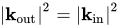
The Laue equations can be written as as the condition of elastic wave scattering by a crystal lattice, where is the scattering vector, , are incoming and outgoing wave vectors (to the crystal and from the crystal, by scattering), and is a crystal reciprocal lattice vector. Due to elastic scattering , three vectors. , , and , form a rhombus if the equation is satisfied. If the scattering satisfies this equation, all the crystal lattice points scatter the incoming wave toward the scattering direction (the direction along ). If the equation is not satisfied, then for any scattering direction, only some lattice points scatter the incoming wave. (This physical interpretation of the equation is based on the assumption that scattering at a lattice point is made in a way that the scattering wave and the incoming wave have the same phase at the point.) It also can be seen as the conservation of momentum as since is the wave vector for a plane wave associated with parallel crystal lattice planes. (Wavefronts of the plane wave are coincident with these lattice planes.)

The equations are equivalent to Bragg's law; the Laue equations are vector equations while Bragg's law is in a form that is easier to solve, but these tell the same content.

The Laue equations

[edit]

Let be primitive translation vectors (shortly called primitive vectors) of a crystal lattice , where atoms are located at lattice points described by with , , and as any integers. (So indicating each lattice point is an integer linear combination of the primitive vectors.)

Let be the wave vector of an incoming (incident) beam or wave toward the crystal lattice , and let be the wave vector of an outgoing (diffracted) beam or wave from . Then the vector , called the scattering vector or transferred wave vector, measures the difference between the incoming and outgoing wave vectors.

The three conditions that the scattering vector must satisfy, called the Laue equations, are the following:


where numbers are integer numbers. Each choice of integers , called Miller indices, determines a scattering vector . Hence there are infinitely many scattering vectors that satisfy the Laue equations as there are infinitely many choices of Miller indices . Allowed scattering vectors form a lattice , called the reciprocal lattice of the crystal lattice , as each indicates a point of . (This is the meaning of the Laue equations as shown below.) This condition allows a single incident beam to be diffracted in infinitely many directions. However, the beams corresponding to high Miller indices are very weak and can't be observed. These equations are enough to find a basis of the reciprocal lattice (since each observed indicates a point of the reciprocal lattice of the crystal under the measurement), from which the crystal lattice can be determined. This is the principle of x-ray crystallography.

Mathematical derivation

[edit]

For an incident plane wave at a single frequency (and the angular frequency ) on a crystal, the diffracted waves from the crystal can be thought as the sum of outgoing plane waves from the crystal. (In fact, any wave can be represented as the sum of plane waves, see Fourier Optics.) The incident wave and one of plane waves of the diffracted wave are represented as

where and are wave vectors for the incident and outgoing plane waves, is the position vector, and is a scalar representing time, and and are initial phases for the waves. For simplicity we take waves as scalars here, even though the main case of interest is an electromagnetic field, which is a vector. We can think these scalar waves as components of vector waves along a certain axis (x, y, or z axis) of the Cartesian coordinate system.

The incident and diffracted waves propagate through space independently, except at points of the lattice of the crystal, where they resonate with the oscillators, so the phases of these waves must coincide.[1] At each point of the lattice , we have

or equivalently, we must have

for some integer , that depends on the point . Since this equation holds at , at some integer . So

(We still use instead of since both the notations essentially indicate some integer.) By rearranging terms, we get


Now, it is enough to check that this condition is satisfied at the primitive vectors (which is exactly what the Laue equations say), because, at any lattice point , we have


where is the integer . The claim that each parenthesis, e.g. , is to be a multiple of (that is each Laue equation) is justified since otherwise does not hold for any arbitrary integers .

This ensures that if the Laue equations are satisfied, then the incoming and outgoing (diffracted) wave have the same phase at each point of the crystal lattice, so the oscillations of atoms of the crystal, that follows the incoming wave, can at the same time generate the outgoing wave at the same phase of the incoming wave.

Relation to reciprocal lattices and Bragg's Law

[edit]

If with , , as integers represents the reciprocal lattice for a crystal lattice (defined by ) in real space, we know that with an integer due to the known orthogonality between primitive vectors for the reciprocal lattice and those for the crystal lattice. (We use the physical, not crystallographer's, definition for reciprocal lattice vectors which gives the factor of .) But notice that this is nothing but the Laue equations. Hence we identify , means that allowed scattering vectors are those equal to reciprocal lattice vectors for a crystal in diffraction, and this is the meaning of the Laue equations. This fact is sometimes called the Laue condition. In this sense, diffraction patterns are a way to experimentally measure the reciprocal lattice for a crystal lattice.

The Laue condition can be rewritten as the following.[2]
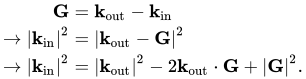

Applying the elastic scattering condition (In other words, the incoming and diffracted waves are at the same (temporal) frequency. We can also say that the energy per photon does not change.)

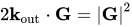
To the above equation, we obtain

The second equation is obtained from the first equation by using .

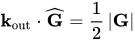
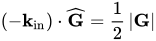
The result (also ) is an equation for a plane (as the set of all points indicated by satisfying this equation) as its equivalent equation is a plane equation in geometry. Another equivalent equation, that may be easier to understand, is (also ). This indicates the plane that is perpendicular to the straight line between the reciprocal lattice origin and and located at the middle of the line. Such a plane is called Bragg plane.[3] This plane can be understood since for scattering to occur. (It is the Laue condition, equivalent to the Laue equations.) And, the elastic scattering has been assumed so , , and form a rhombus. Each is by definition the wavevector of a plane wave in the Fourier series of a spatial function which periodicity follows the crystal lattice (e.g., the function representing the electronic density of the crystal), wavefronts of each plane wave in the Fourier series is perpendicular to the plane wave's wavevector , and these wavefronts are coincident with parallel crystal lattice planes. This means that X-rays are seemingly "reflected" off parallel crystal lattice planes perpendicular at the same angle as their angle of approach to the crystal with respect to the lattice planes; in the elastic light (typically X-ray)-crystal scattering, parallel crystal lattice planes perpendicular to a reciprocal lattice vector for the crystal lattice play as parallel mirrors for light which, together with , incoming (to the crystal) and outgoing (from the crystal by scattering) wavevectors forms a rhombus.

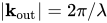
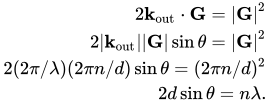
Since the angle between and is , (Due to the mirror-like scattering, the angle between and is also .) . Recall, with as the light (typically X-ray) wavelength, and with as the distance between adjacent parallel crystal lattice planes and as an integer. With these, we now derive Bragg's law that is equivalent to the Laue equations (also called the Laue condition):


References

[edit]
Revisions and contributorsEdit on WikipediaRead on Wikipedia
from Grokipedia
The Laue equations are a fundamental set of three mathematical conditions in that govern the elastic of X-rays by a lattice, specifying the directions in which constructive interference occurs for scattered waves. Derived by German physicist in 1912, these equations relate the difference between the incident wave vector s0\mathbf{s_0} and scattered wave vector s\mathbf{s} (both unit vectors) to the primitive lattice vectors a\mathbf{a}, b\mathbf{b}, and c\mathbf{c} of the , along with the X-ray λ\lambda and integers hh, kk, ll: a(ss0)=hλ,b(ss0)=kλ,c(ss0)=lλ.\mathbf{a} \cdot (\mathbf{s} - \mathbf{s_0}) = h\lambda, \quad \mathbf{b} \cdot (\mathbf{s} - \mathbf{s_0}) = k\lambda, \quad \mathbf{c} \cdot (\mathbf{s} - \mathbf{s_0}) = l\lambda. This formulation confirmed the wave nature of X-rays and their wavelengths on the order of atomic spacings, revolutionizing the field by enabling the probing of structures at the atomic scale. Laue's breakthrough stemmed from an experiment conducted with Walter Friedrich and Paul Knipping at the University of , where polychromatic s were passed through a copper sulfate crystal, producing a pattern of discrete spots that could be indexed using integer values corresponding to the lattice. For this discovery, Laue was awarded the 1914 , recognizing its role in demonstrating and laying the groundwork for modern . The equations are equivalent to the condition that the scattering vector lies along a vector, linking them intrinsically to the crystal's periodic structure in reciprocal space. In relation to Bragg's law, developed shortly after by William Henry and , the Laue equations provide a more general three-dimensional framework; under the assumption of and reflection geometry, they simplify to nλ=2dsinθn\lambda = 2d \sin\theta, where dd is the interplanar spacing and θ\theta is the incidence angle. This connection facilitated the evolution from qualitative observations to quantitative structure analysis, including the determination of atomic positions, bond lengths, and material properties. Today, the Laue equations underpin techniques like Laue diffraction for studying protein crystals and dynamic processes in , remaining essential for interpreting diffraction patterns in both laboratory and synchrotron-based experiments.

Introduction

Historical development

In the early 1900s, , a physicist who had studied under in , joined Arnold Sommerfeld's Institute for Theoretical Physics in in 1909. There, Laue engaged in discussions with Sommerfeld and on wave optics and , which influenced his thinking on phenomena. Sommerfeld, a prominent theorist, and Debye, known for his work on lattice vibrations, provided key insights into the periodic nature of crystals as potential three-dimensional diffraction gratings for electromagnetic waves. These conversations, including informal ones in a Munich café, sparked Laue's realization that X-rays, discovered by in 1895 but whose wave nature was debated, could be tested for diffraction by crystals to confirm their periodicity. In 1912, Laue proposed an experiment to demonstrate diffraction as evidence for the atomic periodicity in crystals, theorizing that crystals would act as natural gratings for short-wavelength radiation. This idea culminated in the mathematical framework now known as the Laue equations, though the focus at the time was on empirical validation of . Walter Friedrich and Paul Knipping, under Laue's guidance at the , conducted the experiment starting in April 1912, directing a beam of X-rays generated from an through a crystal and recording the diffraction pattern on a , with the first successful diffraction pattern observed on April 23, 1912. The resulting spots confirmed the wave nature of X-rays and the regular atomic arrangement in crystals, with clearer patterns obtained after initial trials with other crystals like blende. Laue's discovery earned him the in 1914, awarded for "his discovery of the diffraction of s by , whereby a new and powerful method for studying was provided." The Nobel committee highlighted how this work resolved debates on wavelengths and opened to atomic-scale analysis. However, the initial Laue method relied on polychromatic s from the tube's continuous spectrum, producing complex patterns from multiple wavelengths that complicated precise wavelength determination and structure interpretation. This limitation prompted subsequent developments, such as and William Lawrence Bragg's adoption of monochromatic s in 1913, which simplified diffraction analysis and advanced structural determinations.

Overview and significance

The Laue equations describe the general conditions under which constructive interference occurs in the diffraction of X-rays by the periodic lattice of a , specifying the directions in which diffracted beams appear. These conditions arise from the phase differences among scattered waves originating from identical centers at the lattice points, ensuring that waves reinforce each other only when their path differences align with the lattice periodicity. Originally proposed by in 1912, they provided the theoretical framework for interpreting patterns from crystals. The significance of the Laue equations lies in their role as the foundational principles of , enabling the determination of atomic arrangements within crystalline materials by relating observed patterns to the underlying lattice structure. This breakthrough transformed by allowing precise analysis of crystal symmetries and orientations, which is essential for understanding material properties at the atomic scale. In applications, the Laue equations underpin the Laue diffraction method, which employs polychromatic X-rays on stationary single to study orientation and , offering advantages over rotating crystal or techniques by avoiding mechanical motion. Their modern relevance extends to advanced fields such as protein crystallography, where synchrotron-based Laue diffraction facilitates rapid data collection in under one second with minimal , capturing dynamic structural changes in biomolecules like photosynthetic reaction centers. They also support and time-resolved studies in and materials characterization.

Formulation

Statement of the equations

The Laue equations specify the conditions under which X-rays diffracted by a crystal exhibit constructive interference. These equations, originally formulated by Max von Laue in 1912, are expressed in vector notation as a(ss0)=hλ,\mathbf{a} \cdot (\mathbf{s} - \mathbf{s}_0) = h\lambda, b(ss0)=kλ,\mathbf{b} \cdot (\mathbf{s} - \mathbf{s}_0) = k\lambda, c(ss0)=lλ,\mathbf{c} \cdot (\mathbf{s} - \mathbf{s}_0) = l\lambda, where a\mathbf{a}, b\mathbf{b}, and c\mathbf{c} are the primitive translation vectors of the crystal lattice, s0\mathbf{s}_0 and s\mathbf{s} are the unit vectors pointing in the directions of the incident and diffracted X-ray beams, respectively, λ\lambda is the wavelength of the X-rays, and hh, kk, ll are integers known as the Laue indices. For an orthogonal lattice, in which the primitive vectors are mutually perpendicular, the equations take an equivalent scalar form in terms of the direction cosines of the beams with respect to the lattice axes. Denoting the magnitudes of the primitive vectors by a=aa = |\mathbf{a}|, b=bb = |\mathbf{b}|, c=cc = |\mathbf{c}|, and the direction cosines of s0\mathbf{s}_0 and s\mathbf{s} by (α0,β0,γ0)(\alpha_0, \beta_0, \gamma_0) and (α,β,γ)(\alpha, \beta, \gamma), respectively, the equations become a(αα0)=hλ,a(\alpha - \alpha_0) = h\lambda, b(ββ0)=kλ,b(\beta - \beta_0) = k\lambda, c(γγ0)=lλ.c(\gamma - \gamma_0) = l\lambda. Diffraction occurs only when the Laue indices hh, kk, ll are integers, as this ensures the phase difference between waves scattered from equivalent lattice points is an integer multiple of 2π2\pi, resulting in constructive interference. The specific integer values of the Laue indices also incorporate the of the ; for instance, in planes of high symmetry, one or more indices may be zero, and certain combinations of hh, kk, ll are forbidden due to reflection conditions, such as reflections with mixed-parity indices (not all even or all odd) in face-centered cubic lattices.

Notation and physical meaning

In the Laue equations, the incident beam direction is represented by the unit vector s0\mathbf{s}_0, which points along the propagation of the incoming wave and has a magnitude of unity to normalize for direction only, independent of . Similarly, s\mathbf{s} denotes the unit vector for the scattered (diffracted) beam direction, also with magnitude 1, capturing the geometry of wave propagation after interaction with the lattice. These unit vectors are typically defined in a aligned with the crystal axes, ensuring that angles between s0\mathbf{s}_0, s\mathbf{s}, and lattice directions directly relate to the geometry. The scattering vector is given by Δk=2πλ(ss0)\Delta \mathbf{k} = \frac{2\pi}{\lambda} (\mathbf{s} - \mathbf{s}_0), where λ\lambda is the wavelength of the radiation, representing the change in wavevector from incident to scattered waves and quantifying the momentum transfer to the crystal. Here, λ\lambda is the wavelength of the probing radiation, commonly in the X-ray range (around 0.1–10 Å) for crystallographic applications, though the formalism extends to neutron or electron beams with appropriate λ\lambda values. The factor 2π/λ2\pi / \lambda converts the directional difference into a wavevector with units of inverse length (e.g., Å⁻¹), linking the optical path to quantum mechanical momentum. The primitive lattice vectors a\mathbf{a}, b\mathbf{b}, and c\mathbf{c} define the translations of the 's unit cell, each with lengths corresponding to the lattice parameters (typically 1–10 ) and directions along the principal crystal axes. These vectors span the real-space , where any lattice point position is R=n1a+n2b+n3c\mathbf{R} = n_1 \mathbf{a} + n_2 \mathbf{b} + n_3 \mathbf{c} with integers nin_i. All vectors s0\mathbf{s}_0 and s\mathbf{s} are normalized to unit length, adhering to the convention that directions are scale-invariant, while Δk\Delta \mathbf{k} carries the scale set by λ\lambda, and scattering angles implicitly describe the momentum transfer magnitude Δk=4πλsin(θ/2)|\Delta \mathbf{k}| = \frac{4\pi}{\lambda} \sin(\theta/2), with θ\theta the scattering angle. Physically, the Laue equations impose conditions such that the difference for waves scattered from adjacent lattice points—given by R(ss0)\mathbf{R} \cdot (\mathbf{s} - \mathbf{s}_0)—equals an multiple of λ\lambda, ensuring constructive interference and thus maxima in the intensity pattern. This path difference arises from the projection of the lattice onto the difference in beam directions, reflecting the periodic centers' in phasing the waves coherently. The equations serve as selection rules for hklhkl that permit for given beam geometries.

Derivation

Wave interference in crystals

In the context of wave , a is modeled as a periodic array of centers, typically atoms or electrons arranged in a three-dimensional lattice. When an electromagnetic wave, such as an , impinges on this structure, each center interacts with the incident field and reradiates secondary waves in all directions. This periodic arrangement gives rise to patterns through the collective interference of these secondary waves. The foundational principle governing this process is the Huygens-Fresnel principle, which posits that every point on a , including each lattice point acting as a scatterer, serves as a source of secondary spherical wavelets. These wavelets have the same and as the incident wave and propagate forward with an modulated by an obliquity factor. In a , the coherent superposition of wavelets from all lattice points determines the intensity at a distant observation point, leading to enhanced scattering in specific directions where interference is constructive. The phase difference between secondary wavelets originating from different centers stems from variations in lengths. This includes the path length for the incident to reach each scatterer and the path length for the scattered wave to travel from the scatterer to . These path differences accumulate across the lattice, resulting in a total phase shift that dictates whether the waves reinforce or cancel each other. Constructive interference, manifesting as bright diffraction spots, occurs when the total phase shift between wavelets is an multiple of 2π2\pi, ensuring that the waves arrive in phase at the observation point. This condition highlights the role of the crystal's periodicity in selecting discrete scattering directions. The analysis relies on key assumptions: , preserving the wave's wavelength; incident and scattered waves as plane waves; and an infinite crystal approximation, which ignores boundary effects and finite-size . These principles underpin the vector form of the Laue conditions.

Step-by-step mathematical derivation

The derivation of the Laue equations begins by considering the interference of waves scattered from two adjacent lattice points in a crystal, separated by a lattice vector R\mathbf{R}. The path length difference Δ\Delta for the incident wave (propagating in unit vector direction s0\mathbf{s}_0) and the scattered wave (in unit vector direction s\mathbf{s}) is given by the projection of this vector onto the difference in propagation directions: Δ=(ss0)R.\Delta = (\mathbf{s} - \mathbf{s}_0) \cdot \mathbf{R}. This arises from the additional optical path traversed by the wave to reach the second scatterer and then to the observation point in the far field. The corresponding phase difference δϕ\delta \phi between the waves from these two points is then δϕ=2πλΔ=2πλ(ss0)R,\delta \phi = \frac{2\pi}{\lambda} \Delta = \frac{2\pi}{\lambda} (\mathbf{s} - \mathbf{s}_0) \cdot \mathbf{R}, where λ\lambda is the of the . For constructive interference between these two waves, the phase difference must be an multiple of 2π2\pi, ensuring the waves add in phase: δϕ=2πm\delta \phi = 2\pi m for mm, or equivalently, (ss0)R=mλ.(\mathbf{s} - \mathbf{s}_0) \cdot \mathbf{R} = m \lambda. This condition maximizes the contribution from these points. To extend this to the entire crystal lattice, consider the total scattered as the sum over all lattice points: ARexp[i2πλ(ss0)R],A \propto \sum_{\mathbf{R}} \exp\left[i \frac{2\pi}{\lambda} (\mathbf{s} - \mathbf{s}_0) \cdot \mathbf{R}\right], where the sum is over all lattice vectors R\mathbf{R}. This is a multidimensional over the . The sum is non-zero (and maximized, corresponding to a peak) only if the phase increment 2πλ(ss0)R\frac{2\pi}{\lambda} (\mathbf{s} - \mathbf{s}_0) \cdot \mathbf{R} is 2π2\pi times an for every lattice vector R\mathbf{R}, i.e., 1λ(ss0)R=m\frac{1}{\lambda} (\mathbf{s} - \mathbf{s}_0) \cdot \mathbf{R} = m with mm . If this holds, the phases align, and A|A| scales with the number of unit cells; otherwise, the terms cancel due to the periodicity. The lattice vectors are linear combinations of the primitive basis vectors a\mathbf{a}, b\mathbf{b}, and c\mathbf{c}: R=pa+qb+rc\mathbf{R} = p \mathbf{a} + q \mathbf{b} + r \mathbf{c} for integers p,q,rp, q, r. For the condition to hold for all such R\mathbf{R}, it must hold independently for the basis vectors, yielding the three Laue equations: a(ss0)=hλ,b(ss0)=kλ,c(ss0)=lλ,\mathbf{a} \cdot (\mathbf{s} - \mathbf{s}_0) = h \lambda, \quad \mathbf{b} \cdot (\mathbf{s} - \mathbf{s}_0) = k \lambda, \quad \mathbf{c} \cdot (\mathbf{s} - \mathbf{s}_0) = l \lambda, where h,k,lh, k, l are integers (the Miller indices). This ensures the phase condition is satisfied for every R\mathbf{R}, as the dot product is linear: (ss0)R=phλ+qkλ+rlλ(\mathbf{s} - \mathbf{s}_0) \cdot \mathbf{R} = p h \lambda + q k \lambda + r l \lambda, an integer multiple of λ\lambda. These equations, first derived by Max von Laue in 1912, fully specify the directions s\mathbf{s} for which constructive interference occurs across the lattice.

Interpretations and extensions

Relation to Bragg's law

Bragg's law provides a foundational description of diffraction in crystals, stating that constructive interference occurs when nλ=2dsinθn\lambda = 2d \sin \theta, where nn is a positive representing the diffraction order, λ\lambda is the of the incident radiation, dd is the spacing between parallel lattice planes, and θ\theta is the glancing angle between the incident beam and the lattice planes. This law, originally derived for reflection , assumes where the incident and diffracted beams make equal angles with the reflecting planes. The Laue equations generalize Bragg's law by encompassing a broader range of diffraction conditions, including both transmission and reflection geometries at arbitrary angles. To derive Bragg's law from the Laue equations, consider the reflection geometry where the scattering vector aligns with the reciprocal lattice vector G=ha+kb+lc\mathbf{G} = h\mathbf{a}^* + k\mathbf{b}^* + l\mathbf{c}^*, with h,k,lh, k, l integers and a,b,c\mathbf{a}^*, \mathbf{b}^*, \mathbf{c}^* the reciprocal basis vectors. The condition is kk0=G\mathbf{k} - \mathbf{k}_0 = \mathbf{G}, where k0=2πλs^0\mathbf{k}_0 = \frac{2\pi}{\lambda} \hat{\mathbf{s}}_0 and k=2πλs^\mathbf{k} = \frac{2\pi}{\lambda} \hat{\mathbf{s}} are the incident and scattered wave vectors. In this geometry, the magnitude relation gives G=4πsinθλ|\mathbf{G}| = \frac{4\pi \sin \theta}{\lambda}, and since the interplanar spacing d=2πGd = \frac{2\pi}{|\mathbf{G}|}, it follows that 2dsinθ=nλ2 d \sin \theta = n\lambda, where nn corresponds to the order. Both formulations connect through Miller indices (hkl)(hkl), which specify the lattice planes in Bragg's law and directly define the reciprocal lattice vector G\mathbf{G} in the Laue equations using primitive reciprocal basis vectors. However, while Bragg's law is tailored to monochromatic beams and assumes symmetric reflection off specific planes, the Laue equations accommodate polychromatic radiation and permit diffraction in transmission mode or at non-specular angles, making them more versatile for general crystal analysis.

Reciprocal lattice perspective

The provides a powerful framework for understanding the Laue equations by transforming the real-space periodicity of into where conditions are more intuitively visualized. The reciprocal lattice basis vectors are defined from the direct lattice vectors a\mathbf{a}, b\mathbf{b}, and c\mathbf{c} as a=2πb×ca(b×c)\mathbf{a}^* = 2\pi \frac{\mathbf{b} \times \mathbf{c}}{\mathbf{a} \cdot (\mathbf{b} \times \mathbf{c})}, with b\mathbf{b}^* and c\mathbf{c}^* obtained by cyclic permutation. These vectors satisfy orthogonality conditions such as aa=2π\mathbf{a}^* \cdot \mathbf{a} = 2\pi and ab=0\mathbf{a}^* \cdot \mathbf{b} = 0, ensuring that the reciprocal lattice captures the Fourier components of the crystal's periodic potential. The general reciprocal lattice vectors are then given by Ghkl=ha+kb+lc\mathbf{G}_{hkl} = h\mathbf{a}^* + k\mathbf{b}^* + l\mathbf{c}^*, where hh, kk, and ll are integers known as Miller indices, representing possible momentum transfers in diffraction. In this reciprocal space perspective, the Laue condition for constructive interference simplifies to kk0=Ghkl\mathbf{k} - \mathbf{k}_0 = \mathbf{G}_{hkl}, where k0=2πλs^0\mathbf{k}_0 = \frac{2\pi}{\lambda} \hat{\mathbf{s}}_0 is the incident wave vector and k=2πλs^\mathbf{k} = \frac{2\pi}{\lambda} \hat{\mathbf{s}} is the scattered wave vector, with s^0\hat{\mathbf{s}}_0 and s^\hat{\mathbf{s}} as unit direction vectors and λ\lambda as the radiation wavelength. This vector equation enforces momentum conservation, modulo the reciprocal lattice vector Ghkl\mathbf{G}_{hkl}, which accounts for the crystal's translational symmetry. The condition implies that the magnitude equality k=k0|\mathbf{k}| = |\mathbf{k}_0| (elastic scattering) restricts diffraction to specific Ghkl\mathbf{G}_{hkl} that satisfy the equation's geometry. The Ewald construction geometrically interprets these conditions by representing reciprocal space with a of radius 2πλ\frac{2\pi}{\lambda}, centered at the tip of k0-\mathbf{k}_0 (or equivalently, with the crystal at the origin and the incident vector touching the from its surface). Diffraction spots arise when a point Ghkl\mathbf{G}_{hkl} intersects the 's surface, as this placement ensures k=k0+Ghkl\mathbf{k} = \mathbf{k}_0 + \mathbf{G}_{hkl} points to another location on the . For a fixed , rotating the crystal sweeps the relative to the , revealing accessible reflections; points inside or outside the yield no , while those on the limiting (radius 4πλ\frac{4\pi}{\lambda}) mark the backscattering boundary. This reciprocal lattice view offers key advantages in analyzing diffraction patterns: it directly visualizes allowed reflections as sphere intersections, elucidates missing orders (e.g., higher hklhkl points beyond the sphere), and seamlessly generalizes to three-dimensional crystals without relying on specific plane orientations. By mapping the entire scattering manifold, it highlights systematic absences due to and facilitates prediction of observable peaks for given wavelengths. The framework extends beyond X-rays to other probes, such as neutron diffraction where thermal neutrons provide variable λ\lambda for white-beam Laue methods, and in , adapting the Ewald sphere to de Broglie wavelengths typically around 0.02–0.005 nm. For finite-sized crystals, the Laue condition in transmission geometry enables applications like Laue lenses, which focus high-energy X-rays (>10 keV) by diffracting beams through slightly curved crystal mosaics, achieving angular resolutions of arcseconds for astrophysical imaging.

References

Add your contribution
Related Hubs
User Avatar
No comments yet.