


Community hub
Recent from talks
Contribute something
Nothing was collected or created yet.
Transporter erector launcher
View on Wikipedia | This article includes a list of general references, but it lacks sufficient corresponding inline citations. (April 2024) |

A transporter erector launcher (TEL) is a missile vehicle with an integrated tractor unit that can transport, elevate to a firing position and launch one or more rockets or missiles.
History
[edit]Such vehicles exist for both surface-to-air missiles and surface-to-surface missiles. Early on, such missiles were launched from fixed sites and had to be loaded onto trucks for transport, making them more vulnerable to attack, since once they were spotted by the enemy they could not easily be relocated, and if they were it often took hours or even days to prepare them for launch once they reached their new site.
Usually a number of TELs and TELARs are linked to one command post vehicle (CP or CPV). They may use target information from target acquisition, designation and guidance radar (TADAGR or TAR).
Transporter erector launcher and radar (TELAR)
[edit]A transporter erector launcher and radar (TELAR) is a type of TEL that also incorporates part or all of the radar system necessary for firing the surface-to-air missiles. Such vehicles have the capability of being autonomous, greatly enhancing their effectiveness. With this type of system each vehicle can fight regardless of the state or presence of support vehicles. The vehicle may have to aim the missile, usually through a rotating turret, or they may fire straight up.
Transporter launcher and radar (TLAR)
[edit]A transporter launcher and radar (TLAR) is the same as a TELAR without the erector capability, because the missile in question is transported in the launch-ready position as default. An example is the 9K330 Tor, which mounts a vertical launching system (VLS)-style block of SAMs that correct their trajectory using rockets on the missile body itself.
Mobile erector launcher (MEL)
[edit]The Patriot missile system has a towed launch vehicle or mobile erector launcher (MEL).[1]
.jpg)
Palletised erector launchers
[edit]Another sub-set of the TEL are erector-launchers mounted to pallets, which can then be carried by suitable vehicles to create a TEL. The MBDA iLauncher used to launch the Sky Sabre missile is one example; a 15-tonne unit which is carried by MAN HX trucks in British Army service.[2][3]
Rocket launch vehicle
[edit]In spaceflight, TELs are support structures used to transport a rocket launch vehicle horizontally from an assembly facility to a nearby fixed launch pad where it is raised vertical for launch. It is similar to TELs, except the fact that most space rockets must be erected and launched with the appropriate infrastructure, such as those found in a spaceport. This system is used by several space-launch agencies; the Soyuz has a TE that can be transported by railway, SpaceX for its launch vehicles Falcon 9 and Heavy (but not Starship).

Some small-lift launch vehicles, such as Russian Start-1 and Chinese Kuaizhou series, can be launched from ordinary TELs from unprepared pads.
Types
[edit] |
- Taian TA580/TAS5380 8×8 TEL
- Wanshan WS51200 - 16 wheeled TEL
- M270 Multiple Launch Rocket System - tracked
- Pinaka multi barrel rocket launcher
- Kub missile system, Buk missile system - tracked GM chassis, rarely wheel-based
- S-300 missile system, S-400 missile system - 8 wheeled truck-based TEL or MT-T tracked transporter
- S-500 missile system
- RT-2PM Topol, RT-2PM2 Topol-M
- MAZ-547A/MAZ-7916 - 12 wheeled TEL
- MAZ-7917 - 14 wheeled TEL
- MZKT-79221 - 16 wheeled TEL
- MAZ-7907 - 24 wheeled gas turbine TEL
- ASTROS II 6x6 wheeled rocket artillery launcher
- SPYDER
Gallery
[edit]-
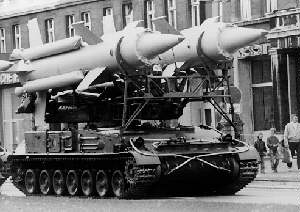
 A Russian S-300V TELAR in transit mode
 -
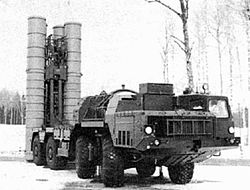 A Russian S-300P TEL ready for launch
 -
 A French Pluton missile in transit mode
 -
 MAZ-7917 TEL
 -
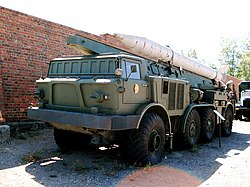
-

-
 S-300
S-300 -

-
 A German PATRIOT launcher
 -
 Russian Topol-M MZKT-79221
 -
 HQ-9 TA580/TAS5380 launcher
 -
 Belarusian Buk-MB3K TELAR on MZKT-69225 chassis


.jpg)
See also
[edit]
- Meillerwagen, the earliest-designed mobile rocket erection vehicle (trailer) ever deployed
- Missile launch facility
References
[edit]- ^ "FM 44-94 Army Air and Missile Defense Command Operations. Glossary. Part I – Abbreviations and Acronyms". Federation of American Scientists. Archived from the original on 2016-03-15.
- ^ "Common Anti Air Missile (CAMM) - Think Defence". 5 November 2022.
- ^ "Finnish Land Ceptor – MBDA Aiming High in ITSUKO". 14 August 2021.
Transporter erector launcher
View on GrokipediaFundamentals
Definition and Purpose
A transporter erector launcher (TEL) is a self-propelled, mobile vehicle that integrates the capabilities for transporting missiles to a launch site, erecting them to a firing position—typically vertical or at a specified angle—and launching them, all within a single unit capable of handling one or more missiles.[1] This design consolidates multiple functions into one platform, eliminating the need for separate transport and launch equipment.[1] The term "transporter erector launcher" originated in Western military terminology to describe the Soviet-developed launchers for the Scud ballistic missile family in the 1950s.[1] The primary purpose of a TEL is to facilitate rapid missile deployment in dynamic combat scenarios, enhancing operational mobility and survivability by enabling covert movement across varied terrain, on-site erection without fixed infrastructure, and immediate firing followed by relocation.[1] TELs are essential for systems including tactical ballistic missiles (TBMs), surface-to-air missiles (SAMs), and anti-ship missiles, allowing these weapons to be employed flexibly against ground, air, or naval targets.[7] Key advantages of TELs include support for "shoot-and-scoot" tactics, where the vehicle launches a missile and rapidly repositions to avoid detection and counter-battery fire from enemy forces.[8] Their mobility also complicates targeting by adversary aviation or precision strikes compared to static silos or ramps, thereby increasing overall system resilience.[1] Furthermore, TELs integrate with broader command and control networks, enabling coordinated strikes across multiple units in real-time operational environments.[9]Operational Principles
A transporter erector launcher (TEL) operates through a structured sequence of phases designed to maximize mobility, survivability, and rapid response in tactical environments. In the transport phase, the missile is stored horizontally on the vehicle's chassis, securely mounted to endure vibrations, shocks, and environmental stresses during road and off-road transit. This configuration allows the TEL to achieve typical highway speeds of 60-80 km/h, enabling quick repositioning across operational areas while maintaining the missile in a protected, non-operational state.[1][10][5] The erection phase follows arrival at a launch site, where hydraulic or pneumatic systems elevate the missile from its horizontal position to a vertical or inclined launch angle, typically ranging from 0 to 90 degrees. This process, which takes 1-5 minutes depending on the system, employs powerful actuators to lift the missile while outriggers or hydraulic jacks extend from the chassis to provide stability against tipping or oscillation. Stabilization is critical to ensure precise alignment for targeting, with the vehicle leveling itself on uneven terrain to support the elevated load.[1][11][12] During the launch phase, ignition is initiated either onboard the TEL or via remote command from a linked control vehicle, propelling the missile skyward. To accommodate ground-level firing, exhaust deflection systems—such as blast deflectors or pads—redirect the engine plume away from the vehicle, preventing damage to the chassis or surrounding area. Immediately after launch, the TEL relocates to a new position to evade counter-battery fire, adhering to "shoot-and-scoot" tactics that emphasize rapid dispersal.[1][11][13] Tactical principles governing TEL operations prioritize survivability through deception, integration with supporting assets, and minimized crew exposure. Deception tactics often involve deploying multiple decoys mimicking TEL signatures to confuse enemy reconnaissance and targeting systems, while the TEL integrates with radar networks for real-time targeting data to enhance accuracy without prolonged site occupation. Crew procedures are streamlined to minimize the time for erection, launch, and withdrawal, often completing the exposure phase in minutes to support shoot-and-scoot tactics.[13][1][14] Safety protocols are integral to mitigate risks during operations, with the missile armed only after full erection to prevent accidental detonation during transit or setup. Environmental constraints, such as wind speed limits that vary by system (often below 30-60 km/h for stability), are enforced to avoid instability in the elevated position or trajectory deviations, ensuring reliable performance under controlled conditions.[1][15]History
Origins and Early Developments
The concept of the transporter erector launcher (TEL) originated during World War II with the German V-2 rocket program, which employed mobile transport and erection methods as foundational precursors to fully integrated missile vehicles. The V-2, a liquid-propellant ballistic missile, was transported horizontally on the Meillerwagen, a specialized semi-trailer that doubled as an erector and launcher, towed by a standard truck to dispersed sites requiring only a flat surface for operation.[16] Launch crews would elevate the 46-foot missile to vertical position using the trailer's hydraulic mechanism, perform gyroscope alignment, and ignite the engine, enabling rapid deployment from camouflaged locations near the front lines, often in proximity to occupied Holland for strikes on England.[17] This approach emphasized survivability through mobility, avoiding fixed infrastructure vulnerable to Allied bombing. In the post-World War II era, the Soviet Union accelerated missile mobility initiatives in the late 1940s and 1950s, leveraging captured German technology while developing domestic heavy-duty trucks at the MAZ plant, which began producing military-grade 6x6 and 8x8 vehicles like the MAZ-535 series by the late 1950s for transporting large payloads, including missiles.[18] The R-11 (Scud-A), a short-range liquid-fueled tactical ballistic missile, entered operational service in 1957 as the Soviet Union's first deployed system of its kind, carried and launched from the tracked 8U218 TEL vehicle, which integrated transport, erection, and firing capabilities for a single missile to facilitate quick battlefield positioning.[19] By 1955, Soviet doctrine shifted toward wheeled TEL configurations for enhanced road speed and logistical efficiency in rapid deployment scenarios, though poor infrastructure and off-road demands prompted parallel development of tracked prototypes to overcome limitations in cross-country traversal.[20] Early U.S. efforts paralleled Soviet advancements but relied on semi-mobile erectors rather than fully integrated TELs until the early 1960s. The MGM-5 Corporal, deployed in the mid-1950s, used a separate hydraulic erector mounted on a dedicated vehicle to raise the liquid-fueled missile from its transport truck to a lightweight launch pedestal, requiring ground-based guidance for firing.[21] Similarly, the MGR-1 Honest John, the U.S. Army's first nuclear-capable surface-to-surface rocket introduced in 1954, employed a simple rail launcher on a standard 2½-ton truck for mobility, allowing free-flight delivery but lacking onboard erection integration.[22] Full integration arrived with the MGM-31 Pershing in 1962, featuring a solid-fueled transporter-erector-launcher that carried, elevated, and fired the missile from a single platform, improving response times over prior semi-mobile setups.[23] These foundational TEL designs were driven by the escalating nuclear threat of the Cold War, prioritizing mobility to evade preemptive strikes and enable dispersed operations, with early systems typically limited to 1-2 missiles per vehicle to balance transport capacity against setup speed and survivability.[24]Cold War Advancements
During the Cold War, the Soviet Union significantly expanded its transporter erector launcher (TEL) capabilities, particularly through advancements in mobile ballistic missile systems that enhanced strategic flexibility and export potential. The R-17 Elbrus, known to NATO as the Scud-B, was integrated onto the MAZ-543 wheeled TEL in 1965, marking a shift from earlier tracked chassis to more versatile wheeled platforms that improved road mobility and rapid deployment.[25] This configuration enabled widespread exports to Arab states, including Egypt and Syria, where the systems supported regional conflicts by providing tactical nuclear or conventional strike options against high-value targets.[26] By the 1980s, Soviet TEL technology evolved further with the RSD-10 Pioneer (NATO: SS-20 Saber), deployed on the improved MAZ-7917 TEL, which facilitated multiple independently targetable reentry vehicle (MIRV) capabilities for intermediate-range strikes, allowing a single launcher to threaten multiple sites with greater accuracy and reduced vulnerability to preemptive attacks.[27] Approximately 499 such TELs were produced to support the SS-20's deployment across Soviet borders facing Europe and China.[28] In response to Soviet advancements, the United States developed TEL systems emphasizing precision and survivability for theater-level operations in Europe. The Pershing II intermediate-range ballistic missile, introduced in 1983, utilized the M983 TEL mounted on the M939 5-ton truck chassis, enabling rapid road transport and erection for strikes up to 1,800 kilometers, primarily targeted at Soviet command centers.[29] This system represented a key component of NATO's modernization efforts, with initial deployments to West Germany enhancing deterrence against Warsaw Pact forces. Concurrently, the U.S. transitioned toward multiple launch rocket systems (MLRS), exemplified by the M270, which entered service in 1983 as a tracked, self-propelled launcher capable of firing clusters of unguided rockets or guided missiles in salvos, providing area suppression superior to single-missile TELs for conventional warfare scenarios. Over 1,300 M270 units were eventually fielded by NATO allies, underscoring the shift to high-volume, mobile fire support.[30] Warsaw Pact allies adapted Soviet TEL designs to bolster collective defense, integrating Scud systems into their national forces for operational synergy. Poland and East Germany modified Scud-B TELs based on the MAZ-543 platform to suit local logistics and terrain, deploying them in forward areas to support potential offensives against NATO.[31] These adaptations included enhanced maintenance protocols for wheeled mobility in Central European theaters. The mobility of such systems was dramatically illustrated during the 1962 Cuban Missile Crisis, where Soviet MRBM TELs—precursors to later Scud variants—were rapidly repositioned across Cuba to evade U.S. surveillance, highlighting TELs' role in crisis escalation and survivability.[32] Key innovations in TEL design during this era addressed terrain and integration challenges, expanding operational envelopes. Tracked variants, such as the 9P117-based systems introduced around 1975, provided superior cross-country mobility for rough terrains, allowing Scud deployments in non-road environments like Eastern European forests or steppes.[33] Simultaneously, the SA-4 Ganef (2K11 Krug) surface-to-air missile system, fielded in 1967, pioneered radar integration on TELs with the P-40 Long Track acquisition radar linked to the Pat Hand fire control radar, enabling semi-automated tracking and guidance for low-altitude threats without fixed-site dependencies.[34] This tracked TEL carried two missiles and operated in batteries, influencing subsequent air defense architectures. Arms control agreements profoundly shaped TEL proliferation by prioritizing mobile over fixed infrastructure. The Strategic Arms Limitation Talks (SALT I in 1972 and SALT II in 1979) imposed ceilings on intercontinental ballistic missile launchers and limited fixed-site deployments, inadvertently spurring emphasis on TELs for their mobility, which complicated verification through national technical means like satellite reconnaissance.[35] This verifiability challenge—stemming from TELs' ability to disperse and conceal—drove both superpowers to refine mobile systems as a hedge against treaty constraints, ensuring strategic parity amid escalating rivalries.[36]Post-Cold War and Modern Evolution
Following the dissolution of the Soviet Union in 1991, Russia initiated upgrades to its mobile missile systems, culminating in the deployment of the Topol-M intercontinental ballistic missile in 1997 as the country's first post-Soviet ICBM, mounted on the MZKT-79221 16-wheel transporter-erector-launcher for enhanced road mobility and survivability. This transition reflected broader efforts to modernize legacy systems amid economic constraints and the need to maintain strategic deterrence without superpower-scale resources. Simultaneously, the proliferation of TEL technology accelerated to non-superpower states, including exports supporting Iran's Shahab-3 medium-range ballistic missile program, which achieved its first successful test in 1998 using a North Korean-derived Nodong engine launched from a mobile TEL platform. North Korea also benefited from similar technology transfers during this period, enabling expansions in its missile capabilities based on Soviet-era designs. In the 2000s, TEL designs entered a digital era with the widespread integration of GPS and inertial navigation systems (INS) to provide precise positioning and guidance for mobile launchers, reducing reliance on fixed infrastructure and improving operational flexibility in contested environments. These advancements facilitated compatibility with emerging hypersonic missile technologies, as seen in Russian efforts by 2018 to adapt ground-based systems for high-speed weapons, building on air-launched prototypes like the Kinzhal to enhance penetration of advanced defenses. From the 2010s to 2025, TEL evolution emphasized larger, more survivable platforms, exemplified by China's deployment of the DF-41 ICBM in 2019 on a 16-axle wheeled TEL capable of carrying multiple independently targetable reentry vehicles over intercontinental ranges. North Korea advanced its arsenal with the Hwasong-17 ICBM's successful test in 2022, utilizing road-mobile TELs and incorporating rail-mobile variants for greater dispersal and concealment options. In 2025, North Korea unveiled a new 12-axle TEL potentially linked to advanced ICBM development, further enhancing its mobile strike capabilities.[37] The ongoing Russia-Ukraine war since 2022 has further influenced designs, prompting accelerations in drone-resistant features such as enhanced camouflage, rapid repositioning, and electronic countermeasures to counter ubiquitous unmanned aerial surveillance and strikes. Similarly, the United States advanced its Dark Eagle hypersonic missile system, deployed on mobile TELs for rapid response as of 2025.[38] Global trends in TEL development have shifted toward hybrid-electric propulsion systems for reduced acoustic and thermal signatures, increasing stealth against detection, as demonstrated by China's introduction of the HTF 5750 HEV 12x12 platform in 2025, designed specifically for ballistic missile carriage with quieter operation.[39] These innovations occur amid tightened arms export controls under the Missile Technology Control Regime (MTCR), established in 1987 and updated in the 2020s to include stricter guidelines on unmanned systems and dual-use components that could support TEL proliferation.[40] Challenges persist due to international sanctions restricting access to advanced electronics and chassis components, spurring indigenous production efforts like India's development of a dedicated TEL for the Agni-V ICBM by 2018, emphasizing self-reliance in strategic mobility to circumvent external dependencies.Technical Design
Chassis and Mobility Systems
The chassis of a transporter erector launcher (TEL) serves as the foundational platform for transporting heavy missile systems across diverse terrains, with wheeled configurations dominating due to their balance of mobility and logistical efficiency. Primarily, TELs utilize heavy-duty truck chassis from Soviet and Russian manufacturers, such as the MAZ and MZKT series, featuring 8x8 or 12x12 wheel configurations for enhanced stability and load distribution. For instance, the MZKT-7930 employs an 8x8 setup to support air defense systems like the S-400, providing robust off-road performance comparable to earlier models. Alternatives include tracked chassis, such as those derived from the Metrovagonmash GM-123/124 series used in legacy Soviet systems like the 2P24 TEL for the 2K11 Krug, which offer superior traction in extreme conditions but at the cost of higher maintenance. Rail-mobile variants, as seen in China's DF-41 ICBM, enable rapid deployment along fixed infrastructure while maintaining canister integration for quick erection.[41][42][43] Propulsion systems in TELs rely on powerful diesel engines to ensure reliable operation under heavy loads and rough conditions, typically ranging from 500 to 1,000 horsepower for sustained off-road travel at speeds up to 40 km/h. The MZKT-79291, a 12x12 chassis, incorporates a YaMZ-854.10 V8 diesel engine producing 650 hp, enabling all-wheel drive with hydropneumatic independent suspension to navigate 60% gradients and ford depths of 1-2 meters. Similarly, advanced platforms like Russia's KamAZ-7850 16x16. These systems prioritize durability, with fuel ranges of 500-800 km to support extended redeployments without refueling.[44][5] Load capacities for TEL chassis are engineered to handle 20-80 ton payloads, accommodating fully assembled missiles in integrated canisters that mount directly to the frame, thereby lowering the center of gravity for improved stability during transit and erection. The MZKT-7930-300, for example, supports a 24.2-ton payload on its 8x8 frame, while the KamAZ-78509 12x12 variant manages up to 60 tons for tactical missile systems. In heavier applications, China's HTF5980 16x16 chassis for the DF-41 ICBM accommodates an 80-ton launch weight, with the canister design distributing mass evenly across the axles to prevent tipping on uneven terrain. This integration ensures the chassis remains operational even under maximum loads, with hydraulic erection mechanisms relying on the underlying stability for safe elevation.[44][45] Mobility enhancements further adapt TEL chassis for combat environments, including central tire inflation systems (CTIS) for dynamic pressure adjustment to optimize traction on soft soil or highways, run-flat tire inserts to maintain operation after punctures, and pivotable axles for tighter turning radii. The Platform-O series, such as the KamAZ-7850, features all-wheel steering and rotary wheel mechanisms that reduce the minimum turning radius, enhancing maneuverability in forested or urban areas. These features, combined with reinforced suspensions, allow TELs to evade detection while preserving payload integrity over long distances.[44][46] The evolution of TEL chassis reflects escalating missile sizes and survivability needs, progressing from 1950s 6x6 configurations for early tactical systems to modern 16x16 designs for strategic ICBMs. Initial Soviet-era 6x6 trucks, like those for the R-11 Scud precursors, prioritized simplicity for rapid production, but by the 1970s, 8x8 models such as the MAZ-543 emerged for better cross-country performance. Post-Cold War advancements culminated in 16x16 platforms, exemplified by China's HTF5980 for the DF-41, which supports multiple independently targetable reentry vehicles with superior off-road autonomy.[45][47]Erection and Launch Mechanisms
Erection systems in transporter erector launchers (TELs) primarily rely on telescopic hydraulic arms or scissor lifts to raise launch tubes from a horizontal transport position to vertical for firing. These mechanisms utilize multi-stage hydraulic cylinders capable of generating 50-200 ton-force to support heavy missile payloads, enabling erection times ranging from 30 to 300 seconds depending on missile size and environmental conditions.[1][12][48] Launch infrastructure incorporates canister-based tubes that house the missile, often employing gas generators to provide an initial boost via pressurized ejection, particularly in cold-launch configurations that minimize thermal stress on the vehicle. To protect the chassis from exhaust plumes reaching temperatures up to 3000°C, flame trenches or deflector plates are integrated, directing hot gases away from the TEL structure and preventing damage during ignition.[49][50][51] Control interfaces feature onboard computers that manage alignment using integrated gyroscopes for precise orientation relative to the launch azimuth, with provisions for manual overrides in case of system anomalies. Stabilization is achieved through hydraulic jacks that extend 2-4 meters to level the vehicle on uneven terrain, ensuring stability during the erection and firing sequence; these jacks draw support from the underlying chassis for secure positioning.[12][52][1] Launch tubes are constructed from high-strength steel alloys designed to withstand accelerations of 10-20g during missile ejection and flight initiation, providing structural integrity under dynamic loads. These materials are also treated for weatherproofing, enabling reliable operations in temperatures from -50°C to +50°C, which is essential for all-weather deployment in diverse environments.[53][54][52] Innovations in 2000s-era models, such as those integrated into systems like the Topol-M, introduced automated sequencing for erection and launch preparation, streamlining operations and reducing required crew to 3-4 personnel by minimizing manual interventions.[55][12][56]Integration and Support Features
Transporter erector launchers (TELs) incorporate robust power systems to support hydraulic erection mechanisms, electronic controls, and onboard equipment during extended operations. In systems like the S-300 and S-400, TELs such as the 5P85 series utilize dedicated gas turbine generators, including the 5S18 and 5S19 models, to provide standalone electrical power independent of the vehicle's main engine.[41] These auxiliary power units ensure reliable operation in remote or contested environments, with supporting mobile observation posts like the MAZ-543M featuring four 30 kW generators and fuel capacity for prolonged crew support.[41] Battery backups are integrated for critical standby functions, maintaining system readiness during transit or power interruptions, though specific durations vary by configuration. Sensor suites on TELs enhance operational precision and safety, particularly for vehicle positioning and launch site assessment. Precision navigation systems, such as the NK Orientir on 5P90S TELs, employ inertial navigation units to achieve accurate geolocation, integrating gyroscopic and accelerometric data for alignment during deployment.[41] Environmental sensors, including wind anemometers, monitor conditions like surface wind speed to confirm launch readiness, as erecting tall missile canisters is sensitive to gusts that could destabilize the platform.[57] These sensors feed into automated checks, preventing launches under adverse weather that might compromise trajectory accuracy or structural integrity. Crew facilities prioritize protection and connectivity in high-threat scenarios. TEL cabs, such as those in the Voshchina series undercarriages for S-300/400 systems, feature armored construction with bulletproof windows to shield operators from small-arms fire and fragments.[41] While NBC filtration is not universally detailed across variants, integrated command posts include environmental controls for sustained operations. Communication systems enable seamless linkage to command-and-control (C2) networks, utilizing encrypted radio datalinks with ranges up to 100 meters for local coordination and telescoping masts for broader SATCOM integration with air defense batteries.[41] Maintenance features facilitate rapid field servicing and reloading to minimize downtime. Built-in transloaders, like the 22T6 series on Ural-5323 chassis, allow transfer of missile containers between TELs and support vehicles without external equipment.[41] Hydraulic cranes on wheeled TELs, as seen in the 9P113 for the 9K52 Luna-M system, enable self-reloading of rockets weighing several tons, streamlining logistics in forward areas.[58] Modular components, including interchangeable launch tubes in 5P85TE2 TELs, support quick repairs by swapping standardized parts, enhancing overall system resilience. Survivability enhancements reduce detectability and vulnerability during dispersal. Camouflage netting mounts are standard on S-300/400 TELs, allowing rapid deployment of covers to obscure visual, synthetic aperture radar (SAR), and forward-looking infrared (FLIR) signatures when stationary.[41] These measures complement the TEL's mobility, enabling "shoot-and-scoot" tactics by blending into terrain and delaying enemy targeting.Variants
TELAR and TLAR Systems
The Transporter Erector Launcher and Radar (TELAR) represents a highly integrated variant of mobile missile platforms, combining transportation, erection, launching capabilities, and full radar suite—including acquisition, tracking, and guidance functions—within a single vehicle for self-contained operation. This design enables rapid engagement without reliance on external command posts, enhancing tactical flexibility in dynamic battlefield environments. A seminal example is the Russian Buk-M1 system's 9A310 vehicle, developed in the late 1970s and entering service around 1980, which mounts a fire control radar directly on the launcher chassis.[59][60] In contrast, the Transporter Launcher and Radar (TLAR) configuration integrates launching and radar elements but separates the radar from the erector mechanism, allowing for modular assembly where the radar operates semi-independently from the missile elevation system. This setup balances integration with adaptability, often using dedicated radar vehicles or masts linked to the launcher. The early S-300 air defense system's 5P85 launcher, introduced in 1978, illustrates this approach, pairing a semi-trailer-based launcher with proximate radar units for coordinated fire control.[61][62] Key features of both TELAR and TLAR systems include phased-array radars mounted on rotating masts, providing detection ranges typically between 30 and 100 km depending on target radar cross-section and altitude. These radars support automatic target designation and prioritization, enabling response times from detection to missile launch of 15 to 30 seconds through onboard digital processing.[63][64] Such systems offer significant advantages in air defense autonomy, with each vehicle typically accommodating 4 to 8 missiles for sustained engagements against aircraft, helicopters, and cruise missiles. The SA-11 Gadfly, the NATO designation for the Buk-M1 TELAR in the 1990s, exemplifies this by allowing independent battery operations that reduce coordination delays and improve survivability in contested airspace.[63] Nevertheless, the integration of radar and launcher components in TELAR and TLAR designs leads to drawbacks, including substantial size and weight—often reaching up to 40 tons—which limits off-road mobility and increases logistical demands. Furthermore, the exposed radar emitters make these platforms particularly susceptible to electronic warfare, where jamming or deception can disrupt target acquisition and guidance, potentially neutralizing their effectiveness in high-threat electronic environments.[65]MEL and TE Configurations
The Mobile Erector Launcher (MEL) is a decoupled configuration consisting of a prime mover tractor towing a specialized trailer that handles both the erection and launch functions for the missile, resulting in a two-vehicle system. This setup allows for greater logistical flexibility in transporting heavy or oversized components separately but requires coordination between the vehicles for deployment. A representative example is the United States Army's Pershing missile system from the 1960s, where the M757 5-ton tractor towed the M790 low-boy flat-bed trailer equipped as an erector launcher, enabling the transport and vertical positioning of the solid-fueled Pershing Ia missile prior to firing.[66] The Transporter Erector (TE) configuration, by comparison, employs a single vehicle dedicated to horizontal transport and erection of the missile, with launching conducted from a distinct, often fixed or semi-mobile launch stand rather than the transport vehicle itself. This approach was common in early missile programs where full integration was not yet feasible, emphasizing separation of functions for maintenance and safety. Notable instances include the U.S. Air Force's Minuteman III ICBM transporter erectors, large specialized vehicles that move and upright the missile for insertion into silo launchers.[67] Compared to fully integrated transporter erector launchers (TELs), both MEL and TE systems exhibit operational trade-offs, including extended preparation times for erection—typically several minutes longer due to vehicle unhitching and alignment—and enhanced adaptability for heavier payloads that exceed single-vehicle limits, though at the expense of overall tactical mobility from managing multiple units. Soviet designs like the 9P117 launcher for the R-300 Elbrus (Scud B) missile, fielded in the 1960s on an early tracked chassis, highlighted advantages in traversing rough terrain over wheeled alternatives. By the 1990s, these separated configurations were largely supplanted by more streamlined integrated TELs for most tactical and intermediate-range applications, persisting primarily for heavy intercontinental ballistic missiles (ICBMs) where payload scale and silo-based launching necessitate specialized handling.[68][69]Palletized and Modular Launchers
Palletized and modular launchers represent a contemporary evolution in transporter erector launcher (TEL) technology, emphasizing swappable standardized containers or pallets that house missiles or rocket pods, enabling rapid reconfiguration without extensive vehicle modifications. These systems typically involve loading pre-assembled missile pallets via crane onto a compatible chassis, such as those equipped with the U.S. Army's Palletized Load System (PLS), which facilitates quick integration across various truck platforms. This design enhances operational flexibility by allowing a single vehicle to support multiple missile types, reducing the need for specialized dedicated launchers.[70] A key advantage of palletized configurations lies in their compatibility with diverse payloads, including conventional and nuclear warheads, as the modular pallets can be pre-loaded with different munitions to suit mission requirements. This modularity simplifies logistics for mixed artillery batteries, where units can exchange pallets to alternate between high-explosive, precision-guided, or area-denial ordnance, streamlining supply chains and minimizing reconfiguration downtime during deployments. For instance, the DARPA Operational Fires (OpFires) program demonstrates this by using interchangeable missile round pallets that support hypersonic boost-glide weapons, allowing forces to adapt to time-sensitive targets with varied ranges and payloads; the program completed its critical design review in 2022 and continues development with further testing and integration as of 2025.[71][70][72] Prominent examples include the U.S. Terminal High Altitude Area Defense (THAAD) system, which employs a palletized load system on its transporter erector launchers to carry eight interceptors per unit, enabling crane-assisted swaps for sustained operations. Similarly, the OpFires initiative, tested successfully in 2022, integrates pallets onto Marine Corps Medium Tactical Vehicle Replacements or Army PLS-equipped trucks, converting standard logistics vehicles into launch platforms in under 30 minutes. These systems highlight the palletized approach's scalability, with the THAAD's design supporting rapid reloads to maintain defensive coverage against ballistic threats.[73][71] Core features of palletized TELs often incorporate ISO-container-compatible interfaces for seamless intermodal transport, allowing pallets to move via ship, rail, or air before crane loading onto launch vehicles. Automated locking mechanisms secure the pallets during transit and erection, ensuring stability under high-g forces; for example, twist-lock fittings aligned with ISO 1161 standards prevent slippage during hydraulic elevation.[70][74] In the 2020s, palletized and modular launchers have gained traction in export markets due to their cost-effectiveness and adaptability, particularly for nations seeking versatile systems without full-scale infrastructure investments. Hybrid modularity is increasingly integrated into hypersonic platforms, such as OpFires' boosters designed for multiple glide vehicle payloads, enabling exporters like the U.S. to offer scalable solutions that blend conventional and advanced munitions. This trend supports global defense proliferation by lowering barriers to rapid deployment, with emphasis on concealable containerized variants for strategic surprise.[72][75]Applications
Military Missile Systems
Transporter erector launchers (TELs) play a critical role in modern military missile systems, enabling rapid deployment, mobility, and survivability for tactical ballistic, surface-to-air, anti-ship, and cruise missiles in armed forces worldwide. These systems integrate missiles into self-propelled platforms that can transport, erect, and launch ordnance, often within integrated battery formations that include command vehicles, radars, and support units. Their design emphasizes quick setup times—typically under 10 minutes for erection—and high cross-country mobility to evade counter-battery fire, making them indispensable for offensive and defensive operations.[10] In tactical ballistic missile applications, TELs have been prominently featured in regional conflicts involving Scud derivatives and advanced systems like Russia's Iskander-M. During the 1991 Gulf War, Iraq employed Al-Hussein variants of the Scud-B missile, launched from MAZ-543 TELs, prompting coalition forces to conduct extensive "Scud hunts" that destroyed multiple launchers to mitigate threats to Israel and Saudi Arabia.[76] More recently, in the ongoing Ukraine conflict since 2022, Russian forces have utilized 9P78-1 TELs for the Iskander-M short-range ballistic missile, conducting over 195 launches as of October 2024 as part of integrated strike packages targeting Ukrainian infrastructure and defenses.[77] These operations highlight TELs' doctrinal emphasis on shoot-and-scoot tactics to saturate enemy air defenses. Surface-to-air missile (SAM) batteries also rely heavily on TELs for layered defense, with examples including Russia's S-400 Triumph system and U.S. Patriot configurations. The S-400, featuring the 9A83 TEL introduced in 2007, supports mobile regiments capable of engaging aircraft, drones, and ballistic missiles at ranges up to 400 km, and has been integrated into Russian operations for air defense in contested environments. In contrast, the U.S. Patriot MSE uses towed launchers with integrated erection mechanisms, known as mobile erector launchers (MELs), that, while highly mobile, differ from self-propelled TELs; Saudi Arabia deployed these in 2019 to intercept Houthi ballistic missiles and drones during the Yemen conflict, achieving high success rates in battery formations.[78] For anti-ship and cruise missiles, North Korea tested the solid-fueled KN-23 short-range ballistic missile in 2019, displayed on a 5-axle TEL during parades, underscoring its role in asymmetric deterrence strategies. Doctrinally, TELs incorporate active protection measures, such as Russia's use of inflatable decoys and electronic warfare to mimic launcher signatures and confuse reconnaissance-strike complexes in Ukraine.[79] India's Agni-V intercontinental ballistic missile, tested from a canisterized road-mobile TEL in 2018, exemplifies strategic deterrence applications, with the system's mobility ensuring second-strike credibility against regional adversaries.[80] Combat experiences, particularly in Ukraine, have exposed TEL vulnerabilities to low-cost drones; Ukrainian Bayraktar TB2 strikes in 2022 targeted exposed Russian ground systems, including missile launchers, leading to adaptations like enhanced camouflage netting and dispersed operations by 2025 to improve survivability.[81] These lessons have influenced global militaries to prioritize TEL integration with unmanned assets and deception tactics in missile batteries.Space and Rocket Launch Vehicles
In space launch applications, a transporter erector (TE) is a specialized mobile system designed for the horizontal transport of assembled rocket stages to the launch site, followed by vertical erection onto the launch mount, without integrated firing capabilities typical of military systems.[82] Unlike full transporter erector launchers, TEs prioritize stability and precision for large orbital vehicles, often relying on rail or crawler platforms to handle the rocket's mass during transit and setup.[83] This configuration emerged in the mid-20th century to streamline assembly in controlled environments before site-specific positioning. Key historical systems include the rail-based transporter erectors used in the Russian Soyuz program at Baikonur Cosmodrome since the 1960s, employing a transport and erector wagon (TEW) to move the integrated launch vehicle horizontally from assembly to the pad before raising it vertically.[84] For heavier payloads, China's Long March 5 employs a 20-axle crawler transporter introduced with its 2016 debut at Wenchang Spaceport, enabling horizontal rollout of the 57-meter vehicle weighing over 500 tons fully fueled.[85] Operational differences from military variants emphasize precision over speed, with space TEs requiring erection times of around 30 minutes—such as for the Antares rocket—to ensure alignment and structural integrity, contrasting the minutes needed for tactical missile setups.[83][86] These systems are typically fixed-site dependent, integrated into dedicated launch complexes rather than enabling rapid relocation. Modern examples include the Indian PSLV's rail-mobile launcher platform, in use since its 1993 debut at Sriharikota, which transfers the integrated vehicle over 1 km on a bogie system before erection.[87] SpaceX's approach for Starship in the 2020s incorporates semi-mobile self-propelled modular transporters (SPMTs) for subassembly movement within Starbase, supporting vertical stacking directly at the pad via the launch tower, diverging from traditional horizontal erection.[88] Challenges in space TEs stem from managing extreme masses of 100-500 tons or more, necessitating robust rail or crawler systems like NASA's crawler-transporters, which face issues of terrain stability, vibration control, and load distribution during slow transit at speeds under 2 km/h.[89] Unlike military designs, these lack "scoot" mobility for post-launch evasion, prioritizing secure fixed-site operations to mitigate risks from cryogenic fuels and precise alignment requirements.[90]References
- https://commons.wikimedia.org/wiki/Category:Transporter_erectors