Hubbry Logo
Palletized Load SystemPalletized Load SystemMain
Open search
Palletized Load System
Community hub
Palletized Load System
logo
8 pages, 0 posts
0 subscribers
Be the first to start a discussion here.
Palletized Load System
from Wikipedia

The Palletized Load System (PLS) is a truck-based logistics system that entered service in the United States Army in 1993. It performs long and short distance freight transport, unit resupply, and other missions in the tactical environment to support modernized and highly mobile combat units. It provides rapid movement of combat configured loads of ammunition and all classes of supply, shelters and intermodal containers. It is similar to systems such as the British Demountable Rack Offload and Pickup System (DROPS).[3]

Key Information

History

[edit]

In January 1989, the United States Army Tank Automotive Command awarded prototype PLS contracts to Oshkosh Truck Corporation, the PACCAR Government Group and General Motors, Military Vehicle Operations, with each contractor to deliver nine trucks, six trailers, and 30 flatracks for prototype hardware testing which began in September 1989. Oshkosh Truck Corporation was awarded a five-year contract for PLS in September 1990, with production commencing in 1992.[3]

The original contract award was for 2626 PLS trucks, 1050 M1076 PLS trailers, and 11,030 M1077 PLS flat racks. Under the initial PLS contract, between 1992–1997 Oshkosh delivered 2905 PLS trucks and 1534 PLS trailers. Around half of the PLS trucks were fitted with a Grove material handling crane and were designated M1074. PLS without the crane are designated M1075.[2][3] Under an additional add-on contract from 1997 to 2001, Oshkosh produced 595 PLS trucks and 800 trailers, bringing the PLS fleet to 3,500 trucks and 2,334 trailers.[3][4]

In March 2001, Oshkosh Truck was awarded the Family of Heavy Tactical Vehicles (FHTV) contract. The FHTV award differed in that in addition to the provision for up to 740 PLS trucks and 1060 PLS trailers, the award covered deliveries of Oshkosh Heavy Expanded Mobility Tactical Truck (HEMTT) and Heavy Equipment Transporter (HET). The FHTV contract was extended twice, following which FHTV 2 was awarded to Oshkosh Truck. In October 2008 FHTV 3 was awarded to Oshkosh Defense. As part of the FHTV 3 contract, Oshkosh commenced deliveries of PLS in A1 configuration.[3] In December 2009 the last of 6,288 production PLS A0 was delivered.[3][4]

Oshkosh announced in January 2012 that it had been awarded a bridge contract by the U.S. Army to continue FHTV production. Under this extended contract, the government could place orders through October 2013 and Oshkosh Defense could deliver through September 2014.[3]

In July 2013 the U.S. Army released a synopsis for a FHTV 4 award. This stated the government intended to award the FHTV 4 contract on a sole-source basis to Oshkosh Corporation, and it is understood that the aim was to ensure negotiations with Oshkosh for FHTV 4 were concluded in time to ensure there was no break in production between FHTV 3 and FHTV 4 production and deliveries. There would be a break of seven months. FHTV 4 was awarded to Oshkosh Defense in June 2015 as a five-year requirements contract worth a potential USD780 million. At this time the FHTV IV award covered an estimated 1,800 FHTVs and in addition to Recapitalized (Recap'd) PLS covered Recap'd HEMTT and also included the production of approximately 1,000 new production PLSTs. PLSs accounted for about 25% of the Recap potential.[4]

In March 2020 the final FHTV 4 award was announced by Oshkosh, this calling for an undisclosed quantity of U.S. Army and U.S. Army Reserve FHTVs to be Recap'd. Quantities/breakdown have been revealed. Contract value was USD346.4 million, with deliveries scheduled to conclude in December 2021. As of the award date, Oshkosh disclosed that since 1995 the company had rebuilt over 3,400 PLS trucks.[4] On 3 May 2021 the U.S. Army announced that it had awarded Oshkosh Defense a three-year extension to the FHTV 4 contract. Under the extension, Oshkosh provided new and Recap'd PLS trucks and trailers, HEMTTs, and HETs. The initial delivery orders under the extension called for a total of 353 new and recapitalized vehicles,[4] with the final known orders placed in June 2024, these valued at $231.9 million for trucks, kits and kit installs. In total, Oshkosh is known to have received four FHTV 4 orders during 2024.[5]

In August 2024 Oshkosh Defense LLC announced that U.S. Army Contracting Command – Detroit Arsenal (ACC-DTA) had awarded the company a five-year, Fixed Price with Economic Price Adjustment Requirements contract for the Family of Heavy Tactical Vehicles (FHTV) V (5) program. Based on evaluated quantities, the requirements-type contract is estimated at $1.54 billion and allows Oshkosh to continue delivering new and recapitalized trucks and associated trailers into 2031. The Army was able to purchase under FHTV 5 from August 2024. The first known purchase under FHTV 5 was announced in April 2025, this $95 million order calling for an undisclosed quantity of autonomy-ready Palletized Load Systems A2.[5] It was not stated if these PLS A2 formed part of the Expedient Leader Follower (ExLF) program.

Reset and Recapitalization: Reset and Recapitalization are formal U.S. Army programs that refurbish and return equipment to service in as new condition. Since the award of two separate contracts in 2004, Oshkosh (in addition to HEMTTS and HETs) has rebuilt/overhauled service-worn PLS trucks to new build standard under the Reset and Recapitalization programs. The completed vehicles are stripped to the chassis frame rails from the process and are returned to service in zero miles/zero hours condition and with a new vehicle warranty. The Reset process returns trucks to original build standard (for example PLSA0 to PLSA0), with the exception of certain safety-related items. Recapitalized vehicles are completely rebuilt to meet the current build standard specifications and at a cost to the US DoD per vehicle of about 75% of new build (for example PLSA0 to PLSA1). The first A0 PLS were Recap’d to A1 standard in March 2012. In addition to Reset and Recap, Oshkosh has also refurbished PLS through the Theatre-Provided Equipment Refurbishment (TPER) program.

Expedient Leader Follower (ExLF) program On 27 June 2018, Oshkosh announced that the US army's Tank Automotive Research, Development, and Engineering Center (TARDEC) had awarded the company a USD49 million contract to integrate existing PLS trucks with scalable autonomous technology as part of the army's Expedient Leader Follower (ExLF) program. The ExLF program addresses the needs of the Leader Follower Directed Requirement and Program of Record by removing soldiers from the vehicle while operating in highly contested areas. Under the contract, Oshkosh will integrate an initial 70 autonomy kits for Program Development and Operational Technical Demonstrations (OTD). The contract holds an option to procure up to 150 autonomy kits.[6]

Common Tactical Truck (CTT); previously Next Generation Future Truck (NGFT) Parallel to the FHTV 4 extension effort, the U.S. Army’s Heavy Tactical Vehicles (HTV) PEO CS&CSS issued on 20 July 2020 Notice ID W56HZV-20-R-0237, a Request for Information (RfI) for the Next Generation Future Truck (NGFT). Responses were due by 24 August 2020 for what was quickly renamed the Common Tactical Truck (CTT). It was then the stated intent that CTT would replace the PLSA1, plus the HEMTT and M915 Truck Tractor, Line Haul. The Army desired five variants of the NGFT/CTT, and all with the option to perform semi-autonomous or autonomous operations. The five variants muted were: a wrecker to recover Stryker, MRAPs, and other tactical wheeled vehicles up to 40 US tons; an LHS Heavy variant with crane to transport flatrack with up to 16 tons of cargo payload; a Tractor variant operable with the M870, M871, M172, M872, M967 tanker, M1062 tanker, future tanker (8,200 gallons), and commercial standard trailers; a Tanker variant with a 2,500 gallon threshold or objective fuel payload greater than 2,500 gallons; and a Cargo variant with crane capable of carrying a payload of up to 22 tons or greater.[4]

By early 2025, the program had progressed and August and September 2024 an operational demonstration to assess prototype designs had taken place. Back in April 2024. The actual demonstration involved 12 prototypes supplied by American Rheinmetall Vehicles, Mack Defense, Navistar Defense, and Oshkosh Defense. Wording related to CTT had revised by this time and the program is now referred to as a next-generation family of vehicles (FoV) by the Army, and one that seeks to replace existing platforms such as the PLS, HEMTT, and other medium- and heavy-duty transport vehicles. The CTT FoV is now stated to feature a specialized range variants that will include cargo and LHS, off-road and line-haul tractors, tankers, and base platforms capable of supporting air defense systems, and bridging and boat transport/handling. Data collected from the operational demonstration will be used by the Army to refine CTT's Capability Development Document (CDD) for the CTT, and following some limited additional testing CTT is scheduled to transition to a major capability acquisition program at Milestone C (MS C) in Fiscal Year 2028. The Army then plans to commence low-rate initial production (LRIP), with the longer term objective being to procure 7,217 CTTs by FY2035. A single vendor will be selected for production through an open competition that is scheduled to commence FY2026.[7]

Components

[edit]
An early Oshkosh M1075A0 PLS truck

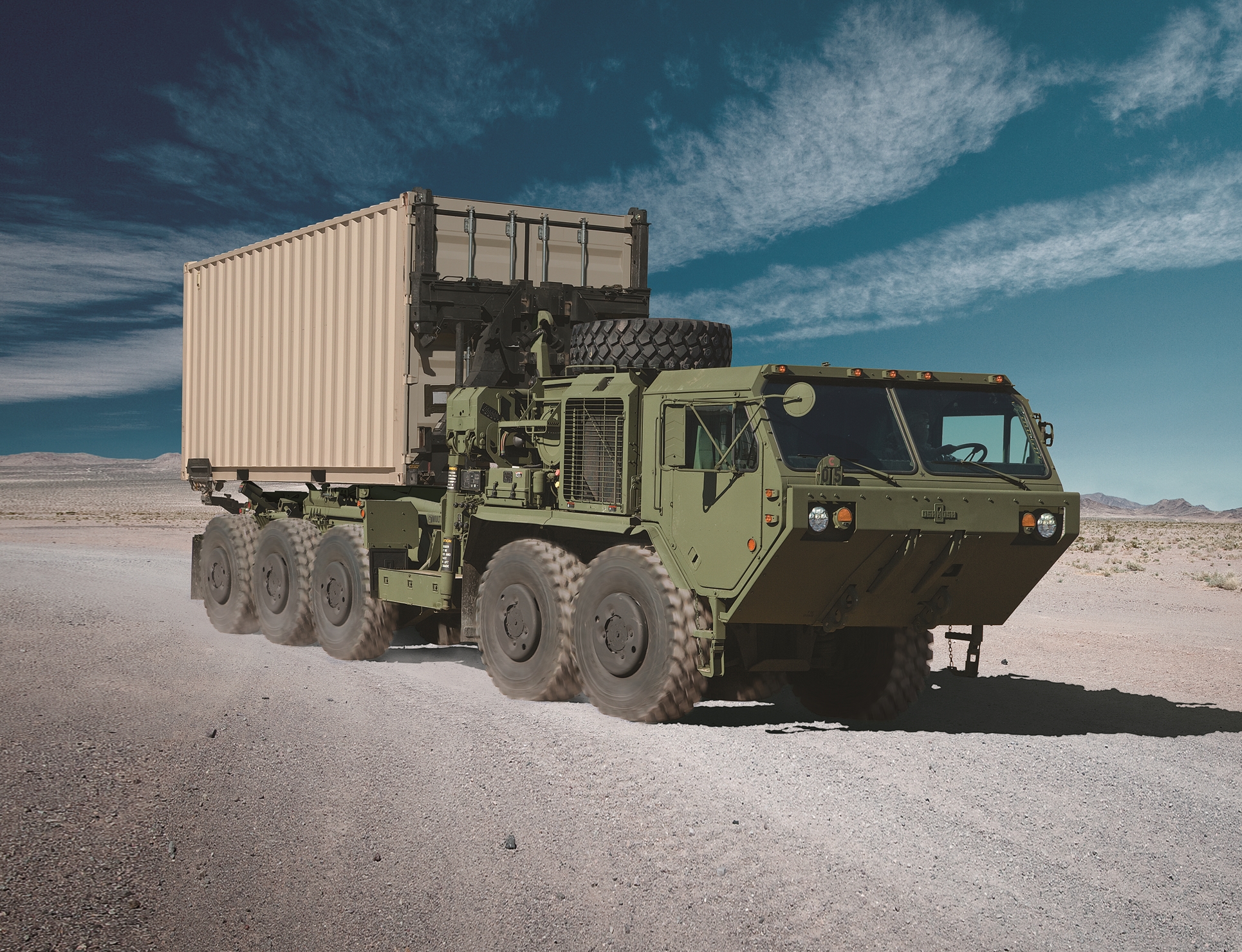
The Palletized Load System (PLS) is based around two variants of prime mover truck (M1074 and M1075) fitted with an integral self-loading and unloading capability, a trailer (M1076), and demountable cargo beds, referred to as flatracks. PLS trucks and trailers are air-transportable in C-5A and C-17 cargo aircraft.[2]

Truck

[edit]

The PLS prime mover truck carries its payloads on its demountable flatrack cargo beds, or inside 8×8×20 foot International Organization for Standardization (ISO) intermodal containers, or shelters. The M1074 is equipped with a variable reach material handling crane (MHC), the M1075 is not. A dp Manufacturing PLS-22K self-recovery winch with a capacity of 9,072 kg is an option on both the M1074 and M1075.[3]

The Oshkosh PLS truck is based on a C-section chassis formed of 356 × 89 × 9.5 mm SAE 1027 modified heat-treated carbon manganese steel with a yield strength of 758 MPa. Bolted construction with Grade 8 bolts is used throughout. PLS is unusual in that it is a five-axle truck, with two front and three rear axles, and with steering on the rear (5th) and front axle pair. A five-axle (10 × 10) configuration was selected by Oshkosh as it provides optimum turning capability and good weight distribution between all axles providing mobility and capability above the desired level of the U.S. Army specification. Competing PLS designs were both four-axle (8x8s), the Paccar offering having a single front axle and rear tridem, the General Motors offering was an Americanised MAN KAT1 (8×8).[3]

PLS A1 variants are powered by a Caterpillar C-15 four-stroke diesel developing 600 hp, this coupled to an Allison 4500SP six-speed automatic transmission, and Oshkosh 36000 Series two-speed transfer case.[2] The original PLS was powered by a Detroit Diesel 8V92TA V-8 two-stroke diesel developing 500 hp, with later production examples having the electronically controlled DDECIV version of this engine. Original PLS were fitted with an Allison CLT-755 ATEC 5F/1R automatic transmission and Oshkosh 55000 two-speed transfer box. After October 2005, an Allison HD-4500 Generation 4 six-speed automatic transmission was fitted.[3]

All PLS variants have the same rear tridem unit which consists of a single Hendrickson-Turner air-sprung drive axle (3rd axle) and a Hendrickson RT-400 leaf-sprung AxleTech tandem (4th and 5th axles) on which the rearmost axle contra-steers.[2] On PLS A1 variants the front AxleTech/Oshkosh axles are sprung using Oshkosh's TAK-4 fully independent coil spring suspension. The original PLS had a pair of rigid AxleTech front axles, these with leaf springs.

Tires are Michelin 1600R 20. Current fit is Michelin XZL, earlier PLS were fitted Michelin XL. A central tire inflation system (CTIS) is fitted, this having four settings - HWY (highway) • CC (cross-country) • MSS (mud sand snow) • EMERG (emergency). A spare wheel and tire is mounted behind the cab on A0 variants. On A1 variants the spare wheel and tire is located on the right-hand side of the vehicle, on the top of the engine/cooling compartments.[3]

The two-seat forward control cab is a development of the original Oshkosh M977 HEMTT cab. The PLS A1 (and HEMTT A4)has a visually similar, but slightly larger, revised cab. An add-on armor kit has been developed for the M1074/M1075 by Armor Holdings Inc. PLS A1's cab is compliant with the U.S. Army's Long Term Armor Strategy (LTAS) requirements of an A- and B-kit armoring philosophy. Additionally, it comes as standard with integrated floor armor.[3]

Trailer

[edit]

The M1076 is a three-axle dolly-type trailer. It is capable of carrying the same 16.5 short ton payload as the prime mover. Flatracks can be on- and off-loaded from the trailer by the prime mover's load handling system. Without leaving the cab, the driver can load or unload the truck in less than one minute, and both truck and trailer in less than five minutes. The M1076 can be towed by M1074 and M1075 PLS trucks.[3]

Flatrack

[edit]

Three types of flatrack have been procured as part of the system, the M1077/M1077A1, the M3/M3A1 and the M1 ISO Compatible Flatrack. The M1077 and M1077A1 General Purpose A-frame flatracks are sideless flatracks used to transport pallets of ammunition and other classes of supplies. On the ISO-compatible Palletized Flatrack (IPF) Type M1 there are two end walls, one incorporating the A-frame. Both walls can fold down inwardly for stacking when empty. The M3/M3A1 Container Roll-in/Out Platform (CROP) is, a flatrack that fits inside a 20 ft (6.1 m) ISO container.[3]

Container Handling Unit

[edit]

The Container Handling Unit (CHU) is an add-on kit that allows for the loading/unloading and transport of standard 20 ft (6.1 m) ISO containers without the need for an intermediate flatrack. M1075 PLS trucks (with or without winch) can have an integral CHU stowage facility between the LHS hook arm and engine. CHUs were procured as part of the original FHTV contract. Weight of the complete CHU is 1746 kg. Installation time is 80 man hours. Oshkosh produced the original CHU, the current E-CHU (E - Enhanced) is manufactured by GT Machining & Fabricating Ltd of Canada. Order totals for CHU/E-CHU are at least 6300 units.[3]

PLS M1075A0 truck laden with Engineer Mission Modules (EMM); M5 Concrete Mobile Mixer (EMM-CMM) on the truck, and M6 Dump Body (EMM-DB) on the M1076 trailer

Engineer Mission Modules

[edit]

Engineer Mission Modules (EMM) components are flatrack-based and designed to be used on M1075 PLS trucks fitted with the Universal Power Interface Kit (UPIK). Three EMMs were procured under the initial FHTV contract, the M4 Bituminous Distributor (EMM-BD), the M5 Concrete Mobile Mixer (EMM-CMM), and the M6 Dump Body (EMM-DB). The M4 EMM-BD provides the capability to spread measured amounts of bituminous material for road preparation, repair, and other engineer applications. The M5 EMM CMM transports raw concrete materials, mixes concrete as needed, and emplaces the mixed concrete. The M6 EMM-DB transports and spreads engineering construction material such as rocks, gravel, sand, and soil. A water Distributor also now in service, this placed under contract in 2009.[3]

Flat racks and CHU/E-CHU are interchangeable between PLS and the HEMTT-LHS. Also interchangeable between PLS and HEMTT LHS are Modular Fuel System (MFS) and Hippo (water) tankracks, and the Forward Repair System (FRS). a PLS version optimized for the transport and handling of WFEL Heavy Dry Support Bridge (HDSB) components is also in service. The DSB launch vehicle is a modified PLS truck.[3]

PLS is a major enabler of the Army's drive to achieve a distribution-based logistics system. The PLS-Enhanced (PLS-E) program procures the Movement Tracking System, which provides a multitude of tactical wheeled vehicles with Global Positioning System capability and two-way digital messaging. The MTS enables the commander to track logistics assets over the range of the battle space. The two-way messaging allows redirection of logistics assets as needs develop.[citation needed]

Manufacturer

[edit]

Operators

[edit]
[edit]

See also

[edit]

References

[edit]
[edit]
Revisions and contributorsEdit on WikipediaRead on Wikipedia
from Grokipedia
The Palletized Load System (PLS) is a heavy tactical vehicle-based logistics platform developed for the United States Army, designed to enable rapid, self-loading transport of palletized ammunition, supplies, equipment, and containers across diverse terrains to support maneuver-oriented distribution operations. Introduced into service in 1993 following a multiyear production contract awarded to Oshkosh Corporation in 1990, the PLS serves as the core element of the Army's Maneuver-Oriented Ammunition Distribution System (MOADS), facilitating local-haul, line-haul, and tactical airlift missions while reducing personnel requirements for resupply tasks. Comprising a prime mover truck (designated M1075) and optional trailer (M1077), the PLS utilizes a hydraulic Load Handling (LHS) to independently load and unload demountable flatracks or 8x8x20-foot ISO containers, achieving truck-only operations in under one minute and full truck-trailer configurations in less than five minutes. The system supports a 16.5-ton (14,969 kg) payload capacity on both the truck and trailer, with the three-axle trailer enhancing extended-haul efficiency for up to 33 tons total when paired. Powered by a 600-horsepower with all-wheel drive, the PLS demonstrates high mobility, including the ability to climb 60% grades fully loaded or 30% grades when towing the trailer, and fording water up to 48 inches deep. Key to its operational versatility, the PLS integrates interchangeable flatracks for secure transport of , , or specialized loads like components, and it is assigned to , Ordnance, and Field Artillery units for battlefield sustainment. Evolving through variants such as the M1075A1 (enhanced engine and transmission) and M1075A2 (incorporating by-wire steering for potential and active features like the Long Term Armor Strategy B-kit), the system has been deployed in operations including Bosnia, , and , underscoring its role in modernizing . As of 2025, ongoing upgrades focus on integrating autonomous capabilities to further transform sustainment principles amid distributed operations.

Introduction

Overview and Purpose

The Palletized Load System (PLS) is a -based platform designed as a non-developmental item (NDI), utilizing commercially proven components configured to meet U.S. Army operational requirements, and it entered service in 1993. This system integrates a heavy tactical with a compatible trailer and demountable flatracks to facilitate rapid transport across varied terrains, forming a core element of the Army's distribution capabilities. The primary purpose of the PLS is to enable efficient distribution of palletized or containerized loads up to 16.5 tons, directly supporting sustainment, resupply, and tasks in forward areas. By streamlining the Maneuver-Oriented Distribution (MOADS), it reduces handling times and minimizes congestion at transfer points, allowing for quicker delivery to and other units without reliance on additional . As the backbone of U.S. Army resupply operations, the PLS excels in self-loading and unloading through its integrated Load Handling System (LHS), which can deploy or retrieve flatracks in under one minute, enhancing operational flexibility and personnel safety. This capability supports intermodal compatibility with ISO containers and flatracks, ensuring seamless integration into broader chains. In comparison to legacy systems like the M939 5-ton truck, the PLS provides substantial advantages in payload capacity—three times greater—and mobility, enabling fewer vehicles to deliver equivalent supplies while reducing overall personnel and needs for distribution tasks.

Key Specifications

The Palletized Load System (PLS) M1075A1 is designed to handle substantial in diverse terrains, with a payload capacity of 16.5 short tons (33,000 lb). This capability supports rapid in operations, enabling the transport of flatracks or ISO containers without requiring external . The baseline PLS truck features a 10×10 wheeled configuration, providing enhanced traction and stability across rough terrain through its all-wheel-drive setup and (CTIS), which allows real-time adjustment of tire pressures for optimal mobility. Powering the system is a C15 inline 6-cylinder , delivering 600 horsepower at 2100 rpm, paired with an Allison 4500SP 6-speed for efficient power delivery and gear shifting under load. Key physical parameters include a curb weight of approximately 26.5 short tons (53,000 lb), an overall length of 35 feet 5 inches (without flatrack), a width of 8 feet 3 inches, and a ground clearance of 16 inches, ensuring compatibility with standard and operational environments. Performance metrics emphasize tactical versatility, with a top speed of 62 mph and an operational range of 300 miles at full load, while maintaining gradeability up to 30% slope when fully loaded with trailer.

History and Development

Origins and Design

The Palletized Load System (PLS) originated in 1989 as an expansion of the U.S. Army's Heavy Expanded Mobility Tactical Truck (HEMTT) family, aimed at enhancing logistics capabilities for rapid ammunition and supply distribution. This initiative stemmed from the need to integrate advanced material handling into tactical trucks, building on earlier concepts like the Maneuver Oriented Ammunition Distribution System (MOADS) tested in 1985-1986. In January 1989, the U.S. Army Tank-automotive and Armaments Command (TACOM) awarded prototype contracts to manufacturers, including Oshkosh Truck Corporation, to develop the system as part of this HEMTT evolution. The primary design goals focused on overcoming the limitations of older tactical trucks, such as slow loading/unloading processes that required multiple personnel and equipment like forklifts or cranes. By incorporating a demountable load handling (DLHS), the PLS enabled a single operator to self-load or unload up to 16.5 tons of palletized cargo—such as 24 standard ammunition pallets—onto flatracks in under one minute, thereby boosting efficiency, mobility, and deployability in combat environments. This addressed inefficiencies in traditional resupply methods, reducing the logistical footprint while standardizing vehicle use across units. Key design efforts were led by , which provided military specifications and oversight, in collaboration with industry partners like Oshkosh, whose expertise in heavy tactical vehicles shaped the integration of robust chassis and hydraulic systems. The approach emphasized a non-developmental item (NDI) strategy, adapting proven commercial truck technologies—such as all-wheel-drive configurations and ISO-compatible flatracks—for military ruggedness without extensive new development. Prototype testing occurred in the early 1990s at , where engineers evaluated the system's performance in rough-terrain conditions, particularly the DLHS's ability to transfer loads swiftly over uneven surfaces without hydraulic failures. These trials, including preproduction qualification tests with leased commercial trucks from Oshkosh and others, confirmed the design's reliability for high-mobility .

Procurement and Production Contracts

The procurement of the Palletized Load System (PLS) was initiated through a multiyear production contract awarded by the to Oshkosh Truck Corporation on September 28, 1990, valued at $859.6 million for 2,626 trucks, with an option for an additional 100 percent. Production began in 1992 at Oshkosh's facility in , with deliveries of the trucks, 1,050 trailers, and 11,030 flatracks occurring between 1993 and 1997. Over the course of the program, a total of 6,288 PLS A0 trucks were produced, supplemented by more than 2,150 PLS A1 configurations (including recapitalizations of A0 models to A1 standards) and over 15,000 trailers. Subsequent manufacturing has been conducted under the Family of Heavy Tactical Vehicles (FHTV) program, encompassing contracts FHTV I through V, which support ongoing production, modernization, and sustainment of PLS and related heavy tactical vehicles. Key recent contracts include the 2024 FHTV V requirements contract, estimated at $1.54 billion, enabling Oshkosh Defense to deliver new and recapitalized vehicles with production and deliveries continuing through 2031. In April 2025, an order valued at $95 million was placed under FHTV V for modernized, autonomy-ready PLS A2 vehicles, kits, and installations. On October 1, 2025, an additional $89 million order was awarded under FHTV V for new PLS A2 trucks, kits, and installations, incorporating advanced technologies such as by-wire functionality for autonomy and active safety systems. To extend the PLS service life beyond 20 years, the U.S. Army has pursued recapitalization programs, including multi-year extensions awarded to Oshkosh Defense for remanufacturing and upgrading existing fleets. These efforts integrate enhanced components such as improved powertrains and suspensions while maintaining production at the facility.

System Components

Prime Mover Truck

The prime mover truck forms the self-propelled core of the Palletized Load System, designed to transport and handle heavy in tactical environments. It is produced in two primary models: the M1074, which incorporates a crane for additional versatility, and the M1075, which omits the crane to prioritize capacity and line-haul efficiency. Both models utilize a 10×10 all-wheel-drive configuration to ensure robust mobility over rough terrain, with the baseline engine specifications detailed in the system's key specifications section. Central to the truck's functionality is its integral demountable handling system (DHS), a hydraulic-powered mechanism featuring extendable arms that allow the vehicle to self-load flatracks or 8×8×20-foot ISO containers directly from the ground. This system enables rapid deployment, loading the truck in under one minute or the full truck-trailer combination in under five minutes, enhancing logistical efficiency without requiring external support equipment. The DHS integrates seamlessly with compatible trailers for combined operations. The M1074 model's material handling crane, manufactured by Grove, provides supplemental lifting capability with a maximum load of 5,400 pounds at a 12-foot or 3,900 pounds at a 22.5-foot boom extension, facilitating precise placement of munitions or for forward units. This variable-reach design supports operations in constrained spaces while maintaining the truck's overall integrity. Mobility is supported by a suspension system with front tandem and rear tridem axles using high-hardness torsion bars and rotary shock absorbers, optimized for heavy loads and off-road performance. The rides on 16.00R20 radial tires fitted with a (CTIS), which automatically adjusts pressures—ranging from 15 psi in emergency mode to 75 psi on highways—to optimize traction and reduce wear across terrains like , , or cross-country paths. Auxiliary features include dual fuel tanks with a combined capacity of 185 gallons (100-gallon main and 85-gallon optional auxiliary) for a cruising range exceeding 300 miles, nuclear-biological-chemical () protection via a fitted gas particulate filter unit (GPFU) with M-3 heaters, and an optional self-recovery rated at pounds for extracting the vehicle from obstacles. These elements ensure operational reliability in contaminated or remote environments.

Trailer and Flatrack

The Palletized Load System (PLS) trailer, designated as the M1076, is a three-axle, dolly-type trailer designed to tow behind the PLS prime mover , providing extended transport capabilities. It features a 16.5-ton (33,000 lb) capacity and is specifically compatible with 8×20 ft flatracks, allowing for the secure carriage of palletized loads over various terrains. The trailer's design includes a two-position drawbar for adjustable , self-adjusting slack adjusters on brakes, and / brakes on all axles, ensuring reliable operation in demanding environments. The PLS employs several flatrack variants to facilitate versatile load handling, with the primary external type being the M1077 and M1077A1, constructed from durable steel with a deck suitable for heavy palletized cargo. These external flatracks support a maximum payload of 33,000 lb (M1077) or 32,300 lb (M1077A1, equivalent to 14.6 metric tons), enabling transport of ammunition, supplies, or equipment in open configuration. For internal use within the prime mover's bed, the M3 and M3A1 Container Roll-in/Out Platforms (CROP) serve as A-frame flatracks that fit inside 20 ft ISO containers, offering a payload capacity aligned with the system's 16.5-ton standard while allowing roll-on/roll-off functionality. Additionally, the M1 ISO-compatible flatrack provides interoperability with standard shipping containers, featuring steel structure, wood decking, and a rear wall for enhanced load stability during transit. Securing mechanisms on these flatracks include retractable twistlocks at the corners for locking the flatrack to the trailer or bed, preventing movement during high-speed or off-road operations, as well as multiple D-rings along the side and end rails rated for up to 10,000 lb working load limits to accommodate straps or chains for individual items. Optional sideboard kits can be attached to the M1077 flatrack via side pockets, providing partial enclosures for weather protection or load without compromising the open-frame design. These features ensure loads remain stable across the system's operational envelope. The trailer and flatracks are engineered for rapid demounting and remounting using the PLS Load Handling System (LHS), allowing transfer from to the trailer or direct ground placement in under five minutes to support agile . Constructed with corrosion-resistant coatings on components, they withstand exposure to harsh environmental conditions, including saltwater and chemicals common in deployments. The flatracks are rated for repeated handling, supporting hundreds of load cycles while maintaining structural integrity for sustained use.

Container Handling Unit

The Container Handling Unit (CHU) is a bolt-on attachment kit for the M1075 prime mover truck in the Palletized Load System (PLS), designed to facilitate the lifting, , and unloading of standard 20-foot ISO without requiring additional host equipment. This capability enhances the PLS's versatility for intermodal by allowing direct handling of in addition to palletized flatracks. The enhanced variant, known as the Enhanced Container Handling Unit (ECHU), further improves efficiency by enabling trans-loading of between the truck bed and M1076 trailer via integration with the Container Transfer Enhancement (CTE) . Key components of the include an H-shaped lifting frame that attaches to the truck's Load Handling System (LHS) hook, four ISO corner lock fittings for securing the , rear-mounted rollers and slider guides for positioning, and hydraulic mechanisms for raising and lowering the load. The ECHU builds on this design with adjustable arms and improved stowage for the front lift assembly when not in use, ensuring compatibility with both PLS trucks and Load Handling System (HEMTT-LHS) variants like the M1120. The control interface integrates with the truck's onboard systems to synchronize operations, allowing operators to manage container engagement and movement from . In operation, the enables self-loading and unloading modes where the LHS boom extends to hook the unit, lifts the up to a payload capacity of 17,600 pounds, and positions it onto the or trailer. This supports direct container pickup from the ground or rail/ship interfaces and trans-loading without flatracks or external cranes, reducing logistical bottlenecks in supply distribution. The operates in both standalone mode and combined truck-trailer configurations, with the ECHU specifically allowing seamless roll-on/roll-off transfers for 8x8x20-foot ISO containers. Production of CHU and ECHU kits has supported ongoing PLS fleet modernization, with contracts procuring quantities such as 168 installation kits in recent years to equip additional M1075 and M1075A1 trucks. These units, manufactured by Oshkosh Defense, have been in service since the , with enhancements focused on durability and compatibility with tactical environments. Limitations of the /ECHU include restriction to a single 20-foot per load, exclusion of 40-foot or specialized refrigerated units, and the need for the unit to be removable for flatrack operations, which adds setup time of about 80 man-hours. It is not designed for trailer-direct handling without the truck's LHS and requires modifications like rear roller adjustments for optimal performance. These constraints ensure focus on standard while prioritizing integration with the broader .

Engineer Mission Modules

The Engineer Mission Modules (EMMs) are interchangeable, flatrack-mounted attachments for the Palletized Load System (PLS), enabling the M1075 cargo truck to perform specialized and functions in support of operations. These demountable units fit the standard flatrack footprint and are swapped rapidly using the PLS's load-handling equipment, allowing a single vehicle to transition between and engineering roles in minutes without requiring additional crew or tools. The primary EMM variants include the M4 Bituminous Distributor Module, M5 Mobile Mixer Module, and M6 Dump Body Module, each permanently affixed to a flatrack for seamless integration with the PLS. The M4 Bituminous Distributor Module is equipped to spray and distribute bituminous materials for road surfacing and maintenance, with a tank capacity of 2,800 gallons to support quick application over extended distances. The M5 Mobile Mixer Module mixes and dispenses directly on the vehicle, producing up to 5 cubic yards per batch for on-site needs. The M6 Dump Body Module features a hydraulically actuated dump bed with a capacity of 12 to 14 cubic yards, designed for hauling and unloading bulk materials like aggregate or soil. These modules facilitate rapid engineering responses in austere environments, such as applying bituminous seals to repair damaged routes, erecting fortifications or barriers, and clearing obstacles through material dumping and redistribution. By mounting on the Universal Power Interface Kit-equipped M1075 truck, the EMMs draw power and from the PLS prime mover, ensuring operational compatibility while adhering to the system's 16.5-ton limit. Production of these modules has been integrated into the broader PLS program under the U.S. 's Program Executive Office for Combat Support & Combat Service Support, with units fielded to enhance the fleet's versatility for units.

Variants and Upgrades

PLS A0 Configuration

The Palletized Load System (PLS) A0 configuration represented the baseline production model introduced in the mid-1990s and produced through the 2000s, serving as the U.S. Army's primary heavy tactical logistics vehicle for rapid supply distribution. This variant included two primary truck configurations: the M1074A0, equipped with a variable-reach material handling crane (MHC) for forward artillery support and self-loading operations, and the M1075A0, designed for line-haul transportation without the MHC. Both models utilized the M1076 trailer to carry up to 16.5 tons of payload on compatible flatracks, enabling versatile cargo handling in diverse terrains. Key features of the PLS A0 centered on its robust mechanical design, powered by a Detroit Diesel 8V92TA V-8 two-stroke diesel engine delivering 500 horsepower, coupled to an Allison CLT-755 five-speed automatic transmission and an Oshkosh 55000 two-speed transfer case. The integral load handling system (LHS) allowed for quick self-loading of flatracks—under one minute for the truck and less than five minutes for the trailer—using hydraulic controls, while incorporating a central tire inflation system for enhanced mobility across rough surfaces. This configuration lacked advanced electronic diagnostics, relying on basic mechanical systems for operation and maintenance. A total of 6,288 PLS A0 units were procured and produced between 1992 and 2009 by Oshkosh Defense, establishing the core fleet for early deployments in operations such as those in the and initial phases of conflicts in the . These vehicles provided essential sustainment capabilities, supporting , supplies, and at speeds up to 55 mph with a range of approximately 300 miles. The PLS A0 exhibited limitations in stemming from its older design, which consumed more fuel than subsequent iterations, and featured rudimentary electronics without modern data buses or integrated diagnostics that would emerge in upgrades. It also lacked foundational preparations for autonomous operations, focusing instead on manual crew-driven . Many A0 units have since undergone recapitalization through the Army's Extended Service Program, where they are disassembled and rebuilt to the enhanced A1 configuration to extend operational life and incorporate improved components.

PLS A1 Enhancements

The PLS A1 enhancements were implemented as part of the Family of Heavy Tactical Vehicles (FHTV) 3 program, awarded to Oshkosh Defense in , focusing on recapitalizing existing PLS A0 vehicles to the improved A1 configuration while also enabling new production. These upgrades, designated as M1074A1 (with integrated crane for forward support) and M1075A1 (standard cargo variant without the crane), emphasized enhanced reliability and sustainment for demanding missions, building on the baseline A0 design by addressing wear from high-mileage operations. Key technical modifications included upgrading to a C-15 ACERT 15.2-liter producing 600 horsepower, an increase from the A0's 500 horsepower output, to provide superior power for heavy payloads and challenging terrains. This was paired with an Allison 4500SP six-speed , incorporating enhanced cooling systems to maintain performance under prolonged high-load conditions. The cab structure was redesigned with lightweight composite materials and integrated armor provisions, offering scalable protection against ballistic and blast threats in line with the U.S. Army's Long Term Armor Strategy, while reducing overall vehicle weight for improved fuel efficiency and mobility. Further improvements featured an upgraded (CTIS) with four programmable pressure settings—highway, cross-country, mud/sand/snow, and emergency—for optimized traction across diverse environments, alongside a robust 24-volt/260-ampere electrical supporting advanced digital diagnostics and prognostic tools for real-time fault detection and maintenance prediction. These changes extended the vehicle's through comprehensive recapitalization, resetting high-mileage units to near-zero operational hours and targeting sustained reliability up to 30,000 miles. By the mid-2010s, production under the FHTV program had delivered over 2,150 PLS A1 units, encompassing both newly manufactured trucks and recapped A0 conversions to meet U.S. sustainment requirements. In March 2020, Oshkosh Defense secured a $346.4 million under the FHTV 4 extension from the U.S. Contracting Command at Warren for ongoing modernization of the FHTV fleet, including additional PLS A1 recapitalizations and integration of enhanced capabilities to extend operational readiness.

PLS A2 and Autonomy Features

The Palletized Load System (PLS) A2 variant represents the latest evolution in the U.S. Army's heavy tactical vehicle fleet, emphasizing readiness to enhance operations in contested environments. In April 2025, the U.S. Army Contracting Command–Detroit Arsenal awarded Oshkosh Defense a $95 million order under the Family of Heavy Tactical Vehicles (FHTV) V contract for modernized PLS A2 trucks, incorporating updated electronics and sensors to support advanced autonomous capabilities. This configuration builds on prior upgrades by integrating by-wire and braking systems, along with active safety features, to enable future automation while maintaining compatibility with existing A1 components such as the prime mover and container handling unit. A key enhancement in the PLS A2 is its leader-follower capability, derived from the Expedient Leader Follower (ExLF) program initiated in 2018. Under this program, the U.S. Army awarded Oshkosh Defense a $49 million contract to develop and install over 70 autonomy kits on PLS and other resupply vehicles, allowing a single manned lead vehicle to guide unmanned followers in convoy formation. These kits facilitate semi-autonomous convoying, where follower vehicles maintain formation using GPS and inertial navigation systems (INS) for precise positioning and path following, complemented by onboard sensors—including LIDAR and cameras—for real-time obstacle detection and avoidance. However, full self-driving autonomy remains developmental and not yet operational in fielded systems, focusing instead on reducing driver workload during logistics resupply missions. The PLS A2's design prioritizes seamless integration with legacy systems, ensuring that autonomy features can be retrofitted or activated without major overhauls to the core truck, trailer, or flatrack components. This approach aims to lower operational risks in high-threat areas by enabling unmanned trailing to operate behind a human-driven leader, thereby minimizing personnel exposure during supply . An additional $89 million contract awarded in October 2025 further supports PLS A2 production, underscoring the Army's commitment to scaling these capabilities. Looking ahead, the PLS A2 is integral to the FHTV V framework, with initial deliveries slated to begin in , paving the way for broader adoption of autonomy in to improve efficiency and survivability across dispersed operations.

Operational Use

Role in U.S. Army Logistics

The Palletized Load System (PLS) serves as a cornerstone of U.S. , primarily facilitating the distribution of , , and other critical supplies across sustainment units. In divisions such as the Combat Sustainment Support Battalion, PLS trucks enable efficient delivery to forward operating bases, supporting rapid movement of combat-configured loads from supply points to frontline troops. This capability aligns with the 's emphasis on responsive sustainment, where PLS integrates into broader distribution networks to maintain operational tempo during high-intensity maneuvers. During Operations Iraqi Freedom and Enduring Freedom, the PLS proved essential for long-range resupply missions, transporting supplies over extended distances exceeding 300 miles to sustain dispersed forces in dynamic theaters. In Operation Iraqi Freedom, for instance, the 377th Theater Support Command deployed 147 PLS trucks as part of its dry cargo fleet, enabling the movement of bulk items like and repair parts from theater distribution centers to supply support activities, despite challenges from threats and infrastructure limitations. These operations highlighted the system's role in just-in-time , where PLS facilitated surge deliveries to combat units, reducing dependency on vulnerable convoys and improving overall flow. A key advantage of the PLS is its ability to drastically reduce load and unload times—from hours required by traditional tractor-trailer systems to under one minute for the truck alone or five minutes including the trailer—allowing operators to perform tasks from within the protected cab without additional equipment. This efficiency supports just-in-time logistics in contested environments, minimizing exposure to threats and enhancing responsiveness for time-sensitive resupply in divisions. The system integrates seamlessly with assets like Rough Terrain Container Handlers (RTCH), such as the RT240, for port-to-frontline transfers; RTCH loads containers onto PLS flatracks, enabling swift onward movement during exercises and operations. Despite these strengths, the PLS faced challenges in IED-prone areas during early deployments, where its initial configuration offered limited underbody protection, contributing to vulnerabilities in operations. The PLS A1 variant addressed this through up-armored cabs compliant with the Army's Long Term Armor Strategy, incorporating blast-deflecting V-shaped hulls and reinforced structures to better safeguard crews against improvised explosive devices.

International Deployment and Operators

The Palletized Load System (PLS) has seen limited export through the U.S. (FMS) program, primarily to close allies, with examples including sales of PLS trailers and components to in 2021. Export contracts are facilitated through FMS, including comprehensive programs and spare parts support to ensure operational readiness. Some operators have made adaptations to meet local requirements, such as adding indigenous armor kits for enhanced or integrating with non-standard trailers for compatibility with regional infrastructure.

References

Add your contribution
Related Hubs
User Avatar
No comments yet.