



Community hub
Recent from talks
Knowledge base stats:
Talk channels stats:
Members stats:
Lead(II) sulfide
Lead(II) sulfide (also spelled sulphide) is an inorganic compound with the formula PbS. Galena is the principal ore and the most important compound of lead. It is a semiconducting material with niche uses.
Addition of hydrogen sulfide or sulfide salts to a solution containing a lead salt, such as PbCl2, gives a black precipitate of lead sulfide.
This reaction is used in qualitative inorganic analysis. The presence of hydrogen sulfide or sulfide ions may be tested using "lead acetate paper."
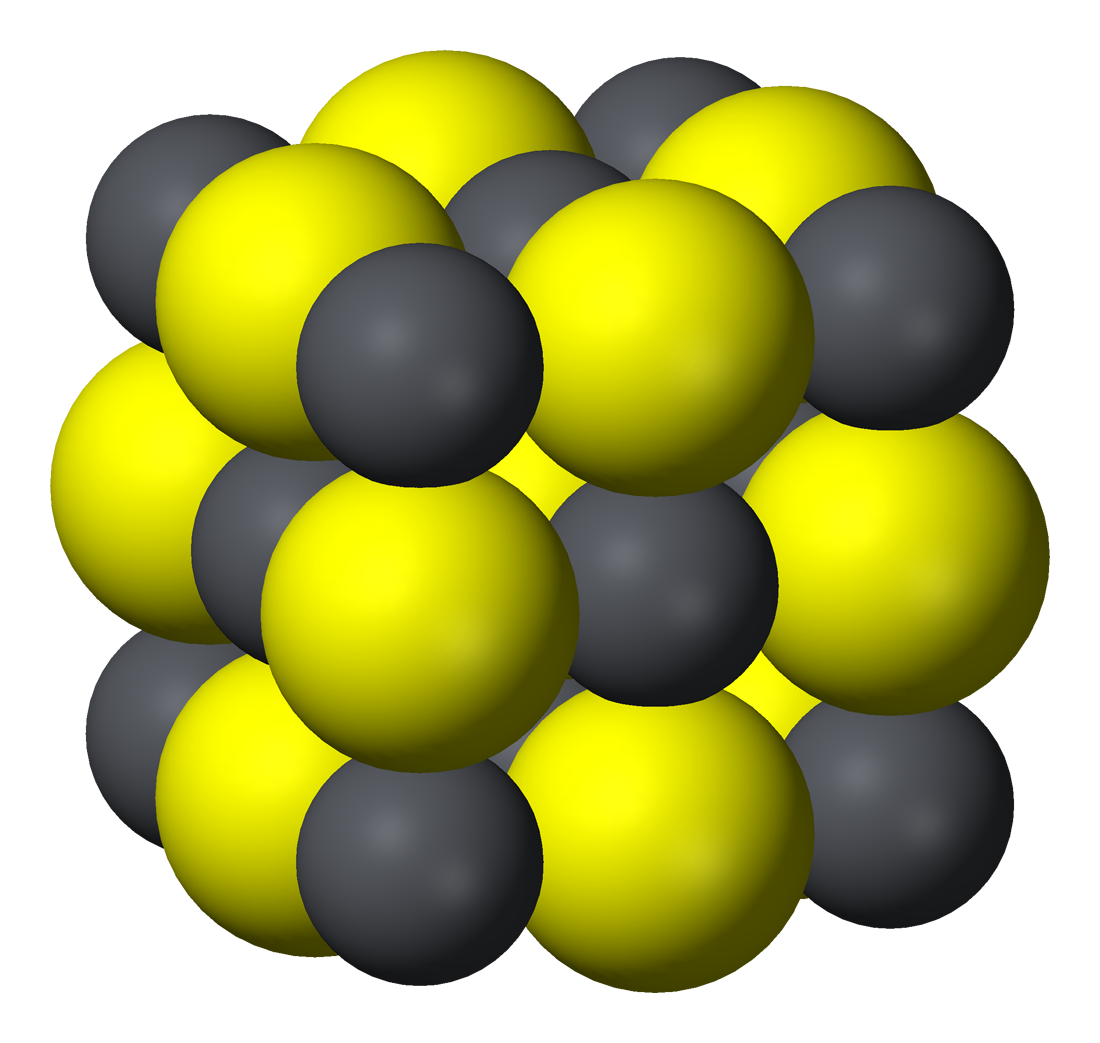
Like the related materials PbSe and PbTe, PbS is a semiconductor. In fact, lead sulfide was one of the earliest materials to be used as a semiconductor. Lead sulfide crystallizes in the sodium chloride motif, unlike many other IV-VI semiconductors.
Since PbS is the main ore of lead, much effort has focused on its conversion. A major process involves smelting of PbS followed by reduction of the resulting oxide. Idealized equations for these two steps are:
The sulfur dioxide is converted to sulfuric acid.
Lead sulfide-containing nanoparticle and quantum dots have been well studied. Traditionally, such materials are produced by combining lead salts with a variety of sulfide sources. In 2009, PbS nanoparticles have been examined for use in solar cells.
PbS was one of the first materials used for electrical diodes that could detect electromagnetic radiation, including infrared light. As an infrared sensor, PbS directly detects light, as opposed to thermal detectors, which respond to a change in detector element temperature caused by the radiation. A PbS element can be used to measure radiation in either of two ways: by measuring the tiny photocurrent the photons cause when they hit the PbS material, or by measuring the change in the material's electrical resistance that the photons cause. Measuring the resistance change is the more commonly used method. At room temperature, PbS is sensitive to radiation at wavelengths between approximately 1 and 2.5 μm. This range corresponds to the shorter wavelengths in the infra-red portion of the spectrum, the so-called short-wavelength infrared (SWIR). Only very hot objects emit radiation in these wavelengths.
Hub AI
Lead(II) sulfide AI simulator
(@Lead(II) sulfide_simulator)
Lead(II) sulfide
Lead(II) sulfide (also spelled sulphide) is an inorganic compound with the formula PbS. Galena is the principal ore and the most important compound of lead. It is a semiconducting material with niche uses.
Addition of hydrogen sulfide or sulfide salts to a solution containing a lead salt, such as PbCl2, gives a black precipitate of lead sulfide.
This reaction is used in qualitative inorganic analysis. The presence of hydrogen sulfide or sulfide ions may be tested using "lead acetate paper."
Like the related materials PbSe and PbTe, PbS is a semiconductor. In fact, lead sulfide was one of the earliest materials to be used as a semiconductor. Lead sulfide crystallizes in the sodium chloride motif, unlike many other IV-VI semiconductors.
Since PbS is the main ore of lead, much effort has focused on its conversion. A major process involves smelting of PbS followed by reduction of the resulting oxide. Idealized equations for these two steps are:
The sulfur dioxide is converted to sulfuric acid.
Lead sulfide-containing nanoparticle and quantum dots have been well studied. Traditionally, such materials are produced by combining lead salts with a variety of sulfide sources. In 2009, PbS nanoparticles have been examined for use in solar cells.
PbS was one of the first materials used for electrical diodes that could detect electromagnetic radiation, including infrared light. As an infrared sensor, PbS directly detects light, as opposed to thermal detectors, which respond to a change in detector element temperature caused by the radiation. A PbS element can be used to measure radiation in either of two ways: by measuring the tiny photocurrent the photons cause when they hit the PbS material, or by measuring the change in the material's electrical resistance that the photons cause. Measuring the resistance change is the more commonly used method. At room temperature, PbS is sensitive to radiation at wavelengths between approximately 1 and 2.5 μm. This range corresponds to the shorter wavelengths in the infra-red portion of the spectrum, the so-called short-wavelength infrared (SWIR). Only very hot objects emit radiation in these wavelengths.