Hubbry Logo
Lys (river)Lys (river)Main
Open search
Lys (river)
Community hub
Lys (river)
logo
8 pages, 0 posts
0 subscribers
Be the first to start a discussion here.
Lys (river)
Lys (river)
from Wikipedia
Lys/Leie
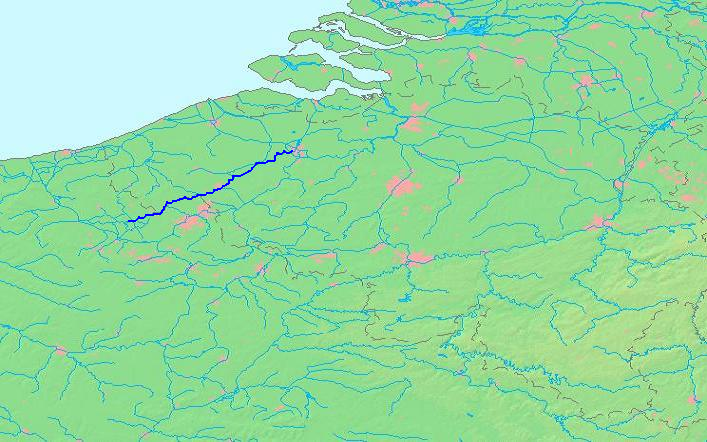
The course of the Lys
Lys (river) is located in France
Lys (river)
Lys (river) is located in Belgium
Lys (river)
Map
Location
CountryFrance, Belgium
Physical characteristics
Source 
 • locationPas-de-Calais
 • elevation115 m (377 ft)
Mouth 
 • location
Scheldt
 • coordinates
51°3′18″N 3°44′3″E / 51.05500°N 3.73417°E / 51.05500; 3.73417
Length202 km (126 mi)
Basin features
ProgressionScheldtNorth Sea

The Lys (French pronunciation: [lis] ) or Leie (Dutch pronunciation: [ˈlɛiə] ) is a river in France and Belgium, and a left-bank tributary of the Scheldt. Its source is in Pas-de-Calais, France, and it flows into the river Scheldt, with the confluence in the city of Ghent, Belgium. Its total length is 202 kilometres (126 mi).

Historically a very polluted river from the high population density and industrialisation in both Northern France and Belgium, it has seen substantial improvements in recent years, partly due to the decline of the principal industry, the spinning and weaving of flax. The region of the Leie (between Deinze and Ghent) was known as a favourite place for numerous painters in the first half of the 20th century.

The source of the Lys is in a village, Lisbourg, east of Fruges, in the Pas-de-Calais department of France. It flows generally northeast through the following departments of France, provinces of Belgium and towns and municipalities:

Lys in Ghent
The river in Ghent
Buildings south along the Leie in Ghent

The main tributaries of the Leie are, from source to mouth: Laquette, Clarence, Lawe, Deûle, Gaverbeek [nl], Heulebeek [fr; nl; vls], and Mandel.[1]

The river was the location of three battles between the Allies and the German Army during the two world wars. During the First World War in 1918 the location was the scene of the First Battle of the Lys, which was part of the German Spring Offensive and later that year of the Second Battle of the Lys, which was part of the Allies' Hundred Days Offensive. During the Second World War, the Battle of the Lys (1940) was part of the Nazi German Wehrmacht's Blitzkrieg offensive towards the English Channel.

History

[edit]

The Leie/Lys was a commercial navigation from the Middle Ages, but it was the river's devastating floods rather than navigation improvements which justified major works and meander cut-offs started around 1670. The 9 meter difference in elevation between Aire-sur-la-Lys and the border was gradually overcome by six locks and weirs, completed in 1780. The river carried a heavy traffic in grain and linen through to Ghent and Antwerp. The navigation was leased out to a company around 1825, and the locks upgraded to 5.20 m wide, for a draught of 1.60 m. In December 1899, more than 40 schoolchildren skating on the frozen river at Frelinghien fell through the ice and drowned.[2]

The river was given its present depth by the Freycinet programme. The section below Armentières was enlarged to class III from 1930, and the border section was improved to class Va starting from 1960. This section is part of the EU's priority project 30 for the Seine-Escaut waterway. The upstream section, by contrast, is used almost exclusively by recreational craft, and is at present heavily silted.[3]

References

[edit]
[edit]
Revisions and contributorsEdit on WikipediaRead on Wikipedia
from Grokipedia
The Lys River (French: Lys; Dutch: Leie), a significant waterway in northern and , originates in the village of Lisbourg in the Pas-de-Calais department of and flows approximately 202 kilometers (126 miles) northeast before joining the River at , , as its left-bank tributary. The river traverses the historic regions of and Belgian Flanders, forming the international border between and for nearly 24 kilometers downstream from Armentières. Its catchment area spans about 4,727 square kilometers, supporting diverse agricultural, industrial, and urban landscapes across the two countries. The Lys is navigable for much of its course, particularly from near Aire-sur-la-Lys in France to Ghent in Belgium, facilitating historical trade and modern freight transport with vessels up to 5.18 meters in beam and 1.80 meters in draft. Major tributaries include the Laquette, Clarence, Lawe, Deûle, Gaverbeek, Heulebeek, and Mandel, which contribute to its flow through low-lying plains and meandering valleys prone to flooding. Historically, the river played a strategic role in conflicts, including World War I battles along its banks, and faced severe pollution from industrialization in the 20th century, though restoration efforts have improved its ecological health in recent decades. Today, it supports cross-border cooperation in water management, tourism, and environmental protection within the Scheldt River Basin District.

Geography

Etymology

The river is known by two primary names corresponding to the linguistic regions it crosses: Lys in French, pronounced [lis], and Leie in Dutch and Flemish, pronounced [ˈlɛi̯ə]. This bilingual nomenclature underscores its path through French-speaking areas in northern and Dutch-speaking in . The earliest attested form of the name appears as Legia in a dated to 694 AD. Subsequent medieval variations include Lisia and Leia in Latin texts from the 9th to 11th centuries, evolving into the modern forms through Romance and Germanic linguistic influences. Linguists propose that the name originates from Celtic roots, potentially linked to an Indo-European stem denoting "flow" or "stream," as seen in Old Irish legaim, meaning "to flow" or "to melt." Alternative interpretations suggest possible Germanic contributions, though the Celtic derivation remains the predominant scholarly view based on hydronymic patterns in the region.

Physical characteristics

The Lys River, originating in the hills of , has a total length of 202 kilometers (126 miles). Its source is located in the commune of Lisbourg in the department of northern , emerging at an elevation of 115 meters above . From there, the river flows generally northeast, traversing the lowland plains of and Belgian before reaching its mouth. The river's mouth is at the confluence with the (Escaut) River in the city of , province, , where the elevation is near at approximately 4.5 meters. The Lys drains a basin area of approximately 4,727 square kilometers within the larger River system, encompassing parts of northern and western . This relatively modest basin supports the river's passage through fertile alluvial plains characterized by gentle gradients and meandering channels typical of lowland fluvial systems.

Course

The Lys River originates from a series of springs in the hills of Lisbourg, a small village in the department of northern , at an elevation of approximately 115 meters above sea level. In its French course, the river flows northeast for about 85 kilometers through the and Nord departments, traversing the gently rolling plains of . It passes through several historic towns, including Saint-Venant, Aire-sur-la-Lys, Merville, and Armentières, where it meanders through rural landscapes shaped by agriculture and small-scale industry. The Lys then forms the international boundary between France and Belgium for approximately 25 kilometers, beginning near Deûlémont in the Nord department and continuing to Menin (Menen), with the right bank remaining in French territory and the left bank in Belgium. This border section, known as the Lys mitoyenne, highlights the river's role as a natural divider managed jointly by both nations under bilateral agreements. Entering fully into Belgium, the Lys continues for 92 kilometers through the province of and into , flowing across the flat Flemish lowlands toward its confluence with the River in . Along this stretch, it passes key towns such as , (Courtrai), Wervik, and , where the terrain shifts to expansive polders and reclaimed wetlands, reflecting a transition from the undulating French uplands to the low-gradient alluvial plains of .

Hydrology and environment

Basin and tributaries

The Lys River basin encompasses a transboundary watershed spanning the French region of , particularly the departments of and Nord, and the Belgian province of , covering a total area of approximately 4,727 km² at its confluence with the in . This drainage network supports a hydrological system influenced by sub-basins in these areas, where clay-loam soils contribute to significant interactions, including recharge and occasional flooding from rising tables during saturation. within the basin is predominantly agricultural, with historical emphasis on cultivation and general crop production, though urban expansion has intensified around key centers such as in and in . The primary tributaries form a structured network that augments the Lys's flow, beginning in the upstream French sections. The Laquette, originating from the south, joins the Lys at Aire-sur-la-Lys, contributing drainage from loamy agricultural plains in . Further downstream in the mid-French course, the Clarence enters near Merville, draining a sub-basin of about 276 km² characterized by rural landscapes, while the Lawe converges at La Gorgue, integrating waters from the area and its own sub-basin including the Loisne tributary. Near the border, the Deûle tributary merges with the Lys at Deûlémont, close to Comines, channeling urban-influenced runoff from the metropolitan area. In the Belgian portion, the basin's network continues with key inflows from West Flanders sub-basins, supporting polder-like agricultural and features. The Gaverbeek joins the Lys at , draining eastern rural areas; the Heulebeek enters near Kuurne, contributing from meandering valley lowlands; and the Mandel converges at Wielsbeke, integrating waters from broader Flemish farmlands upstream of . These confluences highlight the basin's dendritic , where sub-basins enhance overall hydrological connectivity across permeable and semi-impermeable soil zones.

Discharge and flow

The Lys River displays a hydrological regime, driven by rainfall from Atlantic weather systems, resulting in variable flows that increase progressively downstream as tributaries contribute additional water volume. The average discharge at the mouth near is approximately 35 m³/s, as recorded at key downstream gauging stations in . Flow variations are marked by seasonal patterns, with winter peaks often exceeding 160 m³/s during intense rainfall events, compared to lower summer flows typically around 10-20 m³/s amid reduced precipitation and higher . These dynamics reflect the river's response to its 4,727 km² basin, where upstream sections in experience lower volumes that build toward the Belgian portion. Critical measurement sites include Saint-Venant in , draining a 643 km² sub-basin with more modest flows, and Harelbeke in , where discharges rise notably due to accumulated inputs from upstream tributaries. Overall, the regime is shaped by basin-wide annual of 700-800 mm, concentrated in autumn and winter to sustain higher outflows while summer droughts constrain volumes.

Flood management and ecology

The Lys River basin has experienced significant flooding throughout history, with notable events including the catastrophic inundations of February 1784, triggered by rapid thaw after a severe winter freeze, which affected the and its tributaries like the Lys, causing widespread damage to and in . More recent floods in late 2023 and early 2024 highlighted ongoing vulnerabilities, with peak discharges reaching 88.6 m³/s at after water diversion measures, underscoring the river's susceptibility to in its low-lying course. These events have driven long-term flood management strategies, beginning in the with meander cut-offs initiated around to shorten the river's length from approximately 90 km to 68 km, reducing flood-prone loops and improving flow efficiency, alongside the construction of dikes and weirs by 1780 to manage the 9 m elevation drop along its navigable stretch. In the , flood defenses expanded with the development of the Lys Canal (Leieomleidingkanaal) as a bypass around , part of broader efforts to divert excess water during high flows and protect urban areas, integrated into the -funded Seine- linkage project since the 2000s, which includes recalibration and dredging to enhance resilience. The Sigma Plan, launched in 1977 for the estuary and its tributaries including the Lys, combines dike reinforcements, controlled flooding areas, and to safeguard over 20,000 hectares, with post-2000s updates incorporating Floods Directive requirements for vulnerability mapping and adaptive infrastructure. These measures have mitigated risks, but the basin remains prone to overflows during intense rainfall, with average non-flood discharges around 7.5 m³/s at key points providing baseline context for extremes. Ecologically, the Lys has suffered from historical linked to the region's and industries, which introduced and nutrients into sediments, impairing and aquatic habitats through the mid-20th century. Recent improvements, driven by plants achieving over 94% reduction in (BOD), (COD), and since 2003, have restored much of the river to good ecological status, with nutrient loads like nitrates and now managed under cross-border SAGE plans. Restoration efforts, including reconnection of floodplains and semi-oxbow lakes via the Seine-Scheldt project aiming to rehabilitate 500 ha of wetlands, have boosted , supporting species such as and the returning European otter (Lutra lutra) in enhanced riparian zones. Climate change projections indicate increased flood frequency in the Lys basin due to more intense and altered flow patterns, with 2020s vulnerability assessments emphasizing the need for expanded nature-based defenses like restoration to address heightened risks in this urbanized lowland area.

Historical development

The Lys River served as a vital commercial waterway from the onward, facilitating the transport of grain, timber, and early products to key trading centers such as and . Fords and water mills dotted its course, supporting local trade and milling operations that harnessed the river's flow for grinding grain and processing raw materials. In the 17th and 18th centuries, efforts to improve were spurred more by recurrent flooding than by demands alone. Starting in 1670, engineers implemented cut-offs to straighten the channel and reduce flood risks, marking the beginning of systematic hydraulic modifications. By 1780, under French administration following the region's , six locks and weirs were constructed to address the 9-meter elevation drop between Aire-sur-la-Lys and the Belgian border, enabling more reliable upstream passage for barges. The brought an industrial surge to the Lys, driven by the booming and sectors in northern and . retting—immersing harvested stalks in the river to separate fibers—became a activity, with the Lys's clear waters ideal for producing high-quality exported across ; by mid-century, the valley was a leading producer, supporting mills and factories in towns like Armentières and Courtrai. was further standardized in the 1880s through the Freycinet Plan, which deepened the channel to a uniform 1.60-meter draught, accommodating larger vessels and boosting freight capacity for industrial goods. In the early , strategic canal connections amplified the river's role in regional trade: the Canal de la Deûle linked the Lys to , facilitating coal and textile shipments, while direct access to via the confluence supported exports to broader European markets. These enhancements sustained heavy commercial traffic until disruptions from damaged locks and halted operations.

Modern infrastructure

The Lys River has been canalized for approximately 130 km from Aire-sur-la-Lys in to in , enabling commercial and recreational navigation with 8 locks managing a total elevation difference of 11 meters in the French section, with additional weirs in Belgium. The channel dimensions support vessels up to 5.18 m wide and 1.80 m draught up to Armentières (2.00 m downstream), accommodating barges of up to 300 tonnes in most sections, though larger vessels up to 1,000 tonnes can navigate downstream portions near Armentières. Upstream sections above Aire-sur-la-Lys are heavily silted due to reduced flow and , limiting them to recreational use by small pleasure craft. Key modern structures include the Espierre and Comines locks in northern , which handle cross-border traffic, and the Kortrijk and weirs in , which regulate water levels and integrate the Lys with the Scheldt-Escaut Canal system for seamless connections to and beyond. This integration forms part of the broader European inland waterway network and the EU's Seine-Scheldt project. Ongoing maintenance since the includes regular to combat silting and ensure minimum depths, with annual freight traffic estimated at 1-2 million tonnes, predominantly bulk goods such as aggregates and agricultural products.

History

Pre-modern

In the Roman , the Lys River facilitated settlements and activities along its banks in northern . Archaeological excavations at Thérouanne revealed a well-preserved imperial-period center, including workshops for , butchery, tanning, and glassmaking, with artifacts like studded shoes and fishing tools such as gaffs and net anchors indicating the river's role in local economy and daily life. deposits from the Lys preserved these organic remains for over 1,700 years. Late Roman sites in the Lys-Scheldt valley, including occupied areas near and Kerkhove, further attest to the river's importance for rural communities in the Menapiorum. During the early medieval period, particularly in the 9th century under Carolingian rule, the Lys emerged as a vital in , supporting the transport of commodities like , , and through connected waterways to towns such as and . Charlemagne's regulations promoted linen production, with monasteries refining spinning and techniques using the river's clear waters to enhance fiber quality. The Abbey of Saint-Vaast in nearby benefited from its proximity to the Lys, which influenced regional monastic life, though it faced disruptions from Viking incursions along the river in 881 that targeted the abbey and surrounding areas. The river's economic significance grew in the , especially from the 13th century, when flax cultivation in the Lys Valley fueled ' linen , producing supple fabrics retted in its pure waters and exported to markets in Bruges, , and via guilds in , , and . As a key tributary of the , the Lys contributed to 's medieval prosperity by enabling the shipment of textiles, , and , transforming the city into a major European hub at the rivers' . Local reflected the river's cultural role, with legends tying the fleur-de-lys to irises blooming along its banks, as in tales of floral contests where the Lys's lilies prevailed. Before the , human modifications to the Lys remained limited, preserving its natural meanders for essential uses like and in medieval .

World Wars and modern conflicts

During , the Lys River served as a critical strategic line in the Allied defenses during the of 1918. Operation Georgette, launched on April 9, targeted a 25-mile front along the Lys in , aiming to break through British positions and advance toward the . The initial assault involved a massive 4.5-hour barrage followed by infantry attacks that penetrated nine miles of frontline on the first day, capturing key points like Estaires and Armentières. The ensuing Battle of the Lys, spanning April 9 to 29, saw intense fighting as Allied forces, including British, French, and troops, mounted counterattacks to hold the Lys line. A pivotal episode occurred around Kemmel Hill, a dominant terrain feature overlooking the Lys valley, where German forces launched a surprise assault on using stormtroopers and elite mountain units. This action captured the hill after fierce close-quarters combat, disrupting Allied artillery observation and threatening the . Heavy casualties mounted in the sector, with the French ossuary on Kemmel Hill later interring over 5,000 unidentified soldiers from the April fighting. Overall, the battle resulted in approximately 80,000 British and casualties (killed, wounded, captured, or missing), 30,000 French, and 85,000 German, marking it as one of the costliest engagements of the Spring Offensive despite failing to achieve decisive breakthroughs. In , the Lys again became a focal point during the German invasion of in , as part of the broader offensive. The Battle of the Lys unfolded from May 23 to 28, pitting Belgian and infantry against the German 6th , which sought rapid crossings to outflank Allied forces and advance toward . German engineers and motorized units forced multiple bridgeheads over the river near Courtrai and Menin, using Stuka dive-bombers to suppress Belgian defenses and artillery. These crossings enabled the 4th and 6th Panzer Divisions to exploit gaps, contributing to the encirclement of British Expeditionary Forces and hastening the evacuation at . Belgian casualties in the battle accounted for half of the nation's 80,000 total losses during the 18-day campaign. Post-war recovery efforts focused on reconstructing infrastructure damaged along the Lys, including numerous bridges destroyed during retreats and advances. In , for instance, the original iron over the Lys, demolished in 1940 amid 33 other local spans, was rebuilt as a double-beam structure between 1950 and 1951 to restore connectivity. Broader demilitarization in involved Allied oversight and the repurposing of wartime fortifications, with the Lys valley transitioning from a zone to civilian use under NATO's emerging framework. During the 1944-45 Allied liberation, the river played a minimal role, serving mainly as a logistical axis for advancing forces rather than a contested barrier. Since , the Lys basin has seen no direct involvement in armed conflicts, though its location in influenced Cold War planning as part of Belgium's central defense sector.

References

  1. https://en.wiktionary.org/wiki/Leie
  2. https://en.wiktionary.org/wiki/Lys#French
Add your contribution
Related Hubs
User Avatar
No comments yet.