Hubbry Logo
search
logo
1106685

Lescot Wing

logo
Community Hub0 Subscribers
Read side by side
from Wikipedia

48°51′36.95″N 2°20′15.08″E / 48.8602639°N 2.3375222°E / 48.8602639; 2.3375222

The Lescot Wing of the Louvre Palace

The Lescot Wing (Aile Lescot in French, also Aile Henri II) is the oldest preserved structure above ground of the Louvre Palace in Paris, France. It was designed by architect Pierre Lescot and built between 1546 and 1551. Its architecture is influenced by Italian Mannerism.[1] It had seminal influence on what became the Parisian Renaissance style, and beyond it, French architectural classicism.

King Francis I appointed architect Pierre Lescot (1510–1578) to lead all building projects at the Louvre Palace. Lescot's role was reconfirmed following Francis's death by his son and successor Henry II; Lescot kept working on the Louvre project until his death, completing the Lescot Wing in 1551, the Pavillon du Roi, and the western section of the southern wing of the Cour Carrée.

Exterior

[edit]

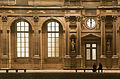
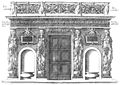
The wing's façade on the court side, now the Cour Carrée, consists of two main stories (ground floor and first floor) plus an attic richly decorated with Jean Goujon's bas-relief sculptures. It is crowned by a sloping or Mansard roof, which had considerable influence on the subsequent development of French architecture, including the later work of François Mansart which gave his name to the roof profile. The deeply recessed arch-headed windows of the ground story form an arcade, while the projecting pavilions bear small round oeil de bœuf windows above them. In the second storey slender fluted pilasters separate the windows, which alternate triangular and arched pediments. Goujon's sculpture and architectural ornaments are subordinated to the construction.

The eastern façade was comprehensively renovated in the early 1980s and inaugurated by President François Mitterrand, together with the rest of the cleaned-up Cour Carrée, on 24 February 1986.

Interior

[edit]

Both the ground floor and the first floor include major ceremonial spaces or Great Halls that played a significant symbolic and practical role in the operation of the French monarchy for more than a century after their initial construction.

Ground floor

[edit]

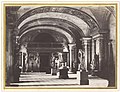
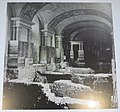
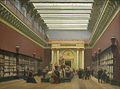
The Lower Great Hall (Grande Salle basse), now known as Hall of the Caryatids (French: Salle des Caryatides), first completed in 1549, replaced what had been the Great Hall of the Medieval Louvre built in the 13th century. The former adjacent chapel's footprint was kept as a semi-separated space on the southern end, known since as the "tribunal", whose floor was originally slightly higher than the rest.[2]: 71, 73  On the room's northern end, Goujon created a tribune or minstrels' gallery supported by four caryatid figures inspired by classical precedents (not directly by those of the Erechtheion in Athens, which were not known in Renaissance France, but presumably by ancient Roman copies thereof).[3]: 16  The original ceiling, supported by wooden beams, had to be propped up as early as the reign of Henry IV; in 1638, that wooden ceiling was replaced by the current stone vault supported by pillars decorated with columns, designed by Jacques Lemercier.[3]: 30  The sculpted decoration thereof was completed around 1806-1808 by Percier and Fontaine, who removed the difference of floor level between the "tribunal" and the rest of the room. The room was used for multiple festivities and ceremonies, including the mourning of King Henry IV from 10 to 26 June 1610, and a ritual foot washing of thirteen paupers performed by Louis XIV on Maundy Thursday.[2]: 74 

First floor

[edit]

The Upper Great Hall (Grande Salle haute), long known as the Salle La Caze as it hosted the collection donated by Louis La Caze in 1870 and now (since 2021) used for the display of Etruscan art, was used for numerous royal ceremonies and functions. In the 18th century, it was partitioned and the various rooms thus created were used by the Academies and other institutions. The large room was recreated in the late 1810s and merged with the attic to form a vast ceremonial space, with an upper gallery for the public, that was used for the joint opening sessions of France's two legislative chambers (first on 9 December 1820[2]: 74 ) and correspondingly known as salle des Etats or salle des séances.[4]: 11  In 1864, Hector-Martin Lefuel renovated the room for museum use, including a skylight in the ceiling, after a new salle des Etats had been created in Napoleon III's Louvre expansion.[2]: 74  During the 1930s, Louvre architect Albert Ferran recreated the attic to expand the Louvre's exhibition spaces and redecorated the room, thus brought back to its 16th-century height and volume, in a stripped Classicism style, keeping Percier and Fontaine's triumphal-arch-shaped structures at both ends of the room and their ample cornice that supported the public's gallery. This setup was complemented in 2010 by a painted ceiling by Cy Twombly that pays homage to great artists of ancient Greece. In 2020-2021, the room was redecorated by government architect Michel Goutal in the spirit of Lefuel's design of the 1860s, which triggered a lawsuit from the Cy Twombly Foundation, even though the painting was left untouched;[5] the Louvre and the Cy Twombly Foundation eventually found an agreement to modify the redecoration to bring it closer to the earlier color combination.[6]

To the south of the Upper Great Hall were two rooms leading to the Pavillon du Roi, a wardrobe and an antechamber, which were merged into a single King's antechamber (French: antichambre du Roi) in 1660, where Louis XIV used to dine in public.[7] That room still displays its ornate carved ceiling, the central section of which was originally the ceiling of the 16th-century antechamber and was complemented by two side sections in the same style during the 1660 enlargement. The ceiling reserves three spaces for paintings, which were decorated in 1822 with works by Merry-Joseph Blondel.[2]: 75  These were in turn deposed in 1938 and replaced in 1953 with Les Oiseaux, a set of paintings by Georges Braque that marked the first installation of contemporary art in the Louvre for more than half a century.[8]

Second floor

[edit]

The attic served as lodgings for high-ranking officials and courtiers until its suppression[vague] in the early 19th century. In the 1650s it was inhabited by Cardinal Mazarin's nieces. Since 1993 it has been dedicated to the exhibition of 19th-century French paintings.

Staircases

[edit]

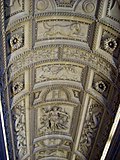
To the immediate north of these spaces is the Lescot Wing's ceremonial staircase, mostly preserved in its mid-16th-century state, known in the past as the grand degré du Roi and now as the escalier Henri II. Its vaulted stone ceiling is decorated with ornate motifs designed by Jean Goujon.[9]: 11–13  Immediately to the north is the Pavillon de l'Horloge, built between 1624 and 1643 and served by that staircase and its symmetrical counterpart on the other side, known as escalier Henri IV (which is anachronistic, since it was only started in 1639 and left unfinished during the Fronde).[9]: 13 

Two smaller spiral staircases also served the Lescot Wing and adjacent Pavillon du Roi. They still exist but are not open to the public.

See also

[edit]

Notes

[edit]
[edit]
Revisions and contributorsEdit on WikipediaRead on Wikipedia
from Grokipedia
The Lescot Wing (French: Aile Lescot, also known as Aile Henri II) is the oldest surviving above-ground structure of the Louvre Palace in Paris, France, marking the beginning of its transformation from a medieval fortress into a Renaissance palace.[1] Commissioned by King Francis I in 1546, it was designed by French architect Pierre Lescot (c. 1515–1578) and primarily constructed between 1546 and 1551, with completion under Henry II.[2][3] This wing, located on the western side of the Cour Carrée between the Pavillon Sully and Pavillon du Roi, exemplifies early French Renaissance architecture through its innovative use of classical orders and proportions.[4] The structure comprises two principal stories topped by an attic, featuring a richly decorated stone façade with pilasters, pediments, and elaborate bas-relief sculptures crafted by the Mannerist sculptor Jean Goujon (c. 1510–c. 1567).[5] These decorations, including allegorical figures and mythological motifs, draw inspiration from ancient Roman models while adapting them to a distinctly French idiom, symbolizing royal power and cultural revival.[1] Internally, the wing houses significant spaces such as the ground-floor Salle des Caryatides, originally a royal ballroom with vaulted ceilings supported by caryatid figures sculpted by Goujon in 1550.[1] As a seminal project, the Lescot Wing initiated the Parisian Renaissance style, influencing subsequent French architecture by prioritizing symmetry, classical detailing, and integration of sculpture with building fabric, and it remains a cornerstone of the Louvre's architectural evolution.[6][7]

History

Commission and Design

In 1546, King Francis I commissioned the transformation of the medieval Louvre fortress into a modern royal palace, marking the first major Renaissance intervention at the site and emphasizing a French adaptation of Italian Renaissance principles to create a unified architectural ensemble. This initiative aimed to demolish the old keep and defensive structures, replacing them with elegant facades that symbolized the monarchy's cultural aspirations. The project focused initially on the west wing, laying the groundwork for the eventual Cour Carrée, a square courtyard that would enclose the palace in a harmonious, classical manner.[8][1][9] Pierre Lescot was appointed as the principal architect in 1546, selected for his emerging talent despite a primary background in law; he had studied at the University of Paris and gained early architectural experience through designs like the Fontaine des Innocents (1547–1550), a public fountain that showcased his ability to integrate sculpture with architecture. Lescot's selection reflected Francis I's preference for a native French talent capable of blending local traditions with imported innovations, rather than relying solely on foreign experts like Sebastiano Serlio, whose earlier grandiose plans for the Louvre had been rejected. Under Lescot's direction, the design incorporated subtle French modifications to Italian models, such as steeper roofs and more ornate detailing, to suit the site's urban context.[8][10] Lescot's designs drew heavily from Italian Mannerism, evident in the rhythmic alternation of projecting and recessed bays, pilasters, and pediments that created dynamic surface play while adhering to classical proportions. The west wing was envisioned as the starting point for a cohesive Cour Carrée layout, with plans extending to adjacent pavilions to form a self-contained Renaissance quadrangle inspired by Roman forums and Italian palazzi. This approach prioritized ornamental elegance over structural mass, adapting Mannerist sophistication to French royal symbolism.[11][9] From 1547, Lescot collaborated closely with sculptor Jean Goujon to develop an integrated decorative scheme, where architecture and sculpture merged seamlessly, as seen in the planned caryatids and reliefs that would adorn the facades and interiors. Goujon's contributions, rooted in classical antiquity, complemented Lescot's framework, ensuring the wing's elevations featured harmonious figural elements that enhanced its ceremonial appeal.[1] Following Francis I's death in 1547, the project continued under Henry II, who in 1549 ordered design shifts to amplify the wing's grandeur, particularly for hosting royal ceremonies and entries. These modifications expanded the scale and ornamental focus, aligning the structure more emphatically with monarchical pomp while retaining Lescot's core vision.[12]

Construction Phases

The construction of the Lescot Wing began in 1546 under King Francis I, following his earlier order in 1528 to demolish the medieval Louvre's keep, with the west wing dismantled that year and the south wing later in the 1560s, to make way for a new Renaissance palace.[13][1] Foundations for the west wing of the Cour Carrée were laid that same year as part of an initial plan for a square-courtyarded residence, marking the site's transformation from a fortified château to a royal palace.[13] This phase involved dismantling the old structures progressively to integrate the new design seamlessly with the existing Pavillon du Roi at the southern end.[13] The primary construction period spanned 1546 to 1551, during which the two-story structure of the west wing was erected under the direction of architect Pierre Lescot, following Francis I's commission for a classically inspired façade.[1] After Francis I's death in 1547, his son Henry II continued and expanded the project, overseeing the masonry work that incorporated local Parisian stone for durability and aesthetic harmony with the surrounding architecture.[13] Lescot's design emphasized classical proportions, such as the Corinthian and Composite orders, signifying a deliberate shift from Gothic forms to Renaissance ideals in French royal building.[13] By 1551, the main body of the Lescot Wing had been completed under Henry II, including its integration with the Pavillon du Roi to form a cohesive southern elevation of the Cour Carrée.[13] Construction efforts paused in the late 1560s amid the disruptions of the Wars of Religion, halting further extensions to the courtyard ensemble until later reigns.[14] Following its 1551 completion, the wing served primarily as royal apartments and ceremonial spaces, accommodating state functions and private quarters for the monarch.[13]

Renovations and Modifications

In 1638, architect Jacques Lemercier directed significant elevations and extensions to the Lescot Wing as part of Louis XIII's efforts to expand the Louvre Palace, including the addition of stone vaulting on the ground floor to provide structural support for the upper levels and facilitate the wing's integration into the larger complex.[15] This modification preserved the Renaissance proportions of Pierre Lescot's original design while adapting the structure for increased functionality. During the early 19th century, under Napoleon I, architects Charles Percier and Pierre Fontaine undertook modifications between 1806 and 1808 to enhance the wing's utility as part of the emerging museum, including adjustments to the attic level for expanded exhibition space by suppressing its residential function, which had previously served as lodgings for officials and courtiers.[1] These changes connected interior spaces like the Salle des Caryatides to adjacent galleries of antiquities, completing decorative elements such as ceiling arches and fireplaces to align with imperial aesthetics and practical needs. In 1864, Hector-Martin Lefuel led renovations to the Lescot Wing as part of broader Second Empire transformations, commissioning decorative sculptures and ensuring stylistic harmony with the surrounding urban developments under Baron Haussmann's oversight of Paris's modernization.[16] The eastern façade of the Lescot Wing underwent comprehensive restoration in the 1980s as part of the Grand Louvre project, with archaeological and structural work on the Cour Carrée occurring from 1983 to 1985; the revitalized spaces were completed and inaugurated in 1986 by President François Mitterrand to celebrate the palace's heritage while accommodating modern museum demands.[17]

Architectural Features

Exterior Façade

The Lescot Wing's exterior presents a paradigmatic example of French Renaissance architecture, characterized by a two-story elevation topped by a crowning attic storey beneath a steeply pitched Mansard roof, the latter representing an early iteration of the form that would become emblematic of later French design. The ground floor employs a shallow blind arcade with recessed windows framed by Corinthian pilasters and subtle rustication, evoking solidity and continuity with classical precedents while adapting to French traditions. Above, the first floor features Composite pilasters dividing the bays, with broad friezes and cornices marking clear horizontal divisions; the attic, roughly half the height of the main stories, adds vertical emphasis through its segmented composition. This arrangement achieves harmonious proportions and axial symmetry, underscoring the era's emphasis on measured elegance and royal authority.[13][9][18] The western façade, oriented toward the Cour Carrée, exemplifies balanced classical orders across its nine-bay span, with three slightly projecting frontispieces that accentuate the central rhythm through paired columns on the ground level and unified rustication enhancing textural depth. These elements create a subtle hierarchy, where the ground floor's robust articulation transitions to the more refined upper stories, fostering a sense of progression and enclosure within the courtyard. The overall layout positions the wing as the southwest corner of the Cour Carrée, its symmetrical design reinforcing the geometric perfection of the square enclosure as a symbol of monarchical order.[13][9][13] The eastern façade, initially conceived as an internal elevation abutting the remnants of the medieval fortress, was comprehensively restored in the 1980s as part of the Grand Louvre project to align with the Renaissance detailing of the courtyard side, ensuring stylistic coherence across the complex. This intervention preserved the original proportions while adapting the surface to contemporary standards of visibility and integration. The wing seamlessly connects to the adjacent Pavillon du Roi via shared motifs of pilasters and cornices, forming a cohesive southwestern termination that unifies the Cour Carrée's enclosure and amplifies its spatial symmetry. Goujon's sculptural enhancements, including attic reliefs, subtly animate the structural framework without overwhelming its proportional clarity.[19][9][5]

Decorative Sculpture

The decorative sculpture of the Lescot Wing, primarily executed by Jean Goujon between 1547 and 1551, forms a cornerstone of French Renaissance artistry, integrating allegorical and mythological motifs into Pierre Lescot's architectural framework. Goujon's contributions include a series of female allegorical relief figures positioned around the oeil-de-boeuf windows above the three central doors on the façade, depicting themes such as War, Peace, Fame, History, Victory, and the Glory of the King; these stone carvings, dated 1547-1550, exhibit Mannerist characteristics with delicate, flowing drapery and dynamic poses that evoke movement and insubstantiality.[5] Complementing these are bas-reliefs featuring mythological scenes incorporated into the metopes and pediments, such as the central pediment's Allegory of War with angels bearing Henry II's monogram, which blend classical inspirations with royal symbolism to celebrate the monarch's virtues.[5] On the ground floor, Goujon's caryatids—female figures serving as supports for the gallery—exemplify a fusion of classical Greek influences, drawn from ancient models like the Forum of Augustus, with the refined elegance of French Renaissance proportions, their graceful forms and subtle musculature enhancing the structure's rhythmic flow.[1] These figures, carved in stone around 1550, not only bear architectural loads but also infuse the elevation with humanistic vitality, marking a departure from rigid antiquity toward a more fluid, national aesthetic.[5] The attic storey features additional bas-reliefs in high relief on the projecting bays, dated 1552-1555, which incorporate grotesque motifs and intricate strapwork typical of Mannerist detailing; these ornamental elements, including intertwined foliage, mythical creatures, and architectural fantasies, create a layered visual complexity that crowns the façade while echoing the decorative exuberance of Fontainebleau.[5] Goujon's sculptural program played a seminal role in establishing the "French order" in sculpture, characterized by banded columns and pilasters enriched with such motifs, influencing subsequent Louvre expansions like Jacques Lemercier's 17th-century wings that replicated the Lescot Wing's harmonious integration of architecture and ornament.[11] Preservation of these sculptures has faced significant challenges, including aggressive 19th-century cleanings and reconstructions that altered original surfaces, such as the decorative arches and fireplace elements restored by Charles Percier and Pierre-François-Léonard Fontaine to align with neoclassical ideals.[1] In the 1980s, as part of the Grand Louvre project initiated in 1981, the façades underwent steam-cleaning to remove centuries of pollution, alongside targeted restorations to safeguard Goujon's in-situ works from further erosion, ensuring their legibility while respecting patina.[19]

Interior Layout

Ground Floor

The Hall of the Caryatids, constructed between 1546 and 1551 as part of Pierre Lescot's design for the Lescot Wing under King Francis I and completed under Henry II, serves as the primary ceremonial space on the ground floor.[1] This lower great hall features four monumental stone caryatids sculpted by Jean Goujon around 1550, depicting draped female figures that support an elevated musicians' gallery intended for royal audiences and performances.[1] The spatial layout emphasizes grandeur, with the hall's elongated rectangular form and high vaulted ceiling creating an open area suited for gatherings, where the caryatids frame the gallery against the western wall, enhancing visual symmetry and acoustic projection for music and oratory.[1] Originally designed as a royal ballroom and reception hall, the space hosted significant ceremonial events, including the mourning ceremonies for King Henry IV in 1610 following his assassination and performances by Molière's troupe for Louis XIV in the 17th century.[1] Its early use as a guard room under Henry II also extended to formal proceedings, reflecting the multifunctional nature of Renaissance palace interiors. The structure was decorated and reinforced in 1806 by Charles Percier and Pierre Fontaine, who carved vaulted ceiling arches and reconstructed the fireplace incorporating Jean Goujon’s allegorical sculptures, stabilizing the original framework while preserving its Renaissance aesthetic.[1] Today, the Hall of the Caryatids forms part of the Louvre Museum's Department of Antiquities, housing Greek and Roman sculptures such as the Artemis with a Doe, with its acoustics and spatial design still evoking the performative adaptations of its royal past.[1] The hall connects directly to the nearby Henri II staircase, facilitating access to upper levels.[1]

First Floor

The first floor of the Lescot Wing houses the Upper Great Hall, known historically as the Salle Henri II and later as the Salle La Caze after the 1869 donation of Louis La Caze's collection of 583 paintings to the Louvre.[20] Constructed as part of Pierre Lescot's design between 1546 and 1551 during the reigns of Francis I and Henry II, this space originally formed private royal apartments in the mid-16th century, including areas for the king's personal use.[1] By 1660, the room was reconfigured by merging an antechamber and dressing room into a single ceremonial space for royal receptions and audiences.[21] The hall underwent significant renovations over the centuries to adapt it for museum purposes. In the early 19th century, around 1821–1822, artist Merry-Joseph Blondel painted three ceiling canvases as part of broader imperial restorations.[21] Following the La Caze bequest in 1869, the room was repurposed in the 1870s to display the donated 17th- and 18th-century masterpieces, including works by Watteau and Chardin, necessitating structural adjustments.[20] Further modifications occurred in the late 1930s, when the space was remodeled to better accommodate the collection, reducing its height to allow for additional upper-level rooms while preserving its Renaissance proportions.[22] A notable modern intervention came in 1953, when Georges Braque was commissioned to repaint the ceiling with his monumental work Les Oiseaux (The Birds), a triptych of abstract avian motifs installed in the central panels of the wooden framework, replacing the earlier 19th-century paintings and blending 20th-century modernism with the historic interior.[23] The decorative woodwork and paneling, dating to the 17th century, complement this ceiling and frame the room's elongated gallery layout. As of 2025, the Salle Henri II has served as the primary gallery for the Louvre's Etruscan antiquities, following a major reinstallation of the Department of Greek, Etruscan, and Roman Antiquities.[24] It now displays a chronological and thematic selection of artifacts from the 10th to 1st century BCE, including Attic black- and red-figure vases, bronze figures, gold jewelry, terracotta sculptures, and reconstructed tomb ensembles that highlight Etruscan funerary practices and daily life.[25] This exhibition flows spatially into adjacent areas of the Sully Wing, connecting to the former royal apartments in the Pavillon du Roi and providing visitor access via the historic Henri II staircase.[1]

Second Floor

The attic level of the Lescot Wing, comprising the second floor, originally functioned as private lodgings for high-ranking courtiers and officials in the 17th century. This utilitarian space reflected the wing's role as a royal residence before its transformation into museum facilities. In the early 19th century, modifications aligned with broader renovations that repurposed royal interiors for exhibition purposes. As of 2025, the second floor has been dedicated to displaying 19th-century French paintings, forming part of the Sully Wing's collection of works from 1650 to 1850 on level 2.[26] This section features representative masterpieces by artists such as Eugène Delacroix and Jean-Auguste-Dominique Ingres, highlighting Romantic and Neoclassical styles within the museum's Department of Paintings.[27] For instance, Ingres' La Baigneuse de Valpinçon (1808) exemplifies the precise, sculptural forms of his oeuvre in this space.[28] Structurally, the attic retains exposed wooden beams from its Renaissance origins, contributing to its intimate, historical character, while limited natural light—primarily from skylights installed during 19th-century adaptations—has been optimized for art conservation through modern climate control and UV-filtering systems.[29] These features underscore the second floor's position in the wing's vertical hierarchy, bridging the grandeur of the lower ceremonial levels with upper storage and display functions, now integral to the museum's curatorial strategy.[30]

Staircases

The Escalier Henri II, constructed between 1547 and 1555 under the direction of architect Pierre Lescot, serves as the principal ceremonial staircase in the Lescot Wing of the Louvre Palace.[31] Located at the northern end of the wing, it replaced an earlier central staircase envisioned by Francis I, reflecting Henri II's modifications to the palace's layout during the Renaissance reconstruction.[32] This monumental straight staircase, a departure from medieval spiral designs, facilitated vertical circulation between the ground and upper levels, originally designed for royal processions and access within the newly transformed palace.[21][33] The staircase's interior features a vaulted stone ceiling adorned with intricate bas-reliefs and ornate motifs crafted by the workshop of sculptor Jean Goujon, Lescot's primary collaborator. These decorations include allegorical figures centered on hunting themes, prominently featuring the goddess Diana—symbolizing the hunt and alluding to Henri II's courtly interests—as well as other Renaissance-inspired symbolic elements that enhance the space's grandeur.[32] Goujon's contributions, for which he received payment in 1550, integrated seamlessly with the surrounding architectural elements, such as the adjacent Salle des Caryatides, underscoring the unified aesthetic of the wing. The overall design emphasizes spatial progression, creating a dramatic ascent that connects the ground floor's public areas to the first floor's more private chambers.[31] As one of the oldest preserved features of the Louvre in its near-original state, the Escalier Henri II exemplifies early French Renaissance architecture's blend of classical proportions and decorative opulence.[32] Its enduring role in the museum's layout highlights the wing's evolution from royal residence to public institution, with the staircase providing essential linkage between exhibition spaces on the ground and first floors.[33]

Significance

Architectural Influence

The Lescot Wing, designed by Pierre Lescot with sculptural contributions from Jean Goujon, introduced a distinctive "French order" in architecture by synthesizing Italian Renaissance classicism—such as Corinthian and Composite pilasters—with indigenous French elements like proportional adaptations and traditional carpentry techniques for lofty pitched roofs.[34] This hybrid approach deviated from strict Vitruvian sequences, favoring decorative consistency and evolution to suit local materials and aesthetics, thereby laying the groundwork for a national style that balanced imported grandeur with vernacular restraint.[34] The wing's influence extended directly to later Louvre expansions, notably Jacques Lemercier's 17th-century additions, which replicated its pilaster rhythms and facade composition to maintain stylistic unity across the Cour Carrée.[34] Beyond the Louvre, the Lescot Wing exerted seminal influence on Parisian hôtels particuliers and châteaux, establishing templates for urban and rural elite residences during the French Renaissance. For instance, its rusticated arches, window moldings, and giant unfluted Corinthian pilasters inspired structures like the Hôtel des Ligneris (later Carnavalet, 1550s), the Hôtel du Faur (1567), and Louis Métezeau's Hôtel d’Angoulême (early 1560s), which echoed these motifs to convey refined sophistication.[34] The Tuileries Palace, initiated by Philibert de l'Orme in 1564 for Catherine de Médicis, further adopted and adapted the wing's classical principles, incorporating banded Ionic columns in de l'Orme's "ordre des colomnes Françoises" as a direct evolution of Lescot's innovations to symbolize feminine grace and royal prestige.[34] This dissemination helped propagate a cohesive Renaissance idiom across France, transitioning from isolated experiments to widespread adoption in royal and noble commissions. The wing's emphasis on symmetry, proportion, and ornate yet balanced facades symbolized the emerging absolutist ideals of royal power under the Valois monarchs, portraying the Louvre as an emblem of centralized authority and cultural patronage.[34] Courtyard reliefs personifying Abundance, Victories, and Science reinforced monarchical legitimacy, while spandrel motifs celebrated Valois military and artistic prowess, setting precedents for absolutist architecture that prioritized harmonious order to reflect divine and earthly hierarchy.[34] In architectural history, the Lescot Wing is recognized as a pivotal bridge from medieval fortress aesthetics to classical French paradigms, transforming the Louvre from a defensive structure into a model of Renaissance humanism.[35] Contemporary and later treatises offered both critiques and praises for the wing's elegance, underscoring its transformative role. Pierre de Ronsard lauded its beauty in his Élegie à Pierre Lescot (c. 1550s), while Jacques Androuet du Cerceau highlighted its excellence in Les Plus Excellents Bastiments de France (1576–1579); 18th-century commentator Jacques-François Blondel (1752) admired its proportions despite irregularities.[34] Conversely, Philibert de l'Orme critiqued its non-classical techniques in his Architecture (1567), and Blaise de Vigenère (1580s) noted errors amid its originality, yet these discussions affirmed the wing's status as a benchmark for French architectural innovation.[34]

Museum Integration and Legacy

Following the French Revolution, the Lescot Wing transitioned from royal residence to public museum space as part of the broader nationalization of the Louvre Palace in 1793, with initial art displays beginning in the adjacent Grande Galerie and extending to the wing's rooms by the late 1790s.[36][1] The Salle des Caryatides, a key ground-floor hall within the wing, was repurposed as the "Salle des Antiques" in 1692 to showcase Louis XIV's antique sculptures, a function that evolved into permanent antiquities exhibits after the Revolution.[1] Prior to its full museum conversion, the Lescot Wing hosted significant cultural events that underscored its role as a center of French intellectual life. In 1658, Molière's troupe performed Le Docteur amoureux for the first time before Louis XIV in the Salle des Caryatides (originally the salle des gardes), followed by additional presentations including L'Étourdi and Les Précieuses ridicules in 1664.[1][37] The hall also served as the venue for the solemn inauguration of the Institut de France on 25 August 1796, marking a pivotal moment in the post-revolutionary reorganization of arts and sciences.[1] Today, the Lescot Wing forms the core of the Louvre's Sully Wing, providing visitor access to ground- and first-floor galleries dedicated primarily to antiquities, including Greek sculptures such as the Roman-era Artemis with a Doe in the Salle des Caryatides and extensive collections of Egyptian, Near Eastern, Etruscan, and Roman artifacts across rooms like 311 and 344.[1][38] Upper levels house French paintings from the medieval to 19th-century periods, such as works by Guillon-Lethière, integrated into chronological displays that highlight the wing's historical architecture.[39][40] Preservation efforts in the Lescot Wing focus on maintaining its Renaissance integrity amid modern use, including reconstructions of the Salle des Caryatides' vaulted ceiling arches and fireplace by architects Percier and Fontaine in the early 19th century, with ongoing maintenance addressing post-2021 updates such as temporary closures in Sully Wing rooms for conservation (e.g., Room 311 from November 2025).[1][38] These initiatives ensure structural stability without unresolved disputes over artworks in the wing itself, though broader Louvre renovations continue to adapt spaces for contemporary displays.[41] The Lescot Wing's legacy endures as a symbol of the Louvre's evolution from royal palace to global museum, embodying the 18th- and 19th-century shift toward public access to cultural heritage.[36] This transformation is amplified through educational programs, including guided tours of the Sully Wing's antiquities and Renaissance architecture, workshops via the Louvre's Education Department, and courses at the École du Louvre that explore the wing's historical and artistic significance for students and the public.[42][43][44]

References

User Avatar
No comments yet.