



Community hub
Recent from talks
Contribute something
Nothing was collected or created yet.
Edit distance
View on WikipediaIn computational linguistics and computer science, edit distance is a string metric, i.e. a way of quantifying how dissimilar two strings (e.g., words) are to one another, that is measured by counting the minimum number of operations required to transform one string into the other. Edit distances find applications in natural language processing, where automatic spelling correction can determine candidate corrections for a misspelled word by selecting words from a dictionary that have a low distance to the word in question. In bioinformatics, it can be used to quantify the similarity of DNA sequences, which can be viewed as strings of the letters A, C, G and T.
Different definitions of an edit distance use different sets of like operations. Levenshtein distance operations are the removal, insertion, or substitution of a character in the string. Being the most common metric, the term Levenshtein distance is often used interchangeably with edit distance.[1]
Types of edit distance
[edit]Different types of edit distance allow different sets of string operations. For instance:
| Algorithm | Insertions | Deletions | Substitutions | Transposition |
|---|---|---|---|---|
| Levenshtein distance | ✓ | ✓ | ✓ | |
| Longest common subsequence (LCS) | ✓ | ✓ | ||
| Hamming distance | ✓ | |||
| Damerau–Levenshtein distance | ✓ | ✓ | ✓ | ✓ |
| Jaro distance | ✓ |
Some edit distances are defined as a parameterizable metric calculated with a specific set of allowed edit operations, and each operation is assigned a cost (possibly infinite). This is further generalized by DNA sequence alignment algorithms such as the Smith–Waterman algorithm, which make an operation's cost depend on where it is applied.
Formal definition and properties
[edit]Given two strings a and b on an alphabet Σ (e.g. the set of ASCII characters, the set of bytes [0..255], etc.), the edit distance d(a, b) is the minimum-weight series of edit operations that transforms a into b. One of the simplest sets of edit operations is that defined by Levenshtein in 1966:[2]
- Insertion of a single symbol. If a = uv, then inserting the symbol x produces uxv. This can also be denoted ε→x, using ε to denote the empty string.
- Deletion of a single symbol changes uxv to uv (x→ε).
- Substitution of a single symbol x for a symbol y ≠ x changes uxv to uyv (x→y).
In Levenshtein's original definition, each of these operations has unit cost (except that substitution of a character by itself has zero cost), so the Levenshtein distance is equal to the minimum number of operations required to transform a to b. A more general definition associates non-negative weight functions wins(x), wdel(x) and wsub(x, y) with the operations.[2]
Additional primitive operations have been suggested. Damerau–Levenshtein distance counts as a single edit a common mistake: transposition of two adjacent characters, formally characterized by an operation that changes uxyv into uyxv.[3][4] For the task of correcting OCR output, merge and split operations have been used which replace a single character into a pair of them or vice versa.[4]
Other variants of edit distance are obtained by restricting the set of operations. Longest common subsequence (LCS) distance is edit distance with insertion and deletion as the only two edit operations, both at unit cost.[1]: 37 Similarly, by only allowing substitutions (again at unit cost), Hamming distance is obtained; this must be restricted to equal-length strings.[1] Jaro–Winkler distance can be obtained from an edit distance where only transpositions are allowed.
Example
[edit]The Levenshtein distance between "kitten" and "sitting" is 3. A minimal edit script that transforms the former into the latter is:
- kitten → sitten (substitute "s" for "k")
- sitten → sittin (substitute "i" for "e")
- sittin → sitting (insert "g" at the end)
LCS distance (insertions and deletions only) gives a different distance and minimal edit script:
- kitten → itten (delete "k" at 0)
- itten → sitten (insert "s" at 0)
- sitten → sittn (delete "e" at 4)
- sittn → sittin (insert "i" at 4)
- sittin → sitting (insert "g" at 6)
for a total cost/distance of 5 operations.
Properties
[edit]Edit distance with non-negative cost satisfies the axioms of a metric, giving rise to a metric space of strings, when the following conditions are met:[1]: 37
- Every edit operation has positive cost;
- for every operation, there is an inverse operation with equal cost.
With these properties, the metric axioms are satisfied as follows:
- d(a, b) = 0 if and only if a=b, since each string can be trivially transformed to itself using exactly zero operations.
- d(a, b) > 0 when a ≠ b, since this would require at least one operation at non-zero cost.
- d(a, b) = d(b, a) by equality of the cost of each operation and its inverse.
- Triangle inequality: d(a, c) ≤ d(a, b) + d(b, c).[5]
Levenshtein distance and LCS distance with unit cost satisfy the above conditions, and therefore the metric axioms. Variants of edit distance that are not proper metrics have also been considered in the literature.[1]
Other useful properties of unit-cost edit distances include:
- LCS distance is bounded above by the sum of lengths of a pair of strings.[1]: 37
- LCS distance is an upper bound on Levenshtein distance.
- For strings of the same length, Hamming distance is an upper bound on Levenshtein distance.[1]
Regardless of cost/weights, the following property holds of all edit distances:
- When a and b share a common prefix, this prefix has no effect on the distance. Formally, when a = uv and b = uw, then d(a, b) = d(v, w).[4] This allows speeding up many computations involving edit distance and edit scripts, since common prefixes and suffixes can be skipped in linear time.
Computation
[edit]The first algorithm for computing minimum edit distance between a pair of strings was published by Damerau in 1964.[6]
Common algorithm
[edit]Using Levenshtein's original operations, the (nonsymmetric) edit distance from to is given by , defined by the recurrence[2]



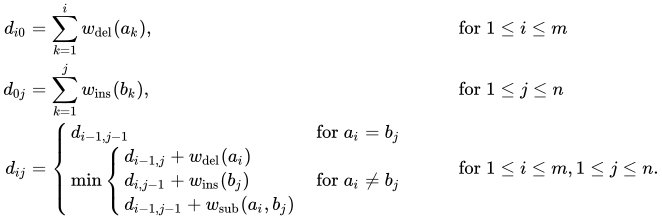
This algorithm can be generalized to handle transpositions by adding another term in the recursive clause's minimization.[3]
The straightforward, recursive way of evaluating this recurrence takes exponential time. Therefore, it is usually computed using a dynamic programming algorithm that is commonly credited to Wagner and Fischer,[7] although it has a history of multiple invention.[2][3] After completion of the Wagner–Fischer algorithm, a minimal sequence of edit operations can be read off as a backtrace of the operations used during the dynamic programming algorithm starting at .
This algorithm has a time complexity of Θ(mn) where m and n are the lengths of the strings. When the full dynamic programming table is constructed, its space complexity is also Θ(mn); this can be improved to Θ(min(m,n)) by observing that at any instant, the algorithm only requires two rows (or two columns) in memory. However, this optimization makes it impossible to read off the minimal series of edit operations.[3] A linear-space solution to this problem is offered by Hirschberg's algorithm.[8]: 634 A general recursive divide-and-conquer framework for solving such recurrences and extracting an optimal sequence of operations cache-efficiently in space linear in the size of the input is given by Chowdhury, Le, and Ramachandran.[9]
Improved algorithms
[edit]Improving on the Wagner–Fisher algorithm described above, Ukkonen describes several variants,[10] one of which takes two strings and a maximum edit distance s, and returns min(s, d). It achieves this by only computing and storing a part of the dynamic programming table around its diagonal. This algorithm takes time O(s×min(m,n)), where m and n are the lengths of the strings. Space complexity is O(s2) or O(s), depending on whether the edit sequence needs to be read off.[3]
Further improvements by Landau, Myers, and Schmidt [1] give an O(s2 + max(m,n)) time algorithm.[11]
For a finite alphabet and edit costs which are multiples of each other, the fastest known exact algorithm is of Masek and Paterson[12] having worst case runtime of O(nm/logn).
Applications
[edit]Edit distance finds applications in computational biology and natural language processing, e.g. the correction of spelling mistakes or OCR errors, and approximate string matching, where the objective is to find matches for short strings in many longer texts, in situations where a small number of differences is to be expected.
Various algorithms exist that solve problems beside the computation of distance between a pair of strings, to solve related types of problems.
- Hirschberg's algorithm computes the optimal alignment of two strings, where optimality is defined as minimizing edit distance.
- Approximate string matching can be formulated in terms of edit distance. Ukkonen's 1985 algorithm takes a string p, called the pattern, and a constant k; it then builds a deterministic finite state automaton that finds, in an arbitrary string s, a substring whose edit distance to p is at most k[13] (cf. the Aho–Corasick algorithm, which similarly constructs an automaton to search for any of a number of patterns, but without allowing edit operations). A similar algorithm for approximate string matching is the bitap algorithm, also defined in terms of edit distance.
- Levenshtein automata are finite-state machines that recognize a set of strings within bounded edit distance of a fixed reference string.[4]
Language edit distance
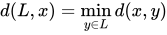
[edit]A generalization of the edit distance between strings is the language edit distance between a string and a language, usually a formal language. Instead of considering the edit distance between one string and another, the language edit distance is the minimum edit distance that can be attained between a fixed string and any string taken from a set of strings. More formally, for any language L and string x over an alphabet Σ, the language edit distance d(L, x) is given by[14], where is the string edit distance. When the language L is context free, there is a cubic time dynamic programming algorithm proposed by Aho and Peterson in 1972 which computes the language edit distance.[15] For less expressive families of grammars, such as the regular grammars, faster algorithms exist for computing the edit distance.[16]

Language edit distance has found many diverse applications, such as RNA folding, error correction, and solutions to the Optimum Stack Generation problem.[14][17]
See also
[edit]References
[edit]- ^ a b c d Daniel Jurafsky; James H. Martin. Speech and Language Processing. Pearson Education International. pp. 107–111.
- ^ a b c d e Esko Ukkonen (1983). On approximate string matching. Foundations of Computation Theory. Springer. pp. 487–495. doi:10.1007/3-540-12689-9_129.
- ^ a b c d Schulz, Klaus U.; Mihov, Stoyan (2002). "Fast string correction with Levenshtein automata". International Journal of Document Analysis and Recognition. 5 (1): 67–85. CiteSeerX 10.1.1.16.652. doi:10.1007/s10032-002-0082-8. S2CID 207046453.
- ^ Lei Chen; Raymond Ng (2004). On the marriage of Lp-norms and edit distance (PDF). Proc. 30th Int'l Conf. on Very Large Databases (VLDB). Vol. 30. doi:10.1016/b978-012088469-8.50070-x.
- ^ Kukich, Karen (1992). "Techniques for Automatically Correcting Words in Text" (PDF). ACM Computing Surveys. 24 (4): 377–439. doi:10.1145/146370.146380. S2CID 5431215. Archived from the original (PDF) on 2016-09-27. Retrieved 2017-11-09.
- ^ R. Wagner; M. Fischer (1974). "The string-to-string correction problem". J. ACM. 21: 168–178. doi:10.1145/321796.321811. S2CID 13381535.
- ^ Skiena, Steven (2010). The Algorithm Design Manual (2nd ed.). Springer Science+Business Media. Bibcode:2008adm..book.....S. ISBN 978-1-849-96720-4.
- ^ Chowdhury, Rezaul; Le, Hai-Son; Ramachandran, Vijaya (July 2010). "Cache-oblivious dynamic programming for bioinformatics". IEEE/ACM Transactions on Computational Biology and Bioinformatics. 7 (3): 495–510. Bibcode:2010ITCBB...7..495C. doi:10.1109/TCBB.2008.94. PMID 20671320. S2CID 2532039.
- ^ Ukkonen, Esko (1985). "Algorithms for approximate string matching" (PDF). Information and Control. 64 (1–3): 100–118. doi:10.1016/S0019-9958(85)80046-2.
- ^ Landau; Myers; Schmidt (1998). "Incremental String Comparison". SIAM Journal on Computing. 27 (2): 557–582. CiteSeerX 10.1.1.38.1766. doi:10.1137/S0097539794264810.
- ^ Masek, William J.; Paterson, Michael S. (February 1980). "A faster algorithm computing string edit distances". Journal of Computer and System Sciences. 20 (1): 18–31. doi:10.1016/0022-0000(80)90002-1. hdl:1721.1/148933. ISSN 0022-0000.
- ^ Esko Ukkonen (1985). "Finding approximate patterns in strings". J. Algorithms. 6: 132–137. doi:10.1016/0196-6774(85)90023-9.
- ^ a b Bringmann, Karl; Grandoni, Fabrizio; Saha, Barna; Williams, Virginia Vassilevska (2016). "Truly Sub-cubic Algorithms for Language Edit Distance and RNA-Folding via Fast Bounded-Difference Min-Plus Product" (PDF). 2016 IEEE 57th Annual Symposium on Foundations of Computer Science (FOCS). pp. 375–384. arXiv:1707.05095. doi:10.1109/focs.2016.48. ISBN 978-1-5090-3933-3. S2CID 17064578.
- ^ Aho, A.; Peterson, T. (1972-12-01). "A Minimum Distance Error-Correcting Parser for Context-Free Languages". SIAM Journal on Computing. 1 (4): 305–312. doi:10.1137/0201022. ISSN 0097-5397.
- ^ Wagner, Robert A. (1974). "Order-n correction for regular languages". Communications of the ACM. 17 (5): 265–268. doi:10.1145/360980.360995. S2CID 11063282.
- ^ Saha, B. (2014-10-01). The Dyck Language Edit Distance Problem in Near-Linear Time. 2014 IEEE 55th Annual Symposium on Foundations of Computer Science. pp. 611–620. doi:10.1109/FOCS.2014.71. ISBN 978-1-4799-6517-5. S2CID 14806359.
Edit distance
View on GrokipediaOverview and History
Basic Concept and Motivation
Edit distance, also known as Levenshtein distance, quantifies the similarity between two strings by measuring the minimum number of single-character operations—insertions, deletions, or substitutions—required to transform one string into the other.[10] This metric provides an intuitive way to assess how closely related two sequences of characters are, with a lower distance indicating greater similarity. For instance, transforming the string "cat" into "cot" requires only one substitution (replacing 'a' with 'o'), resulting in an edit distance of 1.[10] The concept emerged in the 1960s as a tool for addressing practical challenges in early computing, particularly error detection and correction in text processing. At a time when computers were increasingly used for data entry and document preparation, typing mistakes were common, necessitating methods to identify and fix discrepancies efficiently. Edit distance offered a systematic approach to evaluate potential corrections by modeling these errors as minimal transformations, facilitating applications like automated proofreading.[10] Vladimir Levenshtein introduced the idea in 1965, originally in the context of developing error-correcting codes for information transmission, but it quickly found relevance in string correction tasks.[10] This foundational work laid the groundwork for its adoption in spell-checking systems, where comparing user input against dictionary entries became essential for improving accuracy in human-computer interaction.[10]Historical Development
The concept of edit distance emerged in the context of coding theory and error-correcting codes, where measuring the minimum number of operations to transform one sequence into another addressed challenges in reliable information transmission.[11] Soviet mathematician Vladimir Levenshtein formalized this idea in his 1965 paper, introducing the metric now known as Levenshtein distance to quantify differences between binary sequences capable of correcting deletions, insertions, and reversals.[11] In 1964, Frederick J. Damerau proposed a variant incorporating transpositions as an additional operation, motivated by spelling error correction in early computing systems.[12] The 1970s saw significant algorithmic advancements, with Robert F. Wagner and Michael J. Fischer developing a dynamic programming approach in 1974 to efficiently compute the string-to-string correction distance, enabling practical applications beyond theoretical coding.[13] By the 1980s, researchers extended these foundations for approximate string matching, introducing weighted variants and block-edit models to handle more complex error patterns in text processing and pattern recognition tasks.[14] These developments addressed limitations in uniform-cost assumptions, allowing costs to vary by operation type for better alignment in diverse data.[14] Post-2000 milestones integrated edit distance into bioinformatics, building on 1990s tools like BLAST, which leveraged sequence alignment heuristics inspired by edit operations to accelerate database searches for genetic similarities.[9] In recent years, variants have appeared in AI applications, such as transformer models adapting edit distance for efficient DNA sequence alignment in genomic analysis. Notably, while similar sequence comparison ideas existed in linguistics before the 1960s, no standardized metrics akin to edit distance were formalized until Levenshtein's work, marking a gap in pre-1960s quantitative approaches.[9] Today, edit distance variants underpin modern natural language processing for tasks like spell correction and semantic similarity.[14]Types of Edit Distance
Levenshtein Distance
The Levenshtein distance, also known as the standard edit distance, is a measure of the similarity between two strings defined as the minimum number of single-character edits required to transform one string into the other.[15] Introduced by Vladimir Levenshtein in the context of error-correcting codes, it quantifies differences in sequences by considering basic editing operations on characters.[4] The allowed operations in Levenshtein distance are insertion of a single character, deletion of a single character, and substitution of one character for another, with each operation assigned a unit cost of 1.[15] If two characters are identical, no substitution is needed, effectively costing 0.[16] This formulation ensures the distance represents the smallest total cost to achieve equality between the strings.[17] A concrete example illustrates the computation: consider transforming "kitten" into "sitting". One optimal sequence involves substituting the initial 'k' with 's' to get "sitten", then substituting the 'e' with 'i' to get "sittin", and finally inserting 'g' at the end to get "sitting", for a total distance of 3.[17] This can be visualized through an alignment that highlights the operations:k i t t e n
| | -
s i t t i n g
k i t t e n
|     |  -
s i t t i n g
Damerau-Levenshtein and Other Variants
The Damerau-Levenshtein distance extends the Levenshtein distance by incorporating transpositions of adjacent characters as an additional edit operation with a cost of 1, alongside insertions, deletions, and substitutions each costing 1.[12] This variant was introduced to better model common typing errors, where Damerau observed that over 80% of misspellings in an information-retrieval system stemmed from single instances of these four operations.[12] For example, transforming "ca" to "ac" requires only one transposition, yielding a distance of 1, whereas the standard Levenshtein distance would require two substitutions.[12] Other variants adapt edit distance for specific constraints or applications. The Hamming distance, applicable only to strings of equal length, counts the minimum number of substitutions needed to match them, ignoring insertions and deletions.[20] It originated in the context of error-correcting codes for binary strings but extends naturally to general symbols.[20] For instance, the Hamming distance between "abc" and "adc" is 1, reflecting the single differing position.[20] The Jaro distance measures string similarity by considering matching characters within a certain distance window, penalizing transpositions separately, and is particularly suited for record linkage tasks like name matching.[21] It computes a similarity score between 0 and 1 based on the fraction of matches, transpositions, and string lengths, with distance defined as 1 minus the similarity.[21] The Jaro-Winkler variant refines this by boosting the score for strings sharing common prefixes, emphasizing initial characters' importance in identifiers. For example, "JONES" and "JOHNSON" yield a higher Jaro-Winkler similarity due to the shared prefix. Another variant is the longest common subsequence (LCS) distance, which restricts operations to insertions and deletions only, each costing 1, effectively measuring m + n - 2×LCS length, where m and n are the string lengths. This focuses on subsequence preservation without substitutions, useful for comparing ordered but non-contiguous elements like in version control or bioinformatics alignments. For strings "ABCBDAB" (length 7) and "BDCAB" (length 5), the LCS length is 4 ("BCAB"), so the distance is 7 + 5 - 2×4 = 4. Weighted variants assign non-uniform costs to operations for greater flexibility. In particular, affine gap penalties model insertions or deletions as gaps with an opening cost plus a linear extension cost, better capturing biological realities like indels in DNA sequences. This approach, introduced by Gotoh, allows substitution costs to vary based on character similarity, such as using matrices like BLOSUM for proteins. For example, a gap of length k incurs cost α + (k-1)β, where α > β encourages fewer, longer gaps over many short ones.| Variant | Operations Included | Typical Use Cases |
|---|---|---|
| Levenshtein | Insertion, deletion, substitution | General string correction, spell-checking |
| Damerau-Levenshtein | Above plus adjacent transposition | Typing error detection in text entry |
| Jaro/Jaro-Winkler | Matches, transpositions, prefix weighting | Record linkage, name matching in databases |
| Hamming | Substitution only (equal lengths) | Error detection in fixed-length codes |
| LCS | Insertion, deletion only | Subsequence alignment in sequences |
Mathematical Formulation
Formal Definition
The edit distance between two strings and over a finite alphabet is defined as the minimum total cost of an edit sequence that transforms into , where the edit operations are drawn from a specified set, typically including insertion of a symbol from , deletion of a symbol from , and substitution of a symbol in with one from , with transposition sometimes included as an optional operation.[22] Each operation in the sequence is associated with a non-negative cost , which is commonly set to 1 for uniformity across operations in the canonical case (such as Levenshtein distance), though more general cost functions are permitted as long as the cost of an operation equals the cost of its inverse—for instance, the cost of insertion must match that of deletion to ensure consistency.[23][24] An edit sequence corresponds to an alignment path, which can be represented as an ordered list of operations or depicted as a path in a directed graph where vertices correspond to prefixes of and , and edges represent individual edit steps.[25] Formally, the edit distance is given by where the minimum is taken over all valid edit sequences of length .[26]Properties
The edit distance, under the standard assumptions of unit costs for insertions, deletions, and substitutions (all positive and symmetric), forms a metric on the set of finite strings over a finite alphabet. This means it satisfies the four axioms of a metric space: non-negativity, identity of indiscernibles, symmetry, and the triangle inequality. These properties ensure that the distance behaves intuitively as a measure of "closeness" between strings, allowing applications in spaces where metric-based algorithms are required.[27] Non-negativity states that for all strings and . This follows directly from the definition, as the distance is the minimum cost of a sequence of edit operations, each with non-negative cost, and the empty sequence has cost zero. The related identity of indiscernibles requires if and only if : the distance is zero when no operations are needed (i.e., ), and conversely, a zero-cost sequence implies no changes, so the strings are identical. This holds provided all operation costs are strictly positive, preventing zero-cost transformations between distinct strings.[27][28] Symmetry requires . This is satisfied because each edit operation has a corresponding inverse with equal cost: an insertion from to corresponds to a deletion from to , a deletion to an insertion, and a symmetric substitution (cost of replacing with equals replacing with ). Thus, any minimal edit sequence from to can be reversed to yield one from to of the same cost.[27][28] The triangle inequality states that for all strings . To sketch the proof, let be a minimal-cost edit trace (sequence of operations) transforming to with cost , and a minimal-cost trace transforming to with cost . Composing followed by yields a valid (though possibly suboptimal) trace from to with cost at most . Since is the minimal such cost, the inequality holds. This composition property relies on the costs being non-negative.[27][28] For the edit distance to be a true metric, the operation costs must be positive (ensuring positivity: if ) and there must be no zero-cost cycles in the edit graph (sequences of operations returning to the starting string at zero cost, which could otherwise allow distinct strings to have zero distance). If costs are zero for certain operations, such as free transpositions in some variants, positivity fails—for instance, transposing adjacent characters at no cost would make despite . In the Damerau-Levenshtein variant, which adds adjacent transpositions at unit cost, the common restricted implementation (optimal string alignment) violates the triangle inequality; for example, certain edit paths allow indirect routes cheaper than direct ones, as analyzed in theoretical extensions.[27][29] Beyond metric axioms, the edit distance exhibits monotonicity under string extensions: if is obtained by inserting one or more characters into , then for any string , since any optimal edit sequence for to can be adapted to to by treating the extra characters in as additional insertions (or deletions if mismatched), without decreasing the cost. Additionally, for equal-length strings, the edit distance is at most the Hamming distance, as the Hamming distance corresponds to the number of substitutions needed for a direct position-wise alignment, while the edit distance can potentially use insertions and deletions to find a better alignment, reducing the total number of operations.[28]Computation Methods
Dynamic Programming Algorithm
The Wagner-Fischer algorithm provides a standard dynamic programming approach to compute the edit distance between two strings, typically those involving Levenshtein operations of insertion, deletion, and substitution.[13] This method constructs an (m+1) × (n+1) matrix D, where m and n are the lengths of the input strings X = x₁x₂...xₘ and Y = y₁y₂...yₙ, respectively; each entry D[i,j] represents the edit distance between the prefixes X[1..i] and Y[1..j].[13] The algorithm fills this matrix row by row, ensuring that the value at D[m,n] yields the minimum number of operations required to transform X into Y under unit costs (1 for each insertion, deletion, or substitution, with substitution costing 0 if the characters match).[13] The base cases initialize the matrix boundaries to account for transforming a prefix to an empty string: D[i,0] = i for i = 0 to m (cost of i deletions), and D[0,j] = j for j = 0 to n (cost of j insertions), with D[0,0] = 0.[13] The recurrence relation for filling the internal entries is then applied: for 1 ≤ i ≤ m and 1 ≤ j ≤ n.[13] This formulation ensures optimal substructure, as the distance for prefixes builds upon distances for shorter prefixes.[13] The time complexity of this algorithm is O(mn), as each of the (m+1)(n+1) entries requires constant-time computation of the minimum of three values; the space complexity is also O(mn) to store the full matrix.[13] For the Levenshtein case with unit costs, the following pseudocode illustrates the matrix construction:function LevenshteinDistance(X, Y):
m = length(X)
n = length(Y)
create matrix D of size (m+1) x (n+1)
// Base cases
for i = 0 to m:
D[i,0] = i
for j = 0 to n:
D[0,j] = j
for i = 1 to m:
for j = 1 to n:
cost = 0 if X[i] == Y[j] else 1
D[i,j] = min(
D[i-1,j] + 1, // deletion
D[i,j-1] + 1, // insertion
D[i-1,j-1] + cost // substitution
)
return D[m,n]
function LevenshteinDistance(X, Y):
    m = length(X)
    n = length(Y)
    create matrix D of size (m+1) x (n+1)

    // Base cases
    for i = 0 to m:
        D[i,0] = i
    for j = 0 to n:
        D[0,j] = j

    for i = 1 to m:
        for j = 1 to n:
            cost = 0 if X[i] == Y[j] else 1
            D[i,j] = min(
                D[i-1,j] + 1,      // deletion
                D[i,j-1] + 1,      // insertion
                D[i-1,j-1] + cost  // substitution
            )

    return D[m,n]