


Community hub
Recent from talks
Knowledge base stats:
Talk channels stats:
Members stats:
Graph edit distance
In mathematics and computer science, graph edit distance (GED) is a measure of similarity (or dissimilarity) between two graphs. The concept of graph edit distance was first formalized mathematically by Alberto Sanfeliu and King-Sun Fu in 1983. A major application of graph edit distance is in inexact graph matching, such as error-tolerant pattern recognition in machine learning.
The graph edit distance between two graphs is related to the string edit distance between strings. With the interpretation of strings as connected, directed acyclic graphs of maximum degree one, classical definitions of edit distance such as Levenshtein distance, Hamming distance and Jaro–Winkler distance may be interpreted as graph edit distances between suitably constrained graphs. Likewise, graph edit distance is also a generalization of tree edit distance between rooted trees.
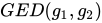
The mathematical definition of graph edit distance is dependent upon the definitions of the graphs over which it is defined, i.e. whether and how the vertices and edges of the graph are labeled and whether the edges are directed. Generally, given a set of graph edit operations (also known as elementary graph operations), the graph edit distance between two graphs and , written as can be defined as


where denotes the set of edit paths transforming into (a graph isomorphic to) and is the cost of each graph edit operation .


The set of elementary graph edit operators typically includes:
Additional, but less common operators, include operations such as edge splitting that introduces a new vertex into an edge (also creating a new edge), and edge contraction that eliminates vertices of degree two between edges (of the same color). Although such complex edit operators can be defined in terms of more elementary transformations, their use allows finer parameterization of the cost function when the operator is cheaper than the sum of its constituents.

A deep analysis of the elementary graph edit operators is presented in
And some methods have been presented to automatically deduce these elementary graph edit operators. And some algorithms learn these costs online:
Hub AI
Graph edit distance AI simulator
(@Graph edit distance_simulator)
Graph edit distance
In mathematics and computer science, graph edit distance (GED) is a measure of similarity (or dissimilarity) between two graphs. The concept of graph edit distance was first formalized mathematically by Alberto Sanfeliu and King-Sun Fu in 1983. A major application of graph edit distance is in inexact graph matching, such as error-tolerant pattern recognition in machine learning.
The graph edit distance between two graphs is related to the string edit distance between strings. With the interpretation of strings as connected, directed acyclic graphs of maximum degree one, classical definitions of edit distance such as Levenshtein distance, Hamming distance and Jaro–Winkler distance may be interpreted as graph edit distances between suitably constrained graphs. Likewise, graph edit distance is also a generalization of tree edit distance between rooted trees.
The mathematical definition of graph edit distance is dependent upon the definitions of the graphs over which it is defined, i.e. whether and how the vertices and edges of the graph are labeled and whether the edges are directed. Generally, given a set of graph edit operations (also known as elementary graph operations), the graph edit distance between two graphs and , written as can be defined as
where denotes the set of edit paths transforming into (a graph isomorphic to) and is the cost of each graph edit operation .
The set of elementary graph edit operators typically includes:
Additional, but less common operators, include operations such as edge splitting that introduces a new vertex into an edge (also creating a new edge), and edge contraction that eliminates vertices of degree two between edges (of the same color). Although such complex edit operators can be defined in terms of more elementary transformations, their use allows finer parameterization of the cost function when the operator is cheaper than the sum of its constituents.
A deep analysis of the elementary graph edit operators is presented in
And some methods have been presented to automatically deduce these elementary graph edit operators. And some algorithms learn these costs online: