


Community hub
0 subscribers8 pages, 0 posts
Recent from talks
Be the first to start a discussion here.
Be the first to start a discussion here.
Be the first to start a discussion here.
Be the first to start a discussion here.
Contribute something
Welcome to the community hub built to collect knowledge and have discussions related to Corella (bird).
Nothing was collected or created yet.
Corella (bird)
View on Wikipediafrom Wikipedia
| Corella | |
|---|---|

| |
| Little corella | |
Scientific classification 
| |
| Kingdom: | Animalia |
| Phylum: | Chordata |
| Class: | Aves |
| Order: | Psittaciformes |
| Family: | Cacatuidae |
| Genus: | Cacatua |
| Subgenus: | Licmetis |
| Species | |
|
6, see text | |
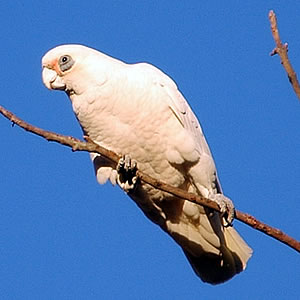
Licmetis is a subgenus of the white cockatoos (genus Cacatua). They are collectively known as corellas in Australia. Three of the six species are primarily – or only – found in Australia, while the Philippines, Indonesia, and the Solomons each have an endemic species. They are relatively small cockatoos and – unlike the members of the subgenus Cacatua – all have pale bills. While most show yellow-tinged underwings and some red to the face, none has conspicuously coloured crests.
Species
[edit]- Long-billed corella, Cacatua (Licmetis) tenuirostris
- Western corella, Cacatua (Licmetis) pastinator
- Muir's corella, Cacatua (Licmetis) pastinator pastinator
- Butler's corella, Cacatua (Licmetis) pastinator butleri
- Little corella, Cacatua (Licmetis) sanguinea
- Red-vented cockatoo, Cacatua (Licmetis) haematuropygia
- Tanimbar corella, Cacatua (Licmetis) goffiniana
- Solomons cockatoo, Cacatua (Licmetis) ducorpsii
References
[edit]
- Brown, D. M., and Toft, C. A. (1999). Molecular systematics and biogeography of the cockatoos (Psittaciformes: Cacatuidae). Auk 116(1): 141–157.
- Juniper, T., and Parr, M. (1998). A Guide to the Parrots of the World. Pica Press, East Sussex. ISBN 1-873403-40-2

Corella (bird)
View on Grokipediafrom Grokipedia
Corellas are a group of small to medium-sized white cockatoos belonging to the subgenus Licmetis within the genus Cacatua, distinguished by their predominantly white plumage, short crests (often inconspicuous), blue-grey periophthalmic skin, pale bills, and yellowish wash on the underwings and undertail in flight. Native primarily to Australia, with additional species in parts of Indonesia and the Solomon Islands, they are highly social birds that typically form large, noisy flocks while foraging on seeds, roots, fruits, and insects in open habitats.[1] The Australian corellas comprise three main species: the widespread little corella (Cacatua sanguinea), the southeastern long-billed corella (C. tenuirostris), and the southwestern western corella (C. pastinator), all of which are adapted to a range of environments from arid grasslands and woodlands to urban areas and agricultural lands.[1]
These birds exhibit opportunistic and nomadic behaviors, often traveling in flocks of dozens to thousands, which allows them to exploit seasonal food resources across vast distances.[2] They nest in tree hollows or cliffs, laying 2–3 eggs per clutch during the austral winter to spring (July–October in Australia), with both parents sharing incubation and chick-rearing duties; fledglings typically leave the nest after about seven weeks.[2] Corellas are vocal, producing loud, distinctive calls such as the little corella's high-pitched screech or the long-billed corella's repetitive "wulluk-wulluk," which serve for communication within flocks and territorial defense.[3]
While most corella populations are stable or increasing due to their adaptability to human-modified landscapes, some subspecies face threats from habitat loss, competition with invasive species, and hybridization where ranges overlap.[4] For instance, the western corella is listed as conservation dependent in Western Australia, requiring ongoing monitoring and protection of breeding sites.[2] Internationally, species like the Tanimbar corella (C. goffiniana) are Near Threatened due to trapping for the pet trade and agricultural conflicts.[5]