Hubbry Logo
Light Strike VehicleLight Strike VehicleMain
Open search
Light Strike Vehicle
Community hub
Light Strike Vehicle
logo
8 pages, 0 posts
0 subscribers
Be the first to start a discussion here.
Light Strike Vehicle
from Wikipedia

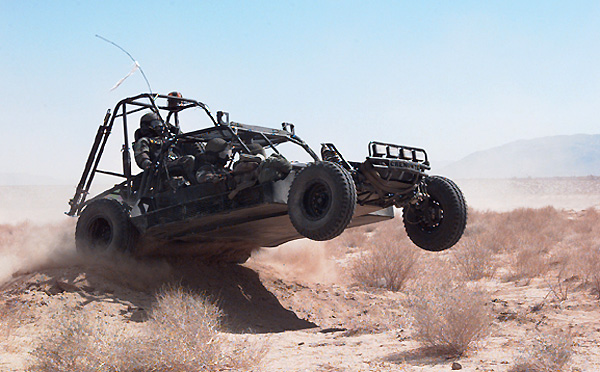
The Light Strike Vehicle (LSV) is an improved version of the Desert Patrol Vehicle (DPV), which it was designed to replace. Special operation groups adopted the LSV for its small size and high mobility. It is part of the family of Internally Transportable Light Strike Vehicles (ITV-LSV).[1] As the name suggests, it is used for fast hit-and-run style raids, scouting missions, special forces support, and low intensity guerrilla warfare.

Key Information

Design

[edit]

Countermeasures

[edit]

The LSV is entirely unarmored, and thus offers no protection from small arms fire. The driver and passengers sit side by side in front, with the gunner sitting in an elevated rear-central seat in front of the engine. The gunner's seat can spin around to operate the 7.62 mm GPMG.

Mobility

[edit]

It can be air transported internally by CH-47 or CH-53 transport helicopters. The new ALSV has a more conventional appearance and differs from the original versions.

Armament

[edit]

A 7.62 mm MG (often an M60E3) is mounted rear-facing on the back of the engines. If TOW is mounted, it replaces the third passenger and rollover cage. Two AT4 are sometimes fitted forward-facing on roll over cage bars (one on each side) above driver.

Users

[edit]
Operators:
  Current
  Former

Unlike the DPV, the LSV has had export success and is marketed as a light attack vehicle. The current generation model is the ALSV, with the "A" standing for "advanced".[2] It is currently used by the United States Marine Corps, United States Army, United States Navy, and the armed forces of Greece, Mexico, Oman, Portugal, and Spain. The UK retired its LSVs in the mid-1990s.

Current operators

[edit]

Former operators

[edit]

See also

[edit]

References

[edit]
Revisions and contributorsEdit on WikipediaRead on Wikipedia
from Grokipedia
The Light Strike Vehicle (LSV), also known as the , is a lightweight, high-mobility 4x4 tactical vehicle developed by ST Kinetics for the , primarily designed for rapid hit-and-run raids, , special forces support, and low-intensity operations in diverse terrains. Introduced in , the LSV emphasizes air-transportability, with up to six units fitting inside a C-130 Hercules , and features a tubular for enhanced durability and foldable components for compact storage. The original LSV Mark I measures 4.5 meters in length, 2.03 meters in width, and 1.9 meters in height, with a curb weight of 1,600 kg and a payload capacity of 1,200 kg, accommodating 3 to 6 personnel depending on configuration. Powered by a 2.8-liter four-cylinder delivering 130 horsepower and 410 Nm of , it achieves road speeds of 120-130 km/h and off-road speeds of up to 80 km/h, with a range of 700 km and the ability to ford 600 mm of or climb 60° gradients. Armament options include and heavy guns, 40 mm launchers, 30 mm cannons, or the Super Rapid Advanced Mortar System (SRAMS) 120 mm mortar, with lightweight composite armor providing protection against 7.62 mm rounds and fragments. In 2013, the upgraded LSV Mark II was unveiled to replace the aging Mark I fleet, incorporating a more powerful 136 hp engine, improved suspension, enhanced networking for battlefield integration, and helicopter portability. This variant, manufactured by Singapore Technologies Kinetics under a S$68 million contract from the Singapore , features dimensions of 4.9 meters long, 2.1 meters wide, and 1.8 meters high, with a weight of 1,800 kg and a top speed of 110 km/h, while supporting up to six occupants. Available in configurations such as the 40 mm (AGL), Spike anti-tank guided missile, or utility variants, it is armed with options like a 7.62 mm , emphasizing versatility against armored threats. While primarily operated by the —with an initial procurement of 50 SRAMS-equipped units for the Mark I and the Mark II continuing in service as of 2025—the LSV platform has seen limited exports to special forces units, including the of .

Overview

Role and Capabilities

The Light Strike Vehicle (LSV), also known as the , is a lightweight, high-mobility 4x4 tactical vehicle developed by ST Kinetics (now ST Engineering Land Systems) for the (SAF). Introduced in 1998, it is designed for rapid hit-and-run raids, , special forces support, and low-intensity operations across diverse terrains, including urban, desert, and jungle environments. Key tactical advantages include its air-transportability, with up to six units fitting inside a C-130 Hercules , and foldable components for compact storage and rapid deployment. The LSV's lightweight tubular enhances durability while maintaining agility, allowing it to ford 600 mm of water and climb 60° gradients. It accommodates 3 to 6 personnel depending on the configuration, making it suitable for small-team operations that prioritize speed and surprise over heavy armor. In 2013, the upgraded LSV Mark II was introduced to replace the original Mark I fleet, featuring a more powerful engine, improved suspension, enhanced networking for battlefield integration, and helicopter portability. This variant supports configurations for counter-armored threats, such as with 40 mm automatic grenade launchers or Spike anti-tank guided missiles. Compared to heavier vehicles, the LSV's low logistical footprint enables sustained operations in austere environments, emphasizing velocity for evasion and pursuit in .

General Specifications

The Light Strike Vehicle (LSV) is a lightweight, high-mobility platform primarily for the , with compact dimensions, diesel powertrain, and performance suited for rapid deployment in varied terrains. It supports a of 3-6 with for armament and equipment. The following table provides specifications for the original Mark I; the Mark II variant has updated dimensions and performance.
SpecificationDetails
Dimensions (Mark I)Length: 4.5 m; Width: 2.03 m; Height: 1.9 m
(Mark I)1,600 kg ( weight)
and Capacity (Mark I)3-6 personnel; up to 1,200 kg including armament
(Mark I)2.8 L Peugeot four-cylinder diesel, 130 hp, 410 Nm
Performance Metrics (Mark I)Maximum speed: 120-130 km/h on-road, 80 km/h off-road; range: 700 km
Dimensions (Mark II)Length: 4.9 m; Width: 2.1 m; Height: 1.8 m
(Mark II)1,800 kg
(Mark II)136 hp diesel
Performance Metrics (Mark II)Maximum speed: 110 km/h; supports 6 occupants
TransportabilityAir-transportable (6 in C-130); portable (Mark II)

Development

Origins and Evolution

The Light Strike Vehicle (LSV), also known as the , originated from a of the U.S.-designed Flyer R-12D light strike vehicle, adapted and manufactured locally by Singapore Technologies Kinetics (ST Kinetics) for the (SAF). The design emphasized high mobility for rapid raids, reconnaissance, and special forces operations, drawing on the Flyer's lightweight, air-transportable chassis suitable for diverse terrains including urban and jungle environments. The first LSV Mark I units were delivered to the SAF in 1998, replacing older jeep-based platforms and incorporating a tubular for durability and foldable components for compact storage in like the C-130 Hercules. Evolution of the LSV accelerated in the 2000s to address operational needs for enhanced protection and integration. In 2008, the Spider variant was showcased at the Singapore Air Show, highlighting modular armament options. The platform underwent upgrades for better payload capacity and networking capabilities. By 2013, the LSV Mark II was introduced as a new-generation model to replace the aging Mark I fleet, featuring a more powerful 2.2-liter diesel engine (136 hp), improved independent suspension for superior cross-country performance, and enhanced ballistic protection against 7.62 mm rounds. The Mark II also supports helicopter sling-load transport and includes advanced electronics for battlefield situational awareness, with configurations for anti-tank roles using the Spike missile system.

Production History

Production of the LSV has been led by ST Kinetics since the late 1990s, with initial manufacturing focused on the Mark I for SAF and units. The vehicle was procured in limited numbers, with early batches emphasizing and mortar support variants equipped with the Super Rapid Advanced Mortar System (SRAMS). In September 2011, ST Kinetics secured a S$68 million contract from the (MINDEF) for additional LSVs and spares, supporting fleet sustainment. The Mark II entered production in 2013 under the same framework, with the first units delivered to the SAF that year. This variant, produced under a dedicated MINDEF contract, includes specialized models such as the 40 mm (AGL), , and utility configurations. Total production remains classified, but the SAF operates over 50 SRAMS-equipped units as of 2013, with ongoing upgrades for export potential. Export versions have been marketed to international partners, building on the platform's versatility for .

Design

Chassis and Mobility

The chassis of the Light Strike Vehicle (LSV), also known as the , utilizes a tubular construction for lightweight durability and ease of air transportability. The original Mark I variant features a welded tube frame with a foldable , measuring 4.5 m in length, 2.03 m in width, and 1.9 m in height, with a curb weight of 1,600 kg and capacity of 1,200 kg. The Mark II, introduced in 2013, incorporates an improved design, larger dimensions of 4.9 m long, 2.1 m wide, and 1.8 m high, and a curb weight of 1,800 kg while maintaining similar capabilities. Mobility is provided by a 4x4 all-wheel-drive with , enabling operation across diverse terrains including 60° gradients and 50° side slopes. The Mark I is powered by a 2.8-liter four-cylinder XUD11 producing 130 hp at 3,800 rpm and 410 Nm of torque at 1,800 rpm, compliant with Euro III emissions standards, achieving road speeds of 120-130 km/h, off-road speeds up to 80 km/h, and a range of 700 km on a capacity supporting these profiles. The Mark II upgrades to a more powerful 136 hp with enhanced suspension for better cross-country performance and a top speed of 110 km/h. Both variants offer 0.6 m water fording depth and ground clearance suitable for rough terrain, with up to six vehicles transportable inside a C-130 Hercules or via sling-load.

Armament Systems

The LSV supports modular armament configurations tailored for rapid raids and reconnaissance. Common options include a 7.62 mm (GPMG) for , a 40 mm (AGL), or a 30 mm cannon mounted on a or ring mount for 360-degree traversal. Anti-armor capabilities are provided by the Spike guided missile system in the Mark II ATGM variant, enabling engagement of armored threats at standoff ranges. A specialized configuration integrates the Super Rapid Advanced Mortar System (SRAMS), a 120 mm mortar with a firing rate of 10 rounds per minute and capacity for six rounds, allowing support during operations. The utility variant focuses on transport without heavy weapons, while all setups accommodate 3 to 6 crew members depending on armament and . storage is integrated into the to balance weight and mobility.

Protection Features

Protection on the LSV emphasizes lightweight solutions to preserve mobility, with composite armor panels providing resistance against 7.62 mm fire and fragments. The open-top design includes a removable windscreen and foldable roll-over protection structure (ROPS) for crash safety, compliant with operational standards for high-speed maneuvers. Four-point harnesses secure the crew of up to six in the Mark II. No active protection systems or mine-resistant features are standard, prioritizing speed and evasion in low-intensity scenarios over heavy armor. The Mark II enhancements include better-integrated crew seating for improved safety during off-road travel. netting compatibility aids in concealment, but the vehicle's thin-skinned limits use in high-threat environments without additional modifications.

Operational History

U.S. Military Service

The Light Strike Vehicle (LSV) has not been adopted by U.S. forces but has been used in joint training exercises with the . In exercises such as Valiant Mark, Light Strike platoons have trained alongside U.S. Marines from Combined Anti-Armor Teams, focusing on and shared tactics for and rapid assault. As of 2025, these collaborations enhance bilateral defense ties, with U.S. personnel occasionally riding LSVs for experiential training.

International Deployments

The LSV has seen limited international deployments, primarily through exports to select operators. received five Flyer-based LSV units, while the acquired prototypes in 2003 for evaluation. These exports support and roles in regional security operations, though specific deployment details remain classified. The LSV participates in multinational exercises, including with U.S. and Thai forces, demonstrating air-transportability and high-mobility tactics in diverse terrains. In 's service, the vehicle has been used for internal security and low-intensity operations since 1998, with the Mark II variant enhancing capabilities in joint exercises as of 2025. No major combat deployments are publicly documented due to its orientation.

Operators

Current Operators

The Light Strike Vehicle (LSV) is in active service primarily with the , where it is known as the and used for , rapid raids, and support. An initial procurement of 50 SRAMS-equipped units was made, with additional Mark II variants acquired under a S$68 million contract in 2011. In the United States, variants of the LSV design are employed by the U.S. Marine Corps within Marine Expeditionary Units (MEUs) for internal transport and rapid deployment via V-22 Osprey, by U.S. Army for , and by U.S. Navy SEALs for maritime and coastal operations. Greece operates LSVs with the for island reconnaissance and rapid response, as of 2013. In Mexico, the Mexican Army utilizes LSVs for coastal interdiction and patrols, as of 2013. Oman's Royal Guard employs desert-adapted LSV variants for border patrols and internal security, as of 2013. Portugal's Army commandos incorporate the LSV for exercises and expeditionary operations, as of 2013. Spain fields LSVs with the and Special Operations Command for reconnaissance in support of multinational missions, as of 2013.

Former Operators

The operated the Light Strike Vehicle (LSV) through its units, including the British (SAS) and , acquiring variants such as the Longline LSV in the early 1990s as an urgent operational requirement ahead of the (). These lightweight, high-mobility vehicles were intended for reconnaissance, rapid raids, and support roles, with features like 4x4 drive, weapon mounts for machine guns or anti-tank missiles, and air-transportability by . However, testing revealed limitations including fragile suspension and limited , leading to their non-deployment in combat by SAS squadrons during the conflict; post-war, the SAS transferred the LSVs to regular army units like the and 24th Airmobile Brigade. The British military retired the LSV in the mid-1990s due to reliability issues in non-desert environments, such as European climates, compounded by high maintenance costs and increasing vulnerability to evolving threats like improvised explosive devices. This shift aligned with broader doctrinal changes toward more protected platforms, particularly after experiences in and , favoring mine-resistant ambush-protected (MRAP)-style vehicles over ultra-light designs. The LSV was replaced by the Supacat High Mobility Transporter (HMT), known as the in British service, which offered enhanced protection, payload, and versatility for . Limited exports of the LSV occurred to allied nations in the for similar roles, but these operators have phased out the vehicle in favor of heavier, more survivable alternatives amid rising demands and adaptations. The LSV's emphasis on extreme mobility and air-deployability influenced subsequent designs, including the U.S. Growler ITV (Internally Transportable Vehicle-Light Strike Variant), which built on the concept for internal carriage by V-22 aircraft while addressing prior vulnerabilities.
Add your contribution
Related Hubs
User Avatar
No comments yet.