Hubbry Logo
Trigonometric integralTrigonometric integralMain
Open search
Trigonometric integral
Community hub
Trigonometric integral
logo
8 pages, 0 posts
0 subscribers
Be the first to start a discussion here.
Trigonometric integral
from Wikipedia
Plot of the hyperbolic sine integral function Shi(z) in the complex plane from −2 − 2i to 2 + 2i
Plot of the hyperbolic sine integral function Shi(z) in the complex plane from −2 − 2i to 2 + 2i

Si(x) (blue) and Ci(x) (green) shown on the same plot.
Sine integral in the complex plane, plotted with a variant of domain coloring.
Cosine integral in the complex plane. Note the branch cut along the negative real axis.

In mathematics, trigonometric integrals are a family of nonelementary integrals involving trigonometric functions.

Sine integral

[edit]
Plot of Si(x) for 0 ≤ x ≤ 8π.
Plot of the cosine integral function Ci(z) in the complex plane from −2 − 2i to 2 + 2i
Plot of the cosine integral function Ci(z) in the complex plane from −2 − 2i to 2 + 2i

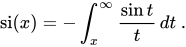
The different sine integral definitions are
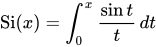
Note that the integrand is the sinc function, and also the zeroth spherical Bessel function. Since sinc is an even entire function (holomorphic over the entire complex plane), Si is entire, odd, and the integral in its definition can be taken along any path connecting the endpoints.

By definition, Si(x) is the antiderivative of sin x / x whose value is zero at x = 0, and si(x) is the antiderivative whose value is zero at x = ∞. Their difference is given by the Dirichlet integral,

In signal processing, the oscillations of the sine integral cause overshoot and ringing artifacts when using the sinc filter, and frequency domain ringing if using a truncated sinc filter as a low-pass filter.

Related is the Gibbs phenomenon: If the sine integral is considered as the convolution of the sinc function with the Heaviside step function, this corresponds to truncating the Fourier series, which is the cause of the Gibbs phenomenon.

Cosine integral

[edit]
Plot of Ci(x) for 0 < x ≤ 8π

The different cosine integral definitions are

Cin is an even, entire function. For that reason, some texts define Cin as the primary function, and derive Ci in terms of Cin .

for where γ ≈ 0.57721566490 ... is the Euler–Mascheroni constant. Some texts use ci instead of Ci. The restriction on Arg(x) is to avoid a discontinuity (shown as the orange vs blue area on the left half of the plot above) that arises because of a branch cut in the standard logarithm function (ln).

Ci(x) is the antiderivative of cos x/ x (which vanishes as ). The two definitions are related by


Hyperbolic sine integral

[edit]

The hyperbolic sine integral is defined as
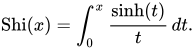
It is related to the ordinary sine integral by

Hyperbolic cosine integral

[edit]

The hyperbolic cosine integral is

Plot of the hyperbolic cosine integral function Chi(z) in the complex plane from −2 − 2i to 2 + 2i
Plot of the hyperbolic cosine integral function Chi(z) in the complex plane from −2 − 2i to 2 + 2i

where is the Euler–Mascheroni constant.

It has the series expansion

Auxiliary functions

[edit]

Trigonometric integrals can be understood in terms of the so-called "auxiliary functions" Using these functions, the trigonometric integrals may be re-expressed as (cf. Abramowitz & Stegun, p. 232)

Nielsen's spiral

[edit]
Nielsen's spiral.

The spiral formed by parametric plot of si, ci is known as Nielsen's spiral.

The spiral is closely related to the Fresnel integrals and the Euler spiral. Nielsen's spiral has applications in vision processing, road and track construction and other areas.[1]

Expansion

[edit]

Various expansions can be used for evaluation of trigonometric integrals, depending on the range of the argument.

Asymptotic series (for large argument)

[edit]

These series are asymptotic and divergent, although can be used for estimates and even precise evaluation at ℜ(x) ≫ 1.

Convergent series

[edit]

These series are convergent at any complex x, although for |x| ≫ 1, the series will converge slowly initially, requiring many terms for high precision.

Derivation of series expansion

[edit]

From the Maclaurin series expansion of sine:

Relation with the exponential integral of imaginary argument

[edit]

The function is called the exponential integral. It is closely related to Si and Ci,

As each respective function is analytic except for the cut at negative values of the argument, the area of validity of the relation should be extended to (Outside this range, additional terms which are integer factors of π appear in the expression.)

Cases of imaginary argument of the generalized integro-exponential function are which is the real part of


Similarly

Efficient evaluation

[edit]

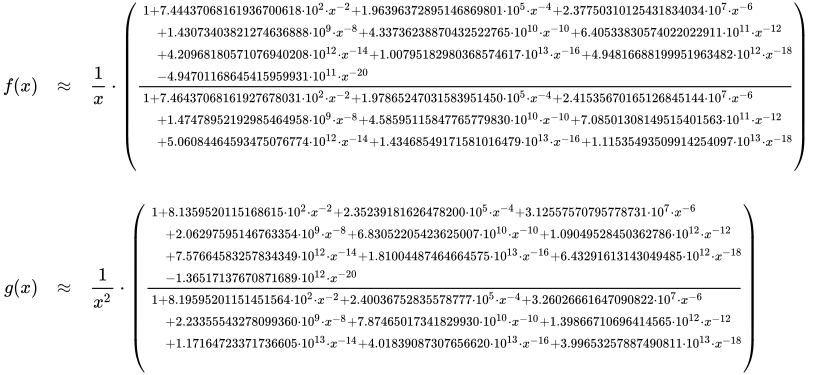
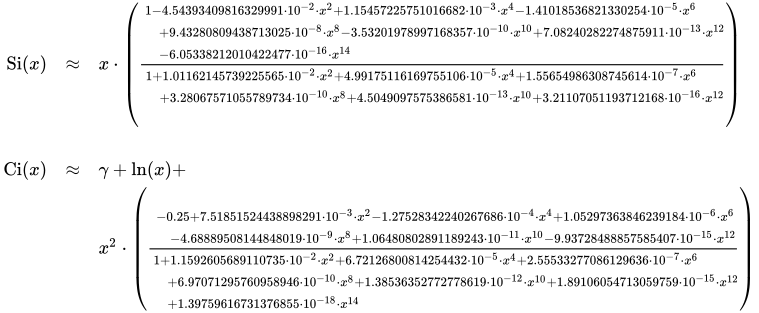
Padé approximants of the convergent Taylor series provide an efficient way to evaluate the functions for small arguments. The following formulae, given by Rowe et al. (2015),[2] are accurate to better than 10−16 for 0 ≤ x ≤ 4,
The integrals may be evaluated indirectly via auxiliary functions and , which are defined by

or equivalently

For the Padé rational functions given below approximate and with error less than 10−16:[2]

See also

[edit]

References

[edit]

Further reading

[edit]
[edit]
Revisions and contributorsEdit on WikipediaRead on Wikipedia
from Grokipedia
In , trigonometric integrals are a family of nonelementary defined as integrals involving in the integrand. They arise in the evaluation of definite integrals that cannot be expressed in terms of elementary functions and are important in applications such as diffraction theory, , and solutions to differential equations modeling wave propagation. The primary trigonometric integrals are the sine integral and the cosine integral. The sine integral is defined for real or complex argument zz as Si(z)=0zsinttdt,\mathrm{Si}(z) = \int_0^z \frac{\sin t}{t} \, dt, an odd entire function with limxSi(x)=π/2\lim_{x \to \infty} \mathrm{Si}(x) = \pi/2. A related function is si(z)=Si(z)π/2=zsinttdt\mathrm{si}(z) = \mathrm{Si}(z) - \pi/2 = -\int_z^\infty \frac{\sin t}{t} \, dt. The cosine integral is defined as Ci(z)=zcosttdt=γ+lnz+0zcost1tdt,\mathrm{Ci}(z) = -\int_z^\infty \frac{\cos t}{t} \, dt = \gamma + \ln z + \int_0^z \frac{\cos t - 1}{t} \, dt, where γ\gamma is the Euler-Mascheroni constant, valid for the principal branch avoiding the negative real axis, and limxCi(x)=0\lim_{x \to \infty} \mathrm{Ci}(x) = 0. A related entire function is Cin(z)=0z1costtdt\mathrm{Cin}(z) = \int_0^z \frac{1 - \cos t}{t} \, dt.

Introduction

Definition and Motivation

The trigonometric integrals, specifically the sine integral Si(x)\mathrm{Si}(x) and cosine integral Ci(x)\mathrm{Ci}(x), are that emerge as solutions to the indefinite integrals sinxxdx\int \frac{\sin x}{x} \, dx and cosxxdx\int \frac{\cos x}{x} \, dx, which cannot be expressed using elementary functions. The sine integral is defined by Si(x)=0xsinttdt\mathrm{Si}(x) = \int_0^x \frac{\sin t}{t} \, dt for real x0x \geq 0, with the understanding that the integrand approaches 1 as t0t \to 0. The cosine integral is defined by Ci(x)=xcosttdt\mathrm{Ci}(x) = -\int_x^\infty \frac{\cos t}{t} \, dt for x>0x > 0, ensuring convergence through the principal value. These functions are motivated by their essential role in evaluating non-elementary integrals that arise across physics and engineering. In , Si(x)\mathrm{Si}(x) models the step response of an ideal low-pass , highlighting the Gibbs overshoot phenomenon as the function oscillates toward its asymptotic limit. In , they contribute to computations of three-center overlap integrals in and scattering problems involving oscillatory potentials. Key properties include Si(0)=0\mathrm{Si}(0) = 0 due to the lower limit of integration and Ci()=0\mathrm{Ci}(\infty) = 0 from the absolute convergence of the . As x0+x \to 0^+, Si(x)x\mathrm{Si}(x) \sim x and Ci(x)γ+lnx\mathrm{Ci}(x) \sim \gamma + \ln x, where γ0.57721\gamma \approx 0.57721 is the Euler-Mascheroni constant, reflecting the logarithmic singularity of the cosine case. As xx \to \infty, Si(x)π/2\mathrm{Si}(x) \to \pi/2 with damped oscillations, while Ci(x)sinxx2cosxx2+\mathrm{Ci}(x) \sim \frac{\sin x}{x} - \frac{2 \cos x}{x^2} + \cdots, decaying inversely with xx. Leonhard Euler introduced these integrals in 1768 during his investigations into the summation of infinite series, recognizing their utility in connecting trigonometric expressions to convergent forms. Hyperbolic variants, such as Shi(x)\mathrm{Shi}(x) and Chi(x)\mathrm{Chi}(x), provide analogous definitions using sinht/t\sinh t / t and cosht/t\cosh t / t.

Historical Development

The trigonometric integrals, particularly the sine and cosine integrals, trace their origins to the mid-18th century amid advancements in infinite series and products. Leonhard Euler first recognized the significance of the integral 0xsinttdt\int_0^x \frac{\sin t}{t} \, dt in 1768, exploring it within extensions of the Basel problem and connections to the infinite product representation of the sine function, which highlighted its role in summing series involving reciprocals of squares. This work laid foundational insights into the oscillatory nature of such integrals, influencing subsequent studies in analysis. Euler's contributions were further built upon by Lorenzo Mascheroni in 1790 and 1819, who incorporated related exponential forms and expanded their applications in integral calculus. In the , the development accelerated through connections to and physical problems. James Whitbread Lee Glaisher introduced the standard notations Si(x)\mathrm{Si}(x) for the sine integral and Ci(x)\mathrm{Ci}(x) for the cosine integral in 1870, accompanying extensive numerical tables computed to high precision, which facilitated practical use in computations. Eugen von advanced the theory in the latter half of the century by relating these integrals to , particularly in problems where they model patterns. Simultaneously, Hermann Hankel contributed contour integral representations that unified trigonometric integrals with , providing analytic continuations essential for broader applications in and beyond. The notation for the cosine integral evolved over time due to its logarithmic discontinuity at the origin; modern variants, such as the auxiliary ci(x)=xcost1tdt\mathrm{ci}(x) = -\int_x^\infty \frac{\cos t - 1}{t} \, dt, were introduced to ensure continuity at zero while preserving key properties. The 20th century saw standardization through comprehensive tables and handbooks, reflecting growing computational needs. Eugene Jahnke and Fritz Emde compiled influential tables of , including detailed values and asymptotic expansions for trigonometric integrals, in their 1914 publication Tafeln höherer Funktionen, which became a standard reference for engineers and mathematicians. Updates continued, culminating in the NIST Handbook of Mathematical Functions in 2010, with ongoing digital revisions in the 2000s incorporating modern algorithms for evaluation and interrelations with other functions. A key milestone occurred during , when trigonometric integrals gained prominence in and optical analysis for antenna design and wave modeling, spurring computational advancements like the Mathematical Tables Project's 1940 tables for Si(x)\mathrm{Si}(x) and Ci(x)\mathrm{Ci}(x) from arguments 10 to 100, computed to 15 decimal places using mechanical aids. These efforts not only supported wartime technologies but also paved the way for electronic computation of post-war. Later unification with the Ei(x)\mathrm{Ei}(x) provided a broader framework, expressing trigonometric forms as real or imaginary parts of exponential variants.

Primary Functions

Sine Integral

The sine integral, denoted Si(x)\mathrm{Si}(x), is defined as Si(x)=0xsinttdt\mathrm{Si}(x) = \int_0^x \frac{\sin t}{t} \, dt for real x0x \geq 0. For x<0x < 0, the function is extended using its odd symmetry property, Si(x)=Si(x)\mathrm{Si}(x) = -\mathrm{Si}(-x), ensuring consistency across the real line. This definition makes Si(x)\mathrm{Si}(x) an entire function in the complex plane, analytic everywhere. By the fundamental theorem of calculus, its derivative satisfies ddxSi(x)=sinxx.\frac{d}{dx} \mathrm{Si}(x) = \frac{\sin x}{x}. An alternative integral representation expresses the sine integral in terms of the complex exponential: Si(x)=(0xeittdt),\mathrm{Si}(x) = \Im \left( \int_0^x \frac{e^{it}}{t} \, dt \right), where \Im denotes the imaginary part, highlighting its connection to the . This form underscores the oscillatory nature inherent in the integrand. As xx \to \infty, Si(x)\mathrm{Si}(x) converges to π/2\pi/2, the value of the 0(sint/t)dt\int_0^\infty (\sin t / t) \, dt. The approach to this limit is marked by damped oscillations, where the function overshoots and undershoots π/2\pi/2 with amplitude decaying proportionally to 1/x1/x. Qualitatively, for x>0x > 0, Si(x)\mathrm{Si}(x) begins at and increases monotonically to its first maximum at x=πx = \pi, where Si(π)1.85194>π/21.5708\mathrm{Si}(\pi) \approx 1.85194 > \pi/2 \approx 1.5708. Subsequent behavior features alternating overshoots and undershoots of decreasing magnitude, gradually settling toward the horizontal at π/2\pi/2. This oscillatory damping reflects the integrated effects of the sint/t\sin t / t kernel. The sine integral Si(x)\mathrm{Si}(x) is bounded for x>0x > 0, approaching π/2\pi/2 as xx \to \infty, while the cosine integral Ci(x)\mathrm{Ci}(x) exhibits a logarithmic singularity as x0+x \to 0^+.

Cosine Integral

The cosine integral, denoted Ci(x)\mathrm{Ci}(x), is a special function defined for x>0x > 0 by the expression Ci(x)=γ+lnx+0xcost1tdt,\mathrm{Ci}(x) = \gamma + \ln x + \int_0^x \frac{\cos t - 1}{t} \, dt, where γ0.57721\gamma \approx 0.57721 is the Euler-Mascheroni constant. This form regularizes the singularity at the lower limit, as the integrand behaves like t/2-t/2 near t=0t = 0. An equivalent representation, useful for large xx, is the tail integral Ci(x)=xcosttdt.\mathrm{Ci}(x) = -\int_x^\infty \frac{\cos t}{t} \, dt. The principal value is taken along a path avoiding the branch cut along the negative real axis. Near x=0+x = 0^+, Ci(x)\mathrm{Ci}(x) exhibits a logarithmic singularity, diverging as γ+lnx\gamma + \ln x because the integral term remains finite. As xx \to \infty, Ci(x)\mathrm{Ci}(x) decays to 0, accompanied by oscillations in sign due to the oscillatory nature of cost\cos t in the integrand, modulated by the decaying 1/t1/t. This behavior contrasts with the bounded sine integral Si(x)\mathrm{Si}(x), highlighting the unbounded nature unique to Ci(x)\mathrm{Ci}(x). Differentiation yields ddxCi(x)=cosxx,\frac{d}{dx} \mathrm{Ci}(x) = \frac{\cos x}{x}, which follows directly from the applied to either integral form. on the tail representation provides useful relations, such as xcosttdt=sinxx+xsintt2dt,\int_x^\infty \frac{\cos t}{t} \, dt = -\frac{\sin x}{x} + \int_x^\infty \frac{\sin t}{t^2} \, dt, so Ci(x)=sinxxxsintt2dt\mathrm{Ci}(x) = \frac{\sin x}{x} - \int_x^\infty \frac{\sin t}{t^2} \, dt. This connects Ci(x)\mathrm{Ci}(x) to integrals involving sint/t2\sin t / t^2, which can be further related to the derivative of Si(x)\mathrm{Si}(x). For complex extension, the principal branch of Ci(z)\mathrm{Ci}(z) for argz<π|\arg z| < \pi satisfies Ci(z)=12[E1(iz)+E1(iz)],\mathrm{Ci}(z) = -\frac{1}{2} \left[ E_1(iz) + E_1(-iz) \right], where E1(w)E_1(w) is the . Focusing on the real part for real arguments, this links Ci(x)\mathrm{Ci}(x) to the real part of the complex . For negative real arguments, the analytic continuation gives Ci(x)=Ci(x)iπ\mathrm{Ci}(-x) = \mathrm{Ci}(x) - i\pi for x>0x > 0, introducing an imaginary component due to the branch cut. The cosine integral pairs with the sine integral in the complex form Ci(x)+iSi(x)\mathrm{Ci}(x) + i \mathrm{Si}(x), which equals iπ2E1(ix)\frac{i\pi}{2} - E_1(-ix), providing a unified view through the .

Hyperbolic Variants

Hyperbolic Sine Integral

The hyperbolic sine integral, denoted Shi(x)\operatorname{Shi}(x), is defined as Shi(x)=0xsinhttdt.\operatorname{Shi}(x) = \int_0^x \frac{\sinh t}{t} \, dt. This function is odd, satisfying Shi(x)=Shi(x)\operatorname{Shi}(-x) = -\operatorname{Shi}(x), and Shi(0)=0\operatorname{Shi}(0) = 0. It arises as a hyperbolic analogue to the trigonometric sine integral, but exhibits monotonic growth rather than oscillatory behavior. The of Shi(x)\operatorname{Shi}(x) is given by ddxShi(x)=sinhxx,\frac{d}{dx} \operatorname{Shi}(x) = \frac{\sinh x}{x}, which is positive for x>0x > 0, confirming that Shi(x)\operatorname{Shi}(x) is strictly increasing on the positive real axis. For small values of x|x|, Shi(x)x\operatorname{Shi}(x) \approx x, reflecting the leading term in the Taylor expansion of sinht/t1\sinh t / t \approx 1. The power series expansion is Shi(x)=n=0x2n+1(2n+1)(2n+1)!,\operatorname{Shi}(x) = \sum_{n=0}^\infty \frac{x^{2n+1}}{(2n+1) (2n+1)!}, obtained by integrating the series for sinht/t\sinh t / t term by term. For large positive xx, the asymptotic behavior is dominated by : Shi(x)12exx,\operatorname{Shi}(x) \sim \frac{1}{2} \frac{e^x}{x}, with higher-order terms involving additional powers of 1/x1/x. An important identity linking the hyperbolic and trigonometric variants is Shi(ix)=iSi(x),\operatorname{Shi}(ix) = i \operatorname{Si}(x), which follows from the relation sinh(ix)=isinx\sinh(ix) = i \sin x and the oddness of Si(x)\operatorname{Si}(x). The hyperbolic sine integral appears in solutions to hyperbolic partial differential equations, such as those modeling wave propagation, and in heat conduction problems involving unbounded domains or infinite time horizons, where its monotonic growth captures cumulative effects without .

Hyperbolic Cosine Integral

The hyperbolic cosine integral, denoted X(x)\Chi(x), is a special function defined for x>0x > 0 by the expression X(x)=γ+lnx+0xcosht1tdt,\Chi(x) = \gamma + \ln x + \int_0^x \frac{\cosh t - 1}{t} \, dt, where γ0.57721\gamma \approx 0.57721 is the Euler-Mascheroni constant. This definition arises from the need to regularize the divergent 0xcoshttdt\int_0^x \frac{\cosh t}{t} \, dt, subtracting the problematic 0x1tdt\int_0^x \frac{1}{t} \, dt term, which is handled via the logarithmic component. An equivalent representation in terms of the is X(x)=Ei(x)+Ei(x)2+iπ2\Chi(x) = \frac{\operatorname{Ei}(x) + \operatorname{Ei}(-x)}{2} + \frac{i\pi}{2} for the principal branch, reducing to the real form for x>0x > 0. As x0+x \to 0^+, X(x)\Chi(x) diverges logarithmically, asymptotically equivalent to γ+lnx\gamma + \ln x, reflecting the singularity at the origin due to the integrand's behavior. For large positive xx, the function grows exponentially, with the leading asymptotic behavior X(x)12exx\Chi(x) \sim \frac{1}{2} \frac{e^x}{x}, followed by higher-order terms in the expansion X(x)ex2x(1+1x+3x2+)\Chi(x) \sim \frac{e^x}{2x} \left(1 + \frac{1}{x} + \frac{3}{x^2} + \cdots \right). The derivative is given by ddxX(x)=coshxx\frac{d}{dx} \Chi(x) = \frac{\cosh x}{x}, which follows directly from differentiating the integral definition. While primarily defined for positive reals, analytic continuation to negative reals yields complex values: X(x)=X(x)iπ\Chi(-x) = \Chi(x) - i\pi. In the complex domain, X(ix)=\Ci(x)+iπ2\Chi(ix) = \Ci(x) + i \frac{\pi}{2} for real x>0x > 0, linking the hyperbolic cosine integral to the trigonometric cosine integral \Ci(x)\Ci(x) and highlighting its role in analytic continuations between hyperbolic and circular functions. Focusing on real hyperbolic properties, X(x)\Chi(x) pairs briefly with the hyperbolic sine integral \Shi(x)\Shi(x) to complete the hyperbolic analogs of the trigonometric integrals, aiding in solutions to differential equations involving hyperbolic potentials. A notable application lies in its connection to modified Bessel functions, where the asymptotic growth of X(x)\Chi(x) mirrors that in expressions like I0(2x)ex2πxI_0(2\sqrt{x}) \approx \frac{e^x}{\sqrt{2\pi x}}
Add your contribution
Related Hubs
User Avatar
No comments yet.