



Community hub
Recent from talks
Contribute something
Nothing was collected or created yet.
Nonelementary integral
View on Wikipedia
 | This article needs additional citations for verification. (December 2009) |
In mathematics, a nonelementary antiderivative of a given elementary function is an antiderivative (or indefinite integral) that is, itself, not an elementary function.[1] A theorem by Liouville in 1835 provided the first proof that nonelementary antiderivatives exist.[2] This theorem also provides a basis for the Risch algorithm for determining (with difficulty) which elementary functions have elementary antiderivatives.
Examples
[edit]Examples of functions with nonelementary antiderivatives include:
- [1] (elliptic integral)
- [3] (logarithmic integral)
- [1] (error function, Gaussian integral)
- and (Fresnel integral)
- (sine integral, Dirichlet integral)
- (exponential integral)
- (in terms of the exponential integral)
- (in terms of the logarithmic integral)
- (incomplete gamma function); for the antiderivative can be written in terms of the exponential integral; for in terms of the error function; for any positive integer, the antiderivative is elementary.


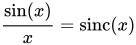


Some common non-elementary antiderivative functions are given names, defining so-called special functions, and formulas involving these new functions can express a larger class of non-elementary antiderivatives. The examples above name the corresponding special functions in parentheses.
Properties
[edit]Nonelementary antiderivatives can often be evaluated using Taylor series. Even if a function has no elementary antiderivative, its Taylor series can always be integrated term-by-term like a polynomial, giving the antiderivative function as a Taylor series with the same radius of convergence. However, even if the integrand has a convergent Taylor series, its sequence of coefficients often has no elementary formula and must be evaluated term by term, with the same limitation for the integral Taylor series.
Even if it isn't always possible to evaluate the antiderivative in elementary terms, one can approximate a corresponding definite integral by numerical integration. There are also cases where there is no elementary antiderivative, but specific definite integrals (often improper integrals over unbounded intervals) can be evaluated in elementary terms: most famously the Gaussian integral [4]

The closure under integration of the set of the elementary functions is the set of the Liouvillian functions.
See also
[edit]- Algebraic function – Mathematical function
- Closed-form expression – Mathematical formula involving a given set of operations
- Derivative – Instantaneous rate of change (mathematics)
- Differential algebra – Algebraic study of differential equations
- Lists of integrals
- Liouville's theorem (differential algebra) – Says when antiderivatives of elementary functions can be expressed as elementary functions
- Richardson's theorem – Undecidability of equality of real numbers
- Symbolic integration – Computation of an antiderivatives
- Tarski's high school algebra problem – Mathematical problem
- Transcendental function – Analytic function that does not satisfy a polynomial equation
References
[edit]- ^ a b c Weisstein, Eric W. "Elementary Function." From MathWorld--A Wolfram Web Resource. http://mathworld.wolfram.com/ElementaryFunction.html From MathWorld Accessed 24 Apr 2017.
- ^ Dunham, William (2005). The Calculus Gallery. Princeton. p. 119. ISBN 978-0-691-13626-4.
- ^ Impossibility theorems for elementary integration; Brian Conrad. Clay Mathematics Institute: 2005 Academy Colloquium Series. Accessed 14 Jul 2014.
- ^ Weisstein, Eric W. "Gaussian Integral". mathworld.wolfram.com. Retrieved 2025-05-06.
Further reading
[edit]- Williams, Dana P., NONELEMENTARY ANTIDERIVATIVES, 1 Dec 1993. Accessed January 24, 2014.
Nonelementary integral
View on GrokipediaFundamentals
Elementary functions
Elementary functions constitute the core class of functions in mathematical analysis, built through finite applications of algebraic operations, composition, exponentials, and logarithms starting from the identity function and constants. Formally, an elementary function is one that belongs to an elementary extension field of the rational functions in one variable, obtained by successively adjoining algebraic elements, exponentials, or logarithms of previous elements. This construction ensures a precise characterization rooted in differential field theory. The primary components include rational functions, which are ratios of polynomials such as ; exponential functions of linear arguments, exemplified by where and are constants; logarithmic functions like , with an elementary function; trigonometric functions including , , , and their variants; and inverse trigonometric functions such as , , . These basics extend to finite compositions and algebraic combinations, such as sums, products, quotients, and roots, yielding expressions like . The collection of elementary functions forms a field, hence closed under addition and multiplication (as well as subtraction and division by non-zero elements). Moreover, it is closed under differentiation: the derivative of any elementary function remains elementary. However, closure fails under integration, as certain definite or indefinite integrals of elementary functions yield non-elementary results. In standard calculus contexts, this class underpins most antiderivatives encountered, such as the polynomial integral for , the exponential , and the trigonometric , all preserving elementarity. The notion of elementary functions was formalized by Joseph Liouville during the 1830s, through investigations into integrability in finite terms. This framework highlights the contrast with nonelementary integrals, whose antiderivatives transcend this class.Definition of nonelementary integrals
In mathematics, a nonelementary integral is the indefinite integral of an elementary function whose antiderivative cannot be expressed as a finite combination of elementary functions, such as rational, exponential, logarithmic, and trigonometric functions, along with their algebraic compositions.[2] This concept arises in the study of integration in finite terms, which seeks to determine whether the antiderivative of a given function can be formulated using only a finite sequence of standard operations—addition, multiplication, division, root extraction, exponentiation, and logarithmic differentiation—starting from the base field of rational functions. The framework of differential fields is essential here, providing an algebraic structure where a differential field is a field equipped with a derivation that satisfies the Leibniz rule and linearity; elementary functions are precisely those lying in elementary extensions of the rational function field , which are built by adjoining constants, algebraic elements, exponentials, or logarithms in a finite tower of such extensions. A key distinction exists between indefinite and definite nonelementary integrals: while the indefinite integral may lack an elementary antiderivative, the corresponding definite integral can sometimes yield a closed-form expression through alternative techniques, such as contour integration or symmetry arguments, even when no elementary antiderivative is available.[2] For instance, the Gaussian integral over the real line evaluates to , despite its indefinite form being nonelementary.[2] Criteria for determining whether an integral is nonelementary rely on Liouville's theorem from differential algebra, which imposes structural constraints on possible elementary antiderivatives by analyzing decompositions in logarithmic and exponential parts within differential field extensions.[2] For integrands that are themselves elementary functions, the Risch algorithm provides a decision procedure to algorithmically verify the existence (or absence) of an elementary antiderivative, resolving the problem computably in finite terms.[4] However, for general integrands beyond the elementary class, the problem of determining nonelementary status is algorithmically undecidable, as it encompasses undecidable questions in computability theory.[5] Cardinality considerations further underscore the prevalence of nonelementary integrals: the set of all elementary functions is countable, whereas the set of continuous functions on the reals has the cardinality of the continuum , implying that almost all integrable functions possess nonelementary antiderivatives.[2]Historical Development
Early recognition
The initial encounters with nonelementary integrals occurred in the 17th and 18th centuries as mathematicians grappled with functions whose antiderivatives defied expression in terms of elementary operations. In 1655, John Wallis studied the arc length of an ellipse, leading to integrals of the form , which could not be resolved elementarily and marked an early informal acknowledgment of their nonelementary character.[6] This challenge persisted into the early 18th century, where Giovanni Fagnano in 1718 examined the arc length of the lemniscate, another elliptic integral requiring non-elementary methods. Abraham de Moivre in 1733 considered the definite Gaussian integral , recognizing its importance in probability approximations despite the indefinite form remaining intractable. Leonhard Euler made repeated attempts to find closed forms for similar integrals, including expansions and series representations in his Institutiones calculi integralis (1768–70), but ultimately concluded that they required new transcendental functions beyond the elementary repertoire.[7] By the 19th century, the limitations became more evident in the study of algebraic functions. Augustin-Louis Cauchy and contemporaries highlighted the difficulties in integrating expressions such as , which arose in problems of arc length and mechanics, noting that such forms resisted reduction to elementary antiderivatives and necessitated specialized approaches.[8] This recognition spurred the compilation of integral tables that explicitly cataloged nonelementary cases; for instance, David Bierens de Haan's Nouvelles tables d'intégrales définies (1867) systematically documented definite integrals involving non-elementary functions, providing practical reductions for computation.[9] A pivotal transition emerged with the adoption of special functions to handle these integrals in applied contexts. Around 1809, Carl Friedrich Gauss introduced the concept of the error function, defined as , specifically for astronomical and probabilistic calculations where the Gaussian integral proved indispensable, thereby formalizing a nonelementary entity for practical use.[10]Contributions from 19th-20th century mathematicians
In the 1830s and 1840s, Joseph Liouville made foundational contributions to the theory of integration in finite terms by developing a systematic framework using differential algebra to determine when antiderivatives can be expressed via elementary functions. His work culminated in Liouville's theorem, which provides necessary conditions for the existence of elementary antiderivatives and was used to prove that specific integrals, such as , cannot be expressed in elementary terms.[2] Liouville's approach involved analyzing the structure of differential fields and logarithmic extensions, establishing that certain rational functions lead to nonelementary integrals when integrated.[11] During the 1880s, Henri Poincaré extended these ideas by incorporating group-theoretic methods into the study of differential equations, laying groundwork for what would become differential Galois theory to assess the solvability of integrals by quadratures. His investigations into Fuchsian equations and automorphic functions highlighted structural obstructions to explicit integration, influencing later developments in determining when nonelementary integrals arise in solutions to linear differential equations.[12] In the 20th century, Robert Risch advanced symbolic integration with his 1969 algorithm, which provides a decision procedure for elementary integrands, determining whether their antiderivatives are elementary and constructing them if possible. This algorithm leverages Liouville's theory through tower decompositions of differential fields, enabling computational verification of elementarity for complex expressions involving exponentials, logarithms, and algebraics. Parallel to these theoretical advances, the cataloging of special functions addressed nonelementary antiderivatives practically; the 1964 Handbook of Mathematical Functions by Milton Abramowitz and Irene Stegun compiled extensive tables and formulas for functions like the error function and the exponential integral , standardizing their use in evaluating otherwise intractable integrals. Despite these milestones, modern efforts reveal ongoing incompleteness, with unsolved cases for integrands involving special functions and links to computability theory, where deciding closed-form integrability in broader classes remains open or undecidable due to limitations akin to those in Diophantine problems.[13]Key Examples
Gaussian and error function integrals
The Gaussian integral, a prototypical nonelementary integral, evaluates to in its definite form over the real line: , while its indefinite counterpart cannot be expressed using elementary functions.[14][10] This result underpins the normalization constant for the normal probability distribution. One standard derivation of the definite value uses a polar coordinate transformation: squaring the integral gives , which in polar coordinates becomes , so .[14] Alternatively, relating it to the Gamma function via the substitution yields , confirming the full integral as .[14] The integral first appeared in probability theory with Abraham de Moivre's 1733 approximation of the binomial distribution and was rigorously applied by Carl Friedrich Gauss in his 1809 astronomical work Theoria Motus Corporum Coelestium, where he modeled observational errors via the normal distribution.[14] Pierre-Simon Laplace independently computed the value in 1774 and later connected it to the central limit theorem in 1812.[14] These developments established the Gaussian integral's foundational role in statistics and physics. Closely related is the error function, defined as which inherits the nonelementary nature of the Gaussian integrand and serves as its antiderivative scaled by . For small , it admits a Taylor series expansion: convergent for all .[15] The error function approaches 1 as and is an odd function, with early formulations as a probability integral tracing to de Moivre (1718–1733) and Laplace (1774).[16] The name "error function" was introduced by J. W. L. Glaisher in 1871, reflecting its use in quantifying measurement errors.[16] The complementary error function, , is particularly useful for large arguments, where it decays rapidly and has the leading asymptotic behavior as .[15] This expansion, first derived by Laplace in 1812, facilitates approximations in heat conduction and diffusion problems.[16] The complementary form was defined by Christian Kramp in 1799.[16]Exponential and logarithmic integrals
The exponential integral function, denoted , is a prototypical example of a nonelementary integral involving exponentials. It is defined by the Cauchy principal value integral for , where the path of integration avoids the origin. This representation highlights its nonelementary nature, as the antiderivative cannot be expressed in terms of elementary functions. The function satisfies the power series expansion which converges for all , with denoting the Euler-Mascheroni constant. For large positive , an asymptotic expansion provides useful approximation: obtained via repeated integration by parts, though the series is divergent beyond a certain point. Closely related is the complementary exponential integral for , with . Its series expansion is converging for all finite . These functions exhibit branch points at the origin and exhibit analytic continuation properties across the complex plane, excluding the negative real axis.[17] The logarithmic integral, , provides a key nonelementary example involving logarithms and is defined by the Cauchy principal value for . This integral encounters a singularity at , necessitating the principal value interpretation. In number theory, approximates the prime-counting function , as stated by the prime number theorem: as . Other nonelementary integrals in this category include , whose antiderivative involves special functions like the dilogarithm rather than elementary ones. These examples underscore the challenges in integrating rational functions of exponentials and logarithms, often requiring special functions for closed-form representation.Theoretical Properties
Liouville's theorem
Liouville's theorem, originally developed by Joseph Liouville in a series of papers published between 1833 and 1841, establishes the structural conditions under which an elementary function admits an elementary antiderivative. In essence, the theorem asserts that if an elementary function in a differential field has an elementary integral, then this integral can be expressed through a finite combination of algebraic operations, exponentials, logarithms, and explicit integrations of simpler forms within the same field structure. This result forms the cornerstone for determining when integrals are nonelementary, by showing that not all elementary integrands yield elementary antiderivatives.[18] In the framework of differential algebra, the theorem is precisely stated as follows: Let be a differential field of characteristic zero and . If the equation has a solution in some elementary differential extension field of having the same subfield of constants, then there exist constants (the constants of ) and elements such that where is a positive integer.[19] Key concepts underlying this formulation include differential fields, which are fields equipped with a derivation satisfying the Leibniz rule, and elementary extensions, constructed via a finite tower of simple extensions: algebraic adjunctions (roots of polynomials), logarithmic adjunctions ( where the base field), and exponential adjunctions ( where the base field). These towers represent the iterative building of elementary functions starting from rational functions.[19] The proof of the theorem relies on an inductive argument over the length of the tower of elementary extensions, typically attributed to Maxwell Rosenlicht's algebraic formulation in 1972. For the base case of no extensions, the result is trivial. In the inductive step, one considers each type of extension: for algebraic extensions, the proof uses conjugates and symmetric functions to reduce to the base field; for logarithmic extensions, it applies properties of logarithmic derivatives and valuations to bound the degrees; for exponential extensions, similar valuation techniques ensure the form persists without introducing new logarithmic terms. This approach leverages the derivation's properties to show that any primitive must decompose into rational and logarithmic parts from the original field, without requiring higher extensions.[19] A classic application of the theorem demonstrates that has no elementary antiderivative. Considering the differential field with derivation , suppose there exists an elementary primitive such that . By the theorem, must equal for elements in , but analyzing the associated differential equation (from the logarithmic derivative form) yields no solution , leading to a contradiction. Thus, the integral is nonelementary.[19] The theorem has limitations, as it applies exclusively to integrands that are elementary functions in differential fields of characteristic zero and assumes no new constants are introduced in the extension; it does not address non-elementary integrands or fields of positive characteristic.[20]Implications for differential fields
A differential field is a field equipped with a derivation , which is an additive endomorphism satisfying the Leibniz rule for all .[19] The constants of , denoted , form a subfield, and in characteristic zero, the derivation extends uniquely to algebraic extensions.[19] Within this framework, elementary functions are interpreted as elements of an elementary differential extension of a base field, constructed as a finite tower of simple extensions where each step adjoins either an algebraic element, an exponential (satisfying for some constant ), or a logarithm (satisfying for some in the previous field).[19] Building on Liouville's theorem as the foundational result, Maxwell Rosenlicht's work in the 1960s provided the first purely algebraic proof of the theorem and extended it to logarithmic extensions. Specifically, Rosenlicht's theorem states that if is an elementary differential extension with , and there exists such that , then for some , constants , and elements , where the number of logarithmic terms is at most the number of logarithmic adjunctions in the tower defining . This bound limits the complexity of potential elementary antiderivatives, facilitating structural analysis of nonelementarity by constraining the form any such integral must take. Differential Galois theory, particularly through Picard-Vessiot extensions, connects to the integrability problem by providing a Galois-theoretic framework for determining when solutions to linear differential equations lie in elementary extensions.[21] A Picard-Vessiot extension of a differential field for a linear differential equation is the smallest differential extension containing a full set of solutions and closed under the derivation, analogous to splitting fields in classical Galois theory.[21] For integration, which involves solving with , the theory aids in assessing whether the required extension remains elementary, as non-elementary integrals correspond to cases where the Picard-Vessiot extension introduces transcendental elements beyond algebraic, exponential, or logarithmic adjunctions.[21] These theoretical foundations have algorithmic implications, enabling partial decidability for integration problems within differential fields. The Risch algorithm, developed in 1969, leverages Rosenlicht's structural bounds and the tower decomposition of elementary extensions to provide a decision procedure that determines whether an elementary integrand admits an elementary antiderivative and constructs it if so. This algorithm operates recursively on the extension tower, reducing the problem to integration in simpler fields, thus achieving full decidability for integration in finite (elementary) terms over fields of characteristic zero. Open problems persist regarding undecidability in broader contexts, particularly for nonelementary integrands where the class of allowable functions is enlarged beyond elementary ones, such as by including the absolute value function, rendering the integration problem undecidable.[22] These undecidability results highlight limitations in automating the recognition of closed-form integrals for certain transcendental extensions and tie into Hilbert's 13th problem through questions of representability, where the superposition complexity of functions parallels the challenges in expressing nonelementary integrals via finite compositions of simpler operations.[23]Evaluation Techniques
Series and asymptotic expansions
One approach to evaluating nonelementary integrals analytically involves representing them through infinite series expansions, which provide exact or approximate expressions useful for theoretical analysis and computation in regions where direct integration is infeasible. Power series expansions, in particular, offer convergent representations around specific points, such as the origin. For the error function, a canonical nonelementary integral arising from the Gaussian distribution, the power series is given by which converges for all finite complex due to the entire nature of the function. This series is derived by term-by-term integration of the Taylor expansion of within the integral definition . The radius of convergence is infinite, ensuring uniform convergence on any compact subset of the complex plane.[24] For large arguments, where power series may converge too slowly, asymptotic series provide efficient approximations, though they are typically divergent and best truncated optimally. The complementary error function admits the asymptotic expansion as in the sector for , with the leading terms . This expansion is obtained via integration by parts on the integral representation of . In the subsector , the remainder after terms has the same sign as the next term and magnitude no larger than that term; for , the remainder is bounded by times the first neglected term.[25] Similar series representations apply to the exponential integral , defined as the Cauchy principal value for . Near , it has a Taylor-like expansion incorporating a logarithmic singularity: valid for , where is the Euler-Mascheroni constant.[26] For large positive , the asymptotic (Laurent-type at infinity) expansion is the divergent series derived through repeated integration by parts, with optimal truncation yielding relative errors on the order of the first omitted term. A general technique for deriving such series from nonelementary integrals involves differentiation under the integral sign, also known as Leibniz's rule or Feynman's trick, which introduces a parameter to transform the integral into a solvable differential equation whose solution yields a series expansion. For an integral , differentiating with respect to under the integral (justified by dominated convergence or similar conditions) often simplifies the form, allowing integration term by term or solution via power series in . This method has been applied to derive expansions for functions like by parameterizing the exponential and expanding accordingly.[27] Practical use of these series requires careful error estimation to ensure reliability. For power series like that of , the remainder after terms can be bounded using the Lagrange form, , providing uniform bounds on compact sets where convergence is absolute.[24] Asymptotic series, being divergent, achieve uniform convergence in truncated form over sectors excluding the negative real axis, with error estimates derived from the Stokes phenomenon to control oscillatory behavior near transition regions.[28] These representations are particularly valuable for the Gaussian-related nonelementary integrals, where series facilitate asymptotic analysis in probability contexts.Numerical approximation methods
Quadrature methods form a cornerstone for numerically evaluating definite nonelementary integrals, such as those defining the error function . The trapezoidal rule approximates the integral over a finite interval by dividing it into subintervals of width and summing trapezoid areas, with the composite error bounded by , where and is bounded on compact sets. This O() convergence makes it suitable for quick estimates but less ideal for high precision without small . Gaussian quadrature, which exactly integrates polynomials up to degree with points, can be adapted for Gaussian-weight integrands by constructing orthogonal polynomials with respect to weights like on . For instance, an 8-point rule derived via moment-based recursion achieves 5-digit accuracy for integrals like when , offering exponential convergence for smooth and efficiency on semi-infinite domains.[29] Continued fractions provide convergent rational approximations for functions like the complementary error function , especially for large where direct series diverge. A standard form is , evaluated as convergents from the asymptotic series for numerical stability via backward recursion. Optimized variants, such as 4-level continued fractions approximating over , yield relative errors around with minimal terms. These methods are particularly useful for indefinite evaluations, converging rapidly for with error decreasing as O() for terms.[30] Special algorithms leveraging Chebyshev polynomials offer near-minimax rational approximations for across intervals, minimizing maximum deviation. Cody's rational Chebyshev approximations for on achieve maximal relative errors down to using polynomials of degree up to 28, computed via Remes algorithm for equioscillation. These are widely implemented in software: MATLAB'serf function uses Cody's scheme for double-precision results with errors below , while SciPy's scipy.special.erf employs similar Chebyshev rational fits from Numerical Recipes, enabling fast, vectorized evaluations.[31][32]
In terms of accuracy and efficiency, quadrature excels for low-dimensional definite integrals (e.g., Gaussian quadrature reaches machine precision in O() operations for smooth integrands), while Chebyshev and continued fraction methods suit indefinite cases or function tabulation, delivering O(1) evaluations with errors post-optimization. Monte Carlo handles high-dimensional definite integrals effectively despite slower O() convergence, outperforming grid-based quadrature beyond by avoiding the curse of dimensionality.[33] Series expansions may underpin initial approximations but are referenced sparingly here for finite computations.
Applications
In probability and statistics
In probability and statistics, nonelementary integrals arise prominently in the formulation and computation of key distributions and inference procedures. The cumulative distribution function (CDF) of the standard normal distribution, which underpins much of classical statistics, is expressed using the error function as This relation underscores the nonelementary character of the normal CDF, as the error function itself lacks an elementary antiderivative, necessitating special functions or numerical methods for evaluation.[34] Although the normal probability density function is elementary, the integral defining the CDF from the density requires the nonelementary erf, making it central to probabilistic modeling of continuous data.[34] The error function's role extends to practical statistical inference, where the normal distribution is invoked for approximations in large samples. Confidence intervals for parameters, such as means or proportions, often rely on normal quantiles derived from the inverse error function; for example, the 95% interval uses the quantile corresponding to , computed via erfinv.[34] In hypothesis testing, p-values for z-tests or t-tests under normality assumptions are obtained by evaluating the normal CDF at the test statistic, again involving erf; this is essential for determining significance in procedures like two-sample tests or regression analysis.[34] These applications highlight how nonelementary integrals enable precise probabilistic statements in empirical research. Additionally, the logarithmic integral , a nonelementary function, approximates the prime-counting function via the prime number theorem as , providing a probabilistic lens on the distribution of primes through analytic number theory.[35] Computational challenges in handling these nonelementary integrals are addressed through specialized libraries in statistical software. In R, thepnorm function computes the normal CDF by leveraging the error function via underlying C implementations for high precision and speed, avoiding direct quadrature of the Gaussian integral.[36] Similar numerical strategies are employed for and in packages like pracma or gsl, ensuring reliable evaluation in Monte Carlo simulations and bootstrap procedures.