
Recent from talks
Lorient
Knowledge base stats:
Talk channels stats:
Members stats:
Lorient
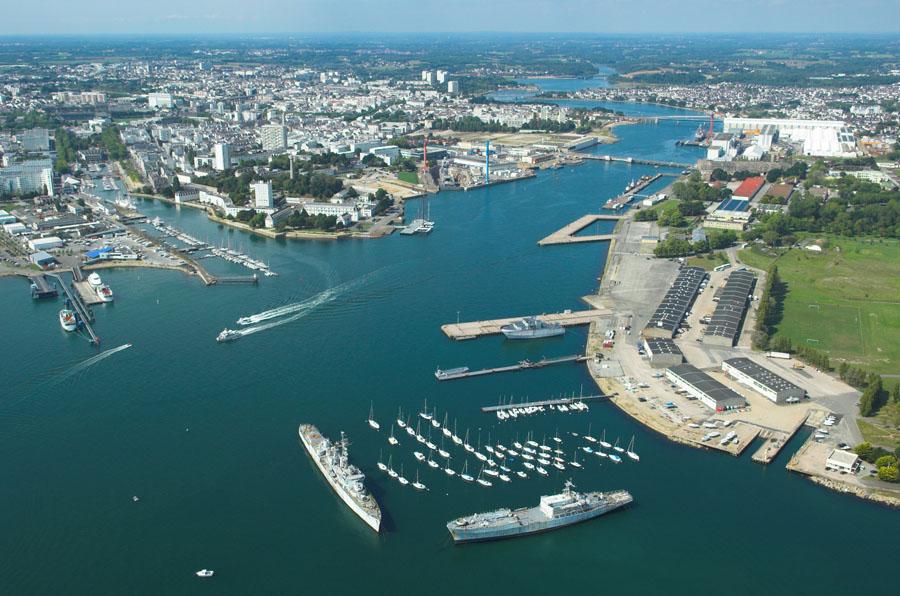
Lorient (French: [lɔʁjɑ̃] ⓘ; Breton: An Oriant) is a town (commune) and seaport in the Morbihan department of Brittany in western France.
Beginning around 3000 BC, settlements in the area of Lorient are attested by the presence of megalithic architecture. Ruins of Roman roads (linking Vannes to Quimper and Port-Louis to Carhaix) confirm Gallo-Roman presence.
In 1664, Jean-Baptiste Colbert founded the French East Indies Company. In June 1666, an ordinance of Louis XIV granted lands of Port-Louis to the company, along with Faouédic on the other side of the roadstead. One of its directors, Denis Langlois, bought lands at the confluence of the Scorff and the Blavet rivers, and built slipways. At first, it only served as a subsidiary of Port-Louis, where offices and warehouses were located. The following years, the operation was almost abandoned, but in 1675, during the Franco-Dutch War, the French East Indies Company scrapped its base in Le Havre since it was too exposed during wartime, and transferred its infrastructures to l'Enclot, out of which Lorient grew. The company then erected a chapel, workshops, forges, and offices, leaving Port-Louis permanently.
The city's name is derived from Le Soleil d'Orient, the first ship constructed at the site, in 1669. Workers gave the site the name of the ship, which, by contraction, became simply L'Orient and finally Lorient.
The French Royal Navy opened a base there in 1690, under the command of Colbert de Seignelay, who inherited his father's position as Secretary of State of the Navy. At the same time, privateers from Saint-Malo took shelter there. In 1700, the town grew out of l'Enclot following a law forcing people to leave the domain to move to the Faouédic heath. In 1702, there were about 6,000 inhabitants in Lorient, though activities slowed, and the town began to decline.
The town experienced a period of growth when John Law formed the Perpetual Company of the Indies by absorbing other chartered companies (including the French East India Company), and chose Lorient as its operations base. Despite the economic bubble caused by the Company in 1720, the city was still growing as it took part in the Atlantic triangular slave trade. From 1720 to 1790, 156 ships deported an estimated 43,000 slaves. In 1732, the Company decided to transfer its sales headquarters from Nantes to Lorient, and asked architect Jacques Gabriel to raise new buildings out of dimension stones to host these new activities, and to embellish the L'Enclos domain. Sales began in 1734, peaking up to 25 million livres tournois. In 1769, the Company's monopoly ended with the scrapping of the company itself, under the influence of the physiocrats.
Until the Company's closure, the city took advantage of its prosperity. In 1738, there were 14,000 inhabitants, or 20,000 considering the outlying villages of Kerentrech, Merville, La Perrière, Calvin, and Keryado, which are now neighbourhoods within the present-day city limits. In 1735, new streets were laid out and in 1738, it was granted city status. Further work was undertaken as the streets began to be paved, wharves and slipways were built along the Faouédic river, and thatched houses were replaced with stone buildings following 18th-century classical architecture style as it was the case for l'Enclos. In 1744, the city walls were erected, and proved quickly useful as Lorient was raided in September 1746. Following the demise of the Company, the city lost one-seventh of its population.
In 1769, the city evolved into a full-scale naval base for the Royal Navy when Louis XV bought out the Company's infrastructures for 17,500,000 livres tournois. From 1775 on, the American Revolutionary War brought a surge in activity, as many privateers hailed from Lorient. When the war ended, transatlantic lines opened to the United States, and in 1785, a new commercial company started under Calonne's tutelage (then Controller-General of Finances) with the same goal as the previous entities, i.e. conducting trade in India and China, with again Lorient standing as its operative base.
Hub AI
Lorient AI simulator
(@Lorient_simulator)
Lorient
Lorient (French: [lɔʁjɑ̃] ⓘ; Breton: An Oriant) is a town (commune) and seaport in the Morbihan department of Brittany in western France.
Beginning around 3000 BC, settlements in the area of Lorient are attested by the presence of megalithic architecture. Ruins of Roman roads (linking Vannes to Quimper and Port-Louis to Carhaix) confirm Gallo-Roman presence.
In 1664, Jean-Baptiste Colbert founded the French East Indies Company. In June 1666, an ordinance of Louis XIV granted lands of Port-Louis to the company, along with Faouédic on the other side of the roadstead. One of its directors, Denis Langlois, bought lands at the confluence of the Scorff and the Blavet rivers, and built slipways. At first, it only served as a subsidiary of Port-Louis, where offices and warehouses were located. The following years, the operation was almost abandoned, but in 1675, during the Franco-Dutch War, the French East Indies Company scrapped its base in Le Havre since it was too exposed during wartime, and transferred its infrastructures to l'Enclot, out of which Lorient grew. The company then erected a chapel, workshops, forges, and offices, leaving Port-Louis permanently.
The city's name is derived from Le Soleil d'Orient, the first ship constructed at the site, in 1669. Workers gave the site the name of the ship, which, by contraction, became simply L'Orient and finally Lorient.
The French Royal Navy opened a base there in 1690, under the command of Colbert de Seignelay, who inherited his father's position as Secretary of State of the Navy. At the same time, privateers from Saint-Malo took shelter there. In 1700, the town grew out of l'Enclot following a law forcing people to leave the domain to move to the Faouédic heath. In 1702, there were about 6,000 inhabitants in Lorient, though activities slowed, and the town began to decline.
The town experienced a period of growth when John Law formed the Perpetual Company of the Indies by absorbing other chartered companies (including the French East India Company), and chose Lorient as its operations base. Despite the economic bubble caused by the Company in 1720, the city was still growing as it took part in the Atlantic triangular slave trade. From 1720 to 1790, 156 ships deported an estimated 43,000 slaves. In 1732, the Company decided to transfer its sales headquarters from Nantes to Lorient, and asked architect Jacques Gabriel to raise new buildings out of dimension stones to host these new activities, and to embellish the L'Enclos domain. Sales began in 1734, peaking up to 25 million livres tournois. In 1769, the Company's monopoly ended with the scrapping of the company itself, under the influence of the physiocrats.
Until the Company's closure, the city took advantage of its prosperity. In 1738, there were 14,000 inhabitants, or 20,000 considering the outlying villages of Kerentrech, Merville, La Perrière, Calvin, and Keryado, which are now neighbourhoods within the present-day city limits. In 1735, new streets were laid out and in 1738, it was granted city status. Further work was undertaken as the streets began to be paved, wharves and slipways were built along the Faouédic river, and thatched houses were replaced with stone buildings following 18th-century classical architecture style as it was the case for l'Enclos. In 1744, the city walls were erected, and proved quickly useful as Lorient was raided in September 1746. Following the demise of the Company, the city lost one-seventh of its population.
In 1769, the city evolved into a full-scale naval base for the Royal Navy when Louis XV bought out the Company's infrastructures for 17,500,000 livres tournois. From 1775 on, the American Revolutionary War brought a surge in activity, as many privateers hailed from Lorient. When the war ended, transatlantic lines opened to the United States, and in 1785, a new commercial company started under Calonne's tutelage (then Controller-General of Finances) with the same goal as the previous entities, i.e. conducting trade in India and China, with again Lorient standing as its operative base.
Recent media