Hubbry Logo
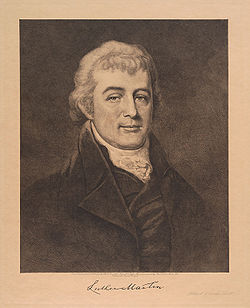
Luther MartinLuther MartinMain
Open search
Luther Martin
Community hub
Luther Martin
logo
8 pages, 0 posts
0 subscribers
Be the first to start a discussion here.
Luther Martin
Luther Martin
from Wikipedia

Luther Martin (February 20, 1748 – July 10, 1826)[1] was a Founding Father of the United States, framer of the U.S. Constitution, politician, lawyer, and slave owner. Martin was a delegate from Maryland to the Constitutional Convention in 1787, but did not sign the Constitution, having left the convention early because he felt the document as proposed violated states' rights. In the months following the convention, he was a leading Anti-Federalist, along with Patrick Henry and George Mason, whose collective efforts led to the passage of the Bill of Rights.

Key Information

Early life

[edit]

Martin was an early advocate of American independence from Great Britain. In the fall of 1774, as a resident of Somerset County, Maryland,[2] he served on the county's patriot committee and in December attended a convention of the Province of Maryland in Annapolis, which had been called to consider the recommendations of the Continental Congress. He went to the College of New Jersey (Princeton) and graduated with honors in 1766.

Constitutional convention

[edit]

In 1785, he was elected to the Confederation Congress by the Maryland General Assembly, but his numerous public and private duties prevented him from traveling to Philadelphia. Martin was elected as a delegate to the Constitutional Convention of 1787 in Philadelphia. When he arrived on June 9, 1787, he expressed suspicion of the secrecy rule imposed on the proceedings. He also opposed the creation of a government in which the large states would dominate the small ones, he consistently sided with the small states, helping to formulate the New Jersey Plan and voting against the Virginia Plan. On June 27, Martin spoke for more than three hours in opposition to the Virginia Plan's proposal for proportionate representation in both houses of the legislature.

He was known for his warm opposition to the development of a strong central government. He was known for his ability to talk and as stated by William Pierce "he was educated for the Bar... and he never speaks without tiring the patience of all who hear him."

Martin believed the legislative branch should be unicameral, proposed limiting the standing army during peacetime, and argued that the Convention had exceeded its powers by creating a national government when they were sent to Philadelphia "for the sole and express purpose of revising the Articles of Confederation."[3]

Martin served on the committee formed to seek a compromise on representation, where he supported the case for equal numbers of delegates in at least one house. Before the convention closed, he became convinced that the new government would have too much power over state governments and would threaten individual rights. Failing to find any support for a bill of rights, Martin and another Maryland delegate, John Francis Mercer, walked out of the convention on September 3, 1787. He was one of the most vocal opponents of slavery at the Constitutional Convention, denouncing it as "inconsistent with the principles of the revolution and dishonorable to the American character."[4]: 26 

Ratification fight

[edit]
Martin among the Constitutional Convention delegates in the U.S. National Archives 1936 Faulkner Mural, located in the building's rotunda above the Charters of Freedom.

In November 1787, in a speech to the Maryland House of Delegates, he assailed the Constitutional Convention for what it was attempting to do and for how it was going about the job. He broke the pledge to secrecy under which the convention had met and informed the Maryland legislators that the convention had violated its instructions to meet "for the sole and express purpose of revising" the Articles of Confederation. Instead, convention delegates had taken it upon themselves to make a fresh start by creating an entirely new system of government. To Martin, such an effort was akin to launching a coup d'état. George Washington and Benjamin Franklin had backed the change of direction of the convention, but, Martin said, we should not "suffer our eyes to be so far dazzled by the splendor of names, as to run blindfolded into what may be our destruction."

In an address to the Maryland House of Delegates in November 1787 and in numerous newspaper articles, Martin attacked the proposed new form of government and continued to fight ratification of the Constitution through 1788. He lamented the ascension of the national government over the states and condemned what he saw as unequal representation in Congress. He owned six slaves of his own, but he opposed including slaves in determining representation (most slave owners supported counting slaves for the purposes of determining representation because this would increase the power of Slave States), and he believed that the absence of a jury in the U.S. Supreme Court gravely endangered freedom. At the convention, Martin complained, the aggrandizement of particular states and individuals often had been pursued more avidly than the welfare of the country. The assumption of the term "federal" by those who favored a national government also irritated Martin.

Martin served as a delegate to the Maryland State Convention of 1788, to vote whether Maryland should ratify the proposed Constitution of the United States.[5] Most of the delegates at the convention ignored Martin's warnings. In April 1788, the majority of the delegates voted to ratify the Constitution, making Maryland the seventh state to do so. In June, when New Hampshire became the ninth state to ratify, the required threshold had been reached, and the new Constitution took effect. Three years later, the first 10 amendments were added.

[edit]

In the beginning of the 19th century, Martin was defense counsel in two controversial national cases. In the first case, Martin won an acquittal for his close friend Supreme Court Justice Samuel Chase in his impeachment trial in 1805. Two years later, Martin was one of Aaron Burr's defense lawyers when Burr stood trial for treason in 1807.

After a record 28 consecutive years as state attorney general, Martin resigned in December 1805. In 1813, he became chief judge of the court of oyer and terminer for the City and County of Baltimore. He was reappointed attorney general of Maryland in 1818, and, in 1819, he argued Maryland's position in the landmark Supreme Court case McCulloch v. Maryland. The plaintiffs were represented by Daniel Webster, William Pinkney and William Wirt.

Martin's fortunes declined dramatically in his last years. Alcoholism, illness, and poverty weighed heavily on Martin, taking their toll as he aged. By the mid-1820s, he was subsisting on a special tax imposed on Maryland lawyers solely for his personal support. Eventually, he was taken in by Burr. By this time, detestation of Thomas Jefferson, his one-time decentralist ally, led Martin to embrace the Federalist Party, in apparent repudiation of everything he had argued for so strenuously. Paralysis, which had struck in 1819, forced him to retire as Maryland's attorney general in 1822.

Death and legacy

[edit]
Coat of Arms of Luther Martin

On July 10, 1826, at the age of 78, Martin died in Burr's home in New York City and was buried in an unmarked grave in St. John's churchyard. His death came six days after the deaths on July 4 of Jefferson and John Adams.

Martin married Maria Cresap (daughter of Captain Michael Cresap) on Christmas Day 1783. Of their five children, three daughters lived to adulthood.

An extended display of his eloquence and volubility appears in "Modern Gratitude in Five Numbers: Addressed to Richard Raynall Keene, Esq. Concerning a Family Marriage"[6] (1802)—a closely documented, fiercely argued (and partly autobiographical) denunciation of a former protégé who, against Martin's express wishes, had wooed and married Martin's daughter Eleonora.

Notes

[edit]

References

[edit]

Further reading

[edit]
[edit]
Revisions and contributorsEdit on WikipediaRead on Wikipedia
from Grokipedia
Luther Martin (February 20, 1748 – July 10, 1826) was an American lawyer and statesman from who served as a delegate to the Constitutional Convention of 1787, where he emerged as a leading critic of the proposed U.S. . Born in , Martin graduated from (now ) and established a prominent legal practice in after studying . He refused to sign the final document, decrying it as a blueprint for consolidated national power that undermined state sovereignty and individual liberties, positions he detailed in his influential pamphlet Genuine Information. As a key Anti-Federalist, Martin delivered marathon speeches at the convention opposing provisions like the and the supremacy of federal law, warning they enabled unchecked executive and legislative authority. His efforts extended to Maryland's debates, where he argued against without a , though the state ultimately approved the . In his legal , Martin served multiple terms as Maryland's , notably defending Justice during his 1805 impeachment trial in the Senate and participating in high-profile cases that shaped early American . Despite personal struggles with alcohol and finances later in life, his principled stand against centralized power foreshadowed enduring debates over .

Early Life and Education

Birth and Family

Luther Martin was born on February 20, 1748, in . He was the son of Benjamin Martin and (also recorded as Elenora). The Martin family adhered to the Episcopal faith, reflecting the predominant religious tradition among colonial settlers of British descent. Little is documented about his father's occupation, but the household appears to have been of modest colonial stock, typical of mid-18th-century provincial life in the province.

Academic and Professional Formation

Martin attended (now ), where he received a emphasizing Latin, Greek, , and moral , graduating in approximately 1766. Following graduation, he relocated to the , initially working as a schoolmaster in Somerset County while beginning self-directed studies in law, a common path for aspiring attorneys in the colonial era lacking formal legal institutions. In 1770, Martin left teaching to pursue full-time under the of , a practitioner in Back Creek, ; such mentorships typically involved clerking, observing court proceedings, and memorizing legal precedents over one to three years. Demonstrating rapid proficiency, he passed his examination and gained admission to the bar in 1771, enabling practice across colonial boundaries. The following year, 1772, he secured admission to the bar, returning to County to establish a private practice focused on land disputes, debt collections, and matters prevalent in agrarian regions. By the mid-1770s, Martin's legal acumen had earned him a reputation for eloquence and thorough preparation, handling cases in both and courts; contemporaries noted his reliance on Blackstone's Commentaries and Coke's reports, supplemented by colonial statutes, rather than speculative theory. This formative period solidified his commitment to common-law traditions, influencing his later advocacy for state sovereignty and jury rights during the Revolutionary era.

Revolutionary War Era and Entry into Maryland Politics

Martin was admitted to the Virginia bar in 1771 after studying law under Samuel Wilson in Somerset County, Maryland, and completing further preparation in Virginia. He returned to Somerset County shortly thereafter to establish his private law practice on Maryland's Eastern Shore, where he was admitted to the Maryland bar in 1772. This period marked the beginning of his professional career as an attorney amid rising colonial tensions with Britain, though specific court cases from his early practice remain sparsely documented in historical records. As the Revolutionary War commenced in 1775, Martin continued his legal work while aligning his professional efforts with patriot sympathies. Elected to the Somerset County Committee of Observation in 1774 and reelected the following year, he contributed to local enforcement of non-importation agreements and resistance to British authority, activities that intersected with his role as a practicing advocating for colonial interests. He also served as a commissioner tasked with opposing British territorial claims in the region, leveraging his legal expertise to support provincial conventions, including attendance at the Annapolis gathering in December 1774. These engagements underscored his emerging reputation as a defender of revolutionary principles through legal and rhetorical means, even as wartime disruptions challenged routine litigation. Martin's practice during this era focused on the Eastern Shore's agrarian and commercial disputes, building a foundation of clientele that reflected his growing stature at the bar. By combining advocacy with public addresses and circulated handbills—such as his 1770s urging peninsula inhabitants southward of British lines to reject Loyalist influences—he positioned himself as a key figure in sustaining legal order and ideological resolve amid conflict. This blend of private practice and patriotic service propelled his trajectory toward formal state roles as the war progressed.

Appointment as Attorney General and State Service

In February 1778, Maryland Governor Johnson appointed Luther Martin as the state's , a role established by the 1776 Maryland Constitution to replace the prior . The appointment, secured with assistance from influential jurist , tasked Martin with enforcing state laws amid the ongoing Revolutionary War. Martin held the position continuously for 28 years until resigning in December 1805, making him one of the longest-serving attorneys general in U.S. history at the time. As , Martin focused on prosecuting Loyalists, whose presence remained significant in despite the war's patriot momentum. He traveled extensively across the state to pursue legal actions against those accused of or property confiscation violations, enforcing statutes that seized Loyalist estates for public use. This role demanded rigorous application of state forfeiture laws, which Martin executed with notable zeal, contributing to 's wartime revenue and political consolidation under republican governance. His efforts aligned with broader policies targeting disloyalty, though they occasionally drew criticism for perceived overreach in asset seizures. Martin's tenure also involved advising the and on legal matters, including wartime finance and organization, solidifying his influence in politics before his 1787 delegation to the Constitutional Convention. In 1785, while still Attorney General, the elected him to the Confederation Congress, where he briefly served on committees addressing interstate commerce disputes. This dual state-federal role underscored his commitment to Maryland's amid national debates over confederation weaknesses.

Participation in the Constitutional Convention

Arrival and Initial Contributions

Luther Martin arrived at the Constitutional Convention in on June 9, 1787, after the assembly had been in session for two weeks. As a delegate selected as a second choice for Maryland's delegation, Martin immediately expressed suspicion toward the convention's secrecy rules, which barred public disclosure of proceedings. His late entry positioned him to engage with ongoing debates over the structure of the proposed national government, particularly the Virginia Plan's emphasis on favoring larger states. From June 9 onward, Martin contributed actively to discussions, advocating for the preservation of state sovereignty and equal representation among states to protect smaller ones like . He supported elements of the , which called for retaining a unicameral legislature with equal state votes, arguing that the federal government should primarily serve to maintain state governments rather than supplant them. Martin's interventions highlighted his commitment to balancing power, warning against a centralized authority that could undermine confederation principles established under the . A notable early contribution came on June 27, 1787, when Martin delivered a lengthy speech contending that the convention's aim should not dissolve state structures but reinforce them through a confederal framework. He emphasized that equal in at least one legislative branch was essential to prevent domination by populous states, influencing the eventual compromise on the . These positions, rooted in Martin's defense of Maryland's interests, marked his initial role as a vocal proponent of amid the convention's push for a stronger union.

Major Objections and Withdrawal

Martin voiced strenuous objections to the early in the convention, arguing on June 28, 1787, that its provisions for a national legislature with in both houses and power over state laws would erode state sovereignty and consolidate power into an overly centralized authority contrary to the confederation's principles. He contended that such a structure deviated from the states' compact under the , which required unanimous consent for fundamental alterations, and warned that favored larger states at the expense of smaller ones like . These concerns aligned with his advocacy for retaining key confederation elements, including equal state and limited federal authority confined to external affairs. Throughout July and August, Martin continued opposing key compromises, including the Connecticut Compromise's bicameral structure with in the and equal in the , which he viewed as insufficient protection against national overreach; the creation of a strong executive branch, which he likened to monarchical tendencies; and the federal judiciary's broad appellate , fearing it would subordinate state courts and s. He also criticized the absence of explicit guarantees for state republican governments and amendments requiring unanimous state approval, asserting that the draft empowered to override state legislation on internal matters, potentially leading to tyranny. Martin's positions, shared with delegates like and John Lansing, emphasized —local governance for internal affairs—and rejected any framework implying states as mere administrative subunits of a national government. Despairing of reversing the convention's trajectory toward a consolidated , Martin withdrew from the proceedings before its conclusion on September 17, 1787, alongside Maryland delegate John Francis Mercer, refusing to sign the final document due to its incompatibility with state sovereignty and precedents. In his subsequent account to the legislature, he explained his departure stemmed from the futility of further opposition once core Anti-Federalist safeguards, such as a strict confederate union and protections against federal supremacy over states, were rejected. This exit underscored his principled stand against what he termed an unauthorized revision transforming a voluntary alliance of sovereign states into a potentially despotic national entity.

Anti-Federalist Campaign Against Ratification

Publication of "Genuine Information"

Luther Martin, upon returning from the Constitutional Convention where he had opposed the proposed document and departed early, prepared a detailed account of the proceedings to share with Maryland's and the public. This report, framed as a letter addressed to Thomas Cockey Deye, a member of the , outlined Martin's objections and insider observations of the secret deliberations in . The full text, titled Genuine Information, Delivered to the of the State of , Relative to the Proceedings of the General Convention, Held at , in 1787, was serialized as a series of eleven letters in the Maryland beginning on December 28, 1787. The publication commenced with the first installment on December 28, 1787, printed by editor Eleazer Oswald Hayes, who used it to counter arguments favoring . Subsequent parts appeared weekly or semi-weekly through early 1788, including the second on January 1, the third around January 4, the fourth on January 8, and continuing to the eleventh on 8. Martin's letters revealed previously undisclosed details of the Convention's debates, such as disputes over representation, executive power, and state sovereignty, which he argued undermined confederation principles and favored consolidation of authority. He emphasized that the document's secrecy had concealed flaws, positioning his account as "genuine information" to inform Anti-Federalist resistance. The serialization amplified Martin's voice in Maryland's ratification debates, where Federalists held influence but faced scrutiny over the Constitution's ambiguities. Although some contemporaries noted Martin's prose as vehement and selectively interpretive—highlighting his advocacy for while critiquing national powers—the letters contributed to public discourse by providing one of the earliest extended critiques from a Convention participant. Later editions were compiled and reprinted, often alongside Secret Proceedings and Debates of the Convention, extending their reach beyond . This publication effort underscored Martin's commitment to transparency, despite the Convention's pledge of secrecy, as a means to rally opposition before Maryland's convention in April 1788.

Debates in Maryland and Broader Influence

Upon returning from the Constitutional Convention, Martin delivered a detailed report to the on November 29, 1787, outlining his objections to the proposed , which was subsequently published as "Genuine Information" in the Maryland Gazette or Baltimore General Advertiser. This document argued that the Constitution consolidated too much power in the federal government at the expense of state sovereignty, emphasizing equal representation of states and warning against the erosion of local liberties. In early 1788, as prepared for its ratifying convention, Martin authored a series of public addresses to defend his stance and counter criticisms. His first address, published on March 18, 1788, in the Maryland Journal, rejected claims that he had shifted positions post-Philadelphia and reaffirmed his opposition to granting excessive powers, such as direct taxation and control over state militias. Subsequent addresses, including one on March 21, 1788, critiqued the suspension of and the lack of explicit protections for individual rights, positioning these as threats to republican principles. As a delegate to Maryland's ratifying convention, convened from April 21 to 29, 1788, in Annapolis, Martin led the minority opposition, arguing vehemently against provisions enabling federal supremacy, including the supremacy clause and the absence of a bill of rights. Despite his efforts, the convention ratified the Constitution on April 28, 1788, by a vote of 63 to 11, with Martin among the dissenters who highlighted risks of aristocratic tendencies in the Senate and executive branch. Martin's Maryland campaign extended broader influence through the wide circulation of "Genuine Information," which informed Anti-Federalist arguments in other states by stressing the need for state equality and limited federal authority, concepts that echoed in and New York debates. His collaboration with figures like amplified critiques of centralized power, contributing to the eventual adoption of the Bill of Rights as a concession to Anti-Federalist concerns over unchecked national authority. Though ratification succeeded, Martin's emphasis on versus consolidation shaped early interpretations of divided powers, influencing judicial and legislative resistance to expansive federal claims in the republic's formative years.

Defense of Aaron Burr

Luther Martin joined Aaron Burr's defense team as lead counsel during the high treason trial in the United States Circuit Court for the District of Virginia, which commenced on May 22, 1807, in Richmond, presided over by Chief Justice John Marshall. Burr faced charges stemming from allegations of conspiring to levy war against the United States by assembling armed men on Blennerhassett Island in December 1806, with purported aims of detaching western territories or invading Spanish Mexico. Martin, alongside Edmund Randolph and other attorneys, was recruited after Burr's initial arrest in Natchez, Mississippi, on January 14, 1807, and subsequent extradition to Richmond, where public sentiment and presidential proclamations had intensified scrutiny. Central to Martin's strategy was a strict interpretation of the treason clause in Article III, Section 3 of the U.S. Constitution, which limits treason to "levying War against [the United States], or in adhering to their Enemies, giving them Aid and Comfort," requiring either two witnesses to the same overt act or a confession in open court. He contended that mere assembly of men in military formation, without commission of actual violence or hostilities against the government, failed to meet the threshold of an "overt act" of levying war, as prosecutors lacked direct evidence of armed conflict or Burr's personal presence during any such act on the island. Martin further argued that President Thomas Jefferson's public declarations of Burr's guilt, including a November 1806 proclamation and messages to Congress, constituted prejudicial interference, violating due process by prejudging the accused before trial. In summation arguments delivered in late August 1807, Martin emphasized evidentiary shortcomings, noting the prosecution's reliance on circumstantial testimony from witnesses like George Blennerhassett and lack of corroboration by to any unified , as demanded by the to prevent abusive expansions of the crime beyond its 18th-century English common-law roots. He challenged the notion that Burr's procurement of boats and funds equated to levying, asserting instead that such preparations, absent execution of force, resembled legitimate private enterprise or filibustering rather than constitutional . Martin's oratory, marked by his reputed stamina despite personal health struggles with alcohol, extended over hours and underscored federal overreach risks, drawing on his prior Anti-Federalist of centralized power. The defense prevailed when, on August 31, 1807, Marshall directed a demurrer to the indictment, ruling insufficient evidence of an overt act, leading to Burr's acquittal on treason charges the following day; a subsequent misdemeanor indictment for preparing war against Spain was dropped in September 1807. Martin's efforts not only secured Burr's freedom but reinforced narrow judicial construction of treason, limiting executive influence in criminal proceedings and affirming constitutional safeguards against politically motivated prosecutions amid partisan tensions between Jefferson's administration and Federalist-leaning defense counsel. This role cemented Martin's reputation as a defender of individual rights against federal excess, though it drew criticism from Jeffersonian Republicans for allegedly shielding disloyalty.

Arguments in Chisholm v. Georgia and Other Litigations

In Chisholm v. Georgia (1793), Luther Martin appeared as counsel for the defendant state, arguing that the federal judiciary lacked jurisdiction to entertain suits by citizens of one state against another state without the latter's consent, as this would violate principles of inherited from English and the of the Union under which states retained their pre-existing . Martin's position emphasized that Article III's extension of judicial power to controversies between a state and citizens of another state did not abrogate the states' immunity, a view rooted in the framers' intent to limit federal overreach, as evidenced by the rapid backlash to the Supreme Court's 4–1 ruling permitting the suit, which directly prompted the ratification of the Eleventh Amendment in 1795 to overturn the decision and affirm state immunity from such actions. Beyond Chisholm, Martin participated in several landmark cases defending and challenging expansive federal authority. In (1810), he represented the plaintiff John Fletcher, a purchaser of land from Georgia's controversial Yazoo Companies grant, contending that the state's subsequent rescission of the grant violated vested property rights and that federal oversight via the 1763 Royal Proclamation placed ultimate title authority with the national government rather than the . The Court, in a 4–1 decision authored by Chief Justice , rejected Martin's federal-title argument but invalidated the rescission on grounds, marking the first time the a state law as unconstitutional. As Maryland's Attorney General, Martin argued for the state in McCulloch v. Maryland (1819), asserting that Congress exceeded its enumerated powers under Article I by incorporating the Second Bank of the United States without explicit constitutional authorization and that Maryland's tax on the bank's Baltimore branch was a legitimate exercise of state sovereignty to regulate operations within its borders. Marshall's unanimous opinion rebuffed these claims, upholding implied powers through the Necessary and Proper Clause and federal supremacy via the Supremacy Clause—which Martin himself had proposed in modified form at the 1787 Constitutional Convention—thus solidifying national authority over state impositions. These arguments reflected Martin's consistent advocacy for strict construction of federal limits, though the Court repeatedly ruled against him, underscoring the evolving dominance of nationalist interpretations. Martin also led the defense of Justice during his 1804–1805 impeachment trial in the , maintaining that the eight articles of impeachment—stemming from Chase's partisan conduct in sedition trials and electoral oversight—constituted policy disagreements rather than "high crimes and misdemeanors" warranting removal, and warning that convicting Chase would politicize the judiciary and undermine . Chase was acquitted on all counts by margins of 18–16 to 25–8, preserving tenure protections and deterring further partisan impeachments of federal judges.

Political Philosophy and Key Positions

Advocacy for States' Rights and Limited Federal Power

Luther Martin consistently championed a confederate structure in which states retained primary , viewing the proposed as a dangerous consolidation of authority that would subordinate states to a national government. At the 1787 Constitutional Convention, he vehemently opposed the , arguing it deviated from the by proposing in the legislature, which would undermine the equality essential to . He asserted that "the cornerstone of a federal government is equality of votes," warning that allowing larger states like disproportionate influence—potentially granting them 16 votes against smaller states' one—would render unequal confederacies "ruinous and destructive," enabling domination and threatening the independence of smaller states. In his address "Genuine Information," delivered to the on November 29, 1787, Martin elaborated on these concerns, contending that the Constitution's structure treated states not as sovereign equals but as mere districts subject to federal override, such as Congress's power to negate state laws, which he described as leaving state "to depend on the good pleasure of the representatives of , , and ." He criticized the shift from a federal to a "national" , predicting it would abolish state autonomy by centralizing powers like militia control and taxation, thereby delivering "the last coup de grace to the State governments" and exposing states to federal coercion without recourse. Martin advocated preserving state control over internal police powers, militias for , and local governance, insisting the federal role be confined to external affairs to safeguard liberty through —governing at the most local level feasible. Martin's philosophy emphasized limiting federal authority to enumerated functions, opposing expansive clauses like the necessary and proper provision, which he feared would enable to encroach on state domains under vague pretexts. He rejected unlimited federal standing armies in peacetime and federal suspension of , viewing them as tools for oppression that bypassed state protections. Throughout his arguments, Martin invoked first-hand convention debates, such as his support for the New Jersey Plan's equal state , to argue that true union required balanced power-sharing to prevent the cyclical tyrannies of centralized rule, a principle he believed the framers' final draft betrayed by prioritizing national splendor over state-level happiness. Luther Martin expressed strong opposition to , arguing in his 1788 pamphlet The Genuine Information that it was "inconsistent with the genius of " and tended to erode the principles of by fostering in masters and in slaves, ultimately leading to societal dissolution. He viewed as antithetical to free government, asserting that it diminished the sense of among citizens and empowered tyrannical tendencies, though he did not advocate for immediate national of existing slaves, prioritizing instead the prevention of its expansion. At the Constitutional Convention in , Martin vocally criticized provisions accommodating , particularly the three-fifths clause in Article I, Section 2, which counted enslaved persons as three-fifths of a person for representation and taxation purposes. He contended this unfairly augmented the political power of slaveholding states without granting slaves any rights or contributions to , estimating that it would inflate Southern representation by including non-voting populations who burdened rather than supported the polity; for instance, he calculated that excluding slaves would prevent disproportionate influence from states like and Georgia. Martin also opposed the clause in Article I, Section 9 permitting the slave trade to continue until 1808, seeing it as a moral compromise that entrenched the institution under federal protection rather than leaving it to state discretion. Regarding suffrage, Martin advocated for in the House based on free population to reflect democratic principles, while insisting on equal state suffrage in the to preserve small states' against larger ones, drawing from natural rights arguments that all free individuals in a society held equal claims to political voice absent artificial distinctions. He supported the House's by the people, subject to state-determined qualifications, but criticized any federal override of state voter restrictions, emphasizing that representation should derive from actual free inhabitants rather than propertyless or enslaved groups, which he deemed incompatible with republican virtue. In related matters of representation tied to , Martin rejected equating enslaved persons with free voters for , arguing it violated equality among states and incentivized human bondage for political gain, as slaveholders gained delegates without extending citizenship. Despite these positions, Martin's personal slave ownership in highlighted tensions between his philosophical critiques and practical realities in a slaveholding society.

Later Career, Personal Struggles, and Death

Resumption of Public Roles and Financial Decline

Following his resignation as Maryland's Attorney General in December 1805 after nearly three decades in the role, Martin continued a prominent private legal practice, including arguing for the appellant in Fletcher v. Peck before the U.S. Supreme Court in 1810, where he challenged the validity of a state legislative repeal of land grants based on Anti-Federalist concerns over legislative overreach. In 1813, he was appointed chief judge of the Court of Oyer and Terminer and General Jail Delivery for Maryland's Eastern Shore, resuming a judicial public role amid ongoing professional demands. Martin returned to statewide executive office in 1818 when reappointed as Maryland's , serving until 1822 and representing the state in (1819), where he contended that the state held sovereign authority to tax the Second Bank of the as an exercise of under the . His arguments, rooted in principles he had long championed, were ultimately rejected by Chief Justice John Marshall's opinion affirming federal supremacy, yet underscored Martin's enduring influence in constitutional litigation despite advancing age. Parallel to these public engagements, Martin's personal finances deteriorated severely in his final years, culminating in by the early 1820s notwithstanding his legal eminence and practice revenues. Chronic heavy drinking, compounded by recurrent illnesses including a paralytic in 1820 shortly after the McCulloch case, eroded his health and capacity, leading to that overshadowed his professional stature. These factors, documented in contemporary accounts of his decline, reflected a tragic unraveling for a figure who had amassed significant fees from high-profile defenses yet failed to maintain fiscal stability amid personal dependencies.

Health Issues, Dependencies, and Final Years

In the final decade of his life, Luther Martin grappled with severe alcoholism, which contemporaries attributed to excessive drinking that clouded his once-sharp intellect and contributed to physical deterioration. This dependency, often mocked in nicknames like "Lawyer Brandy Bottle," exacerbated his health issues, including paralysis that rendered him increasingly immobile. Compounding these afflictions were chronic illnesses and financial ruin from mounting debts, which had forced Martin into poverty despite earlier legislative efforts to provide him a pension. In 1823, he relocated to New York City to reside with his former client Aaron Burr, who offered shelter amid Martin's incapacitation. Martin died on July 10, 1826, at age 78 in Burr's home, his passing attributed to the cumulative toll of , , and related ailments. He was buried in an in the yard of St. John's Episcopal Church in , reflecting his impoverished state at death.

Legacy and Historical Reassessment

Impact on Constitutional Interpretation

Luther Martin's vehement opposition to the proposed U.S. Constitution, articulated in his 1787 pamphlet Genuine Information and his objections to the Virginia Plan, underscored a strict constructionist view that prioritized state sovereignty and limited federal authority, influencing subsequent interpretations of federalism. He argued that the Constitution's structure, particularly provisions like the Supremacy Clause and the Necessary and Proper Clause, threatened to consolidate power in a national government at the expense of states' equal standing under the Articles of Confederation, warning that it would enable larger states to dominate smaller ones and erode local self-governance. These critiques contributed to the broader Anti-Federalist emphasis on retaining residual powers in the states, which underpinned demands for the Tenth Amendment and shaped early debates over the scope of enumerated powers. Martin's legal advocacy extended this interpretive stance into courtroom battles, most notably in McCulloch v. Maryland (1819), where, representing Maryland, he contested the federal government's to charter the Second Bank of the United States and challenged Maryland's taxation of it as a defense of state prerogatives. He contended that the granted no such unenumerated authority, insisting on a narrow reading of Article I, Section 8, to prevent federal overreach into state domains—a position that, though rejected by John Marshall's opinion affirming implied powers, reinforced arguments for textual fidelity and state immunity from federal intrusion. His prior arguments in Chisholm v. Georgia (1793), defending Eleventh Amendment principles against federal suits against states, similarly advanced a vision of dual sovereignty that informed later jurisdictional limits on federal courts. In the long term, Martin's advocacy for confederative federalism—viewing the union as a compact among sovereign states rather than a consolidated national entity—resonated in doctrines of interposition and reserved powers, influencing nullification theories in the 1830s and modern originalist interpretations favoring decentralized authority. Scholars note that his warnings against loose constitutional construction prefigured critiques of expansive federal commerce and spending powers, as seen in twentieth-century cases limiting national authority, though his slaveholding state's context sometimes entangled his states' rights rhetoric with pro-slavery defenses, complicating unqualified endorsement of his legacy. Despite the Constitution's ratification, Martin's persistent litigation and writings sustained a counter-narrative to Hamiltonian nationalism, embedding tensions between strict textualism and broader interpretive elasticity that persist in federalism jurisprudence.

Criticisms, Achievements, and Modern Perspectives

Martin faced contemporary criticisms primarily for his personal habits and rhetorical style. Observers at the Constitutional Convention described him as a "gadfly" due to his late arrival on June 9, 1787, verbose speeches, and tendency to oppose measures already agreed upon by delegates. His chronic intemperance and alcoholism drew particular scorn, with accounts noting excessive drinking during debates, such as closing arguments where he appeared more inebriated than usual yet maintained command of his arguments. These flaws contributed to his later financial ruin, health deterioration, and death in poverty on July 10, 1826, after years of dependency on friends and state aid; contemporaries like Thomas Jefferson referenced his debilitated state amid professional endeavors. Politically, detractors accused him of inconsistency for initially refusing to sign the Constitution in 1787 while later defending it in cases like the 1805 impeachment trial of Justice Samuel Chase. Among his achievements, Martin distinguished himself as a formidable , serving as Maryland's intermittently from 1778 to 1805 and arguing landmark cases before the U.S. , including Chisholm v. Georgia (1793), where he represented Georgia despite its loss on grounds. He successfully defended Federalist Justice against impeachment in the trial of 1805, preserving judicial independence against Republican attacks, and represented in his 1807 treason trial, leveraging arguments on federal overreach that echoed his earlier Anti-Federalist stance. At the Convention, Martin's advocacy for equal state representation in the helped pave the way for the , and he proposed the supremacy clause in Article VI, though he later critiqued its implications in his 1788 pamphlet Genuine Information. His detailed objections to the , emphasizing risks to state sovereignty and individual liberties, provided a foundational Anti-Federalist critique that influenced ratification debates. Modern historians reassess Martin as a prescient defender of and , whose warnings against a dominant national authority—such as the potential for to "call up and support armies" without state consent—resonate amid contemporary concerns over federal expansion. Though once dismissed as a fringe figure, scholars credit him with shaping early constitutional discourse, including indirect influences on and executive term limits later enshrined in the 22nd Amendment. Conservative and libertarian analysts highlight his emphasis on and human nature's corrupting influence on power as enduringly relevant, portraying him less as a loser of the Convention than a prophetic voice against centralized tyranny. His legacy endures in debates over , though tempered by acknowledgment of his personal failings, which some biographers argue humanize rather than overshadow his intellectual contributions.

References

Add your contribution
Related Hubs
User Avatar
No comments yet.