


Community hub
Recent from talks
Contribute something
Nothing was collected or created yet.
Mac Davis
View on Wikipedia
Key Information


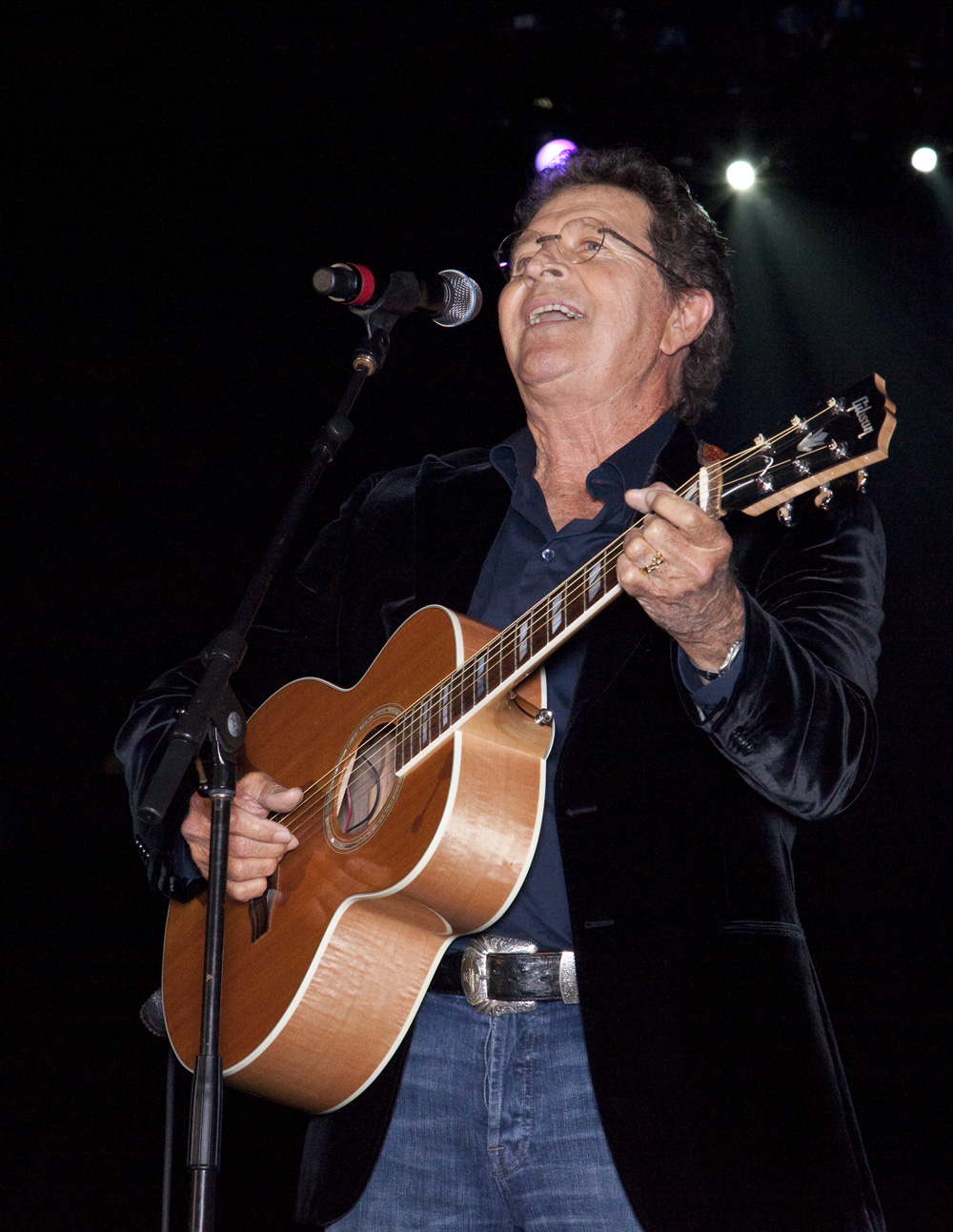
Morris Mac Davis[1] (January 21, 1942 – September 29, 2020) was an American songwriter, singer, performer, and actor. A native of Lubbock, Texas, he enjoyed success as a crossover artist[2] and writing for Elvis Presley during his early career, providing him with the hits "Memories", "In the Ghetto", "Don't Cry Daddy", and "A Little Less Conversation". A subsequent solo career in the 1970s produced hits such as "Baby Don't Get Hooked on Me". Davis also starred in his own variety show, a Broadway musical, and various films and TV shows.[3][4][5][6]
Biography
[edit]Early life
[edit]Davis was born and raised in Lubbock, Texas as the son of Edith Irene (Lankford) and T. J. Davis, a building contractor.[7]
Career as a songwriter
[edit]Once Davis was settled in Atlanta, he organized a rock and roll group called the Zots, and made two singles for OEK Records, managed and promoted by OEK owner Oscar Kilgo.[3][4][5] [8] Davis also worked for the Vee Jay record company (home to such R&B stars as Gene Chandler, Jerry Butler, and Dee Clark) as a regional manager and later became a regional manager for Liberty Records.[2]

Davis became famous as a songwriter and got his start as an employee of Nancy Sinatra's company, Boots Enterprises, Inc. Davis was with Boots for several years in the late 1960s. During his time there, he played on many of Sinatra's recordings, and she worked him into her stage shows. Boots Enterprises also acted as Davis's publishing company, publishing songs such as "In the Ghetto", "Friend, Lover, Woman, Wife", "Home", and "Memories", which were recorded by Elvis Presley, Nancy Sinatra, B. J. Thomas and many others. During a short timespan Davis used the pseudonym "Scott Davis" for songwriting purposes (borrowing from the given name of his son) to avoid confusion with songwriter Mack David.[9] Davis left Boots Enterprises in 1970 to sign with Columbia Records, taking all of his songs with him.[3][4][5]
One of the songs he wrote in 1968, called "A Little Less Conversation", was recorded by Elvis Presley (and became a posthumous success for Presley years later). Presley also recorded Davis's "In the Ghetto" in sessions in Memphis. Mac Davis eventually recorded the tune after Presley's version became a success, and was released in a Ronco In Concert compilation in 1975. Presley continued to record more of Davis's material, such as "Memories", "Don't Cry Daddy", and "Clean Up Your Own Backyard". Bobby Goldsboro also recorded some of Davis's songs, including "Watching Scotty Grow",[2] which became a No. 1 Adult Contemporary success for Goldsboro in 1971. Other artists who recorded his material included Vikki Carr, O.C. Smith, and Kenny Rogers and The First Edition. "I Believe in Music", often considered to be Davis's signature song, was recorded by several artists (including Marian Love, B.J. Thomas, Louis Jordan, Perry Como, Helen Reddy, Lynn Anderson, and Davis himself) before it finally became a success in 1972 for the group Gallery.[3][4][5]
During the 1970s, many of his songs "crossed over", successfully scoring on both the country and popular music charts, including "Baby Don't Get Hooked on Me"[2] (a number one Grammy-nominated success), "One Hell of a Woman" (pop no. 11), and "Stop and Smell the Roses" (a no. 9 pop hit).[2] Also, during the 1970s and 1980s, he was very active as an actor, appearing in several movies, including 1979's North Dallas Forty, as well as hosting a successful variety show. In 2010, Davis co-wrote the song "Time Flies" with Rivers Cuomo which appeared on Weezer's Hurley album. In 2013 he was part of the Los Angeles writing and producing team that created the hit "Young Girls" for Bruno Mars.[10] Davis also wrote and collaborated with the Swedish D.J. and music producer Avicii, penning the song "Addicted to You" for Avicii's debut studio album True. They performed the song "Black and Blue" together at the Ultra Music Festival in Miami in 2013.
Success as a singer
[edit]
Davis soon decided to pursue a career of his own as a recording artist. After several years of writing songs for other artists, he was signed by Clive Davis for Columbia, later topping the Country and Pop charts with the song "Baby Don't Get Hooked on Me" in 1972. It sold over one million copies and was awarded a gold disc by the Recording Industry Association of America in September 1972.[11]
In 1974, Davis was awarded the Academy of Country Music's Entertainer of the Year award. He had other successes including the songs "Stop and Smell the Roses" (a number one Adult Contemporary success in 1974) (pop no. 9), "One Hell of a Woman" (pop no. 11), "Rock 'N' Roll (I Gave You the Best Years of My Life)" (pop no. 15), and "Burnin' Thing" (pop no. 53). At the end of the 1970s, he was signed by Neil Bogart and moved to Casablanca Records, which was best known at the time for its successes with disco star Donna Summer and rock'n'roll band Kiss. His first success for the company in 1980 was the novelty song "It's Hard to Be Humble", a light-hearted look at how popularity and good looks could go to one's head. The song became his first Country music top 10 and a rare top 30 hit in the UK. (It was translated into Dutch as "Het is moeilijk bescheiden te blijven" and became a hit for the Dutch singer Peter Blanker in 1981). Later that year, he had another top 10 song with "Let's Keep It That Way" written by Curly Putman and Rafe Van Hoy. In November, "Rock 'N' Roll (I Gave You the Best Years of My Life)" was played by KHJ in Los Angeles as its last song before it switched from Top 40 to Country music.[12] He achieved success with other songs like "Texas in My Rear View Mirror" and "Hooked on Music", which became his biggest Country music success in 1981 going to number 2. In 1985, he recorded his last top 10 country music success with the song "I Never Made Love (Till I Made Love With You)".[13]
On January 19, 1985, Davis performed "God Bless the USA" at the 50th Presidential Inaugural Gala, held the day before the second inauguration of Ronald Reagan.[13]
Acting career
[edit]From 1974 to 1976, Davis had his own television variety show on NBC, The Mac Davis Show.[13] He made his feature film debut opposite Nick Nolte in the football film North Dallas Forty (1979)[14] and was listed as one of 12 "Promising New Actors of 1979" by Screen World magazine.[citation needed]
In 1980, Davis hosted an episode of The Muppet Show.[15] He performed "Baby Don't Get Hooked On Me", "It's Hard To Be Humble", and "I Believe in Music".[citation needed]
Davis also starred in the 1981 comedy film Cheaper To Keep Her, playing a divorced detective who worked for a neurotic feminist attorney.
In 1983, he appeared in The Sting II, as Jake Hooker, a younger relative of Johnny Hooker, portrayed by Robert Redford in The Sting.[3][4][5]
In November 1991, Davis checked into the Betty Ford Clinic, marking the beginning of his commitment to sobriety. Exactly four months later, he performed as Will Rogers in the Broadway production of The Will Rogers Follies at the Palace Theater, noting that it was his first-ever sober performance. Following each show, Davis shared his journey to sobriety and urged anyone battling addiction to attend an Alcoholics Anonymous meeting. He continued to play Will Rogers for over a year during the show's national tour.[16]
In 1998, Davis starred in the sports comedy Possums, which debuted at the Sundance Film Festival. Davis served as the balladeer for the 2000 telefilm The Dukes of Hazzard: Hazzard in Hollywood, replacing Don Williams, who had served the part in 1997's The Dukes of Hazzard: Reunion! and Waylon Jennings, who narrated the original Dukes of Hazzard television show. Davis was the first balladeer to appear on-screen to welcome the audience and provide exposition.[6] Davis was inducted into the Nashville Songwriters Hall of Fame in 2000. He was awarded a star symbol on the Hollywood Walk of Fame, located at 7080 Hollywood Boulevard, for his contribution to the recording industry.[3][4][5]
In 2001, Davis played a fellow karaoke competitor to Jon Gries's Sunny Holiday in the Polish brothers' film Jackpot. In the film, a dispute began between Sunny's manager, played by Garrett Morris, and Davis's character about what song he should sing. The manager suggested Davis's "Baby Don't Get Hooked On Me", which Davis's character claimed just was not him.[citation needed]
From 2001 to 2003, Davis voiced the character of Barber Bingo on two episodes of the animated TV series Oswald; "Henry Needs A Haircut" and "The Naughty Cat".[citation needed]
Between 1999 and 2006, Davis provided the character voices of Sheriff Buford (two episodes) and a talk radio host named "Sports Jock" (three episodes), on the animated series King of the Hill.[citation needed]
Davis also guest-starred briefly in the 8 Simple Rules episode "Let's Keep Going: Part 2" in April 2004.[citation needed]
He had a recurring role as Rodney Carrington's father-in-law in the sitcom Rodney.[citation needed]
In 2000, Davis hosted Labor of Love, a live FM radio show for KZLA Los Angeles.
Personal life and death
[edit]At 21, he married Fran Cook from Georgia. Their son, Joel Scott, (Scotty in "Watching Scotty Grow") was born a year later; Davis shifted from playing in rock bands to learning the music business while working in Liberty Records' publishing division.[2] The Liberty job got him to Los Angeles and made it easier to "pitch his own tunes" to record producers. Davis commented, "One day Fran decided to do her own thing and she wanted me to do mine." They divorced and she went back to Atlanta.[citation needed]
Davis next met Sarah Barg, then 16 and living in his apartment building with her mother. Two years later, they were married. "We talked about having a family, but I was waiting for her to grow up," he says. She left him in 1976 for Glen Campbell, with whom she then had one child, Dillon. She also left Campbell shortly after Dillon's birth.
In 1979, Davis started to date a young nurse, Lise Gerard.[3][4][5][17] They married in 1983 when she was 25, and they had two children, Noah Claire and Cody Luke.[18] They remained married until Davis' death at age 78 on September 29, 2020, following heart surgery.[3][4][5] [19][20]
Legacy and Posthumous Recognition
[edit]Following Davis’s death in late September 2020, numerous tributes and honors celebrated his influence. Many artists mourned his passing. Dolly Parton hailed Davis as “one of the world’s greatest writers, singers, and entertainers” in a heartfelt statement,[21] and Kenny Chesney remembered him as a “songwriting hero” who welcomed younger artists with support.[22] At the 54th Annual CMA Awards in November 2020, hosts Reba McEntire and Darius Rucker performed Davis’s signature song “In the Ghetto” in an on-air tribute to him.[23] The pair had recorded a duet version of the song shortly after Davis’s death, underscoring the enduring impact of his songwriting. Earlier that fall, Vince Gill also honored Davis by singing “In the Ghetto” on the stage of the Grand Ole Opry shortly after news of his death.[24]
In 2023, Davis’s estate (Mac Davis Enterprises) launched a charitable initiative called “Song Painter: The Mac Davis Fund for the Art of Songwriting.[25] Established to honor Davis’s legacy (and named after his 1970 debut album Song Painter), the fund’s mission is to promote greater appreciation for the craft of songwriting and to support emerging and underrepresented songwriters . The fund was spearheaded by Davis’s widow, Lisë Davis, and is administered by the Community Foundation of Middle Tennessee.[26] Programs under the Song Painter Fund include workshops, grants, and music education initiatives designed to foster creative talent in songwriting, reflecting causes and ideals that were dear to Davis during his life . The launch of the fund drew support from many of Davis’s peers; for example, Dolly Parton and Reba McEntire both praised his prolific songwriting and voiced support for nurturing the next generation of songwriters in his honor.[25][27]
Davis’s songwriting continued to reach audiences through new projects. In 2025, British singer-songwriter Coyle Girelli announced Out of This Town, an album composed of songs written by or co-written with Mac Davis.[28] Girelli and Davis had begun collaborating on a duets album before Davis’s passing, leaving behind a collection of demos and unfinished songs. Out of This Town was completed from that material as a posthumous tribute and is slated for release on August 29, 2025 through Sun Records. The 12-track album features Girelli alongside guest artists like KT Tunstall, Jaime Wyatt, and Cassandra Lewis, performing both new co-written compositions and a few of Davis’s unreleased originals.[28] Notably, the album includes two versions of the song “I Wanna Make Love”, one being a home demo recording by Mac Davis himself (his vocal captured via a phone recording), which stands as one of the last original recordings of Davis to be released.[28] The project has been described as a multi-generational collaboration that honors Davis’s legacy; Girelli noted that Davis had even praised his voice as reminiscent of Roy Orbison and entrusted him to bring these songs to the world. Upon announcement of Out of This Town, industry press highlighted the significance of Davis’s songwriting enduring beyond his lifetime, with Sun Records (the label once home to Elvis Presley and Johnny Cash) deeming it a fitting release to carry forward Davis’s “song painter” legacy. Since 2020, Mac Davis’s work has also reappeared in popular culture and media. In 2022, Baz Luhrmann’s biographical film Elvis featured a contemporary remix of “In the Ghetto” on its soundtrack (titled “Product of the Ghetto,” performed by Elvis Presley & Nardo Wick).[29]
Discography
[edit]Filmography
[edit] | This section needs additional citations for verification. (September 2020) |
| Year | Title | Role | Notes |
|---|---|---|---|
| 1979 | North Dallas Forty | Seth Maxwell | |
| 1981 | Cheaper to Keep Her | Bill Dekker | |
| 1983 | The Sting II | Jake Hooker | |
| 1985 | Brothers-in-Law | T.K. "Tom" Kenny | TV movie |
| 1988 | What Price Victory | Jake Ramson | TV movie |
| 1991 | Blackmail | Norm | TV movie |
| 1996 | For My Daughter's Honor | Norm Dustin | TV movie |
| 1998 | Still Holding On: The Legend of Cadillac Jack | Clayton | TV movie |
| 1998 | Possums | Wilbur "Will" Clark | |
| 1999 | Angel's Dance | Norman | |
| 2000 | The Dukes of Hazzard: Hazzard in Hollywood | The Balladeer | TV movie |
| 2001 | Murder, She Wrote: The Last Free Man | Sheriff Underwood | TV movie |
| 2001 | Jackpot | Sammy Bones | |
| 2003 | Where the Red Fern Grows | Hod Bellington | |
| 2004 | True Vinyl | Frank Thompson | |
| 2005 | The Wendell Baker Story | Agent Buck | |
| 2008 | Beer for My Horses | Reverend J.D. Parker | |
| 2017 | Where the Fast Lane Ends | Big Jack |
Television
[edit] |
| Year | Title | Role | Notes |
|---|---|---|---|
| 1970 | The Johnny Cash Show[30] | Himself (Guest Star) | Season 2, Episode 4 |
| 1973 | The Midnight Special | Himself (Guest Host - Performer) | Season 1, Episode 3 |
| 1974–1976 | The Mac Davis Show | Himself (Host – Performer) | TV variety show (35 episodes) |
| 1975 | The Mac Davis Special | Himself (Host – Performer) | TV special |
| 1975 | The Mac Davis Christmas Special | Himself (Host – Performer) | TV special |
| 1976 | Mac Davis Christmas Special: When I Grow Up | Himself (Host – Performer) | TV special |
| 1977 | Mac Davis: Sounds Like Home | Himself (Host – Performer) | TV special |
| 1977 | Mac Davis: I Believe in Christmas | Himself (Host – Performer) | TV special |
| 1978 | Mac Davis's Christmas Odyssey: Two Thousand and Ten | Himself (Host – Performer) | TV special |
| 1979 | A Christmas Special with Love, Mac Davis | Himself (Host – Performer) | TV special |
| 1980 | The Muppet Show | Himself (Guest Star) | Episode: "Mac Davis" |
| 1980 | Mac Davis 10th Anniversary Special: I Still Believe in Music | Himself (Host – Performer) | TV special |
| 1980 | Mac Davis – I'll Be Home for Christmas | Himself (Host – Performer) | TV special |
| 1981 | The Mac Davis Christmas Special | Himself (Host – Performer) | TV special |
| 1983 | The Mac Davis Special: The Music of Christmas | Himself (Host – Performer) | TV special |
| 1986 | Webster | Uncle Jake Tyler | Episode: "Almost Home" |
| 1986 | Tall Tales & Legends | Davy Crockett | Episode: "Davy Crockett" |
| 1987 | Dolly | Himself (Guest Star) | Episode: "A Down Home Country Christmas" |
| 1993 | The Legend of the Beverly Hillbillies | Himself (Host) | TV special |
| 1995 | Lois & Clark: The New Adventures of Superman | Larry Smiley | Episode: "Just Say Noah" |
| 1995–1996 | The Client | Waldo Gaines | 3 episodes |
| 1996 | Daytona Beach | Reese Elliot | TV pilot episode |
| 1999 | Chicken Soup for the Soul | Sheriff Riley | Episode: "It's Never Too Late" |
| 1999–2006 | King of the Hill | Sheriff Mumord / Sports Jock (voice) | 5 episodes |
| 2000 | That '70s Show | St. Peter | Episode: "Holy Crap" |
| 2000 | The Prosecutors: In Pursuit of Justice | Reenactment Actor | Episode: "The Bone Yard" |
| 2001–2003 | Oswald | Barber Bingo (voice) | 2 episodes |
| 2004 | 8 Simple Rules | Guitar Player | Episode: "Let's Keep Going: Part 2" |
| 2004 | Johnny Bravo | Bee Bearded Man / Troubadour (voice) | 2 episodes |
| 2004–2006 | Rodney | Carl | 13 episodes |
| 2019 | Dolly Parton's Heartstrings | Reverend Riggs | Episode: "J.J. Sneed" |
References
[edit]- ^ "Nashville Songwriters Hall of Fame - Mac Davis". Nashvillesongwritersfoundation.com. Retrieved October 21, 2021.
- ^ a b c d e f Larkin, Colin, ed. (May 27, 2011). Encyclopedia of Popular Music (5th Concise ed.). Omnibus Press. pp. 344–345. ISBN 978-0857125958.
- ^ a b c d e f g h Newman, Melinda (September 30, 2020). "COUNTRY: Mac Davis, Iconic Artist & Elvis Songwriter, Dies at 78". Billboard. Retrieved September 30, 2020.
- ^ a b c d e f g h Owoseje, Toyin (September 30, 2020). "Mac Davis, Elvis songwriter and country star, dead at 78". CNN. Retrieved September 30, 2020.
- ^ a b c d e f g h Wood, Mikael (September 30, 2020). "Mac Davis, hit songwriter for Elvis Presley and '70s solo star, dies at 78". Los Angeles Times. Retrieved September 30, 2020.
- ^ a b Moore, Bobby (September 29, 2020). "Country Legend Mac Davis Dead at Age 78". Wide Open Country.
- ^ Block, Maxine; Rothe, Anna Herthe; Candee, Marjorie Dent (1981). "Mac Davis". Current Biography Yearbook. Vol. 41. H. W. Wilson Company.
- ^ Kerns, William (March 2, 2008). "Mac Davis remembers his days in Lubbock". Lubbock Avalanche-Journal. Archived from the original on August 14, 2015. Retrieved April 11, 2020.
- ^ "Elvis Information Network - Mac Davis Interview". elvisinfonet.com. Retrieved October 21, 2021.
- ^ Young Girls#Background and writing
- ^ Murrells, Joseph (1978). The Book of Golden Discs (2nd ed.). London: Barrie and Jenkins Ltd. p. 310. ISBN 978-0214204807.
- ^ "KHJ Goes Country". Formatchange.com. November 8, 1980. Retrieved August 26, 2015.
- ^ a b c "Mac Davis". West Texas Guitar. Retrieved September 30, 2020.
- ^ Maslin, Janet (August 1, 1979). "Dallas Forty: Cynicism and Comedy". The New York Times. Retrieved February 23, 2011.
- ^ "Mac Davis: Episode 110". The Muppet Show. Archived from the original on October 31, 2006.
- ^ Frym, Michael (August 30, 1993). "The Will Rogers Follies: A Life in Revue". Variety. Retrieved April 11, 2020.
- ^ Buchalter, Gail (May 26, 1980). "Mac Attack! – Mac Davis". People. Retrieved April 4, 2012.
- ^ "Milestones". Time. September 13, 1982. Archived from the original on October 15, 2010. Retrieved April 4, 2012.
- ^ Stefano, Angela (September 29, 2020). "'In The Ghetto' Songwriter Mac Davis Dead At 78". Taste of Country. Retrieved September 30, 2020.
- ^ Hall, Kristin M. (September 30, 2020). "Country star and hit Elvis songwriter Mac Davis dies at 78". Associated Press. Retrieved September 30, 2020.
- ^ "Dolly Parton Tributes Mac Davis: 'I Will Always Love You'". Taste of Country. October 1, 2020. Retrieved August 5, 2025.
- ^ Hudak, Joseph (September 30, 2020). "Mac Davis, Country Singer and Elvis Presley Songwriter, Dead at 78". Rolling Stone Australia. Retrieved August 5, 2025.
- ^ "Reba McEntire and Darius Rucker debut 'In the Ghetto' collaboration at 2020 CMA Awards". ABC News. Retrieved August 5, 2025.
- ^ "In the Ghetto". New Country 101-FIVE. Retrieved August 5, 2025.
- ^ a b Hollabaugh, Lorie (October 6, 2023). "Mac Davis' Legacy Honored With New Song Painter Fund". MusicRow.com. Retrieved August 5, 2025.
- ^ "Song Painter: The Mac Davis Fund for the Art of Songwriting". Community Foundation of Middle Tennessee. Retrieved August 5, 2025.
- ^ "Song Painter: The Mac Davis Fund for the Art of Songwriting Announces Major Grant Distribution in Honor of Mac Davis' Birthday – Mac Davis". January 18, 2024. Retrieved August 5, 2025.
- ^ a b c Benitez-Eves, Tina (July 11, 2025). "Coyle Girelli Revisits Songs Written With Legendary Songwriter Mac Davis on 'Out of This Town,' Shares "Everyone But Me And You". American Songwriter. Retrieved August 5, 2025.
- ^ Trzcinski, Matthew (March 8, 2024). "The Writer of Elvis' 'In the Ghetto' Explained It". Showbiz Cheat Sheet. Retrieved August 5, 2025.
- ^ Jackson, Nate (September 30, 2020). "Mac Davis, Actor, Country Star and Host of 'The Mac Davis Show,' Dies at 78". TheWrap.
Bibliography
[edit]- Wolff, Kurt. The Rough Guide to Country Music. Penguin Publishing. ISBN 978-1858285344
External links
[edit]

Mac Davis
View on GrokipediaBiography
Early life
Morris Mac Davis was born on January 21, 1942, in Lubbock, Texas, to Thomas Jefferson "T.J." Davis, a building contractor who owned local apartment complexes, and Edith Irene Lankford Davis.[1][5] His parents divorced when he was nine years old, after which Davis and his sister Linda remained in Lubbock with their father, while his brother Kim moved to Atlanta with their mother, who had remarried.[5] Growing up in a modest, working-class environment amid the vibrant West Texas music scene, Davis showed an early aptitude for music, recalling that he was making up melodies by the age of five or six.[6][7] Davis's childhood in Lubbock was marked by a strong connection to his hometown's cultural landscape, which fostered his creative interests alongside sports and outdoor activities.[1] He attended Lubbock High School, where he was influenced by local music luminaries like Buddy Holly, a fellow alumnus six years his senior whose rock and roll innovations left a lasting impression on the young Davis.[8] The region's rich musical heritage, including exposure to emerging country and rock sounds, helped shape his formative years, though Davis later described Lubbock's conservative, religious atmosphere as somewhat restrictive for his ambitions.[7][9] After graduating from Lubbock High School at age 16 in 1958, Davis relocated to Atlanta, Georgia, to join his mother and pursue broader opportunities beyond his West Texas roots.[1] There, he briefly attended Emory University and Georgia State College while immersing himself in the local music scene, forming a rock and roll band called the Zots and performing at fraternity parties and high school dances.[10][3] These early experiences ignited his passion for songwriting and performance, marking the beginning of his transition into a professional music career as a young adult.[11]Songwriting career
Davis began his songwriting career in Atlanta, Georgia, in the late 1950s, where he formed a rock 'n' roll band and worked as a promotion man for Vee-Jay Records while writing and recording demos.[12] He also created advertising jingles and produced demo recordings for labels such as Columbia Records, honing his craft amid associations with artists like Tommy Roe and Bruce Channel.[12] In the early 1960s, Davis worked with Liberty Records on the West Coast and became affiliated with Nancy Sinatra's music publishing company, further expanding his industry connections.[13] A pivotal shift occurred in 1967 when Davis signed with Nashville's Combine Music as a staff songwriter, marking his entry into the country music scene despite initial skepticism from the establishment.[12] His breakthrough came in 1968 with "Memories," recorded by Elvis Presley and peaking at #35 on the Billboard Hot 100.[14] This was followed by two major hits in 1969: "In the Ghetto," which reached #3 on the Billboard Hot 100, and "Don't Cry Daddy," climbing to #6 on the same chart.[14] These compositions, blending social commentary and emotional depth, solidified Presley's comeback and established Davis as a versatile hitmaker.[13] Beyond Presley, Davis penned notable tracks for other artists, including "In the Ghetto" for Dolly Parton, which charted at #50 on the Billboard Hot Country Songs in 1969, and "Something's Burning" for Kenny Rogers & the First Edition, reaching #11 on the Billboard Hot 100 in 1970.[13][15] Despite these successes, Davis faced significant challenges, including repeated rejections early on and perceptions as an outsider in Nashville's insular community; he also lacked formal music notation skills, relying on vocal demos to pitch his work.[12] These Elvis hits, however, paved the way for his transition to performing and securing his own recording contracts.[16]Singing career
Davis signed with Columbia Records in 1970, marking his transition from songwriter to recording artist, and released his debut album Song Painter that year.[17][18] The album featured original compositions, including the single "Whoever Finds This, I Love You," which became his first chart entry on the Billboard Hot 100, peaking at No. 81.[19] Building on his earlier success writing hits for Elvis Presley, Davis's move to performing allowed him to showcase his versatile voice blending country, pop, and folk influences. He remained with Columbia through the 1970s before switching to Casablanca Records in 1979 and later MCA in the mid-1980s.[20][21] Davis achieved mainstream breakthrough with the 1972 single "Baby Don't Get Hooked on Me," which topped the Billboard Hot 100 for three weeks and earned gold certification for one million units sold in the United States.[19][22] The track, from his self-titled album of the same name, exemplified his country-pop style with witty, lighthearted lyrics warning against romantic attachment, reflecting his knack for accessible, narrative-driven songs. Follow-up releases solidified his presence, including the 1974 album Stop and Smell the Roses, which peaked at No. 13 on the Billboard 200 and featured the single "One Hell of a Woman" reaching No. 11 on the Hot 100.[19][19] His music often incorporated humorous, self-deprecating themes, as seen in tracks that playfully explored relationships and personal flaws, appealing to a broad audience during the 1970s crossover era. In the late 1970s and 1980s, Davis maintained momentum on country charts while touring extensively, delivering energetic live shows that highlighted his charisma and guitar skills. The 1980 single "It's Hard to Be Humble" from his Casablanca album of the same name peaked at No. 10 on the Billboard Hot Country Songs chart, showcasing satirical lyrics poking fun at ego in a humorous, relatable way.[19] These performances, including major U.S. tours in the 1970s, emphasized his engaging stage presence and blend of storytelling with comedy.[23] By the late 1980s, Davis's pop chart success waned, but he sustained a presence on country radio with occasional releases and comebacks, such as contributions to Dolly Parton projects, focusing on his enduring songwriting roots rather than new solo hits.[17]Acting and television career
Davis transitioned from music into television hosting with The Mac Davis Show, a variety series on NBC that aired in three seasons from 1974 to 1976, featuring musical performances by guests such as Dean Martin and George Gobel alongside comedy sketches and duets.[24][25] The program, which ran for approximately 33 episodes, showcased Davis's charisma through a mix of country-oriented entertainment and lighthearted humor, helping to broaden his appeal beyond recording studios.[26] His acting career began with a leading role in the 1979 sports drama North Dallas Forty, where he portrayed Seth Maxwell, the smooth-talking quarterback of a fictional professional football team inspired by the Dallas Cowboys, opposite Nick Nolte as a disillusioned wide receiver.[24][27] Davis followed this with the lead in the 1981 comedy Cheaper to Keep Her, playing Bill Dekkar, a chauvinistic private detective hired by a feminist lawyer to pursue deadbeat fathers.[24][28] In 1983, he took on the role of Jake Hooker, a young con artist mentored by Jackie Gleason's character, in the sequel The Sting II.[24][29] Later film appearances included a supporting role as a radio announcer in the 1998 independent comedy Possums, where his character fabricates winning games for a struggling high school football team to boost town morale.[30][31] On television, Davis made a memorable guest appearance on The Muppet Show in 1980, performing songs like "Baby, Don't Get Hooked on Me" and "It's Hard to Be Humble" in comedic segments with the puppets.[32] From the late 1990s to the 2000s, he shifted toward character roles, voicing characters such as Sports Jock and Sheriff Buford on King of the Hill across four episodes between 1999 and 2006, and appearing in episodic shows like Webster and Lois & Clark.[24][33] This phase balanced smaller acting parts with occasional hosting duties, such as co-hosting the CMA Awards from 1980 to 1982.[24]Personal life
Davis married his first wife, Fran Cook, in 1963 when he was 21 years old; the couple had one son, Joel Scott (often called Scotty), born in 1964, before divorcing around 1968.[8][2][34] His second marriage, to Sarah Barg in 1970, ended in divorce in 1974 and produced no children.[35][36] In 1982, Davis married Lise Gerard, a former nurse, and the couple remained together until his death; they had a daughter, Noah Claire, born in 1986, and a son, Cody Luke, born in 1988.[5][37] The family resided in Nashville, Tennessee, where Davis focused on raising his children away from the spotlight of his earlier career, though the demands of his touring schedule occasionally strained family time.[11] He contributed to philanthropy efforts supporting music education and youth development programs, reflecting his passion for songwriting as a creative outlet for young people.[38] In his later years, Davis embraced a low-profile lifestyle in Nashville, enjoying hobbies such as golf and occasionally sharing personal writings that echoed his songwriting roots.[35][16]Death and Legacy
Death
In September 2020, Mac Davis was hospitalized at Vanderbilt University Medical Center in Nashville, Tennessee, for elective heart bypass surgery. Complications arose following the procedure, leading to his death on September 29, 2020, at the age of 78.[39][5][40] Davis's longtime manager and friend, Jim Morey, confirmed the news in a statement, noting that Davis "passed away peacefully this morning in Nashville after a year-long battle with a variety of health issues" and was "surrounded by his family and friends when he passed." The family had issued a public appeal the previous day, requesting prayers as Davis was "critically ill following heart surgery in Nashville."[41][42] Funeral arrangements were kept private for family only, with Davis laid to rest on October 5, 2020, at the City of Lubbock Cemetery in Lubbock, Texas, his birthplace. He was buried in a Texas pecan wood casket and his favorite blue jeans, honoring his roots in a final procession through the city. Immediate media coverage highlighted his contributions to music, with tributes from peers including Dolly Parton, who called him "one of the world's greatest writers, singers and entertainers," and Kenny Chesney, who described him as a "great friend" and "true entertainer."[43][44][45][46]Awards and honors
Mac Davis garnered significant recognition for his songwriting and performing achievements throughout his career, earning accolades from major music organizations that highlighted his versatility in country and pop genres. In 1974, Davis was named Entertainer of the Year by the Academy of Country Music, acknowledging his rising stardom as a crossover artist following hits like "Baby, Don't Get Hooked on Me."[47] He received three Grammy nominations during his lifetime: in 1970 for Best Contemporary Song for "In the Ghetto," written for and recorded by Elvis Presley; in 1973 for Best Pop Vocal Performance, Male for his own recording of "Baby, Don't Get Hooked on Me"; and in 1977 for Best Country Vocal Performance, Male for the album Forever Lovers.[48][11][49] Davis's songwriting prowess was further honored through inductions into prestigious halls of fame. He was inducted into the Nashville Songwriters Hall of Fame in 2000, recognizing his contributions to country music, including Elvis Presley hits like "Don't Cry Daddy" and "Memories."[13] In 2006, he entered the Songwriters Hall of Fame, celebrating his broader impact on American music.[3] Additional BMI honors included the 2015 BMI Icon Award, presented for his enduring catalog of pop and country songs, many of which were popularized by Presley and amassed millions of performances.[50] These lifetime achievements, including his 1975 People's Choice Award for Favorite Male Singer, elevated Davis's visibility and opened doors to acting roles in films like North Dallas Forty.[1] His frequent performances at the Grand Ole Opry underscored his stature in country music, where he delivered memorable sets that contributed to his reputation as a live entertainer, though he did not receive formal lifetime membership there.[10]Posthumous recognition
Following Mac Davis's death in September 2020, the Country Music Association (CMA) Awards featured a poignant tribute performance during its November 2020 broadcast, where Reba McEntire and Darius Rucker delivered an emotional rendition of Davis's iconic Elvis Presley hit "In the Ghetto," highlighting his enduring songwriting legacy in country music.[51] In 2023, the Song Painter: The Mac Davis Fund for the Art of Songwriting was established to honor Davis's contributions to the craft, providing financial support, workshops, and resources to emerging songwriters facing hardships in the music industry.[52] The fund, announced by Mac Davis Enterprises, distributed its first major grants in January 2024 on what would have been Davis's 82nd birthday, aiding members of the country music community in line with his philanthropic spirit.[53] A posthumous album titled Out of This Town, featuring unreleased songs co-written by Davis and British singer-songwriter Coyle Girelli, was released on August 29, 2025, via Sun Records, serving as a collaborative tribute that completes tracks originally intended as duets from sessions dating back over a decade.[54] The project underscores Davis's late-career creative output, with Girelli producing and performing the material to preserve their shared vision.[55] Additionally, a 2022 PBS segment in the Lubbock Lights series explored Davis's pivotal role in Elvis Presley's catalog, including hits like "In the Ghetto" and "Don't Cry Daddy," through archival footage and interviews that emphasize his behind-the-scenes impact on rock and country crossover.[56] Davis's influence continued to resonate in music publications through 2024 and 2025, with features in outlets like MusicRow and Songwriting Magazine addressing overlooked aspects of his later years, such as unfinished projects and mentorship roles, while celebrating releases like Out of This Town as evidence of his timeless songcraft.[52][55]Professional Works
Discography
Mac Davis began his recording career as a solo artist in 1970 with Columbia Records, releasing a series of country and pop albums that showcased his songwriting alongside cover material. His debut album, Song Painter, arrived that year, followed by several more under Columbia. After releasing Fantasy on Columbia in 1978, Davis signed with Casablanca Records for his 1980 album It's Hard to Be Humble, where he continued producing hits into the early 1980s.[57] Later works included releases on other labels, and posthumously, a collaborative tribute album featuring his co-written songs emerged in 2025. Compilations like Dreams and Memories: The Best of Mac Davis (1990) and Greatest Hits (1973) collected key tracks from his catalog.[58][57]Studio Albums
- Song Painter (1970, Columbia)[57]
- I Believe in Music (1971, Columbia)[57]
- Baby Don't Get Hooked on Me (1972, Columbia)[57]
- Mac Davis (1973, Columbia)[57]
- Stop and Smell the Roses (1974, Columbia)[57]
- All the Love in the World (1974, Columbia)[57]
- Burnin' Thing (1975, Columbia)[57]
- Forever Lovers (1976, Columbia)[57]
- Thunder in the Afternoon (1977, Columbia)[57]
- Fantasy (1978, Columbia)[57]
- It's Hard to Be Humble (1980, Casablanca)[57]
- Texas in My Rear View Mirror (1980, Casablanca)[57]
- Midnight Crazy (1981, Casablanca)[57]
- Forty 82 (1982, Casablanca)[57]
- Soft Talk (1984, Mercury)[57]
- Till I Made It with You (1985, MCA)[57]
- Somewhere in America (1986, MCA)[57]
- Will Write Songs for Food (1994, Columbia)[57]
Compilations
- Greatest Hits (1973, Columbia)[57]
- Dreams and Memories: The Best of Mac Davis (1990, Columbia)[58]
Key Singles
Davis's singles often crossed over between pop and country charts, with notable peaks on the Billboard Hot 100 and Hot Country Songs. Early efforts included tracks like "I Believe in Music" (1970, Columbia), but his breakthrough came in the 1970s.[19]- "Baby Don't Get Hooked on Me" (1972, Columbia) – #1 Billboard Hot 100, #26 Hot Country Songs[59]
- "Stop and Smell the Roses" (1974, Columbia) – #9 Hot 100, #40 Hot Country Songs[59]
- "One Hell of a Woman" (1974, Columbia) – #11 Hot 100[59]
- "It's Hard to Be Humble" (1980, Casablanca) – #43 Hot 100, #10 Hot Country Songs[59]
Posthumous Releases
Following Davis's death in 2020, unfinished material he co-wrote with Coyle Girelli was completed as the collaborative tribute album Out of This Town (2025, Sun Records), featuring tracks intended as duets.[62][63]Filmography
Mac Davis's filmography primarily consists of supporting and leading roles in feature films spanning the late 1970s to the 2000s, often in comedies, dramas, and independent productions that highlighted his affable, Southern-inflected screen presence. His debut marked a transition from music to acting, with subsequent roles in ensemble casts and smaller indie projects. While not a prolific film actor, Davis's contributions added a distinctive everyman quality to these works.| Year | Title | Role | Notes |
|---|---|---|---|
| 1979 | North Dallas Forty | Seth Maxwell | Feature film debut as the team's quarterback in this sports drama adaptation of Peter Gent's novel, directed by Ted Kotcheff.[64] |
| 1981 | Cheaper to Keep Her | Bill Dekkar | Lead role as a divorced private detective in this comedy directed by Ken Annakin. |
| 1983 | The Sting II | Jake Hooker | Supporting role as a con artist in this sequel to the 1973 classic, directed by Jeremy Paul Kagan and starring Jackie Gleason.[65] |
| 1998 | Possums | Will Clark | Lead role as a small-town radio announcer in this independent comedy-drama about a struggling high school football team, directed by Max Burnett.[66] |