
Recent from talks
Magnetosonic wave
Knowledge base stats:
Talk channels stats:
Members stats:
Magnetosonic wave
In physics, magnetosonic waves, also known as magnetoacoustic waves, are low-frequency compressive waves driven by mutual interaction between an electrically conducting fluid and a magnetic field. They are associated with compression and rarefaction of both the fluid and the magnetic field, as well as with an effective tension that acts to straighten bent magnetic field lines. The properties of magnetosonic waves are highly dependent on the angle between the wavevector and the equilibrium magnetic field and on the relative importance of fluid and magnetic processes in the medium. They only propagate with frequencies much smaller than the ion cyclotron or ion plasma frequencies of the medium, and they are nondispersive at small amplitudes.
There are two types of magnetosonic waves, fast magnetosonic waves and slow magnetosonic waves, which—together with Alfvén waves—are the normal modes of ideal magnetohydrodynamics. The fast and slow modes are distinguished by magnetic and gas pressure oscillations that are either in-phase or anti-phase, respectively. This results in the phase velocity of any given fast mode always being greater than or equal to that of any slow mode in the same medium, among other differences.
Magnetosonic waves have been observed in the Sun's corona and provide an observational foundation for coronal seismology.
Magnetosonic waves are a type of low-frequency wave present in electrically conducting, magnetized fluids, such as plasmas and liquid metals. They exist at frequencies far below the cyclotron and plasma frequencies of both ions and electrons in the medium (see Plasma parameters § Frequencies).
In an ideal, homogeneous, electrically conducting, magnetized fluid of infinite extent, there are two magnetosonic modes: the fast and slow modes. They form, together with the Alfvén wave, the three basic linear magnetohydrodynamic (MHD) waves. In this regime, magnetosonic waves are nondispersive at small amplitudes.
The fast and slow magnetosonic waves are defined by a bi-quadratic dispersion relation that can be derived from the linearized MHD equations.
In an ideal electrically conducting fluid with a homogeneous magnetic field B, the closed set of MHD equations consisting of the equation of motion, continuity equation, equation of state, and ideal induction equation (see Magnetohydrodynamics § Equations) linearized about a stationary equilibrium where the pressure p and density ρ are uniform and constant are:
where equilibrium quantities have subscripts 0, perturbations have subscripts 1, γ is the adiabatic index, and μ0 is the vacuum permeability.
Looking for a solution in the form of a superposition of plane waves which vary like exp[i(k ⋅ x − ωt)]
with wavevector k and angular frequency ω, the linearized equation of motion can be re-expressed as
And assuming that ω ≠ 0, the remaining equations can be solved for perturbed quantities in terms of v1:
Without loss of generality, we can assume that the z-axis is oriented along B0 and that the wavevector k lies in the xz-plane with components k∥ and k⊥ parallel and perpendicular to B0, respectively. The equation of motion after substituting for the perturbed quantities reduces to the eigenvalue equation
where cs = √γp0/ρ0 is the sound speed and vA = B0/√μ0ρ0 is the Alfvén speed. Setting the determinant to zero gives the dispersion relation
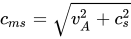
where
is the magnetosonic speed.
This dispersion relation has three independent roots: one corresponding to the Alfvén wave and the other two corresponding to the magnetosonic modes. From the eigenvalue equation, the y-component of the velocity perturbation decouples from the other two components giving the dispersion relation ω2
A = v2
Ak2
∥ for the Alfvén wave. The remaining bi-quadratic equation
is the dispersion relation for the fast and slow magnetosonic modes. It has roots
where the upper sign gives the fast magnetosonic mode and the lower sign gives the slow magnetosonic mode.







The phase velocities of the fast and slow magnetosonic waves depend on the angle θ between the wavevector k and the equilibrium magnetic field B0 as well as the equilibrium density, pressure, and magnetic field strength. From the roots of the magnetosonic dispersion relation, the associated phase velocities can be expressed as where the upper sign gives the phase velocity v+ of the fast mode and the lower sign gives the phase velocity v− of the slow mode.

Hub AI
Magnetosonic wave AI simulator
(@Magnetosonic wave_simulator)
Magnetosonic wave
In physics, magnetosonic waves, also known as magnetoacoustic waves, are low-frequency compressive waves driven by mutual interaction between an electrically conducting fluid and a magnetic field. They are associated with compression and rarefaction of both the fluid and the magnetic field, as well as with an effective tension that acts to straighten bent magnetic field lines. The properties of magnetosonic waves are highly dependent on the angle between the wavevector and the equilibrium magnetic field and on the relative importance of fluid and magnetic processes in the medium. They only propagate with frequencies much smaller than the ion cyclotron or ion plasma frequencies of the medium, and they are nondispersive at small amplitudes.
There are two types of magnetosonic waves, fast magnetosonic waves and slow magnetosonic waves, which—together with Alfvén waves—are the normal modes of ideal magnetohydrodynamics. The fast and slow modes are distinguished by magnetic and gas pressure oscillations that are either in-phase or anti-phase, respectively. This results in the phase velocity of any given fast mode always being greater than or equal to that of any slow mode in the same medium, among other differences.
Magnetosonic waves have been observed in the Sun's corona and provide an observational foundation for coronal seismology.
Magnetosonic waves are a type of low-frequency wave present in electrically conducting, magnetized fluids, such as plasmas and liquid metals. They exist at frequencies far below the cyclotron and plasma frequencies of both ions and electrons in the medium (see Plasma parameters § Frequencies).
In an ideal, homogeneous, electrically conducting, magnetized fluid of infinite extent, there are two magnetosonic modes: the fast and slow modes. They form, together with the Alfvén wave, the three basic linear magnetohydrodynamic (MHD) waves. In this regime, magnetosonic waves are nondispersive at small amplitudes.
The fast and slow magnetosonic waves are defined by a bi-quadratic dispersion relation that can be derived from the linearized MHD equations.
In an ideal electrically conducting fluid with a homogeneous magnetic field B, the closed set of MHD equations consisting of the equation of motion, continuity equation, equation of state, and ideal induction equation (see Magnetohydrodynamics § Equations) linearized about a stationary equilibrium where the pressure p and density ρ are uniform and constant are:
where equilibrium quantities have subscripts 0, perturbations have subscripts 1, γ is the adiabatic index, and μ0 is the vacuum permeability.
Looking for a solution in the form of a superposition of plane waves which vary like exp[i(k ⋅ x − ωt)]
with wavevector k and angular frequency ω, the linearized equation of motion can be re-expressed as
And assuming that ω ≠ 0, the remaining equations can be solved for perturbed quantities in terms of v1:
Without loss of generality, we can assume that the z-axis is oriented along B0 and that the wavevector k lies in the xz-plane with components k∥ and k⊥ parallel and perpendicular to B0, respectively. The equation of motion after substituting for the perturbed quantities reduces to the eigenvalue equation
where cs = √γp0/ρ0 is the sound speed and vA = B0/√μ0ρ0 is the Alfvén speed. Setting the determinant to zero gives the dispersion relation
where
is the magnetosonic speed.
This dispersion relation has three independent roots: one corresponding to the Alfvén wave and the other two corresponding to the magnetosonic modes. From the eigenvalue equation, the y-component of the velocity perturbation decouples from the other two components giving the dispersion relation ω2
A = v2
Ak2
∥ for the Alfvén wave. The remaining bi-quadratic equation
is the dispersion relation for the fast and slow magnetosonic modes. It has roots
where the upper sign gives the fast magnetosonic mode and the lower sign gives the slow magnetosonic mode.
The phase velocities of the fast and slow magnetosonic waves depend on the angle θ between the wavevector k and the equilibrium magnetic field B0 as well as the equilibrium density, pressure, and magnetic field strength. From the roots of the magnetosonic dispersion relation, the associated phase velocities can be expressed as where the upper sign gives the phase velocity v+ of the fast mode and the lower sign gives the phase velocity v− of the slow mode.