Hubbry Logo
Outer ManchuriaOuter ManchuriaMain
Open search
Outer Manchuria
Community hub
Outer Manchuria
logo
8 pages, 0 posts
0 subscribers
Be the first to start a discussion here.
Outer Manchuria
Outer Manchuria
from Wikipedia

Key Information

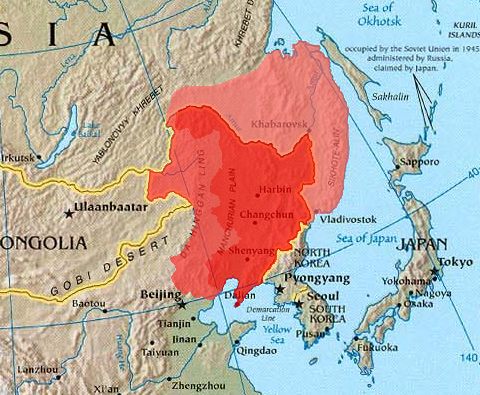
Map showing the original border (in pink) between Qing Manchuria and Russia according to the 1689 Treaty of Nerchinsk, and subsequent losses of Chinese territory to Russia in the 1858 Treaty of Aigun (beige) and 1860 Treaty of Peking (red)

Outer Manchuria,[3][4][1][2][5] sometimes called Russian Manchuria, refers to a region in Northeast Asia that is now part of the Russian Far East[1] but historically formed part of Manchuria (until the mid-19th century). While Manchuria now more normatively refers to Northeast China, it originally included areas consisting of Priamurye between the left bank of Amur River and the Stanovoy Range to the north, and Primorskaya which covered the area in the right bank of both Ussuri River and the lower Amur River to the Pacific Coast. The region was ruled by a series of Chinese dynasties and the Mongol Empire, but control of the area was ceded to the Russian Empire by Qing China during the Amur Annexation in the 1858 Treaty of Aigun and 1860 Treaty of Peking,[6] with the terms "Outer Manchuria" and "Russian Manchuria" arising after the Russian annexation.

Prior to its annexation by Russia, Outer Manchuria was predominantly inhabited by various Tungusic peoples who were categorized by the Han Chinese as "Wild Jurchens". The Evenks,[1] who speak a closely related Tungusic language to Manchu, make up a significant part of the indigenous population today. When the region was a part of the Qing dynasty, a small population of Han Chinese men migrated to Outer Manchuria and married the local Tungusic women. Their mixed descendants would emerge as a distinct ethnic group known as the Taz people.

Etymology

[edit]

"Manchuria" was coined in the 19th century to refer to the northeastern part of the Qing Empire, the traditional homeland of the Manchu people. After the Amur Annexation by the Russian Empire, the ceded areas were known as "Outer Manchuria" or "Russian Manchuria".[1][7][8][9][10][11][better source needed] (Russian: Приаму́рье, romanizedPriamurye;[note 1] simplified Chinese: 外满洲; traditional Chinese: 外滿洲; pinyin: Wài Mǎnzhōu or simplified Chinese: 外东北; traditional Chinese: 外東北; pinyin: Wài Dōngběi; lit. 'outer northeast').

History

[edit]

Outer Manchuria comprises the modern-day Russian areas of Primorsky Krai, southern Khabarovsk Krai, the Jewish Autonomous Oblast, the Amur Oblast and the island of Sakhalin.[9][12]: 338 (map) 

In the 7th century, the Tang dynasty built administrative and military outposts on the Amur and in Suchan. The region was later controlled by the Parhae, a Korean-Manchu polity, during which time Korean communities were established in the region.[13]

The northern part of the area was disputed by Qing China and the Russian Empire, in the midst of the Russia's Far East expansion, between 1643 and 1689. The Treaty of Nerchinsk signed in 1689 after a series of conflicts, defined the Sino–Russian border as the Stanovoy Mountains and the Argun River. When the Qing sent officials to erect boundary markers, the markers were set up far to the south of the agreed limits, ignoring some 23,000 square miles of territory.[12]: 38 

In 1809, the Japanese government sent explorer Mamiya Rinzō to Sakhalin and the region of the Amur to determine the extent of Russian influence and penetration.[12]: 334 

Chang estimates that there were ten thousand Chinese and four to five thousand Koreans in the region during the 19th century. There might have been more than this number as well. The Qing had sent many of its political prisoners and criminals to exile in Manchuria beginning in 1644. This included all of the ethnic groups in China including Koreans.[14] Perhaps, the Han dynasties prior to the Qing did so as well.[13]: 74–77 [15]

To preserve the Manchu character of Manchuria, the Qing dynasty discouraged Han Chinese settlement in Manchuria; nevertheless, there was significant Han Chinese migration into areas south of the Amur and west of the Ussuri.[12]: 332  By the mid-19th century, there were very few subjects of the Qing Empire living in the areas north of the Amur and east of the Ussuri,[12]: 333  and Qing authority in the area was seen as tenuous by the Russians.[12]: 336  Despite warnings, Qing authorities remained indecisive about how to respond to the Russian presence.[12]: 338–339 In 1856, the Russian military entered the area north of the Amur on a pretext of defending the area from France and the UK;[12]: 341  Russian settlers founded new towns and cut down forests in the region,[12]: 341  and the Russian government created a new maritime province, Primorskaya Oblast, including Sakhalin, the mouth of the Amur, and Kamchatka with its capital at Nikolayevsk-on-Amur.[12]: 341  After losing the Opium Wars, Qing China was forced to sign a series of treaties that gave away territories and ports to various Western powers as well as to Russia and Japan; these were collectively known by the Chinese side[16] as the Unequal Treaties. Starting with the Treaty of Aigun in 1858 and, in the wake of the Second Opium War, the Treaty of Peking in 1860, the Sino–Russian border was realigned in Russia's favour along the Amur and Ussuri rivers. As a result, China lost the region[12]: 348  that came to be known as Outer Manchuria or Russian Manchuria (an area of 350,000 square miles (910,000 km2)[2]) and access to the Sea of Japan.[17][18][19] In the wake of these events, the Qing government changed course and encouraged Han Chinese migration to Manchuria (Chuang Guandong).[1][12]: 348 

Map Presenting Ernst G. Ravenstein's Travels in the Primore from 1854 to 1860

After 1860, Russian historians began to intentionally erase the histories and contributions of the Chinese and Koreans to the Russian Far East.[13]: 73–75 [20] The Russian historian, Semyon D. Anosov wrote, “In the 17th century, the Manchu-Tungus tribes living in the region were conquered by China and deported. Since then, the region has been deserted.”[21] Kim Syn Khva, a Soviet Korean historian and author of Essays on the History of the Soviet Koreans [очерки по историй Советских корейтсев], wrote, "The first Korean migrants appeared in the southern Ussuri region when secretly 13 families came here fleeing Korea from unbearable poverty and famine" in 1863.[22] However, the historian, Jon K. Chang found Western sources, most notably Ernst G. Ravenstein's The Russians on the Amur and J.M. Tronson's Personal Narrative of a Voyage to Japan, Kamtschatka, Siberia, Tartary, and Various Parts of Coast of China: In H.M.S. Barracouta,[23] which detailed Chinese, Korean and Manchu settlements from Ternei to Vladivostok and Poset before 1863 (see small map below).

Both Ravenstein (1856-60) and Tronson (1854-56) explored the Russian Far East before 1860. Ravenstein's account notes the differences between Koreans and Chinese versus the Manchus in the region. The former prepared and sold trepangs according to Ravenstein. They (Chinese and Koreans) also raised crops and cattle and lived in small villages and settlements among their co-ethnics. Ravenstein was a German geographer, cartographer and ethnographer of some note. Tronson's account called all of the East Asians whether Chinese, Korean, Manchu or Tungusic peoples "Mantchu-Tartars." Chang also interviewed an elderly Soviet Korean grandmother in 2008, named Soon-Ok Li. Ms. Li stated that, "No one came from Korea. We have always lived in Vondo [the Korean name for the Russian Far East]. Even my grandparents [Ms. Li was born in 1928] were born here."[13]

Modern opinions

[edit]

In Russia

[edit]

In 2016, Victor L. Larin, [ru] the director of the Institute of History, Archaeology and Ethnography of the Peoples of the Far East in Vladivostok, said that the fact that Russia had built Vladivostok "is a historical fact that cannot be rewritten", and that the notion that Vladivostok was ever a Chinese town is a "myth" based on a misreading of evidence that a few Chinese sometimes came to the area to fish and collect sea cucumbers.[24] The main point of Viktor Larin was that the "Russian Far East (outer Manchuria) is Russia's. They developed the region and thus, will not give it back."[citation needed]

Sergey Radchenko, a professor at Johns Hopkins SAIS known for his writings on Sino-Russian relations,[25] stated, "China fully recognizes Russia's sovereignty over these territories" (referring to the Russian Far East). He also called Taiwan's President Lai "seriously misguided" for attempting to suggest to China to take back her "lost territories", rather than invade Taiwan.[26] On 3 September 2024 Maria Zakharova, the spokesperson for the Russian Foreign Ministry, said that "the mutual renunciation of territorial claims by Moscow and Beijing had been enshrined in the July 16, 2001, Treaty of Good Neighborliness, Friendship and Cooperation, with Moscow and Beijing putting border issues to bed once and for all by signing the Additional Agreement on the Eastern part of the Russia-China Border on October 14, 2004, and ratifying the document later. This position was confirmed in a number of other joint documents that China and Russia adopted at various levels, including at the highest one."[27]

In the West

[edit]

Despite the potential for territorial claims coextensive with the Qing dynasty, Chinese leaders as of 2014 had not suggested that Mongolia and part of Outer or Russian Manchuria would be a legitimate objective.[10] In April 2023, US diplomat John Bolton speculated that China is "undoubtedly eyeing this vast territory, which potentially contains incalculable mineral wealth", referring to Asian Russia generally, further noting that "[s]ignificant portions of this region were under Chinese sovereignty until the 1860 Treaty of Peking".[5] However, two American historians, Jon K. Chang and Bruce A. Elleman, disagree with Larin, Radchenko and other Russian historians. Chang and Elleman note that in 1919 and 1920, Lev M. Karakhan, the Soviet deputy minister (also called "commissar") of foreign affairs, issued two legally binding "declarations" called the Karakhan Manifestos in which he promised to return to China all territories taken in Siberia and Manchuria during the Tsarist period and to return the Chinese Eastern Railway and other concessions. He signed his name on both documents as deputy minister of foreign affairs. To date, China has never renounced the offer of the two Karakhan Manifestos. During 1991 and 2004, there were border-treaties between Russia and China. The Karakhan Manifestos are not border treaties. They are unilateral, but legally binding offers of the return of territory to China.[28][29] Here are three excerpts from the first Karakhan Manifesto (I) according to the translated, English version published by Allen S. Whiting:

Karakhan Manifesto I (signed 25 July 1919) courtesy of Allen S. Whiting's Soviet Policies in China, 1917–1924.

We bring help not only to our own labouring classes, but to the Chinese people too, and we once more remind them of what they have been told ever since the great October revolution of 1917, but which was perhaps concealed from them by the venal press of America, Europe, and Japan. ...

But the Chinese people, the Chinese workers and peasants, could not even learn the truth, could not find out the reason for this invasion by the American, European, and Japanese robbers of Manchuria and Siberia. ...

The Soviet Government has renounced the conquests made by the Tsarist Government which deprived China of Manchuria and other areas. ... The Soviet Government is well aware ... that the return to the Chinese people of what was taken from them requires first of all putting an end to the robber invasion of Manchuria and Siberia. The Karakhan Manifestos I and II are similar. Both promise to return "the conquests made by the Tsarist Government which deprived China of Manchuria and other areas."

— Whiting, Soviet Policies, pp. 269–271[30]

Place names

[edit]

Today, there are reminders of the ancient Manchu domination in English-language toponyms: for example, the Sikhote-Alin, the great coastal range; the Khanka Lake; the Amur and Ussuri rivers; the Greater Khingan, Lesser Khingan and other small mountain ranges; and the Shantar Islands.

In 1973, the Soviet Union renamed several locations in the region that bore names of Chinese origin. Names affected included Partizansk for Suchan; Dalnegorsk for Tetyukhe; Rudnaya Pristan for Tetyukhe‐Pristan; Dalnerechensk for Iman; Sibirtsevo for Mankovka; Gurskoye for Khungari; Cherenshany for Sinan cha; Rudny for Lifudzin; and Uglekamensk for Severny Suchan.[16][31]

On 14 February 2023, the Ministry of Natural Resources of the People's Republic of China relabelled eight cities and areas inside Russia in the region with Chinese names.[32][33] The eight names are Boli for Khabarovsk, Hailanpao for Blagoveshchensk, Haishenwai (Haishenwei) for Vladivostok, Kuye for Sakhalin, Miaojie for Nikolayevsk-on-Amur, Nibuchu for Nerchinsk, Outer Khingan (Outer Xing'an[34]) for Stanovoy Range, and Shuangchengzi for Ussuriysk.[35]

See also

[edit]

Notes

[edit]

References

[edit]
[edit]
Revisions and contributorsEdit on WikipediaRead on Wikipedia
from Grokipedia
Outer Manchuria, also termed Russian Manchuria, refers to the territories in the lying north of the River, east of the River, and extending to the , encompassing roughly 1 million square kilometers now administered as , , , and . These lands, historically under nominal control with sparse indigenous populations of Tungusic tribes like the Nanai and Udege, were sparsely settled due to Qing restrictions on migration to preserve Manchu heartlands. The region's transfer to the occurred amid Qing military weakness during the and , when Russian forces under advanced into the basin without significant resistance, culminating in the on May 28, 1858, which ceded the Amur's left bank (about 600,000 square kilometers) to in perpetuity. This was followed by the in 1860, ratified after Anglo-French forces sacked , which confirmed the Amur cession and additionally transferred the Ussuri region's right bank (Primorye, including future ) to Russia, securing its Pacific outlet. These "unequal treaties," imposed under duress without equivalent Qing military presence in the area, enabled Russian colonization, infrastructure like the , and demographic shifts to predominantly Slavic populations, transforming the frontier into an integral economic zone reliant on timber, minerals, and ports. Though Chinese nationalists invoke the cessions as part of the "," the has formally recognized the borders through bilateral agreements, including the 2004 supplementary protocol resolving minor island disputes while affirming the 19th-century delimitations, with no official territorial amid contemporary Sino-Russian strategic alignment. Today, the area hosts about 4 million residents, facing depopulation challenges but benefiting from resource extraction and cross-border trade, underscoring its evolution from contested periphery to stabilized .

Definition and Geography

Geographical Extent and Boundaries

Outer Manchuria comprises the territories in the ceded by the to the through the on May 16, 1858, and the Treaty of Peking on November 14, 1860. The established Russian control over all lands north of the River, from its confluence with the Argun River eastward to the Ussuri River. This cession included the left bank of the , significantly expanding Russian territory in by securing the river as the boundary. The Treaty of Peking confirmed the Amur boundary and further delimited the eastern extent by ceding to the lands between the River and the , including access to the Sea of . This added approximately 400,000 square kilometers east of the , completing the southern and western boundaries along these rivers from the Argun-Shilka downstream via the to the , then to the sea. The northern boundary follows the Stanovoy Mountains, as referenced in earlier delimitations like the 1689 , though adjusted by the later treaties. In contemporary terms, the region's boundaries align with the international border between and , with minor adjustments finalized in 2008 when transferred 173 square kilometers of disputed islands in the and rivers to , including parts of . Geographically, Outer Manchuria spans from the in the north to the and rivers in the south and west, and to the Sea of Japan in the east, encompassing diverse terrain including forests, river valleys, and coastal plains.

Etymology and Terminology

The term "Manchuria" derives from the name of the , whose Manchu (or Manju in Manchu script) literally means "pure" or "true," referring to their self-perceived descent from the Jurchen tribes. This regional exonym emerged in European and literature through 18th-century romanizations of Manchu terms, possibly influenced by Dutch, Russian, or French sources, and was later popularized by the Japanese designation Manshū during their late-19th-century expansionist interests in the area. The name does not correspond to any indigenous toponym used by local Tungusic, Mongol, or Han populations, who historically referred to parts of the region by riverine or tribal names such as the (Heilong in Chinese) or basins. "Outer Manchuria" specifically designates the territories ceded by the Qing Empire to —encompassing approximately 1 million square kilometers north of the Amur River, east of the River, and including Island—via the on May 16, 1858, and the Treaty of Peking on November 14, 1860. The prefix "outer" contrasts these areas with "Inner Manchuria," the core Manchu homeland retained under Chinese control, reflecting a post-cession geographical distinction rather than a pre-19th-century native usage. In Russian imperial and Soviet administration, the region was termed Priamurye (Приаму́рье), denoting "Amur-adjacent lands," emphasizing its fluvial boundaries over ethnic connotations. The English compound "Outer Manchuria" gained traction in 20th-century Western scholarship to describe these provinces, including modern , , , , and parts of , though Chinese sources more commonly employ Wài Dōngběi ("Outer Northeast") to frame it within a narrative of territorial loss.

Historical Development

Indigenous Peoples and Pre-Qing Era

The territories comprising Outer Manchuria were primarily inhabited by Tungusic-speaking indigenous peoples, such as the Nanai, Ulchi, Udege, Oroch, Evenki, Negidal, and Oroqen, who maintained traditional lifestyles centered on hunting, fishing, gathering, and, in northern areas, reindeer herding. These groups, distributed along the Amur River basin and its tributaries, formed small, semi-nomadic communities adapted to the region's taiga and riverine environments, with archaeological and genetic evidence indicating their presence for millennia prior to significant external influences. Jurchen tribes, also Tungusic, occupied parts of the area, particularly in the east, and were known to Chinese chroniclers as "Wild Jurchens" distinct from southern counterparts. Prior to the , these indigenous populations experienced sporadic interactions with neighboring powers but lacked centralized governance. The exerted nominal authority through expeditions and tribute systems, notably establishing the Nurgan Regional Military Commission in 1409 at the River's mouth to oversee Jurchen and Tungusic guards, though permanent control was limited and the commission was dismantled by the 1430s amid logistical challenges and internal Ming priorities. Local tribes, including Tungusic groups under Ming categorization as "Guards," paid intermittent tribute—such as furs and horses—but maintained autonomy, with no evidence of widespread Han settlement or agricultural transformation in the region. This era reflected a of tribal confederations rather than state administration, shaped by environmental constraints and mobility.

Qing Dynasty Control and Conflicts

The , established by the Manchu conquest of the Ming in 1644, asserted firm control over as its ethnic homeland, integrating the region into a system of military-administrative divisions known as the . Bannermen garrisons were stationed at strategic points, including along the Amur River basin, to enforce authority over indigenous such as the Daur and Evenks, who were incorporated via tribute relations rather than direct settlement. This structure maintained sparse but effective oversight, with Manchu nobles administering vast tracts through a network of generals (jiangjun) responsible for border defense and tax collection. To preserve Manchu cultural and demographic dominance and prevent Han assimilation, the Qing imposed stringent bans on civilian Han migration into Manchuria starting in the mid-17th century, reversing earlier encouragements of settlement. These restrictions were physically demarcated by the , a wooden barrier system of felled trees and ditches constructed between 1615 and the , stretching approximately 1,000 to 1,500 kilometers from the to the Liao River, with gates for controlled access. Enforcement involved patrols and penalties, though smuggling and gradual loosening occurred due to famines and in ; by the Qianlong era (1735–1796), limited Han refugee influx was tolerated, but core Manchu lands remained restricted until the mid-19th century. Border conflicts with Tsarist Russia emerged in the mid-17th century as Cossack explorers, seeking furs, penetrated the region; Yerofey Khabarov's 1649–1653 expedition clashed with local tribes under Qing , prompting initial Manchu countermeasures. Escalation occurred with Russian construction of Albazin fort in the –1660s, leading to skirmishes over rights and territory. The (r. 1661–1722) responded decisively, dispatching expeditions in 1684–1686; the first siege of Albazin in involved a Qing force of up to 15,000 against 450–800 Russians, employing artillery and entrenchments, while the 1686 siege forced a Russian capitulation after heavy and . These victories checked Russian advances, culminating in the on August 27, 1689, which delineated the border along the Argun River and Stanovoy Mountains, awarded Qing the basin (including Outer Manchuria), mandated Russian fort dismantlement, and opened limited trade—marking the Qing's only pre-19th-century diplomatic equality with a European power. Qing control persisted through the 18th century, bolstered by the 1727 Treaty of Kyakhta, which refined borders west of Outer Manchuria and regulated trade caravans, amid minimal incursions due to mutual wariness and Qing military prestige. However, by the 1850s, internal crises—the (1850–1864), which mobilized over 20 million combatants and devastated northern resources, and the Second Opium War (1856–1860)—eroded Qing capacity for frontier defense, leaving garrisons understrength and logistics strained. Russian Governor-General exploited this, dispatching gunboat flotillas and troops to occupy islands and build forts unopposed from 1854–1858, facing no significant Qing resistance beyond protests. The resulting , signed May 16, 1858, under duress by Qing envoy Yishan, ceded approximately 600,000 square kilometers north of the to Russia without compensation, establishing the river as the boundary and reflecting the dynasty's fiscal-military exhaustion rather than battlefield defeat. This opportunistic expansion, confirmed by the 1860 Treaty of Peking, ended substantive Qing authority over Outer Manchuria, with conflicts reduced to diplomatic coercion amid the dynasty's broader systemic decline.

Russian Acquisition Through Treaties

The , signed on August 27, 1689, between the and the , initially delimited the Sino-Russian border along the Argun River and the Stanovoy Mountains, assigning the upper River basin to Qing control and requiring Russian withdrawal from fortified outposts like Albazin to avert further military confrontation. This agreement temporarily halted Russian eastward expansion into the region amid Qing military superiority, establishing a for diplomatic border resolution rather than conquest. By the mid-19th century, Qing internal rebellions, including the (1850–1864), and external pressures from the weakened Chinese administrative control over the sparsely populated frontier, enabling Russian explorers and military expeditions under figures like Gennady Nevelskoy and to assert presence through settlement and navigation claims from 1849 onward. Muravyov-Amursky's forces advanced along the , prompting negotiations under duress; on May 16, 1858, the was concluded between Muravyov and Qing commissioner Yishan, ceding to approximately 600,000 square kilometers north of the from the Argun confluence to the Pacific, including both banks in the estuary and adjacent islands, while designating the Amur as a shared navigational boundary. This treaty effectively reversed key provisions of by transferring the left (northern) bank territories without compensation, exploiting Qing diplomatic isolation during the Second . The , ratified on November 14, 1860, amid Qing defeats by Anglo-French forces and Russian opportunistic diplomacy via envoy Nikolay Ignatyev, confirmed the Aigun cessions and annexed an additional 400,000 square kilometers south of the and east of the River to , establishing the modern Primorye territory and access to the Sea of Japan via the Golden Horn Bay. These provisions, part of a broader settlement following the sack of Beijing's , granted ice-free Pacific ports and resource-rich lands previously under nominal Qing , totaling over 1 million square kilometers in Outer Manchuria acquired through these instruments. Russian negotiators framed the acquisitions as corrections to ambiguous Nerchinsk boundaries based on prior explorations, though Qing records indicate coerced assent amid existential threats. Subsequent border protocols, such as the 1881 Treaty of , minorly adjusted fringes but preserved the core 1858–1860 demarcations.

Tsarist Russian Settlement and Administration

The acquisition of Outer Manchuria through the 1858 and the 1860 Treaty of Peking prompted immediate Russian efforts to populate and secure the and basins against Qing reconquest. , serving as of Eastern from 1847 to 1861, directed exploratory expeditions and founded strategic outposts, including in 1856 at the -Zeya confluence and in 1858 at the - junction, to anchor Russian claims and facilitate navigation. These sites initially housed military garrisons and Cossack squadrons, with detachments like the established by 1860 to patrol frontiers and cultivate land for self-sufficiency. Settlement accelerated after the 1861 emancipation of serfs, as the Imperial government incentivized voluntary migration from overcrowded western provinces through decrees offering up to 15 desyatins (16.4 hectares) of tax-exempt farmland per household, subsidized transport via steamers on the , and loans for tools and livestock. Political exiles and convicts supplemented free settlers, comprising up to 20% of early arrivals by the 1870s, providing labor for road-building, , and while introducing administrative expertise. By the 1880s, over 10,000 households had been granted plots in the valley alone, shifting the economy toward grain cultivation and fur trapping, though indigenous groups like Evenks and Nanais retained nominal autonomy under Russian oversight. Administrative reforms culminated in the 1884 creation of the Priamurye Governor-Generalship, headquartered in , which consolidated control over the , Maritime, and districts previously fragmented under jurisdiction. This entity, led by figures like Aleksey Peshkov, emphasized cadastral surveys to formalize land titles, suppression of illicit Chinese , and infrastructure like telegraph lines to by 1890, aiming to integrate the periphery into the imperial fiscal system. Local governance relied on district ispravniks and assemblies dominated by Russian colonists, with Orthodox missions promoting amid sparse policing of an estimated 500,000 square kilometers. Demographic expansion reflected these policies: the 1897 Imperial recorded 120,306 residents in and 223,336 in , up from fewer than 10,000 non-indigenous in 1861, with migrants—primarily Orthodox and —outnumbering natives by over 5:1. Urban centers like grew to 28,896 inhabitants, serving as naval bases, while rural densities remained low at under 1 person per square kilometer, underscoring the frontier's underdevelopment despite state subsidies exceeding 1 million rubles annually by 1900.

Soviet Era Transformations

![Flag of Khabarovsk Krai.svg.png][float-right] The , encompassing the territories of modern , , and , underwent significant administrative reorganization following the Bolshevik consolidation of power. Initially established as the in April 1920 to serve as a buffer against Japanese intervention during the , the entity was integrated into the on November 15, 1922. From 1922 to 1926, it operated as the Far Eastern Oblast; subsequently, as the Far Eastern Krai until 1938, when it was divided into and to enhance regional governance and economic planning. These changes facilitated centralized Soviet control over the sparsely populated frontier. Economic transformations emphasized rapid industrialization and collectivization, aligning with Stalin's Five-Year Plans. , dominated by small-scale farming among Russian settlers and indigenous groups, was restructured through forced collectivization starting in , forming kolkhozy and sovkhozy despite the region's challenging climate and limited fertile land, which constrained yields compared to western USSR districts. Industrial development prioritized extractive industries, including gold and tin mining, timber harvesting, and fish processing, supported by expanded rail networks and ports like . The system supplied forced labor for these projects, with camps in the and Primorye areas contributing to infrastructure such as logging operations and penal railways, though exact prisoner numbers for the region remain estimates due to archival opacity. Demographic shifts were profound, driven by purges and mass deportations to secure borders amid fears of . In 1937, Soviet authorities deported approximately 171,781 ethnic from the to and , labeling them as potential Japanese agents; this operation halved the Korean in the region. Chinese residents faced similar fates, with orders leading to the and expulsion of tens of thousands from enclaves like Vladivostok's "Millionka" between 1930 and 1937, reducing the Chinese presence from over 100,000 to negligible levels by the late . These policies promoted Slavic influx through incentives, increasing the Russian share of the from around 60% in the 1920s to over 80% by 1959, while suppressing indigenous Evenks, Nanais, and others through and relocation. Militarily, the era saw escalating tensions with , resolved through decisive Soviet victories. Border skirmishes peaked in the (May–September 1939), where Soviet-Mongolian forces under defeated Japanese troops, inflicting over 50,000 casualties and prompting a neutrality pact in April 1941. In August 1945, the USSR declared war on , launching Operation August Storm into with 1.5 million troops, capturing key cities and dismantling Japanese industrial assets for Soviet relocation, which accelerated post-war reconstruction in the but strained local resources. These events solidified Soviet dominance, transforming the region into a fortified outpost against Asian threats.

Modern Russian Integration

Administrative Divisions

Outer Manchuria is administratively integrated into the Russian Federation as components of the , primarily comprising , the southern part of , , and the . These federal subjects were established through Soviet-era consolidations and post-1991 reforms, overlaying the historical territories acquired via the (1858) and Treaty of Peking (1860), with boundaries adjusted to align with rivers like the and . Primorsky Krai governs the southeastern expanse, including the Ussuri River basin and Pacific coastline, with as its administrative center since its designation as a key port in the late 19th century. covers northern riverine areas, incorporating segments along the upstream of , which serves as the krai's capital and a historical outpost established in 1632 by Russian explorers. administers the central valley left bank, centered on , reflecting its origins as a post-1858 annexation. The , created in 1934 as a Soviet experiment in Jewish settlement, manages a discrete enclave in the middle basin adjacent to , with as its capital, though its ethnic Jewish population has since declined sharply. These divisions operate under Russia's federal system, where krais and oblasts possess varying degrees of but are subordinate to for defense, , and macroeconomic coordination. Local governance involves elected legislatures and governors appointed or elected per , with tied to federal programs emphasizing resource extraction and cross-border trade with . No distinct administrative status exists for "Outer Manchuria" itself, as Russian policy treats the area as irrevocably integrated territory without irredentist challenges from within the federation.


The demographic composition of Outer Manchuria's constituent regions—primarily , , , and —is overwhelmingly dominated by ethnic , who form over 90% of the population in most areas based on recent censuses. In , Russians accounted for 95.17% of residents per the 2020 national census data. Indigenous Tungusic groups such as Evenks, Nanai, and Udege constitute minor fractions, typically under 2% regionally, with their numbers further diminished by assimilation and out-migration. Other minorities include , , and Central Asians, but no single non-Russian group exceeds 3-5% in aggregate across the territories. Population totals have contracted steadily, reflecting low birth rates and net out-migration. The recorded 150,453 residents in the census, declining to an estimated 145,802 by 2024. Primorsky Krai's population fell to 1,845,165 in from prior peaks, with further estimates at 1,798,047 in 2024. The broader has lost 20% of its inhabitants since 1991, with decline rates accelerating due to economic disparities favoring . Migration trends since the Soviet collapse have been characterized by heavy outflows of ethnic and other Slavic groups to western , driven by better opportunities and . Net migration turned negative in 1991, with annual losses compounding depopulation despite sporadic incentives for resettlement. Inflows from involve temporary labor in , , and trade—estimated in tens of thousands annually—but permanent settlement remains limited, with many workers returning home amid regulatory crackdowns and economic reversals. Claims of mass Chinese colonization lack substantiation in official data, as undocumented numbers do not translate to demographic shifts; official Chinese residents numbered under 40,000 nationwide in early censuses, with regional concentrations small relative to totals. Indigenous mobility has declined, with communities increasingly urbanized and integrated into Russian-majority locales.

Economic Activities and Resource Management

The economy of Outer Manchuria relies heavily on natural resource extraction, , fisheries, and transportation infrastructure, reflecting the region's vast forests, mineral deposits, and arable lands in the . constitutes a core activity, particularly in , which holds Russia's largest gold reserves and ranked sixth nationally in output as of , contributing nearly 20% to the oblast's industrial production. predominates in , accounting for 5.3% of Far Eastern coal output, with operations like those of SUEK supplying domestic energy needs. and timber processing are vital in , where reserves support industry comprising 17.9% of gross regional product, alongside tin production and energy generation exceeding one-fifth of the Far Eastern Federal District's total electricity and thermal output. Agriculture focuses on , soybeans, and , with producing two-thirds of the Far East's and half its soybeans, bolstered by favorable soils and federal incentives for crop specialization. The emphasizes soybeans, potatoes, and fodder grains, which form over 3% of regional GDP and support livestock through expanded cultivation since the . Fisheries thrive in , leveraging Pacific access for processing and exports, while transportation—particularly ports and rail—facilitates trade, with logistics driving income growth amid Russia-China exchanges. These sectors underpin federal development priorities, including the 2019-2024 Far Eastern programs targeting resource-based growth. Resource management emphasizes state licensing and quotas under Russia's Forest Code, yet faces challenges from illegal logging, biodiversity loss, and inadequate regeneration, as highlighted by environmental NGOs critiquing wood-centric practices over ecosystem services like watershed protection. In forestry, federal policies promote auctions and reforestation, but ground-level enforcement lags, exacerbating disturbances in Khabarovsk and Primorsky areas. Mining operations in Amur and Zabaykalsky prioritize open-pit methods for efficiency, with reserves exceeding 1 billion tonnes of coal in Khabarovsk, though air pollution and waste management strain local ecosystems. Agricultural expansion, including soybean cooperatives with China, has boosted yields—reaching near-national averages by 2022 in Amur—but raises concerns over soil degradation without integrated sustainability measures. Overall, management balances export revenues with federal subsidies, prioritizing economic output amid geopolitical trade shifts.

Claims, Disputes, and Perspectives

Chinese Nationalist and Irredentist Views

Chinese nationalists and irredentists consider the territories comprising Outer Manchuria—roughly 1 million square kilometers ceded by the to the —as integral historical Chinese lands unjustly lost through coercive 19th-century treaties. These include the on May 16, 1858, which transferred the left bank of the Amur River, and the on November 14, 1860, which ceded the area east of the Ussuri River, including . They frame these agreements as exemplars of the "unequal treaties" imposed during China's "," arguing that the Qing's military weakness and internal instability enabled Russian expansionism rather than legitimate negotiation. Irredentist rhetoric emphasizes demographic and cultural precedents, citing pre-19th-century Chinese settlement, Manchu administrative control, and ancient maps depicting the region—such as 13th-century cartography showing areas around modern (rechristened Hǎishēnwǎi in Chinese usage) as Chinese territory. Some nationalists advocate demographic reclamation through migration and economic dominance in the sparsely populated , where Chinese workers and investments have surged, potentially creating de facto influence without immediate conflict. Public expressions include online forums and opinion pieces urging to exploit Russian vulnerabilities, such as post-Ukraine war weaknesses, to press claims, though these remain marginal compared to official border affirmations in the 2004 Sino-Russian agreement. Recent actions fueling irredentist sentiments involve state-affiliated maps, like the 2023 Ministry of Natural Resources publication using pre-Russian Chinese toponyms for locales, including and Bolshoi Ussuriysky Island, prompting Russian security concerns over historical revisionism. Analysts note that while the prioritizes strategic partnership with , nationalist narratives align with Xi Jinping's "great rejuvenation" discourse, portraying territorial recovery as unfinished business, potentially escalating if Sino-Russian ties fray. These views, often disseminated via and semi-official channels, contrast with Beijing's diplomatic restraint but underscore persistent grievances over historical losses exceeding those to other powers. However, military recovery of these regions by China remains infeasible, given Russia's second-ranked global military position, its nuclear arsenal exceeding China's in size, and experienced land forces suited to the Siberian terrain; the Sino-Russian strategic partnership, which includes affirmations of no territorial claims, further precludes such pursuits, with the risk of nuclear escalation rendering them prohibitive.

Russian Official and Nationalist Positions

The Russian government maintains that the territories comprising Outer Manchuria, acquired through the in 1858 and the in 1860, constitute integral parts of the Russian Federation, with sovereignty unchallenged by subsequent border demarcations. In the 2004 Supplementary Agreement on the Eastern Section of the China-Russia Border, both nations affirmed the definitive delimitation of their shared boundary, with Article 6 explicitly stating that neither party harbors territorial claims against the other, thereby resolving all disputes including those pertaining to islands like Bolshoi Ussuriysky. This position aligns with earlier protocols from 1991 and 2001, which Russia interprets as conclusive validation of the 19th-century treaties' outcomes, rejecting characterizations of them as "unequal" as ahistorical revisionism disconnected from the geopolitical realities of Qing military weakness and Russian exploratory advances along the Amur River. Official Russian responses to sporadic Chinese cartographic assertions or nationalist rhetoric depicting the as historically Chinese have been dismissive or silent, underscoring confidence in the legal finality of bilateral accords and the demographic entrenchment of Russian-majority populations in regions like and . President has acknowledged the Qing origins of the area while promoting policies to bolster Russian settlement and economic integration, such as the 2016 Far Eastern Hectare program, which allocates land to citizens to counter migration imbalances without conceding territorial legitimacy. The frames any Chinese irredentist undercurrents as marginal and incompatible with the strategic partnership forged since the 2000s, prioritizing joint development over historical grievances. Russian nationalists, drawing on imperial historiography, portray the 19th-century annexations as rightful civilizational expansion into undergoverned frontier zones, crediting Tsarist initiatives with transforming sparsely populated Manchu tributaries into viable economic hubs through Russian , , and defense against Japanese and Qing threats. Figures in and broader nationalist circles vehemently oppose Chinese claims, viewing them as expansionist pretexts masked by demographic infiltration via labor migration, which they quantify as exceeding sustainable levels—e.g., Chinese workers comprising up to 20% of certain sectors by the early 2000s—potentially eroding Russian ethnic predominance without formal territorial demands. Organizations and commentators emphasize the region's since the 1860s, citing census data showing ethnic Russians at over 90% in key areas like by 2021, and decry "kitaizatsiya" () narratives as alarmist only insofar as they underestimate Beijing's long-term demographic leverage. Nationalist discourse often invokes defensive irredentism, arguing that reversion to would betray the sacrifices of Russian settlers and soldiers who secured the amid 19th-century power vacuums, while dismissing Qing suzerainty as nominal overlordship lacking effective control or investment. Events like the 2020 Vladivostok foundation anniversary celebrations have galvanized patriotic assertions of the city's indelible Russian identity, countering Chinese online backlash as unsubstantiated unfit for modern interstate relations. Overall, these positions prioritize empirical markers of Russian stewardship—resource extraction yielding billions in annual GDP from and Primorye oblasts—over abstract historical entitlements, framing the territory's retention as essential to amid 's rising influence.

International and Scholarly Assessments

The Sino-Russian , encompassing the territories historically termed Outer Manchuria, has been internationally recognized as settled through a series of agreements, culminating in the and supplementary protocols ratified in 2004 and 2008, which delineated the final boundary along the and rivers without territorial concessions from either side. These accords resolved lingering disputes from 19th-century treaties, affirming Russian sovereignty over , , and , with no formal challenges raised in international forums such as the . Under principles of , including , the enduring validity of these treaties—despite their origins in asymmetrical power dynamics—has precluded revisionist claims, as evidenced by China's consistent adherence in bilateral and multilateral recognition of post-1991 demarcations. Scholarly assessments generally characterize the 1858 and 1860 as products of Qing China's military vulnerabilities during the era, resulting in the cession of approximately 1 million square kilometers to , but emphasize that subsequent demographic integration, development, and mutual stabilizations have entrenched Russian control. Historians note these pacts as exemplars of 19th-century imperial expansion, akin to other contemporaneous land transfers, yet highlight China's pragmatic under and successors, which prioritized economic cooperation over , as seen in the 2001 Treaty of Good-Neighborliness and Friendly Cooperation. Academic analyses, drawing on declassified diplomatic records, underscore that while nationalist narratives in Chinese media occasionally invoke "lost territories" for domestic mobilization, official has avoided irredentist rhetoric to maintain strategic alignment against Western pressures, with confined to fringe online discourse rather than state doctrine. International relations experts assess the stability of the as bolstered by Russia's resource exports to and shared geopolitical interests, rendering territorial revision improbable absent a in bilateral ties; simulations of conflict scenarios, such as those modeling vulnerabilities, predict Chinese opportunism only under extreme conditions like state fragmentation, not current realist calculations. Critiques from Western scholars often frame the acquisitions within broader critiques of tsarist , yet acknowledge that prescriptive favors principles—preserving post-colonial s—over historical grievance rectification, as applied in cases like Latin American independences. Empirical studies of disputes indicate that Sino-Russian demarcation ranks among the most successfully resolved globally since 1945, with minimal militarized incidents post-1969 clashes, attributing endurance to exceeding $200 billion annually in trade by 2023.

Toponymy and Cultural References

Dual Naming Conventions

In Chinese official cartography and documentation, locations within Outer Manchuria are frequently denoted using historical Chinese toponyms alongside or in substitution for their modern Russian designations, a practice that underscores continuity with Qing-era administration prior to the territorial cessions formalized by the Treaty of Aigun on May 16, 1858, and the Treaty of Peking on November 14, 1860. This asymmetric dual naming persists primarily in Chinese contexts, where it serves to evoke pre-Russification geography, rather than in Russian administration, which has systematically Russified indigenous, Manchu, and Chinese-derived names since the mid-19th century. For instance, in 2023, China's Ministry of Natural Resources mandated the inclusion of such legacy names on national maps for eight key sites, including major cities and geographical features, to standardize exonyms and preserve historical nomenclature. These Chinese names often originated as transliterations of local Nanai, Udege, or Manchu terms during Qing oversight of the region, adapted into hanzi characters for administrative use. Russian renaming efforts intensified under Tsarist expansion and continued through Soviet policies in the , replacing many with Slavic or descriptive terms, though some indigenous variants were occasionally retained or revived post-1970s for cultural recognition. In contemporary , official remains monolingual in Russian, with no formal endorsement of Chinese equivalents, reflecting the region's integration as federal subjects like and since the . Chinese usage, by contrast, appears in state media, education, and irredentist discourse, where names like Hǎishēnwǎi for are invoked to highlight perceived historical injustices of the "unequal treaties." The following table enumerates prominent examples of this dual nomenclature, drawing from Qing records and modern Chinese mappings:
Russian NameChinese Historical NamePinyin TranscriptionNotes
海参崴HǎishēnwǎiRefers to sea cucumber habitat; site of Russian fort established 1860.
伯力BólìDerived from Nanai term for "pine tree"; founded as military outpost 1858.
海兰泡HǎilánpàoIndicates "sea orchid bubble" (lagoon); border city opposite .
庙街Miàojiē"Temple street"; key River port developed 1850s.
库页岛KùyèdǎoFrom Ainu "island at the edge"; claimed by Qing until 1860, fully Russian by 1875.
外兴安岭Wài Xīng'ān Lǐng"Outer Xing'an Mountains"; natural boundary per 1858 .
This convention, while not reciprocated in bilateral agreements, highlights enduring cultural divergences in territorial memory, with Chinese sources framing it as factual restoration rather than , though Russian observers interpret it as provocative signaling amid demographic shifts in the borderlands. Scholarly analyses note that such naming reinforces without altering legal , as affirmed by the 2004 China-Russia demarcation .

Legacy in Historical Narratives

In Chinese historical narratives, the cession of Outer Manchuria via the Treaty of Aigun on May 16, 1858, and the Treaty of Peking on November 14, 1860, is frequently framed as a pivotal episode in the "Century of Humiliation," emblematic of Qing Dynasty weakness and foreign predation that resulted in the loss of approximately 1 million square kilometers of territory to Russia. These accounts, prevalent in nationalist discourse and some official historiography, attribute the transfers to coercion amid the Opium Wars, portraying Russia as exploiting China's internal rebellions, such as the Taiping Rebellion (1850–1864), to extract concessions without military confrontation on the scale of British or French actions. While mainstream Chinese education emphasizes victimhood to foster national unity, ultranationalist fringes invoke these events to advocate irredentism, though such claims are often censored to preserve Sino-Russian relations, reflecting a pragmatic suppression of revanchist rhetoric in state-controlled narratives. Russian historical accounts, by contrast, depict the acquisition as a strategic consolidation of sparsely populated frontier lands, justified by exploratory expeditions like those of Gennady Nevelskoy in the and the need to secure against Qing encroachments, culminating in the treaties as diplomatic triumphs that integrated the and basins into the empire without prolonged warfare. reframed this as anti-imperialist resistance to Qing , emphasizing while downplaying tsarist , whereas post-Soviet Russian narratives often highlight demographic realities—such as minimal indigenous Manchu and Tungusic populations—and through settlement, portraying the region as inherently Russianized by the early . These portrayals, found in military histories and regional studies, underscore causal factors like and resource potential (e.g., timber and fisheries) over moral critiques of inequality, attributing longevity of control to effective administration rather than mere possession. Western scholarly assessments offer a more detached , recognizing the treaties' unequal nature under 19th-century international norms—where might often dictated right—but affirming their legal validity absent contemporary revanchist challenges, with emphasis on how Russian demographic influx (reaching over 100,000 settlers by 1900) and infrastructure like the (construction began 1891) entrenched de facto sovereignty. This perspective critiques both Chinese victimology, which overlooks Qing administrative neglect of the periphery, and Russian , noting parallels to European colonial partitions, while empirical data on population shifts—e.g., from nomadic tribes to Slavic majorities—support the narrative of irreversible integration absent major power intervention. Such analyses prioritize verifiable treaties and migration patterns over ideological framings, highlighting how narratives serve domestic legitimization in both claimant states.

References

Add your contribution
Related Hubs
User Avatar
No comments yet.