


Community hub
Recent from talks
Contribute something
Nothing was collected or created yet.
The Manhattan Transfer
View on Wikipedia | This article needs additional citations for verification. (January 2012) |
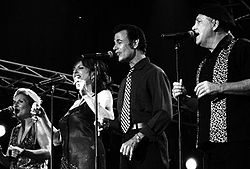
The Manhattan Transfer was an American vocal group founded in 1969 in New York City, performing music genres like a cappella, Brazilian jazz, swing, vocalese, rhythm and blues, pop, and standards. They won eleven Grammy Awards.
Key Information


There were several incarnations and formations of the Manhattan Transfer, with each edition having different styles.
The first rendition was in the 1960s, consisting of a mostly a cappella-tinged style; it featured Tim Hauser, Erin Dickins, Marty Nelson, Pat Rosalia, and Gene Pistilli. The second version of the group, formed in 1972, incorporating a more vocal jazz approach, consisted of Hauser, Alan Paul, Janis Siegel, and Laurel Massé.
The third, and most commercially perceived, formation of the group happened in 1979, because Massé had to leave the group after being badly injured in a car crash and was replaced by Cheryl Bentyne. This edition of the Manhattan Transfer performed electronic-styled pop, soul, funk, and rhythmic music, having success in the 1980s.
Since the 1990s, the lineup of Hauser, Paul, Siegel, and Bentyne continued, and performed mostly cool and smooth jazz. The group also had several rotating touring members, and longtime pianist Yaron Gershovsky accompanied the group on tour and served as music director. Trist Curless from the Los Angeles a cappella group m-pact became a permanent member in October 2014 following Hauser's death.[2] The group officially retired in 2023.[3]
Early years
[edit]In 1969, Tim Hauser formed a vocal group in New York City called The Manhattan Transfer after the novel by John Dos Passos.[4] The group consisted of Hauser, Erin Dickins, Marty Nelson, Pat Rosalia, and Gene Pistilli. This group made one album, Jukin' (Capitol, 1971), which looked at the jazz music of the past as well as rock and country genres unlike the later incarnations of the group.[5] They were not picked up by Capitol Records for a second album, and the group broke up in 1973.
Shortly thereafter, Hauser met Laurel Massé while he was a cab driver and she was his passenger. Soon after, he met Janis Siegel. During this time, session drummer Roy Markowitz, who had played with Janis Joplin and recorded with Don McLean, attended a performance of the group and convinced Tim to change the group's direction. Roy was in the Broadway band of Grease and introduced one of its cast members, Alan Paul (who played the dual role of bandleader Johnny Casino and the Teen Angel), to Tim. Thus began another version of The Manhattan Transfer.[4][5] After performing in clubs in New York City, the quartet asked Roy to produce a demo to present to Ahmet Ertegun at Atlantic Records. The demo was a success and Atlantic released its debut album with guest appearances by bona fide jazz musicians Randy Brecker, Jon Faddis, and Zoot Sims. The Manhattan Transfer (Atlantic, 1975) eschewed the condescension of the previous album, presenting instead serious vocalese renditions of "Java Jive" and "Tuxedo Junction" and scoring a Hot 100 top 25 hit with the gospel-tinged "Operator."[5] During the month of August 1975, the group hosted a four-week variety series on CBS-TV. The hour-long show was simply called The Manhattan Transfer, aired on Sunday evenings, and for the most part concentrated on showcasing the talents of the group.[6] Their next album, Coming Out (1976), produced "Chanson d'Amour," which was a number one hit in the UK and Ireland.[5]
Bentyne and "Birdland"
[edit]In 1978, Laurel Massé was in a car crash and dropped out of the group. She was replaced by Cheryl Bentyne.[4][5] The group's next album, Extensions (Atlantic, 1979), produced the hit "Twilight Zone/Twilight Tone", a song based on the TV series The Twilight Zone (including an impersonation of Rod Serling's narration from Alan Paul).[7]
Extensions featured a cover version of "Birdland", an instrumental by the jazz fusion group Weather Report, with lyrics by Jon Hendricks of Lambert, Hendricks, and Ross. One of the most popular jazz recordings of 1980, "Birdland" won the Grammy Award for Best Jazz Fusion Performance, while Janis Siegel won the Grammy Award for Best Vocal Arrangement.
In 1981, the Manhattan Transfer made music history by becoming the first group to win Grammy awards for both popular and jazz categories in the same year. "The Boy from New York City", a cover of the 1965 success by The Ad Libs, reached the Top 10 on the Hot 100 and won them the award for Best Pop Performance by a Duo or Group with Vocal, and "Until I Met You (Corner Pocket)" earned them a Grammy Award for Best Jazz Vocal Performance, Duo or Group. Both of these songs appeared on the group's fifth album, Mecca for Moderns (Atlantic, 1981). In 1982, the group won another Grammy, for Best Jazz Vocal Performance, Duo or Group, for its rendition of "Route 66". The song was featured on the soundtrack to the Burt Reynolds film Sharky's Machine.
Stretching out
[edit]In September 1983, the group released the album Bodies and Souls, with an urban-contemporary style which resulted in two R&B chart singles. The first was the No. 2 hit "Spice of Life", which was co-written by former Heatwave member Rod Temperton who had penned several hits for Michael Jackson. The single also reached No. 40 on the US pop chart and No. 19 in the UK. The other single, the ballad "Mystery" (#80 R&B, No. 102 Pop), was later covered by Anita Baker on her 1986 album Rapture.
In 1985, the group released two albums; the first was Bop Doo-Wopp, which included both live and studio recordings, and the second was Vocalese, which received twelve Grammy nominations—at the time making it second only to Michael Jackson's Thriller as the most nominated single album ever. The group won in two categories: Best Jazz Vocal Performance, Duo or Group, and Best Arrangement for Voices. This was followed by a live recording of many of these songs titled Live. This concert, recorded in Japan, was also released on VHS and DVD, later titled Vocalese Live.
For their next album, Brasil (1987), the group headed south to work with Brazilian songwriters and musicians Ivan Lins, Milton Nascimento, Djavan and Gilberto Gil. Brasil won a Grammy for Best Pop Performance by a Duo or Group with Vocal.
The group did not release any studio albums again until 1991, when they signed with the Sony Music label and released The Offbeat of Avenues, featuring original material written or co-written by members of the quartet. Their efforts brought them their 10th Grammy award, for the song "Sassy". This was followed by the release of their first holiday album entitled The Christmas Album in 1992.
Switching back to Atlantic Records as their distributor, they released Tonin' (a collection of R&B and popular successes from the 1960s), The Manhattan Transfer Meets Tubby the Tuba (a children's album), and their 1997 album Swing which covered 1930s-era swing music. Their final album for Atlantic was The Spirit of St. Louis in 2000, dedicated to the music of Louis Armstrong. The group was inducted into the Vocal Group Hall of Fame in 1998.
Since 2000
[edit]The group signed to the Telarc label in 2003 to release Couldn't Be Hotter, a live performance capturing many of the songs from The Spirit of St. Louis. In 2004, the group released Vibrate, another one of their pastich albums, blending original tunes with older ones, pop, jazz and funk. Vibrate featured notable musicians such as bassist Will Lee and Steve Hass on drums. They also released, first in Japan, their second holiday album, An Acapella Christmas, in 2005. The album was released in the U.S. in 2006.
During 2006, the group released The Symphony Sessions, a collection of some of their best-known songs re-recorded with an orchestra, and also The Definitive Pop Collection, a two-disc collection of the group's material from their Atlantic Records period. They also recorded their first original title song for a movie, "Trail of the Screaming Forehead"; and, in late 2006, the group released a new concert DVD, The Christmas Concert, which was broadcast by PBS.
The Chick Corea Songbook, a tribute to the works of that American jazz musician, was released in September 2009. The album features an appearance by Corea himself on the track "Free Samba". Other prominent musicians on this recording are Airto Moreira, Scott Kinsey, Steve Hass, Alex Acuña, Jimmy Earl, John Benitez, and Christian McBride.
In 2011, The Manhattan Transfer worked on an album of previously recorded, but never finished, songs to honor their 40th anniversary. "We are working on a project now that is called The Vaults. Over the years, there are a lot of different songs that we recorded but never finished. We pull out from the archives a lot of these songs and are finishing them," said Alan Paul in an interview for Jazz FM radio in Bulgaria.[8] One of the highlights of the album was a vocalese version of George and Ira Gershwin's "The Man I Love," based on an Artie Shaw and His Orchestra performance of the composition, which had originally been slated for the Swing album.
Substitutes and fourth line-up
[edit]Original member Pat Rosalia died from cancer in July 2011.
In 2011, while receiving treatment for Hodgkin's lymphoma, Cheryl Bentyne was replaced on stage for eight months by the soprano Margaret Dorn; Dorn replaced her again December 2013 (followed by Katie Campbell in early 2014) while Bentyne underwent further treatment.[9] Tim Hauser was absent from the stage in 2013 and early 2014 as he recovered from spinal surgery; he was replaced on stage by bass/baritone Trist Curless of the a cappella group m-pact.
In September 2013, one of the original members of the group, Erin Dickins, started a Kickstarter campaign to re-record "Java Jive" with the surviving original members. It featured Tim Hauser's scat musings, as well as a vocal arrangement by Marty Nelson, sung by Dickins, Nelson, Hauser and Gene Pistilli. The project was successfully funded on October 9, 2013, and released on the CD Java Jive on Dot Time Records.[10]
Tim Hauser died of cardiac arrest on October 16, 2014. Following Hauser's death, the group announced Curless would replace him.[2]
Gene Pistilli died on December 26, 2017.
Retirement and final concert
[edit]The Manhattan Transfer performed their final concert on December 15, 2023, at the Walt Disney Concert Hall in Los Angeles.[3]
Awards and honors
[edit]- 1980 "Birdland", Grammy Award for Best Vocal Arrangement for Two or More Voices, Janis Siegel
- 1980 "Birdland", Grammy Award for Best Jazz Fusion Performance
- 1981 "Boy from New York City", Grammy Award for Best Pop Performance By A Duo Or Group With Vocal
- 1981 "A Nightingale Sang in Berkeley Square", Grammy Award for Best Vocal Arrangement for Two or More Voices, Gene Puerling
- 1981 "Until I Met You (Corner Pocket)", Grammy Award for Best Jazz Vocal Performance, Duo or Group
- 1982 "Route 66", Grammy Award for Best Jazz Vocal Performance, Duo or Group
- 1983 "Why Not! (Manhattan Carnival)", Grammy Award for Best Jazz Vocal Performance, Duo or Group
- 1986 Vocalese, Grammy Award for Best Jazz Vocal Performance, Duo or Group
- 1986 "Another Night in Tunisia", Grammy Award for Best Vocal Arrangement for Two or More Voices, Bobby McFerrin and Cheryl Bentyne, performed by The Manhattan Transfer
- 1989 Brasil, Grammy Award for Best Pop Performance by a Duo or Group with Vocals
- 1992 "Sassy", Grammy Award for Best Contemporary Jazz Performance, Instrumental
- 1998 Vocal Group Hall of Fame
Discography
[edit]Albums
[edit]| Album | Label | Year | Peak chart positions | Certifications | |||||
|---|---|---|---|---|---|---|---|---|---|
| US [11] |
US Jazz [11] |
US R&B [11] |
UK [12] |
AUS [13] |
NZ [14] | ||||
| Jukin' | Capitol | 1971 | — | — | — | — | — | — | |
| The Manhattan Transfer | Atlantic | 1975 | 33 | — | — | 49 | — | — | |
| Coming Out | Atlantic | 1976 | 48 | — | — | 12 | 29 | 18 | |
| Pastiche | Atlantic | 1978 | 66 | — | — | 10 | 39 | — |
|
| The Manhattan Transfer Live | Atlantic | 1978 | — | — | — | 4 | 71 | 17 |
|
| Extensions | Atlantic | 1979 | 55 | — | — | 63 | 91 | 48 | |
| Mecca for Moderns | Atlantic | 1981 | 22 | 6 | — | — | 65 | 21 | |
| Bodies and Souls | Atlantic | 1983 | 52 | 10 | 38 | 53 | 75 | 49 | |
| Bop Doo-Wopp | Atlantic | 1984 | 127 | 11 | — | — | — | — | |
| Vocalese | Atlantic | 1985 | 74 | 2 | — | — | — | 39 | |
| Live | Atlantic | 1987 | 187 | — | — | — | — | — | |
| Brasil | Atlantic | 1987 | 98 | 2 | — | — | — | — | |
| The Offbeat of Avenues | Columbia | 1991 | 179 | 2 | — | — | — | — | |
| The Christmas Album | Columbia | 1992 | 120 | — | — | — | — | — | |
| The Manhattan Transfer Meets Tubby the Tuba | Summit | 1994 | — | — | — | — | — | — | |
| Tonin' | Atlantic | 1995 | 123 | — | — | — | — | — | |
| Man-Tora! Live in Tokyo | Rhino | 1996 | — | — | — | — | — | — | |
| Swing | Atlantic | 1997 | — | 1 | — | — | — | — | |
| The Spirit of St. Louis | Atlantic | 2000 | — | 3 | — | — | — | — | |
| Couldn't Be Hotter | Telarc | 2003 | — | 12 | — | — | — | — | |
| Vibrate | Telarc | 2004 | — | 11 | — | — | — | — | |
| An Acapella Christmas | King / Rhino | 2004 | — | 9 | — | — | — | — | |
| The Symphony Sessions | Rhino | 2006 | — | — | — | — | — | — | |
| The Chick Corea Songbook | 4Q / King | 2009 | — | 10 | — | — | — | — | |
| The Junction | BMG | 2018 | — | — | — | — | — | — | |
| Fifty | Craft Recordings | 2022 | — | — | — | — | — | — | |
| "—" denotes releases that did not chart or were not released in that territory. | |||||||||
Compilations
- The Best of The Manhattan Transfer (Atlantic, 1981) – ARIA: Platinum[18]
- Anthology: Down in Birdland (Atlantic, 1992)[2CD]
- The Very Best of The Manhattan Transfer (Atlantic, 1994)
- Boy from New York City and Other Hits (Flashback, 1997)
- The Definitive Pop Collection (Rhino, 2005)[2CD]
Singles
[edit]| Year | Title | Peak chart positions | Certifications | |||||||
|---|---|---|---|---|---|---|---|---|---|---|
| US [11] |
US Adult [19] |
US Dance [11] |
US R&B [11] |
UK [12] |
AUS [13] |
CAN [20] |
NZ [14] | |||
| 1975 | "Operator" | 22 | 34 | — | — | — | 60 | 26 | — | |
| 1976 | "Tuxedo Junction" | — | — | — | — | 24 | — | — | — | |
| 1977 | "Chanson D'Amour" | — | 16 | — | — | 1 | 9 | — | 14 |
|
| "Don't Let Go" | — | — | — | — | 32 | — | — | — | ||
| 1978 | "Walk In Love" | — | — | — | — | 12 | — | — | — | |
| "On a Little Street in Singapore" | — | — | — | — | 20 | — | — | — | ||
| "Where Did Our Love Go/Je Voulais Te Dire (Que Je T'Attends)" | — | — | — | — | 40 | 27 | — | — | ||
| 1979 | "Who What Where When Why" | — | — | — | — | 49 | — | — | — | |
| "I Kiss Your Hand Madam" | — | — | — | — | — | 54 | — | — | ||
| 1980 | "Twilight Zone" / "Twilight Tone" | 30 | — | 4 | — | 25 | 28 | — | 15 | |
| "Trickle Trickle" | 73 | — | — | — | — | 25 | — | 32 | ||
| 1981 | "The Boy from New York City" | 7 | 4 | 30 | — | — | 36 | 8 | 2 | |
| "Smile Again" | — | 41 | — | — | — | — | — | — | ||
| 1982 | "Spies in the Night" | 103 | — | — | — | — | — | — | — | |
| "Route 66" | 78 | 22 | — | — | — | — | — | — | ||
| 1983 | "Spice of Life" | 40 | 5 | 29 | 32 | 19 | — | — | — | |
| 1984 | "Mystery" | 102 | 6 | — | — | — | — | — | — | |
| "Baby Come Back to Me (The Morse Code of Love)" | 83 | 14 | — | — | — | — | — | — | ||
| 1987 | "Soul Food to Go (Sina)" | — | 25 | — | — | — | — | — | — | |
| 1995 | "Too Busy Thinking About My Baby" (with Phil Collins) | — | 27 | — | — | — | — | 58 | — | |
| "—" denotes releases that did not chart or were not released in that territory. | ||||||||||
Guest/soundtrack appearances
[edit]- Schöner Gigolo, armer Gigolo OST (1979): "Johnny," "Jealous Eyes," "I Kiss Your Hand, Madame" Conducted by Frank Barber/ Produced by Tim Hauser
- Sharky's Machine OST (1981): "Route 66"
- Weather Report, Procession (Columbia, 1983): "Where the Moon Goes"
- A League of Their Own OST (1992): "Choo Choo Ch'Boogie" and "On the Sunny Side of the Street"
- Home Improvement (1992): Sing "Santa Claus Is Coming To Town" and "It Came Upon The Midnight Clear" as part of a Tool Time Christmas special ("I'm Scheming Of A White Christmas", Season 2).
- Swing Kids OST (1993): "Bei Mir Bist du Schön" was sung by Janis Siegel
- Various artists, Tapestry Revisited: A Tribute to Carole King (Atlantic, 1995): "Smackwater Jack"
- Pentatonix, A Pentatonix Christmas (RCA, 2016): "White Christmas"
In other media
[edit]"Chanson d'Amour" was featured in Are You Being Served, performed by all the staff of Grace Brothers department store in the final episode of the long running sitcom.[citation needed]
The Manhattan Transfer was parodied in a popular sketch of the 1990s Argentine comedy show Cha Cha Cha, were the group is renamed as "Los Maltrattan Hamsters" (a wordplay meaning "They Mistreat Hamsters"), and are led by a fictitious Albino band leader named "Albin Stromber".[22]
References
[edit]- ^ "The Manhattan Transfer Group History".
- ^ a b The Manhattan Transfer (November 1, 2013). "Ladies and Gentlemen ... Trist Curless!". Manhattan Transfer Official Site. Retrieved December 2, 2013.
- ^ a b Willman, Chris (December 17, 2023). "The Manhattan Transfer Calls It a Night with a Final Show at Disney Hall: There's 'Grieving,' but 'We Think We're Going Out on Top'". Variety. Retrieved October 7, 2024.
- ^ a b c Weber, Bruce (October 17, 2014). "Tim Hauser, the Founder of the Manhattan Transfer, Dies at 72". The New York Times. Retrieved March 13, 2017.
- ^ a b c d e Bush, John. "The Manhattan Transfer". AllMusic. Retrieved March 11, 2017.
- ^ McNeil, Alex (1984). Total Television: A Comprehensive Guide to Programming from 1948 to the Present. Penguin Books. p. 403. ISBN 0-14-00-7377-9.
- ^ The introduction of the song is incorrectly attributed in the liner notes to Bernard Herrmann, who wrote the theme used in Season 1 of the series. The more famous Twilight Zone theme that is used in the Manhattan Transfer song (and from season 2 of the TV series onward) was composed by Marius Constant.
- ^ "40 years of harmony – The Manhattan Transfer's Alan Paul". Jazz FM Radio. Archived from the original on April 2, 2012.
- ^ Manhattan Transfer, November 28, 2013. "Ladies and Gentlemen ... Margaret Dorn!". Manhattan Transfer Official Site. Retrieved December 2, 2013.
{{cite web}}: CS1 maint: multiple names: authors list (link) CS1 maint: numeric names: authors list (link) - ^ Dickins Geyelin, Erin. ""Java Jive" Jazz for Foodies". Kickstarter. Retrieved December 1, 2013.
- ^ a b c d e f "The Manhattan Transfer - Awards". AllMusic. Archived from the original on July 11, 2014. Retrieved January 15, 2022.
- ^ a b Roberts, David (2006). British Hit Singles & Albums (19th ed.). London: Guinness World Records Limited. p. 346. ISBN 1-904994-10-5.
- ^ a b Kent, David (1993). Australian Chart Book 1970–1992 (illustrated ed.). St Ives, N.S.W.: Australian Chart Book. p. 190. ISBN 0-646-11917-6.
- ^ a b "Discography The Manhattan Transfer". charts.org.nz. Retrieved January 15, 2022.
- ^ "Manhattan Transfer - Manhattan Transfer (album)". bpi.co.uk. Retrieved January 18, 2022.
- ^ "Manhattan Transfer - Pastiche". bpi.co.uk. Retrieved January 18, 2022.
- ^ "Manhattan Transfer - Live". bpi.co.uk. Retrieved January 18, 2022.
- ^ "Kent Music Report No 453 – 28 February 1983 > Platinum Albums 1982 (Continued)". Retrieved December 26, 2022 – via Imgur.com.
- ^ Whitburn, Joel (2007). Joel Whitburn Presents Billboard Top Adult Songs 1961-2006. Menomonee Falls, Wisconsin: Record Research Inc. p. 172. ISBN 9780898201697.
- ^ Lwin, Nanda (1999). Top 40 Hits: The Essential Chart Guide. Music Data Canada. ISBN 9781896594132.
- ^ "Manhattan Transfer - Chanson D'amour". bpi.co.uk. Retrieved January 18, 2022.
- ^ Albin Stromber y los Maltrattan Hamsters (Cha Cha Cha) YouTube
External links
[edit]
| International | |
|---|---|
| National | |
| Artists | |
| Other | |


The Manhattan Transfer
View on GrokipediaHistory
Origins and first incarnation (1969–1971)
The Manhattan Transfer was founded in early 1969 in New York City by Tim Hauser and Erin Dickins, who recruited Pat Rosalia and Marty Nelson as the initial members, with Gene Pistilli soon joining as a fifth vocalist and songwriter.[9][10] The group drew its name from John Dos Passos's 1925 novel Manhattan Transfer, a modernist work depicting the frenetic energy and social fragmentation of urban New York life in the Jazz Age, which resonated with the vocal ensemble's interest in capturing the city's diverse musical pulse.[11][12] Performing primarily a cappella-tinged arrangements blended with folk, pop, and early rock influences, the group quickly secured gigs in New York clubs, honing their harmonious style amid the vibrant late-1960s scene.[11] In late 1969, they signed with Capitol Records through producer Dick Asher, leading to recording sessions in Nashville that incorporated country and jug-band elements to broaden their appeal.[11][13] The group's sole release with this lineup, the self-titled album Jukin' (billed as The Manhattan Transfer and Gene Pistilli), came out in 1971 on Capitol Records, featuring tracks like "Jukin'" and "Operator" that showcased their vocal interplay but leaned heavily into novelty and rockabilly sounds.[13] Despite the album's modest production, it achieved little commercial traction, failing to chart or gain radio play, which reflected the label's limited promotional support amid shifting industry priorities toward harder rock acts.[12][14] Internal tensions over musical direction, compounded by the album's poor reception and Capitol's disinterest in further investment, led to the group's disbandment later in 1971, marking the end of this short-lived original incarnation before Hauser's later revival efforts.[15][16]Reformation and debut album (1972–1975)
In 1972, Tim Hauser decided to revive the group following its dissolution in 1971. Drawing on his prior experience, Hauser sought to assemble a new quartet focused on vocal jazz harmonies. He first recruited soprano Laurel Massé after encountering her as a passenger in his taxi, where she expressed familiarity with his earlier work; soon after, he brought in alto Janis Siegel, a singer from the New York music scene, and tenor Alan Paul, a mutual acquaintance active in New York theater. This configuration—Hauser on baritone—marked a shift toward a more polished, jazz-inflected sound compared to the original's folk-rock leanings.[17][18][19] The reformed group quickly immersed themselves in New York City's music scene, performing regularly in Greenwich Village clubs and coffeehouses to refine their arrangements and stage presence. These early gigs allowed Siegel, who had been part of the local folk scene with her group Laurel Canyon, and the others to experiment with close-knit vocal blending, drawing from doo-wop, bebop, and pop influences. Their dynamic interplay fostered innovative harmonies, with live shows evolving from intimate sets to energetic performances that showcased scat singing and rhythmic precision, building a dedicated following in Manhattan's underground circuit. By 1975, their reputation led to a pivotal signing with Atlantic Records under label head Ahmet Ertegun, who recognized their potential to bridge jazz and contemporary audiences.[18][20][2] Under Ertegun's guidance, alongside co-producer Hauser, the quartet recorded their self-titled debut album at Atlantic Studios in New York City, released on April 2, 1975. The LP captured their emergent vocal jazz-pop style through covers like the gospel-infused "Operator" and swing standard "Tuxedo Junction," emphasizing layered a cappella sections backed by subtle instrumentation. "Operator" emerged as their breakthrough single, peaking at No. 22 on the Billboard Hot 100 and introducing their harmonious delivery to mainstream listeners. The album itself climbed to No. 33 on the Billboard 200, signifying their commercial arrival and solidifying a signature sound that fused intricate vocal techniques with accessible melodies, setting the stage for broader acclaim.[21][22][23]Lineup changes and breakthrough hits (1976–1980)
In 1978, soprano Laurel Massé departed from The Manhattan Transfer following a serious car accident that required extensive recovery, leaving the group uncertain about its future but prompting temporary performances as a trio while they sought a replacement.[2] The accident curtailed Massé's activities, including having her jaw wired shut, and marked the end of her tenure with the quartet after contributing to albums like Pastiche earlier that year.[11] Ahmet Ertegun, co-founder of Atlantic Records, encouraged the remaining members—Tim Hauser, Alan Paul, and Janis Siegel—to continue by auditioning new vocalists.[2] Cheryl Bentyne joined as the new soprano in 1979, solidifying the classic quartet lineup that would define the group's sound for decades.[2] Bentyne's audition came through her manager, and she made her recording debut on the group's next album, bringing a fresh vocal energy that blended seamlessly with the established harmonies.[24] This lineup shift stabilized the ensemble just as they entered a period of creative and commercial momentum. The 1978 live album The Manhattan Transfer Live, recorded during European tours, captured the group's dynamic stage presence and early repertoire, including energetic renditions of jazz standards and vocal showcases that highlighted their improvisational flair. Building on the success of their self-titled 1975 debut, which continued to gain traction through reissues and airplay, the group released Extensions in October 1979, their first studio effort with Bentyne.[25] The album peaked at No. 55 on the Billboard Top LPs chart and featured the hit single "Twilight Zone/Twilight Tone," a fusion of Rod Serling's Twilight Zone narration with original music by Jay Graydon and lyrics by Alan Paul, which reached No. 30 on the Billboard Hot 100.[25] Extensions also introduced "Birdland," a vocalese adaptation of Joe Zawinul's Weather Report instrumental with lyrics by Jon Hendricks, which became a signature hit for the group and the most-played jazz record of 1980.[25] Performed at the 22nd Annual Grammy Awards in 1980, "Birdland" earned two Grammys: Best Jazz Fusion Performance, Vocal or Instrumental, for the group, and Best Vocal Arrangement for Two or More Voices, for Janis Siegel. This breakthrough underscored The Manhattan Transfer's innovative blend of jazz, pop, and vocal improvisation, propelling them toward mainstream acclaim.[2]Commercial peak and experimentation (1981–1990)
The Manhattan Transfer reached the height of their commercial success in the early 1980s with the release of their sixth studio album, Mecca for Moderns, in 1981 on Atlantic Records. The album featured a blend of pop, jazz, and vocal harmonies, peaking at No. 2 on the Billboard Jazz Albums chart and marking their strongest mainstream crossover to date. The lead single, "Boy from New York City," a cover of the 1964 doo-wop song by The Ad Libs, became their biggest hit, reaching No. 7 on the Billboard Hot 100 and No. 1 on the Adult Contemporary chart. This success earned the group two Grammy Awards in 1982: Best Pop Performance by a Duo or Group with Vocals for the single and Best Jazz Vocal Performance, Duo or Group for the album, making them the first ensemble to win in both pop and jazz categories in the same year.[7] Following this peak, the group continued to release albums that explored diverse influences while maintaining their vocal precision. Bodies and Souls (1983) shifted toward a slicker pop-R&B sound, incorporating funk elements and collaborations with producers like Phil Ramone, though it received mixed reviews for departing from their jazz roots.[26] In late 1984, Bop Doo-Wopp combined live recordings from international tours with studio tracks, reviving 1940s and 1950s doo-wop and bebop styles in songs like "Route 66" and "Jeannine," showcasing their improvisational live energy.[27] The pinnacle of their experimental phase came with Vocalese (1985), a ambitious project where jazz scat solos by artists like Clifford Brown and Dizzy Gillespie were transcribed into lyrics by Jon Hendricks, the "poet laureate of vocalese." Featuring guest vocalists and instrumentalists, the album won three Grammy Awards in 1986: Best Jazz Vocal Performance, Duo or Group; Best Arrangement Accompanying a Vocalist for "Another Night in Tunisia"; and Best Jazz Vocal Performance, Male for Hendricks' contributions.[7] Throughout the decade, The Manhattan Transfer undertook extensive international tours, performing at venues like the North Sea Jazz Festival in the Netherlands (1987) and in Japan, Europe, and South America, where their eclectic style resonated with global audiences. Their 1987 album Brasil represented a bold foray into Brazilian music, recording in Rio de Janeiro with local artists like Ivan Lins and Milton Nascimento to fuse bossa nova, samba, and jazz in tracks such as "Soul Food to Go (Sina)."[28] This experimentation, however, coincided with challenges from the evolving music industry, including the rise of MTV-driven pop and hip-hop that marginalized vocal jazz groups, leading to declining U.S. chart performance after 1981.[29] Internal creative tensions also emerged as members balanced commercial pressures with artistic innovation, though the core lineup of Tim Hauser, Alan Paul, Janis Siegel, and Cheryl Bentyne remained intact.[30]Sustained career and challenges (1991–2013)
Following their commercial peak in the 1980s, The Manhattan Transfer maintained a steady output of recordings while navigating a shifting music landscape dominated by pop and hip-hop, focusing increasingly on vocal jazz and niche projects. In 1991, the group signed with Columbia Records and released The Offbeat of Avenues, their first studio album in five years, which featured original compositions largely written by members or specifically for the ensemble, blending jazz harmonies with contemporary rhythms.[31] The album included tracks like the title song and "Sassy," showcasing their signature close-harmony style amid a period of label transitions.[32] The group diversified into thematic releases in the mid-1990s, beginning with the children's album The Manhattan Transfer Meets Tubby the Tuba in 1994 on Summit Records, a collaborative project with the Naples Philharmonic that narrated and musicalized the classic Tubby stories through vocal arrangements and orchestral backing.[33] This was followed by Tonin' in 1995 on Atlantic Records, a collection of covers reinterpreting 1960s R&B and soul hits such as "Let's Hang On" with Frankie Valli and "Groovin'" with the WDR Big Band, emphasizing their interpretive vocal prowess on Motown-era material.[34] These efforts highlighted the quartet's adaptability, though they achieved modest chart success compared to earlier decades, appealing primarily to jazz enthusiasts. Entering the 2000s, The Manhattan Transfer continued with jazz-centric tributes, releasing The Spirit of St. Louis in 2002 on Atlantic, a homage to Louis Armstrong featuring standards like "Stompin' at the Savoy" and "Mack the Knife" arranged for vocal quartet and small ensemble.[35] Their first live album in over a decade, Couldn't Be Hotter (2003) on Telarc, captured performances of swing-era classics such as "A-Tisket, A-Tasket" and "Sugar," recorded during European tours and underscoring their enduring stage energy.[36] The classic lineup of Tim Hauser, Alan Paul, Janis Siegel, and Cheryl Bentyne remained intact, providing continuity amid these releases. Throughout the 1990s and 2000s, the group adapted to personal and industry challenges, including Tim Hauser's emerging health concerns related to a prolonged illness that occasionally affected touring schedules, prompting substitutions and a focus on selective performances.[37] They prioritized jazz festivals, appearing at events like the Umbria Jazz Festival in 1993 and the Heineken Jazz Festival in Puerto Rico in 2000, where sets emphasized vocal improvisation and standards to connect with dedicated audiences.[38] This era marked a shift toward a loyal fanbase of vocal jazz aficionados, preserving the genre's traditions through educationally oriented projects and live shows that countered mainstream pop's dominance, ensuring the group's influence in niche vocal harmony circles.[11]Final lineup and anniversary projects (2014–2019)
The death of founding member and bass vocalist Tim Hauser on October 16, 2014, from cardiac arrest at age 72 marked a significant transition for The Manhattan Transfer.[39] Following his passing, the remaining members—Janis Siegel, Alan Paul, and Cheryl Bentyne—continued performing select engagements as a temporary trio to honor scheduled commitments.[37] To maintain the group's signature quartet format, Trist Curless, a bassist from the a cappella ensemble m-pact who had substituted for Hauser during tours starting in 2013, officially joined as permanent bass vocalist later in 2014.[8] This lineup, comprising Siegel, Paul, Bentyne, and Curless, became the final configuration, enabling the ensemble to sustain its intricate vocal harmonies and jazz-infused repertoire without interruption. With renewed stability, The Manhattan Transfer embarked on extensive international tours from 2015 onward, incorporating selections from their 2009 release The Chick Corea Songbook into live sets, which highlighted their collaborative affinity with jazz composer Chick Corea through vocal adaptations of his compositions.[40] The group also captured their evolving sound in live recordings during this era, including The Christmas Concert (2014), a festive performance documenting holiday standards, and 2018's The Junction, a collaborative effort with the WDR Funkhausorchester blending vocal jazz with orchestral arrangements. As 2019 approached the 50th anniversary of the group's original formation in 1969, members reflected on their enduring legacy in interviews, emphasizing the blend of innovation and tradition that defined their career amid ongoing global performances.[15] These activities underscored a period of artistic continuity and introspection, solidifying the quartet's position as vocal jazz pioneers while preparing for milestone commemorations.Retirement tour and farewell concert (2020–2023)
In 2022, after 53 years since the group's original formation in 1969, The Manhattan Transfer announced their retirement from live performances, opting to conclude their career on a high note with a farewell tour tied to their 50th anniversary of the 1972 reformation.[41] The decision was driven by the physical toll of extensive travel and the challenges of maintaining vocal harmonies with age, as noted by founding member Janis Siegel, who emphasized the desire to avoid diminishing returns.[41] The COVID-19 pandemic significantly disrupted their plans, leading to the postponement of multiple concerts in 2020, including shows in Phoenix and Miami, which forced a scaled-back approach to touring.[42][43] Performances resumed in a limited capacity starting in 2022, with the farewell tour featuring select U.S. dates and international stops, allowing the group to celebrate their legacy while prioritizing health and sustainability.[44] Key highlights of the farewell tour included appearances at prominent jazz festivals, such as the 2022 Grand Haven Festival of the Arts and international venues like the Berlin Jazz Festival, where they delivered signature blends of jazz, pop, and vocal improvisation to enthusiastic crowds.[45][46] These shows often incorporated material from their recent 50th anniversary album Fifty, showcasing their evolution while honoring early hits.[47] The tour culminated in their final concert on December 15, 2023, at Walt Disney Concert Hall in Los Angeles, presented by the Los Angeles Philharmonic as "The Final Farewell Concert."[48] The retrospective setlist spanned their career, from "Operator" and "Java Jive" to later tracks like "Birdland," closing with an emotional rendition that drew tributes from guests and fans alike.[49][6] Members reflected on the evening as bittersweet, with Siegel stating, "There's grieving, but we think we're going out on top."[6] As of 2025, the group has engaged in no further collective activity, with members like Alan Paul pursuing songwriting and production, and Siegel focusing on solo vocal projects.[41][50]Members
Core and original members
Tim Hauser (December 12, 1941 – October 16, 2014) was the founder and baritone singer of The Manhattan Transfer, establishing the group in 1969 in New York City as a vocal ensemble inspired by urban doo-wop and jazz harmonies.[9] After the original incarnation disbanded in 1971, Hauser reformed the group in 1972 by recruiting Janis Siegel, Alan Paul, and Laurel Massé, serving as its business manager and contributing to vocal arrangements that blended pop, jazz, and R&B influences.[51] His visionary leadership propelled the quartet to international success, including multiple Grammy Awards, until his death from cardiac arrest in 2014.[39] Laurel Massé (born December 29, 1951) served as the original soprano from the group's 1972 reformation until 1978, providing the high vocal range that helped define its early sound on albums like The Manhattan Transfer and Coming Out.[52] Her contributions included lead vocals on tracks such as "Operator," showcasing a pure, emotive tone rooted in folk and jazz traditions. After departing following a car accident, Massé pursued a solo career, releasing albums like Easy Living (1986) and Feather and Bone (2001), while occasionally collaborating with jazz artists and maintaining a focus on intimate vocal performances.[53][54] Janis Siegel (born July 23, 1952) joined as the alto in 1972 and has remained a cornerstone of the group, delivering versatile leads on hits like "Chanson D'Amour," "Birdland," and "Spice of Life," which highlighted her scat singing and improvisational skills.[55] A Grammy-winning arranger, she earned awards for her work on "Birdland" (1980, Best Jazz Fusion Performance, Vocal or Instrumental) and contributed to the group's harmonic complexity across genres.[56] Siegel's solo career, beginning with At Home (1987), includes over a dozen albums and collaborations with artists like Bobby McFerrin, earning her ten Grammy wins overall.[57] Alan Paul (born November 23, 1949) became the tenor in 1972, bringing a Broadway-honed falsetto and high-range capabilities that added theatrical flair to the ensemble's sound, evident in songs like "The Boy from New York City" and "Twilight Zone/Twilight Tone," the latter of which he co-arranged.[58] Starting his professional career at age 12 in the original Broadway cast of Oliver!, Paul helped shape the group's ten Grammy wins, including for pop and jazz vocal performances.[59] His enduring presence has supported the quartet's evolution through live tours and recordings.[60] Cheryl Bentyne (born January 17, 1954) joined as soprano in 1979, replacing Massé and infusing the group with jazz sensibilities from her West Coast upbringing, where her father led a swing band; her soaring leads on tracks like "Route 66" and "Another Night in Tunisia" earned a Grammy for the latter's arrangement in 1982.[61] Bentyne's tenure marked the start of the group's commercial peak, contributing to platinum albums and ten Grammy Awards total with the ensemble.[24] In the 2010s, she faced health challenges, including two cancer diagnoses, leading to temporary absences but returning for key performances and her solo jazz projects.[62]Substitutes and lineup evolutions
During the group's initial formation in 1969, the lineup included Tim Hauser, Erin Dickins (soprano), Marty Nelson (tenor), Pat Rosalia (baritone), and Gene Pistilli (bass), who contributed to the folk-oriented, a cappella-leaning style that defined their early performances and the 1971 album Jukin'. This incarnation disbanded shortly after, with Dickins and Rosalia representing key early voices that helped shape the group's foundational harmonies before the 1972 reformation around a more jazz-inflected quartet. [2] Following Laurel Massé's departure in 1978 due to a car accident, the group experienced a transitional period where soprano Margaret Dorn served as an interim replacement for approximately eight months, allowing performances and recordings to continue while auditions for a permanent member proceeded. [2] Dorn's tenure bridged the gap until Cheryl Bentyne joined permanently in 1979, marking a shift to a stable core lineup that endured for decades. [2] In the 2010s, health challenges for Bentyne, including a 2011 diagnosis of Hodgkin's lymphoma requiring eight months of treatment, led to further substitutions; Dorn returned as a temporary soprano to maintain tour schedules during Bentyne's recovery. A recurrence in 2013 necessitated another stint for Dorn, ensuring the group's vocal balance through stem cell transplant recovery. [2] After founding member Tim Hauser's death in October 2014, bassist Trist Curless (b. May 28, 1971) joined as a permanent member, having previously substituted for Hauser during health-related absences in 2013. [2] A Cheyenne, Wyoming native with a degree in music education and jazz studies from the University of Northern Colorado, Curless brought extensive experience in vocal jazz ensembles such as The Four Freshmen and New York Voices, alongside theater credits in productions like The Fantasticks and Jesus Christ Superstar. [63] His integration emphasized seamless adaptation to the group's intricate four-part harmonies, contributing to albums like The Junction (2018) and enabling the quartet's evolution through performances until their retirement in 2023. [64][6] The Manhattan Transfer's lineup evolved from the fluid, short-lived configurations of the early 1970s—marked by frequent changes and experimental styles—to a fixed quartet by 1979 that prioritized vocal precision and commercial success. [2] Post-2014 adjustments reflected a more adaptive phase, incorporating substitutes for health reasons while preserving the core harmonic identity through experienced vocalists like Curless; the final lineup of Siegel, Paul, Bentyne, and Curless performed together until the group's farewell concert in December 2023. [37][6]Musical style and legacy
Genre influences and vocal techniques
The Manhattan Transfer's musical style draws from a rich tapestry of genres, including vocal jazz, a cappella, doo-wop, bossa nova, and swing, which they blended to create a distinctive sound that bridged traditional jazz harmonies with contemporary pop sensibilities.[65] Influenced by pioneering vocal groups such as Lambert, Hendricks & Ross and The Hi-Lo's, the quartet emulated their sophisticated arrangements while expanding into eclectic fusions that incorporated rhythmic elements from Brazilian jazz and doo-wop's rhythmic drive.[66] This foundation allowed the group to revive mid-20th-century vocal traditions, positioning them as modern stewards of jazz vocal innovation.[65] Central to their technique is vocalese, a method of composing lyrics to existing jazz instrumentals, transforming solos into singable narratives—a practice perfected by influences like Lambert, Hendricks & Ross.[67] The group frequently employed this in their repertoire, notably adapting Weather Report's instrumental "Birdland" with lyrics by Jon Hendricks, turning complex improvisation into harmonious vocal storytelling.[68] Their quartet arrangements emphasize close harmonies, where voices interlock in tight, layered clusters to mimic instrumental sections, often augmented by scat singing for rhythmic and improvisational flair.[65] Role divisions enhance this precision: alto Janis Siegel typically handles lead vocals with her versatile range, while soprano Cheryl Bentyne provides soaring high notes, complemented by tenor Alan Paul and bass Trist Curless for foundational depth.[69] In the 1970s, their style leaned toward pop-jazz hybrids, as seen in accessible hits that incorporated doo-wop and swing rhythms to appeal to broader audiences.[65] By the 1980s, they shifted toward purer vocalese explorations, exemplified in albums like Vocalese, where intricate scat and harmonic complexity took precedence, solidifying their reputation in jazz circles.[68] This evolution reflected a deepening commitment to vocal artistry, prioritizing technical mastery over commercial polish.[15]Innovations, collaborations, and cultural impact
The Manhattan Transfer demonstrated innovative approaches to vocal music through targeted projects that blended genres and formats. In 1994, they released The Manhattan Transfer Meets Tubby the Tuba, a children's album that adapted the classic narrative tale originally composed by Paul Tripp and George Kleinsinger into a vocal-orchestral production, featuring the group's harmonies alongside the Naples Philharmonic to make classical storytelling accessible via jazz-inflected vocals.[33] This project highlighted their ability to reimagine instrumental works for vocal ensembles, emphasizing narrative delivery through layered singing. Similarly, for their 50th anniversary, the group produced Fifty in 2022, which included reimagined versions of their signature hits like "Chanson D'Amour" and new arrangements of standards such as "The Man I Love," orchestrated with the WDR Funkhausorchester to fuse their vocal style with symphonic elements.[70] These efforts showcased their evolution in adapting past material for contemporary audiences while expanding vocal possibilities. Key collaborations expanded the group's reach across musical boundaries. Their 2009 album The Chick Corea Songbook featured interpretations of Corea's compositions, including a new piece written for the ensemble, blending vocalese with jazz fusion and earning acclaim for revitalizing instrumental jazz through lyrics and harmonies.[71] In the vocal group realm, partnerships with Take 6 culminated in joint tours and the 2017 PBS special The Summit: The Manhattan Transfer Meets Take 6, where the two ensembles merged their styles for shared performances of standards and originals, highlighting cross-generational vocal innovation.[72] Earlier, on the 1987 album Brasil, they worked with Brazilian artists including Milton Nascimento, who contributed vocals and co-writing to tracks like "Sina," integrating bossa nova rhythms with their harmonic precision and earning a Grammy for Best Pop Performance by a Duo or Group with Vocal.[29] The group's cultural impact lies in their role in reviving vocal harmony during the rock-dominated 1970s and 1980s, when four-part arrangements were seen as outdated, positioning them as pioneers who reintroduced sophisticated ensemble singing to mainstream audiences through hits like "Operator" and "Birdland."[73] They inspired subsequent vocal ensembles, such as The Real Group, by demonstrating versatile applications of jazz harmony in modern contexts, influencing educational programs and group formations worldwide.[74] Additionally, through projects like the 2008 EP 35th Anniversary: Great American Songbook, they contributed to the preservation of mid-20th-century standards by Irving Berlin, Cole Porter, and others, updating them with contemporary vocal techniques to sustain the repertoire's relevance.[75] Their induction into the Great American Songbook Hall of Fame recognizes this ongoing commitment to safeguarding and evolving American musical heritage.[76] Post-retirement following their 2023 farewell concert, The Manhattan Transfer's legacy endures through educational outreach, with members like Janis Siegel conducting vocal workshops on harmony and technique to mentor emerging singers.[77] Their recordings continue to receive regular airplay on jazz and smooth jazz radio stations, ensuring classics like "Birdland" remain staples in broadcasts and playlists. This sustained presence underscores their influence on vocal music education and performance traditions.Awards and honors
Grammy Awards
The Manhattan Transfer has earned 10 Grammy Awards from more than 20 nominations, underscoring their pivotal role in bridging pop and jazz genres.[2] [1] Their accolades predominantly fall within vocal jazz categories, reflecting their innovative vocal harmonies and genre-blending style. The group's first Grammy came in 1981 at the 23rd Annual Grammy Awards for "Birdland," which won Best Jazz Fusion Performance, Vocal or Instrumental, marking a historic moment as the first vocal group to secure wins in both pop and jazz fields that year.[2] [78] Key victories include multiple awards tied to their 1985 album Vocalese, which received 12 nominations and propelled their commercial peak through its experimental vocalese technique of setting lyrics to jazz solos. At the 28th Annual Grammy Awards in 1986, Vocalese won Best Jazz Vocal Performance, Duo or Group, while the track "Another Night in Tunisia" earned Best Vocal Arrangement for Two or More Voices (shared with arrangers Cheryl Bentyne and Bobby McFerrin).[79] [68] These successes highlighted the group's mastery of vocal improvisation and collaboration with jazz luminaries like Jon Hendricks. In 1989, at the 31st Annual Grammy Awards, their album Brasil secured Best Pop Performance by a Duo or Group with Vocals.[78] Further wins came in 1992 at the 34th Annual Grammy Awards for "Sassy" in Best Contemporary Jazz Performance, Instrumental, from their live album The Offbeat of Avenues, showcasing their scat singing and big band influences.[80] Patterns in their wins often align with vocalese projects like Vocalese and live recordings such as The Offbeat of Avenues, emphasizing the Recording Academy's appreciation for their technical vocal prowess and genre fusion.[8] Their most recent nomination arrived at the 65th Annual Grammy Awards in 2023 for Best Jazz Vocal Album for Fifty, their 50th-anniversary release, though they did not win; this brought their total nominations to more than 20 across five decades.[7] These achievements affirm the group's enduring industry recognition, particularly in vocal jazz, where they are one of the most awarded ensembles.[78]| Year (Ceremony) | Category | Work | Notes |
|---|---|---|---|
| 1981 (23rd) | Best Jazz Fusion Performance, Vocal or Instrumental | "Birdland" | First win; from Extensions album |
| 1981 (23rd) | Best Pop Performance by a Duo or Group with Vocals | "Boy from New York City" | Historic pop-jazz double win |
| 1981 (23rd) | Best Jazz Vocal Performance, Duo or Group | "Until I Met You (Corner Pocket)" | From Extensions album |
| 1982 (24th) | Best Jazz Vocal Performance, Duo or Group | "Route 66" | From Mecca for Moderns |
| 1983 (25th) | Best Jazz Vocal Performance, Duo or Group | "Why Not!" | From Bodies and Souls |
| 1986 (28th) | Best Jazz Vocal Performance, Duo or Group | Vocalese | Album win; 12 nominations total for project |
| 1986 (28th) | Best Vocal Arrangement for Two or More Voices | "Another Night in Tunisia" (Vocalese) | Shared with Cheryl Bentyne and Bobby McFerrin |
| 1989 (31st) | Best Pop Performance by a Duo or Group with Vocals | Brasil | Highlighted Brazilian influences |
| 1992 (34th) | Best Contemporary Jazz Performance, Instrumental | "Sassy" (The Offbeat of Avenues) | Live recording emphasis |
| 1981 (23rd) | Best Arrangement Accompanying Vocalist(s) | "Birdland" | To arranger Janis Siegel; group-associated |
Other accolades and recognitions
The Manhattan Transfer was inducted into the Vocal Group Hall of Fame in 1998, recognizing their pioneering contributions to vocal harmony and jazz fusion over nearly three decades.[81] This honor highlighted their innovative blend of genres, from a cappella pop to bebop scat singing, which had earned them a global following and multiple chart successes since reforming in 1972.[81] They were also inducted into the East Coast Music Hall of Fame in 2011.[1] In addition to their Grammy successes, the group dominated jazz polls throughout the 1980s, securing the DownBeat Critics Poll award for Best Vocal Jazz Group every year from 1980 to 1990.[11] These annual victories underscored their technical prowess and influence on contemporary vocal ensembles, as critics praised their seamless four-part harmonies and genre-crossing arrangements. Janis Siegel, a founding member, received the Lifetime Achievement Award from the Los Angeles Jazz Society in 1989 for her solo and group work, further affirming her role in elevating jazz vocal artistry.[82] The ensemble marked its 50th anniversary in 2019 with a series of commemorative performances and projects, culminating in the 2022 release of their album Fifty, which celebrated their enduring legacy.[83] Following their retirement announcement and farewell concert on December 15, 2023, at Walt Disney Concert Hall, media outlets paid tribute to the group's five-decade impact, noting their 10 Grammy Awards and role in bridging pop and jazz for new generations.[6][84]Discography
Studio albums
The Manhattan Transfer released their debut studio album, The Manhattan Transfer, in 1975 on Atlantic Records, produced by Jimmy Haskell and the group itself. This pop-jazz effort introduced their signature vocal harmonies and eclectic mix of doo-wop, jazz, and R&B influences, peaking at No. 206 on the Billboard 200 chart, with standout tracks like "Operator" and "At the Codfish Ball" highlighting their interpretive style. Their follow-up, Coming Out (1976), also produced by Haskell, shifted toward swing and vocal jazz, reaching No. 82 on the Billboard 200 and featuring notable tracks such as "Chanson D'Amour" and "Where Did Our Love Go," which demonstrated their ability to blend French chanson with American pop standards. In 1978, Pastiche, produced by Russell George, explored a broader palette including Brazilian rhythms and rock covers, charting at No. 66 on the Billboard 200; key tracks like "The Thought of Loving You" and "Birdland" (a vocalese adaptation) marked an early foray into jazz improvisation. Extensions (1979), produced by the group with Jay Graydon, emphasized extended vocal arrangements and jazz fusion, peaking at No. 99 on the Billboard 200, with "Rhapsody in Blue / I Can't Get Started" as a highlight that fused classical elements with scat singing. The second self-titled album, The Manhattan Transfer (1981, often called Mecca for Moderns), produced by Geoff Emerick, incorporated world music and new wave influences, reaching No. 54 on the Billboard 200; "Boy from New York City" became a major hit, peaking at No. 7 on the Hot 100. Bodies and Souls (1983), produced by David Foster, leaned into contemporary pop and R&B, charting at No. 35 on the Billboard 200 and earning a Grammy nomination; standout tracks included "Spice of Life" and "Mystery," showcasing lush production and emotional depth.[85] Bop Doo-Wopp (1984), a hybrid of live and studio recordings produced by the group, celebrated 1940s and 1950s jump blues and doo-wop, reaching No. 85 on the Billboard 200, with "Route 66" and "That's All" as energetic highlights. The group explored vocalese extensively on Vocalese (1985), produced by Bobby McFerrin and the group, which peaked at No. 111 on the Billboard 200 and won two Grammys; collaborations with jazz legends on tracks like "Another Night in Tunisia" exemplified their innovative lyricization of instrumental solos.[86] Brasil (1987), produced by César Camargo Mariano, delved into bossa nova and samba, peaking at No. 81 on the Billboard 200; tracks like "Soul Food to Go (Sina)" and "Bahia de Todas as Belezas" reflected their affinity for Latin jazz rhythms. The Offbeat of Avenues (1991), produced by Mervyn Warren, incorporated hip-hop and gospel elements into jazz, charting at No. 28 on the Jazz Albums chart; "Sassy" and "What Goes Around Comes Around" illustrated their adaptation to 1990s sounds. The Christmas Album (1992), produced by Johnny Mandel, focused on holiday standards with big-band arrangements, reaching No. 2 on the Holiday Albums chart; "Santa Maney" and "Christmas in Our Hearts / Sleigh Ride Medley" emphasized festive vocal interplay. The Manhattan Transfer Meets Tubby the Tuba (1994), produced by the group, featured narrated jazz compositions for children, with tracks like "Tubby the Tuba at the Circus" blending storytelling and improvisation. Tonin' (1995), produced by Phil Ramone, covered 1960s and 1970s pop hits with guest artists, peaking at No. 9 on the Jazz Albums chart; "Operator (That's Not the Way It Feels)" with The Drifters and "Too Busy Thinking About My Baby" highlighted their interpretive versatility. Swing (1997), produced by the group and Don Tennison, revived swing era tunes, reaching No. 1 on the Jazz Albums chart and earning a Grammy; "Choo Choo Ch'Boogie" and "On the Sunny Side of the Street" captured their energetic big-band revival. The Spirit of St. Louis (2000), produced by Kurt Reiss and Yaron Gershovsky, explored American songbook standards with a modern twist, featuring "Stompin' at the Savoy" as a key track. Vibrate (2004), produced by Don Tennison, incorporated electronic and world beats into vocal jazz, with "Walk in the Sunshine" standing out for its fusion elements. An A Cappella Christmas (2006), produced by the group, delivered unaccompanied holiday songs, peaking at No. 4 on the Holiday Albums chart; "Carol Medley" showcased pure vocal layering. The Chick Corea Songbook (2010), produced by Timeless Records team, paid tribute to Chick Corea's compositions, with vocal adaptations of "Spain" and "Armando's Rhumba" earning acclaim for jazz fidelity. The Symphony Sessions (2010), produced by Yaron Gershovsky, featured orchestral arrangements of their hits, like "Birdland" with symphony backing. The Junction (2018), produced by Dan Muse, marked a return to roots with doo-wop and jazz, featuring "The Junction" as title track.[87] Fifty (2022), produced by Joel McNeely, celebrated their 50th anniversary with reimagined classics and new material, peaking at No. 1 on the Jazz Albums chart; tracks like "Hallelujah Blue" reflected their enduring vocal mastery.[70] Over their 21 studio albums as of 2022, The Manhattan Transfer evolved from eclectic pop-jazz ensembles to masters of vocalese and genre-blending, consistently innovating within vocal group traditions. No new studio albums have been released since, following their retirement announcement in 2023.Live albums, compilations, and singles
The Manhattan Transfer released several live albums that captured their energetic performances and vocal harmonies in concert settings. Their debut live recording, The Manhattan Transfer Live, was issued in 1978 by Atlantic Records, featuring material from earlier studio efforts performed during European tours in April and May of that year at venues including Manchester's Free Trade Hall and London's Hammersmith Odeon.[88] A second live album, simply titled Live, followed in 1987, also on Atlantic, documenting shows from February 1986 at Tokyo's Nakano Sunplaza Hall and highlighting their evolving jazz-pop repertoire with tracks like "Four Brothers" and "Route 66." In 2003, the group debuted on Telarc Records with Couldn't Be Hotter, their third live release, which showcased high-energy renditions of classics such as "Birdland" and "Java Jive" from various international performances, emphasizing their enduring stage presence into the new millennium.[89] Compilations have played a key role in preserving and reintroducing The Manhattan Transfer's hits to new audiences. The 1981 Atlantic release The Best of The Manhattan Transfer collected early successes like "Operator" and "Tuxedo Junction," serving as a retrospective of their breakthrough years on the label. That same year, Boy from New York City and Other Hits focused on pop-oriented tracks, including the title song and "Spice of Life," targeting fans of their chart-friendly material. Later efforts expanded this approach; the 1994 Atlantic compilation The Very Best of The Manhattan Transfer spanned two decades with 16 tracks, blending jazz standards and originals to highlight their Grammy-winning versatility. In the digital era, Rhino's 2006 The Definitive Pop Collection offered a two-disc set of remastered hits and rarities, making their catalog more accessible via streaming platforms and underscoring their influence on vocal jazz. The group issued over 20 singles across their career, many achieving notable chart success in pop, jazz, and adult contemporary formats. Early entry "Operator (That's Not the Way It Feels)" from 1975 reached No. 9 on the Billboard Jazz Singles chart, marking their initial foray into jazz airplay. Their 1981 cover of "Boy from New York City" became a major pop breakthrough, peaking at No. 7 on the Billboard Hot 100 and earning a Grammy for Best Pop Performance by a Duo or Group with Vocal.[90] "Route 66," released in 1985 from the Bop Doo-Wopp sessions, charted modestly but exemplified their swing revival style. Other highlights include "Chanson d'Amour" (1977, No. 12 Adult Contemporary), "Twilight Zone/Twilight Tone" (1980, No. 32 Hot 100), and "Spice of Life" (1983, No. 36 Hot 100), with several reissues in compilation formats boosting digital streams in later years.| Single | Year | Peak Chart Position |
|---|---|---|
| Operator (That's Not the Way It Feels) | 1975 | No. 9 Billboard Jazz Singles |
| Chanson d'Amour | 1977 | No. 12 Billboard Adult Contemporary |
| Boy from New York City | 1981 | No. 7 Billboard Hot 100[90] |
| Twilight Zone/Twilight Tone | 1980 | No. 32 Billboard Hot 100 |
| Spice of Life | 1983 | No. 36 Billboard Hot 100 |
| Route 66 | 1985 | Billboard Jazz Singles chart entry |