
Recent from talks
Manuel Foster Observatory
Knowledge base stats:
Talk channels stats:
Members stats:
Manuel Foster Observatory
The Observatorio Manuel Foster, or Manuel Foster Observatory, is an astronomical observatory constructed on Cerro San Cristóbal near Santiago, Chile in 1903. This site was originally known as the D. O. Mills Observatory after the philanthropist Darius Ogden Mills. It was built as an offshoot of the Lick Observatory to observe stars in the southern hemisphere, and, under the direction of the American astronomer W. W. Campbell, was used in an extensive project to determine the apex of the Sun's motion through space.
The initial funding for the project financed operations for a two year period. Because Campbell had been seriously injured, the expedition was headed up by his assistant, William H. Wright. After setting up the telescope and the observation dome, the instrument quality was found to be satisfactory and operations began late in 1903. A total of 800 spectrograms had been successfully collected by October 1905. Heber D. Curtis took over operations in March 1906, and new financing from Mills allowed improvements to the observatory. Using the data collected from this observatory, Campbell completed his study on the motion of the Sun in 1926. With added funding, operations continued at the observatory until 1928, when it was purchased by Chilean lawyer Manuel Foster Recabarren for the Universidad Católica de Chile and transferred to their control.
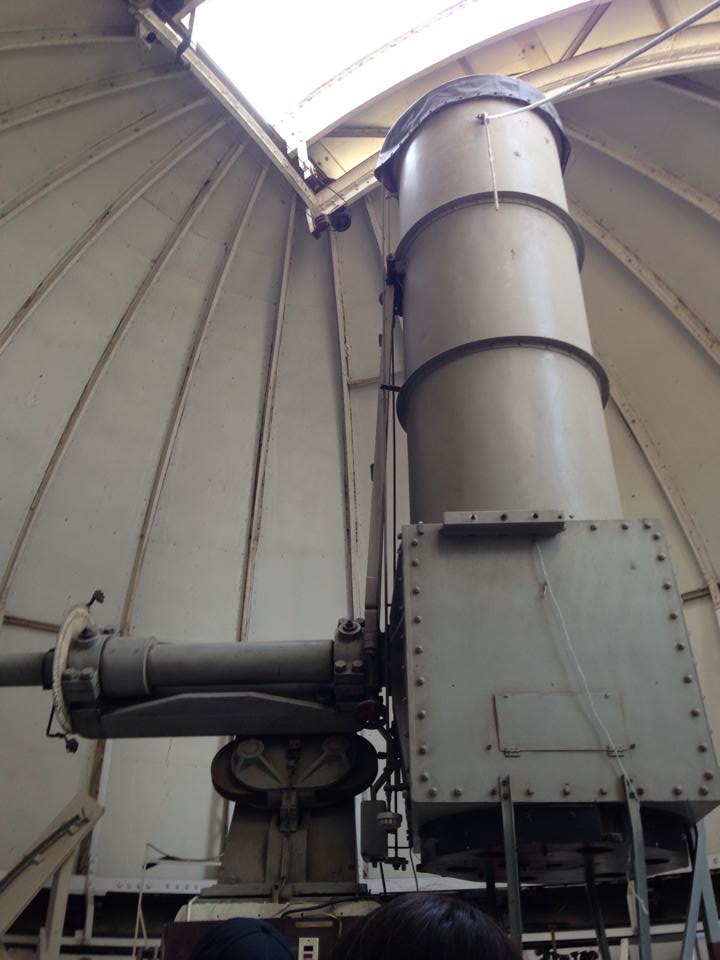
The observatory is located in the Santiago Metropolitan Park and became a national monument in 2010. The main telescope is a cassegrain reflector with a 0.93 m (3.1 ft) aperture and an equatorial mount. This instrument is housed inside a rotating dome.
In 1897, the astronomer William Wallace Campbell, assisted by William H. Wright, began a program of measuring the radial velocity of all stars in the northern hemisphere having an apparent visual magnitude of 5.51 or brighter. This task was facilitated by the newly installed Mills spectrograph, which was attached to the 91 cm (36 in) telescope at the Lick Observatory. This instrument was specifically designed for photographing stellar spectra, and was made possible by a grant from the banker Darius O. Mills. It saw first use in May 1895 and proved highly successful, improving accuracy by an order of magnitude over previous instruments. The design included three prisms and an iron arc comparison system. However, there were flexure and light loss issues that limited its capabilities. By 1903, an improved design allowed measurements of stars at fainter magnitudes.
In 1894 Campbell first recognized the need for similar radial velocity measurements of stars in the Southern Hemisphere. This would allow a more complete investigation of the Solar System's motion with respect to the neighboring stars. The director of the Lick observatory, James Edward Keeler, died on August 12, 1900, and Campbell was named to succeed him as of January 1, 1901. When Campbell brought the need for a southern observatory to the attention of D. O. Mills, the banker agreed to finance this expedition. In sum, an amount of $26,075 would be provided, to cover the cost of instruments, building construction, salaries, travel expenses, and supplies for this two year expedition. This is equivalent to $985,531 in 2024. The plan was for the completed observatory to be a much less costly duplicate of the spectroscopic capabilities of the instruments used for the northern survey. The resulting cost was one eighteenth the cost of the Lick observatory main telescope. For the observatory location, Campbell initially considered possible sites in Australia. However, climate records and the reports from other astronomers indicated that Chile would be a better site. He finally settled on placing it in the vicinity of the Chilean capital of Santiago, so that supplies and living quarters would be readily available.
The Lick observatory had a spare 92 cm (36.25 in) silvered parabolic glass mirror in its possession, but the shape was imperfect. After deciding on a Cassegrain-style reflecting telescope, during the spring of 1901 the mirror was shipped to the John A. Brashear Company in Allegheny for refiguring. However, the mirror broke while the central hole was being cut, so a new mirror had to be ordered. The mount was constructed by the Fulton Engine Works in Los Angeles, and it arrived at the observatory in December 1901. A rotating steel dome for the observatory was constructed by Warner and Swasey Company, and the spectroscope and other optics by Brashear. When the mirror arrived in 1902, it was found to be again shaped to the wrong figure and had to be returned for correction. With the schedule delayed, it was resolved that the instruments would be shipped to their final destination without testing the completed instrument. The finished mirrors arrived in February 1903, and, as a result, the expedition reached Chile in April at the start of the southern rainy season.
W. W. Campbell had intended to travel with the expedition, but he was severely injured while testing the equipment. Instead, the expedition was headed up by Campbell's associate, William H. Wright, with Harold K. Palmer as his assistant. They set sail from San Francisco on February 28, 1903 in the Pacific Mail steamship Peru. After transferring to the steamship Columbia at Panama, they arrived at Valparaíso on April 18. After a month-long delay due to a riotous strike in the port, the gear was unloaded and then transported 193 kilometres (120 miles) to Santiago by rail. There they were greeted by members of the Chilean government, who had agreed to assist by prior arrangement.
After a search for a suitable site for the observatory, the middle rise of the Cerro San Cristóbal was settled upon as the best location for meeting Campbell's general requirements. This ridge is located in the northeastern suburbs of Santiago, with a height of around 262 metres (860 ft) above the city. This placed it above the dust and haze of the urban area, and free of the frequent fogs that occurred in the valley. Even better, the temperature range on the mount was found to be lower than below. Unfortunately the weather was unusually cloudy that year, limiting observation tests. Late in May the strike ended in Valparaíso, which allowed the observatory equipment to be shipped and construction begun.
Hub AI
Manuel Foster Observatory AI simulator
(@Manuel Foster Observatory_simulator)
Manuel Foster Observatory
The Observatorio Manuel Foster, or Manuel Foster Observatory, is an astronomical observatory constructed on Cerro San Cristóbal near Santiago, Chile in 1903. This site was originally known as the D. O. Mills Observatory after the philanthropist Darius Ogden Mills. It was built as an offshoot of the Lick Observatory to observe stars in the southern hemisphere, and, under the direction of the American astronomer W. W. Campbell, was used in an extensive project to determine the apex of the Sun's motion through space.
The initial funding for the project financed operations for a two year period. Because Campbell had been seriously injured, the expedition was headed up by his assistant, William H. Wright. After setting up the telescope and the observation dome, the instrument quality was found to be satisfactory and operations began late in 1903. A total of 800 spectrograms had been successfully collected by October 1905. Heber D. Curtis took over operations in March 1906, and new financing from Mills allowed improvements to the observatory. Using the data collected from this observatory, Campbell completed his study on the motion of the Sun in 1926. With added funding, operations continued at the observatory until 1928, when it was purchased by Chilean lawyer Manuel Foster Recabarren for the Universidad Católica de Chile and transferred to their control.
The observatory is located in the Santiago Metropolitan Park and became a national monument in 2010. The main telescope is a cassegrain reflector with a 0.93 m (3.1 ft) aperture and an equatorial mount. This instrument is housed inside a rotating dome.
In 1897, the astronomer William Wallace Campbell, assisted by William H. Wright, began a program of measuring the radial velocity of all stars in the northern hemisphere having an apparent visual magnitude of 5.51 or brighter. This task was facilitated by the newly installed Mills spectrograph, which was attached to the 91 cm (36 in) telescope at the Lick Observatory. This instrument was specifically designed for photographing stellar spectra, and was made possible by a grant from the banker Darius O. Mills. It saw first use in May 1895 and proved highly successful, improving accuracy by an order of magnitude over previous instruments. The design included three prisms and an iron arc comparison system. However, there were flexure and light loss issues that limited its capabilities. By 1903, an improved design allowed measurements of stars at fainter magnitudes.
In 1894 Campbell first recognized the need for similar radial velocity measurements of stars in the Southern Hemisphere. This would allow a more complete investigation of the Solar System's motion with respect to the neighboring stars. The director of the Lick observatory, James Edward Keeler, died on August 12, 1900, and Campbell was named to succeed him as of January 1, 1901. When Campbell brought the need for a southern observatory to the attention of D. O. Mills, the banker agreed to finance this expedition. In sum, an amount of $26,075 would be provided, to cover the cost of instruments, building construction, salaries, travel expenses, and supplies for this two year expedition. This is equivalent to $985,531 in 2024. The plan was for the completed observatory to be a much less costly duplicate of the spectroscopic capabilities of the instruments used for the northern survey. The resulting cost was one eighteenth the cost of the Lick observatory main telescope. For the observatory location, Campbell initially considered possible sites in Australia. However, climate records and the reports from other astronomers indicated that Chile would be a better site. He finally settled on placing it in the vicinity of the Chilean capital of Santiago, so that supplies and living quarters would be readily available.
The Lick observatory had a spare 92 cm (36.25 in) silvered parabolic glass mirror in its possession, but the shape was imperfect. After deciding on a Cassegrain-style reflecting telescope, during the spring of 1901 the mirror was shipped to the John A. Brashear Company in Allegheny for refiguring. However, the mirror broke while the central hole was being cut, so a new mirror had to be ordered. The mount was constructed by the Fulton Engine Works in Los Angeles, and it arrived at the observatory in December 1901. A rotating steel dome for the observatory was constructed by Warner and Swasey Company, and the spectroscope and other optics by Brashear. When the mirror arrived in 1902, it was found to be again shaped to the wrong figure and had to be returned for correction. With the schedule delayed, it was resolved that the instruments would be shipped to their final destination without testing the completed instrument. The finished mirrors arrived in February 1903, and, as a result, the expedition reached Chile in April at the start of the southern rainy season.
W. W. Campbell had intended to travel with the expedition, but he was severely injured while testing the equipment. Instead, the expedition was headed up by Campbell's associate, William H. Wright, with Harold K. Palmer as his assistant. They set sail from San Francisco on February 28, 1903 in the Pacific Mail steamship Peru. After transferring to the steamship Columbia at Panama, they arrived at Valparaíso on April 18. After a month-long delay due to a riotous strike in the port, the gear was unloaded and then transported 193 kilometres (120 miles) to Santiago by rail. There they were greeted by members of the Chilean government, who had agreed to assist by prior arrangement.
After a search for a suitable site for the observatory, the middle rise of the Cerro San Cristóbal was settled upon as the best location for meeting Campbell's general requirements. This ridge is located in the northeastern suburbs of Santiago, with a height of around 262 metres (860 ft) above the city. This placed it above the dust and haze of the urban area, and free of the frequent fogs that occurred in the valley. Even better, the temperature range on the mount was found to be lower than below. Unfortunately the weather was unusually cloudy that year, limiting observation tests. Late in May the strike ended in Valparaíso, which allowed the observatory equipment to be shipped and construction begun.