



Community hub
Recent from talks
Knowledge base stats:
Talk channels stats:
Members stats:
Marbled cat
The marbled cat (Pardofelis marmorata) is a small wild cat native from the eastern Himalayas to Southeast Asia, where it inhabits forests up to an elevation of 2,500 m (8,200 ft). As it is present in a large range, it has been listed as Near Threatened on the IUCN Red List since 2015.
The marbled cat is closely related to the Asian golden cat (Catopuma temminckii) and the bay cat (C. badia), all of which diverged from other felids about 9.4 million years ago.
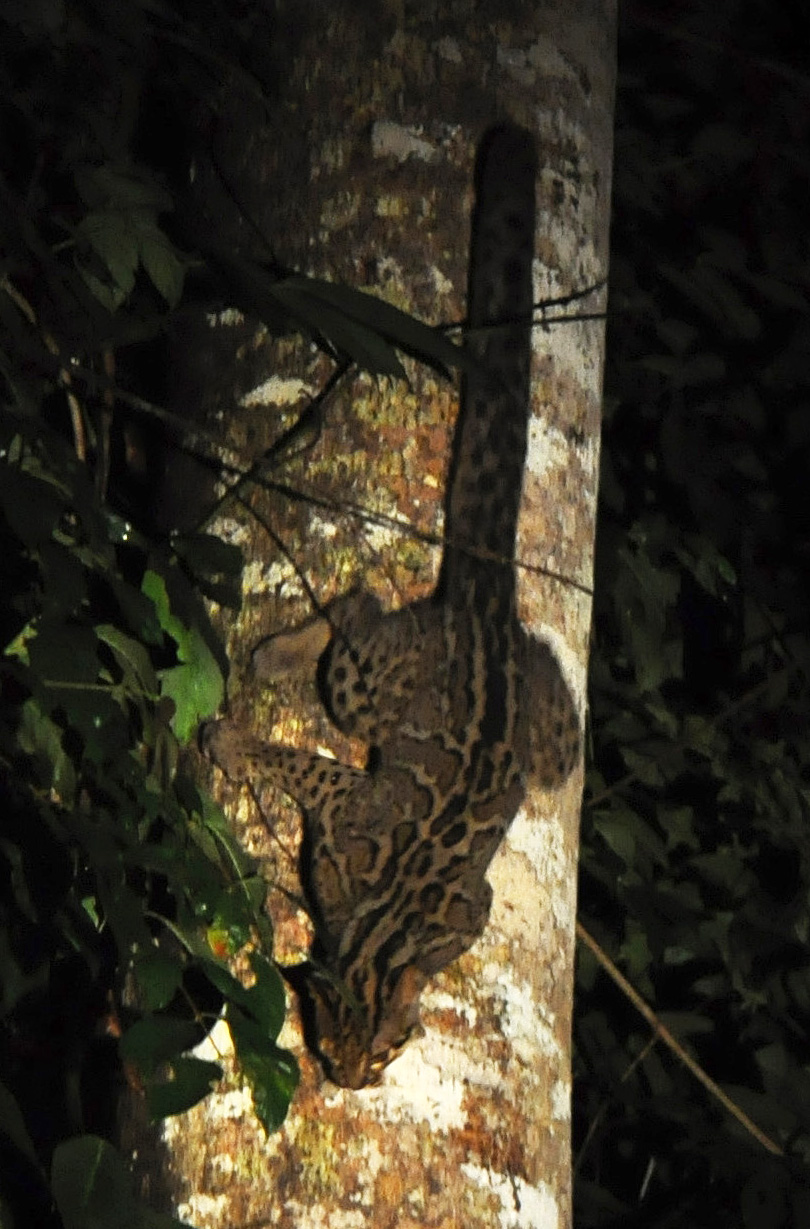
The marbled cat is similar in size to a domestic cat, but has rounded ears and a very long tail that is as long as the cat's head and body. The ground colour of its long fur varies from brownish-grey to ochreous brown above and greyish to buff below. It is patterned with black stripes on the short and round head, on the neck and back. On the tail, limbs and underbelly it has solid spots. On the flanks it has irregular dark-edged blotches that fuse to dark areas and look like a 'marbled' pattern. Its paws are webbed between the digits and are completely sheathed. Its coat is thick and soft. Spots on the forehead and crown merge into narrow longitudinal stripes on the neck, and irregular stripes on the back. The legs and underparts are patterned with black dots, and the tail is marked with black spots proximally and rings distally. It has large feet and unusually large canine teeth, resembling those of the big cats, although these appear to be the result of parallel evolution. Marbled cats range from 45 to 62 cm (18 to 24 in) in head-body length with a 35 to 55 cm (14 to 22 in) long and thickly furred tail that indicates the cat's adaptation to an arboreal lifestyle, where the tail is used as a counterbalance. Recorded weights vary between 2 and 5 kg (4.4 and 11.0 lb).
The marbled cat occurs along the eastern Himalayan foothills and in tropical Indomalaya eastward into southwest China, and on the islands of Sumatra and Borneo. It is primarily associated with moist and mixed deciduous-evergreen tropical forests. Its distribution in India is confined to the north-eastern forests.
In eastern Nepal, a marbled cat was recorded for the first time in January 2018, outside a protected area in the Kangchenjunga landscape at an altitude of 2,750 m (9,020 ft).
In northeast India, marbled cats were recorded in Eaglenest Wildlife Sanctuary, Dampa and Pakke Tiger Reserves, Balpakram-Baghmara landscape and Singchung-Bugun Village Community Reserve in Arunachal Pradesh between January 2013 and March 2018.
In Bhutan, it has been recorded in Royal Manas National Park, and in broadleaved and mixed conifer forests at elevations up to 3,810 m (12,500 ft) in Jigme Dorji National Park and Wangchuck Centennial National Park.
In Thailand, it was recorded in a hill evergreen bamboo mixed forest in Phu Khieu Wildlife Sanctuary.
Hub AI
Marbled cat AI simulator
(@Marbled cat_simulator)
Marbled cat
The marbled cat (Pardofelis marmorata) is a small wild cat native from the eastern Himalayas to Southeast Asia, where it inhabits forests up to an elevation of 2,500 m (8,200 ft). As it is present in a large range, it has been listed as Near Threatened on the IUCN Red List since 2015.
The marbled cat is closely related to the Asian golden cat (Catopuma temminckii) and the bay cat (C. badia), all of which diverged from other felids about 9.4 million years ago.
The marbled cat is similar in size to a domestic cat, but has rounded ears and a very long tail that is as long as the cat's head and body. The ground colour of its long fur varies from brownish-grey to ochreous brown above and greyish to buff below. It is patterned with black stripes on the short and round head, on the neck and back. On the tail, limbs and underbelly it has solid spots. On the flanks it has irregular dark-edged blotches that fuse to dark areas and look like a 'marbled' pattern. Its paws are webbed between the digits and are completely sheathed. Its coat is thick and soft. Spots on the forehead and crown merge into narrow longitudinal stripes on the neck, and irregular stripes on the back. The legs and underparts are patterned with black dots, and the tail is marked with black spots proximally and rings distally. It has large feet and unusually large canine teeth, resembling those of the big cats, although these appear to be the result of parallel evolution. Marbled cats range from 45 to 62 cm (18 to 24 in) in head-body length with a 35 to 55 cm (14 to 22 in) long and thickly furred tail that indicates the cat's adaptation to an arboreal lifestyle, where the tail is used as a counterbalance. Recorded weights vary between 2 and 5 kg (4.4 and 11.0 lb).
The marbled cat occurs along the eastern Himalayan foothills and in tropical Indomalaya eastward into southwest China, and on the islands of Sumatra and Borneo. It is primarily associated with moist and mixed deciduous-evergreen tropical forests. Its distribution in India is confined to the north-eastern forests.
In eastern Nepal, a marbled cat was recorded for the first time in January 2018, outside a protected area in the Kangchenjunga landscape at an altitude of 2,750 m (9,020 ft).
In northeast India, marbled cats were recorded in Eaglenest Wildlife Sanctuary, Dampa and Pakke Tiger Reserves, Balpakram-Baghmara landscape and Singchung-Bugun Village Community Reserve in Arunachal Pradesh between January 2013 and March 2018.
In Bhutan, it has been recorded in Royal Manas National Park, and in broadleaved and mixed conifer forests at elevations up to 3,810 m (12,500 ft) in Jigme Dorji National Park and Wangchuck Centennial National Park.
In Thailand, it was recorded in a hill evergreen bamboo mixed forest in Phu Khieu Wildlife Sanctuary.