Hubbry Logo
Joker Marchant StadiumJoker Marchant StadiumMain
Open search
Joker Marchant Stadium
Community hub
Joker Marchant Stadium
logo
8 pages, 0 posts
0 subscribers
Be the first to start a discussion here.
Joker Marchant Stadium
from Wikipedia

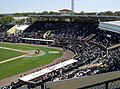
Publix Field at Joker Marchant Stadium is a baseball field in Lakeland, Florida. The 8,500-seat stadium was opened in 1966 and has had multiple renovations, most recently in 2017. It was named after local resident and former Lakeland Parks and Recreation Director Marcus "Joker" Marchant. It is the spring training home of the Detroit Tigers and the regular-season home of the minor league affiliates Lakeland Flying Tigers and Gulf Coast Tigers.

Key Information

Joker Marchant Stadium was the one of several host venues for the 1974 Amateur World Series, the first and only edition of the tournament (later renamed the Baseball World Cup) to be held in the United States.[3]

On March 15, 2011, the largest crowd in the stadium's history (10,307 people) watched a spring training game between the Detroit Tigers and the Boston Red Sox.[4]

Expansions

[edit]

The stadium could seat 4,900 people when it opened in 1966. In 1988, a bleacher section was added down the left field line, increasing seating capacity to 7,027. In 2002, Joker Marchant Stadium was renovated. The State of Florida's $4.5 million grant was the biggest chunk of the financing, while the Polk County Tourist Development Council chipped in $2 million. The remainder of the renovation's cost was paid for by the Tigers and City of Lakeland, increasing capacity to its present 8,500.[1]

In October 2014, the Lakeland City Commission announced part of a new agreement with the Detroit Tigers included the start of a $37 million renovation and upgrade of the 50-year-old stadium, starting in April 2016[5][6] after Major League Baseball Spring Training. Funding provided in part by the Detroit Tigers, the City of Lakeland and Polk County. Two construction firms – Barton Malow of Southfield, Michigan, and Rodda Construction of Lakeland – were chosen by the City Commission to oversee the project. The Lakeland Flying Tigers – the Detroit Tigers' High Class 'A' Minor League club at the time – played their Florida State League season at Henley Field, 1.5 miles (2.4 km) away.

Naming rights

[edit]

Under a 20-year deal that ends in 2036, the stadium was renamed Publix Field at Joker Marchant Stadium on the first day of MLB's 2017 Spring Training. The Publix supermarket chain is headquartered in Lakeland and their hometown field is the only sports complex for which they have purchased naming rights. [7]

[edit]

References

[edit]
[edit]
Revisions and contributorsEdit on WikipediaRead on Wikipedia
from Grokipedia
Publix Field at Joker Marchant Stadium is a park located in , that serves as the home of the Major League Baseball's Detroit Tigers and the regular-season home of the , a affiliate in the . Opened on March 12, 1966, the stadium was constructed on the former site of the Lodwick School of Aeronautics and initially seated about 4,900 fans, with expansions increasing its capacity to 9,598 by the 2020s. Named in honor of Marcus "Joker" Marchant, the city's pioneering director who died in 1983 and played a key role in securing the Tigers' long-term presence in Lakeland starting in , the venue is part of the larger TigerTown complex that includes training fields and player development facilities. The stadium's development reflects Lakeland's deep ties to professional baseball, as the Detroit Tigers have conducted in the area since 1934, making it one of the oldest continuous sites in . Significant renovations in added seating and amenities, boosting capacity from its original footprint, while a $48 million renovation of the Tigertown complex, including a major overhaul of the stadium completed in 2017, introduced modern features like a climate-controlled , premium club areas, and improved sightlines to enhance the fan experience during games and events. In 2024-2025, a $9 million upgrade to the TigerTown complex added a covered half-field with , a fully enclosed air-conditioned , and upgraded bullpens. In 2016, Super Markets acquired , rebranding it as Publix Field at Joker Marchant Stadium while preserving Marchant's legacy through a prominent outside the main entrance depicting him alongside the company's founder, . Situated at 2301 Lakeland Hills Boulevard near Lake Parker and , the stadium not only hosts but also community events, underscoring its role as a central hub in Polk County's sports and recreational landscape. With dimensions of 340 feet to left field, 420 feet to center, and 330 feet to right, it provides a hitter-friendly environment that has witnessed numerous memorable moments in Tigers history, including games featuring Hall of Famers like and .

Overview

Location and ownership

Joker Marchant Stadium, officially known as Publix Field at Joker Marchant Stadium, is situated at 2301 Lakeland Hills Boulevard in Lakeland, Florida, USA. Its precise geographic coordinates are 28°4′29″N 81°57′3″W, placing it in the northern part of the city within Polk County. The stadium has been owned by the City of Lakeland since its opening in 1966, with the city also handling its operations and maintenance. The playing field features natural grass, specifically EMPIRE Zoysia sod, which supports high-quality baseball play year-round. In line with modern venue practices, Joker Marchant Stadium operates under a cash-free policy for parking and concessions, requiring all transactions to use credit/debit cards or mobile payments to streamline operations and enhance efficiency. The facility forms a key component of the larger TigerTown complex, serving as the central hub for activities in the area.

Capacity and field dimensions

Publix Field at Joker Marchant Stadium features a of 9,598, which can expand to over 10,000 spectators through the use of grass berms, party decks, and standing areas along the outfield perimeter. The playing field adheres to standard dimensions, measuring 340 feet to left field, 420 feet to center field, and 340 feet to right field, providing a symmetrical layout conducive to and minor league play. The stadium's record single-game attendance stands at 10,468, achieved during the Detroit Tigers' final 2025 home game against the on March 22. Originally constructed in 1966 with a capacity of 4,900 seats, the venue has undergone expansions, including a significant increase to 9,000 seats by 2003 and enhancements from the 2017 that support greater overall attendance without altering the core seating configuration.

History

Construction and opening

The construction of Joker Marchant Stadium was spearheaded by Marcus "Joker" Marchant, who served as the director of Lakeland's Department and played a pivotal role in advocating for the project to establish a dedicated facility for the Detroit Tigers' operations. As a longtime local official, Marchant oversaw the development process, ensuring the stadium met the needs of while integrating into the community's recreational landscape. The facility was named in his honor to recognize his contributions. Groundbreaking occurred in September 1965, with construction progressing rapidly over the following months to utilize a structure that provided durability for year-round use. The total cost of the project amounted to $360,000, equivalent to about $3.57 million in 2025 dollars based on adjustments. Upon completion in early 1966, the stadium featured an initial of 4,900, designed to accommodate fans and players in a compact, efficient layout. Joker Marchant Stadium made its debut on March 12, 1966, hosting the Detroit Tigers' spring training opener against the . The Tigers secured a 4-2 victory in the inaugural contest, drawing an attendance of 4,919 spectators to mark the official start of operations at the new venue.

Early usage and notable events

Upon its opening in 1966, Joker Marchant Stadium immediately became the home for the Detroit Tigers' operations, a role it has fulfilled continuously since, marking the longest such partnership in history. The Tigers, who had trained in Lakeland since 1934 at previous venues like Henley Field, transitioned to the new facility to accommodate their growing needs during the Grapefruit League season. In addition to , the stadium hosted early through the Lakeland Tigers, the Tigers' Class A affiliate in the , beginning in 1966 following the team's affiliation establishment in 1964. These tenancies provided local fans with regular , complementing the major league exhibitions and helping establish the venue as a hub for Tigers-affiliated play in . A significant early international event at the stadium was its role as one of the host venues for the 1974 Amateur World Series, the inaugural edition of the tournament featuring national teams from around the globe, held across several sites. This competition, which drew amateur players including future professionals, showcased the stadium's capability for high-profile baseball just eight years after its debut. With an initial seating capacity of 4,900, the stadium saw notable early crowds for games and matches, though figures from the pre-1980s were modest by modern standards; for instance, the Lakeland Tigers drew a seasonal total of around 46,000 fans in 1980, averaging under 700 per game. Throughout the and into the , the facility underwent general maintenance and minor updates to sustain operations and address wear from regular use, including basic improvements to seating and infrastructure without major overhauls.

Renovations and expansions

Pre-2017 developments

In 1988, Joker Marchant Stadium underwent its first major expansion with the addition of a large section along the left field line, boosting the from 4,900 to 7,027. This upgrade addressed growing attendance demands for Detroit Tigers games and matches hosted by the Lakeland Tigers. The stadium received another significant renovation in 2002–2003, which increased capacity further to 8,500 through the addition of a sodded left-field accommodating up to 500 spectators, new box seats, and the relocation of bullpens to the right-center field area. Key improvements included replacing grandstand seating with modern molded plastic chairs equipped with cup holders, installing five elevated handicapped seating areas, widening stairways with handrails, expanding concessions and restrooms, and upgrading the visitors' dressing room to major league standards. The project, costing approximately $10.5 million, was financed through a combination of public and private contributions, including a $4.5 million grant from the State of , $2 million from the Polk County Tourist Development Council, $1.5 million from the Detroit Tigers, and $1 million from the City of Lakeland. These efforts reflected strong community support, with local revenues playing a pivotal role in sustaining the Tigers' long-term presence in Lakeland. Earlier incremental enhancements laid the groundwork for these expansions, such as the 1971 installation of permanent lighting for $160,000, which enabled the stadium's first night game on March 31, 1972, and expanded scheduling flexibility. Ongoing seating adjustments and minor structural tweaks in the intervening years focused on safety and comfort without a full redesign, setting the stage for the comprehensive 2017 overhaul.

2017 major renovation

The 2017 renovation of Joker Marchant Stadium represented a comprehensive modernization effort for the Detroit Tigers' facility in , transforming its infrastructure to meet contemporary standards for player performance and operational efficiency. The project commenced in early April 2016, immediately following the conclusion of the Tigers' 2016 , and spanned approximately 15 months, with major phases including in April 2016, completion of clubhouse and office structures by December 2016, and final work wrapping up in January 2017 ahead of the February opening. Officially budgeted at $37 million under the 2014 lease agreement between the Tigers and the City of Lakeland, the total cost was reported variably in media accounts as ranging from $40 million to $48 million, reflecting the scale of additions exceeding 75,000 square feet across the and adjacent facilities. Funding for the renovation was led by the Detroit Tigers organization, supplemented by contributions from local and state entities to support the facility's role in the regional economy. The Tigers committed $530,000 annually over 20 years as rent and management fees, while the City of Lakeland provided $190,000 per year, Polk County allocated $14.56 million through its Tourist Development Council, and the contributed $20 million via its Retention Program. This public-private partnership ensured the project's completion without disrupting the long-term lease extension through 2034. Among the key structural enhancements were a new canopy roof over the seating along the first- and third-base lines, replacing exposed to provide greater shade and protection from Florida's intense sun. The playing field underwent significant improvements, including a 22-inch lowering, complete rebuild, and enhanced drainage system that reduced post-rain recovery time to 20 minutes, at a cost of $600,000 for the field work alone. Clubhouse expansions featured a new 60-player facility with cherrywood lockers, a 9,400-square-foot weight room equipped for $500,000, pools, and integrated batting cages, all housed in a three-story building that also included administrative offices. These changes, totaling $20 million for the clubhouse and offices, marked a substantial upgrade from the prior structures. Construction necessitated temporary relocations for affiliated teams to maintain operations, with the Class A shifting their home games to nearby Henley Field for the 2016 summer season amid the demolition and rebuild. The Tigers major league squad continued workouts at Joker Marchant Stadium and adjacent Tigertown fields during the 2016-2017 offseason, adapting to phased construction. Upon completion, the renovated confirmed a of 8,500, incorporating 2,800 new armchair seats in place of older benches while preserving the overall footprint. This capacity supported the facility's debut under its new sponsorship with Super Markets, aligning the upgrades with enhanced fan and player experiences for the 2017 season.

2025 and future upgrades

In preparation for the 2025 season, the Detroit Tigers completed a $9 million upgrade to the TigerTown complex adjacent to Joker Marchant Stadium, focusing on player development facilities. Key enhancements included a covered half-field with for all-weather practice sessions, climate-controlled hitting tunnels equipped with batting cages to allow indoor training during inclement weather, and additional spaces for strength and conditioning work. These improvements, unveiled in February 2025, directly supported the Tigers' operations by providing protected environments for daily workouts and skill development, minimizing disruptions from Florida's variable weather and enabling more consistent preparation for and major league players. Building on post-2017 investments in the Lakeland facilities, the Tigers and the City of Lakeland held a groundbreaking ceremony on September 10, 2025, for a new $33 million player development academy at TigerTown. The project, primarily funded by the organization in partnership with the city, aims to modernize infrastructure originally developed decades ago. Scheduled to open in , the four-story, 59,000-square-foot academy will replace the aging Fetzer Hall dormitory and serve as a year-round hub for players, featuring upgraded dormitories, a dining hall, medical training rooms, and integrated spaces for on-site coaching and analytics within the broader TigerTown complex. This facility will enhance the Tigers' pipeline by providing advanced, centralized resources for physical conditioning, nutrition, and skill refinement, fostering long-term player growth.

Facilities and features

Stadium amenities for fans

The 360-degree walkable , introduced as part of the 2017 , encircles the entire field and provides fans with panoramic views from any vantage point, enhancing mobility and sightlines during games. This open design facilitates easy access to restrooms, concessions, and other services without interrupting the game experience. Family-oriented spaces include an interactive kids zone adjacent to the berm, featuring a 27-foot inflatable bounce house modeled after the mascot, Southpaw, along with playground equipment for young visitors. Behind center field, a spacious area allows children to play and even attempt to catch warm-up home runs, fostering a relaxed, engaging atmosphere for families. These features complement the berm's grass seating, where groups can spread out on the hillside for informal viewing. Premium seating options cater to diverse preferences, including air-conditioned indoor suites for climate-controlled comfort and shaded areas in the upper levels. Picnic areas with tables and drink rails in support group outings, while all-inclusive indoor/outdoor packages offer dedicated lounges with food and beverage service. The stadium operates as a cash-free venue, with parking and concessions accepting only credit or debit cards to streamline transactions and reduce wait times. is available on-site with attendants processing payments digitally, and additional options like nearby church lots provide affordable alternatives at around $5 per vehicle. Concessions feature a variety of local and standard fare, including diverse snacks accessible from multiple stands along the . Accessibility enhancements include wheelchair-accessible seating throughout all sections, with companion seats and electric outlets for mobility devices in designated areas. The 360-degree concourse improves navigation for those with mobility needs, and dedicated support is available via the stadium's ticket office at (863) 413-4140, which handles accessibility inquiries. Game-day experiences are further elevated by high-definition video boards for replays and announcements, expanded shaded seating to combat Florida heat, and family activities that promote an inclusive environment.

TigerTown training complex

TigerTown is an 84-acre player development complex adjacent to Publix Field at Joker Marchant Stadium in , serving as the Detroit Tigers' year-round hub for training, rehabilitation, and operations. The facility supports hundreds of players and staff during , off-season programs, and regular-season games for affiliates, with a focus on fostering for prospects transitioning to . Key components of TigerTown include six practice fields arranged behind the stadium's —Fields 1 through 4 in a cloverleaf configuration, plus Field and Field—along with climate-controlled indoor batting cages and expanded bullpen mounds for drills. clubhouses are housed in a three-story building near the right field concourse, complemented by dedicated weight rooms equipped for strength and conditioning. Additional amenities encompass a dining hall with kitchen facilities to nourish players, as well as medical and rehabilitation centers for injury recovery and performance optimization. The complex integrates seamlessly with the main stadium, allowing players to transition between game-day preparations and dedicated practice sessions on the adjacent fields and indoor facilities, thereby streamlining workouts and team activities during Spring Training and beyond. TigerTown's development has paralleled expansions at Joker Marchant Stadium, evolving from a basic Spring Training site since the Tigers' arrival in Lakeland in 1934—excluding a wartime hiatus—to a comprehensive center through renovations in 2003 and 2017 that added modern training infrastructure. Over the past decade, upgrades have transformed it into a full-fledged player development and rehab facility, supporting rookie-level Florida Complex League teams, Single-A Lakeland Flying Tigers, and instructional leagues. Access to TigerTown's training areas is restricted to Tigers personnel, prospects, Major Leaguers, and rehab players, with non-public policies ensuring privacy during practices; fans may observe select fields like 2, 3, and Field from behind outfield fences but are prohibited from entering the complex during sessions. Ongoing 2025-2027 enhancements include a new 60,000-square-foot Player Development Academy featuring dormitories, expanded dining, and recreational spaces to further bolster year-round operations.

Teams and tenancy

Detroit Tigers spring training

The Detroit Tigers have utilized Field at Joker Marchant Stadium as their primary venue for Grapefruit League games since the stadium's opening in 1966, marking the longest continuous tenancy for any MLB team at a single site. This arrangement allows the team to host annual exhibition contests against other American and National League clubs, typically spanning late February to late March, as part of preparations for the regular season. The stadium's location within the TigerTown complex facilitates integrated workouts and intrasquad scrimmages, enhancing the team's preseason operations. For the 2025 Grapefruit League season, the Tigers were scheduled to play 15 home games at Joker Marchant Stadium, beginning with an exhibition against the Philadelphia Phillies on February 22. Subsequent highlights included matchups against the Toronto Blue Jays on February 24 and March 3, the Boston Red Sox on February 27, and the New York Yankees on March 13 and 21, concluding with the on March 22. These games drew significant fan attendance, with the 2025 season representing the Tigers' 60th consecutive year at the venue. The Tigers' spring training presence has profoundly shaped Lakeland's and culture since 1966, generating an estimated $50 million annually for the local through spending on tickets, , dining, and merchandise. This influx supports thousands of jobs in and , while statewide activities, including the Tigers' games, contribute over $680 million to Florida's . Culturally, the team's longstanding residency fosters traditions, such as fan festivals and youth programs, reinforcing Lakeland's identity as a hub and drawing international s to experience the sport's informal, exhibition-style atmosphere. Joker Marchant Stadium has hosted several notable moments, including setting an all-time attendance record of 10,468 fans during a 2025 game against the . Rivalries with divisional foes like the and have been prominently featured in exhibition series, often drawing heated crowds and showcasing emerging talent in high-stakes intrasquad-like environments. The venue's history also includes memorable individual performances, such as Miguel Cabrera's home runs that previewed his regular-season prowess.

Minor league affiliates

Publix Field at Joker Marchant Stadium serves as the regular-season home for two Tigers minor league affiliates, providing a dedicated venue for their full-season play from to September each year. The , the Tigers' Single-A affiliate in the , have called the stadium home since it opened in 1966. This longstanding relationship dates back to the team's affiliation with beginning in , making it one of the longest continuous partnerships in . Following Major League Baseball's 2021 reorganization of the minor leagues, the Lakeland Flying Tigers transitioned from High-A to Single-A status, aligning with the restructuring that reduced levels and renamed leagues, including the return of the Florida State League designation. The team plays a 130-game schedule at the stadium, drawing fans to experience developing talent in a professional setting distinct from the seasonal spring training exhibitions. In 2024, the Flying Tigers attracted 40,392 total attendees across their home games, averaging 621 fans per contest, reflecting steady community interest in affordable, family-oriented baseball. In 2025, attendance increased to 52,147 total, averaging 401 fans per contest. The stadium also hosts the Tigers, Detroit's Rookie-level affiliate, for their short-season games typically running from June to August. This rookie team, formerly known as the Gulf Coast Tigers prior to the league restructuring, utilizes Field for key matchups while sharing the broader TigerTown complex for practices and development activities. These affiliates contribute to year-round operations at the facility, with games fostering local engagement through promotions and events separate from major league preparations. Community involvement is a hallmark of the affiliates' presence, with initiatives like the "Strike Out Hunger" program partnering with local organizations such as to donate funds for every during home games, supporting food insecurity efforts in Lakeland. Such programs enhance the stadium's role as a hub for regional , drawing families and boosting economic activity through game-day experiences that emphasize and player-fan interactions.

References

Add your contribution
Related Hubs
User Avatar
No comments yet.