Hubbry Logo
Martha CoreyMartha CoreyMain
Open search
Martha Corey
Community hub
Martha Corey
logo
8 pages, 0 posts
0 subscribers
Be the first to start a discussion here.
Martha Corey
Martha Corey
from Wikipedia

Martha Corey (née Panon; died September 22, 1692) was accused and convicted of witchcraft during the Salem witch trials, on September 9, 1692, and was hanged on September 22, 1692.[3] Her second husband, Giles Corey, was also accused and killed.

Key Information

Early life and marriages

[edit]

Born Martha Panon, somewhere within New England, her exact date of birth is unknown.[4] At least 20 years before her death, Martha had a mixed race son, Benoni, out of wedlock.[5] Benoni was thought to have an African or Native American biological father and represented, to the Puritans, living proof of Martha's sinful and shameful past.[6]

Martha married Henry Rich in 1684 and had a second son named Thomas Rich. After the death of her first husband, she married wealthy farmer Giles Corey in the year 1690. Benoni lived with Martha and her husband Giles, so town members were aware of him.[6] Giles also had a controversial past including petty theft and a trial for the murder of a servant boy. Both of their pasts may have contributed to their accusations and death in the Salem Witch Trials.[7]

Salem witch trials

[edit]

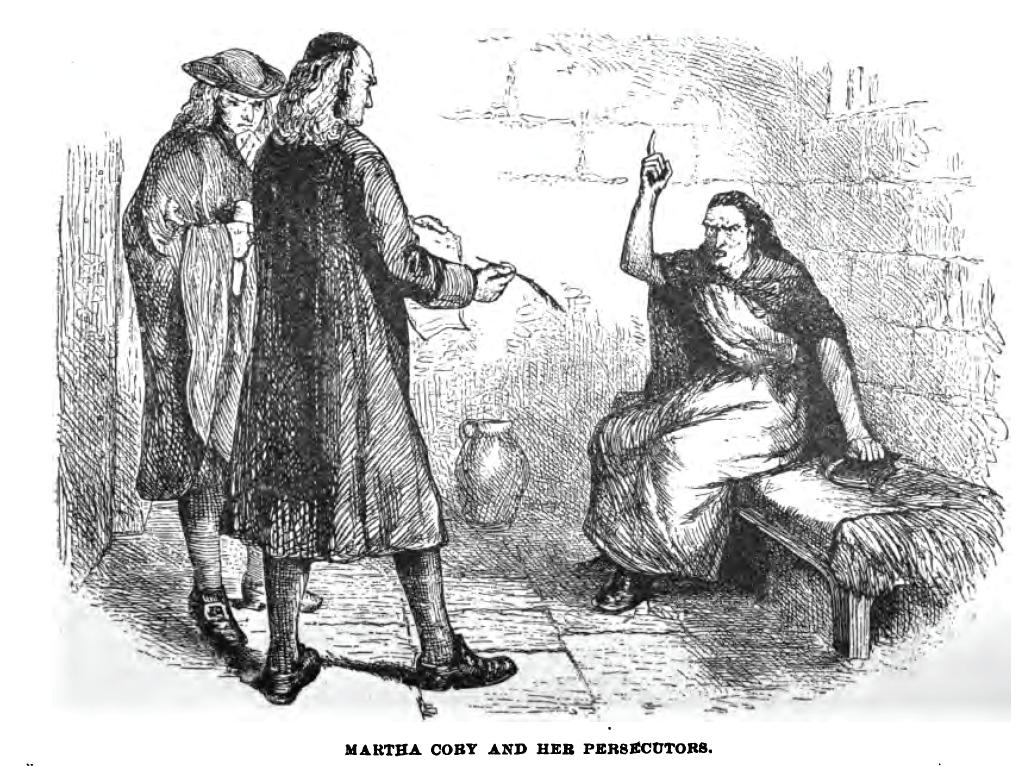
Still, Martha had attempted to turn away from her past transgressions. The community was surprised to see Corey accused, as she was known for her piety and dedicated church attendance, and had been officially admitted to the Salem Village Church in 1691.[8] She had never shown support for the witch trials, since she did not believe witches or warlocks existed. She publicly denounced the witch trials as well as the judges who were involved in the various cases.[6][9] She was outspoken in her belief that the accusers were lying, and upon hearing this, two young girls, Ann Putnam Jr. and Mercy Lewis, promptly accused her of witchcraft.

She was unaware of the level of paranoia in the village, and when she went to trial, she was simply truthful about her innocence and never doubted she would be exonerated. As the girls testified against her during examination, Corey asked the judge not to believe the rantings of hysterical children and continued to make similar claims throughout the Salem trials, so this combination made it easy for the afflicted girls to create a story accusing Corey.[6]

The girls began mimicking her movements as if they were being controlled by her. Mercy Lewis called out, "There's a man he whispered in her ear." John Hathorne asked Lewis if the man was Satan, then shortly Ann Putnam Jr. cried out that Martha Corey had a yellow bird sucking on her hand, which was enough evidence to persuade the jury of her guilt. By accusing her, the Putnam family established their power in the town and showed that they would willingly attack anyone who openly doubted their motives and authority.[6] She was hanged on September 22, 1692. She was 72 years old. This accusation represented a turning point in the Salem Witch Trials as Corey was a respected member of the church who had good economic and social standing within the community. After this, accusations escalated across social boundaries, and over one hundred women were eventually accused of witchcraft.[6]

Her husband, Giles, defended her against the allegations, and in due time he was also accused of witchcraft himself. He refused to undergo a trial and was executed by pressing, a slow crushing death under a pile of stones.[8][10] The main reason usually cited for his refusal to be tried or to say yea or nay was to keep his estate from being confiscated from his heirs. When the sheriff asked how he would plead, he responded only by asking for more weight. He died on September 19, 1692, three days before his wife Martha was hanged. Since he had not been convicted, his estate passed, in accordance with his last will and testament, to those of his children who had maintained that he was innocent.[11]

[edit]

In John Neal's 1828 novel Rachel Dyer, Martha Corey is depicted as aloof and lacking the mental capacity to understand her legal predicament during her trial.[12] After protagonist George Burroughs fails to defend her in court, the attention of the accusers turn to him and he is convicted and executed as a result.[13] Martha and Giles Corey are the central characters in Mary Eleanor Wilkins Freeman's play, Giles Corey, Yeoman, where Martha appears as a wronged innocent and Giles does not accuse her (instead the magistrates twist his words to implicate her).[14] They also feature in Henry Wadsworth Longfellow's play Giles Corey of the Salem Farms, where both are portrayed sympathetically as victims of local power struggles.[15] Martha Corey and her husband are both characters in the Arthur Miller play The Crucible (although Martha is only heard off-stage). In the 1957 and 1996 film adaptations of Miller's play, she was depicted (on-screen) by Jeanne Fusier-Gir and Mary Pat Gleason, respectively. Martha Corey is also the titular character in Lyon Phelps's The Gospel Witch.[16]

References

[edit]

Sources

[edit]
  • Upham, Charles (1980). Salem Witchcraft. New York: Frederick Ungar Publishing Co., 2 vv., v. 1 p. 190, v. 2 pp. 38–42, 43–55, 111, 324, 458, 507.
[edit]
Revisions and contributorsEdit on WikipediaRead on Wikipedia
from Grokipedia
Martha Corey (died September 22, 1692) was a church member and wife of farmer Giles Corey in Salem Village, Province of Massachusetts Bay, who was accused of witchcraft, convicted based on spectral evidence, and executed by hanging during the 1692 Salem witch trials. Arrested on March 19, 1692, following complaints from Edward Putnam and Henry Kenney that she had harmed Ann Putnam and others through witchcraft, Corey underwent examination on March 21, where she denied the charges, affirmed her status as a "Gospel Woman," and questioned the validity of the accusers' fits. Indicted on August 5 for afflicting Elizabeth Hubbard and Mercy Lewis, her trial featured testimonies of spectral apparitions, including a yellow bird and a black man, which formed the basis of her conviction despite her steadfast denials. As one of the first full communicants of the church to face such accusations, Corey's case highlighted the extension of suspicions beyond social outcasts and fueled emerging skepticism toward the proceedings, exemplified by her own challenges to the afflicted girls' claims. Her husband Giles was subsequently accused and died under judicial pressing on September 19 for refusing to enter a plea, further underscoring the trials' harsh methods.

Early Life and Background

Origins and Childhood

Martha Corey, born Martha Panon, entered the world in the early seventeenth century, with historical estimates placing her birth circa 1620, though precise records of the date, location, or parentage are absent from surviving colonial documentation. Accounts differ on her birthplace, with some suggesting prior to immigration and others indicating the itself amid the wave of Puritan settlement. Her family's origins are equally undocumented, reflecting the era's limited record-keeping for non-elite women in frontier communities. Panon's early years unfolded in the austere Puritan milieu of , where children were raised under strict Calvinist doctrines emphasizing , , and communal moral vigilance from infancy. Daily life centered on familial labor in or small-scale , essential for survival in a harsh environment prone to crop failures, disease outbreaks, and territorial disputes with indigenous tribes. These pressures, including sporadic raids and wars like the of 1637, cultivated a collective psyche attuned to interpreting misfortunes through lenses of and providential , though specific anecdotes from Panon's childhood do not survive. The scarcity of personal details underscores broader archival gaps for women of her station, with Puritan emphasis on and civil records favoring male or communal events over individual biographies. By adulthood, Panon had integrated into Salem's settler society, but her formative experiences likely mirrored those of contemporaries: rote scriptural , household chores from a young age, and indoctrination into the colony's theocratic order.

First Marriage and Family

Martha Corey married Henry Rich, a resident of Salem, around 1684. Prior to this union, she had given birth to an illegitimate mixed-race son named Benoni circa 1677, a fact that generated local questioning her and the legitimacy of her offspring, though it did not result in formal at the time. With Rich, Corey bore at least one legitimate son, Thomas Rich, establishing a amid these lingering rumors of impropriety. Henry Rich died sometime between 1684 and 1690, leaving Corey a who retained control over family property in a colonial society where women's independent landholding was uncommon and often viewed with suspicion. This status highlighted her resourcefulness, as she managed without apparent legal challenges, despite the patriarchal norms that typically subordinated widows' economic autonomy to male oversight. The pre-existing rumors about Benoni's parentage continued to shadow her reputation, serving as fodder for character attacks, yet Corey avoided or severe communal , demonstrating resilience in navigating personal scandals prior to her later associations in Salem Village.

Life in Salem Village

Marriage to Giles Corey

Martha Corey wed Giles Corey, an established farmer, in 1690 following the death of her first husband, Henry Rich, on April 27 of that year. The couple established their home on Giles' 150-acre farm in Salem Farms, located in what was then the southwestern outskirts of Salem Village and is now West , near the modern intersection of Pine and Johnson Streets. This property, acquired through Giles' prior endeavors after his relocation from Salem Town around 1659, underscored his relative prosperity as a amid ongoing local tensions over land boundaries and usage in the agrarian community. Giles Corey, born circa 1611 and thus in his late sixties at the marriage, brought a blended dynamic shaped by his two previous unions. His first wife, Margaret, had borne him at least four daughters before her death in 1664, several of whom remained connected to the household or village affairs into the 1690s. He had remarried Mary Bright on , 1664, producing a son, John, though she passed away in 1684. Martha, meanwhile, integrated her own son, Benoni (or Benjamin), from her union with Rich, who resided with the couple and contributed to farm labor. The Coreys produced no offspring together, with their domestic life centered on agricultural routines—tending crops, , and possibly hiring occasional help—while navigating interpersonal frictions inherent to Giles' reputation for assertiveness in property matters. These household interactions positioned the within Salem Village's web of neighborly exchanges, though insulated from the era's escalating religious and spectral controversies at this stage.

Social and Religious Standing

Martha Corey held formal membership in the Salem Village Church as a full communicant, a status achieved through rigorous examination of one's and under Puritan standards, which she attained by early 1691 after transferring from another congregation. This "gospel woman" designation, as she herself affirmed during questioning, reflected her participation in sacraments like the Lord's Supper and underscored a vetted religious standing that contrasted with unsubstantiated rumors from her earlier life, including irregularities surrounding her first marriage and the birth of a son, Benjamin, prior to her union with . Her consistent church attendance and professed piety positioned her as an exemplar of doctrinal adherence in a where such membership was not granted lightly, signaling communal despite any prior moral scrutiny. Socially, Corey resided on a 150-acre farm in the southwestern part of Salem Village (now ), owned by her husband Giles, a prosperous though illiterate farmer whose holdings placed the family among the area's more established households. As the wife of a substantial landowner, she engaged in the daily management of farm affairs, including interactions with neighbors over labor, livestock, and communal resources, roles that afforded her a degree of visibility uncommon for women in a patriarchal Puritan society emphasizing male authority and female subordination. This involvement highlighted her practical independence, as she navigated economic and interpersonal dynamics without evident deference to traditional constraints, though always within the bounds of marital and norms prior to the trials. Her status as a church member further elevated her social influence, allowing participation in village gatherings and deliberations where moral and communal issues arose, fostering a reputation for forthrightness rooted in her accepted position rather than marginalization.

Skepticism and Accusation in the Witch Trials

Public Doubts About Witchcraft Claims

In early March 1692, Martha Corey publicly questioned the validity of the accusations emerging in Salem Village, specifically challenging the convulsions and fits exhibited by the so-called afflicted girls during village examinations. She described the accusers as "poor distracted children" whose testimonies warranted no credence without tangible proof, arguing that their behaviors appeared contrived rather than . This arose from direct observation of the girls' selective episodes, which ceased or altered conveniently in the presence of suspected witches, suggesting pretense over genuine devilish affliction. Corey's doubts extended to the core mechanism of the accusations: , wherein accusers claimed visions of spirits or shapes tormenting them remotely. On March 12, 1692, when Edward Putnam and Ezekiel Cheever confronted her at home regarding potential , Corey tested the claims' reliability by inquiring whether Ann Putnam Jr. could accurately describe her clothing from afar, underscoring the logical inconsistencies in unverifiable spectral sightings. She maintained that such evidence lacked empirical foundation, insisting instead on adherence to principles and refusing to affirm pacts with the absent concrete indicators like physical marks or corroborated acts of maleficium. Her outspoken , delivered as a full church member in good standing, directly antagonized key accusers, including Ann Putnam Jr., who reported intensified spectral attacks following Corey's interrogations of the girls' authenticity. This positioned Corey as an internal restraint on the escalating , yet no records indicate any substantive of her own engagement in practices; her critiques stemmed from principled scrutiny amid communal fervor, not outright rejection of Puritan theology's framework.

Arrest and Initial Charges

Martha Corey was accused of witchcraft on March 19, 1692, when a warrant was issued by local magistrates claiming she had committed "sundry acts of Witchcraft" that injured Ann Putnam Sr., Ann Putnam Jr., , and through spectral torment. The accusations stemmed primarily from by the afflicted girls, who alleged that Corey's spirit had appeared to them, pinching and afflicting them despite her physical absence, a claim rooted in the prevailing acceptance of during the early stages of the trials. Her prior public skepticism toward the girls' fits—dismissing them as pretense during a March 18 church meeting—intensified the charges, as villagers interpreted her doubts as evidence of guilt in a community gripped by fear of hidden witches. Following the warrant, Corey was arrested on March 20 or 21, 1692, and subjected to an initial examination before magistrates and in Salem Village meetinghouse. During the proceeding, the accusers fell into violent fits upon her entrance, claiming her specter caused their convulsions, bit their hands, and appeared as a black man or bird; Corey consistently denied the charges, asserting she had never seen the devil or signed his book. No tangible evidence, such as poppets or harmful substances, was produced; the case relied entirely on the girls' unverifiable outbursts and supporting depositions from villagers who attested to Corey's odd behavior, like her reluctance to receive church sacraments. Corey was committed to jail shortly after the examination, initially held in Salem before transfer to Boston's facility, where conditions were harsh with inadequate food and shelter contributing to high mortality among prisoners. Her steadfast refusal to confess—viewing admission as lying and thus sinful—further fueled suspicions in a judicial framework that often equated denial with defiance of , escalating her from skeptic to without preliminary physical proof.

Trial and Execution

Court Proceedings and Evidence

Martha Corey was tried on September 9, 1692, before the Court of in Salem, where the prosecution relied primarily on and testimonies from the afflicted girls. Affliction accusers, including , , and Ann Putnam Jr., claimed Corey's specter appeared to them, inflicting pain through biting, pinching, and choking, and urging them to sign the Devil's book while accompanied by a yellow bird familiar. These accounts formed the core of the evidence, with no physical artifacts, such as the alleged book or bird, produced in court, nor witnesses to direct maleficium—harmful acts—against victims. Additional testimony drew from local disputes, including Elizabeth Booth's deposition alleging Corey caused the death of George Needham amid a quarrel over a loom, and claims linking her to the affliction of Thomas Gould's grandchildren. Corey mounted a vigorous defense during her March 21 examination and subsequent proceedings, denying witchcraft, proclaiming herself a "Gospel Woman," and labeling the accusers as "distracted" or unreliable; she questioned the validity of spectral visions, arguing they lacked empirical basis and could not convict. Despite her challenges, the court admitted these "invisible" proofs, correlating her courtroom gestures—like biting her lip—with the girls' reported fits, though Corey attributed such actions to innocent causes and requested opportunities for prayer, which were refused. The proceedings exemplified broader irregularities in the court, which privileged subjective spectral testimony over verifiable facts, a practice later discredited; while coerced confessions bolstered other cases, Corey's refusal to confess highlighted the system's dependence on unprovable personal experiences rather than tangible verification. Indictments against her, issued August 4, 1692, for acts like entertaining and afflicting individuals, proceeded without corroborative physical evidence, underscoring the trial's reliance on presumption and grudge-fueled narratives.

Conviction and Hanging

Martha Corey was convicted of witchcraft by the Court of on September 9, 1692, based on and testimonies from afflicted girls claiming her specter tormented them. During her trial, she entered a of not guilty and refused entreaties from John Hathorne to confess and seek , maintaining her innocence throughout the proceedings. On September 22, 1692, Corey was hanged on Gallows Hill (now identified as Proctor's Ledge) alongside seven others—Mary Easty, , , Mary Parker, Margaret Scott, Wilmot Redd, and Samuel Wardwell Sr.—marking the final executions by hanging in the episode. Her execution occurred three days after her husband Giles Corey's death by pressing on September 19, when he refused to enter a to avoid forfeiting to the . Corey's steadfast denial of guilt, without a , underscored her against the trial process amid mounting skepticism from provincial elites, contributing to the suspension of the special shortly thereafter.

Historical Interpretations and Controversies

Contextual Factors in the Salem Trials

The devastation wrought by (1675–1676), the deadliest conflict in American colonial history with losses exceeding those of the Civil War, profoundly shaped the psychological and cultural milieu of Essex County, including Salem Village, where over 800 English settlers perished alongside thousands of Native Americans. Puritan clergy, such as , framed the war's atrocities—raids, captivities, and massacres—as evidence of Satan's alliance with indigenous forces, interpreting Native successes as demonic incursions portending apocalyptic judgment on a covenant-breaking . This providential worldview persisted into the 1690s amid renewed border skirmishes, such as those tied to the in , blurring distinctions between earthly foes and spectral witches in colonists' minds, as argued by historian Mary Beth Norton in her analysis of how frontier traumas fueled perceptions of invisible diabolical agencies. In Salem Village specifically, entrenched factionalism exacerbated these tensions, centering on disputes over ministerial , land allocation, and economic orientation between agrarian villagers and the more commercial Salem Town. , installed as minister in 1689 amid contentious debates that split congregants into pro- and anti-Parris camps, embodied these rifts; his supporters, often from established farming families like the Putnams, clashed with opponents favoring ties to the prosperous port, leading to boycotts of church contributions and lawsuits by early 1692. Historians Paul Boyer and Stephen Nissenbaum document how these divisions, rooted in shifting property boundaries and resistance to village autonomy, created a volatile where accusations could settle old scores over and resources. Compounding these strains were legal and economic structures that incentivized prosecutions, as witchcraft convictions triggered property forfeitures under law modeled on English precedents, with estates escheating to the county to cover court costs and debts, often benefiting creditors or officials like who oversaw seizures. In , at least a dozen condemned individuals lost and valued in hundreds of pounds, providing tangible gains amid postwar and depreciating local economies strained by revoked colonial charters and mercantile disruptions. Underpinning the trials was a sincere 17th-century in as a verifiable causal mechanism for empirical harms like illness, crop failures, and livestock deaths, grounded in Biblical mandates (Exodus 22:18) and English statutory law, including the 1604 Witchcraft Act that had prompted over 500 executions across the Atlantic. precedents, such as the 1662 Hartford executions and earlier cases totaling around 50 accusations by 1690, reinforced this framework, where Puritan divines like viewed spectral assaults not as delusion but as real incursions by the Devil's agents, limited only by contemporaries' pre-scientific understanding of natural phenomena. These factors collectively primed Salem for an outbreak where misfortunes were attributed to human pacts with rather than coincidence or , setting the stage for skeptics like Martha Corey to face charges amid widespread .

Debates on Motivations and Evidence

Historians interpreting the Salem trials through a lens of evidentiary skepticism contend that Martha Corey's targeting arose from her public denunciation of the afflicted girls' claims, which undermined the trials' momentum by demanding tangible proof over purported fits and visions. This stance, voiced during examinations where she insisted on biblical standards for accusation, positioned her as a direct challenge to the court's reliance on unverified testimonies, leading Ann Putnam Jr. and Mercy Lewis to allege her specter tormented them shortly thereafter. Personal animosities and economic incentives further fuel debates, with some attributing accusations to retaliatory motives linked to Giles Corey's history of boundary disputes and lawsuits against figures like the Putnam family, whose involvement in accusations was prominent. While property forfeiture upon conviction provided state gain—evident in broader trial patterns where estates were inventoried for seizure—Corey's case highlights how skepticism intersected with grudges, as her church membership and prosperity made her an improbable witch in orthodox eyes yet a convenient target to sustain proceedings. Contemporaneous Puritan rationale defended as valid, rooted in where apparitions signified a breach with , allowing the to impersonate the innocent to implicate the guilty; endorsed this in print, viewing it as corroborative when aligned with other signs like malice toward accusers. Yet critiques, even from era figures like , exposed its flaws—susceptible to fabrication or demonic deception indistinguishable from truth—prompting its 1692 disallowance and underscoring causal reliance on subjective perceptions over empirical harm. Minority scholarly positions reject mass delusion frameworks, emphasizing accusers' calculated agency amid factional church divides and land pressures, where individuals like the Putnams leveraged claims for resolution of disputes rather than systemic alone; this view prioritizes verifiable interpersonal conflicts over generalized , attributing outcomes to opportunistic rather than collective breakdown.

Corey's Significance as a Skeptic

Martha Corey, a full communicant in the Salem Village church since 1690, publicly questioned the credibility of the afflicted girls' accusations and the explanations for their afflictions during the early stages of the trials. Her , rooted in the absence of tangible beyond spectral visions and hysterical testimonies, directly challenged the trials' foundational premise that invisible spirits inflicted harm, exposing the reliance on unverifiable claims as a form of causal error where temporal correlation was mistaken for direct causation. As one of the first church members accused on , , her case demonstrated that dissent from the invited retaliation, broadening suspicions beyond social marginals and alerting the community to the proceedings' arbitrary nature. This intolerance for Corey's critique amplified scrutiny of the evidentiary standards, particularly , which formed the bulk of testimony against her during her examination where accusers claimed her specter tormented them. Her prosecution as a pious contributed to the growing clerical reservations, culminating in Increase Mather's October 1692 publication Cases of Conscience Concerning Evil Spirits, which rejected absent physical corroboration, arguing it permitted the to impersonate innocents and thus failed first-principles tests of reliable proof. Corey's steadfast refusal to confess, in contrast to over fifty who did so to evade execution, underscored the trials' coercive dynamics and the fallacy of equating coerced admissions or unverified visions with guilt, thereby illuminating the need for empirical validation over testimonial presumption in determining causality.

Legacy and Posthumous Recognition

In October 1710, heirs and representatives of those executed for witchcraft during the 1692 Salem trials, including Martha Corey's family, began petitioning the for reversal of attainders and restitution of confiscated estates. On October 17, 1711, the legislature enacted Chapter 80 of the Resolves, formally reversing the attainders of , John Proctor, George Jacobs Sr., , Martha Carrier, and —explicitly including Martha Corey among those whose convictions were nullified. This legislative action restored civil rights to the condemned, vacated their attainders (which had forfeited property to ), and authorized compensation from the provincial treasury, drawn from escheated estates of the accused; Corey's heirs, like others, received partial reimbursement for losses, though exact amounts varied and were often modest relative to documented damages such as imprisonment fees and property seizures. Subsequent efforts built on this foundation without altering Corey's status, as her case had been addressed in 1711. In 1957, the Massachusetts legislature passed a resolve acknowledging the "great wrongs" committed in the witchcraft prosecutions, emphasizing procedural irregularities and judicial overreach rather than a wholesale rejection of supernatural claims; this did not introduce new reversals for Corey but reinforced the 1711 exonerations for historical reflection. Later resolutions, such as those in and , exonerated additional accused individuals overlooked in earlier acts but confirmed the comprehensive coverage of executed figures like Corey under the 1711 framework. No records indicate persistent compensation claims from Corey's direct descendants post-1711, with settlements largely concluding by the 1750s amid administrative disputes over funds; empirical assessments of trial records, including the absence of tangible evidence against Corey, align with the legislative vindication as affirming her factual innocence against unsubstantiated spectral testimony.

Depictions in Culture and Scholarship

Martha Corey features prominently in Arthur Miller's 1953 play , depicted as an upright Puritan woman arrested for witchcraft after her reading of books raises suspicions, with her off-stage denial of guilt underscoring principled opposition to the proceedings; this portrayal, while allegorical to mid-20th-century anti-communist purges, accurately reflects historical accounts of her toward accusers' claims. In 19th-century , Charles Wentworth Upham's two-volume Salem Witchcraft (1867) examines her examination transcript in detail, presenting her as a victim of flawed spectral testimony and courtroom theatrics, thereby critiquing the era's evidentiary standards without romanticizing her defiance. Modern scholarship, particularly post-2000 analyses, portrays Corey's public questioning of the afflicted girls' fits as a pivotal challenge to the trials' momentum, shifting focus from collective narratives to grounded fears of manipulation and jurisdictional overreach amid colonial border conflicts. Mary Beth Norton's In the Devil's Snare (2002) integrates her into broader causal explanations involving wartime anxieties and imperial pressures, countering oversimplified psychological tropes by emphasizing verifiable social and evidentiary breakdowns. These works highlight distortions in earlier cultural retellings, such as allegorical simplifications that underplay contextual , while affirming her role in eroding elite support for the prosecutions through rational dissent. Memorials in Salem commemorate Corey without embellishment, including the Giles and Martha Corey Memorial stones in West Peabody, erected to mark the site near their farm and inscribed with execution dates—September 19, 1692, for Giles by pressing, and September 22 for Martha by hanging—serving as tangible reminders of the trials' tangible human costs rather than mythic symbols. The adjacent Salem Witch Trials Memorial similarly lists her among the condemned, prioritizing historical specificity over interpretive narrative.

References

Add your contribution
Related Hubs
User Avatar
No comments yet.