


Community hub
Recent from talks
Contribute something
Nothing was collected or created yet.
Martin Baltimore
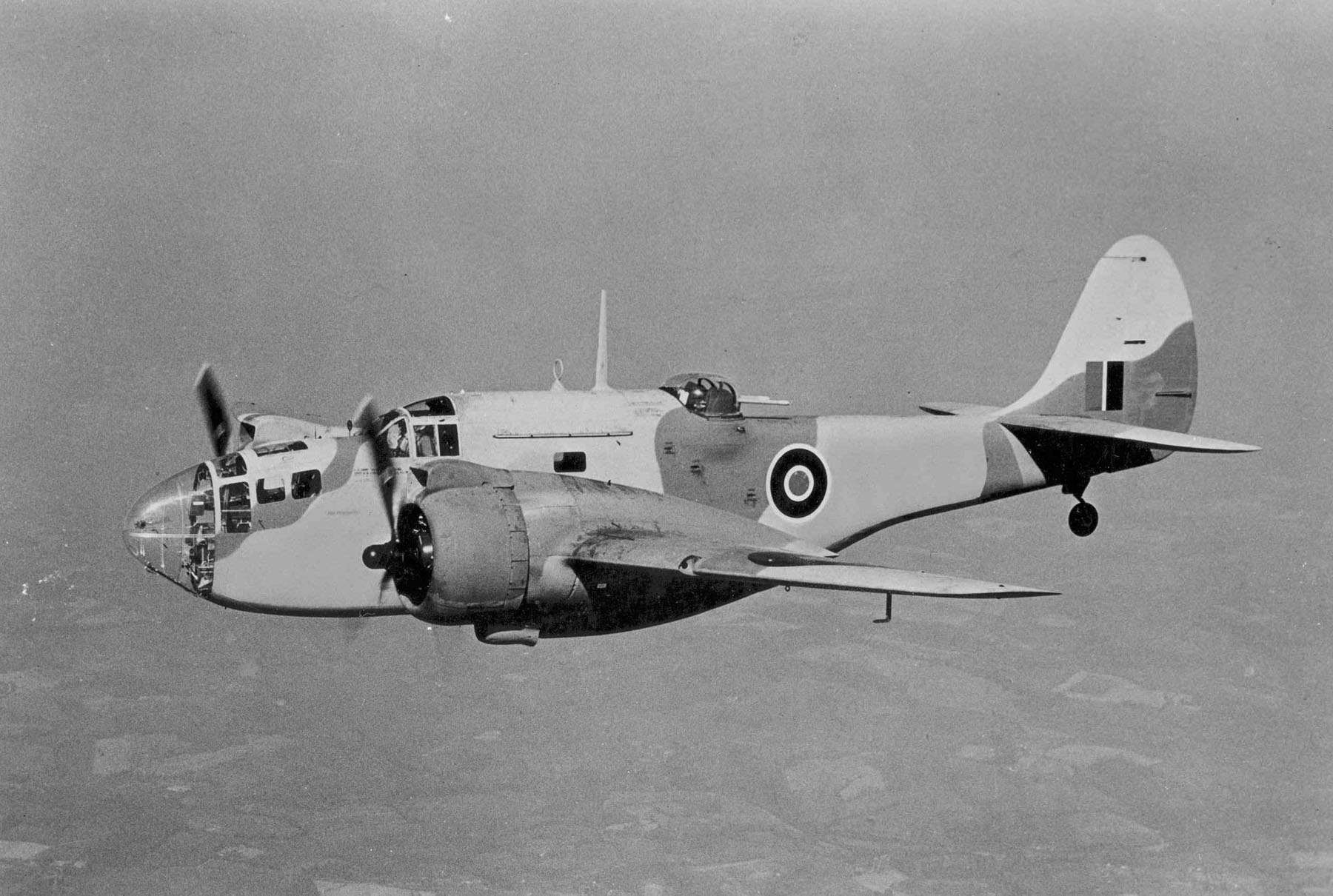
View on WikipediaThe Martin 187 Baltimore was a twin-engined light attack bomber built by the Glenn L. Martin Company in the United States as the A-30. The model was originally ordered by the French in May 1940 as a follow-up to the earlier Martin Maryland, then in service in France. With the fall of France, the production series was diverted to the United Kingdom and after mid-1941, supplied by the U.S. as Lend Lease equipment.
Key Information


Development of the Baltimore was hindered by a series of problems, although the type eventually became a versatile combat aircraft. Produced in large numbers, the Baltimore was not used operationally by United States armed forces but eventually served with the British, Canadian, Australian, South African, Hellenic and the Italian air forces.[1] It was subsequently used almost exclusively in the Mediterranean and Middle East theatre of World War II.
Design and development
[edit]Initially designated the A-23 (derived from the A-22 Martin 167 Maryland design), the Model 187 (company designation) had a deeper fuselage and more powerful engines. The Model 187 met the needs for a light-to-medium bomber, originally ordered by the Anglo-French Purchasing Commission as a joint project in May 1940. The French Air Force sought to replace the earlier Maryland; 400 aircraft being ordered. With the Fall of France, the Royal Air Force (RAF) took over the order and gave it the service name Baltimore. To enable the aircraft to be supplied to the British under the Lend-Lease Act the United States Army Air Forces designation A-30 was allocated.[a] With the passing of the Lend Lease Act two further batches of 575 and then 600 were provided to the RAF.
Operational history
[edit]
The first British aircraft were delivered in late 1941 to equip Operational Training Units. The RAF only used the Baltimores operationally in the Mediterranean theater and North Africa.[2] Many users were impressed by the step up that the Baltimore represented from older aircraft like the Bristol Blenheim. Users of the Baltimore and Martin pilot Benjamin R. Wallace, praised the aircraft for its heavy armament, structural strength, manoeuvrability, bombing accuracy and relatively high performance but crews complained of cramped conditions similar to those in the earlier Maryland bomber. The narrow fuselage made it nearly impossible for crew members to change positions during flight if wounded (the aircraft's interior structure separated the pilot and observer from the wireless operator and rear gunner, a characteristic shared with several light and medium bomber designs of that era including the Handley Page Hampden, Douglas Boston and Blenheim). Crews also complained about the difficulties in handling the aircraft on the ground. On takeoff, the pilot had to co-ordinate the throttles perfectly to avoid a nose-over or worse.[3]
First used in action to stop Rommel's advance, the Baltimore suffered massive losses when it was used as a low-level attack aircraft, in large part due to being unescorted.[1] Operating at medium altitude with fighter escorts, the Baltimore had a very low loss rate, with the majority of losses coming from operational accidents. Undertaking a variety of missions in the Middle East, Mediterranean and European theaters, the Baltimore's roles included reconnaissance, target-towing, maritime patrol, night intruder and as a somewhat uncomfortable fast transport. The Baltimore saw limited Fleet Air Arm service with aircraft transferred from the RAF in the Mediterranean to equip a squadron in 1944. Used in the anti-submarine role during the war, the Baltimore achieved moderate success, sinking up to eight U-boats.
The RAF also transferred aircraft to other Allies in the Mediterranean area. The Baltimore was used intensively in the Italian campaign to clear the road to Rome for advancing Allied forces after the Italian surrender on 3 September 1943.[3] After the Armistice between Italy and Allied armed forces an Italian-manned squadron, the 28th Bomber Wing, was equipped with ex-RAF Baltimores, becoming the co-belligerent Stormo Baltimore.[4] The Italians suffered considerable attrition during their training phase on the Baltimore. The majority of accidents were during takeoffs and landings due to the aircraft's fairly high wing loading, high approach speed and a directional stability problems during takeoffs. The Italians operated the Baltimore for about six months. Many of those operations were in Yugoslavia and Greece, providing air support for partisan forces or dropping supplies.
Most Baltimores were scrapped soon after the war, although one RAF squadron continued to use the type in Kenya where the aircraft were used in aerial mapping and locust control until 1948. In post-war service, the Baltimore took part in United States Navy instrument and control surface tests in the effort to break the sound barrier. With its powerful engines and light, yet robust construction, the aircraft was able to dive at high speed, reaching Mach .74 in tests.[1] All Baltimores were withdrawn from service by the end of 1949, the last one being retired on 23 December 1949.
In 2025, the wreck of a Royal Australian Air Force 454 Squadron Baltimore was discovered off the coast of the Mediterranean island Antikythera. On 3 December 1943, the plane had been on a reconnaissance mission from its base in Bengazi, Libya, when it was shot down by two Messerschmitt fighters.[5]
Variants
[edit]
- Baltimore B. I
- Fitted with 1,600 hp (1,193 kW) Wright GR-2600-A5B radial piston engines, armed with 10 0.303 in (7.7 mm) machine guns, eight fixed Brownings and two flexible Vickers K machine guns; all marks had two fixed 0.303 in (7.7 mm) Brownings in the leading-edge of each wing and four similar fixed guns, two on each side of the lower fuselage aft firing backwards, plus two flexible Vickers K guns in dorsal and ventral. 50 aircraft built.
- Baltimore B. II
- Defensive armament increased to 12 0.303 in (7.7 mm) machine guns including twin 0.303 in (7.7 mm) Vickers K machine guns in both the dorsal and ventral positions. Otherwise the same as the Mk I. 100 aircraft built.
- Baltimore B. III

- Modified Mk II design with defensive armament increased to 14 0.303 in (7.7 mm) guns by the replacement in the UK of the original dorsal turret with a hydraulically powered turret supplied by Boulton Paul fitted with four Browning machine guns. 250 aircraft built.
- Baltimore B. IIIa (A-30-MA)
- Ordered by USAAF and supplied under Lend-lease to the RAF, two 0.50 in (12.7 mm) machine guns in a Martin-built electrically powered dorsal turret. 281 aircraft built.
- Baltimore B. IV (A-30A-MA)
- USAAF order, lend-lease to RAF. Four 0.303 in (7.7 mm) Brownings machine guns in the wings. 294 aircraft built.
- Baltimore B. V (A-30A-MA)
- USAAF order, upgraded with two 1,700 hp (1,268 kW) Wright R-2600-29 radial piston engines, and with 0.50 in (12.7 mm) machine guns in the wings. 600 aircraft built.
- Baltimore GR. VI (A-30C-MA)
- Two prototypes built for maritime reconnaissance. They included a lengthened fuselage, accommodations for extra fuel tanks and a torpedo, and a Radome in nose. The whole program was cancelled in April 1944.[1]
All of the series were built for the RAF. A number were lost on delivery across the Atlantic Ocean when two ships carrying Baltimores were sunk.
Operators
[edit]
- Royal Australian Air Force
- No. 454 Squadron RAAF (Baltimore III, IV, V) (North Africa, Pescara Italy: February 1943 – 14 August 1945)
- No. 459 Squadron RAAF (Baltimore IV – V) (Mediterranean: July 1944 – March 1945)

- Royal Canadian Air Force
- Baltimore B. III FA187
- A single Baltimore was loaned to the RCAF by RAF Ferry Command for "special" project duties (1942)[6]
- Baltimore B. III FA187

- Free French Air Force
- GB 1/17

- Royal Hellenic Air Force
- RHAF 13 Light Bomber Squadron (Baltimore II, IV) (Gambut North Africa, Biferno Pescara Italy, Balkans: 1943–1945)

- Italian Co-Belligerent Air Force – 49 aircraft[7]
- 28° Gruppo (Stormo Baltimore) (1945 – February 1948)
- 132° Gruppo – 254 Wing RAF

- Italian Air Force operated 49 aircraft until 1947[8]

- South African Air Force
- No. 15 Squadron SAAF (Baltimore IIIa – V) (Mediterranean: 1943–1945)
- No. 21 Squadron SAAF. (Baltimore III – IV) (North Africa, Italy: 1942–1944)
- No. 60 Squadron SAAF (Baltimore II – III) (North Africa: 1942–1943)

- Turkish Air Force
- 1st Bomber Regiment

- Royal Air Force
- 1st Middle East Training Squadron
- No. 13 Squadron RAF (Baltimore IV – V) (Italy: 1944)
- No. 52 Squadron RAF (Baltimore IIIa – V) (Tunisia, Italy: February 1942 – February 1943)
- No. 55 Squadron RAF (Baltimore I – V) (Libya, Tunisia, Italy: 1942–1944)
- No. 69 Squadron RAF (Baltimore I – IV) (Mediterranean: 1942–1944)
- No. 162 Squadron RAF (Baltimore III) (Libya: 1943–1944)
- No. 203 Squadron RAF (Baltimore I, II, IIIa, V) (North Africa: 1942–1943)
- No. 223 Squadron RAF (Baltimore I – V) (North Africa, Italy: April 1941 – 12 August 1944)
- No. 249 Squadron RAF (Baltimore IV – V) (South-East Europe: October 1945 – April 1946)
- No. 500 Squadron RAF (Baltimore IV – V) (Italy: 1944–1945)
- No. 680 Squadron RAF (Baltimore III, V) (Italy: 1944)
- Fleet Air Arm
- 728 Naval Air Squadron (Baltimore GR IV – V) (Malta: September 1944 – October 1946)[9]
Surviving aircraft
[edit]Although the Baltimore was produced in greater numbers than any other Martin design except the B-26 Marauder, with 1575 produced, no aircraft have survived intact, although the wreckage of several are known to exist.[citation needed]
Specifications (Baltimore GR.V)
[edit]
Data from Jane's Fighting Aircraft of World War II.[10]
General characteristics
- Crew: four: pilot, navigator/bombardier, radio operator, gunner
- Length: 48 ft 6 in (14.8 m)
- Wingspan: 61 ft 4 in (18.7 m)
- Height: 14 ft 2 in (4.32 m)
- Wing area: 538.5 sq ft (50 m2)
- Empty weight: 15,991 lb (7,253 kg)
- Gross weight: 23,185 lb (10,900 kg)
- Powerplant: 2 × Wright GR-2600-A5B geared radial engines, 1,700 hp (1,268 kW) each
Performance
- Maximum speed: 305 mph (488 km/h, 295 kn) at 11,600 ft (3,540 m)
- Cruise speed: 224 mph (360 km/h, 195 kn)
- Range: 980 mi (1,577 km, 850 nmi)
- Wing loading: 46.2 lb/sq ft (226 kg/m2)
- Power/mass: 0.14 hp/lb (220 W/kg)
Armament
- Guns:
- 4 × wing mounted 0.30 in (7.62 mm) M1919 Browning machine guns
- 2–4 × 0.303 in (7.7 mm) machine guns in dorsal turret
- 2 × 0.303 in (7.7 mm) machine guns in ventral position
- provisions for up to 4 × fixed rear firing 0.303 in (7.7 mm) machine guns.
- Bombs: 2,000 lb (910 kg) carried internally
See also
[edit]Related development
Aircraft of comparable role, configuration, and era
Related lists
References
[edit]- Notes
- ^ under the provisions of Lend-Lease, aircraft supplied to Allied nations had first to be purchased by the USAAC and be taken onto that service's inventory. Thus, aircraft not requested by the USAAC had still to be allocated a USAAC designation, in this case 'A-30'.
- ^ a b c d Martin Model 187, marylandaviationmuseum.org, archived from the original on 2007-09-20, retrieved 17 June 2010
- ^ Rickard, J. "Martin Baltimore – Development and Combat Record." historyofwar.org, 2 September 2008. Retrieved: 17 June 2010.
- ^ a b Angelucci and Matricardi 1978, p. 63.
- ^ Caliaro 2000, p. 25.
- ^ Donaldson, Rachel Helyer (25 Apr 2025). "Anzac Day hits home after wreck of uncle's WWII aircraft found". RNZ. Retrieved 25 Apr 2025.
- ^ RCAF Baltimore, rcaf.com, retrieved 2 July 2012
- ^ Martin A.30 Baltimore, archived from the original on 2014-12-08, retrieved 2014-12-07
- ^ "Italian Air Force". aeroflight. Retrieved 30 May 2019.
- ^ Sturtivant and Ballance 1994, pp. 50–51, 361
- ^ Bridgeman 1946, p. 246.
- Bibliography
- Angelucci, Enzo and Paolo Matricardi. World Aircraft: World War II, Volume II (Sampson Low Guides). Maidenhead, UK: Sampson Low, 1978. ISBN 0-562-00096-8.
- Bridgeman, Leonard. "The Martin Model 187 Baltimore." Jane's Fighting Aircraft of World War II. London: Studio, 1946. ISBN 1-85170-493-0.
- Caliaro, Luigino. "51° Stormo: 'Ferruccio Serafini'." Wings of Fame, Volume 20. London: Aerospace Publishing Ltd., 2000. ISBN 1-86184-053-5.
- Lawrence, Joseph (1945). The Observer's Book Of Airplanes. London and New York: Frederick Warne & Co.
- Mermingas, Georgios. "Δημήτριος Π. Καγκελάρης, 'Ενας έφεδρος αρχισμηνίας πολυβολητής στην Ελληνική Βασιλική Αεροπορία"(in Greek). Military History magazine, No.144/2008, pp. 62–68.
- Shores, Christopher F. Martin Maryland and Baltimore variants (Aircraft in Profile, Volume 11) Windsor, Berkshire, UK: Profile Publications Ltd., 1972, pp. 217–241.
- Sturtivant, Ray; Ballance, Theo (1994). The Squadrons of the Fleet Air Arm. Tonbridge, Kent, UK: Air Britain (Historians) Ltd. ISBN 0-85130-223-8.
- Sturtivant, Ray and Mick Burrow. Fleet Air Arm Aircraft 1939 to 1945. Tonbridge, Kent, UK: Air Britain (Historians) Ltd, 1995. ISBN 0-85130-232-7.
External links
[edit]

Martin Baltimore
View on GrokipediaDevelopment
Origins and initial orders
The Martin Baltimore originated as an export-oriented development of the earlier Martin Maryland scout bomber, designated as the A-23 by the Glenn L. Martin Company to meet foreign requirements for an improved light attack aircraft.[4][2] Building on the Maryland's Model 167 design, the A-23 featured a deeper fuselage for enhanced crew accommodations and more powerful Wright R-2600 Twin Cyclone engines to boost performance, positioning it as a versatile light bomber for overseas operators.[5] In May 1940, the French Armée de l'Air placed an order for 400 aircraft through a joint French-British purchasing commission, intending them as light bombers to support operations in North Africa and replace aging Maryland units in service.[5][6] However, the Fall of France in June 1940 disrupted deliveries, with none of the ordered aircraft reaching French hands; instead, the contract was redirected under the U.S. Lend-Lease Act to the United Kingdom, where the type received the RAF designation Baltimore and the U.S. military serial A-30.[4][5] This diversion ensured the Baltimore's production continued, aligning it with British wartime needs rather than French colonial deployments. The RAF influenced early design refinements to adapt the Baltimore for diverse roles, including requests for increased fuel capacity through fuselage extensions that allowed auxiliary tanks, extending operational range for long patrols.[2] Additionally, the structure was strengthened to accommodate maritime tasks, such as torpedo carriage beneath the fuselage, enhancing its utility for anti-shipping strikes in theater.[1] These modifications were incorporated during the prototype phase, with the first Baltimore (Model 187B) completing its maiden flight on June 14, 1941, at Martin's Baltimore factory airfield, followed by intensive testing through 1941 to validate stability, engine performance, and bombing accuracy.[4]Production history
The Glenn L. Martin Company manufactured a total of 1,575 Martin Baltimore aircraft at its facility in Middle River, Maryland, between 1941 and 1944. Production began with the first flight of the prototype in June 1941, following British orders placed in 1940, and continued through multiple contracts to meet wartime demands.[1][7] Output ramped up significantly during the war, with peak production occurring in 1942 when approximately 600 units were completed, supported by a workforce that reached 52,474 employees by year's end. This surge aligned with a major contract for 600 additional aircraft awarded in September 1942, reflecting the company's expanded capacity amid Allied needs in the Mediterranean theater. Earlier batches in 1941 focused on initial orders of around 400, while 1943 and 1944 saw sustained but declining rates as resources shifted.[8][9] Subcontractors contributed components to streamline assembly, though specific roles varied; wartime priorities led to challenges such as material shortages, which affected aluminum and other alloys across Martin’s production lines and occasionally delayed timelines. This contributed to substantial economic growth for the Martin Company, which transformed from a pre-war employer of a few thousand into a major industrial powerhouse.[10] Production phased out by mid-1944, with final deliveries completed in May, as the U.S. military prioritized newer light attack designs like the Douglas A-26 Invader for emerging operational requirements. This transition marked the end of the Baltimore line, allowing Martin to reallocate resources to other projects such as the B-26 Marauder.[1]Design
Airframe and powerplant
The Martin Baltimore featured an all-metal semi-monocoque fuselage construction, measuring 48 feet 6 inches in length, which provided a robust semi-monocoque structure with stressed skin panels for strength and lightness.[11][2] This design incorporated a deeper profile compared to its predecessor, the Martin Maryland, to accommodate enhanced crew accommodations and a larger internal bomb bay while maintaining a narrow overall cross-section for aerodynamic efficiency.[2][1] The airframe's structural reinforcements emphasized durability, particularly for low-level attack and dive bombing roles, contributing to its reputation for overall sturdiness during operations in demanding theaters such as North Africa.[1][12] The wings adopted a low-mounted configuration with a span of 61 feet 4 inches, utilizing a cantilever structure with metal-covered surfaces and fabric-covered control surfaces including the rudder, elevators, and ailerons for flexibility and ease of maintenance.[8][5] The retractable tricycle landing gear, hydraulically operated, featured main wheels retracting into the engine nacelles and a nose wheel folding rearward, enhancing ground handling and propeller clearance for operations on unprepared desert airstrips.[2][1] Power was supplied by two Wright R-2600 Twin Cyclone 14-cylinder, air-cooled radial engines, each rated at 1,700 horsepower for takeoff in later variants, equipped with single-stage, two-speed superchargers to maintain performance at altitude.[8] These engines drove three-bladed, constant-speed Hamilton Standard Hydromatic propellers, optimized for the aircraft's tactical bombing mission.[13] Internal fuel capacity totaled approximately 490 U.S. gallons, distributed in wing tanks, supporting a combat range of around 980 miles with typical bomb loads and enabling sustained operations in remote desert environments.[13][12] Key weight figures included an empty weight of 15,460 pounds and a maximum takeoff weight of 22,600 pounds, reflecting the airframe's balance of payload capacity and structural integrity for frontline service.[12][5] The design's corrosion-resistant features, such as protective coatings on metal components, proved advantageous for prolonged exposure to arid, sandy conditions during Mediterranean campaigns.[1]Armament and equipment
The Martin Baltimore was equipped with an internal bomb bay designed to carry up to 2,000 lb (910 kg) of ordnance, typically configured as four 500 lb (227 kg) bombs or eight 250 lb (113 kg) bombs for tactical bombing missions.[14] This capacity supported its multi-role profile, allowing for precision strikes while maintaining aerodynamic efficiency during flight.[2] Defensive armament varied across production models but generally included two .303 in (7.7 mm) Browning machine guns in a dorsal turret and two in a ventral position, with additional fixed forward-firing guns in the wings and optional nose-mounted weapons for strafing.[15] Early Baltimore I and II variants retained lighter configurations with single or twin .303 in guns in the turrets, while later Mk III models featured a hydraulically powered Boulton Paul dorsal turret with four .303 in Brownings, and Mk IIIA/IV upgrades incorporated a Martin 250CE electrically driven turret with twin .50 in (12.7 mm) Browning machine guns for enhanced firepower.[2] The Mk V further modernized the wing guns to .50 in caliber, though ventral guns were sometimes omitted to reduce weight.[15] For reconnaissance duties, the Baltimore integrated cameras mounted in the fuselage floor to capture vertical imagery, supplemented by drift sights for navigation accuracy and standard radio sets enabling communication during maritime patrol operations.[2] These features facilitated its use in photo-reconnaissance and mapping roles, particularly in theater commands requiring detailed intelligence gathering. Anti-submarine warfare adaptations appeared in dedicated GR variants, such as the proposed GR.Mk VI prototype, which included provisions for depth charges or torpedoes in an extended fuselage and a solid nose housing ASV (anti-surface vessel) radar for detecting submerged threats.[2] Although the GR.Mk VI program was ultimately shelved after initial prototyping, earlier GR models contributed to coastal patrols by the Fleet Air Arm, where they were credited with sinking several U-boats using depth charge deployments guided by rudimentary radar and visual search techniques.[15] The aircraft's crew of four—comprising a pilot, bombardier, navigator, and gunner—was accommodated in a compact layout optimized for its narrow fuselage, with provisions for high-altitude operations including oxygen systems to sustain performance above 20,000 ft (6,100 m).[2] Armor plating protected critical crew positions and vital systems, enhancing survivability in contested airspace, while avionics evolved from basic radio navigation in early models to more integrated sets in later production for improved coordination in reconnaissance and patrol scenarios.[15]Operational history
World War II service
The first Martin Baltimores were delivered to the Royal Air Force in late 1941, initially equipping operational training units before entering frontline service.[16] No. 55 Squadron RAF received its aircraft in early 1942 and began tactical bombing operations from bases in Egypt against Axis ground forces and supply lines in the Western Desert.[17] These missions focused on low-level attacks to disrupt German and Italian advances, marking the Baltimore's debut in combat as a reliable light bomber in harsh desert conditions.[18] During the North African Campaign from 1942 to 1943, Baltimores played a pivotal role in supporting Allied ground operations, particularly in the Second Battle of El Alamein. Squadrons such as No. 55 and No. 21 SAAF conducted intensive bombing runs against Axis armor and logistics, including strikes on the 15th Panzer Division in September 1942 to halt Rommel's offensive.[18] For instance, on 6 October 1942, No. 55 Squadron targeted a petrol depot at El Daba, though the mission resulted in the loss of three aircraft to intense anti-aircraft fire.[19] Baltimores also executed anti-shipping strikes in the Mediterranean, targeting Axis convoys resupplying North Africa and contributing to the isolation of enemy forces ahead of the Allied victory at El Alamein in late October 1942.[20] In maritime patrol duties, Baltimores operated extensively from bases in Malta and Gibraltar, conducting reconnaissance and anti-submarine warfare missions across the Mediterranean. These efforts achieved moderate success, with the type credited for sinking up to eight German U-boats through depth charge attacks and coordinated strikes, helping to secure vital Allied supply routes during 1942 and 1943.[21] The Baltimore's service extended to the Italian Campaign from 1943 to 1945, where it supported No. 21 Squadron SAAF and Royal Australian Air Force squadrons such as Nos. 454 and 459 in tactical bombing roles. Operating from forward bases in southern Italy, the squadron provided close air support for the Anzio landings in January 1944, striking German reinforcements and coastal defenses to aid the Allied beachhead expansion.[22] These operations continued through the advance to Rome and beyond, with Baltimores flying sorties against troop concentrations and infrastructure in central and northern Italy until the war's end in Europe.[23] Throughout its WWII service, the Baltimore endured high operational tempo, with squadrons maintaining frequent low-level missions that exposed crews to heavy flak and enemy fighters, leading to significant combat losses alongside numerous accidents from operational hazards like dust ingestion and navigation errors in rugged terrain.[24] Despite these risks, the type's escorted medium-altitude operations later in the campaign resulted in relatively low combat attrition rates compared to unescorted raids, underscoring its effectiveness in sustained frontline use from 1942 to 1945.[1]Post-war service
Following the conclusion of World War II, the Royal Air Force relegated the Martin Baltimore to second-line roles, including aerial mapping and locust control operations in Kenya, where the type remained in service until 1948.[25] Many surplus aircraft were stored at Maintenance Unit (MU) depots in the UK and Middle East pending disposal or transfer, reflecting the rapid demobilization of Allied air forces. Efforts to export additional airframes to neutral nations like Turkey during the late 1940s met with limited success, as the type's piston-engine design quickly became outdated amid the jet age transition. The Royal Hellenic Air Force utilized a small number of ex-RAF Baltimores with its 13th Light Bomber Squadron for general support missions, including anti-communist strikes, briefly during the early phase of the Greek Civil War until April 1946.[26] Similarly, the Italian Co-Belligerent Air Force's 28° Gruppo, known as the Stormo Baltimore, extended its operations beyond 1945 into post-war reconnaissance tasks in southern Italy and the Adriatic region until 1947, supporting partisan activities and maritime patrols.[27] Surplus RAF and Allied Baltimores were transferred to nations such as South Africa and Turkey for training purposes in the immediate post-war years. The South African Air Force employed its fleet of 92 Mk III and IIIA variants in second-line duties before full retirement.[28] Turkey, which had acquired 72 Mk IVs in 1944 as a neutral power, phased them out of front-line bomber roles by 1947, repurposing the survivors for pilot training, target towing, and liaison work until the last example was withdrawn in 1950.[29] By 1950, the Martin Baltimore had been fully retired across all operators due to its obsolescence compared to emerging jet-powered aircraft, with most airframes scrapped or abandoned rather than repurposed for Cold War operations.[1] The type saw no significant role in the early Cold War era, marking the end of its brief but versatile service life.Variants
Primary production variants
The primary production variants of the Martin Baltimore were developed to meet evolving Royal Air Force requirements for light attack and reconnaissance, incorporating progressive enhancements in armor, armament, fuel systems, and engines while maintaining the core airframe design. The initial order placed in May 1940 for 400 aircraft formed the basis for the first three marks, with subsequent Lend-Lease procurements under USAAF designations expanding production to include later models optimized for Mediterranean Theater operations.[30][1] The Baltimore I, the initial RAF version, numbered 50 units and featured minor radio modifications adapted from the baseline A-30 design, along with Wright GR-2600-19 engines rated at 1,600 hp each; its armament included four fixed forward-firing .303-inch Browning machine guns in the wings, single .303-inch guns in dorsal and ventral positions, and four rearward-firing guns.[1][2] The Baltimore II followed with 100 units, introducing self-sealing fuel tanks for improved survivability and upgrading the dorsal position to twin .303-inch Vickers machine guns, while retaining the same engines and basic wing armament.[1][31] Subsequent variants addressed defensive weaknesses through enhanced turrets and heavier calibers. The Baltimore III comprised 250 units, with increased armor protection around crew positions and, in some examples, .50-caliber guns; it replaced the earlier dorsal setup with a hydraulically powered Boulton Paul turret mounting four .303-inch Browning machine guns, powered by the same 1,600 hp Wright GR-2600 engines.[1][2] The Baltimore IIIA, built in 281 units as the USAAF A-30 equivalent under Lend-Lease, utilized Wright R-2600-A5B engines and featured a Martin electrically powered dorsal turret with twin .50-caliber Browning machine guns, marking a shift to heavier defensive firepower without major airframe alterations.[1][31] The Baltimore IV, totaling 294 units and also derived from the A-30A, incorporated further fuel capacity for extended range, along with refinements to the dorsal turret system using twin .50-caliber guns, and was equipped with 1,660 hp Wright R-2600-19 engines.[1][2][12] The most numerous variant, the Baltimore V, reached 600 units and represented the production peak, standardizing .50-caliber armament across all positions—including wing guns and eliminating ventral guns to streamline the crew to three—while fitting 1,700 hp Wright R-2600-29 engines for superior power and range; some were adapted for general reconnaissance roles.[1][31]| Variant | Production Quantity | Key Engines | Principal Armament Changes |
|---|---|---|---|
| Baltimore I | 50 | Wright GR-2600-19 (1,600 hp) | Basic .303-inch guns; four fixed forward, singles dorsal/ventral |
| Baltimore II | 100 | Wright GR-2600-19 (1,600 hp) | Self-sealing tanks; twin dorsal .303-inch guns |
| Baltimore III | 250 | Wright GR-2600 (1,600 hp) | Increased armor; Boulton Paul four-gun .303-inch dorsal turret |
| Baltimore IIIA | 281 | Wright R-2600-A5B (1,600 hp) | Martin twin .50-caliber dorsal turret |
| Baltimore IV | 294 | Wright R-2600-19 (1,660 hp) | Enhanced fuel for range; refined .50-caliber turret |
| Baltimore V | 600 | Wright R-2600-29 (1,700 hp) | All .50-caliber guns; crew reduced to three |