Hubbry Logo
Martin XB-48Martin XB-48Main
Open search
Martin XB-48
Community hub
Martin XB-48
logo
8 pages, 0 posts
0 subscribers
Be the first to start a discussion here.
Martin XB-48
Martin XB-48
from Wikipedia
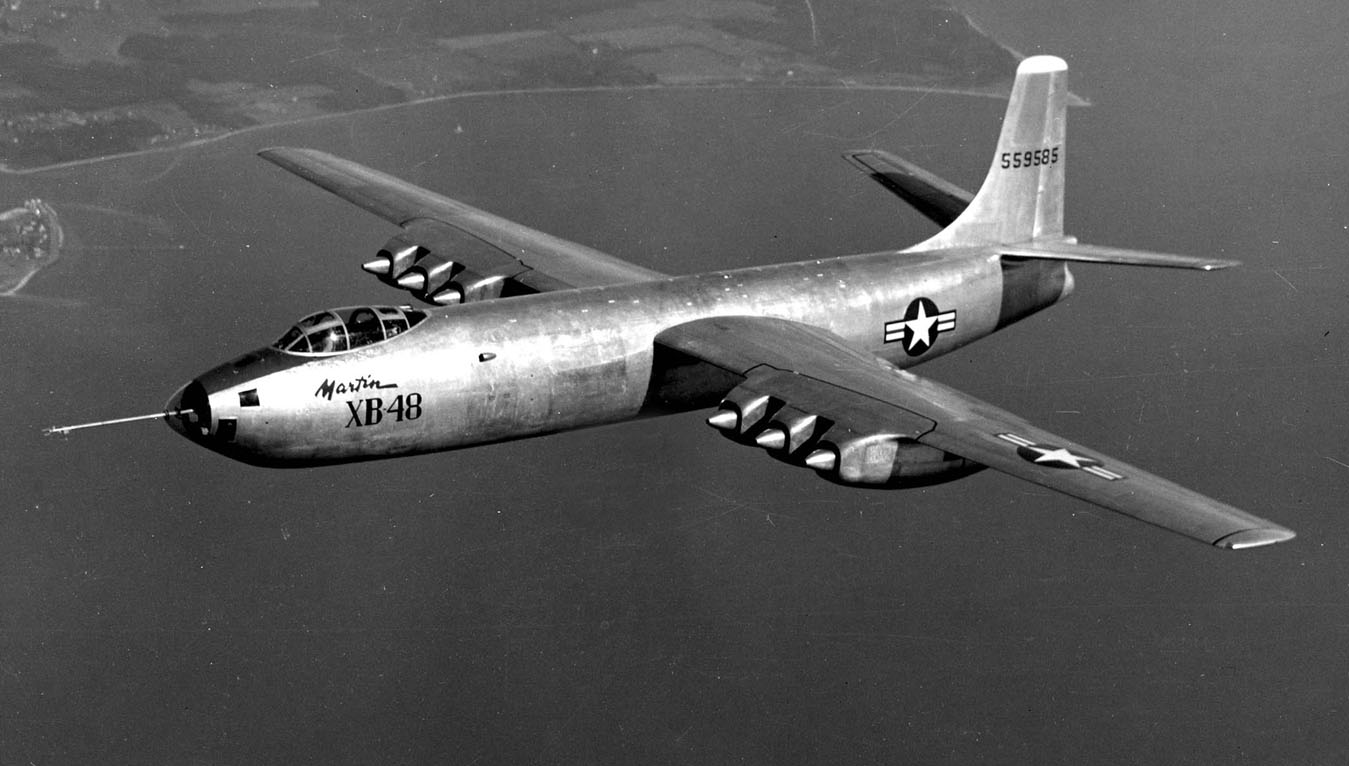
Martin XB-48 prototype taxiing, showing spaces between engines for cooling, tandem main gear, and nacelle outriggers

Key Information

The Martin XB-48 was an American medium jet bomber developed in the mid-1940s. It competed with the Boeing B-47 Stratojet, which proved to be a superior design, and was largely considered as a backup plan in case the B-47 ran into development problems. It never saw production or active duty, and only two prototypes, serial numbers 45-59585 and 45-59586,[1] were built.

Design and development

[edit]

In 1944, the U.S. War Department was aware of aviation advances in Germany and issued a requirement for a range of designs for medium bombers weighing from 80,000 pounds (36,000 kg) to more than 200,000 pounds (91,000 kg). Other designs resulting from this competition, sometimes nicknamed "The Class of '45", included the North American XB-45 and the Convair XB-46.

All of the bombers comprising the Class of '45 were transitional aircraft, which combined the power of turbojets with the aeronautical design of World War II, notably the unswept wings and tail surfaces. The XB-48 was no exception, as its round fuselage and unswept wings showed a distinct influence of Martin's B-26 Marauder medium bomber.

At the time of the XB-48's design, jet propulsion was still in its infancy. While the B-26 had enough thrust with two massive 18-cylinder radial engines, the XB-48 needed no less than six of the low-thrust turbojets available at the time. And, although it appeared superficially to have six separate engine nacelles – that is, three under each wing – the XB-48 actually had only two, unusually wide, three-engined nacelles. Each of these large nacelles also contained an intricate set of air ducts that constituted the engines' cooling system.

The XB-48 was the first aircraft designed with bicycle-type tandem landing gear, which had previously been tested on a modified B-26. The wing airfoil was too thin to house conventional landing gear mechanisms.[2] The main landing gear was in the fuselage and small outriggers located on each wing were used to balance the aircraft.

During development, Boeing was using German swept-wing research to develop the dramatically more capable Boeing B-47 Stratojet for the same role. As this outperformed all of the Class of '45, development of the XB-48 continued only as a backup in case the B-47 ran into problems, which did not occur. The only member of the '45 to be put into production was the North American B-45 Tornado, which only served for a few years as a bomber before being replaced by the B-47.

Operational history

[edit]

The XB-48 made its first flight on 22 June 1947, a 37-minute, 73 mi (117 km) hop from Martin's Baltimore, Maryland plant to NAS Patuxent River, Maryland, but blew all four tires on its fore-and-aft mounted undercarriage on landing when pilot Pat Tibbs applied heavy pressure to the specially designed, but very slow to respond, insensitive air-braking lever. Tibbs and co-pilot Dutch Gelvin were uninjured.[3]

Specifications (XB-48)

[edit]
3-view line drawing of the Martin XB-48

Data from "Encyclopedia of US Air Force Aircraft and Missile Systems, Volume II"[4]

General characteristics

  • Crew: three (pilot, co-pilot, and bomber-navigator)
  • Length: 85 ft 9 in (26.14 m)
  • Wingspan: 108 ft 4 in (33.02 m)
  • Height: 26 ft 6 in (8.08 m)
  • Wing area: 1,330 sq ft (123.5 m2)
  • Empty weight: 58,500 lb (26,535 kg)
  • Gross weight: 92,600 lb (42,000 kg)
  • Max takeoff weight: 102,600 lb (46,540 kg)
  • Powerplant: 6 × General Electric J35 axial flow turbojet, 3,820 lbf (17.0 kN) thrust each

Performance

  • Maximum speed: 454 kn (523 mph, 841 km/h) at 35,000 ft
  • Cruise speed: 361 kn (415 mph, 668 km/h)
  • Range: 1,566 nmi (1,802 mi, 2,900 km)
  • Combat range: 691 nmi (795 mi, 1,280 km)
  • Service ceiling: 39,400 ft (12,000 m)
  • Rate of climb: 4,200 ft/min (21 m/s)

Armament

  • Guns: 2 × .50 in (12.7 mm) M-2 machine guns in tail turret (proposed)[2]
  • Bombs: 1 × 20,000 lb (9,980 kg) or 36 × 250 lb (113 kg)

See also

[edit]

References

[edit]
[edit]
Revisions and contributorsEdit on WikipediaRead on Wikipedia
from Grokipedia
The Martin XB-48 was an experimental American jet-powered medium bomber developed by the in the mid-1940s as part of a competition for advanced strategic capable of long-range missions. Designed to meet a 1944 specification requiring a range of approximately 3,000 miles, a service ceiling of 45,000 feet, and a top speed of 550 mph, the XB-48 featured innovative elements such as a bicycle-type tandem and six J35 turbojet engines arranged in three underwing pods, each containing a pair of engines. Only two prototypes were constructed, with the first taking flight on June 22, 1947, from Baltimore, Maryland, but the program was ultimately canceled in favor of the superior , and neither aircraft entered production or operational service. Development of the XB-48 began in 1944 amid post-World War II advancements in , with Martin receiving a for two prototypes in December 1946 after initial delays due to the war's end and military budget cuts. The 's conservative straight-wing design, high-mounted for stability, accommodated a three-man consisting of a pilot, co-pilot, and bombardier-navigator, and included a large internal capable of carrying up to 20,000 pounds of conventional or nuclear ordnance. Defensive armament was planned as a tail turret with twin .50-caliber machine guns, though this was never fitted on the prototypes. The first prototype's lasted about 45 minutes but ended with undercarriage damage upon landing, while the second flew on October 16, 1948, after minor modifications; both underwent limited testing, including de-icing trials, accumulating fewer than 100 flights before the program ended in 1949. Performance shortcomings, such as a maximum speed of around 520 mph at 35,000 feet—below the required 550 mph—and high fuel consumption from the early J35 engines, contributed to its rejection in competition against rivals like the North American XB-45, , and XB-47. Key specifications of the XB-48 included a length of 85 feet 9 inches, a of 108 feet 4 inches, and a height of 26 feet 6 inches, with an empty weight of 58,500 pounds and a of 102,600 pounds. Its range was estimated at 1,800 miles with a full load, and it reached a service ceiling of 39,400 feet, though real-world tests revealed inefficiencies in the engine pod configuration and overall . The prototypes were eventually scrapped—the first cannibalized for parts in 1949 and the second destroyed during structural tests at the in 1951—leaving the XB-48 as a notable but forgotten stepping stone in the evolution of U.S. jet bomber technology.

Origins and requirements

Post-WWII strategic context

Following , U.S. strategic bombing doctrine evolved from the emphasis on precision industrial targeting with piston-engine heavy bombers like the , which had proven effective in the Pacific theater but vulnerable to emerging threats, to a focus on nuclear deterrence and massive retaliation against the amid escalating tensions. The establishment of the (SAC) in March 1946 under General marked a pivotal shift, prioritizing atomic-capable bombers for intercontinental strikes from U.S. bases, as outlined in early war plans like Operation Pincher and Halfmoon that envisioned atomic offensives on Soviet urban and industrial centers. By 1948, under General Curtis LeMay's leadership, SAC accelerated the transition to faster platforms to counter Soviet air defenses, incorporating lessons from the U.S. Survey that affirmed bombing's decisiveness while highlighting the need for speed and range to evade interceptors. Key technological shifts in the mid-1940s propelled this doctrinal change, particularly the rapid adoption of turbojet engines in the United States following wartime collaborations and postwar acquisitions. In 1941, U.S. engineers, led by Major General Hap Arnold, obtained British inventor Frank Whittle's centrifugal-flow turbojet designs, prompting to produce the first American I-A engine by 1942, which powered early like the Bell XP-59A Airacomet. Postwar, the capture of advanced German axial-flow technology, including data from the that powered the , significantly influenced U.S. development through programs like , which integrated German scientists and accelerated the shift from propeller-driven to jet-propelled bombers for superior speed over long ranges. The U.S. Army Air Forces (USAAF) played a central role in advocating for medium bombers capable of high-speed, long-range operations to replace vulnerable piston-engine types, issuing formal requirements in April 1944 for jet-powered designs with gross weights of 80,000 to 200,000 pounds, cruising speeds around 500 mph, and combat radii exceeding 2,000 miles to enable independent strategic strikes. This push reflected the USAAF's recognition of aircraft limitations against future threats, leading to contracts awarded in 1944 for parallel experimental programs, including the North American XB-45 and , as interim steps toward more advanced jet bombers. By 1945, with concluding, the USAAF formalized postwar specifications through the , prioritizing integration to meet demands, a need to which the Martin XB-48 later responded.

USAAF 1944 bomber specification

In November 1944, the (USAAF) issued specification for a jet-powered , marking one of the first formal requirements for such an aircraft outside . This directive, dated , sought designs capable of a top speed of 550 mph at 25,000 feet, a range of 3,000 miles while carrying a 10,000-pound load, and a service ceiling of 45,000 feet, with provisions for a gross weight around 100,000 pounds. The Glenn L. Martin Company responded promptly to the specification with its Model 223 design, which was assigned the prototype designation XB-48 by the USAAF's Air Technical Service Command. Martin's proposal, submitted on December 9, 1944, emphasized a three-man crew consisting of pilot, copilot, and bombardier-navigator, along with defensive armament provisions such as remote-controlled turrets for .50-caliber machine guns to protect against interceptors. The design also incorporated all-weather operational capabilities, including radar bombing systems, to enable strategic strikes in adverse conditions. This effort unfolded within a competitive landscape known as the "Class of '45" jet bomber program, under which the USAAF awarded contracts to three major manufacturers for experimental prototypes: for the XB-45, for the XB-46, and Martin for the XB-48. These requirements were shaped by wartime experiences with German jet technology and the emerging need for high-altitude, long-range platforms adaptable to post-war strategic roles, including potential atomic bomb delivery. Martin's contract, approved on December 29, 1944, as Letter Contract W33-038 ac-7675, initiated development with an initial allocation of approximately $570,000 for a and static tests.

Design features

Airframe and configuration

The Martin XB-48 employed a sleek, cigar-shaped tubular fuselage that drew upon the Company's extensive experience designing the B-26 Marauder during , emphasizing a streamlined all-metal structure optimized for aerodynamic efficiency in the . This configuration resulted in overall dimensions of 85 ft 9 in (26.14 m) in length, 108 ft 4 in (33.02 m) in wingspan, and 26 ft 6 in (8.08 m) in height, providing a compact yet capacious form for its intended role under the USAAF's 1944 specification. The wings were straight and mounted high on the , featuring a thin cross-section to support high-speed flight while maintaining structural simplicity amid the transitional post-World War II era. Lacking swept-back , the prioritized ease of fabrication over advanced , with the high placement aiding in the integration of underwing engine pods without compromising the fuselage's clean lines. The crew consisted of three members accommodated in a pressurized : the pilot and co-pilot seated in tandem beneath a for improved visibility, and the bombardier-navigator positioned in the glazed nose section. This layout included dedicated provisions for bombing radar, navigation instruments, and mission planning equipment, ensuring operational effectiveness in a compact, enclosed environment. For defensive capabilities, the XB-48 incorporated a remote-controlled tail turret twin 0.50 in (12.7 mm) machine guns, directed by an AN/APG-27 radar system, to provide rearward protection against interceptors. This turret was seamlessly integrated into the fuselage's tapered rear section, maintaining the aircraft's overall aerodynamic profile without protrusions that could induce drag.

Propulsion and landing gear

The Martin XB-48 was powered by six J35 engines, early axial-flow designs each rated at 3,820 lbf (17.0 kN) of . These engines were grouped in three pairs within pods mounted beneath the wings—two engines per pod—with interconnecting air ducts between the pods to optimize airflow and reduce drag during jet operations. The configuration aimed to integrate the powerplants efficiently into the , though the experimental engines posed integration challenges related to reliability and supply shortages. Internal fuel tanks provided a capacity supporting an estimated ferry range of 1,800 miles (2,900 km), sufficient for medium-bomber missions but limited by the high fuel consumption typical of early turbojets. The employed a pioneering bicycle-type tandem arrangement, featuring dual main gear units positioned forward and aft along the beneath the , augmented by auxiliary wheels at the wingtips for stability. This setup, first validated on a modified Martin B-26 known as the "Middle River Stump Jumper," accommodated heavy loads while enabling operations from shorter runways, as the thin wing structure precluded conventional retractable gear.

Development and construction

Prototype building process

In response to the 1944 USAAF requirement for a medium jet bomber, the received an initial letter contract (W33-038 ac-7675) on 29 December 1944 for engineering services and completion of one mockup of its Model 223 design by 1 May 1945, valued at $569,252 after amendment; the aircraft was designated XB-48 at this time. This was superseded on 13 December 1946 by contract W33-038 ac-13492, which formalized the program for two prototypes, spare parts, and related support equipment (including a bomb-bay test stand) at approximately $10.9 million. Construction of the prototypes commenced at Martin's plant shortly after the mockup inspection in June 1945, leveraging the company's wartime experience in bomber production. The airframes utilized conventional aluminum alloy construction adapted from prior projects, with the unique six-engine layout requiring paired J35 turbojets mounted in underwing pods. The first prototype (serial 45-59585) was completed in early 1947, ahead of its revised delivery date of 30 September 1947, despite broader post-war reductions in defense spending that affected aviation programs. Significant manufacturing challenges arose from availability issues with the J35 engines, as General Electric prioritized production for other military projects, leading to delays in integration and overall timeline slippage. The prototypes incorporated to accommodate the thin straight wings, with wheels for stability during ground operations. The second prototype (serial 45-59586) followed a similar assembly process but featured upgraded J35-GE-9 engines in place of the J35-GE-7 units on the first aircraft, reflecting minor refinements based on initial build experience; its completion was delayed by three months beyond the 30 June 1948 target. The total program cost reached $11.5 million for the two aircraft and associated development.

Initial ground testing

The first prototype of the Martin XB-48, serial number 45-59585, rolled out of the Company's assembly plant in Middle River, , on April 11, 1947, marking the commencement of initial ground testing. This event followed a streamlined 13-month construction period and initiated a series of pre-flight evaluations to verify the aircraft's structural integrity and operational readiness. Ground runs during this phase successfully confirmed engine starts using the six J35 turbojets and demonstrated basic taxi mobility across the factory grounds. Taxi tests revealed key handling characteristics of the novel bicycle configuration, which had been pre-validated through dozens of landing and takeoff trials on a modified testbed. In high-speed taxi runs, the aircraft's wings, which exhibited a slight droop at rest, reversed to an upward camber under aerodynamic load, lifting the outrigger wheels clear of the ground while maintaining lateral stability via wing lift distribution. Systems checks encompassed validation of the hydraulic actuators for control surfaces and retraction, as well as basic functionality, with the airframe's components enduring the high temperatures generated by engine operation exceeding 800°F. These evaluations were supported by detailed film analysis and pilot reports to ensure safe progression to flight. Development of the XB-48 prototypes encountered significant delays due to reliability issues with the J35 engines during high-power ground runs, necessitating modifications to improve thrust consistency and reduce startup failures before the aircraft received clearance for its . These engine challenges, stemming from early maturation problems, extended the ground testing timeline at the facility by several months. Martin and USAAF personnel conducted on-site familiarization sessions to prepare for subsequent evaluations, though full-scale flight operations would later shift to Muroc Dry Lake (now ) in .

Flight testing and evaluation

Maiden flight and early trials

The first Martin XB-48 prototype conducted its on June 22, 1947, departing from the company's airfield in Baltimore, Maryland, and arriving at NAS Patuxent River, Maryland, after a 37-minute low-altitude flight. Piloted by Martin Pat Tibbs, the prioritized caution with the unproven J35 turbojet engines, limiting operations to conservative profiles for initial data collection on takeoff and basic flight characteristics. On landing, all four tires blew out due to overheated brakes and heavy braking pressure, but the pilots were uninjured and no major damage occurred. Following the initial hop, the first entered an early test series comprising 21 flights through 1948, totaling 35 hours of flight time. These trials emphasized handling qualities, longitudinal and lateral stability, and integration of core systems, including the novel landing gear configuration derived from prior B-26 modifications. Observers from the participated to monitor procedural compliance and gather preliminary operational insights. The second XB-48 prototype followed with its on October 16, 1948, adhering to similar low-risk profiles to validate tandem gear performance during takeoff and landing sequences. Both prototypes were subsequently transferred to for expanded dedicated testing under controlled conditions, enabling systematic progression from company-conducted hops to structured evaluations.

Performance assessments and issues

The Martin XB-48 prototypes underwent extensive by both Martin and the , revealing significant shortfalls in meeting the original 1944 USAAF specifications for a medium jet bomber. The aircraft achieved a maximum speed of approximately 500 mph, below the required speed exceeding 500 mph, primarily due to the underpowered J35 turbojets that delivered less than the promised 5,000 pounds of thrust per engine. High-altitude performance was particularly deficient, with the straight-wing configuration and engine limitations preventing effective operation near the targeted service ceiling of 40,000 feet, as the wings generated insufficient lift at thinner air densities compared to emerging swept-wing designs. Specific operational issues further hampered the XB-48's viability during evaluations. reliability proved problematic, with the first consuming 14 engines across just 44 flights due to frequent failures and inefficiencies in the clustered pod arrangement, leading to asymmetric thrust that exacerbated yaw instability—test pilots noted ineffective response during maneuvers. Landing challenges arose from the innovative bicycle-type gear, including sensitive nose wheel control and severe tire blowouts on , compounded by overheated and hydraulic system turbulence in the . Overall, the two prototypes accumulated about 168 flight hours—105 on the first and 63 on the second—limiting comprehensive data collection and highlighting the design's developmental constraints. In comparative assessments, the XB-48 was decisively outclassed by competitors like the XB-47 Stratojet, which demonstrated superior speed exceeding 550 mph, better high-altitude handling from its swept wings, and greater growth potential for production variants. A spring 1948 USAAF evaluation report concluded the XB-48 was non-viable for operational use, citing its failure to meet performance guarantees and inability to compete in the evolving jet bomber landscape. The program was terminated in September 1948, with the prototypes' final sorties occurring in late summer and October; both aircraft were subsequently placed in storage at Davis-Monthan Air Force Base, marking the end of development without any production orders.

Specifications

General characteristics

The Martin XB-48 was crewed by three personnel: a pilot, co-pilot, and bombardier-navigator. Dimensions
  • Length: 85 ft 9 in (26.14 m)
  • Wingspan: 108 ft 4 in (33.02 m)
  • Height: 26 ft 6 in (8.08 m)
  • Wing area: 1,330 sq ft (124 m²)
Weights Powerplant
6 × J35 turbojets, 4,000 lbf (18 kN) thrust each

Performance and armament

The Martin XB-48 achieved a maximum speed of 520 mph (840 km/h) at 35,000 ft (10,700 m), with a cruising speed of 390 mph (630 km/h), though these fell short of the design goals for a medium jet bomber capable of high-altitude operations in the post-World War II era. Its range was 1,800 mi (2,900 km) with a full load, supported by internal capacity sufficient for extended missions, while the service ceiling was 39,400 ft (12,000 m) to enable operations above most contemporary threats. These performance parameters emphasized strategic reach and endurance, drawing from the U.S. Army Air Forces' requirements for jet-powered that could deliver payloads over long distances at tactical altitudes. For defensive and offensive capabilities, the XB-48 featured provisions for two 0.50 in (12.7 mm) machine guns mounted in a powered, remotely controlled tail turret, guided by the AN/APG-27 radar system to provide rearward fire coverage against interceptors. The aircraft's internal was designed to carry up to 22,000 lb (10,000 kg) of conventional bombs, such as the 10,000 lb M-121 class, or equivalent stores, facilitating its role as a tactical . Avionics systems were basic yet functional for the era, incorporating a bombing system for all-weather precision strikes and standard navigation aids including and radio equipment to support a of three—pilot, copilot, and bombardier-navigator—in conducting medium-range bombing missions. These elements reflected the transitional technology of jet aviation, prioritizing reliability over advanced .
Add your contribution
Related Hubs
User Avatar
No comments yet.