Marvel Cave
Marvel Cave
Main page
1652603

Marvel Cave

logo
Community Hub0 subscribers

Wikipedia

from Wikipedia

Marvel Cave is a privately owned cave located just west of Branson, Missouri, in Stone County. It is one of the main attractions of Silver Dollar City and is registered as a National Natural landmark.[1]

Key Information

The first recorded expedition of the cave was in 1869, led by Henry T. Blow. Marvel Cave was originally called Marble Cave, after explorers in 1882 saw what they thought was marble on the cave's ceiling. This started the Marble Cave Mining Company, although later it was realized that there was never any marble in the cave. The Marble Cave Mining Company ceased all operations after only four and a half years. William Lynch purchased the cave in 1889, and soon after opened the cave to the public. In 1950, Hugo Herschend leased the cave for 99 years. The Herschends made renovations to the cave, and later opened the popular theme park, Silver Dollar City, on the surface above the cave.[2] Marvel Cave is one of the largest caves in Missouri, with one of the largest cave entry rooms (the Cathedral Room) of any cave in North America, and is one of the longest running tourist attractions in the Ozarks.

History

[edit]

The Bald Knobbers

[edit]

According to Silver Dollar City park legend, a local group of vigilantes who later turned into outlaws called the Bald Knobbers were known for throwing people through the sinkhole into Devil's Den around the mid 19th century. Though it's possible that roving Bushwhackers and outlaws could have chosen to dispose of their victims through this sinkhole, the Bald Knobbers did not form until 1883 (starting-up in neighboring Taney County) and were replaced by an unofficial chapter in 1886 within nearby Christian County, with unofficial chapters in other counties (including Stone County, where the cave is located) later than that.

Despite there being no written evidence to substantiate it, it's possible that Stone County's unofficial Bald Knobbers used the cave sometime in 1889, between the time the mining operations ceased and late October of that year when it was purchased for sightseeing tours.

Early explorers

[edit]

There is evidence that the Spanish explored the cave in 1541, hoping to uncover riches and possibly the fountain of youth.[3] There is a legend that the Spanish buried gold in the cave. The first known expedition was in 1869 and led by Henry T. Blow of St. Louis, a lead mining magnate. He explored the cave with six other miners.[3] One by one, the miners lowered themselves down into the sinkhole. They carried lanterns for light and spent hours studying the cave walls carefully searching for signs of mineral deposits. They went as far as the Shoe Room, because on one side was the Gulf of Doom, which they believed was the bottomless pit after throwing rocks down the Gulf of Doom and hearing no sound. On the other side was the Cloud Room, which was filled to the ceiling with bat guano. The miners returned to the surface late that evening having failed to discover the lead ore they sought, but were convinced that the flat ceiling of the Shoe Room contained marble. Their report gained the interest of area locals who decided to name the cave Marble Cave.

No more expeditions took place until 1882 when another group of entrepreneurs, led by Mr. T. Hodges Jones and Truman S. Powell of Barton County, entered the cave in hopes of finding lead. Jones and Powell found huge amounts of guano and the flat ceiling, which they also believed to be marble.

Marble Cave Mining and Manufacturing Company

[edit]

In 1884, Mr. T. Hodge Jones bought the property and, with several of his friends, formed the Marble Cave Mining and Manufacturing Company to mine the marble from the cave. The company hired a geologist, and it was proved that what looked like marble on the ceiling of the Shoe Room was really limestone. To keep the company alive they mined out the guano and sold it for $700 a ton. The guano was used for gunpowder and fertilizer. The miners filled ore carts with guano, then the carts were pulled by donkeys to the Cathedral Room, and the carts were lifted out of the cave by a pulley system. In 1889, after four and a half years, all the guano was mined out. Marble Cave Mining, Co. closed all operations.

Marmaros

[edit]

Marmaros (or Μαρμαρος, Greek for "Marble") was a small town that formed along with the Marble Cave Mining and Manufacturing Company in 1884. Originally called Marble City, it was located on the rough hilltop near the cave and recorded a plat map at the courthouse in Galena, Missouri. Marmaros contained a hotel, general store, pottery shop, white oak furniture factory, and was rumored to have a saloon. The town turned into a ghost town in 1889 after the Marble Cave Mining, Co. closed. When the Lynches bought the cave, the town was burned to the ground by the local group of vigilantes known as the Bald Knobbers.

The Lynches

[edit]

On October 30, 1889, William Henry Lynch, a Canadian miner and dairyman, purchased the cave and the square mile of land around the cave where Marmaros was located for $10,000.[3] After coming to Marvel Cave, he found that Marmaros was burnt to the ground. Lynch, with the aid of his family, proposed to open the cave to sightseers. The Lynches began operation of the sightseeing venture in 1894 with a grand celebration and a few visitors.[3] The cave has remained open since, making it one of the oldest continuously running tourist attractions in the Ozarks.

When William Lynch died in 1927, ownership of the cave passed to his daughters. Shortly thereafter, the name of the cave was changed to Marvel Cave.[3] The Lynch family operated the cave for over fifty years.

The Herschends

[edit]

A Chicago vacuum cleaner salesman, Hugo Herschend, purchased a 99-year lease on the cave in 1950, from The Lynch sisters.[3]

After Hugo Herschend's death in 1955, his wife Mary took over the day-to-day operations of the cave. With the aid of her two sons, Jack and Peter, Mary Herschend was able to make vast improvements to the cave. They added concrete paths and stairs to the cave, and a tower from the sinkhole to the top of the debris pile. Also, they added a narrow gauge funicular (cable-pulled) railway in 1957, whose trains pulled visitors a distance of 218 feet (66 m),[3] from the depths of the cave up to the surface. Before building the cable train, the Army Corps of Engineers said that it could not be built, because a cable train can not make a turn like the one the Herschends planned. The Herschends built it anyway, and it is still in operation to this day.

Once the cable train was in operation, the Herschends decided to recreate the mining village Marmaros, for tourists waiting to go on a tour. It opened in 1960, and grew into Silver Dollar City.

In 1972 Genevieve Lynch died and bequeathed the cave to the College of the Ozarks and the First Presbyterian Church of Branson. The Herschends continue to operate the property under lease.[4]

Tours

[edit]

There are two different tours offered: The Traditional Tour and The Lantern Tour.

Traditional tours

[edit]

The first guided tours in the cave were in 1894 run by the Lynches. They lasted 8 hours and were by candle or lantern. Visitors climbed through the sink hole on a 100 feet (30 m) ladder down to the top of the pile. Then you were instructed to slide down the pile to the bottom. You received a candle to guide your way. The tours included the Egyptian Room (now the Shoe Room), the Lakes Passage, and you saw formations such as the Great White Throne (now the Liberty Bell), and the Spring Room Sentinel (now just the Sentinel). After the Hershends started tours in 1950, they removed the wooden stairs, and added concrete stairs and paths through the cave. Tours last for about an hour, and are limited to 45 people.

Lantern tour

[edit]

In 2006, Marvel Cave started offering The Lantern Light Tour. In this tour the electric lights are turned off in the cave and lanterns are given to each member of the tour. Unlike the regular tours which are free, this tour costs $16.12, and is limited to 20 people. The tour has been extended into the Mammoth Room, making it the first tour to incorporate this room in more than fifty years. One is also able to see both the summer and fall sections if the Waterfall Room is not flooded. The tour lasts about an hour and a half. The guide focuses on the history and folklore of the cave and is able to explain more information about the cave due to the small group setting of the tour.

Rooms and passages

[edit]
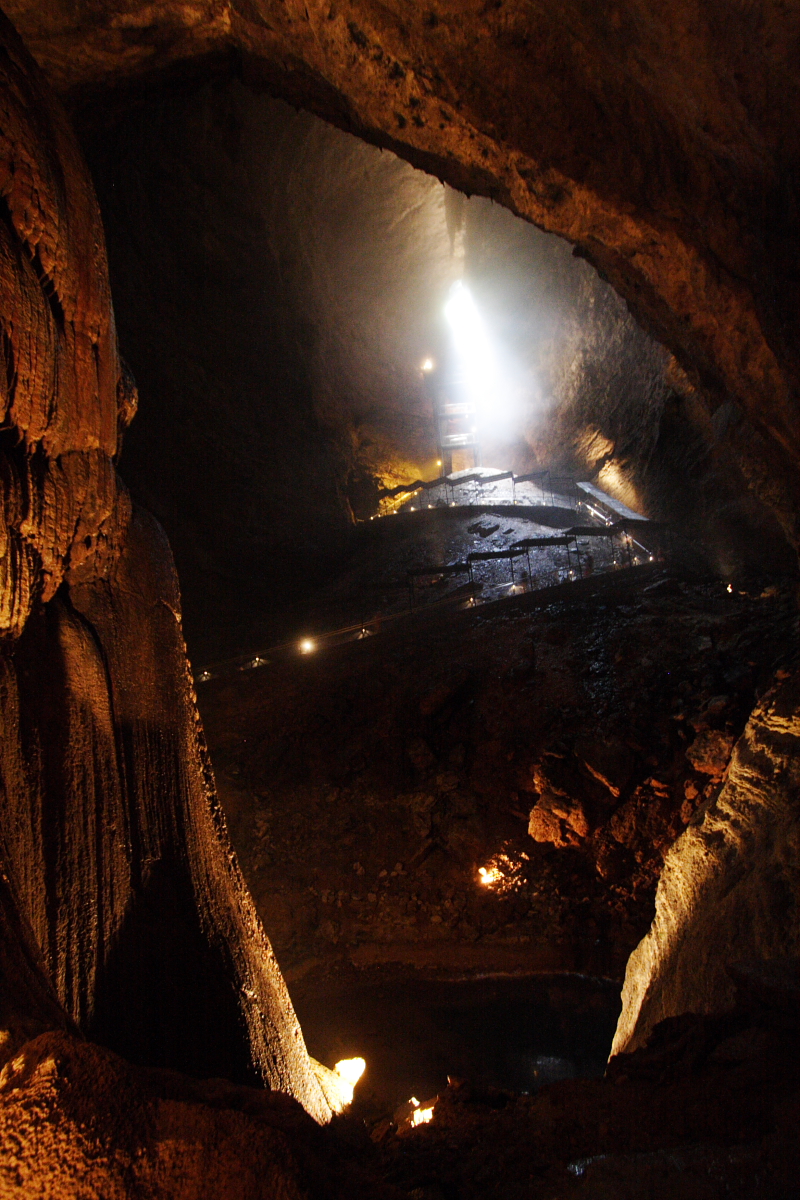
  • The Cathedral Room is one of the largest cave entrance rooms found in North America. The room measures 204 feet (62 m) high, 225 feet (69 m) wide, and 411 feet (125 m) feet long. Entrance to the cave is made through a sink hole which is 94' deep. Two large openings are at the bottom of the sink. Rocks, trees, dirt and animals falling through the sinkhole and falling boulders from the ceiling throughout the centuries has left a debris pile measuring 124 feet (38 m) tall. This pile is sometimes referred to as the Underground Mountain. On July 7, 1963, an underground altitude record was set by Don Piccard by flying a hot air balloon around the massive room. Later, in 1994 five hot air balloons were flown simultaneously in the Cathedral Room in celebration of the 100th anniversary of giving cave tours.
  • The Mammoth Room is where the majority of the bats choose to hibernate. In 1869 Spanish style ladders, small trees with notches carved in them, were found in the Mammoth Room by Henry T. Blow, one of the first known explorers of the cave.
  • The Dungeon is a passage located next to the Cathedral Room. The entrance can be made through a small crevice located 80 feet (24 m) below the sinkhole entrance. Blood like stains cover the walls due to the abundance of iron oxide, which led some early cave guides to claim the Dungeon Passage a torture place of the Spanish Explorers. The passage has an entrance through the Mammoth Room as well.
  • The Lakes Passage is past the Mammoth Room and contains two lakes named Genevieve and Miriam, after the daughters of William Lynch. Divers have explored the lakes and have found several underwater passages. The deepest they dived was around 110 feet (34 m). The two lakes are long and were once thought to be a river, known as No-Name River. Genevieve later led an expedition of the passage and discovered that there was an end to the water filled passages. Her party found that the cave continued up hill. The passage has not been entirely explored. The last room explorers have discovered is a tall terminal dome pit that contains two small water falls that makes climbing to the top very difficult. Many have tried but failed.
  • The Spring Room A small crevice behind a tall column known as the Sentinel lies the Spring Room. The room is covered in orange calcite and contains several waterfalls that looks and sounds like rain fall. Legends have spread about the water being magical, possibly a Fountain of Youth.
  • Serpentine Passage connects the Cathedral Room and the Egyptian Room. The route perfectly displays the way that water used to flow through the cave passages.
  • Egyptian Room / Shoe Room Genevieve and Miriam Lynch had a fondness for the study of Egypt, and this flat smooth desert-like room reminded them of a pyramid. Among the rocks of the room they saw King Tutankhamen's Sarcophagus, The Sphinx's Nose, Arrow Head Entry, and Cleopatra's Sandal. The ceiling is shaped like a large sandal or shoe, leading some to call it the Shoe Room. The flat smooth ceiling was once mistaken for marble.
  • The Gulf of Doom is located under the "heel" of the shoe print ceiling. The great pit was once thought to be bottomless. Rocks would be thrown into the darkness, but no sound would ever resonate. The superstitious thought it was a gateway to the underworld, when the true reason was simple: large amounts of clay and bat guano covered the bottom of the gulf's floor over 100' below.
  • Cloud Room or Cloud Land has a rough porous ceiling. The ceiling is made of dolomite and looks like low hanging clouds.
  • Tall Man's Headache / Fat Man's Misery is a passage with a low ceiling and narrow sides, the smallest passage in the guided tour. It is about 4 feet (1.2 m) 7 inches (18 cm) tall, and 7 feet (2.1 m) long.
  • The Harold Bell Wright Passage is before the Waterfall Room during fall and winter tours. Harold Bell Wright, the author of The Shepherd of the Hills, was a friend of the Lynches, and stayed in the cave for days at a time. There is a cabin located in the passage where Harold Bell Wright stayed. Some people believe that he wrote parts of his book in the cave. Inside the cabin he painted a picture of his book's character, Maggie. The cabin that remains there is a replica, not the original, although it uses some of the same wood.
  • The Waterfall Room is the lowest room on the tour, 505 feet (154 m) below the surface. The source of the water is from the underground stream named The Lost River. This room can flood to the ceiling during times of rain.
  • The Mud Passage is located between the Waterfall Room and the Mystic Pool Room, named for the mud in the passage during early tours, which has since been cleared out.
  • The Mystic River Passage is a small water filled passage that eventually opens up to the second largest room in the cave. The room is called the T Room and is in the shape of the letter T. The cave extends beyond the T Room, but the passage becomes much smaller and narrower than before. To enter the passage one must lie on their back and keep their face above the water. The passage is extremely tight and filled with mud and water causing many to call it the "Sewer Pipe." The end of the passage has not been reached.
  • The Mystic Pool Room is the room in which the Mystic River Passage is located.
  • The Elves Chamber is the top of the terminal dome pit extending upwards from the Mystic Pool Room. Numerous calcite formations can be seen in this area of the cave. The ceiling is filled with long stalactites and covered in helictites. The entrance to the Cable Train Tunnel is located in the Elves Chamber making it the last room on the tourist trail of Marvel Cave.

Formations

[edit]
  • Blondie's Throne is a flowstone located near the end of the tour of the cave, the name comes from its obvious resemblance to a throne. The name "Blondie" comes from a story about a boy (Charles Smallwood) who was lost in the cave in the late 19th or early 20th century. He was later found sleeping near this formation, and the first thing they saw in the candlelight was his blonde hair. While there is a legend that some substance in the cave turned his hair blonde, it is more likely that the boy was known for his blonde hair.
  • The Liberty Bell is a 55 feet (17 m) tall stalagmite, Although it started out on the ceiling near the Serpentine Passage as a stalactite. It gets its name from its shape, and the crack on its side. The crack was made when it fell from the ceiling, and now it is on the cave floor. After falling, it continued to grow on the floor. It is hollow and can fit four to five adults inside. It was originally called "The Great White Throne".
  • The Sentinel is a column located in the Cathedral Room, right in front of the passage that leads to the Spring Room. It used to be referred as "The Spring Room Sentinel" Tour guides also say that it is the only thing supporting the dome of the Cathedral Room.

Life in the cave

[edit]
Gray bat in a hibernaculum. A colony of this species lives in Marvel Cave.

Marvel Cave is host to a variety of bats and salamanders. Marvel Cave has been recognized for its outstanding work in preserving its colony of endangered Gray Bats.

Bats
Salamanders

See also

[edit]

References

[edit]
[edit]

Grokipedia

from Grokipedia
Marvel Cave is a privately owned karst limestone cave situated in Stone County, Missouri, directly beneath the Silver Dollar City theme park near Branson.[1][2] As one of the deepest caves in the state, it features a massive subterranean entrance room known as the Cathedral Room, measuring 62 meters high, 125 meters long, and 69 meters wide, making it one of the largest in the United States, along with active dripstone formations that continue to grow in its wet environment.[3][2] Designated a National Natural Landmark in 1972, the cave spans 22 acres and is renowned for its geological significance, including a dome-shaped sinkhole entrance and extensive dome-pits, representing one of the premier dripstone units among Ozark caves.[1] The cave's history dates back to indigenous knowledge, with the Osage Indians referring to it as "The Devil’s Den" around 1500 due to eerie sounds echoing from its depths.[2] European exploration began in 1541 when Spanish miners searched for treasures and the Fountain of Youth, leaving behind a wooden ladder still visible today.[4] In the 19th century, it was prospected for lead and marble—hence its early name Marble Cave—but yielded neither, though guano mining occurred briefly from 1882 to 1889.[2] Canadian entrepreneur William Henry Lynch purchased the property in 1889 and opened it to the public as a tourist attraction in 1894, marking it as the first major draw to the Branson area and establishing guided tours that continue today.[5] After Lynch's death in 1927, his daughters renamed it Marvel Cave; it was leased to Hugo Herschend in 1950, leading to renovations and the development of Silver Dollar City in 1960, which now encompasses the cave as its foundational attraction.[2][4] Today, Marvel Cave offers hour-long guided tours included with Silver Dollar City admission, descending 300 feet via over 600 stairs to explore the Cathedral Room and other passages, though the activity is strenuous and not suitable for those with mobility or respiratory issues.[3][4] Additional experiences include 90-minute lantern-lit tours using period oil lamps, available seasonally for an extra fee, providing a more immersive historical perspective and access to rooms like the Mammoth Room and a bat wall.[2] The cave's preservation highlights its role in Ozark geology and tourism, drawing visitors to its living formations and underground wonders seasonally from mid-March through early January as of 2025.[1][3][6]

Overview

Description

Marvel Cave is a privately owned show cave situated in Stone County, Missouri, within the Silver Dollar City theme park in Branson.[1][5] This cave serves as one of the park's primary attractions, offering guided tours that explore its subterranean passages.[3] As a wet limestone cave, Marvel Cave extends nearly 500 feet (152 m) below the surface and features active, growing formations such as stalactites and stalagmites that continue to develop due to ongoing water flow.[5][7] Opened to the public in 1894, it holds the distinction of being a National Natural Landmark, recognized for its significant geological features including one of the greatest dripstone units among Ozark caves.[3][1] A standout feature is the Cathedral Room, one of North America’s largest cave entrance rooms, which measures approximately 204 feet (62 m) high, 225 feet (69 m) wide, and 411 feet (125 m) long.[2] This vast chamber, located about 300 feet underground, exemplifies the cave's impressive scale and natural beauty.[5]

Significance

Marvel Cave serves as the foundational attraction for Silver Dollar City, the theme park that opened on May 1, 1960, around the cave's entrance and has since drawn approximately two million visitors annually (as of 2024), establishing it as one of Missouri's premier entertainment destinations.[8][9] This integration has transformed the cave from a standalone natural wonder into a central element of a larger cultural and recreational complex, amplifying its visibility and appeal to families across the Midwest. The cave provides habitat for approximately 40,000 bats, including big brown bats, little brown bats, tri-colored bats, and endangered gray bats (Myotis grisescens).[10] These bats play an ecological role by consuming thousands of insects nightly, supporting pest control around the park and broader regional biodiversity efforts monitored by state conservation agencies.[11][12] Culturally, Marvel Cave holds significance through its association with Ozark folklore, particularly legends of the Bald Knobbers—a vigilante group turned outlaws in the 1880s—who are said to have used the cave as a site for disposing of adversaries by throwing them into its depths.[13] This narrative influences local storytelling and theme park theming at Silver Dollar City, where Bald Knobber lore is incorporated into shows and exhibits, preserving and popularizing 19th-century regional history.[2] Economically, the cave has been a key driver of Branson's tourism industry since its public opening in 1894, helping establish the area as a major destination that attracts over 10 million visitors yearly (as of 2023) and generates billions in statewide tourism revenue.[14][15] Silver Dollar City's development around Marvel Cave has amplified this impact, contributing hundreds of millions annually to Missouri's economy (as of 2024) through visitor spending on attractions, lodging, and related services.[16] In October 2024, Silver Dollar City announced plans to invest $500 million over the next decade in new attractions and a resort, further enhancing its role in regional tourism and economic growth.[17]

History

Early Exploration and Legends

The earliest known association with Marvel Cave dates to the Osage Native Americans around 1500, who referred to it as "Devil's Den" due to eerie sounds emanating from its entrance, possibly from wind or wildlife.[2] Local folklore among the Osage includes a tale of a hunter and a bear tumbling into the cave through a sinkhole, contributing to its ominous reputation.[2] The first documented entry occurred in 1869, when St. Louis industrialist Henry T. Blow led a group of miners on horseback to the site, descending approximately 200 feet via rope in search of lead ore deposits; they found none but noted the cave's vast chambers.[5] This expedition marked the cave's introduction to systematic prospecting, though it yielded no commercial minerals at the time.[2] In 1882, entrepreneurs T. Hodges Jones and Truman S. Powell conducted further exploration, mistaking the cave's limestone ceiling formations for marble, which led to its original naming as Marble Cave and sparked interest in potential quarrying.[18] This misidentification fueled early commercial ambitions, paving the way for organized mining efforts beginning in 1884.[2] Mid-19th-century folklore intertwines the cave with the Bald Knobbers, a vigilante group formed in 1883 in nearby Taney County to combat post-Civil War lawlessness in the Ozarks; according to local legends promoted in cave tours, the group used the cave's sinkhole entrance atop Roark Mountain as a hideout and reportedly disposed of enemies by throwing them through the hole into the Cathedral Room below.[2] Though the Bald Knobbers' activities peaked in the 1880s and involved real vigilante actions across southwest Missouri, the cave-specific tales are likely embellished for dramatic effect, with no historical records confirming their use of the site.[19]

Mining and Settlement Period

In 1884, T. Hodges Jones acquired the property surrounding Marvel Cave and, together with associates including Truman S. Powell, established the Marble Cave Mining and Manufacturing Company to exploit the site's resources. Initially drawn by what they mistook for marble deposits in the cave's limestone ceiling, the group shifted focus upon a geologist's assessment, targeting the substantial bat guano accumulations discovered during prior explorations. The guano, rich in nitrogen, was valued for use as fertilizer and in gunpowder production.[2][18] Mining operations began promptly in 1884 and lasted until 1889, involving the construction of trails, staircases, and a pulley system to facilitate extraction. Workers used donkey-pulled ore carts to transport guano from deep chambers like the Cathedral Room to the surface, where it was processed and sold. Despite initial promise, the venture yielded limited overall output due to the finite nature of the deposits and challenges in sustaining commercial volumes amid fluctuating markets for fertilizers.[2][18] To accommodate the workforce and support logistics, the company platted the town of Marmaros—named after the Greek word for "marble"—near the cave entrance in 1884. The settlement, initially envisioned as a modest hub akin to nearby resort towns, included a hotel, general store, pottery shop, stagecoach stop, and a white oak furniture factory, attracting a small population of miners and entrepreneurs. Infrastructure such as access roads and basic utilities was developed to aid guano transport and daily operations.[2][20] By 1889, the guano reserves were exhausted after approximately four and a half years of extraction, prompting the company to cease all activities and leading to the rapid depopulation of Marmaros, which became a ghost town. The failed enterprise left behind remnants of the mining infrastructure, including trails that would later serve tourism. Reports indicate the abandoned town was subsequently burned, with involvement attributed to the Bald Knobbers vigilante group.[2]

Tourism Development and Ownership

In 1889, Canadian entrepreneur William Henry Lynch purchased Marvel Cave, then known as Marble Cave, along with approximately one square mile of surrounding land for $10,000 from the Marble Cave Mining Company, with the intention of transforming it into a tourist attraction.[18] Lynch invested in infrastructure, including pathways and lighting, to facilitate visitor access, and the cave officially opened for public tours on October 18, 1894, marking the beginning of organized tourism in the Ozarks region.[5] Following Lynch's death in 1927, ownership passed to his daughters, Miriam and Genevieve, who renamed the cave "Marvel Cave" to reflect its natural wonders rather than the earlier misconception that it contained marble deposits suitable for mining—though only bat guano had ever been extracted.[5] This change emphasized the site's spectacular geological features and helped sustain its appeal as a visitor destination during the early 20th century.[2] In 1950, Chicago businessman Hugo Herschend and his wife Mary secured a 99-year lease on the cave from the Lynch sisters, acquiring operational rights to revitalize the aging attraction.[21] Under the Herschend family's management, significant enhancements were made, including the installation of a narrow-gauge funicular railway in 1957 to transport visitors up the challenging 1,070-foot ascent from the cave's depths to the surface, improving efficiency and comfort for tourists.[5] By 1960, the family had integrated the cave into the newly opened Silver Dollar City theme park, constructing the village-themed park directly around the cave entrance to create a cohesive entertainment experience that drew over 125,000 visitors in its inaugural year.[5] As of 2025, the Herschend family continues to oversee the cave through their entertainment corporation, with ongoing construction of a new resort featuring a lobby inspired by Marvel Cave's stonework and natural aesthetics, set to open in 2026 and enhancing visitor amenities adjacent to the site (as of September 2025).[22] The cave also faces periodic flooding from heavy rainfall, which operators manage through real-time monitoring and adaptive tour protocols to maintain safety and accessibility, such as shortening routes or temporarily closing passages when water levels rise.

Geology and Features

Geological Setting

Marvel Cave is situated in the Springfield Plateau section of the Ozark Plateau, a karst landscape characterized by the dissolution of soluble carbonate rocks over millions of years. The cave formed primarily through the chemical weathering of Mississippian-age limestone, particularly the Reeds Spring Formation, a cherty limestone unit that caps the surrounding ridges. This process began in the phreatic zone deep below the water table, where groundwater saturated with carbonic acid slowly dissolved the bedrock, creating initial voids that enlarged into passages and chambers.[23] As a wet cave, Marvel Cave maintains high humidity levels due to persistent underground water flow, supporting active deposition of dripstone and flowstone features. The primary water source is the Lost River, an underground stream that traverses the cave and connects subsurface to Neely’s Spring via dye-trace confirmed flow paths. These hydrological dynamics result from the region's abundant rainfall infiltrating the karst terrain, sustaining the cave's moist environment and contributing to ongoing speleogenesis.[23] The cave is prone to periodic flooding in its lower passages from surface runoff, particularly after heavy rains, which can inundate rooms like the Waterfall Room despite a man-made dam designed to mitigate such events. For instance, significant flooding occurred in April 2024 following intense precipitation, temporarily halting full tours. This vulnerability stems from the cave's connection to the local aquifer and the Ozarks' high permeability.[23][24] The overall structure includes vertical shafts and horizontal passages developed through a combination of phreatic dissolution, subsequent vadose incision by descending water, and regional tectonic uplift that lowered the water table and exposed the karst system. Lower levels expose older Ordovician Cotter Dolomite, while the entrance sinkhole and dome pits reflect surface collapse into underlying voids. Originally misidentified as marble by explorers in 1882 due to the limestone's appearance, the cave was initially named Marble Cave.[23][5]

Rooms and Passages

The Cathedral Room serves as the primary entrance chamber of Marvel Cave, renowned as one of the largest cave entrance rooms in the United States. Measuring 204 feet in height, 225 feet in width, and 411 feet in length, it features a bell-shaped structure with a talus slope and natural light penetrating from the sinkhole above.[2] This expansive space hosted a notable historical event in 1963, when balloonist Don Piccard achieved an underground altitude record by inflating and ascending in a hot air balloon to the ceiling, approximately 204 feet above the floor.[25] Beyond the Cathedral Room lies the Mammoth Room, a key chamber accessible only on the special Lantern Light Tour, where the cave's bat population hibernates during winter.[5][26] Exploration records indicate that in 1869, early visitor Henry T. Blow discovered Spanish-style ladders—small trees notched for climbing—within this room, remnants possibly linked to 16th-century explorers.[2] The Lakes Passage connects deeper sections of the cave and includes two significant bodies of water: Genevieve Lake and Miriam Lake, named after the daughters of early cave operator William Lynch. Divers have mapped these lakes to a depth of 110 feet, revealing submerged passages and confirming they are not a continuous river but isolated features.[27] The Shoe Room, formerly known as the Egyptian Room, exhibits a distinctive flat ceiling composed of limestone that early miners mistook for marble, contributing to the cave's original name, Marble Cave.[2] Its smooth, desert-like floor and formations evoked Egyptian pyramid imagery for the Lynch sisters, who managed the cave in the late 19th and early 20th centuries. At the lowest point accessible on standard tours, the Waterfall Room descends to 505 feet below the surface, featuring a dramatic cascade fed by the underground Lost River.[2] This chamber is prone to rapid flooding during heavy rainfall, with water levels rising to the ceiling in extreme events, as observed in recent storms.

Formations

Marvel Cave features a variety of active speleothems, including stalactites, stalagmites, and draperies, which continue to grow due to the deposition of minerals from water percolating through the limestone.[5] These formations develop in the cave's wet environment, where dissolved calcium carbonate precipitates as water evaporates or degasses, as noted in regional geological studies.[23] One of the most prominent formations is the Liberty Bell, a 55-foot-tall stalagmite in the Cathedral Room that originated as a stalactite from the ceiling near the Serpentine Passage before falling and cracking, giving it a bell-like shape.[2] This large speleothem exemplifies multiple growth phases influenced by subsidence and water flow, making it a highlight of the cave's dripstone features.[23] The Sentinel is a striking column formation in the Cathedral Room, often described by guides as appearing to support the chamber's dome-like ceiling.[2] This connected stalactite-stalagmite structure demonstrates the ongoing union of ceiling and floor deposits in the cave's active karst system. Blondie’s Throne, a flowstone feature resembling a throne, is located near the tour's end and derives its name from a 19th-century legend involving a lost boy named Charles Smallwood, whose blonde hair was the first sight rescuers spotted upon finding him resting there.[28] This drapery-like formation showcases the smooth, cascading layers typical of flowstone in mineral-saturated areas.[23]

Ecology

Cave Fauna

Marvel Cave supports a diverse array of troglobitic and troglophilic species adapted to its dark, humid subterranean environment, where life depends heavily on limited nutrient sources from external inputs. These organisms exhibit specialized adaptations such as reduced pigmentation, enhanced sensory structures, and reliance on echolocation or chemoreception to navigate perpetual darkness and high humidity levels.[29] The cave is a significant habitat for the federally endangered gray bat (Myotis grisescens), which forms hibernation and maternity colonies within its chambers, including the expansive Mammoth Room. Approximately 40,000 bats, including gray bats alongside big brown bats (Eptesicus fuscus), little brown bats (Myotis lucifugus), and tri-colored bats (Perimyotis subflavus), inhabit the cave seasonally, with gray bats particularly utilizing it for winter hibernation and summer roosting. These bats are adapted to the cave's stable temperatures and humidity, emerging at dusk to forage on insects, thereby contributing guano that sustains much of the cave's ecosystem.[30][29][31] Amphibians in Marvel Cave include the grotto salamander (Eurycea spelaea), a blind, translucent troglobite collected from the cave as early as 1906 and adapted to perpetual darkness through the loss of eyesight and pigmentation, relying instead on heightened tactile and olfactory senses in the humid, nutrient-poor dark zone. These salamanders inhabit damp passages and streams, feeding primarily on small invertebrates and detritus derived from bat guano.[32][29] Invertebrates such as cave crickets (Ceuthophilus spp.) and various spiders, including orb-weavers, are common troglophiles in the cave, scavenging on organic matter washed in from surface streams or deposited as bat guano, with adaptations like long antennae for navigation and elongated limbs for humidity retention. Other invertebrates, including beetles like Ptomaphagus cavernicola, further illustrate the reliance on these episodic nutrient inputs in the absence of photosynthesis.[32][29][33] Due to the lack of sunlight penetrating beyond the entrance zone, vascular flora is entirely absent in the cave's interior, with only minimal fungal growth—such as mycorrhizal species associated with guano—sustaining microbial communities in the dark passages.[29]

Conservation Efforts

Silver Dollar City, as the private owner of Marvel Cave, plays a central role in its conservation by restricting access to guided tours only, thereby minimizing human disturbance to sensitive subterranean habitats. This management approach particularly protects areas like the Mammoth Room, which is accessible exclusively through limited-capacity lantern tours, preserving delicate formations and bat roosting sites from overuse.[26] The cave's designation as a National Natural Landmark in 1972 by the National Park Service underscores its geological significance and bolsters habitat protection efforts for endangered species, such as the federally listed gray bat (Myotis grisescens), which inhabits the cave and relies on undisturbed roosts for survival. This status encourages ongoing stewardship without federal oversight, aligning with private initiatives to maintain ecological integrity.[1][31] Bat preservation programs at Marvel Cave, implemented by Silver Dollar City, focus on mitigating threats like white-nose syndrome—a fungal disease that has decimated bat populations across North America—through regular monitoring of colony health during tours and proactive guano cleanup to reduce pathogen buildup in high-traffic areas. These efforts complement broader educational campaigns, including myth-busting during visits and annual Bat Appreciation Week events, to promote public awareness and support for bat conservation. Despite the impacts of white-nose syndrome, gray bat populations at key Missouri sites like Marvel Cave have shown stability through ongoing monitoring as of 2024.[30][34][31] Following severe flooding events in 2024, which temporarily inundated passages like the Waterfall Room due to heavy regional rainfall, tours were adjusted to half-length until water levels receded.[24]

Tours

Traditional Tours

The traditional tours of Marvel Cave provide a guided exploration lasting approximately 60 minutes, accommodating groups of participants, and depart from the cave entrance within Silver Dollar City theme park.[2][5] Visitors descend nearly 500 feet (152 meters) below the surface via a series of stairs, traversing concrete paths and boardwalks that wind through the Cathedral Room—the largest cave entrance room in the United States—and the Waterfall Room, where cascading formations create a striking visual effect.[5][35][2] The route features electric lighting that illuminates key formations, enhancing visibility and safety along the half-mile pathway.[5][36] These tours are included with general Silver Dollar City admission and are led by trained guides who narrate the cave's history, including its development as a tourist site, and highlight notable geological features encountered along the way.[5][37] The return ascent utilizes a funicular cable train installed in 1957, which transports guests back to the surface over a 1,070-foot (326-meter) incline.[5][2] While sections of the path incorporate paved walkways for smoother navigation, the tour's over 700 steps render it strenuous and not fully wheelchair accessible, with recommendations against participation for individuals with heart, lung, or mobility conditions.[5][2][3]

Lantern Tour

The Lantern Tour at Marvel Cave, introduced in 2006, offers visitors a specialized experience that recreates the atmosphere of early explorations through the use of minimal lighting provided by handheld oil lanterns, with the cave's electric lights turned off.[2] This 90-minute guided tour accommodates small groups of up to 20 people and requires an additional fee of $16 plus tax on top of standard park admission.[26][38] Participants traverse a distinct route from the traditional tour, accessing restricted areas such as the expansive Mammoth Room, while navigating darker passages that emphasize the cave's natural acoustics and ambient sounds for an immersive journey.[26][2] The tour includes approximately 700 steps over uneven, wet, and dimly lit surfaces, including narrow and enclosed sections, making it physically demanding.[26] Availability is limited to one departure per day, typically 90 minutes before park closing, and operates weather permitting; reservations are recommended due to capacity constraints.[2][5] The tour is not suitable for children under 8 years old and is not wheelchair-accessible owing to the rugged terrain and steep inclines.[26][3]

References

User Avatar
No comments yet.