


Community hub
Recent from talks
Contribute something
Nothing was collected or created yet.
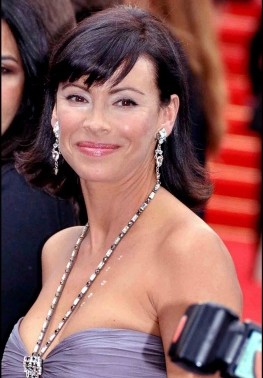
Mathilda May
View on Wikipedia
 |
Mathilda May (born Karin Haïm;[2] 8 February 1965) is a French film actress and director. Her most well-known turns include the roles of Space Girl in Lifeforce (1985) and Jeanne Gardella in Toutes peines confondues (1992).
Key Information


May's film work is primarily in French and made for the European market. She was the recipient of the César Award for Most Promising Actress in 1988[3] for her role in Le Cri du Hibou (The Cry of the Owl) and the Romy Schneider Prize for best up and coming actress in 1989. In 1992, she also recorded an album called Joy of Love.[4][5] May was the writer and director for the theater show Open Space, which ran from 2013 to 2015.[6][7][8]
Early life
[edit]May was born in Paris, France. Her father, the playwright,[9] screenwriter, and actor Victor Haïm, is of Sephardic Jewish (Greek and Turkish) descent. Her mother is the Swedish ballet teacher and choreographer Margareta Hanson.[10] May studied under Christiane Vaussard at the Conservatoire de Paris, graduating at age 16.[11]
Career
[edit]May's film work is primarily in French and made for the European market. She was the recipient of the César Award for Most Promising Actress in 1988[3] and the Prix Romy Schneider in 1989. Non-French films she has appeared in include Naked Tango (1990), Becoming Colette (1991), and The Tit and the Moon (1994). In the United States, she is best-known for her role as an alien vampire in the Tobe Hooper science fiction/horror-film Lifeforce (1985), in which she is naked for most of her performance. She also appeared in the 1996 space adventure game Privateer 2: The Darkening. She played Isabella in The Jackal, a 1997 action film.
May recorded an album in 1992 called Joy of Love.[4][5]
May was the writer and director for the theater show Open Space, which was performed in the Théâtre Jean-Vilar in the commune of Suresnes, the Théâtre du Rond-Point, and the Théâtre de Paris from 2013 to 2015.[6][7][8] Open Space was a show without words; the story was presented by movement, music, and sound. May said of the show "[i]t will be choreographed without it being dance, and musical without an instrument".[12]
Personal life
[edit]May has been married four times. Her first husband was Paul Powell. Her second husband was Gérard Darmon, with whom she has two children, a daughter and a son. Her third husband was Philippe Kelly. Her fourth husband was Sly Johnson.
Filmography
[edit]| Year | Title | Role | Director | Notes |
|---|---|---|---|---|
| 1984 | Nemo | Alice | Arnaud Sélignac | |
| 1985 | Lifeforce | Space Girl | Tobe Hooper | |
| Les Rois du gag | Alexandra | Claude Zidi | ||
| 1987 | La vie dissolue de Gérard Floque | Pauline | Georges Lautner | |
| The Cry of the Owl | Juliette | Claude Chabrol | César Award for Most Promising Actress | |
| 1988 | La passerelle | Cora Elbaz | Jean-Claude Sussfeld | |
| Three Seats for the 26th | Marion | Jacques Demy | ||
| 1990 | Naked Tango | Alba/Stéphanie | Leonard Schrader | |
| 1991 | Isabelle Eberhardt | Isabelle Eberhardt | Ian Pringle | |
| Scream of Stone | Katharina | Werner Herzog | ||
| Becoming Colette | Sidonie Gabrielle Colette | Danny Huston | ||
| 1992 | Toutes peines confondues | Jeanne Gardella | Michel Deville | |
| 1994 | Le voleur et la menteuse | Suzanne Henson | Paul Boujenah | |
| Dead Tired | Herself | Michel Blanc | ||
| The Tit and the Moon | Estrellita | Bigas Luna | ||
| 1996 | Celluloide | Cameo | Carlo Lizzani | |
| 1997 | The Jackal | Isabella Zanconia | Michael Caton-Jones | |
| 1999 | Entrevue | Alix | Marie-Pierre Huster | Short |
| 2000 | Là-bas... mon pays | Nelly Azera | Alexandre Arcady | |
| 2004 | Love Express | Anne-Charlotte | Elena Hazanov | |
| 2007 | New délire | Fanny's voice | Éric Le Roch | |
| A Girl Cut in Two | Capucine Jamet | Claude Chabrol (2) | ||
| 2012 | The Players | Ariane | Jean Dujardin | |
| 2019 | Je ne rêve que de vous | Cora Madou | Laurent Heynemann | |
| 2021 | Le Chemin du bonheur | Sarah Glücksmann | Nicolas Steil |
Television
[edit]| Year | Title | Role | Notes |
|---|---|---|---|
| 1985 | Giorno dopo giorno | TV series | |
| 1986 | Les louves | Agnès | Miniseries |
| Se un giorno busserai alla mia porta | TV film | ||
| 1988 | The Secret of the Sahara | Myriam | Miniseries |
| Piazza Navona | Jeanne | Episode 6 | |
| L'heure Simenon | Edmée | Episode 10 | |
| 1994 | The Whipping Boy | Betsy | TV film |
| 1996 | Noces cruelles | Sandra | TV film |
| La ferme du crocodile | Sandrine Jaussier | TV film | |
| 1998 | Only Love | Silvia Rinaldi | TV film |
| 2000 | Les redoutables | Military woman | Episode 6 |
| 2001 | De toute urgence | Julie | TV film |
| Caméra Café | The Boss's wife | 1 episode | |
| 2002 | Fabio Montale | Hélène Pessayre | 2 episodes |
| Perlasca – Un eroe Italiano | Contessa Eleonora | TV film | |
| 2003 | Soyez prudents... | TV film | |
| Soraya | TV film | ||
| 2005 | L'homme pressé | Irène Debord | TV film |
| L'homme qui voulait passer à la télé | Mélanie | TV film | |
| 2009 | Au siècle de Maupassant | Thérèse de Marsanne | 1 episode |
| 2010 | Les nuits d'Alice | Angélique | TV film |
| 2011 | Une vie française | Anna Blick | TV film |
| 2012 | Clash | Laure Rossignol | 3 episodes |
| 2013 | La croisière | Françoise | 1 episode |
| Délit de fuite | Cécile | TV film | |
| 2014 | Crossing Lines | Audrey St. Marie | 1 episode |
| 2015 | On se retrouvera | Hélène Janson | TV film |
| 2016 | Mystère à l'Opéra | Éva Fontaine | TV film |
| 2018 | Access | Valérie Couderq | 11 episodes |
| 2020 | Coup de foudre à Bangkok | Sandrine Lafore | TV film |
| 2023 | Daron | Coco |
Video Games
[edit]| Year | Title | Notes |
|---|---|---|
| 1996 | Privateer 2: The Darkening | Melissa Banks |
Awards and accolades
[edit]- The César Award (the national film award of France): 1988 Best Young Female Newcomer for The Cry of the Owl
- The 1989 Romy Schneider Award
- The 2019 Molliere for Best Director of a Public Theatre Show for The Wedding Banquet[13]
- The 2020 Molliere for Best Solo Performance for her production of Monsieur X starring Pierre Richard at the Théâtre de l’Atelier.[14]
- The 2020 SACD (Société des Auteurs et Compositeurs Dramatiques) for Best Director[15]
References
[edit]- ^ Ouadhi, Sonia (8 February 2022). "Mathilda May fête ses 57 ans : qui est son compagnon le chanteur Sly Johnson ?". Voici (in French). Retrieved 9 February 2022.
- ^ May, Mathilda (2018). "Prologue". V.O. (in French). Paris: Éditions Plon. ISBN 978-2-259-26450-1.
- ^ a b "The Cry of the Owl (translated from French)".
- ^ a b "Mathilda May – Album Discography". AllMusic. Retrieved 8 June 2023.
- ^ a b "Mathilda May – Mathilda May". Discogs. Retrieved 8 June 2023.
- ^ a b Blanchard, Sandrine (16 October 2013). "La petite entreprise de Mathilda May". Le Monde (in French). Retrieved 24 April 2021.
- ^ a b Patricelli, Sonia (9 June 2015). "Mathilda May, dans l'enfer de l'open space". France 24 (in French). Retrieved 24 April 2021.
- ^ a b "A ne pas rater : Open Space, le spectacle burlesque mis en scène par Mathilda May". Paris Select Book (in French). 24 April 2015. Retrieved 24 April 2021.
- ^ C.R.I.S, Association. "Actualités de Victor Haïm, actualités, textes, spectacles, vidéos, tous ses liens avec la scène - theatre-contemporain.net". theatre-contemporain.net (in French).
- ^ Gurtler, Matthias; Simon-Michel, Joséphine (15 January 2008). "CV de stars: Mathilda May". VSD (in French). Archived from the original on 1 March 2011. Retrieved 8 June 2023.
- ^ "Mathilda May : "je renoue avec moi-même"". Danser canal historique (in French). 29 January 2016. Retrieved 8 June 2023.
- ^ "Open Space". Théâtre de Suresnes Jean Vilar (in French). 10 October 2013. Retrieved 6 May 2024.
- ^ "Le Banquet - Théâtre de Paris | THEATREonline". www.theatreonline.com. Retrieved 6 May 2024.
- ^ Palmares 1987 - 2023.docx (lesmolieres.com)
- ^ "La SACD dévoile les 35 lauréats des Prix SACD 2020". SACD (in French). 12 June 2020. Retrieved 7 May 2024.
Further reading
[edit]- May, Mathilda (2007). Personne ne le saura (in French). Paris: Flammarion. ISBN 978-2-08-068459-2.
External links
[edit]

Mathilda May
View on GrokipediaEarly life and education
Family background
Mathilda May was born Karin Haïm on February 8, 1965, in Saint-Ouen, Seine-Saint-Denis, France.[2][12][3] Her father, Victor Haïm, is a French playwright, screenwriter, and actor of Sephardic Jewish descent, with roots in Greek and Turkish Jewish communities; his ancestors hailed from Thessaloniki.[2][3] Her mother, Margareta Hanson, is a Swedish ballet teacher and choreographer who also worked as a dancer.[2][13] Raised in a multicultural and artistically vibrant household in Paris, May grew up immersed in the performing arts, influenced by her father's literary pursuits and her mother's dedication to ballet.[13] Upon entering the acting profession, she adopted the stage name Mathilda May.[2]Dance and acting training
Mathilda May, born into an artistic family with her mother serving as a prominent dance teacher and choreographer, began her formal training in classical ballet at age 8, auditioning for the Opéra de Paris and participating in a three-month preparatory stage at the Opéra Garnier.[14] She entered the Conservatoire National Supérieur de Musique et de Danse de Paris at age 9, where she studied under instructors including the renowned ballet instructor Christiane Vaussard, honing her skills in classical dance techniques.[14][15] She demonstrated exceptional talent early on, training alongside future stars like Sylvie Guillem, while also competing internationally, including in Lausanne and with the New York City Ballet. By age 16, in 1981, May graduated with the prestigious Premier Prix du Conservatoire de Danse de Paris, marking her as one of the institution's top achievers in classical ballet.[15][14] Following her graduation, May joined professional dance companies, performing in early roles such as a figurante in the Opéra de Paris production of Les Indes galantes at age 19, where she experienced the rigorous demands of ensemble ballet work.[14] However, despite these opportunities—including invitations to dance with the Hamburg Ballet—she grew disillusioned with the profession's strict hierarchies, physical toll, and repetitive nature, describing it as lacking the creative freedom she craved.[15][14] Influenced by her lifelong passion for storytelling and theater, May decided to pivot toward acting around age 18, seeking roles that allowed narrative expression beyond dance's physical constraints.[15][14] This shift was motivated by her desire to convey emotions and stories through dialogue and character, drawing on her dance-honed physicality as a foundation for dramatic roles.[15]Career
Early film roles and breakthrough
Mathilda May made her film debut in the fantasy adventure Nemo (1984), directed by Arnaud Sélignac, where she portrayed the character Alice, a princess from a dreamlike realm. This role marked her entry into cinema following her background in dance, providing an initial showcase for her on-screen presence in a whimsical production aimed at younger audiences.[16] Her international breakthrough came with the role of the enigmatic Space Girl, a vampiric alien entity, in Tobe Hooper's science fiction horror film Lifeforce (1985).[17] The character, who spends much of the film nude after shedding her spacesuit, required significant physical demands, which May met through her ballet training, allowing her to perform with graceful, ethereal movements that enhanced the role's otherworldly quality.[17] This English-language debut exposed her to a global audience, though the film's campy style and explicit elements drew mixed reviews, with May's poised performance often highlighted as a standout amid the production's excesses.[18] Returning to French cinema, May appeared in supporting roles such as Alexandra in the comedy Les Rois du gag (1985) and Pauline in La Vie dissolue de Gérard Floque (1987), comedies that demonstrated her versatility in lighter fare.[19] Her pivotal breakthrough in domestic film arrived with Le Cri du hibou (The Cry of the Owl, 1987), directed by Claude Chabrol, where she played Juliette, a woman entangled in a obsessive thriller plot.[20] For this nuanced portrayal, May received the César Award for Most Promising Actress in 1988, recognizing her emotional depth and screen charisma.[19] Critics praised the film as suspenseful and darkly amusing, with May's radiant and touching performance contributing to its impact as a faithful adaptation of Patricia Highsmith's novel.[21]International and mature roles
Following her breakthrough in the 1985 science fiction film Lifeforce, where she portrayed a nude space vampire, Mathilda May transitioned to more diverse international projects that showcased her range beyond genre constraints.[22] In 1990, May starred in the Argentine-American co-production Naked Tango, directed by Leonard Schrader, playing the dual role of Stephanie, a restless young bride, and Alba, the identity she assumes after witnessing a suicide on a ship bound for Buenos Aires in the 1920s.[23] Her character becomes entangled in the tango underworld, exploring themes of identity, passion, and danger amid the film's erotic and atmospheric depiction of 1920s Argentina.[24] The role marked one of her early forays into English-language cinema outside France, highlighting her ability to embody complex, seductive figures in a narrative blending romance and noir elements.[25] May's international profile grew with her lead performance as the young Sidonie-Gabrielle Colette in the 1991 biographical drama Becoming Colette, directed by Danny Huston.[26] She portrayed the aspiring writer and performer navigating a stifling marriage to the manipulative Willy (Klaus Maria Brandauer), capturing Colette's evolution from provincial innocence to literary independence in turn-of-the-century Paris.[27] The film, a French-UK-German co-production, emphasized May's dramatic depth in scenes of intellectual and sensual awakening, though critics noted the production's uneven pacing.[26] In 1992, amid this period of rising visibility, May released her self-titled debut album Mathilda May (1992), a pop collection featuring tracks like "Life Goes On" and "Around the World," reflecting her multifaceted artistic pursuits.[28] Returning to French cinema, May took on a mature supporting role as Jeanne Gardella in the 1992 crime thriller Toutes peines confondues (also known as Sweetheart), directed by Michel Deville.[29] She played the wife of a shady businessman (Jacques Dutronc) entangled in a web of murder and corruption in the Swiss Alps, bringing emotional intensity to a character caught between loyalty and moral ambiguity as a police inspector (Patrick Bruel) investigates the crimes.[29] The film, praised for its atmospheric tension, allowed May to delve into psychological drama, shifting toward nuanced ensemble parts in domestic thrillers. By the late 1990s, May achieved a Hollywood crossover in The Jackal (1997), an action thriller directed by Michael Caton-Jones, where she portrayed Isabella Zanconia, a former Basque terrorist and ex-lover of the IRA operative Declan Mulqueen (Richard Gere).[30] Now living a reformed life in Washington, D.C., with her husband and child, her character provides crucial insights into the enigmatic assassin known as the Jackal (Bruce Willis), aiding federal agents in a high-stakes pursuit.[31] This role, opposite major stars, underscored her versatility in fast-paced international blockbusters, though the film received mixed reviews for its plot contrivances.[30] Throughout the 2000s and 2010s, May continued to embrace character-driven roles in French productions, evolving toward more introspective portrayals that highlighted her dramatic maturity. In the 2021 drama Le Chemin du bonheur (The Way to Happiness), directed by Nicolas Steil, she played Sarah Glücksmann, a key figure in a story of Holocaust survival and reconciliation, as an aging Saul Birnbaum (Simon Abkarian) confronts his past through encounters in 1980s Brussels.[32] The film, drawing on themes of memory and family, exemplified May's return to substantive French cinema, focusing on emotional depth in later-career works.[32]Music, theater, and directing
In 1992, Mathilda May released her self-titled debut album Mathilda May (1992), a collection of pop and soul tracks sung in English that showcased her vocal style influenced by artists like Rickie Lee Jones.[33][28] May transitioned into theater directing with her debut production, Open Space, which she also wrote; the play premiered in 2013 at the Théâtre Jean Vilar in Suresnes and was revived in 2015 at the Théâtre du Rond-Point in Paris.[34][35] Her work in theater expanded further with Le Banquet in 2019, earning her the Molière Award for Best Director of a Public Theater Show.[36][10] In 2020, she received another Molière Award for Best Solo Show for directing Monsieur X, featuring Pierre Richard.[37] May's television role as Commandante Coco in the series Le Daron, produced in 2023 and aired starting in 2024, highlighted her versatility before returning to the stage.[38][39] This period marked her continued involvement in directing, culminating in the 2025 premiere of Cut! Des Histoires, des Vies, a play exploring human stories through interconnected vignettes with six performers; it ran initially in October 2025 and is scheduled for reprise from January 13 to 17, 2026, at the Grande Halle de La Villette in Paris.[11][40]Personal life
Marriages and relationships
Mathilda May's first marriage was to musician Paul Powell in 1991, which ended in divorce two years later.[15] She married French actor Gérard Darmon in 1994, a union that garnered significant attention in French media due to their prominence in the entertainment industry; the couple divorced in 1999.[41] In 2000, May wed musician Philippe Kelly after dating for a year, but this marriage also concluded in divorce after six years.[42] May began a relationship with French rapper Sly Johnson around 2016, leading to their marriage in 2022, which she announced publicly on Instagram that year; the couple remains together as of 2025.[43][44] In recent interviews, May has discussed the challenges of maintaining romantic partnerships amid her acting career, emphasizing a sense of urgency at age 60 to prioritize authentic love and creative pursuits without wasting time, as reflected in her current stable marriage.[45]Children and family
Mathilda May has two children from her marriage to actor Gérard Darmon: daughter Sarah, born on August 17, 1994, and son Jules, born in 1997.[46] From her marriage to Philippe Kelly, she has a daughter. May has consistently prioritized her children's privacy, rarely sharing details about their lives in public interviews or on social media, and has described her approach to parenting as protective to allow them normal upbringings away from the spotlight of her career.[47] The family resides in Paris, where May emphasizes an artistic environment for her children, mirroring her own upbringing in a creative household influenced by her father's work as a playwright. Sarah has pursued a career in furniture design and production, while Jules has contributed to theater projects, including sound design for his mother's stage productions, reflecting the family's immersion in the arts.[48] May has spoken of balancing her professional commitments with family time, often crediting her children for grounding her amid a demanding schedule in film and theater.Awards and honors
Film awards
Mathilda May received the César Award for Most Promising Actress in 1988 for her performance as Juliette in Claude Chabrol's Le Cri du hibou.[49] This accolade, presented by the Académie des Arts et Techniques du Cinéma, highlighted her emergence as a compelling new talent in French cinema following her international exposure in the 1985 science fiction film Lifeforce.[50] In 1989, May was awarded the Prix Romy Schneider, an honor given annually to promising young actresses in the French film industry, further affirming her rising status.[50] The prize, named after the iconic actress Romy Schneider, recognized May's versatile portrayals in early career roles and contributed to her growing reputation among directors and producers.[51] These early awards significantly influenced May's career trajectory by increasing her visibility and leading to more prominent offers within the French film sector, including collaborations with established filmmakers.[19] Despite no further César nominations in subsequent years, the recognition solidified her position as a key figure in 1980s and 1990s French cinema.[52]Theater awards
Mathilda May's transition to theater directing in the 2010s marked a significant phase in her career, where her prior experience in film and music informed innovative, visually dynamic stagings that blended physical comedy and ensemble performance.[10] In 2019, May received the Molière Award for Best Director in a Public Theater Production for Le Banquet, a burlesque play she also wrote, which depicted chaotic wedding festivities through silent, choreographed mishaps.[53] The production also earned the Molière Award for Best Female Revelation for Ariane Mourier that same year, highlighting its critical and popular success at the Théâtre du Rond-Point. These honors underscored May's ability to craft accessible yet sophisticated theater.[54] May's 2020 direction of Monsieur X, an introspective solo piece starring Pierre Richard and adapted from George Langelaan's work, won the Molière Award for Best Solo Performance, further affirming her prowess in intimate, character-driven formats.[55] This accolade brought her total Molière recognitions to two, emphasizing her evolution as a director.[10] Earlier, her 2013-2015 production Open Space, a wordless satire on office life, received acclaim in French theater circles for its Tati-esque humor and international cast, though it did not secure a major award.[56]Filmography and media appearances
Feature films
Mathilda May's feature film career began in 1984 with the role of Alice in Nemo, directed by Arnaud Sélignac. She gained international recognition for portraying the Space Girl in Tobe Hooper's science fiction horror Lifeforce (1985). Her performance as Juliette in Claude Chabrol's Le Cri du hibou (1987) earned her the César Award for Most Promising Actress in 1988.[57][57][50] The following table lists her major feature film roles chronologically, including character names and directors:| Year | Film Title (English / Original) | Role | Director |
|---|---|---|---|
| 1984 | Nemo | Alice | Arnaud Sélignac |
| 1985 | Lifeforce / Lifeforce, l'Etoile du Mal | Space Girl | Tobe Hooper |
| 1985 | Les Rois du gag | Alexandra | Claude Zidi |
| 1986 | Les Louves | Agnès | Hervé Baslé |
| 1987 | Le Cri du hibou / The Cry of the Owl | Juliette | Claude Chabrol |
| 1987 | La Vie dissolue de Gérard Floque | Pauline | Georges Lautner |
| 1988 | Trois places pour le 26 / Three Seats for the 26th | Marion | Jacques Demy |
| 1988 | La Passerelle | Cora Elbaz | Jean-Claude Sussfeld |
| 1990 | Naked Tango | Alba / Stéphanie | Leonard Schrader |
| 1991 | Isabelle Eberhardt | Isabelle Eberhardt | Ian Pringle |
| 1991 | Cerro Torre, le cri de la roche / Scream of Stone | Katharina | Werner Herzog |
| 1991 | Devenir Colette / Becoming Colette | Sidonie Gabrielle Colette | Danny Huston |
| 1992 | Toutes peines confondues | Jeanne Gardella | Michel Deville |
| 1993 | Le Voleur et la menteuse | Suzanne Henson | Paul Boujenah |
| 1994 | Grosse fatigue / Dead Tired | Herself | Michel Blanc |
| 1994 | La Lune et le Téton / The Tit and the Moon | Estrellita | Bigas Luna |
| 1995 | Noces cruelles | Sandra | Bertrand van Effenterre |
| 1995 | Pocahontas, une légende indienne / Pocahontas | Pocahontas (voice) | Mike Gabriel, Eric Goldberg |
| 1996 | La Ferme du crocodile | Sandrine Jaussier | Fabrice Cazeneuve |
| 1997 | Le Chacal / The Jackal | Isabella | Michael Caton-Jones |
| 2000 | Là-bas... mon pays | Nelly Azera | Alexandre Arcady |
| 2007 | La fille coupée en deux / A Girl Cut in Two | Capucine Jamet | Claude Chabrol |
| 2012 | Les Infidèles / The Players | Ariane | Émile Gaudreault, Jean Dujardin |
| 2018 | Ralph 2.0 / Ralph Breaks the Internet | Pocahontas (voice) | Rich Moore, Phil Johnston |
| 2020 | Je ne rêve que de vous / An Irrepressible Woman | Cora Madou | Laurent Heynemann |
| 2022 | Le Chemin du bonheur / The Way to Happiness | Sarah Glücksmann | Nicolas Steil |
Television
Mathilda May began her television career in the mid-1980s with roles in international miniseries and TV movies, transitioning to more prominent French series and guest appearances in the 1990s and 2000s, before taking on lead and recurring roles in contemporary productions.[57] Her early television work includes the 1985 TV movie Letters to an Unknown Lover (original French title: Les louves), where she portrayed Agnès, the half-sister of the protagonist in a World War II drama.[60] In 1986, she appeared in the Italian-French miniseries Se un giorno busserai alla mia porta as Claudia Bandini across four episodes, playing the daughter of a famous actress entangled in family secrets.[61] The following year, May starred as Myriam in the adventure miniseries The Secret of the Sahara, a co-production involving American, Italian, and French elements, depicting an archaeologist's quest in the desert.[62] In 1998, she played Silvia Rinaldi in the American TV movie Only Love, a romantic drama based on Erich Segal's novel, opposite Marisa Tomei and Rob Morrow.[63] Moving into the 2000s, May guest-starred as a military woman in the 2001 horror-comedy series Les redoutables, specifically in the episode "Déviations."[64] That same year, she took the role of Hélène Pessayre in the crime miniseries Fabio Montale, appearing in multiple episodes as a key figure in a murder investigation. In 2003, she appeared as La princesse Shams in the TV movie Soraya, a biopic of Soraya Esfandiary-Bakhtiari.[65] In 2004, May featured as Irène Debord in the TV movie L'Homme pressé, a thriller centered on a high-stakes legal case.[57] Guest appearances followed in 2009, including as herself in an episode of the family comedy series Fais pas ci, fais pas ça (Season 2) and as Thérèse de Marsanne in the anthology series Au siècle de Maupassant: Contes et nouvelles du XIXe siècle (Season 1), adapting classic short stories.[57] In 2012, she portrayed Laure Rossignol in the crime drama series Clash (Season 1), a recurring role in a story about corporate intrigue.[57] The next year, May appeared as Françoise in six episodes of the comedy series La Croisière (Season 1), playing a passenger on a luxury cruise ship.[57] In 2014, she joined the international crime series Crossing Lines (Season 2) in a supporting role within the European-based procedural.[57] May's 2015 television output included the lead role of Lieutenant Janson in the mystery TV movie On se retrouvera (also known as A Woman's Revenge), investigating a disappearance in a rural setting, and Eva Fontaine in the TV movie Mystère à l'Opéra.[57] In 2018, she had a main cast role as Valérie Couderq in the thriller series Access (Season 1), centered on media and corporate scandals.[57] In 2020, May starred as Sandrine Lafore in the TV movie Coup de foudre à Bangkok, a romantic comedy.[66] More recently, May played Coco, the wife of the protagonist, in the 2024 comedy series Le Daron (Season 1), a family-oriented production airing on TF1 about a quirky lawyer. In 2025, she appeared as Myriam in the TV series La belle et le boulanger (Season 1).[67]Video games and other media
Mathilda May provided the voice for the character Melissa Banks in the 1996 space simulation video game Privateer 2: The Darkening, developed by Electronic Arts and released for MS-DOS. In the game, her character serves as a key figure in the narrative involving interstellar intrigue and combat.[68][69] In addition to her acting career, May ventured into music with her self-titled debut album Mathilda May, released in 1992 by Epic Records. The album blends pop, rock, and blues influences, showcasing her vocal talents across nine tracks. It was produced with contributions from musicians such as Colin Towns and features songwriting collaborations.[28] The track listing for Mathilda May (1992) is as follows:| Track Number | Title | Duration |
|---|---|---|
| 1 | Joy of Love (Intro) | 2:25 |
| 2 | Life Goes On | 4:23 |
| 3 | Around the World | 5:36 |
| 4 | If You Miss... | 5:03 |
| 5 | Do You Want Me? | 4:21 |
| 6 | Magic Touch | 4:35 |
| 7 | Make Me Smile | 5:08 |
| 8 | Souvenirs | 4:30 |
| 9 | Incognito | 4:45 |