


Community hub
Recent from talks
Contribute something
Nothing was collected or created yet.
Matthew Axelson
View on Wikipedia
Matthew Gene "Axe" Axelson (June 25, 1976 – June 28, 2005)[1] was an enlisted United States Navy SEAL who was awarded the U.S. Navy's second highest decoration, the Navy Cross and the Purple Heart, for his actions during the War in Afghanistan. Serving as a sniper in the operation, Axelson was killed in action during the firefight phase of Operation Red Wings.
Key Information


Personal life
[edit]Axelson was born on June 25, 1976, in Cupertino, California, to parents Donna and Cordell Axelson. He graduated from Monta Vista High School in 1994,[2] attended San Diego State University for a year and graduated from the California State University Chico with a degree in political science.[3] Axelson's brother, Jeffery, wrote a book about him.[3] Axelson married Cindy Oji in 2003, in Sacramento, California.[4]
Military service and death
[edit]Axelson enlisted in the United States Navy in December 2000, and completed basic training at Naval Station Great Lakes. After finishing Sonar Technician Surface (STG) "A" School,[5] he undertook Basic Underwater Demolition/SEAL training (BUD/S) and graduated with Class 237 in Coronado, California. After BUD/S, Axelson went to the Army Airborne School, completed SEAL Qualification Training and then attended SEAL Delivery Vehicle School. He reported to SEAL Delivery Vehicle Team 1 in December 2002, in Hawaii. He deployed to Afghanistan in April 2005.[4]
Operation Red Wings
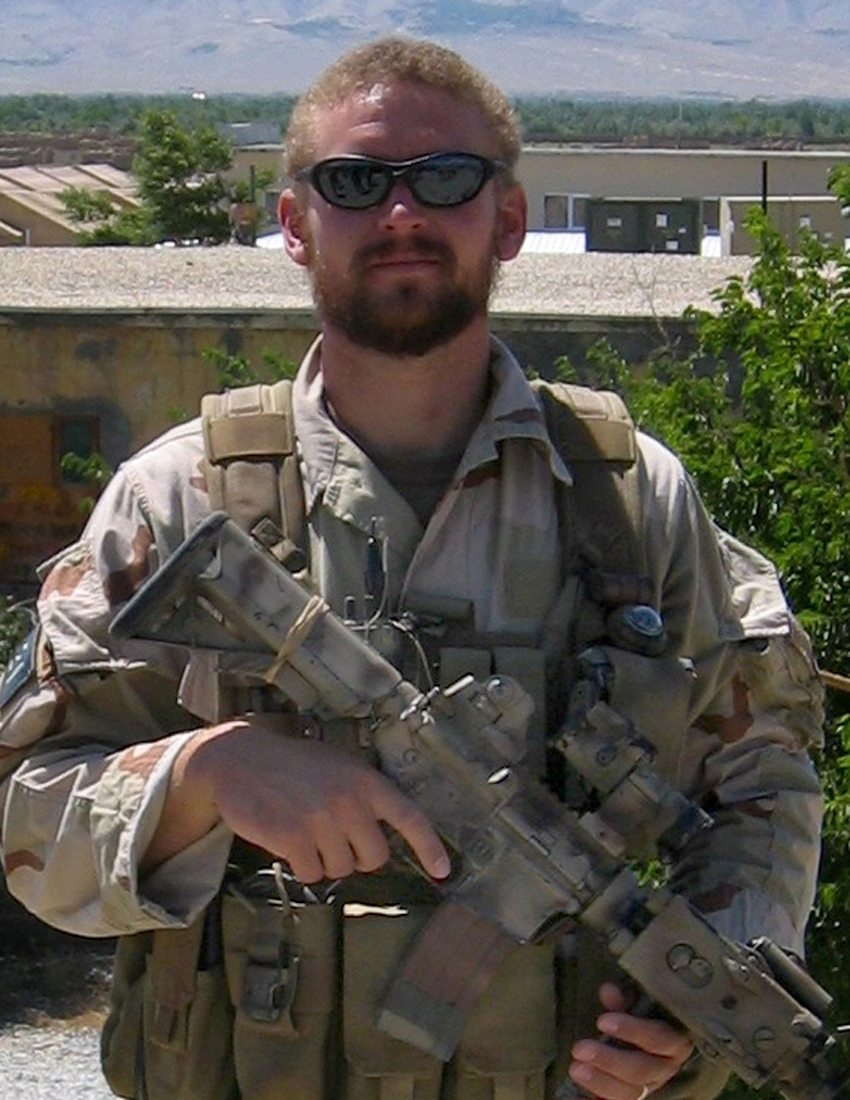
[edit]_2nd_Class_Matthew_G._Axelson,_of_Cupertino,_Calif.,_taken_in_Afghanistan.jpg)
_2nd_Class_(SEAL)_Matthew_Axelson,_comforts_her_daughter-in-law,_Maria.jpg)
Operation Red Wings was a counter-insurgency operation carried out by the United States Armed Forces in Kunar Province, Afghanistan, in 2005. The objective of the operation was to kill or capture Ahmad Shah (code name Ben Sharmak), a known terrorist and head of the "Mountain Tigers" militia group. During the operation, Axelson and Marcus Luttrell were assigned as snipers while Danny Dietz and Michael P. Murphy served as spotters.[6]
The mission was compromised after goat herders discovered the SEALs and reported their location to the Taliban in the village. An intense firefight ensued and Dietz was killed as a result of a gunshot wound to the head, becoming the first casualty of the operation. After Murphy moved to a clearing to get reception and call for support, he was shot multiple times and killed, while Axelson died as a result of bullet wounds and fragmentation wounds from an RPG blast as he tried to escape.[7]
The quick reaction force that was dispatched in response to a request from Murphy, consisted of eight Navy SEALs and eight 160th SOAR Night Stalker crewmen. As the aircraft arrived onsite and the SEALs attempted to fast rope, an RPG hit their Chinook causing it to crash. All 16 personnel aboard were killed.[8][9]
Axelson had been severely wounded after taking the brunt of the initial attack and the fall with his teammates. After regrouping with the team, he began firing back and hours later he suffered a gunshot wound to the head, by this point of time he had been shot in several places including his chest and head.[10] On July 10, 2005, Axelson's body was discovered 3 miles away from the initial RPG explosion, by a group of SEALs during a search and rescue operation and returned to the United States. Axelson was buried with full military honors at Glen Oaks Memorial Park in Chico, California.[10]
Awards and decorations
[edit]Navy Cross
[edit]On September 13, 2006, Axelson was posthumously awarded the Navy Cross by Navy Secretary Donald C. Winter.[11]
Citation
[edit]
The President of the United States of America takes pride in presenting the Navy Cross (Posthumously) to Sonar Technician Second Class Matthew Gene Axelson, United States Navy, for extraordinary heroism in actions against the enemy while serving in a four-man Special Reconnaissance element with SEAL Delivery Vehicle Team ONE, Naval Special Warfare Task Unit, Afghanistan from 27 to 28 June 2005. Petty Officer Axelson demonstrated extraordinary heroism in the face of grave danger in the vicinity of Asadabad, Konar Province, Afghanistan. Operating in the middle of an enemy-controlled area, in extremely rugged terrain, his Special Reconnaissance element was tasked with locating a high-level Anti-Coalition Militia leader, in support of a follow-on direct action mission to disrupt enemy activity. On 28 June 2005, the element was spotted by Anti-Coalition Militia sympathizers, who immediately revealed their position to the militia fighters. As a result, the element directly encountered the enemy. Demonstrating exceptional resolve and fully understanding the gravity of the situation, Petty Officer Axelson's element bravely engaged the militia, who held both a numerical and positional advantage. The ensuing firefight resulted in numerous enemy personnel killed, with several of the Navy members suffering casualties. Ignoring his injuries and demonstrating exceptional composure, Petty Officer Axelson advised the teammate closest to him to escape while he provided cover fire. With total disregard for his own life and thinking only of his teammate's survival, he continued to attack the enemy, eliminating additional militia fighters, until he was mortally wounded by enemy fire. A champion of freedom, Petty Officer Axelson will be remembered for his self-sacrificing actions in the continuing Global War on Terrorism. By his undaunted courage, fortitude under fire, and unwavering dedication to duty, Petty Officer Axelson reflected great credit upon himself and upheld the highest traditions of the United States Naval Service. He gallantly gave his life for the cause of freedom.[12]
Axelson's awards include:[13]


.svg)


Legacy
[edit],_the_Honorable_Donald_C._Winter_escorts_Donna_Axelson_to_view_a_memorial_of_her_son_during_a_Veterans_Day_dedication.jpg)
On November 11, 2007, the town of Cupertino, California, erected a bronze lifesize statue of Axelson and fellow SEAL James Suh (also killed in action during Operation Red Wings), holding their rifles in a defensive kneeling position. The Navy Cross citation was replicated on the memorial.[14]
On November 3, 2015, Naval Base San Diego renamed their Pacific Beacon housing complex to The Axelson Building and dedicated a display box in the building's lobby which houses some of Axelson's possessions.[15]
On November 13, 2015, Axelson was recognized as an alumnus at San Diego State University and included on the university's war memorial.[16][17]
For the 2013 film Lone Survivor, which covered the events of Operation Red Wing, Axelson was portrayed by actor Ben Foster.[18]
A bill was proposed in October 2019 to rename the post office in Cupertino, California, to "Petty Officer 2nd Class (SEAL) Matthew G. Axelson Post Office Building", the bill had passed on 14 September 2020 and the building was renamed.[19]
In 2016, Axelson Tactical, a firearm company started in Axelson's honor, unveiled a replica rifle similar to what Axelson had carried at the time he was killed in action in June 2005.[20] On January 19, 2016, Axelson Tactical and Team Never Quit Ammunition, announced a raffle to giveaway an Axelson replica rifle and a 1,000 rounds of ammunition to raise money for the Special Operations Wounded Warriors charity.[21][22]
References
[edit]- ^ Shyamsundar, Harini (December 4, 2020). "Alumnus gives life for U.S.A." estoque Monta Vista High School. Retrieved December 4, 2020.
- ^ a b "Axelson's career". United States Navy SEALs. 2008. Retrieved April 13, 2019.
- ^ a b "Petty Officer 2nd Class Matthew G. Axelson, 29, Cupertino; Navy SEAL Killed in an Ambush in Afghanistan". Los Angeles Times. July 24, 2005. Retrieved April 15, 2019.
- ^ "Rank". Military Times. 2005. Retrieved December 5, 2020.
- ^ Kessler, Morris (February 4, 2014). "Lone Survivor: What Really Happened During Operation Red Wings". Esquire. Retrieved November 8, 2020.
- ^ "Survivor". 60 Minutes. CBS News. 2013. Retrieved April 10, 2019.
- ^ "LT Michael P. Murphy USN". United States Navy. Archived from the original on March 16, 2016. Retrieved April 10, 2019.
- ^ Widener, Laura (June 28, 2020). "11 SEALs, 8 Army Night Stalkers killed 15 years ago today in Operation Red Wings". American Military News. Retrieved December 4, 2020.
- ^ a b "The American Fallen Soldiers Project". 2013. Archived from the original on April 15, 2019. Retrieved April 15, 2019.
- ^ "Matthew G. Axelson". veterantributes.org. Retrieved November 29, 2020.
- ^ "Axelson's Memorial Sculpture". The Mercury News. 2014. Retrieved April 15, 2019.
- ^ "the Axelson Building". United States Navy magazine. Retrieved November 20, 2020.
- ^ "Ceremony to Honor Uncommon Accomplishments of Noteworthy Aztecs". San Diego State University Alumni. Retrieved November 20, 2020.
- ^ "Profiles of SDSU Military Alumni" (PDF). San Diego State University. Retrieved November 20, 2020.
- ^ "Ben Foster: why I ate dirt for Lone Survivor". The Guardian. January 24, 2014. Retrieved April 17, 2019.
- ^ Bennett, Abbie (2020), House passes bill to honor fallen Navy SEAL Matthew Axelson, retrieved October 22, 2020 – via Radio.com
- ^ Ainsworth, Kat (2016), Axelson Tactical Rifle Review, retrieved October 31, 2020
- ^ PRWEB, CISION (2016), Brownells, SOWW Partner to Raffle Matt "Axe" Axelson Tribute Rifle, retrieved October 31, 2020
- ^ "Sip & Savor: A Night To Benefit The Matthew Axelson Foundation". KPBS (TV). Archived from the original on November 3, 2020. Retrieved October 31, 2020.
Matthew Axelson
View on GrokipediaEarly Life and Education
Childhood and Family Background
Matthew Gene Axelson was born on June 25, 1976, in Cupertino, California, to parents Donna Axelson and Cordell "Corky" Axelson.[7][8] He had one brother, Jeffery "Jeff" Axelson, with whom he shared a close family bond characterized by mutual support and orientation toward familial responsibilities.[9][10] Axelson grew up in the suburban environment of Cupertino, located in the heart of Silicon Valley, during a period when the area was transitioning from orchards to a tech hub, though his family's inclinations leaned toward traditional values rather than emerging industry pursuits.[11] His father, Cordell, had served in the Vietnam War, and relatives on both sides of the family had military experience, instilling an early awareness of service and duty within the household dynamics.[12][13] This background contributed to a home environment that valued resilience and commitment, shaping Axelson's formative perspectives without overt emphasis on militarism at the time.[3] The Axelson family's stability and emphasis on personal accountability provided a foundation for Axelson's development, as evidenced by his later-described family-oriented nature, though specific childhood anecdotes beyond this general context remain limited in public records.[14][15]Academic and Pre-Military Pursuits
Axelson attended San Diego State University for one year following his high school graduation before transferring to California State University, Chico.[16] There, he earned a bachelor's degree in political science, completing his studies shortly before enlisting in the U.S. Navy.[1][17] His academic pursuits reflected an interest in governance and policy, though specific coursework or extracurricular involvement in student government or debate remains undocumented in available records. Axelson maintained a focus on physical conditioning during this period, building on earlier athletic experiences in soccer, skiing, swimming, and golf to develop the endurance and precision that would later define his military aptitude.[18] Transitioning from university life, Axelson sought outlets for his competitive drive beyond civilian routines, motivated by a desire for purposeful challenge and adventure rather than routine employment or further academia.[3] This personal initiative led him to enlist in December 2000, marking a deliberate shift toward elite special operations service.[1]Personal Life
Marriage and Relationships
Axelson met Cindy Oji in 1999 while both were students at California State University, Chico, where he pursued a degree in political science.[19] The couple married in Sacramento, California, in 2003, establishing a partnership characterized by mutual support despite the rigors of his Navy SEAL career.[20] Throughout his training periods and deployments, Axelson sustained their bond via letters and phone calls, navigating the challenges of separation inherent to special operations service.[21] The Axelsons had no children, reflecting a family life centered on their marital commitment amid professional demands.[22] Axelson's devotion to Oji underscored his prioritization of personal ties, even as military obligations frequently pulled him away; she later co-founded the Matthew Axelson Foundation with his brother Jeff to honor his legacy of valuing family alongside duty.[22] Upon his death in 2005, Oji survived him along with his parents, Donna and Corky Axelson, and brother Jeff, forming the core of his immediate family network.[22]Interests and Character Traits
Matthew Axelson, known by the nickname "Axe," was characterized by family members as quiet and observant, often taking time to assess situations before becoming involved.[23] His brother Jeff noted this reserved nature in accounts of his pre-military life, emphasizing a preference for thoughtful reflection over impulsive action.[24] Comrades described him as affable and good-natured, refusing to engage in gossip or judgment of others, instead redirecting conversations positively.[23] Axelson demonstrated emotional maturity and resilience, accepting feedback constructively without defensiveness and maintaining integrity under pressure. Fellow SEAL Marcus Luttrell recalled him as highly intelligent, with a pragmatic mindset and exceptional skill at Trivial Pursuit, reflecting a broad knowledge base and strategic thinking.[25] He was deeply family-oriented, prioritizing loyalty to his parents Cordell and Donna, brother Jeff, and wife Cindy, whom he met at California State University, Chico.[9] Among his personal interests, Axelson enjoyed cars and motorsports, owning a 1969 Chevrolet Corvette and planning to rebuild a Triumph TR6 alongside his father.[23] He pursued reading as a hobby, aligning with his introspective and philosophical disposition.[26] Friends portrayed him as gentle yet determined, with a low-key demeanor that valued self-reliance and quiet stoicism over overt displays.[27]Military Enlistment and Training
Entry into the Navy and SEAL Qualification
Matthew Axelson enlisted in the United States Navy on December 12, 2000, following his graduation with a degree in political science from California State University, Chico.[17] [28] He entered recruit training at Naval Station Great Lakes, Illinois, where he completed basic training before advancing to specialized instruction.[17] [29] Following basic training, Axelson attended Sonar Technician Surface (STG) "A" School to develop skills in advanced communications and sonar operations, essential for special warfare roles.[17] He then proceeded to Basic Underwater Demolition/SEAL (BUD/S) training at the Naval Special Warfare Center in Coronado, California, graduating with Class 237 in 2001.[30] BUD/S encompassed intense physical conditioning, combat swimming, and small-boat handling, culminating in Hell Week—a five-and-a-half-day ordeal of continuous evolution with minimal sleep, over 200 miles of running, and exposure to cold ocean conditions designed to test candidates' endurance and mental fortitude.[31] Axelson's perseverance through this grueling phase underscored his determination, as only a fraction of entrants typically complete the program.[29] After BUD/S, Axelson completed Army Airborne School for parachutist qualification, followed by SEAL Qualification Training (SQT), which integrated tactical skills, weapons proficiency, and mission planning. He earned the SEAL Trident insignia upon finishing SQT and was promoted to Petty Officer Second Class (STG2), specializing in communications while developing sniper expertise during qualification phases.[32] This progression marked his transition from recruit to qualified Naval Special Warfare operator, prepared for operational demands through rigorous selection that emphasized individual resilience over attrition rates exceeding 70 percent.[29]Early Assignments and Skill Development
Following completion of SEAL Qualification Training and SEAL Delivery Vehicle School, Axelson reported to SEAL Delivery Vehicle Team One (SDVT-1) at Joint Base Pearl Harbor-Hickam, Hawaii, in December 2002, where he integrated into Alfa Platoon.[17] This assignment emphasized mastery of specialized underwater insertion and extraction techniques using swimmer delivery vehicles, critical for covert reconnaissance and special operations in denied environments, building on his Sonar Technician Surface rating to incorporate advanced acoustic and communication skills for mission coordination.[17] SDVT-1's rigorous regimen selected operators through merit alone, filtering for those demonstrating superior adaptability and precision under extreme conditions, a process that reinforced the unyielding elitism of Naval Special Warfare units where subpar performance results in reassignment rather than accommodation.[33] During his tenure with SDVT-1 from 2002 to early 2005, Axelson honed reconnaissance proficiencies through platoon-level exercises simulating stealth infiltrations and target acquisition, integrating his technical expertise in sonar-based intelligence gathering with tactical mobility.[33] By summer 2003, he engaged in efforts to overhaul the Naval Special Warfare sniper curriculum, co-contributing to curriculum updates that prioritized independent long-range engagements and instructor accountability, reducing course failure rates from over 30% to under 3% by June 2004.[33] This development phase underscored a commitment to empirical skill validation, where operators like Axelson advanced via demonstrated proficiency in marksmanship, ballistics, and fieldcraft, rejecting diluted standards in favor of causal effectiveness in high-leverage roles.[33] Axelson's pre-2005 service record reflects non-combat contributions to team readiness, including mentorship in specialized training detachments by fall 2002 and participation in cave-complex simulations at Coronado to replicate real-world subterranean reconnaissance challenges.[33] These activities fortified his role as a multi-domain operator, blending communications reliability—essential for maintaining operational tempo—with sniper precision, all within SDVT-1's merit-driven culture that prioritized empirical outcomes over egalitarian participation.[33][17]Operational Service
Pre-Operation Red Wings Deployments
Axelson reported to SEAL Delivery Vehicle Team 1 (SDV-1) in Pearl Harbor, Hawaii, in December 2002, where he served as a sonar technician second class, specializing in special reconnaissance and underwater insertion techniques essential for clandestine operations.[17] This assignment honed his skills in navigation, communications, and precision marksmanship, preparing him for high-stakes environments through intensive training cycles that emphasized team interoperability and endurance in austere conditions.[34] In April 2005, Axelson deployed to Afghanistan with a special reconnaissance element from SDV-1, attached to support Naval Special Warfare Squadron 10 and SEAL Team 10 operations in eastern Afghanistan.[35] Over the ensuing two months prior to Operation Red Wings, the unit acclimated to the Hindu Kush's extreme altitudes and conducted initial reconnaissance patrols amid Taliban-controlled areas, accumulating practical exposure to asymmetric threats, including ambushes and human intelligence challenges from local populations.[29] These activities underscored the tactical demands of maintaining operational security in rugged, low-visibility terrain, where effective counterinsurgency required rapid adaptation to enemy mobility and limited lines of sight for sniper overwatch. Within SEAL Team 10's structure, Axelson formed enduring professional bonds with key teammates, including Lt. Michael P. Murphy, the platoon leader; Gunner's Mate Second Class Danny Dietz, the communications specialist; and Hospital Corpsman Second Class Marcus Luttrell, the corpsman and point man—relationships forged during pre-deployment workups at Naval Amphibious Base Coronado and SDV-1's Hawaii base.[36] This cohesion, built on shared drills simulating prolonged patrols and casualty evacuation, enabled seamless role execution under stress, with Axelson's dual expertise in sonar-derived targeting and long-range engagement complementing the team's direct action capabilities. Early deployment experiences reinforced causal factors in mission success, such as pre-mission terrain reconnaissance to counter improvised enemy reinforcements and the perils of compromised positions in isolated valleys.[34]Role as a SEAL Sniper
Axelson specialized as a sniper in Naval Special Warfare, focusing on precision engagements that supported platoon-level reconnaissance and direct action in asymmetric conflicts. After SEAL Qualification Training, he completed the Naval Special Warfare sniper course, revamped around 2003-2004 to emphasize independent operations with reduced attrition rates from over 30% to under 3%, graduating at the top of his class despite its demands for flawless performance under duress.[37][33] His training honed skills in precision marksmanship, enabling self-spotting for rapid shot corrections and assessments without a dedicated spotter, a core SEAL sniper competency for minimizing exposure in hostile zones.[38] Axelson excelled in reconnaissance techniques, including advanced stalking and evasion, as demonstrated in exercises where he evaded detection while traversing known paths in forested areas like those near Bangor, Washington, underscoring his ability to gather intelligence undetected.[37] Communication roles involved relaying precise enemy data to teams, enhancing coordination in dynamic scenarios. In high-altitude, rugged terrains typical of operations in Afghanistan, Axelson's sniper expertise contributed to team survivability by delivering overwatch fire, countering threats like enemy marksmen or improvised devices, and establishing safe corridors for follow-on forces, all grounded in rigorous standards that prioritized consistent accuracy over indiscriminate suppression.[33] His empirical proficiency, evidenced by expert rifleman qualification, aligned with the strategic value of snipers in extending operational reach while conserving team resources in prolonged engagements.[37]Operation Red Wings
Mission Objectives and Team Composition
Operation Red Wings, launched in late June 2005, was a U.S. military counterinsurgency effort in the Pech District of Kunar Province, Afghanistan, targeting Ahmad Shah, a Taliban commander in his mid-30s leading the "Mountain Tigers" militia, which had conducted multiple ambushes against coalition forces.[36][39] The reconnaissance phase's core objective was to locate Shah's position, gather intelligence on his network of approximately 50-200 fighters, and enable follow-on actions to disrupt anti-coalition militia activities amid Operation Enduring Freedom.[36][39] The operational core was a four-man Navy SEAL reconnaissance and surveillance team from SEAL Team 10's Alpha Platoon, inserted by MH-47 Chinook helicopter into the steep, forested terrain of the Hindu Kush mountains on the night of June 27, 2005.[36][39] Team leadership fell to Lieutenant Michael P. Murphy as officer in charge; Petty Officer Second Class Matthew G. Axelson, a sonar technician by rate, functioned as the sniper and backup communicator; Petty Officer Second Class Danny P. Dietz handled primary communications; and Hospital Corpsman Second Class Marcus Luttrell served as point man and combat medic.[36][39] Early on June 28, 2005, while establishing an observation post overlooking a suspected enemy valley, the team detained three unarmed Afghan goat herders—an elderly man, a teenage boy, and a younger boy—whose sudden appearance with a herd of approximately 100 goats compromised the element's concealment.[40][41] The SEALs conducted a brief vote on options, including potential lethal force, but adhered to prevailing rules of engagement prohibiting engagement of non-combatant civilians absent an imminent threat, opting instead to release the herders downhill after confiscating their equipment.[40][41] This decision reflected doctrinal emphasis on minimizing civilian casualties to align with laws of armed conflict, though team members expressed internal reservations about operational security risks in a Taliban-dominated area where locals often sympathized with insurgents; subsequent analyses have highlighted ROE tensions between force protection and humanitarian restraints, with some military commentators arguing for greater on-scene discretion in denied environments to avert predictable compromises.[40][41]The Ambush and Initial Engagement
Following the release of three local goatherds encountered earlier that morning, the four-man SEAL reconnaissance team—Lt. Michael P. Murphy, SO2 Matthew Axelson, STG2 Danny Dietz, and HM2 Marcus Luttrell—positioned themselves on the forested slopes of Sawtalo Sar mountain in Afghanistan's Kunar Province on June 28, 2005. Approximately one hour later, around midday, Taliban fighters led by Ahmad Shah initiated the ambush from elevated ridgelines above, exploiting the team's disadvantaged lower position in the rugged terrain between the Korangal and Shuryek valleys. Estimates of the initial attacking force varied, with after-action intelligence and video analysis indicating 8 to 10 fighters, though military reports cited up to 20 to 35 engaged in the opening volleys.[42][43] The assault opened with plunging small-arms fire and rocket-propelled grenades from the higher ground, forcing the SEALs into immediate cover amid boulders, sparse trees, and steep gullies that offered limited concealment but channeled their movements into exposed chutes. The team responded with disciplined suppressive fire using their M4 carbines, Mk 48 machine gun, and grenades, inflicting initial casualties on the attackers while attempting to bound downhill to better defensive positions; however, the interlocking fields of fire and cliff faces exacerbated their vulnerability, preventing effective flanking or evasion. Communication attempts via tactical radios failed due to the mountainous interference, prompting reliance on a satellite phone for extraction requests.[42][43] Dietz, serving as the team's communicator, sustained multiple wounds early in the engagement while exposing himself to maintain radio contact and direct fire, ultimately succumbing to his injuries during the initial hour of combat. Murphy similarly advanced to higher, exposed terrain to secure a signal for the quick reaction force call, receiving fatal wounds in the process amid the ongoing barrage that careened across cliffs and ridges. These early losses compounded the team's isolation, as the environmental factors—elevations exceeding 8,000 feet, dense fog potential, and sheer drops—hindered maneuverability and reinforcement, turning the ambush into a protracted defense against superior numbers and positions.[43][42]Axelson's Specific Actions and Survival Efforts
Axelson sustained gunshot wounds to the chest and head during the June 28, 2005, firefight but ignored his injuries to provide suppressive fire, enabling teammate Marcus Luttrell to attempt escape while he eliminated additional enemy fighters.[34][17] Despite the severity of these wounds, compounded by injuries from a nearby rocket-propelled grenade blast that separated him from Luttrell, Axelson continued combat operations, expending ammunition across multiple magazines in sustained resistance against numerically superior Taliban forces.[17] His remains, recovered on July 10, 2005, were located several hundred yards from the RPG impact site, evidencing post-separation mobility and evasion under duress.[17] This displacement, along with the expenditure of three magazines leaving one partially used, underscores documented efforts to reposition and prolong engagement after initial team fragmentation, reflecting resilience beyond the ambush's immediate phase.[17] According to Luttrell's eyewitness account, Axelson's final directive amid mortal wounding was to relay love to his wife, Cindy, prioritizing familial bonds in extremis.[44]Death and Posthumous Identification
Circumstances of Death
Matthew Axelson succumbed to multiple gunshot wounds to the chest and head on June 28, 2005, compounded by blast injuries from an RPG detonation during the prolonged firefight in the Hindu Kush mountains of Kunar Province, Afghanistan.[17] These wounds were sustained amid intense enemy fire from Taliban forces estimated at 50 or more fighters, with no indication from physical evidence or location that Axelson surrendered or was captured; his position, separated by several hundred meters to a mile from the initial ambush site, reflected continued movement and resistance post-separation from survivor Marcus Luttrell.[45][46] Recovery of Axelson's remains occurred on July 10, 2005, following a multi-day search complicated by rugged terrain, hostile weather, and ongoing enemy presence, as part of Operation Red Wings II efforts.[45] Forensic observations by U.S. personnel at the site revealed expended ammunition and weapon remnants consistent with sustained solo engagement, underscoring causal persistence in combat despite mortal injuries rather than immediate incapacitation as initially reported by separated teammates.[17] Accounts from recovery teams, drawing on direct examination, noted body condition indicative of death occurring approximately 1-2 days prior to discovery—contrasting with anecdotal survivor narratives of instant fatality from head trauma—thus privileging empirical decomposition and wound progression data over eyewitness limitations in visibility and separation during chaos.[47] This aligns with physiological realism of delayed lethality from penetrating trauma in austere environments, where blood loss and shock unfold over hours amid adrenaline-fueled exertion.Recovery of Remains and Forensic Insights
Following the ambush on June 28, 2005, and the subsequent shootdown of a quick reaction force Chinook helicopter that killed 16 additional U.S. personnel, recovery operations under Operation Red Wings II faced severe challenges in the rugged Hindu Kush mountains of Kunar Province, Afghanistan. The terrain, exceeding 7,500 feet in elevation with steep cliffs, dense vegetation, and persistent Taliban presence, complicated searches amid ongoing enemy activity and limited visibility.[48][49] Axelson's remains were recovered on July 10, 2005, by a U.S. Navy SEAL unit, approximately a few hundred yards from the initial RPG detonation site where the team had been overrun.[50] This location indicated he had separated from the main fight, likely crawling or moving under fire to evade capture or continue resistance despite severe injuries.[49] Forensic examination post-recovery determined that Axelson succumbed to multiple gunshot wounds to the chest and head, compounded by shrapnel and blast injuries from an RPG explosion that had fragmented the team.[17] The wounds' pattern—non-immediately incapacitating initial hits followed by lethal ones—aligned with eyewitness accounts of him sustaining a head wound yet persisting in combat, though medical realism limits such survival to glancing or non-penetrating trauma rather than full exposure as dramatized in some narratives.[51] The remains' condition, showing limited decomposition inconsistent with 12 days post-ambush, suggested death occurred days after the initial engagement, supporting evidence of extended evasion or sporadic fighting before fatal injuries overwhelmed him.[49]Awards and Decorations
Navy Cross Citation
Petty Officer Second Class Matthew G. Axelson was posthumously awarded the Navy Cross on September 13, 2006, for extraordinary heroism during Operation Red Wings on June 27–28, 2005, in Kunar Province, Afghanistan. This decoration, the United States Navy's second-highest award for valor after the Medal of Honor—presented to his team leader, Lieutenant Michael P. Murphy for actions in the same engagement—recognizes Axelson's sustained combat effectiveness against overwhelming enemy forces despite mortal wounds.[34] The official citation reads:For extraordinary heroism in actions against the enemy while serving in a four-man Special Reconnaissance element with SEAL Delivery Vehicle Team ONE, Naval Special Warfare Task Unit, Afghanistan from 27 to 28 June 2005. Petty Officer Axelson demonstrated extraordinary heroism in the face of grave danger in the vicinity of Asadabad, Konar Province, Afghanistan. Operating in the middle of an enemy-controlled area, in extremely rugged terrain, his Special Reconnaissance element was tasked with locating a high-level Anti-Coalition Militia leader, in support of a follow-on direct-action mission to disrupt enemy activity. On 28 June 2005, the element was spotted by Anti-Coalition Militia sympathizers, who immediately revealed their position to the militia fighters. As a result, the element directly encountered the enemy. Demonstrating exceptional resolve and fully understanding the gravity of the situation, Petty Officer Axelson's element bravely engaged the militia, who held both a numerical and positional advantage. The ensuing firefight resulted in numerous enemy personnel killed, with several of the Navy members suffering casualties. Ignoring his injuries and demonstrating exceptional composure, Petty Officer Axelson advised the teammate closest to him to escape while he provided cover fire. With total disregard for his own life and thinking only of his teammate's survival, he continued to attack the enemy, eliminating additional militia fighters, until he was mortally wounded by enemy fire. A champion of freedom, Petty Officer Axelson will be remembered for his self-sacrificing actions in the continuing Global War on Terrorism. By his undaunted courage, fortitude under fire, and unwavering dedication to duty, Petty Officer Axelson reflected great credit upon himself and upheld the highest traditions of the United States Naval Service. He gallantly gave his life for the cause of freedom.[34][35]The citation highlights Axelson's role in inflicting significant casualties on the enemy—estimated at numerous fighters killed during the initial and subsequent engagements—through persistent suppressive fire, enabling a teammate's evasion even as he fought to his last breath.[34]