Hubbry Logo
Nassau University Medical CenterNassau University Medical CenterMain
Open search
Nassau University Medical Center
Community hub
Nassau University Medical Center
logo
8 pages, 0 posts
0 subscribers
Be the first to start a discussion here.
Nassau University Medical Center
from Wikipedia

Nassau University Medical Center (NUMC) is a public teaching and safety net hospital in Nassau County led by Stuart Rabinowitz[1] and Dr. Richard Becker.[2] The 19-story, 631-bed Level I Trauma Center is located at 2201 Hempstead Turnpike in East Meadow, New York, in Nassau County, on Long Island.

Key Information

Overview

[edit]

The mission of Nassau University Medical Center is to provide comprehensive high-quality health care services to patients regardless of their ability to pay.[3] It is organized as a New York state public-benefit corporation under the name, Nassau Health Care Corporation.[4]

In December 2024, the hospital introduced a US$1.06 billion lawsuit against the State of New York, alleging the intentional withholding of federal funds intended for the hospital over the course of several years.[5] This action originated from a posited state takeover from Nassau Interim Finance Authority.

In June 2025, Megan Ryan, then-CEO of Nassau University Medical Center, was fired for cause after allegedly authorizing $3.5 million in payments—at least $1 million of which were deemed excessive—to herself and 12 others, according to a letter from interim CEO Dr. Richard Becker. The payments were made just days before a new oversight board was set to take effect on June 1.[6]

Organization

[edit]

The Nassau Health Care Corporation is guided by an 11-member board of directors.[7] In May 2025, Governor Kathy Hochul appointed Stuart Rabinowitz, who led Hofstra University for over 20 years, to lead the board as well as 3 additional appointees, Konstantinos “Dean” Mihaltses, Lisa Warren, and Amy Flores.[8]

The corporation's management team is led by Dr Richard Becker as interim CEO. Korn Ferry will lead a search for a permanent CEO and general counsel.[9] In 2016, it had operating expenses of $598 million, an outstanding debt of $256 million, and a staffing level of 4,180 people.[10]

History

[edit]
Meadowbrook Hospital in 1939

Meadowbrook Hospital opened on July 15, 1935, in East Meadow as a 200-bed county-owned general hospital. In the 1970s, the hospital's 19-story Dynamic Care Building, designed by Max O. Urbahn, was constructed, opening in 1974.[11]

The hospital's name was changed in 1970 to the Nassau County Medical Center.[12] This caused confusion with Nassau Hospital in Mineola, New York, which a decade later changed its name to Winthrop-University Hospital. The center's name changed again in December 2000, as part of its transition from county-owned hospital to public-benefit corporation, to Nassau University Medical Center to emphasize its affiliation with Stony Brook University's Health Sciences Center.[13]

Dynamic Care Building

[edit]
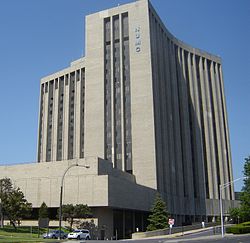
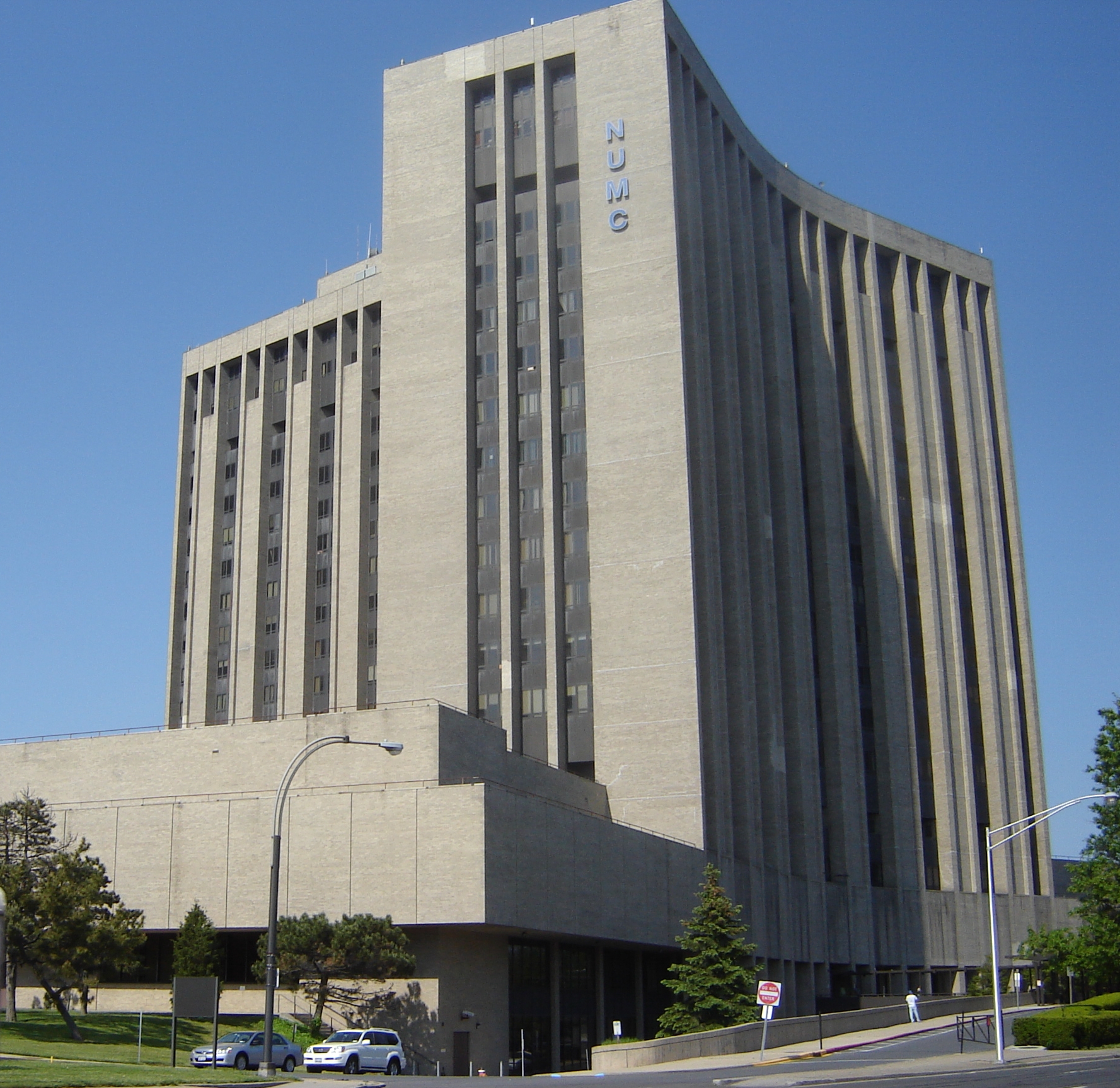
NUMC's Dynamic Care Building, viewed from the northwest

Opening in 1974 and at 299 feet, NUMC's Dynamic Care Building remains the tallest inhabitable building in Nassau County. The facility includes:

  • one- and two-bed patient rooms with private bathrooms
  • physical and rehabilitation center
  • 12 operating room suites
  • 300-seat auditorium
  • two-level Health Sciences Library
  • helicopter landing pad
  • interfaith chapel
  • The Nassau County Firefighters' Burn Center
  • the only multiplace hyperbaric chamber on Long Island, with a team on call 24/7 for diving, carbon monoxide poisoning, and all hyperbaric-related emergencies

Patient care

[edit]

More than 80,000 people annually are treated in the emergency room and 178,000 in its more than 85 specialty clinics. It is accredited by the Commission on Cancer for Teaching Hospital Cancer Programs and is a designated AIDS Center. Its staff totals more than 3,500.

See also

[edit]

References

[edit]
[edit]
Revisions and contributorsEdit on WikipediaRead on Wikipedia
from Grokipedia
Nassau University Medical Center (NUMC) is a 530-bed public tertiary-care and Level I located in , that has served as the primary safety-net provider of medical care for Nassau County's residents, particularly the uninsured and underinsured, since its founding as Meadowbrook Hospital in 1935. Established on a 75-acre site amid the Great Depression-era crises, the facility began with 200 beds and evolved through expansions, including the 1974 opening of its 19-story Dynamic Care Building—the tallest structure in Nassau County—while affiliating with institutions like SUNY Stony Brook for resident training and research in specialties such as burn care, stroke treatment, and . Operated by the state-created Nassau Health Care Corporation since 1999, NUMC handles over emergency visits annually but has contended with chronic underfunding as a safety-net , leading to recent fiscal strains evidenced by executive severance disputes, allegations of lavish spending, and a 2025 seeking $1 billion in allegedly deprived state disproportionate share funds.

Governance and Organization

Administrative Structure

Nassau University Medical Center is operated and administered by the Nassau Health Care Corporation (NHCC), a public benefit corporation established by New York State legislation in 1997 to manage the facility independently from direct Nassau County control, with oversight provided through state-appointed governance mechanisms. The NHCC board holds primary responsibility for strategic direction, fiscal management, and operational policy, while the hospital's day-to-day administration falls under an executive leadership team reporting to the board. The NHCC Board of Directors consists of 11 members, including appointees by the , the State Senate, the State Assembly, and other designated officials, ensuring state-level accountability amid historical financial and operational challenges at NUMC. As of 2025, the board is chaired by Stuart Rabinowitz, Esq., with members including Jason Abelove, Esq., Amy Flores, Rory Lancman, Esq., Konstantinos Mihaltses, Lisa Zakiya Newland, PhD, and Lisa Warren; this composition reflects a approved by the on May 7, 2025, which diminished prior county influence in favor of enhanced state supervision to address persistent deficits and service quality issues. The board's authority includes approving budgets, appointing the CEO, and enforcing compliance with state health regulations, though critics have noted delays in implementing reforms due to overlapping county and state jurisdictional tensions. Executive administration is led by an interim team as of late 2025, with Richard Becker, M.D., serving as Interim President and , overseeing clinical operations, Trent Crable as Interim managing facility logistics and support services, and Perihan El Shanawany, M.D., handling affairs. Additional key roles include Daniel Lindenberg, Esq., as ; Kathleen Mienkiewicz, MPH, MAPP, CPHQ, in quality and performance improvement; Richard Miller in ; and Rivka Mintz in , forming a structure designed to stabilize operations following prior leadership transitions, such as the earlier tenure of Megan Ryan as CEO before interim appointments amid shifts. This layered hierarchy prioritizes clinical expertise in top roles to align with NUMC's role as a safety-net serving indigent and patients.

Leadership History

The Nassau Health Care Corporation (NHCC), established in 1997 by Nassau County and New York State legislation, assumed responsibility for governing Nassau University Medical Center through an independent board of directors, marking a shift from direct county control to a public benefit corporation model aimed at improving operational autonomy and financial management. Arthur A. Gianelli held the position of President and CEO of NHCC for an extended tenure, overseeing the $545 million organization that includes NUMC, and was recognized for contributions such as election to the executive committee of the National Association of Public Hospitals and Health Systems. His leadership ended in 2013 when Nassau County Executive Ed Mangano requested his resignation amid reported internal and fiscal pressures. Subsequent executive leadership experienced marked instability, with NHCC cycling through four CEOs in the three years prior to 2023, alongside vacancies in key roles like and ; this turnover was cited in independent assessments as exacerbating challenges in strategic execution, care integration, and quality improvements at NUMC. In December 2024, Megan C. Ryan, Esq., was appointed President, CEO, and Chief Legal Officer of NHCC, becoming the first woman to lead the corporation in these capacities after serving in an interim role. This period of relative stability ended abruptly in 2025 following New York State legislative reforms granting Governor Kathy Hochul authority to restructure the NHCC board; on May 31, 2025, Hochul announced four new appointments to the reconfigured board, including figures like Stuart Rabinowitz as chair, amid efforts to address NUMC's financial distress. Ryan and nine other leaders resigned or were removed in protest over the changes, described by some as a "hostile takeover," with Ryan's termination formalized on June 10, 2025, and a subsequent lawsuit by NUMC alleging misconduct on her part. Richard Becker, M.D., was installed as Interim President and CEO following Ryan's departure, with the board continuing to oversee transitions amid ongoing fiscal oversight by the Nassau Interim Finance Authority.

Historical Development

Founding and Early Expansion (1935–1970s)

Meadowbrook Hospital was founded by Nassau County in 1935 as a public to address healthcare needs in the rural East Meadow area, primarily serving the indigent population amid the . The county acquired a 75-acre site in 1931 for $95,625, with construction costs totaling $1.6 million and equipment expenses of $178,000, for an overall investment of approximately $1.9 million. The facility opened on July 15, 1935, with 200 beds and an initial staff of 330, admitting fewer than 150 inpatients per day in its first year, alongside 560 emergency room patients and 813 ambulatory clinic visits, for a served population of about 300,000. The hospital expanded repeatedly during the 1940s and 1950s to accommodate post-World War II and rising demand for public medical services. A significant $10 million expansion project broke ground in , adding a large complex of buildings to increase capacity and capabilities. By 1960, for its 25th anniversary, a two-story addition was completed, enabling the institution to function as an emerging tertiary-care teaching center for over one million residents. In 1970, Meadowbrook Hospital was renamed Nassau County Medical Center, signifying its evolution into a major county asset. Construction commenced that year on a 19-story Dynamic Care Building, though a fire inflicted substantial damage; the 1,000,000-square-foot tower, Nassau's tallest structure at the time, ultimately opened in February 1974. These developments solidified the center's role as a safety-net provider, handling increased caseloads from urbanizing demographics.

Renaming and Modernization (1980s–2000s)

In response to persistent financial difficulties and operational inefficiencies under direct Nassau County governance, the established the Nassau Health Care Corporation (NHCC) in 1997 as a public benefit corporation to assume management of the Nassau County Medical Center and related facilities, including the A. Holly Patterson Extended Care Facility. This restructuring aimed to insulate operations from county fiscal , enable independent bonding , and facilitate targeted improvements in service delivery for the indigent population, which constituted a significant portion of the patient base. The NHCC's board convened its inaugural meeting on , 1999, formalizing the transfer of assets and operations from control, with the corporation assuming approximately $100 million in legacy debt while committing to maintain safety-net services. This shift represented a key modernization step, allowing for streamlined decision-making and potential private partnerships, though early years were marked by audits revealing ongoing deficits exceeding $50 million annually due to high uncompensated care costs—over 20% of total expenses—and outdated infrastructure. Reflecting its evolving role as a facility with residencies and affiliations, including with the North Shore-LIJ Health System (now ) for specialized training, the institution was renamed Nassau University Medical Center in the early 2000s to underscore its academic partnerships and tertiary care capabilities, such as Level I trauma and burn units. Limited capital upgrades occurred during this era, including incremental technology integrations for diagnostics and patient records, but comprehensive physical modernization was deferred amid fiscal constraints, with county contributions stabilizing at around $19 million yearly by 2004 to offset shortfalls. These changes positioned the center for future expansions while addressing systemic underfunding inherent to public safety-net models.

Recent Governance Shifts (2010s–Present)

Following the Republican Party's regain of control over Nassau County government in 2010, including the county executive position under Mangano, the Nassau Health Care Corporation (NHCC) board underwent changes reflecting partisan shifts, such as the removal of Martin Payson, a prominent donor to Democratic causes, in late 2013. Arthur A. Gianelli served as NHCC president and CEO during this period, overseeing operations amid fiscal pressures that included a $567 million budget approval for 2011. In April 2018, the NHCC board unanimously ousted Victor Politi, MD, as president and CEO, citing unspecified performance issues amid ongoing financial deficits that exceeded $100 million annually in prior years. Subsequent leadership stabilized under interim arrangements until Megan Ryan was appointed president and CEO in a permanent capacity, having served in the role on an interim basis since early 2023; under her, a new executive team was announced in December 2024, including . Persistent operating losses, projected at $185 million for 2025, prompted state legislative action to restructure the NHCC board, with Senate Bill S415 (introduced in 2023 and approved in May 2025) expanding the board to 11 members and granting Governor authority to appoint a majority, thereby shifting oversight from county dominance to greater state influence. Nassau County Executive , a Republican, opposed the measure as an "illegal takeover," arguing it undermined local control without addressing root causes of deficits. On May 31, 2025, Hochul appointed Stuart Rabinowitz, former president, as board chair, along with three others, to the restructured body. In response, Ryan and nine other senior executives resigned effective July 20, 2025, protesting the changes as a "hostile takeover" that eroded institutional stability. The new board promptly removed Ryan on June 10, 2025, appointing a executive as interim CEO, while the Nassau Interim Finance Authority (NIFA) imposed a control period over NHCC finances. In September 2025, Ryan filed a against NHCC and state appointees, alleging retaliation for her opposition to the restructuring.

Facilities and Infrastructure

Main Campus Overview

The main campus of Nassau University Medical Center is located at 2201 Hempstead Turnpike in East Meadow, New York 11554, positioned between the Meadowbrook State Parkway and Wantagh State Parkway, east of Eisenhower Park. This site houses the 530-bed tertiary care teaching hospital, which operates as Nassau County's sole public acute care facility and primary safety-net provider for indigent and uninsured patients. Designated as a Level I adult trauma center by the New York State Department of Health, the campus manages over 1,500 trauma cases annually, supported by 24/7 on-call surgeons, a helipad, and specialized burn and pediatric capabilities. The campus layout centers on the southern hospital complex, featuring the 19-story Dynamic Care Building, completed in 1974 at a cost of $49 million and standing as the tallest inhabitable structure in Nassau County at 299 feet. Adjacent facilities include the (Building A) and specialized units such as the Eye Institute, encompassing a total of 32 buildings across the property for , operating suites, rehabilitation, and administrative functions. Visitor parking is provided on the western Carman Avenue side, operated by Kinney Corporation with rates starting at $3 for the first hour and $8 for all-day access, available from 6 a.m. to midnight.

Key Buildings and Expansions

The Nassau University Medical Center (NUMC) campus in , encompasses a main complex with several specialized buildings integrated into its operations. The Dynamic Care Building (DCB), a 19-story tower completed in February 1974 at a cost of $49 million, stands as the facility's core structure and Nassau County's tallest building. Housing over 530 beds, it includes key departments such as the , cancer center, eye clinic, and portions of . Adjacent to the DCB is the Women's Pavilion (Building A), dedicated to , gynecology, and related services, forming part of the southern core. The also features auxiliary structures like medical resident housing in eight garden-style apartment buildings and various support buildings (e.g., Buildings G, H, J, K, L, M, Z), some of which remain underutilized or slated for redevelopment. Significant expansions have focused on enhancing emergency and ambulatory capabilities. Construction on a new began in 2009 under a , culminating in a $36 million, state-of-the-art facility opened around 2012 with 32 patient rooms, two resuscitation bays, and advanced trauma infrastructure. Planned developments outlined in environmental impact assessments include an Pavilion (approximately 37,000 square feet) and potential additions like a wellness center and expanded cancer facilities, aimed at increasing capacity up to 970,000 gross square feet across phases, though implementation has proceeded incrementally amid financial constraints.

Clinical Services and Patient Care

Core Medical Departments

Nassau University Medical Center maintains core medical departments that support its function as a 530-bed and Level I trauma facility, emphasizing emergency response, surgical intervention, and chronic disease management for underserved patients. These departments integrate clinical care with residency training programs accredited by bodies such as the ACGME, handling over 80,000 emergency visits annually and serving as a primary safety-net provider since 1935. The Department of operates a high-volume unit designated as a Level I Adult , capable of managing severe injuries, burns, and acute conditions like strokes through rapid , advanced imaging, and multidisciplinary teams. It includes specialized protocols for SAFE-designated services addressing and forensic evidence collection, with 24/7 availability supported by on-site surgical and critical care resources. Residency training in emphasizes procedural skills and high-acuity case exposure. Internal Medicine forms the backbone of adult care, encompassing primary services for , , , and dialysis, alongside inpatient management of complex comorbidities. Subspecialties like address cardiac diagnostics and interventions, while pulmonary medicine and critical care handle and ICU needs, often in coordination with the hospital's ventilator-dependent patient population. These services extend to outpatient clinics treating chronic conditions prevalent in low-income communities. Surgical departments cover general, orthopedic, bariatric, and oral , bolstered by a dedicated Nassau County Firefighters for thermal injuries and reconstructive procedures. Orthopedics focuses on trauma-related fractures and joint disorders, integrating with the for operative stabilization. supports perioperative care across these units, ensuring safe delivery in over 10,000 procedures yearly. Obstetrics and gynecology, through a Level 3 Perinatal Center, provide high-risk maternal-fetal medicine, neonatal intensive care, and pediatric services for adolescent and child health. and address and nerve disorders, leveraging Primary Stroke Center designation for and endovascular interventions. maintains dedicated units for acute crises, including inpatient stabilization for co-occurring substance use and medical issues. Radiology and laboratory services underpin diagnostics across departments, offering CT, MRI, , and for timely confirmation and imaging-guided procedures. An AIDS Center supports specialized infectious disease care, reflecting the hospital's role in managing endemic conditions like in vulnerable populations.

Safety-Net Role and Teaching Affiliations

Nassau University Medical Center (NUMC) serves as Nassau County's sole safety-net , mandated to provide care to patients irrespective of their financial means or insurance status. As the primary provider for enrollees and uninsured individuals through the Nassau Health Care Corporation (NHCC), NUMC handles a substantial volume of indigent care, including sliding-fee scales and financial assistance programs for eligible patients. Approximately 80-90% of its annual patient visits—totaling around 275,000—involve uninsured or publicly insured individuals, underscoring its role in addressing healthcare disparities for vulnerable populations in a suburban county with limited alternatives for such services. NUMC's safety-net function extends to specialized services like its Level I and community health initiatives, such as the CARE Office established in January 2025 for interpreters, advocates, and public benefits navigation, which bolsters access for underserved residents. This obligation, rooted in its status as a public benefit corporation, has persisted amid chronic funding shortfalls, with state support critical to sustaining operations for non-paying patients. As a , NUMC maintains formal academic affiliations that support graduate and undergraduate . It functions as a clinical campus for the Renaissance School of Medicine at (SUNY), enabling rotations and training for medical students in diverse clinical settings. Additional partnerships include the New York Institute of Technology College of Osteopathic Medicine, New York College of Podiatric Medicine, and , facilitating comprehensive educational programs. NUMC sponsors numerous Accreditation Council for Graduate Medical Education (ACGME)- and American Osteopathic Association-accredited residency and fellowship programs, including (using a 4+1 hospitalist model), family medicine, (a four-year program in a high-volume Level I ), general surgery, orthopedics, and oral/maxillofacial surgery. These programs emphasize hands-on experience with complex cases from a diverse, high-acuity base, training over 200 residents annually in a 528-bed facility integrated with NuHealth's broader system.

Financial Operations and Reforms

Revenue Sources and Funding Mechanisms

Nassau University Medical Center (NUMC), operated by the Nassau Health Care Corporation (NHCC), derives the majority of its revenue from net patient service revenue, which totaled $536.8 million in 2023, representing an increase of 17% from $460.6 million in 2022. This category encompasses reimbursements for clinical services, net of contractual allowances and provisions, with payer mix heavily weighted toward government programs; and Medicare accounted for approximately 74% of net revenue from services in 2023, reflecting NUMC's role as a safety-net provider serving a high proportion of indigent and publicly insured patients. Specific breakdowns indicate Medicare at 13%, at 20%, Medicare HMOs at 21%, Medicaid HMOs at 14%, commercial HMOs at 21%, and self-pay/other at 11%, underscoring reliance on federal and state reimbursement mechanisms amid challenges like underpayment relative to costs. Other operating revenues supplemented patient services with $78.2 million in 2023, including $40.6 million in billings to Nassau for non-patient care services such as space charges and retiree , $11.8 million in grant , and $6.8 million in reimbursements for center staffing. Key mechanisms include intergovernmental transfers (IGTs) totaling $88.7 million in 2023—up significantly from $39.3 million in 2022—which facilitate disproportionate share (DSH) payments to offset care for the uninsured and shortfall, sourced from state-directed federal funds. Additional streams encompass contracts like $19.5 million for correctional services in the 2024 and federal/state aid of $5 million, with no direct operational subsidies from Nassau , limiting county exposure to a capped moral obligation bond guarantee. Non-operating revenues, at $56.5 million in 2023, include temporary relief such as $60 million in funding, alongside interest income, though offset by debt service costs; these are not core to ongoing operations but highlight vulnerability to policy-driven fluctuations. Overall, NHCC's structure as a public benefit corporation enables independent generation while depending on layered government reimbursements and transfers, with 2024 projections budgeting $480.9 million in net and $114.2 million in other operating sources, emphasizing revenue cycle enhancements and program optimizations like 340B drug pricing to sustain viability.

Persistent Deficits and Cost Challenges

Nassau University Medical Center (NUMC), operated by the Nassau Health Care Corporation (NuHealth), has faced chronic operating losses exceeding $100 million annually in recent years, contributing to a cumulative deficit of $1.4 billion for its parent entity by the end of 2024. In 2022, NuHealth recorded its largest-ever operating loss of $164 million, followed by $141.9 million in 2023—a slight improvement but still the second-highest in history—and $144 million in 2024. These deficits reflect a pattern of escalating shortfalls since 2018, when losses stood at $46.6 million, rising amid revenue shortfalls that fail to offset expense growth. Auditors have issued "substantial doubt" opinions on NuHealth's ability to continue as a for seven consecutive years through 2024, citing recurring losses and liquidity strains. Cost challenges stem primarily from NUMC's role as a safety-net provider serving a high volume of low-income, , and uninsured patients, resulting in inadequate reimbursements and elevated uncompensated care burdens. Labor expenses, comprising a significant portion of operations, have surged due to wage hikes, overtime from shortages, and union-constrained inefficiencies, with payroll rising from $312.5 million in 2022 to $318.3 million in 2023 despite revenue increases from $460.6 million to $536.8 million in the same period. Declining inpatient volumes and visits—attributed to broader shifts in healthcare delivery—exacerbate the mismatch between fixed costs and utilization, while the end of federal programs like the Delivery System Reform Incentive Payment in and the cessation of subsidies after 2014 have reduced external support. Additional pressures include other post-employment benefit liabilities exceeding $565 million as of late 2019 and operational inefficiencies in affiliated facilities like A. Holly Patterson Extended Care Facility, which alone generates $17–25 million in annual cash losses. Projections indicate worsening deficits without structural changes, with annual operating losses forecasted to reach over $213 million by 2029, driven by persistent revenue declines and unchecked expense growth in an inpatient-heavy model ill-suited to modern care trends. These issues have prompted repeated calls for cost controls, such as restricting overtime and appealing denied insurance claims, though historical underinvestment in revenue-cycle management and lapses have compounded the fiscal strain.

Implemented Reforms and Outcomes

In response to persistent operating deficits, Nassau University Medical Center (NUMC) implemented a financial reform plan starting in late 2023, focusing on enhancement and containment measures. Key actions included overhauling outdated billing and collections processes to improve capture, upgrading systems for better efficiency, and strengthening financial standards through comprehensive audits, daily reporting, and on-time budgeting—the first such achievement in the hospital's history. Additional operational reforms encompassed reducing overtime expenditures, renegotiating managed-care payer and supply contracts, nursing staff, shortening patient lengths of stay, and updating pre-surgical testing protocols. These reforms yielded measurable short-term gains, as confirmed by an independent audit from Grant Thornton. Net patient service revenue rose by $76 million to $536 million in 2023, contributing to over $100 million in total operational improvements. Operating losses decreased by $30 million, from $108 million in 2022 to $77 million in 2023, with overtime costs specifically cut by $4 million. The projected 2023 budget deficit of $179 million was reduced by more than half, and cash on hand tripled from $23 million in January 2024 to $67 million by June 2024. Despite these advancements, NUMC continued to report an operating loss of $149 million in 2024, and independent analyses project escalating annual losses—reaching $185 million in 2026, $198 million in 2027, $205 million in 2028, and $213 million in 2029—absent further turnaround strategies or external funding support. Persistent challenges include declining and volumes, unchecked historical expense growth, and difficulties in securing fair reimbursements, underscoring that while reforms stabilized temporarily, structural deficits remain unaddressed without broader interventions.

Executive Management Conflicts

In June 2025, Nassau University Medical Center's (NUMC) CEO Megan Ryan was fired "for cause" by an interim leadership team appointed following New York State's intervention in the hospital's governance, amid allegations of unauthorized executive payouts totaling $3.5 million approved just before her departure. Ryan disputed the claims, asserting in a letter to the board that the payments were standard severance for departing staff and accusing the new state-backed overseers of political retaliation tied to ongoing disputes between Nassau County Executive and Governor over hospital control. The dismissal followed a May 2025 mass of Ryan and nine other top executives in against Hochul's push for a state-led restructuring of NUMC's parent entity, the Nassau Corporation (NHCC), which critics including county officials argued undermined local and ignored NUMC's operational successes under prior management. This upheaval exacerbated tensions rooted in partisan divides, with Republican-led Nassau County resisting state Democratic appointees to the NHCC board, including Hofstra University President Stuart Rabinowitz as chair, whom Blakeman refused to support through nominations. By August 2025, NUMC filed a lawsuit against Ryan seeking $10 million in damages, accusing her of self-enrichment through improper reimbursements for luxury expenses, destruction of hospital data, and orchestration of the contested payouts estimated at $1 million personally benefiting her circle. Ryan countersued in September 2025, alleging wrongful termination, breach of contract, defamation by the state-appointed board, and gender-based pay discrimination, claiming her ouster was a pretext to install politically aligned leadership amid NUMC's chronic underfunding battles. These dueling legal actions highlight deeper governance fractures, where state oversight—intended to address fiscal deficits—clashed with entrenched county influence, potentially delaying resolutions to NUMC's operational stability.

State Funding Allegations and Investigations

In November 2024, Nassau University Medical Center (NUMC) filed a notice of claim in the New York Court of Claims, alleging that the state of New York violated federal laws through a long-standing scheme that deprived the hospital of over $1 billion in Disproportionate Share Hospital (DSH) funding. NUMC contended that state officials required the hospital to advance the non-federal share of DSH payments to mislead federal authorities into approving the federal matching portion, after which the state reimbursed only a fraction of the required amount, effectively halving the NUMC received. This practice, according to the claim, persisted for more than two decades and systematically underfunded safety-net hospitals like NUMC, which relies heavily on such payments to serve uninsured and low-income patients. The allegations centered on New York's manipulation of financing mechanisms, where the state allegedly used intergovernmental transfers and provider-specific taxes to generate the non-federal share without committing equivalent state general revenue, contravening federal requirements under 42 U.S.C. § 1396a. NUMC's leadership described the arrangement as a "ruse" designed to maximize federal dollars while minimizing state obligations, leading to chronic deficits at the hospital despite its role as Nassau County's primary indigent care provider. The hospital initiated litigation to recover the withheld funds and sought a declaration that the state's funding model was unlawful. Following public disclosure of the claims, the FBI launched an investigation in April 2025 into whether New York officials unlawfully diverted or withheld crucial funds from NUMC, prompted by testimony from the hospital's chairman. Separately, a Republican-led U.S. committee initiated a probe in July 2025 into broader allegations of New York state's abuse of funding, including withholding disproportionate share payments from safety-net providers and counties, which Governor dismissed as a political diversion. As of October 2025, the investigations remain ongoing, with NUMC continuing to pursue legal remedies amid disputes from state entities like the Nassau Interim Finance Authority, which has moved to dismiss related claims by arguing compliance with federal and state regulations.

Oversight and Control Battles

The Nassau Health Care Corporation (NHCC), which operates Nassau University Medical Center (NUMC), has faced ongoing disputes over governance authority between Nassau County officials and state entities, particularly intensified in 2025 amid the hospital's financial distress. Traditionally, the NHCC board's composition allowed significant influence from the Nassau County Executive, with appointments reflecting local priorities for the county's sole safety-net hospital. However, in May 2025, the approved a restructuring of the NHCC board as part of the state budget process, transferring appointment powers primarily to Governor and reducing the county executive's role to a single appointee without chair authority. This shift empowered the state to install a majority of board members, including four new appointees announced by Hochul on May 31, 2025, aimed at addressing NUMC's operational and fiscal challenges. Nassau County Executive , a Republican, vehemently opposed the changes, arguing they constituted an unconstitutional overreach by Albany that stripped local taxpayers of control over essential healthcare services serving over 200,000 uninsured or underinsured patients annually. County officials contended that the restructuring interfered with the NHCC's enabling statute under New York Public Authorities Law, potentially violating principles by excluding Nassau residents from decision-making on a facility reliant on county subsidies exceeding $100 million yearly. In response, NHCC leadership issued statements decrying the move as an "illegal attempt" to seize control, emphasizing NUMC's in providing uncompensated care valued at $150 million in recent years without equivalent state support. Concurrently, the Nassau Interim Finance Authority (NIFA), a state-created fiscal oversight board established in 2000 to monitor finances, gained expanded powers over NHCC operations, including veto authority on contracts exceeding $1 million and enhanced scrutiny of budgets. This followed NIFA's assumption of broader hospital oversight amid NUMC's reported deficits surpassing $200 million cumulatively. In December 2024, NHCC sued NIFA, alleging improper interference in management decisions, a case where an appeals court ruled unanimously in NUMC's favor in 2025 on procedural grounds, though NIFA sought dismissal of related claims. These conflicts highlight tensions between local autonomy and state intervention, with proponents of state control citing chronic mismanagement—such as a $3.5 million severance scandal in 2025 involving former executives—as justification, while critics attribute issues to inadequate reimbursements withheld by the state. Litigation persists, with NHCC pursuing further challenges to preserve influence as of 2025.

References

Add your contribution
Related Hubs
User Avatar
No comments yet.