



Community hub
Recent from talks
Contribute something to knowledge base
Content stats: 0 posts, 0 articles, 0 media, 0 notes
Members stats: 0 subscribers, 0 contributors, 0 moderators, 0 supporters
Subscribers
Supporters
Contributors
Moderators
Hub AI
Mean squared displacement AI simulator
(@Mean squared displacement_simulator)
Hub AI
Mean squared displacement AI simulator
(@Mean squared displacement_simulator)
Mean squared displacement
In statistical mechanics, the mean squared displacement (MSD), also called mean square displacement, average squared displacement, or mean square fluctuation, is a measure of the deviation of the position of a particle with respect to a reference position over time. It is the most common measure of the spatial extent of random motion, and can be thought of as measuring the portion of the system "explored" by the random walker.
In the realm of biophysics and environmental engineering, the MSD is measured over time to determine if a particle is spreading slowly due to diffusion, or if an advective force is also contributing. Another relevant concept, the variance-related diameter (VRD), defined as twice the square root of MSD, is also used in studying the transportation and mixing phenomena in environmental engineering. It prominently appears in the Debye–Waller factor (describing vibrations within the solid state) and in the Langevin equation (describing diffusion of a Brownian particle).
The MSD at time is defined as an ensemble average: where N is the number of particles to be averaged, vector is the reference position of the -th particle, and vector is the position of the -th particle at time t.


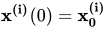


The probability density function (PDF) for a particle in one dimension is found by solving the one-dimensional diffusion equation. (This equation states that the position probability density diffuses out over time - this is the method used by Einstein to describe a Brownian particle. Another method to describe the motion of a Brownian particle was described by Langevin, now known for its namesake as the Langevin equation.) given the initial condition ; where is the position of the particle at some given time, is the tagged particle's initial position, and is the diffusion constant with the S.I. units (an indirect measure of the particle's speed). The bar in the argument of the instantaneous probability refers to the conditional probability. The diffusion equation states that the speed at which the probability for finding the particle at is position dependent.




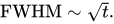
The differential equation above takes the form of 1D heat equation. The one-dimensional PDF below is the Green's function of heat equation (also known as Heat kernel in mathematics): This states that the probability of finding the particle at is Gaussian, and the width of the Gaussian is time dependent. More specifically the full width at half maximum (FWHM)(technically/pedantically, this is actually the Full duration at half maximum as the independent variable is time) scales like Using the PDF one is able to derive the average of a given function, , at time : where the average is taken over all space (or any applicable variable).



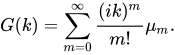
The Mean squared displacement is defined as expanding out the ensemble average dropping the explicit time dependence notation for clarity. To find the MSD, one can take one of two paths: one can explicitly calculate and , then plug the result back into the definition of the MSD; or one could find the moment-generating function, an extremely useful, and general function when dealing with probability densities. The moment-generating function describes the -th moment of the PDF. The first moment of the displacement PDF shown above is simply the mean: . The second moment is given as .


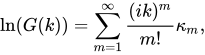
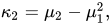
So then, to find the moment-generating function it is convenient to introduce the characteristic function: one can expand out the exponential in the above equation to give By taking the natural log of the characteristic function, a new function is produced, the cumulant generating function, where is the -th cumulant of . The first two cumulants are related to the first two moments, , via and where the second cumulant is the so-called variance, . With these definitions accounted for one can investigate the moments of the Brownian particle PDF, by completing the square and knowing the total area under a Gaussian one arrives at Taking the natural log, and comparing powers of to the cumulant generating function, the first cumulant is which is as expected, namely that the mean position is the Gaussian centre. The second cumulant is the factor 2 comes from the factorial factor in the denominator of the cumulant generating function. From this, the second moment is calculated, Plugging the results for the first and second moments back, one finds the MSD,










For a Brownian particle in higher-dimension Euclidean space, its position is represented by a vector , where the Cartesian coordinates are statistically independent.


Mean squared displacement
In statistical mechanics, the mean squared displacement (MSD), also called mean square displacement, average squared displacement, or mean square fluctuation, is a measure of the deviation of the position of a particle with respect to a reference position over time. It is the most common measure of the spatial extent of random motion, and can be thought of as measuring the portion of the system "explored" by the random walker.
In the realm of biophysics and environmental engineering, the MSD is measured over time to determine if a particle is spreading slowly due to diffusion, or if an advective force is also contributing. Another relevant concept, the variance-related diameter (VRD), defined as twice the square root of MSD, is also used in studying the transportation and mixing phenomena in environmental engineering. It prominently appears in the Debye–Waller factor (describing vibrations within the solid state) and in the Langevin equation (describing diffusion of a Brownian particle).
The MSD at time is defined as an ensemble average: where N is the number of particles to be averaged, vector is the reference position of the -th particle, and vector is the position of the -th particle at time t.
The probability density function (PDF) for a particle in one dimension is found by solving the one-dimensional diffusion equation. (This equation states that the position probability density diffuses out over time - this is the method used by Einstein to describe a Brownian particle. Another method to describe the motion of a Brownian particle was described by Langevin, now known for its namesake as the Langevin equation.) given the initial condition ; where is the position of the particle at some given time, is the tagged particle's initial position, and is the diffusion constant with the S.I. units (an indirect measure of the particle's speed). The bar in the argument of the instantaneous probability refers to the conditional probability. The diffusion equation states that the speed at which the probability for finding the particle at is position dependent.
The differential equation above takes the form of 1D heat equation. The one-dimensional PDF below is the Green's function of heat equation (also known as Heat kernel in mathematics): This states that the probability of finding the particle at is Gaussian, and the width of the Gaussian is time dependent. More specifically the full width at half maximum (FWHM)(technically/pedantically, this is actually the Full duration at half maximum as the independent variable is time) scales like Using the PDF one is able to derive the average of a given function, , at time : where the average is taken over all space (or any applicable variable).
The Mean squared displacement is defined as expanding out the ensemble average dropping the explicit time dependence notation for clarity. To find the MSD, one can take one of two paths: one can explicitly calculate and , then plug the result back into the definition of the MSD; or one could find the moment-generating function, an extremely useful, and general function when dealing with probability densities. The moment-generating function describes the -th moment of the PDF. The first moment of the displacement PDF shown above is simply the mean: . The second moment is given as .
So then, to find the moment-generating function it is convenient to introduce the characteristic function: one can expand out the exponential in the above equation to give By taking the natural log of the characteristic function, a new function is produced, the cumulant generating function, where is the -th cumulant of . The first two cumulants are related to the first two moments, , via and where the second cumulant is the so-called variance, . With these definitions accounted for one can investigate the moments of the Brownian particle PDF, by completing the square and knowing the total area under a Gaussian one arrives at Taking the natural log, and comparing powers of to the cumulant generating function, the first cumulant is which is as expected, namely that the mean position is the Gaussian centre. The second cumulant is the factor 2 comes from the factorial factor in the denominator of the cumulant generating function. From this, the second moment is calculated, Plugging the results for the first and second moments back, one finds the MSD,
For a Brownian particle in higher-dimension Euclidean space, its position is represented by a vector , where the Cartesian coordinates are statistically independent.