Hubbry Logo
That 1 GuyThat 1 GuyMain
Open search
That 1 Guy
Community hub
That 1 Guy
logo
8 pages, 0 posts
0 subscribers
Be the first to start a discussion here.
That 1 Guy
That 1 Guy
from Wikipedia

Key Information

Mike Silverman, better known as That 1 Guy, is an American musician based in Las Vegas, Nevada. He frequently performs and records as a one-man band, singing and using a variety of homemade musical instruments.

Career

[edit]

Early career

[edit]

Silverman is a classically trained double bass player who attended the San Francisco Conservatory of Music and developed a career in the progressive jazz scene in the 1990s, performing live and as a studio musician. He started out in a funk, rockabilly, jazz band called "The Fabulous Hedgehogs" before he developed his own style of solo playing and gained a reputation as a one-man rhythm section, incorporating traditional and slap-bass playing with percussive elements using the body of the instrument. When he began to feel limited by his instrument and a heavy schedule of playing and recording for other people, he started to devise a new instrument that would allow him the range to create his own music. At first he sought out professional help in building his instrument, but decided to make it himself because of the projected cost. The end result was the Magic Pipe, a 7-foot-tall (2.1 m) collection of steel plumbing pipes and joints, orchestral bass strings, and electronics.[1][2]

As That 1 Guy

[edit]
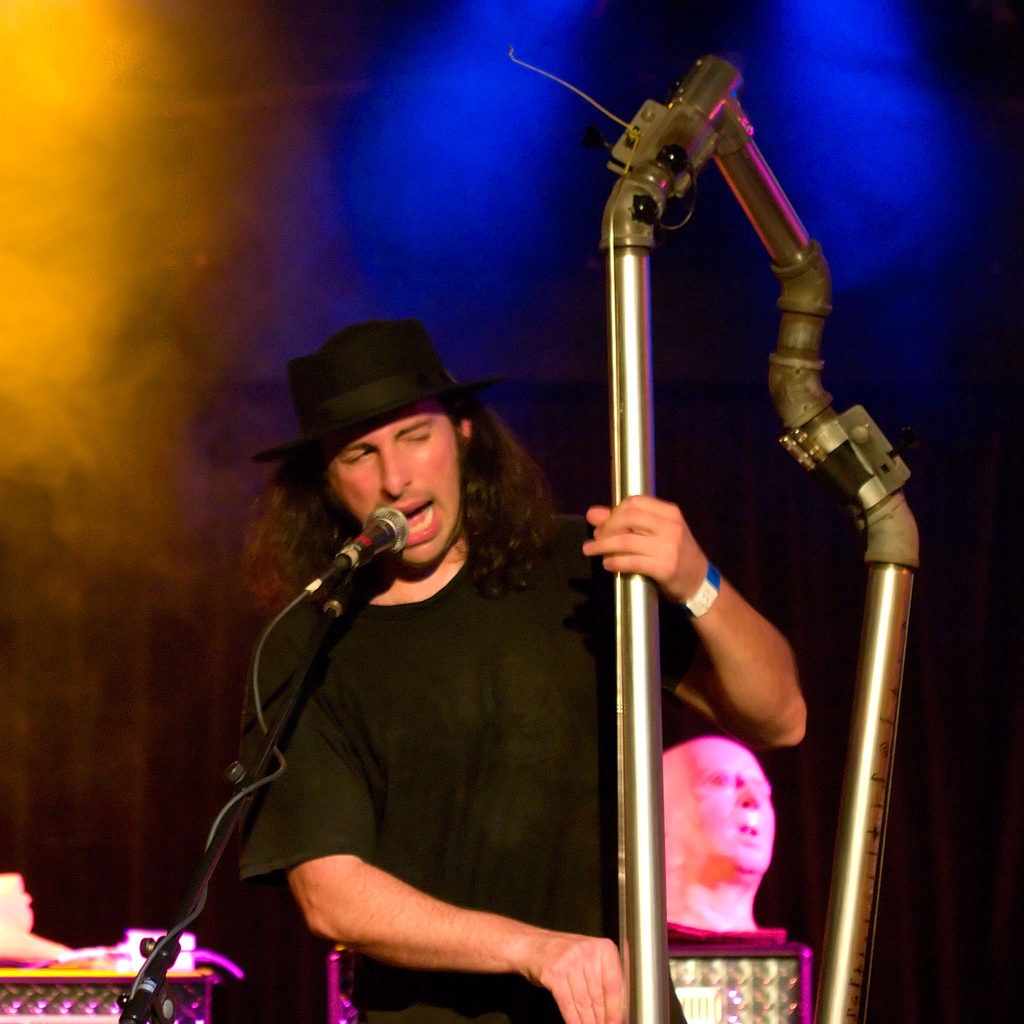
Silverman performing with Buckethead

Since then, Silverman has developed a career as a one-man band under the stage name That 1 Guy, first playing his upright bass, and later singing and beatboxing while playing his Magic Pipe, musical saw, various percussive elements, and using digital looping and sampling to perform his songs.[3] His musical influences include Drums and Tuba, Rush, Frank Zappa, Captain Beefheart, and Dr. Seuss, both in terms of his lyrics and his quirky homemade instruments. He has also been influenced by Tom Waits, and was invited to play saw (and subsequently bass) on tracks for Waits’ Orphans: Brawlers, Bawlers & Bastards album.[4] He has a cult following in the United States of America, as well as in Australia, which he has toured several times, including performances at major festivals such as Big Day Out, Pyramid Rock Festival, and Woodford Folk Festival. He has also played many shows alongside avant-garde guitarist Buckethead, with whom he released a collaborative album under the name Frankenstein Brothers in 2008. He has received little mainstream recognition, but did garner attention after the use of his song "Buttmachine" (from his second album, The Moon is Disgusting) on Showtime's original comedy series Weeds, season 3, episode 9.[5] He started a tour throughout the United States of America in early 2009,[6] and performed at festivals in Canada and France.

Instruments

[edit]

The Magic Pipe

[edit]

The Magic Pipe, also known by his close friends as 'The Broken Bowflex', is a homemade, electronically rigged pair of machined aluminum pipes (previously steel in its first incarnation), connected by adjustable phosphorus bronze joints, with each pipe hosting an orchestral bass string. The harp-shaped instrument is roughly seven feet tall and features 13 trigger points, which can be mapped to various musical sound effects or samples. The front pipe uses a low C string, while the rear pipe's string is used to achieve more tenor ranged notes. The pipes themselves are employed to produce various percussive sounds while That 1 Guy slaps, plucks, or bows the strings, as well as occasionally using a drum stick to sound the strings and the pipes at the same time. The creation of the Magic Pipe was based on Silverman's double bass experience, as well as borrowing from the concepts of the gutbucket and the diddley bow.[1][2][7][8]

The Magic Boot

[edit]

The Magic Boot is a scorpion-emblazoned cowboy boot, which is wired and fed through the Magic Pipe's audio lines. It is then played as a percussive instrument by tapping on the sole while pinching the boot's opening to achieve different sounds, similar to an African talking drum.

The Magic Saw

[edit]

The Magic Saw is a musical saw, which is wired into the main effects box. It uses a small adhesive speaker and is played percussively as well as with a violin bow. It sounds similar to a theremin when played and renditions of "Somewhere Over the Rainbow" have been performed on numerous occasions.

Discography

[edit]

Studio albums

[edit]
  • Let's Hear That 1 Guy (1996)
  • Songs in the Key of Beotch (2000, re-released 2004)
  • The Moon Is Disgusting (2007)
  • Mustaches Remix EP (2009)
  • Packs a Wallop! (2010)
  • Poseidon's Deep Water Adventure Friends (2014)
  • Set the Controls for the Heart of the Buttnoggin (2020)

Frankenstein Brothers (with Buckethead)

[edit]

DVD

[edit]
  • Live in the Land of Oz (DVD, 2007)

References

[edit]
[edit]
Revisions and contributorsEdit on WikipediaRead on Wikipedia
from Grokipedia
That 1 Guy is the stage name of Mike Silverman, an American musician based in , , who performs and records as a using custom-built instruments, most notably the Magic Pipe, a seven-foot-tall galvanized steel contraption featuring a single bass string and electronic components for sampling and effects. Born into a musical family with a musician father, Silverman developed an early passion for music, studying classical upright bass at the Conservatory of Music and bass at Los Medanos College, where he won the Jazz Scholarship competition. As a young from age 15, he joined the local scene, playing percussive styles and performing with bands like the Fabulous Hedgehogs before growing frustrated with conventional instruments and inventing his signature setup. Silverman adopted the moniker That 1 Guy in 1994 as a playful dare, debuting the persona in the late 1990s and holding his first full show in 2003 at Dr. Bombay's in , which quickly built a through high-energy live performances blending spoken-word , , heavy metal, and electronic elements. His breakthrough album, Songs in the Key of Beotch (2003), was re-released by Righteous Babe Records in 2004 after independently selling 10,000 copies, and he has since released additional studio albums and a live DVD filmed in in 2007. Throughout his career, That 1 Guy has toured extensively, averaging 150–200 shows annually across North America and festivals such as Wakarusa, Electric Forest, High Sierra Music Festival, and the Montreal International Jazz Festival, often incorporating magic tricks and visual effects for an immersive audio-visual experience, including dedicated magic shows as of 2025. Notable collaborations include work with guitarist Buckethead as the duo The Frankenstein Brothers and performances alongside artists like Ani DiFranco, Soul Coughing, and Bob Weir of the Grateful Dead. His innovative approach earned him the Tap Water Award for Best Musical Act at the Edinburgh Fringe Festival.

Biography

Early life and education

Mike Silverman, known professionally as That 1 Guy, was born in into a musical family, with his father being a , and developed an early interest in music starting at the age of 15, when he began playing bass. His parents supported his musical pursuits but encouraged a conventional path toward mainstream success, discouraging more unconventional or experimental directions. Silverman pursued formal classical training on the double bass at the San Francisco Conservatory of Music, where he honed his technical skills in the upright bass tradition. He later studied jazz bass at Los Medanos College and won the Dave Brubeck Jazz Scholarship competition, recognizing his emerging talent in improvisational styles. During his studies, Silverman began exploring beyond classical repertoire, gradually shifting toward experimental sounds that would later define his career, though he initially performed in local ensembles to build experience.

Formation as a performer

After establishing himself as a percussive in the scene during the , including with the band The Fabulous Hedgehogs, Mike Silverman decided to abandon traditional band formats in favor of independent artistry, driven by frustrations with the limitations of the bass role and a desire for greater creative control over his performances. His bandmates' reluctance to commit to a touring further motivated this shift, allowing him to pursue a vision unhindered by . In 1994, after a gig with The Fabulous Hedgehogs where the club owner paid the band with an , Silverman jokingly proposed performing the next show solo as "That 1 Guy," a dare the owner accepted, marking the adoption of his to emphasize his emerging solo identity. This persona reflected his aim to create a distinctive sound beyond conventional instrumentation, drawing on his background as a classically trained to experiment with self-accompaniment. The name encapsulated his solitary yet multifaceted approach, setting the stage for performances that blended composition and in real time. Silverman's early solo endeavors in the late 1990s involved rigorous experimentation with to layer rhythms, melodies, and vocals, often incorporating homemade setups to expand his sonic palette without relying on additional musicians. These initial performances honed his ability to construct full arrangements onstage, prioritizing a unique auditory experience that prioritized personal expression. Under the That 1 Guy moniker, he released his debut album, Let's Hear That 1 Guy, in 1996, which served as an early demo of this solo style through tracks showcasing percussive bass and rudimentary looping elements. This recording captured the foundational experiments that defined his performer formation, laying the groundwork for his distinctive artistry.

Career

Early musical groups

In the 1990s, Mike Silverman, known later as That 1 Guy, was actively involved in the music scene, primarily as a in various ensemble settings. He played with several progressive outfits, contributing to live performances that showcased his classical training and improvisational skills in local venues. Silverman's most notable group involvement during this period was with Hedgehogs, a five-piece Bay Area band blending , , , and progressive elements, for which he played bass and provided lead vocals throughout much of the decade. The band performed regularly in San Francisco's vibrant club circuit, including gigs at spots like Dr. Bombay’s in the Mission District, where Silverman honed his rhythmic and melodic contributions to the group's energetic sets. The Fabulous Hedgehogs released limited recordings, including the album in 1994, but their live shows established Silverman's reputation as a versatile in the local scene, drawing on influences from and traditions. Silverman's departure from band work stemmed from frustrations with the limitations of and financial instability, exemplified by a particularly disheartening gig with The Fabulous Hedgehogs where the band received only $50 in payment, prompting him to seek greater creative control through solo innovation. This dissatisfaction with roles and the desire for a more autonomous artistic expression marked the end of his early group phase in the late .

Emergence as That 1 Guy

Mike Silverman, performing as That 1 Guy, released his debut solo album Let's Hear That 1 Guy on September 3, 1996, initially available only on with hand-drawn by the artist himself. The self-produced record, credited to The Stikman and That 1 Guy, blended experimental electronic and elements across tracks such as "Yuk Foo," a 47-second opener, and "Futhermucker," a 2:45 funk-infused piece, establishing Silverman's early penchant for quirky, percussive bass-driven compositions. Though independently released and limited in distribution, the album marked the formal inception of his solo identity, evolving from his prior band experiences into a more liberated creative outlet. In the early 2000s, Silverman refined his signature performances, transitioning from traditional upright bass techniques—such as playing with for percussive effects—to fully integrated solo spectacles that combined , custom inventions, and theatrical elements. This development culminated in high-energy shows that emphasized visual and auditory innovation, drawing cult audiences through touring and appearances, where he layered bass lines, vocals, and effects in real time to simulate a full band dynamic. By mid-decade, these had solidified his reputation as a unique live act, with Silverman noting the name "That 1 Guy" originated as a 1994 that unexpectedly became his enduring moniker. The 2007 release of The Moon Is Disgusting on Righteous Babe Records represented a breakthrough, serving as a inspired by whimsical themes like lunar cheese and , with standout tracks including the 12-minute title epic and "Mustaches." Produced with input from label founder , the garnered critical for its inventive production and Silverman's multifaceted , expanding his reach beyond underground circuits. Complementing this, the live DVD Live in the Land of Oz, released the same year, documented his New Year's Eve performance at Australia's Woodford Folk Festival, showcasing the full scope of his one-man orchestration and further amplifying his innovative stage presence. Around 2005-2010, initial media buzz intensified through virality and features in music publications, which highlighted his eccentric style and DIY ethos as a refreshing to mainstream acts. These elements propelled That 1 Guy from niche performer to a recognized figure in alternative music scenes, with live innovations—such as synchronized projections and prop-assisted rhythms—becoming central to his growing fanbase.

Collaborations and media exposure

That 1 Guy, whose real name is Mike Silverman, contributed bass to several tracks on Tom Waits' 2006 compilation album Orphans: Brawlers, Bawlers & Bastards, after being invited to play musical saw but adapting to the role based on the project's needs. This opportunity arose from Waits' appreciation for Silverman's unique style, marking an early high-profile collaboration that highlighted his versatility beyond solo performances. In 2008, Silverman partnered with guitarist to form the Frankenstein Brothers, releasing the album Bolt on Neck under that moniker. The project blended Silverman's inventive percussion and bass elements with 's experimental guitar work, resulting in a six-track EP that showcased their shared affinity for unconventional sounds. This collaboration expanded Silverman's reach into rock circles and led to joint live performances during that period. Silverman's track "Buttmachine" from his 2007 album The Moon Is Disgusting was featured in the 2007 episode "" (Season 3, Episode 9) of the Showtime series Weeds, providing a quirky underscore to the show's comedic tone. This soundtrack placement introduced his music to a broader television audience, aligning with the series' eclectic soundtrack selections. Further media exposure came in 2009 when Silverman appeared on the series 30-Minute Music Hour, performing live with his custom instruments in a segment dedicated to his approach. The episode captured his innovative setup, emphasizing the handmade nature of his performances and contributing to his growing recognition in outlets.

Tours and recent developments

In early 2009, That 1 Guy embarked on an extensive tour across the , performing approximately 83 concerts that year and solidifying his reputation as a dynamic live act. This tour showcased his setup, drawing crowds to venues from small clubs to larger theaters, and marked a pivotal expansion of his solo career following earlier group performances. The following year, 2010, saw international expansion with appearances at major festivals, including the in on July 16, where he performed alongside a diverse lineup of artists. In , he joined the festival, playing multiple cities including , , and Gold Coast in January, as part of a roster featuring acts like and . He also performed at the Woodford Folk in , delivering sets on December 29 that highlighted his inventive instrumentation during the event's New Year's programming. These outings, totaling around 120 shows that year, introduced his music to broader global audiences and earned acclaim for his high-energy, theatrical style. Post-2010, That 1 Guy maintained a rigorous touring schedule, averaging 70 to 125 performances annually through the , focusing primarily on North American circuits with occasional international stops, such as a 2018 show in , , opening for Eels. In 2020, he promoted his Set the Controls for the Heart of the Buttnoggin with an initial slate of 42 planned U.S. shows, though the curtailed many live events, shifting emphasis to virtual and limited-capacity performances. No new studio albums have followed since, allowing tours to center on established material reimagined for live contexts. From 2021 onward, touring resumed gradually, with a single show in 2021 building to fuller schedules by 2024, including U.S. dates in cities like . Recent developments emphasize an evolved format blending music with magic, as seen in the 2025 "That1Guy & The Magic Pipe Present: An Evening of Musical Magical Wonder" tour, which incorporates intimate VIP pre-shows featuring close-up illusions before main performances. This fall itinerary includes a September 5 show at Club Congress in , and an October 11 date at Higher Ground in , highlighting his dual pursuits as musician and magician. These enhancements, with separate ticketing for VIP experiences including exclusive laminates and posters, reflect a post-pandemic pivot toward interactive, multi-faceted entertainment.

Musical style

Genres and influences

That 1 Guy's music is primarily categorized within and , incorporating strong elements of and derived from his background as a classically trained . His sound features rhythmic, groove-oriented compositions that blend percussive bass lines with electronic loops, creating a futuristic, bass-heavy aesthetic often described as "earthshaking future funk." His influences draw from classical double bass techniques, honed during training at the San Francisco Conservatory of Music, where he initially pursued a traditional path before shifting toward innovative, percussive styles in the local jazz scene. Key artistic inspirations include Tom Waits, whose eccentric songwriting and raw energy shaped Silverman's approach to blending humor and experimentation, as well as guitarist Buckethead, with whom he collaborated on recordings and tours that amplified his exposure to avant-garde rock traditions. Additionally, Silverman draws from one-man band precedents, emphasizing self-sufficient performances that echo historical busker and vaudeville acts while incorporating modern looping technology. Lyrically, That 1 Guy explores whimsical and surreal themes, including adventures, oceanic depths, and playful bodily humor such as butt-related motifs, often delivered with madcap like references to turbo snails or meat storms. This evolution from classical foundations to experimental looping reflects a deliberate departure from conventional structures, prioritizing inventive and thematic irreverence to craft immersive, genre-defying narratives.

Performance techniques

That 1 Guy, whose real name is Mike Silverman, employs as the cornerstone of his performances, layering percussive, bass, and melodic elements in real time to construct complex, multi-track compositions without additional musicians. Using custom processors, samplers, and mixers connected to his inventions like the Magic Pipe, he triggers and overlays sounds—such as orchestral bass strings, pipe percussion, and sampled effects—creating dense sonic landscapes that evolve dynamically during shows. This technique allows him to handle all solo, from low-frequency booms to high-pitched quacks, while managing mixing and troubleshooting on stage, resulting in physically demanding sets that blend with precise control. His performances integrate vocals seamlessly with the looped instrumentation, often incorporating for rhythmic foundations and spoken-word delivery to weave narrative threads through the music. Silverman's lyrics draw from poetic storytelling, infused with whimsical, absurd humor reminiscent of influences like and , transforming songs into satirical tales that poke fun at everyday absurdities—such as in tracks where he chants rhythmic phrases like "" over sampled crowd cheers. This vocal style adds a theatrical layer, turning concerts into engaging audio narratives that balance , sarcasm, and levity. On stage, That 1 Guy fosters dynamic interactions with audiences through improvisational elements, adapting loops and vocals based on crowd energy and encouraging participation to make each show feel spontaneous and communal. His high-energy presence—plucking strings with arms, striking pipes with feet, and modulating effects live—creates an immersive environment where viewers become part of the evolving performance. In recent years, particularly during his 2025 tours, Silverman has expanded his shows by incorporating mind-boggling magic tricks, presented in intimate VIP pre-shows separate from the main music set, enhancing the multi-faceted spectacle with visual illusions that complement the auditory innovation.

Instruments

The Magic Pipe

The Magic Pipe is a custom-built instrument central to the performances of American musician Mike Silverman, known as That 1 Guy. Standing approximately 7 feet tall, it consists of a pair of machined aluminum pipes connected by adjustable joints, strung with two orchestral bass strings—one tuned to low C on the front pipe and another providing a range on the rear pipe—along with an array of including preamps, analog-to-digital converters, samplers, mixers, and 13 trigger points mapped to specific and sound effects. These components allow the instrument to function as a hybrid bass, melodic device, and percussion source, enabling Silverman to generate complex, layered sounds in a solo setup. Silverman invented the Magic Pipe in the late 1990s after abandoning traditional playing in various bands, seeking a way to achieve orchestral-scale music independently. Drawing from his classical training and experiences with upright bass, he constructed the initial version using steel pipes sourced from hardware stores, assembling it piecemeal over about a year while funding the project through frequent gigs in ; the final assembly involved two weeks of intensive, all-night work to prepare for its debut at a birthday performance. This invention was pivotal for his transition to a format, as it consolidated multiple musical elements into a single, portable structure that could produce full arrangements without additional musicians. In operation, the Magic Pipe generates bass lines through plucking or bowing the primary strings, while the tenor-range string supports lines; percussion is created simultaneously by slapping the metal pipes or striking the strings with a drumstick, with the 13 trigger points activating sampled effects, additional notes, and rhythmic elements via electronic processing. This multi-functionality allows for real-time layering of bass, , and percussion, often incorporating looping techniques to build intricate compositions on stage. Over time, the instrument has evolved from its original steel construction to the lighter, more resonant aluminum pipes for improved durability and tone during tours, with ongoing refinements to the electronics and trigger mappings to enhance live improvisation and sound variety. These modifications have ensured its adaptability across Silverman's recordings and performances since the early 2000s.

The Magic Boot

The Magic Boot is a custom percussive instrument invented by musician Mike Silverman, performing as That 1 Guy, featuring a modified cowboy boot fitted with a highly sensitive internal microphone to amplify foot-stomped impacts. The device is wired into the overall audio system, allowing captured sounds to be processed and layered during live sets. Created in the mid-2000s after Silverman's development of the Magic Pipe in the late , the Magic Boot addressed the need for integrated rhythm in his performances, enabling self-contained beat production. Silverman constructed it by embedding the within the boot's structure, transforming simple stomps into versatile percussive elements akin to a kick drum or acoustic-electric . In operation, the Magic Boot triggers drum-like sounds through foot control, with the detecting strikes on the sole to generate bass-heavy percussion that can be routed through effects for variation. These inputs feed into Silverman's looping setup, allowing real-time building of rhythmic layers without external assistance. The instrument's uniquely empowers dynamic, solo beat creation, eliminating the reliance on drummers and supporting That 1 Guy's improvisational style by providing immediate, tactile control.

The Magic Saw

The Magic Saw is a custom electrified designed and built by musician Mike Silverman, performing as That 1 Guy, with integrated wiring that connects to an effects box for amplification, note bending, and sound processing. Developed in the during the early phase of his solo career, it functions as a complementary melodic instrument to the Magic Pipe, expanding his one-man band's sonic palette. Capable of generating eerie, sliding tones via or striking the blade, the Magic Saw produces haunting, experimental sounds that evoke otherworldly atmospheres. In live performances, it contributes textured melodic layers to Silverman's looping setups, blending seamlessly with percussive and bass elements to build complex, immersive arrangements.

Discography

Studio albums

That 1 Guy's debut studio album, Let’s Hear That 1 Guy, was self-released on September 3, 1996. The album spans 13 tracks, blending and with whimsical elements, including highlights like "Futhermucker" and "Steaming Hunks of Hot Love Chunks." It marks Silverman's early exploration as a , produced in collaboration with The Stikman. His second studio album, Songs in the Key of Beotch, was independently released in 2000 and re-released by Righteous Babe Records on , 2004. Featuring 13 tracks over approximately 40 minutes, it blends , spoken-word poetry, and experimental elements, serving as his breakthrough release after selling 10,000 independent copies. Highlights include "If I Was Your..." and "One." His third studio , The Moon Is Disgusting, was released on May 8, 2007. Featuring 11 tracks over 51 minutes, it emphasizes whimsy and experimentation through playful song titles and themes, such as the title track's nonsensical lunar imagery and highlights like "Bananas," "Oranges," and "Mustaches." The showcases Silverman's signature blend of experimental sounds and humorous topics, including extended improvisational pieces. Packs a Wallop!, released on January 19, 2010, represents a more produced effort, recorded at Billy Hume's studio in Atlanta, Georgia. The nine-track album combines distorted with , delivering hard-hitting grooves on songs like "Modern Man" and "Step Into Striped Light." It received positive reception for expanding Silverman's soundscapes while maintaining his inventive one-man-band approach, described as a solid and unique collection. Poseidon's Deep Water Adventure Friends, released on February 25, 2014, is a exploring oceanic themes with and elements. Comprising eight tracks over about 40 minutes, produced by Billy Hume, it features intricate compositions and improvisations, including "The Great Navigator" and "Infinite Depths at the Bottom of the Sea." The reflects Silverman's evolving sonic experimentation tied to underwater motifs. The latest solo studio , Set the Controls for the Heart of the Buttnoggin, was self-released on March 4, 2020, via . Comprising six tracks totaling 38 minutes, it continues themes of whimsy and sonic experimentation, with the title track serving as a centerpiece of inventive . Produced independently by Silverman, the reflects his ongoing evolution as a performer, and no further solo studio releases have followed as of November 2025.

Collaborative projects

That 1 Guy, under his real name Mike Silverman, collaborated with guitarist on the 2008 Bolt on Neck, released under the moniker Frankenstein Brothers. The project emerged from their frequent joint live performances and aimed to blend Buckethead's intricate guitar work with Silverman's inventive percussion and sound effects, creating an sound characterized by quirky rhythms, extended improvisations, and surreal themes. The features six tracks, including the title track "Bolt on Neck" (6:02), which opens with driving bass lines and atmospheric guitar layers; "5 Second Minute" (8:25), an extended piece showcasing rhythmic interplay; and "The Thief and the Prince" (13:37), a longer composition highlighting their improvisational style. Recorded, mixed, and mastered by Travis Dickerson, it was initially available as a tour-only release on September 17, 2008, before a wider distribution on December 1, 2008. The collaboration reinforced Silverman's reputation in circles and led to a joint tour in fall 2008, where they performed selections from the . Silverman also contributed to ' triple album Orphans: Brawlers, Bawlers & Bastards (2006), playing bass on several tracks after being invited due to Waits' appreciation for his unconventional style. His involvement added unique textural elements to the collection's eclectic mix of , ballads, and experimental pieces, though specific track credits remain unitemized in . This marked one of Silverman's early high-profile guest appearances, bridging his persona with Waits' gritty, orchestral sound.

Video and other releases

That 1 Guy's video output is limited, with his primary visual release being the concert DVD Live in the Land of Oz, recorded during his New Year's Eve performance at the 2005–2006 Woodford Folk Festival in , . The DVD captures Silverman's energetic setup, highlighting improvised live renditions of tracks from his early albums, including selections from Songs in the Key of Beotch, performed with his signature custom instruments. This self-released production emphasizes the theatrical and percussive elements of his shows, offering fans a glimpse into his dynamic stage presence without additional commentary or behind-the-scenes features. Beyond the DVD, That 1 Guy has issued supplementary audio releases in the form of EPs, notably the Mustaches Remix EP in 2009. This digital EP features five remixed versions of the title track from his 2007 The Moon Is Disgusting, reinterpreted by collaborators such as Ki:Theory (3:35 runtime), My Dear Disco (4:57), Billy Hume (3:22), Creators (5:47), and That 1 Guy himself (3:14). Distributed via platforms like , the EP extends the original song's funky, bass-driven groove into electronic and experimental variations, appealing to fans of . No additional formal video releases or EPs have been documented since 2009, though Silverman maintains an active YouTube channel with original performance clips and live footage, including Poseidon-themed improvisations tied to his 2014 album Poseidon's Deep Water Adventure Friends. These online videos, such as sessions at Paste Studio ATL, serve as informal extensions of his touring visuals but are not structured as standalone products.

References

Add your contribution
Related Hubs
User Avatar
No comments yet.