
Recent from talks
Lament
Knowledge base stats:
Talk channels stats:
Members stats:
Lament
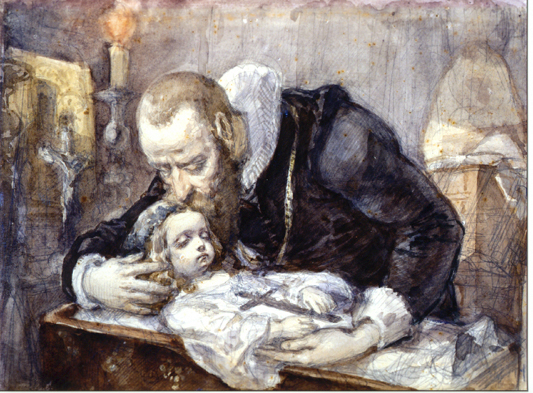
A lament or lamentation is a passionate expression of grief, often in music, poetry, or song form. The grief is most often born of regret, or mourning. Laments can also be expressed in a verbal manner in which participants lament about something that they regret or someone that they have lost, and they are usually accompanied by wailing, moaning and/or crying. Laments constitute some of the oldest forms of writing, and examples exist across human cultures.
Many of the oldest and most lasting poems in human history have been laments. The Lament for Sumer and Ur dates back at least 4000 years to ancient Sumer, the world's first urban civilization. Laments are present in both the Iliad and the Odyssey, and laments continued to be sung in elegiacs accompanied by the aulos in classical and Hellenistic Greece. Elements of laments appear in Beowulf, in the Hindu Vedas, and in ancient Near Eastern religious texts. They are included in the Mesopotamian City Laments such as the Lament for Ur and the Jewish Tanakh, or Christian Old Testament.
In many oral traditions, both early and modern, the lament has been a genre usually performed by women: Batya Weinbaum made a case for the spontaneous lament of women chanters in the creation of the oral tradition that resulted in the Iliad The material of lament, the "sound of trauma" is as much an element in the Book of Job as in the genre of pastoral elegy, such as Shelley's "Adonais" or Matthew Arnold's "Thyrsis".
The Book of Lamentations or Lamentations of Jeremiah figures in the Old Testament. The Lamentation of Christ (under many closely variant terms) is a common subject from the Life of Christ in art, showing Jesus' dead body being mourned after the Crucifixion. Jesus himself lamented over the prospective fall of Jerusalem as he and his disciples entered the city ahead of his passion.
A lament in the Book of Lamentations or in the Psalms, in particular in the Lament/Complaint Psalms of the Tanakh, may be looked at as "a cry of need in a context of crisis when Israel lacks the resources to fend for itself". Another way of looking at it is all the more basic: laments simply being "appeals for divine help in distress". These laments, too, often have a set format: an address to God, description of the suffering/anguish from which one seeks relief, a petition for help and deliverance, a curse towards one's enemies, an expression of the belief of ones innocence or a confession of the lack thereof, a vow corresponding to an expected divine response, and lastly, a song of thanksgiving. Examples of a general format of this, both in the individual and communal laments, can be seen in Psalm 3 and Psalm 44 respectively.
The Lament of Edward II, if it is actually written by Edward II of England, is the sole surviving composition of his.
A heroine's lament is a conventional fixture of baroque opera seria, accompanied usually by strings alone, in descending tetrachords. Because of their plangent cantabile melodic lines, evocatively free, non-strophic construction and adagio pace, operatic laments have remained vividly memorable soprano or mezzo-soprano arias even when separated from the emotional pathos of their operatic contexts. An early example is Ariadne's "Lasciatemi morire", which is the only survivor of Claudio Monteverdi's lost Arianna. Francesco Cavalli's operas extended the lamento formula, in numerous exemplars, of which Ciro's "Negatemi respiri" from Ciro is notable.
Other examples include Dido's Lament ("When I am laid in earth") (Henry Purcell, Dido and Aeneas), "Lascia ch'io pianga" (George Frideric Handel, Rinaldo), "Caro mio ben" (Tomaso or Giuseppe Giordani). The lament continued to represent a musico-dramatic high point. In the context of opera buffa, the Countess's lament, "Dove sono", comes as a surprise to the audience of Wolfgang Amadeus Mozart's The Marriage of Figaro, and in Gioachino Rossini's Barber of Seville, Rosina's plaintive words at her apparent abandonment are followed, not by the expected lament aria, but by a vivid orchestral interlude of storm music. The heroine's lament remained a fixture in romantic opera, and the Marschallin's monologue in act 1 of Der Rosenkavalier can be understood as a penetrating psychological lament.
Hub AI
Lament AI simulator
(@Lament_simulator)
Lament
A lament or lamentation is a passionate expression of grief, often in music, poetry, or song form. The grief is most often born of regret, or mourning. Laments can also be expressed in a verbal manner in which participants lament about something that they regret or someone that they have lost, and they are usually accompanied by wailing, moaning and/or crying. Laments constitute some of the oldest forms of writing, and examples exist across human cultures.
Many of the oldest and most lasting poems in human history have been laments. The Lament for Sumer and Ur dates back at least 4000 years to ancient Sumer, the world's first urban civilization. Laments are present in both the Iliad and the Odyssey, and laments continued to be sung in elegiacs accompanied by the aulos in classical and Hellenistic Greece. Elements of laments appear in Beowulf, in the Hindu Vedas, and in ancient Near Eastern religious texts. They are included in the Mesopotamian City Laments such as the Lament for Ur and the Jewish Tanakh, or Christian Old Testament.
In many oral traditions, both early and modern, the lament has been a genre usually performed by women: Batya Weinbaum made a case for the spontaneous lament of women chanters in the creation of the oral tradition that resulted in the Iliad The material of lament, the "sound of trauma" is as much an element in the Book of Job as in the genre of pastoral elegy, such as Shelley's "Adonais" or Matthew Arnold's "Thyrsis".
The Book of Lamentations or Lamentations of Jeremiah figures in the Old Testament. The Lamentation of Christ (under many closely variant terms) is a common subject from the Life of Christ in art, showing Jesus' dead body being mourned after the Crucifixion. Jesus himself lamented over the prospective fall of Jerusalem as he and his disciples entered the city ahead of his passion.
A lament in the Book of Lamentations or in the Psalms, in particular in the Lament/Complaint Psalms of the Tanakh, may be looked at as "a cry of need in a context of crisis when Israel lacks the resources to fend for itself". Another way of looking at it is all the more basic: laments simply being "appeals for divine help in distress". These laments, too, often have a set format: an address to God, description of the suffering/anguish from which one seeks relief, a petition for help and deliverance, a curse towards one's enemies, an expression of the belief of ones innocence or a confession of the lack thereof, a vow corresponding to an expected divine response, and lastly, a song of thanksgiving. Examples of a general format of this, both in the individual and communal laments, can be seen in Psalm 3 and Psalm 44 respectively.
The Lament of Edward II, if it is actually written by Edward II of England, is the sole surviving composition of his.
A heroine's lament is a conventional fixture of baroque opera seria, accompanied usually by strings alone, in descending tetrachords. Because of their plangent cantabile melodic lines, evocatively free, non-strophic construction and adagio pace, operatic laments have remained vividly memorable soprano or mezzo-soprano arias even when separated from the emotional pathos of their operatic contexts. An early example is Ariadne's "Lasciatemi morire", which is the only survivor of Claudio Monteverdi's lost Arianna. Francesco Cavalli's operas extended the lamento formula, in numerous exemplars, of which Ciro's "Negatemi respiri" from Ciro is notable.
Other examples include Dido's Lament ("When I am laid in earth") (Henry Purcell, Dido and Aeneas), "Lascia ch'io pianga" (George Frideric Handel, Rinaldo), "Caro mio ben" (Tomaso or Giuseppe Giordani). The lament continued to represent a musico-dramatic high point. In the context of opera buffa, the Countess's lament, "Dove sono", comes as a surprise to the audience of Wolfgang Amadeus Mozart's The Marriage of Figaro, and in Gioachino Rossini's Barber of Seville, Rosina's plaintive words at her apparent abandonment are followed, not by the expected lament aria, but by a vivid orchestral interlude of storm music. The heroine's lament remained a fixture in romantic opera, and the Marschallin's monologue in act 1 of Der Rosenkavalier can be understood as a penetrating psychological lament.
Recent media