Hubbry Logo
search
logo

Modular curve

logo
Community Hub0 Subscribers
Read side by side
from Wikipedia

In number theory and algebraic geometry, a modular curve Y(Γ) is a Riemann surface, or the corresponding algebraic curve, constructed as a quotient of the complex upper half-plane H by the action of a congruence subgroup Γ of the modular group of integral 2×2 matrices SL(2, Z). The term modular curve can also be used to refer to the compactified modular curves X(Γ) which are compactifications obtained by adding finitely many points (called the cusps of Γ) to this quotient (via an action on the extended complex upper-half plane). The points of a modular curve parametrize isomorphism classes of elliptic curves, together with some additional structure depending on the group Γ. This interpretation allows one to give a purely algebraic definition of modular curves, without reference to complex numbers, and, moreover, prove that modular curves are defined either over the field of rational numbers Q or a cyclotomic field Qn). The latter fact and its generalizations are of fundamental importance in number theory.

Analytic definition

[edit]

The modular group SL(2, Z) acts on the upper half-plane by fractional linear transformations. The analytic definition of a modular curve involves a choice of a congruence subgroup Γ of SL(2, Z), i.e. a subgroup containing the principal congruence subgroup of level N for some positive integer N, which is defined to be

The minimal such N is called the level of Γ. A complex structure can be put on the quotient Γ\H to obtain a noncompact Riemann surface called a modular curve, and commonly denoted Y(Γ).

Compactified modular curves

[edit]

A common compactification of Y(Γ) is obtained by adding finitely many points called the cusps of Γ. Specifically, this is done by considering the action of Γ on the extended complex upper-half plane H* = HQ ∪ {∞}. We introduce a topology on H* by taking as a basis:

  • any open subset of H,
  • for all r > 0, the set
  • for all coprime integers a, c and all r > 0, the image of under the action of

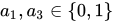
where m, n are integers such that an + cm = 1.

This turns H* into a topological space which is a subset of the Riemann sphere P1(C). The group Γ acts on the subset Q ∪ {∞}, breaking it up into finitely many orbits called the cusps of Γ. If Γ acts transitively on Q ∪ {∞}, the space Γ\H* becomes the Alexandroff compactification of Γ\H. Once again, a complex structure can be put on the quotient Γ\H* turning it into a Riemann surface denoted X(Γ) which is now compact. This space is a compactification of Y(Γ).[1]

Examples

[edit]

The most common examples are the curves X(N), X0(N), and X1(N) associated with the subgroups Γ(N), Γ0(N), and Γ1(N).

The modular curve X(5) has genus 0: it is the Riemann sphere with 12 cusps located at the vertices of a regular icosahedron. The covering X(5) → X(1) is realized by the action of the icosahedral group on the Riemann sphere. This group is a simple group of order 60 isomorphic to A5 and PSL(2, 5).

The modular curve X(7) is the Klein quartic of genus 3 with 24 cusps. It can be interpreted as a surface with three handles tiled by 24 heptagons, with a cusp at the center of each face. These tilings can be understood via dessins d'enfants and Belyi functions – the cusps are the points lying over ∞ (red dots), while the vertices and centers of the edges (black and white dots) are the points lying over 0 and 1. The Galois group of the covering X(7) → X(1) is a simple group of order 168 isomorphic to PSL(2, 7).

There is an explicit classical model for X0(N), the classical modular curve; this is sometimes called the modular curve. The definition of Γ(N) can be restated as follows: it is the subgroup of the modular group which is the kernel of the reduction modulo N. Then Γ0(N) is the larger subgroup of matrices which are upper triangular modulo N:

and Γ1(N) is the intermediate group defined by:

These curves have a direct interpretation as moduli spaces for elliptic curves with level structure and for this reason they play an important role in arithmetic geometry. The level N modular curve X(N) is the moduli space for elliptic curves with a basis for the N-torsion. For X0(N) and X1(N), the level structure is, respectively, a cyclic subgroup of order N and a point of order N. These curves have been studied in great detail, and in particular, it is known that X0(N) can be defined over Q.

The equations defining modular curves are the best-known examples of modular equations. The "best models" can be very different from those taken directly from elliptic function theory. Hecke operators may be studied geometrically, as correspondences connecting pairs of modular curves.

Quotients of H that are compact do occur for Fuchsian groups Γ other than subgroups of the modular group; a class of them constructed from quaternion algebras is also of interest in number theory.

Genus

[edit]

The covering X(N) → X(1) is Galois, with Galois group SL(2, N)/{1, −1}, which is equal to PSL(2, N) if N is prime. Applying the Riemann–Hurwitz formula and Gauss–Bonnet theorem, one can calculate the genus of X(N). For a prime level p ≥ 5,

where χ = 2 − 2g is the Euler characteristic, |G| = (p+1)p(p−1)/2 is the order of the group PSL(2, p), and D = π − π/2 − π/3 − π/p is the angular defect of the spherical (2,3,p) triangle. This results in a formula

Thus X(5) has genus 0, X(7) has genus 3, and X(11) has genus 26. For p = 2 or 3, one must additionally take into account the ramification, that is, the presence of order p elements in PSL(2, Z), and the fact that PSL(2, 2) has order 6, rather than 3. There is a more complicated formula for the genus of the modular curve X(N) of any level N that involves divisors of N.

Genus zero

[edit]

In general a modular function field is a function field of a modular curve (or, occasionally, of some other moduli space that turns out to be an irreducible variety). Genus zero means such a function field has a single transcendental function as generator: for example the j-function generates the function field of X(1) = PSL(2, Z)\H*. The traditional name for such a generator, which is unique up to a Möbius transformation and can be appropriately normalized, is a Hauptmodul (main or principal modular function, plural Hauptmoduln).

The spaces X1(n) have genus zero for n = 1, ..., 10 and n = 12. Since each of these curves is defined over Q and has a Q-rational point, it follows that there are infinitely many rational points on each such curve, and hence infinitely many elliptic curves defined over Q with n-torsion for these values of n. The converse statement, that only these values of n can occur, is Mazur's torsion theorem.

X0(N) of genus one

[edit]

The modular curves are of genus one if and only if equals one of the 12 values listed in the following table.[2] As elliptic curves over , they have minimal, integral Weierstrass models . This is, and the absolute value of the discriminant is minimal among all integral Weierstrass models for the same curve. The following table contains the unique reduced, minimal, integral Weierstrass models, which means and .[3] The last column of this table refers to the home page of the respective elliptic modular curve on The L-functions and modular forms database (LMFDB).

of genus 1
LMFDB
11 [0, -1, 1, -10, -20] link
14 [1, 0, 1, 4, -6] link
15 [1, 1, 1, -10, -10] link
17 [1, -1, 1, -1, -14] link
19 [0, 1, 1, -9, -15] link
20 [0, 1, 0, 4, 4] link
21 [1, 0, 0, -4, -1] link
24 [0, -1, 0, -4, 4] link
27 [0, 0, 1, 0, -7] link
32 [0, 0, 0, 4, 0] link
36 [0, 0, 0, 0, 1] link
49 [1, -1, 0, -2, -1] link

Relation with the Monster group

[edit]

Modular curves of genus 0, which are quite rare, turned out to be of major importance in relation with the monstrous moonshine conjectures. The first several coefficients of the q-expansions of their Hauptmoduln were computed already in the 19th century, but it came as a shock that the same large integers show up as dimensions of representations of the largest sporadic simple group Monster.

Another connection is that the modular curve corresponding to the normalizer Γ0(p)+ of Γ0(p) in SL(2, R) has genus zero if and only if p is 2, 3, 5, 7, 11, 13, 17, 19, 23, 29, 31, 41, 47, 59 or 71, and these are precisely supersingular primes in moonshine theory, i.e. the prime factors of the order of the monster group. The result about Γ0(p)+ is due to Jean-Pierre Serre, Andrew Ogg and John G. Thompson in the 1970s, and the subsequent observation relating it to the monster group is due to Ogg, who wrote up a paper offering a bottle of Jack Daniel's whiskey to anyone who could explain this fact, which was a starting point for the theory of monstrous moonshine.[4]

The relation runs very deep and, as demonstrated by Richard Borcherds, it also involves generalized Kac–Moody algebras. Work in this area underlined the importance of modular functions that are meromorphic and can have poles at the cusps, as opposed to modular forms, that are holomorphic everywhere, including the cusps, and had been the main objects of study for the better part of the 20th century.

See also

[edit]

References

[edit]
Revisions and contributorsEdit on WikipediaRead on Wikipedia
from Grokipedia
A modular curve is a compact Riemann surface, or equivalently an algebraic curve, defined as the quotient of the extended upper half-plane by a congruence subgroup of the modular group SL2(Z)\mathrm{SL}_2(\mathbb{Z}), such as Γ(N)\Gamma(N), Γ0(N)\Gamma_0(N), or Γ1(N)\Gamma_1(N), and it serves as a moduli space parametrizing elliptic curves equipped with a specified level structure, like full level-NN structure or a cyclic subgroup of order NN.[1] These curves, often denoted X(Γ)X(\Gamma) in their compactified form, include cusps corresponding to degenerate elliptic curves and elliptic points of orders 2 or 3, with their genus and number of cusps determined by formulas from the Riemann-Hurwitz theorem, such as genus g=1+μ12ν24ν33ν2g = 1 + \frac{\mu}{12} - \frac{\nu_2}{4} - \frac{\nu_3}{3} - \frac{\nu_\infty}{2} where μ\mu is the index of the subgroup and νi\nu_i count fixed points or cusps.[1][2] Modular curves are defined over number fields like Q(ζN)\mathbb{Q}(\zeta_N), where ζN\zeta_N is a primitive NNth root of unity, and their function fields are generated by modular functions such as the jj-invariant and related forms, enabling explicit equations like the Igusa polynomials or canonical models FN(X,Y)Z[X,Y]F_N(X,Y) \in \mathbb{Z}[X,Y] for relations between jj-invariants.[1] They connect analytic aspects from complex uniformization—via lattices in C\mathbb{C} and the Weierstrass \wp-function—to algebraic geometry, where points on Y1(N)Y_1(N) (the non-compact affine curve) represent elliptic curves with a point of order NN, compactified to X1(N)X_1(N) over Z[1/N]\mathbb{Z}[1/N].[3][2] In number theory, modular curves play a pivotal role through the Eichler-Shimura isomorphism, linking their Jacobians to cusp forms and Hecke algebras, and they underpin the modularity theorem (formerly Taniyama-Shimura conjecture), which asserts that every elliptic curve over Q\mathbb{Q} is modular, a result essential to Wiles's proof of Fermat's Last Theorem.[1] They also facilitate the study of Galois representations attached to modular forms via Jacobians like J1(N)J_1(N), which yield 2-dimensional representations unramified outside primes dividing NN and a prime \ell, and connect to class field theory through complex multiplication points and ring class fields.[3] Historically, the theory traces to Riemann's work on automorphic forms in the 1850s, advanced by Poincaré's investigations of Fuchsian groups in the 1880s, and further developed by Shimura in the mid-20th century to establish their arithmetic properties over rings of integers.[1]

Definitions

Analytic definition

The modular group SL(2,Z)\mathrm{SL}(2, \mathbb{Z}) consists of all 2×22 \times 2 matrices with integer entries and determinant 1. It acts on the upper half-plane H={τC(τ)>0}\mathcal{H} = \{ \tau \in \mathbb{C} \mid \Im(\tau) > 0 \} by fractional linear transformations: for γ=(abcd)SL(2,Z)\gamma = \begin{pmatrix} a & b \\ c & d \end{pmatrix} \in \mathrm{SL}(2, \mathbb{Z}), the action is γτ=aτ+bcτ+d\gamma \cdot \tau = \frac{a\tau + b}{c\tau + d}. This action preserves H\mathcal{H} and is properly discontinuous, enabling the construction of quotient spaces that are Riemann surfaces.[1] Congruence subgroups of SL(2,Z)\mathrm{SL}(2, \mathbb{Z}) are defined by matrix entries satisfying congruence conditions modulo a positive integer NN. The principal congruence subgroup Γ(N)\Gamma(N) is the kernel of the natural reduction map SL(2,Z)SL(2,Z/NZ)\mathrm{SL}(2, \mathbb{Z}) \to \mathrm{SL}(2, \mathbb{Z}/N\mathbb{Z}), consisting of matrices γI(modN)\gamma \equiv I \pmod{N}. The subgroup Γ0(N)\Gamma_0(N) comprises matrices with bottom-left entry c0(modN)c \equiv 0 \pmod{N}, while Γ1(N)\Gamma_1(N) consists of those in Γ0(N)\Gamma_0(N) with bottom-right entry d1(modN)d \equiv 1 \pmod{N}. These subgroups have finite index in SL(2,Z)\mathrm{SL}(2, \mathbb{Z}), with [SL(2,Z):Γ(N)]=N3pN(11/p2)[\mathrm{SL}(2, \mathbb{Z}) : \Gamma(N)] = N^3 \prod_{p \mid N} (1 - 1/p^2), [SL(2,Z):Γ0(N)]=NpN(1+1/p)[\mathrm{SL}(2, \mathbb{Z}) : \Gamma_0(N)] = N \prod_{p \mid N} (1 + 1/p), and similar formulas for Γ1(N)\Gamma_1(N).[1] For a congruence subgroup Γ\Gamma, the modular curve X(Γ)X(\Gamma) is the quotient H/Γ\overline{\mathcal{H}} / \Gamma, where H=HP1(Q)\overline{\mathcal{H}} = \mathcal{H} \cup \mathbb{P}^1(\mathbb{Q}) is the extended upper half-plane obtained by adjoining the rational projective line (including cusps at rational points and infinity) to H\mathcal{H}. The space H/Γ\mathcal{H} / \Gamma is a non-compact Riemann surface, and adjoining the cusps compactifies it to X(Γ)X(\Gamma), which is a compact Riemann surface of genus depending on Γ\Gamma. A fundamental domain for Γ=SL(2,Z)\Gamma = \mathrm{SL}(2, \mathbb{Z}) in H\mathcal{H} is the region D={τH(τ)1/2,τ1}D = \{ \tau \in \mathcal{H} \mid |\Re(\tau)| \leq 1/2, \, |\tau| \geq 1 \}; the SL(2,Z)\mathrm{SL}(2, \mathbb{Z})-translates of DD tile H\mathcal{H} exactly, with boundary identifications under the group action (e.g., left and right arcs identified by translation by 1, and the unit arc by inversion). For general Γ\Gamma, a fundamental domain can be constructed as a union of translates of DD under coset representatives, similarly tiling H\mathcal{H}.[1][2] The jj-invariant provides a key holomorphic function on X(Γ(1))=X(1)X(\Gamma(1)) = X(1), parametrizing isomorphism classes of elliptic curves over C\mathbb{C}. It is defined by
j(τ)=1728E4(τ)3Δ(τ), j(\tau) = 1728 \frac{E_4(\tau)^3}{\Delta(\tau)},
where E4(τ)=1+240n=1σ3(n)qnE_4(\tau) = 1 + 240 \sum_{n=1}^\infty \sigma_3(n) q^n is the normalized Eisenstein series of weight 4 (σ3(n)=dnd3\sigma_3(n) = \sum_{d \mid n} d^3) and Δ(τ)=qn=1(1qn)24\Delta(\tau) = q \prod_{n=1}^\infty (1 - q^n)^{24} is the modular discriminant (a cusp form of weight 12), with q=e2πiτq = e^{2\pi i \tau}. This function is invariant under SL(2,Z)\mathrm{SL}(2, \mathbb{Z}) and has a simple pole at the cusp \infty.[4] From the analytic viewpoint, points on the modular curve X(N)X(N) correspond to isomorphism classes of elliptic curves EE over C\mathbb{C} equipped with a full level-NN structure: a basis {P,Q}\{P, Q\} for the NN-torsion subgroup E[N](Z/NZ)2E[N] \cong (\mathbb{Z}/N\mathbb{Z})^2 such that the Weil pairing satisfies eN(P,Q)=ζNe_N(P, Q) = \zeta_N, a primitive NNth root of unity. For X0(N)X_0(N), points mark elliptic curves with a cyclic subgroup of order NN, while for X1(N)X_1(N), they mark a single point of order NN on the elliptic curve. These structures arise naturally from the action of Γ(N)\Gamma(N), Γ0(N)\Gamma_0(N), and Γ1(N)\Gamma_1(N) on τH\tau \in \mathcal{H}, identifying τ\tau with the lattice Z+τZ\mathbb{Z} + \tau \mathbb{Z} via the elliptic curve $ \mathbb{C} / (\mathbb{Z} + \tau \mathbb{Z}) $.[1]

Algebraic definition

In algebraic geometry, a modular curve associated to a congruence subgroup ΓSL2(Z)\Gamma \subset \mathrm{SL}_2(\mathbb{Z}) is defined as the coarse moduli space parametrizing isomorphism classes of elliptic curves over C\mathbb{C} equipped with a Γ\Gamma-level structure. For the principal congruence subgroup Γ(N)\Gamma(N) of level N1N \geq 1, a Γ(N)\Gamma(N)-level structure on an elliptic curve E/CE/\mathbb{C} consists of an ordered basis (P,Q)(P, Q) of the NN-torsion subgroup E[N](C)(Z/NZ)2E[N](\mathbb{C}) \cong (\mathbb{Z}/N\mathbb{Z})^2 such that the Weil pairing satisfies eN(P,Q)=ζNe_N(P, Q) = \zeta_N, a primitive NNth root of unity. For the subgroup Γ0(N)\Gamma_0(N), the level structure is instead a cyclic subgroup CE[N](C)C \subset E[N](\mathbb{C}) of order NN. The coarse moduli space Y(Γ)Y(\Gamma) thus classifies such pairs (E,ϕ)(E, \phi) up to isomorphism over C\mathbb{C}, where ϕ\phi denotes the level structure.[1][5] More precisely, the stack-theoretic definition views the modular curve X(Γ)X(\Gamma) as the coarse moduli space of the Deligne-Mumford stack MΓ\mathcal{M}_\Gamma over Spec(Z)\mathrm{Spec}(\mathbb{Z}), which classifies families of elliptic curves with Γ\Gamma-level structure over arbitrary base schemes. The stack MΓ\mathcal{M}_\Gamma has objects given by pairs (E/S,ι)(E/S, \iota), where ESE \to S is an elliptic curve and ι:(Z/NZ)2E[N]\iota: (\mathbb{Z}/N\mathbb{Z})^2 \hookrightarrow E[N] is a Γ\Gamma-equivariant embedding compatible with the Weil pairing, up to isomorphism. For Γ=Γ(N)\Gamma = \Gamma(N) with N3N \geq 3, since Γ(N)\Gamma(N) is torsion-free, MΓ(N)\mathcal{M}_{\Gamma(N)} is representable by a scheme, making Y(Γ(N))Y(\Gamma(N)) a fine moduli space. The coarse space X(Γ)X(\Gamma) is then obtained by geometric invariant theory, resolving stacky points arising from elliptic curves with extra automorphisms.[6][7] The affine modular curve Y(Γ)Y(\Gamma) admits models as the spectrum of the ring of modular functions for Γ\Gamma, i.e., C\mathbb{C}-algebraic functions on the upper half-plane invariant under Γ\Gamma and holomorphic at the cusps. For instance, Y(1)=Spec(C[j])Y(1) = \mathrm{Spec}(\mathbb{C}[j]), where jj is the j-invariant, embedding into P1\mathbb{P}^1 via the map sending elliptic curves to their j-invariants. Higher-level affine curves like Y(N)Y(N) embed into projective space over Q(ζN)\mathbb{Q}(\zeta_N) using Hauptmoduln, generators of the function field C(Y(N))\mathbb{C}(Y(N)). Over Y(Γ)Y(\Gamma), there exists a universal elliptic curve EY(Γ)\mathcal{E} \to Y(\Gamma) with Γ\Gamma-level structure, and the projection π:EX(Γ)\pi: \mathcal{E} \to X(\Gamma) forgets the level structure, yielding the versal deformation space of elliptic curves with such structure. All non-cuspidal points of these modular curves lie on components that are 1-dimensional over C\mathbb{C}.[1][5][7] For N3N \geq 3, the compactified modular curve X(N)X(N) is a fine moduli space, as the universal level-NN structure on the universal elliptic curve EX(N)\mathcal{E} \to X(N) rigidly parametrizes all such families without automorphisms interfering. This contrasts with lower levels, where extra automorphisms prevent fine representability.[1][5]

Construction and properties

Compactified modular curves

The modular curve $ Y(\Gamma) $, defined as the quotient of the upper half-plane $ \mathbb{H} $ by a congruence subgroup $ \Gamma \subset \mathrm{SL}_2(\mathbb{Z}) $, is non-compact as a Riemann surface due to the presence of cusps corresponding to $ \Gamma $-orbits of rational points on the boundary, such as the point at infinity $ i\infty $.[8] These cusps arise from the action of $ \Gamma $ on the rational projective line $ \mathbb{P}^1(\mathbb{Q}) $, leading to punctures in the quotient space where elliptic curves degenerate.[9] The compactified modular curve $ X(\Gamma) $ is obtained by adjoining the cusps to $ Y(\Gamma) $, yielding $ X(\Gamma) = Y(\Gamma) \cup {\mathrm{cusps}} $, a smooth projective algebraic curve.[8] Analytically, this compactification is realized by extending to the extended upper half-plane $ \mathbb{H}^* = \mathbb{H} \cup \mathbb{P}^1(\mathbb{Q}) $, on which $ \Gamma $ acts via fractional linear transformations, and taking the quotient $ X(\Gamma) = \Gamma \backslash \mathbb{H}^* $, which embeds into the Riemann sphere $ \mathbb{P}^1(\mathbb{C}) $.[8] At the cusps, modular functions admit q-expansions in a local parameter $ q = e^{2\pi i z / h} $, where $ h $ is the width of the cusp, converging uniformly on compact subsets approaching the cusp.[8] Algebraically, compactification produces smooth projective models over the integers, such as the Deligne-Rapoport model for $ X_0(N) $, which is a proper smooth scheme over $ \mathbb{Z}[1/N] $ classifying generalized elliptic curves.[10] These generalized elliptic curves are semistable genus-1 curves with a specified group law on the smooth locus, degenerating at cusps to nodal rational curves (nodal cubics or N'eron polygons), ensuring the total space remains smooth.[10][9] The number of cusps on $ X(\Gamma) $ equals the number of $ \Gamma $-orbits on $ \mathbb{P}^1(\mathbb{Q}) $. For $ \Gamma = \Gamma_0(N) $, this is given by $ \sum_{d \mid N} \phi(\gcd(d, N/d)) $, where $ \phi $ is Euler's totient function; in the case of $ X(1) $ (corresponding to $ \Gamma = \mathrm{SL}_2(\mathbb{Z}) $), compactification adds a single cusp, yielding $ X(1) \cong \mathbb{P}^1(\mathbb{C}) $.[9] For $ \Gamma_0(N) $, the Atkin-Lehner group $ W(\Gamma_0(N)) $, generated by involutions $ W_d $ for divisors $ d \mid N $ such that $ \gcd(d, N/d) = 1 $, acts on the set of cusps.[9]

Genus of modular curves

The genus $ g $ of a compactified modular curve $ X(\Gamma) $, where $ \Gamma $ is a congruence subgroup of $ \mathrm{SL}_2(\mathbb{Z}) $, is a topological invariant that classifies the curve as a Riemann surface of genus $ g $. It measures the complexity of the surface and determines key arithmetic properties, such as the dimension of the space of holomorphic differentials, which equals $ g $. The genus is given by
g=1+μ12ε4ν3ρ2, g = 1 + \frac{\mu}{12} - \frac{\varepsilon}{4} - \frac{\nu}{3} - \frac{\rho}{2},
where $ \mu = [\mathrm{SL}_2(\mathbb{Z}) : \Gamma] $ is the index of $ \Gamma $, $ \varepsilon $ is the number of elliptic points of order 2 on $ X(\Gamma) $, $ \nu $ is the number of elliptic points of order 3, and $ \rho $ is the number of cusps.[11] A detailed breakdown reveals that the formula reflects the orbifold Euler characteristic of the fundamental domain for $ \Gamma $. The hyperbolic plane $ \mathbb{H} $ has Euler characteristic derived from its triangulation, but the quotient $ \mathbb{H}/\Gamma $ accounts for orbifold points: the area of the fundamental domain is $ \mu \cdot \pi / 3 $, and by Gauss-Bonnet, the orbifold Euler characteristic is $ \chi = \mu/12 - \varepsilon/4 - \nu/3 - \rho/2 $ (normalizing the cusp contributions to match the compact surface). For the compactified surface, $ 2 - 2g = - \chi $, confirming the genus formula. The terms $ \varepsilon $, $ \nu $, and $ \rho $ are finite and computable from the fixed points of $ \Gamma $ on $ \mathbb{H} $ and the action on cusps $ \mathbb{P}^1(\mathbb{Q}) $.[5] Asymptotically, for principal congruence subgroups $ \Gamma(N) $ defining $ X(N) $, the index $ \mu \approx N^3 / 12 $ (more precisely, $ \mu = N^3 \prod_{p \mid N} (1 - 1/p^2) $), so the genus grows like $ g \approx N^3 / 12 ,dominatedbytheindextermasellipticpointsandcuspscontributelowerorderterms(, dominated by the index term as elliptic points and cusps contribute lower-order terms ( O(N^2) $ and $ O(N) $, respectively). For the coarser $ X_0(N) $, the growth is linear on average, with $ g \approx (1.25 / \pi^2) N $. In general, higher-level modular curves exhibit rapid genus growth with level, reflecting increasing geometric complexity.[12] All modular curves $ X(\Gamma) $ have genus $ g \geq 0 $, as they are quotients of the compact Riemann surface obtained by compactifying the upper half-plane, yielding non-negative Euler characteristics. The curve $ X(1) $ has genus 0, corresponding to the Riemann sphere. The first modular curve of genus 1 is $ X_0(11) $, with $ g = 1 $.[12] For genus zero cases, the Hurwitz class number provides an interpretation through trace formulas on the hauptmodul (a generator of the function field). When $ X_0(M) $ has genus zero, Hurwitz-Eichler type formulas express Hurwitz class numbers $ H_8(d, M) $ (counting binary quadratic forms of discriminant $ 8d $ with level $ M $) as traces of Hecke operators or intersections on the curve, linking arithmetic invariants to the geometry of these rational curves. This connects the class number problem to modular correspondences on genus zero quotients.[13] Up to isomorphism over $ \mathbb{C} $, there are only finitely many modular curves of each fixed genus $ g $, as the genus bounds the index $ \mu \leq 12(g + \varepsilon/4 + \nu/3 + \rho/2) $, and there are finitely many congruence subgroups of bounded index in $ \mathrm{SL}_2(\mathbb{Z}) $. For $ g \geq 2 $, this finiteness holds even for non-congruence cases when considering isomorphism classes over $ \mathbb{Q} $.[14][15]

Examples

Genus zero modular curves

Genus zero modular curves are those with genus zero, making them rational curves isomorphic to the projective line P1\mathbb{P}^1. Their function fields are generated by a single element, known as a Hauptmodul, which is a rational function of the absolute invariant jj. This structure allows explicit parametrization and makes them particularly useful for classifying elliptic curves with specific level structures. Among the modular curves X0(N)X_0(N), there are exactly 15 values of NN for which the genus is zero: N=1,2,3,4,5,6,7,8,9,10,12,13,16,18,25N = 1, 2, 3, 4, 5, 6, 7, 8, 9, 10, 12, 13, 16, 18, 25.[1] These curves are all defined over Q\mathbb{Q} and possess a rational point (such as a cusp), ensuring they are isomorphic to PQ1\mathbb{P}^1_\mathbb{Q}. For prime levels p=2,3,5,7,13p = 2, 3, 5, 7, 13, the isomorphism X0(p)P1X_0(p) \cong \mathbb{P}^1 can be realized via explicit maps to the jj-line; for instance, the Hauptmodul for X0(2)X_0(2) is (η(2τ)η(τ))24\left( \frac{\eta(2\tau)}{\eta(\tau)} \right)^{24}, which relates jj-invariants of isogenous elliptic curves by a quadratic equation. The modular curves X1(N)X_1(N) also include genus zero examples for small N=1N = 1 to 1010 and N=12N=12, parametrizing elliptic curves with a point of order NN. These are similarly isomorphic to P1\mathbb{P}^1 over Q\mathbb{Q}, generated by Hauptmoduln like the multiplier function for N=5N=5. Certain Atkin-Lehner quotients, such as X0+(p)X_0^+(p) for primes p=2,3,5,7,13p=2,3,5,7,13, yield additional genus zero curves by quotienting X0(p)X_0(p) by the Atkin-Lehner involution wpw_p, preserving the rational structure. For example, the Hauptmodul for X0(16)X_0(16) is a degree-4 rational function in jj, explicitly given by a quotient of eta products that generates the function field. Similar constructions apply for N=18 and 25, where explicit Hauptmoduln relate to eta quotients or Klein forms. As rational curves over Q\mathbb{Q}, all these genus zero modular curves admit infinitely many rational points, corresponding to infinite families of elliptic curves with the prescribed level-NN structure over Q\mathbb{Q}. This infinitude arises from the birational equivalence to PQ1\mathbb{P}^1_\mathbb{Q}, which has dense rational points. The full classification of all genus zero congruence modular curves with rational points encompasses 109 such subgroups up to conjugacy, but the 15 X0(N)X_0(N) cases form the core classical examples.[16]

Genus one modular curves

Modular curves of genus one are themselves elliptic curves, providing explicit examples of abelian varieties over Q\mathbb{Q}. There are exactly 17 positive integers NN for which the modular curve X0(N)X_0(N) has genus one: N=11,14,15,17,19,20,22,23,26,27,31,34,38,39,46,47N = 11, 14, 15, 17, 19, 20, 22, 23, 26, 27, 31, 34, 38, 39, 46, 47.[1] The smallest such NN is 11, and X0(11)X_0(11) is the unique genus one modular curve with conductor 11. For these NN, X0(N)X_0(N) is an elliptic curve defined over Q\mathbb{Q}, and the natural projection map π:X0(N)X(1)P1\pi: X_0(N) \to X(1) \cong \mathbb{P}^1 is a morphism from this elliptic curve to the projective line, branched at the cusp and certain elliptic points. A representative example is X0(11)X_0(11), which is isomorphic to the Weierstrass model
y2+y=x3x210x20 y^2 + y = x^3 - x^2 - 10x - 20
over Q\mathbb{Q}, with jj-invariant j=122023936161051j = -\frac{122023936}{161051}.[17] Another example is X0(14)X_0(14), isomorphic to
y2+xy=x3x y^2 + xy = x^3 - x
over Q\mathbb{Q}, with jj-invariant j=33537j = -3^3 \cdot 5^3 \cdot 7. The curve X0(27)X_0(27) has jj-invariant j=0j = 0 and is torsion-free over Q\mathbb{Q}, while X0(49)X_0(49) has jj-invariant j=3375j = -3375 and complex multiplication by the ring of integers of Q(7)\mathbb{Q}(\sqrt{-7}).[18] These genus one modular curves illustrate key arithmetic features of elliptic curves, such as complex multiplication and rational torsion points. For instance, X0(17)X_0(17) is given by
y2+xy+y=x3x2x14 y^2 + xy + y = x^3 - x^2 - x - 14
over Q\mathbb{Q}, with jj-invariant j=3593783521j = -\frac{35937}{83521}, and admits non-torsion rational points corresponding to elliptic curves with specific 17-torsion structure.[18] Similarly, X1(11)X_1(11) is a genus one modular curve over Q\mathbb{Q}, providing examples of elliptic curves with rational points of order 11.

Applications

Parametrization of elliptic curves

Modular curves provide a geometric framework for parametrizing families of elliptic curves equipped with additional structure, known as level structures. Central to this is the universal elliptic curve EΓE_\Gamma over a modular curve X(Γ)X(\Gamma), where Γ\Gamma is a congruence subgroup of SL2(Z)\mathrm{SL}_2(\mathbb{Z}). This universal elliptic curve is a fibration π:EΓX(Γ)\pi: E_\Gamma \to X(\Gamma), with each fiber over a point in X(Γ)X(\Gamma) being an elliptic curve together with a Γ\Gamma-level structure, such as a basis for the NN-torsion subgroup for Γ=Γ(N)\Gamma = \Gamma(N). The existence of this universal family follows from the representability of the moduli functor for elliptic curves with level Γ\Gamma-structure, ensuring that EΓE_\Gamma captures all such curves up to isomorphism over the base.[19] A key example is the modular curve X0(N)X_0(N), which classifies elliptic curves up to Q\mathbb{Q}-isogeny of degree NN. Specifically, points of X0(N)(K)X_0(N)(K) over a field KK correspond to KK-rational elliptic curves EE equipped with a cyclic subgroup of order NN, or equivalently, a cyclic NN-isogeny from EE to another elliptic curve. This moduli interpretation arises from the coarse moduli space structure of X0(N)X_0(N), where the level structure is a cyclic subgroup rather than a full basis, making it a quotient of higher-level curves like X1(N)X_1(N). Such parametrizations are essential for studying arithmetic properties of elliptic curves, as they translate geometric data on the curve into algebraic invariants of the elliptic curves. The connection to the coarse moduli space X(1)X(1) is given by the jj-map, a forgetful morphism X(Γ)X(1)X(\Gamma) \to X(1) that sends a point corresponding to an elliptic curve EE with level Γ\Gamma-structure to the jj-invariant j(E)j(E) of EE. This map forgets the level structure and is ramified at elliptic points, where the stabilizer in SL2(Z)\mathrm{SL}_2(\mathbb{Z}) is non-trivial, such as at points with extra automorphisms. The degree of the jj-map equals the index [SL2(Z):Γ][\mathrm{SL}_2(\mathbb{Z}) : \Gamma], reflecting the covering degree of the modular curves.[1] The parametrization role of modular curves culminates in the modularity theorem, formerly known as the Taniyama-Shimura conjecture, which asserts that every elliptic curve over Q\mathbb{Q} is modular, meaning it corresponds to a point on some X0(N)(C)X_0(N)(\mathbb{C}) via the equality of its L-function with that of a weight-2 newform of level NN. This theorem implies that the jj-invariant of such an elliptic curve lies in the function field of X0(N)X_0(N), providing a uniform parametrization. The theorem was established in stages: Andrew Wiles proved it for semistable elliptic curves in 1995, resolving Fermat's Last Theorem as a consequence, and the full proof for all elliptic curves over Q\mathbb{Q} was completed by Christophe Breuil, Brian Conrad, Fred Diamond, and Richard Taylor in 2001, handling the remaining wild cases at primes like 3.

Relation to modular forms

Modular forms of even weight 2k2k for a congruence subgroup Γ\Gamma of SL2(Z)\mathrm{SL}_2(\mathbb{Z}) are in natural isomorphism with the global sections of the kk-th power of the sheaf of differentials on the compact modular curve X(Γ)X(\Gamma).[4] Specifically, the space A2k(Γ)A_{2k}(\Gamma) of modular forms of weight 2k2k corresponds bijectively to Ωk(X(Γ))\Omega^k(X(\Gamma)), the space of holomorphic kk-fold differentials on X(Γ)X(\Gamma).[4] This identification arises from the action of Γ\Gamma on the upper half-plane H\mathbb{H}, where modular forms transform as f(γτ)=(cτ+d)2kf(τ)f(\gamma \tau) = (c\tau + d)^{2k} f(\tau) for γ=(abcd)Γ\gamma = \begin{pmatrix} a & b \\ c & d \end{pmatrix} \in \Gamma, and extend holomorphically to the cusps.[1] The function field C(X(Γ))\mathbb{C}(X(\Gamma)) of the modular curve X(Γ)X(\Gamma) is generated over C\mathbb{C} by the modular functions, which are the meromorphic modular forms of weight 0 invariant under Γ\Gamma.[1] For the specific case of Γ=Γ0(N)\Gamma = \Gamma_0(N), the field C(X0(N))\mathbb{C}(X_0(N)) is generated by the jj-invariant j(τ)j(\tau) and j(Nτ)j(N\tau), satisfying a modular equation of degree equal to the index [SL2(Z):Γ0(N)][\mathrm{SL}_2(\mathbb{Z}) : \Gamma_0(N)].[1] Cusp forms, the subspace of modular forms vanishing at all cusps, correspond to differentials with zeros at the cusp points of X(Γ)X(\Gamma); their qq-expansions have vanishing constant term.[1] Hecke operators act geometrically on the modular curve X0(N)X_0(N) through algebraic correspondences induced by double cosets in the Hecke algebra.[1] For a prime pp not dividing NN, the operator TpT_p corresponds to the double coset Γ0(N)αΓ0(N)\Gamma_0(N) \alpha \Gamma_0(N), where α=(p001)\alpha = \begin{pmatrix} p & 0 \\ 0 & 1 \end{pmatrix}, defining a finite branched covering of degree p+1p+1 that sums over the images of points under the coset representatives.[1] This action on X0(N)X_0(N) mirrors the classical action on spaces of modular forms, preserving the ring structure and commuting with each other.[7] Eigenforms are cusp forms that are simultaneous eigenvectors for all Hecke operators TnT_n, with eigenvalues that are algebraic integers forming the Fourier coefficients via the normalized qq-expansion.[1] Newforms form an orthogonal basis for the space of cusp forms, consisting of eigenforms normalized so the leading coefficient is 1 and primitive with respect to level NN, corresponding to irreducible representations of the Hecke algebra acting on the space.[1] These newforms parametrize the isogeny classes of elliptic curves over Q\mathbb{Q} of conductor NN via their associated LL-functions.[1] The dimension of the space S2(Γ0(N))S_2(\Gamma_0(N)) of weight 2 cusp forms equals the genus gg of X0(N)X_0(N), by the Eichler-Shimura isomorphism S2(Γ0(N))H0(X0(N),Ω1)S_2(\Gamma_0(N)) \cong H^0(X_0(N), \Omega^1). For example, dimS2(Γ0(11))=1\dim S_2(\Gamma_0(11)) = 1, and the space is generated by the eta product f(τ)=η(τ)2η(11τ)2=q2q2q3+2q4+O(q5)f(\tau) = \eta(\tau)^2 \eta(11\tau)^2 = q - 2q^2 - q^3 + 2q^4 + O(q^5), where η(τ)=q1/24n=1(1qn)\eta(\tau) = q^{1/24} \prod_{n=1}^\infty (1 - q^n) is the Dedekind eta function and q=e2πiτq = e^{2\pi i \tau}.[20][21] The Petersson inner product on the space of cusp forms is defined by f,g=Γ0(N)\Hf(z)2yk2dxdyy2\langle f, g \rangle = \int_{\Gamma_0(N) \backslash \mathbb{H}} |f(z)|^2 y^{k-2} \frac{dx dy}{y^2}, where z=x+iyz = x + i y, providing a positive-definite Hermitian form invariant under the Hecke action.[1] This inner product induces orthogonality among Hecke eigenforms with distinct eigenvalue systems, decomposing Sk(Γ0(N))S_k(\Gamma_0(N)) into orthogonal eigenspaces under the self-adjoint Hecke operators.[1]

Connection to the Monster group

The unexpected connections between modular curves and the Monster group $ M $, the largest sporadic finite simple group, arise through the phenomenon known as monstrous moonshine. In 1978, John McKay observed that the coefficient of qq in the q-expansion of the j-invariant, the Hauptmodul for the modular curve X(1)X(1), is 196884 = 1 + 196883, where 1 is the dimension of the trivial representation of MM and 196883 is the dimension of its smallest nontrivial irreducible representation, with the coefficient of q2q^2 being 21493760 = 1 + 196883 + 21296876, the cumulative dimension up to the next irreducible representation. The j-invariant expansion is given by
j(τ)744=q1+196884q+21493760q2+, j(\tau) - 744 = q^{-1} + 196884 q + 21493760 q^2 + \cdots,
where $ q = e^{2\pi i \tau} $ and $ \tau $ lies in the upper half-plane.[22] This numerical coincidence suggested deeper links between the representation theory of $ M $ and modular functions on genus zero modular curves. Building on McKay's observation, John Conway and Simon Norton formulated the monstrous moonshine conjecture in 1979, proposing that the Hauptmoduln of 194 specific genus zero modular curves—one for each conjugacy class of elements in $ M $—generate a positive definite even unimodular graded moonshine module $ V^\natural $ on which $ M $ acts. These curves fall into two classes, $ X^+ $ and $ X^- $, and the graded traces of Monster elements on $ V^\natural $ yield modular functions whose principal parts match those Hauptmoduln, with the j-function corresponding to the identity class.[22] The conjecture posits that this module encodes the full representation theory of $ M $ through these modular invariants. Richard Borcherds proved the Conway–Norton conjecture in 1992 by constructing $ V^\natural $ as a vertex operator algebra and deriving the Monster Lie algebra from it using generalized Kac–Moody algebras, thereby establishing that the j-function appears as the Weyl–Kac denominator formula for the Monster.[23] This proof, which drew on techniques from string theory such as the no-ghost theorem, resolved the moonshine phenomena and earned Borcherds the Fields Medal in 1998.[24] There is no direct geometric action of $ M $ on $ X(1) $, but the connections manifest through $ M $-representations on the cohomology of these modular curves or the spaces of modular forms they parametrize.[22] Recent generalizations of monstrous moonshine, such as umbral moonshine, extend these ideas to other sporadic simple groups, including the Mathieu groups, by associating mock modular forms and Niemeier lattices to their representations via similar genus zero structures.[25]
User Avatar
No comments yet.