Hubbry Logo
Mogadishu CathedralMogadishu CathedralMain
Open search
Mogadishu Cathedral
Community hub
Mogadishu Cathedral
logo
8 pages, 0 posts
0 subscribers
Be the first to start a discussion here.
Mogadishu Cathedral
Mogadishu Cathedral
from Wikipedia

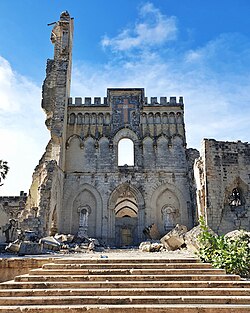
Mogadishu Cathedral (Italian: Cattedrale di Mogadiscio) is a ruined Catholic cathedral located in Mogadishu, Somalia. Between 1928 and 1991, it served as the seat of the Roman Catholic Diocese of Mogadiscio. Built in 1928 by Italian colonial authorities, much of the building was destroyed in 2008 by al-Shabaab. In 2013, the diocese announced plans to refurbish the building.

Key Information

History

[edit]

Mogadishu Cathedral was constructed between 1923 and 1928 by the Italian authorities in the former Italian Somaliland.[1] Known as the Cattedrale di Mogadiscio, it was constructed in a Norman style designed by architect Antonio Vandone, based on the Cathedral of Cefalù in Sicily. The monument deliberately referenced the eleventh-century Norman conquest of Sicily from Islamic rule and capitalized on portrayals of the Normans as tolerant rulers of their Muslim subjects.[2][3]

The cathedral was the largest in eastern Africa. It was constructed in a central area of the capital not far from the Governor's Palace by order of Cesare Maria De Vecchi, governor of Italian Somaliland who promoted the Christianization of Somali people.[4] The Consolata missionaries oversaw its construction and maintained the cathedral until they were replaced by the Franciscans (Friars Minor).

The facade was delimited to the sides by two towers, each 37.50 meters high. The plan of the building was a Latin cross; the interior was divided into three naves separated by piers with pointed arches.[5] Elements such as the bell towers and pointed arches can be compared to Islamic architecture, especially in North Africa, and the colonial authorities hoped that these features would complement the cathedral's surroundings and the sensibilities of the local population.[6]

In 1989, on the eve of the outbreak of the civil war in Somalia, the last Bishop of Mogadishu, Salvatore Colombo, was killed by armed insurgents while celebrating Mass in the cathedral.[7] The assassination of Bishop Colombo remains unsolved, despite calls from Somali officials for the case's investigation.

Current situation

[edit]
Mogadishu Cathedral before destruction

After 1991, the cathedral was no longer regularly used.[8] In late 2008, much of the Catholic cathedral was destroyed.[9]

A BBC correspondent later visited the site in 2012 and reported that some internally displaced people had formed tent settlements on the cathedral grounds. This was in stark contrast to the many new shops that had opened outside, where merchants, optimistic about the city's relative stability since the ousting of the insurgents, had begun to publicly advertise their wares again. The correspondent also mentioned that although the cathedral had structurally incurred considerable damage by having its roof blown off among other things, its walls were still erect, its elegant stone arches still in place, and the general atmosphere was one of serenity.[10]

In April 2013, after a visit to the site to inspect its condition, the diocese announced plans to rebuild the cathedral in the near future.[11] As of 2023, reconstruction of the cathedral has yet to commence.

See also

[edit]

References

[edit]

Bibliography

[edit]
[edit]
Revisions and contributorsEdit on WikipediaRead on Wikipedia
from Grokipedia
The Cathedral, known in Italian as the Cattedrale di Mogadiscio and dedicated to , is a ruined Roman Catholic situated in , the capital of . Constructed between 1925 and 1928 under Italian colonial rule by the Consolata Mission Institute, it functioned as the seat of the Roman Catholic Diocese of Mogadiscio until the early 1990s. Designed in a neomedieval style drawing from the 12th-century in , the edifice incorporated elements such as Gothic arches, Romanesque carvings, and twin towers rising to approximately 37 meters, reflecting Fascist Italy's projection of cultural continuity and "peaceful conquest" in its East African territories. Inaugurated on , 1928, in the presence of Umberto of Savoy, it stood as one of the largest Christian temples in and a focal point for the Italian settler community, later providing refuge during anti-Italian violence in 1948. The cathedral endured initial damage from Somalia's 1991 civil war onset but suffered progressive deterioration, including the 1989 assassination of Bishop Salvatore during Mass within its walls; by the late 2000s, Islamist militants associated with al-Shabaab had reduced much of the structure to rubble as part of broader efforts to eradicate non-Islamic religious sites. As of 2025, the site persists in ruins, occasionally sheltering displaced persons amid debates over preservation versus demolition in a context of minimal Christian presence and persistent security threats.

Construction and Colonial Context

Origins and Italian Initiative

The Italian colonial administration in Somaliland initiated the construction of Mogadishu Cathedral as part of broader efforts to establish enduring symbols of European authority and religious influence in the protectorate's capital during the mid-1920s. , formalized as a colony in 1905 following earlier coastal acquisitions from the of , saw accelerated development under Fascist governance after 1922, with infrastructure projects aimed at accommodating Italian settlers, administrators, and missionaries. The project was directed by the Istituto Missioni Consolata under Governor , a Fascist leader appointed in 1923, who oversaw both urban expansion and military pacification campaigns to subdue local resistance. Construction commenced in 1925 and concluded in 1928, positioning the cathedral as a centerpiece of Mogadishu's emerging colonial quarter near the Governor's Palace. This timeline aligned with De Vecchi's tenure, during which he prioritized initiatives to integrate Catholic institutions into the colony's fabric, serving primarily the spiritual needs of approximately 50 Italian families and officials while projecting an image of harmonious coexistence under Italian rule in a predominantly Muslim society. The endeavor reflected Fascist colonial ideology, which framed such builds as civilizing contributions, drawing on historical precedents like Norman Sicily to legitimize presence amid local Islamic dominance. Funding and labor were state-supported, involving Italian engineers and local workers under supervision, with the structure designed to rival major African cathedrals in scale to underscore imperial ambition. Upon completion, it became the seat of the newly established of Mogadiscio, reinforcing the Vatican's foothold through Italian auspices despite limited indigenous conversions. This initiative, however, occurred against a backdrop of coercive policies, including forced relocations and suppression of movements, highlighting the cathedral's role not merely as a religious site but as an instrument of colonial assertion.

Design and Architectural Planning

The architectural planning for Mogadishu Cathedral originated in the mid-1920s as part of Italian colonial efforts to imprint European religious and cultural symbols on Somalia's urban landscape, following the approval of a new regulatory plan for under Governor di Val Cismon. De Vecchi, a staunch Catholic, prioritized the project to assert Italian dominance and foster a Catholic community amid the predominantly Muslim population, envisioning it as the largest Christian temple in . Antonio Vandone di Cortemilia, an Italian engineer and architect, was tasked with the design, which explicitly modeled the structure after Sicily's Cefalù Cathedral to evoke Arabo-Norman influences blending Gothic elements with Islamic architectural motifs, such as pointed arches and geometric patterns. The plan specified a basilica layout with three naves divided by stone pillars, a pronao featuring three ogival arches accessed via a balustraded terrace with staircases, and twin towers rising 37 meters—the tallest structures in the city at the time—intended to symbolize permanence and colonial prestige. Construction commenced in 1925, with completion targeted for rapid erection using local coral stone and imported materials to withstand the equatorial climate, reflecting pragmatic colonial engineering adapted from Mediterranean precedents.

Architectural Characteristics

Style and Influences

The Mogadishu Cathedral was designed in a Norman Gothic style, featuring pointed arches, ribbed vaults, and intricate stone carvings typical of medieval European ecclesiastical architecture adapted for colonial construction. This aesthetic drew primary inspiration from the Cefalù Cathedral in Sicily, reflecting the Arab-Norman tradition that fused Norman Romanesque foundations with Gothic verticality and decorative motifs influenced by Byzantine mosaics and Islamic geometric patterns from Sicily's multicultural history under Norman rule. Italian engineer Antonio Vandone di Cortemilia, the architect, incorporated these elements to evoke a sense of imperial continuity with Italy's historical Mediterranean legacy, using local labor including Abyssinian and Migiurtini prisoners for construction between 1925 and 1928. The facade exhibited Greco-Norman stylistic cues, such as vegetal motifs on capitals and pilasters supporting ogival arches, blending Romanesque solidity with Gothic aspiration while prioritizing durable coral stone suited to the coastal environment over ornate imported materials.

Structural Features and Materials

The Mogadishu Cathedral adopted a basilical plan in the shape of a , featuring a tripartite nave divided into three aisles by supporting piers. Vaulted ceilings originally spanned the naves, providing structural integrity and acoustic qualities suited to functions. The design drew directly from the Norman Cathedral of , incorporating elements such as a prominent and longitudinal emphasis, but adapted for colonial construction constraints. The facade was defined by flanking the main portal, each reaching a height of 37.5 meters and capped with pointed arches that evoked Gothic influences within a predominantly Romanesque framework. These towers served both aesthetic and symbolic purposes, marking the cathedral as a vertical in Mogadishu's . Entry was through a sole portal leading into the , with minimal interior decoration emphasizing functional simplicity over ornate medieval precedents. Primary construction relied on blocks for the and main body, a practical for durability in Somalia's and to expedite building under Italian oversight from 1925 to 1928. Stone was used selectively for towers and piers, enhancing load-bearing capacity and visual resemblance to the stone-built Cefalù model. This hybrid material approach reflected engineering adaptations, prioritizing resilience against environmental factors like humidity and seismic activity over pure historical replication.

Religious and Communal Role

Establishment of the Diocese

The encompassing Mogadishu originated as the of Benadir, erected on January 21, 1904, by detaching territory from the Apostolic Vicariate of Northern Zanguebar to administer in southern under Italian influence. This prefecture, initially led by Italian Capuchin friars, focused on for a small expatriate community amid a predominantly Muslim population, with early efforts centered on schools and basic evangelization rather than widespread conversion. On December 15, 1927, the prefecture was elevated to the Apostolic Vicariate of , reflecting growth in Catholic infrastructure during the Italian colonial administration of , which included the construction of the the following year as the vicar's principal church. The vicariate operated under bishops appointed by the , such as Antonio Bruccoleri (1929–1936), overseeing a modest Catholic presence estimated at several thousand by mid-century, primarily , , and a few local converts. The full Diocese of Mogadishu was established on November 20, 1975, when promoted the apostolic vicariate to diocesan status, coinciding with Somalia's post- consolidation under the ; however, by this point, the Catholic population had dwindled to around 8,500 amid political instability and emigration following independence in 1960. The diocese retained the cathedral as its , though episcopal appointments became vacant after 1985 due to escalating violence, leaving it as an apostolic without a residential . This elevation marked the formal integration of the local church into the Latin Rite hierarchy, but practical governance shifted to amid declining local and .

Catholic Presence in Somalia

The Catholic presence in Somalia traces its modern origins to the Italian colonial era, when the Prefecture Apostolic of Benadir was established in 1904 to serve southern , while northern regions fell under the Vicariate of Arabia administered by Capuchin friars. This ecclesiastical structure supported a primarily composed of Italian administrators, settlers, , and missionaries, with Catholicism functioning as a facet of colonial administration rather than widespread indigenous adoption. By the mid-20th century, prior to Somali independence in 1960, the Catholic population reached its historical peak of around 8,500, concentrated in urban centers like and bolstered by Italian influence. Following and the exodus of most , the Catholic community contracted sharply, dropping to mere hundreds by the 1970s amid and 's dominance as the . The of Mogadiscio, elevated from vicariate status in 1975, encompasses the entire country but has lacked a residential since the 1980s due to escalating instability. The from 1991 onward, coupled with the rise of Islamist militias enforcing law—under which from carries the death penalty—further eroded open Catholic practice, driving native converts underground and limiting visible presence to expatriate aid workers, diplomats, and peacekeepers in relatively secure enclaves. Today, Somalia's Catholic population is estimated at fewer than 100 individuals, predominantly non-Somali foreigners such as humanitarian staff, with native Somali Catholics numbering in the low dozens and compelled to conceal their faith to evade execution or social ostracism by clans and groups like Al-Shabaab. The sole public Catholic worship site is St. Anthony of Padua Church in , —reconsecrated in 2016 after years of disuse—which serves this expatriate remnant under from , as remains too perilous for clergy or open services. This marginalization reflects Somalia's 99% Sunni Muslim composition and entrenched tribal-Islamic norms, where Christian or visibility provokes lethal reprisals, rendering sustained Catholic institutional presence untenable without external protection.

Deterioration and Destruction

Somali Civil War Impacts

The outbreak of the in the late 1980s, culminating in the January ousting of President by rebel forces, marked the onset of severe structural damage to the Cathedral. Intense urban fighting in exposed the prominent Gothic-style building to direct combat, with reports indicating it was struck by grenades during clashes between rebels and government troops, followed by from retreating soldiers that left it as a gutted shell. Post-1991, the cathedral ceased regular liturgical use amid escalating clan warfare and , undergoing further degradation from neglect and sporadic violence. The roof was demolished, likely from explosive impacts or deliberate , while the robust stone walls and arches endured partial survival despite the chaos. Its central location along the so-called "Green Line"—a frontline dividing factional territories—rendered it vulnerable to sustained and occupation by armed groups, accelerating the ruin of its interior furnishings and features. By the mid-1990s, the edifice stood as a skeletal remnant, emblematic of the war's indiscriminate toll on colonial-era , with no organized possible under fractured . The civil strife's facilitated and repurposing, compounding the initial battle damage and hastening irreversible decay.

Specific Attacks by Islamist Groups

In 2008, Al-Shabaab militants razed the remaining ruins of Mogadishu Cathedral as part of their campaign to eradicate symbols of and non-Islamic heritage in areas under their influence. The group, which emerged in the mid-2000s amid 's ongoing instability, viewed the structure—built during Italian colonial rule—as an emblem of foreign and Christian imposition incompatible with their interpretation of Islamic governance. This deliberate demolition followed earlier damage from clan warfare in the 1990s but marked a targeted ideological assault, aligning with Al-Shabaab's broader pattern of destroying perceived idolatrous or un-Islamic sites, including Sufi shrines and graves across southern Somalia. No other direct attacks on the cathedral site by Islamist groups have been verifiably documented, though the group's control of parts of from 2008 to 2011 facilitated further neglect and occasional skirmishes in the vicinity. Al-Shabaab's actions reflected their Salafi-jihadist ideology, which prohibits non-monotheistic religious infrastructure and punishes or perceived alliances with Western influences, contributing to the near-total erasure of Somalia's overt Christian presence. Incidents near the ruins, such as a January 16, 2024, suicide bombing that killed three people adjacent to the site, underscore ongoing insecurity but were not confirmed as targeting the cathedral itself.

Current Condition and Restoration Attempts

Post-Destruction Usage

Following the cathedral's ransacking and partial burning on January 9, 1991, amid the onset of the , the structure ceased religious use and became accessible to the public without restrictions. It was repurposed informally as a , refuse dump, and shelter for , reflecting the broader collapse of civic infrastructure in . By 2011, during a severe and exacerbated by ongoing conflict, the ruins emerged as a refuge for hundreds of internally displaced persons (IDPs) fleeing rural areas in search of aid. The site's remnants provided makeshift housing within an camp, accommodating families amid widespread displacement that saw over 100,000 people enter in preceding months. Local Catholic leader Giorgio Bertin described the cathedral grounds as one of numerous IDP camps in the city, capable of housing at least 300 individuals, underscoring its unintended role in humanitarian relief despite the absence of formal church oversight. Subsequent Al-Shabaab attacks in 2008 further reduced the building to a skeletal shell, yet the site retained its function as an IDP settlement into the 2010s and beyond. Displaced settlements persisted in the grounds, with residents utilizing surviving walls for basic enclosure amid Mogadishu's chronic insecurity and . As of 2023, the ruins continued to offer informal shelter to homeless and displaced populations, though proposals for conversion to a or full demolition have sparked debate without altering its use.

Efforts and Challenges in Preservation

Efforts to preserve the Mogadishu Cathedral have primarily focused on digital documentation rather than physical restoration, given the site's ongoing instability. In 2018, Somali architecture students and international collaborators initiated projects to create 3D models of the cathedral and other war-damaged landmarks, aiming to archive architectural details for potential future reconstruction and cultural education. These initiatives, such as the Somali Architecture 3D Project, scanned ruins to digitally reconstruct facades and interiors, preserving elements like Gothic arches amid physical decay. Broader heritage efforts in , including UNESCO's 2025 technical assessment of Old Mogadishu sites, have indirectly supported awareness of colonial-era structures like the cathedral, though without site-specific interventions. The Roman Catholic Diocese of , administered from , has expressed satisfaction with the ruins' informal utility—such as shelter for displaced persons—viewing it as a form of communal preservation amid . Preservation faces severe challenges from political symbolism, security threats, and resource scarcity. The cathedral, built in 1925–1928 under Italian rule, is often framed as a colonial relic evoking , fueling debates in 2025 over versus retention as a historical . Islamist groups like al-Shabaab, which attacked the site in , oppose non-Islamic heritage, exacerbating risks in a where falters and militant incursions persist. Indiscriminate damage since 1991, combined with post-conflict priorities favoring infrastructure over niche sites, has left physical refurbishment—despite 2013 diocesan plans—unrealized, with the structure remaining a crumbling shell.

Controversies and Symbolic Debates

Preservation vs. Demolition Arguments

The debate over 's ruins intensified in June 2025 when a tweet by human rights activist Sagal Abbas advocating preservation resurfaced, prompting polarized online responses in . Preservation advocates emphasize the structure's architectural and historical value, including its Gothic arches and Romanesque carvings built between 1925 and 1928, once making it Africa's largest at 37 meters tall. They argue retention serves as a tangible record of 's multifaceted past, including Italian colonial era, without implying endorsement of that history. A 2017 poll by Somali photographer Omar Degan received 112 responses, with 72% favoring repurposing colonial buildings like the into museums to educate on . Somali architecture students have pursued digital 3D modeling of such ruins since 2018 to safeguard heritage identity amid destruction risks, underscoring empirical value in preserving physical remnants for cultural continuity. Critics of warn that erasing sites risks deeper about causal events like damages starting in and the 1989 assassination of Bishop Salvatore Colombo inside the . Opponents of preservation view the cathedral as an offensive relic of Italian colonialism, imposed on a predominantly Muslim , with its alien in 99% Islamic . Online discussions, including on 's r/Somalia subreddit, show a plurality favoring demolition, citing it as a waste of resources or of foreign domination, with some alleging construction via forced Somali labor—though unverified in primary records. Demolition proponents argue removal aligns with national reclamation, preventing provocation of anti-colonial sentiment, as evidenced by backlash against Degan's heritage photos. Alternatives like conversion to a appear in minority views, drawing parallels to repurposing in other Muslim-majority contexts. These positions reflect tensions between historical —favoring preservation for verifiable continuity—and ideological purification via , amid Somalia's Islamist influences that have targeted the site since al-Shabaab's 2008 attacks. No formal government policy has emerged as of October 2025, leaving the ruins in contested limbo.

Broader Cultural and Political Implications

The destruction and contested status of Mogadishu Cathedral underscore the erasure of non-Islamic architectural and in , a nation where over 99% of the adheres to , reflecting deeper tensions between historical pluralism and prevailing Islamist ideologies that view Christian symbols as idolatrous or foreign impositions. Constructed between 1925 and under Italian colonial rule, the cathedral symbolized Catholic institutional presence amid a Muslim-majority society, serving primarily the spiritual needs of Italian settlers and administrators while embodying Europe's rhetoric. Its repeated targeting during the , particularly by Islamist militias enforcing interpretations that prohibit public non-Muslim , illustrates causal links between radical religious enforcement and the systematic of pre-independence structures perceived as threats to Islamic purity. Politically, the cathedral's ruins have fueled debates on and heritage preservation, pitting advocates for retaining colonial-era monuments as markers of Somalia's multifaceted against those who decry them as relics of unfit for a sovereign . Preservation efforts, often supported by international actors emphasizing , encounter resistance from local Islamist factions and even some nationalist elements wary of glorifying foreign domination, as evidenced by post-1991 "colonial " where Italian-built sites like the cathedral were repurposed or neglected amid civil strife. This impasse highlights Somalia's governance challenges, where weak central authority since 1991 has allowed non-state Islamist groups like al-Shabaab to dictate cultural narratives, suppressing minority religious expressions and limiting open Christian practice due to social stigma against conversion from . On a broader scale, the cathedral's fate exemplifies the political marginalization of religious minorities in , where constitutional provisions nominally protect freedoms but yield to clan-based Islamic norms that criminalize and , resulting in underground Christian communities facing . Internationally, it serves as a in the clash between universal heritage conservation principles—promoted by bodies like —and local Islamist priorities that prioritize religious homogeneity, complicating foreign aid for restoration amid ongoing insurgencies. These dynamics reinforce causal patterns where Islamist dominance, rather than mere conflict, drives the obliteration of symbols like the cathedral, signaling limited prospects for without fundamental shifts in power structures.

References

Add your contribution
Related Hubs
User Avatar
No comments yet.