Hubbry Logo
Mohammad Al-Amin MosqueMohammad Al-Amin MosqueMain
Open search
Mohammad Al-Amin Mosque
Community hub
Mohammad Al-Amin Mosque
logo
8 pages, 0 posts
0 subscribers
Be the first to start a discussion here.
Mohammad Al-Amin Mosque
from Wikipedia

The Mohammad Al-Amin Mosque (Arabic: جامع محمد الأمين), also referred to as the Blue Mosque, is a Sunni mosque, located in downtown Beirut, Lebanon.

Key Information

In the 19th century, a zawiya was built on this site. Decades of preparation to obtain sufficient land adjacent to the old Zawiya led finally to the building of the new mosque. The mosque was inaugurated in 2008, and is located adjacent to the Maronite Cathedral of Saint George.

History

[edit]

In the 19th century, a zawiya, named after Sheikh Abu Nasr al-Yafi, was built on this site. Souk Abu Nasr was located in the same area and was operational with the zawiya until 1975.[1][2]

On August 4, 2020, the mosque was badly damaged by the Beirut explosions. Its chandeliers and windows were shattered, leaving broken glass on the floor.[3]

Construction and design

[edit]

Soon after the Lebanon Civil War, following a donation by the late Prime Minister Rafic Hariri, the foundation for the Mohammad Al-Amin Mosque was laid in November 2002. Hariri was assassinated on February 14, 2005, and his body is buried next to the mosque, within the Martyrs' Square of Beirut. The mosque was used for Hariri's funeral ceremony.[4]

During the construction of the mosque, archaeologists uncovered a section of the east–west main Roman street (Decumanus Maximus), with paving and columns.[5] After the first stone was laid out for the mosque, the first concrete was poured in 2003. By 2005, the architecture of the mosque had begun to be built and the mosque was inaugurated in 2008.[6]

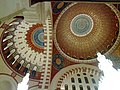
Designed by Azmi Fakhoury in a style similar to the architecture of Ottoman Turk, the mosque can accommodate up to 6,400 worshippers.[7] The Mohammad Al-Amin Mosque contains five domes, all of which are made from light blue tiles. The interior details have patterned ceilings and a dome circle. The ornament that seems to be a chandelier dangles in front of the mihrab.

[edit]

See also

[edit]

References

[edit]
[edit]
Revisions and contributorsEdit on WikipediaRead on Wikipedia
from Grokipedia
The Mohammad Al-Amin Mosque is a prominent Sunni situated in central , , adjacent to Martyrs' Square and the St. George Maronite Cathedral. Commissioned and primarily funded by former Prime Minister Rafic al-Hariri, construction began with groundbreaking in 2003 and culminated in its inauguration on October 17, 2008, after Hariri's assassination in 2005. Designed in an Ottoman architectural style reminiscent of Istanbul's Sultan Ahmed Mosque, the structure features a light blue-tiled central dome, two semi-domes, four slender minarets, and an exterior clad in yellow sandstone quarried in , with interior elements including multi-story arches and a mausoleum completed in 2015 for Hariri's burial. Spanning approximately 10,000 square meters, it represents a major post-Lebanese Civil War reconstruction project, asserting Sunni religious presence in a sectarian landscape amid Hariri's efforts to counter Syrian influence and foster national unity through symbolic infrastructure.

Historical Background

Pre-Construction Site History

The site of the Mohammad Al-Amin Mosque in downtown originally hosted a zawiya (Sufi prayer corner and lodge) established in 1853 and named after Sheikh Muhammad Abu al-Nasr al-Yafi'i, a figure associated with local Islamic traditions. This modest structure functioned as a religious and communal space amid the surrounding commercial area, which included Souk Abu Nasr, a traditional market reflecting Ottoman-era urban patterns in . By the early , the zawiya had evolved into a small , documented in land records as early as , serving 's Sunni Muslim community in a neighborhood marked by mixed religious sites near Martyrs' Square. During the Lebanese Civil War (1975–1990), the downtown district became part of the heavily contested "Green Line" dividing Christian east and Muslim west Beirut, subjecting the area to prolonged artillery bombardment, sniper fire, and abandonment. The zawiya—referred to in some accounts as the Martyr's Mosque—was completely destroyed amid this devastation, leaving the site as rubble within a broader zone of urban ruin where an estimated 70% of central Beirut's buildings were damaged or obliterated. Post-war assessments in the 1990s revealed the plot as vacant wasteland, emblematic of the district's transformation into a no-man's-land during the conflict, with no significant reconstruction until private and state-led initiatives began assembling fragmented properties for redevelopment. Efforts to consolidate land adjacent to the original zawiya site spanned decades prior to construction, involving negotiations among heirs, (Islamic endowment) authorities, and property owners to secure a larger parcel suitable for a grander , reflecting persistent Sunni aspirations for a prominent downtown presence amid competing Christian edifices like St. George Maronite Cathedral. This pre-construction phase underscored the site's layered Islamic heritage, from 19th-century Sufi origins to wartime obliteration, setting the stage for its post-1990 repurposing in Beirut's reconstruction.

Initiation and Planning Under Rafic Hariri

The Mohammad Al-Amin Mosque project, long envisioned by Beirut's Sunni community since the early , saw its modern initiation under Prime Minister in the early , as part of broader post-civil war reconstruction efforts in downtown . Hariri, leveraging his influence through the real estate company —which oversaw the area's redevelopment—facilitated the expansion of the site, originally a modest zawiya owned by the Sunni since 1933, by financing the necessary land acquisitions adjacent to it. This addressed decades of stalled preparations due to political instability and limited resources, positioning the mosque as a central religious and symbolic landmark in the revitalized urban core. Hariri personally funded the entire project, including land costs and construction, viewing it as an opportunity to erect a monumental structure honoring Sheikh Muhammad al-Amin, the 20th-century , while bolstering Sunni visibility amid Lebanon's sectarian balance. In collaboration with Dar al-Fatwa, the Sunni religious authority led by Rashid Qabbani, planning accelerated in 2001, culminating in the laying of the on November 6, 2002 (the first day of 1423), a ceremonial event conducted jointly by Hariri and Qabbani. The initiative reflected Hariri's strategic motivations, blending communal religious needs with to affirm Sunni resurgence in a reconstructed , where the mosque's prominence would counterbalance nearby Christian sites like the St. George Maronite Cathedral. Design planning involved competitive proposals, with Jordanian architect Rasem Badran initially commissioned in 2002 for a more integrated urban scheme featuring two minarets, which Qabbani rejected for lacking sufficient grandeur and monumentality. Hariri endorsed the mufti's preference for a bolder Ottoman-inspired aesthetic—modeled after Istanbul's Sultan Ahmed Mosque—with four towering minarets (scaled to 55 meters) and a central dome, entrusting finalization to his own firm, Oger Liban, under Azmi Fakhouri, who collaborated with earlier inputs from Saleh Lamei. This decision secured Oger Liban's contract while aligning with Hariri's vision of a "landmark of Islamic civilization," though it drew internal debates over scale and integration with Solidere's master plan. followed with the pouring of first concrete on October 3, 2003, marking the transition from planning to active construction under Hariri's oversight.

Construction and Architectural Features

Timeline and Engineering Details

The Mohammad Al-Amin Mosque's construction was initiated under the patronage of Lebanese Prime Minister , with the foundation stone laid in 2002. followed in 2003, commencing the primary building phases after years of site preparation in downtown . Active construction progressed through 2005, when key architectural components took shape, leading to the mosque's inauguration on October 17, 2008. The adjacent for Hariri was completed later in 2015. Structurally, the mosque covers approximately 10,000 square meters and features a central blue-tiled dome elevated for spacious interiors, supported by two semi-domes and a perforated that facilitates penetration. Four slender minarets, each rising to about 65 meters, anchor the design in Ottoman traditions while employing modern techniques for stability. The facade utilizes Beiruti yellow sandstone, quarried in , , cladding large multi-story arches to blend contemporary engineering with regional aesthetics.

Design Elements and Influences

The Mohammad Al-Amin Mosque exemplifies Ottoman-style architecture, characterized by a central blue dome and four prominent minarets, each rising to 65 meters in height. This design draws direct inspiration from the Sultan Ahmet Mosque in , known as the Blue Mosque, incorporating elevated interior spaces and traditional Ottoman construction techniques that emphasize grandeur and . The structure is clad in yellow sandstone, blending local Beiruti materials with imported stone to achieve a harmonious aesthetic integration into Beirut's urban fabric while evoking classical Islamic . Architect Azmi Fakhoury led the planning, focusing on exterior form and spatial organization, while Nabil Dada & Associates handled the interior detailing. Key elements include intricate adorning the domes and walls, crystal chandeliers illuminating the prayer hall, and expansive oriental carpets covering the floors, which enhance the mosque's capacity for up to 6,400 worshippers. The blue dome, a hallmark of Ottoman influence, symbolizes the heavens and provides a visual focal point, with its interior painted in motifs that align with Sunni architectural traditions rather than Shia variants. While primarily Ottoman in expression, subtle Mamluk elements appear in decorative motifs, reflecting a synthesis of historical Islamic styles adapted for modern construction completed in 2008. This blend underscores the mosque's role as a contemporary revival of pre-modern Islamic architecture, prioritizing visual impact and functional scale over strict historical replication.

Location and Urban Integration

Placement in Downtown Beirut

The Mohammad Al-Amin Mosque occupies a central position in Downtown 's (BCD), at the intersection of Martyrs' Square (Sahat al-Shuhada) and Amir Bashir Street, with precise coordinates of approximately 33°53′43″N 35°30′23″E. This placement positions the mosque directly facing the historic Martyrs' Square, a key commemorating Lebanon's struggles and serving as a focal point for civic gatherings. Adjacent to the mosque stands the St. George Maronite Cathedral, highlighting its integration into a religiously diverse urban fabric where Sunni and Christian sites coexist in close proximity. The mosque's corner site provides a prominent facade opening onto the square, enhancing its visibility amid surrounding commercial and historical structures rebuilt after the (1975–1990). As part of the Solidere-led reconstruction of the war-ravaged downtown, the mosque's location underscores its role in revitalizing the BCD into a modern economic hub while asserting a Sunni architectural presence in an area historically associated with mixed sectarian influences. The site's selection facilitated the mosque's four minarets, reaching 65 meters, to dominate the skyline alongside nearby edifices, including the later-added Rafic al-Hariri mausoleum adjacent to the complex. This strategic urban placement not only maximizes accessibility for worshippers but also symbolizes post-conflict renewal in Beirut's commercial core.

Relation to Nearby Religious and Civic Sites

The Mohammad Al-Amin Mosque stands adjacent to the St. George Maronite Cathedral in downtown Beirut's Martyrs' Square area, a deliberate positioning that underscores the site's role in Lebanon's multi-sectarian landscape. This proximity to a prominent Maronite Christian cathedral, constructed between 1884 and 1894, highlights architectural juxtaposition amid urban reconstruction efforts following the Lebanese Civil War. The mosque's minarets rise to 65 meters, comparable in height to the cathedral's bell tower, which was rebuilt in 2016 to match the mosque's scale, reflecting ongoing civic adaptations to visual harmony. Nearby, the Greek Orthodox Cathedral of Saint George and Al-Omari Mosque contribute to the dense cluster of religious structures within a few hundred meters, exemplifying Beirut's historical predating modern planning. Civic landmarks include Martyrs' Square itself, site of independence commemorations in 1943 and protests during the 2019 revolution, positioning the mosque as a focal point for both spiritual and public gatherings. Roman ruins, including baths from the Roman era, lie in close vicinity, integrating the mosque into Beirut's layered archaeological and civic fabric without direct overlap. The in Nejmeh Square, approximately 500 meters away, further embeds the mosque in the governmental quarter, linking religious symbolism to national institutions.

Religious and Communal Role

Capacity and Daily Use

The Mohammad Al-Amin Mosque's main hall has a capacity of 3,000 worshippers, with an additional space accommodating 800 in a separate women's section. Other estimates place the total capacity higher, at over 5,000 individuals across the facility during peak times. This supports large-scale gatherings, reflecting its as Lebanon's largest mosque. Daily operations center on the five obligatory Islamic prayers (), performed at dawn (Fajr), noon (Dhuhr), afternoon (Asr), sunset (Maghrib), and night (Isha), with the call to prayer () broadcast from the minarets. Attendance varies, but the mosque sees heightened participation during Friday's congregational Jumu'ah , when the space fills significantly as the primary Sunni worship site in central . Beyond rituals, it functions as a communal hub for Sunni , hosting educational sessions and social activities, though specific daily attendance figures remain undocumented in available records. Non-worshippers may enter outside hours, subject to modest dress requirements and guided access to preserve sanctity.

Symbolic Importance for Sunni Muslims

The Mohammad Al-Amin Mosque embodies a resurgence of Sunni identity in post-civil war , serving as a monumental assertion of communal presence in 's urban core, where Sunnis sought to reclaim visibility after decades of marginalization during the 1975–1990 conflict. Financed and championed by , a Sunni who positioned himself as a patron of Sunni revival, the mosque's inauguration on October 17, 2008, marked a deliberate architectural response to the perceived erosion of Sunni influence in the capital amid rising Shiite and Christian institutional power. Its scale—featuring four 65-meter minarets and capacity for 3,500 worshippers—positions it as the largest Sunni mosque in , symbolizing not only religious devotion but also political empowerment within 's confessional framework, where sectarian landmarks often reflect balances of power. For Sunni Muslims, the mosque's Ottoman-inspired design, drawing from Istanbul's Sultan Ahmed Mosque with its blue dome and intricate evoking Quranic verses, evokes a return to traditional Islamic might and , countering narratives of Sunni decline in a Shiite-ascendant regional context. Hariri's intent, as articulated in project planning from onward, was to forge a "building of might and " that intertwined religious symbolism with his personal legacy, fostering Sunni cohesion around themes of resilience and heritage amid Lebanon's fragile sectarian equilibrium. The structure's naming after the Prophet Muhammad (, "the trustworthy") reinforces core Sunni reverence for his exemplary character, positioning the site as a spiritual anchor for the community, which constitutes roughly 27% of Lebanon's population per 2018 estimates from religious demographics studies. Adjacency to Hariri's , established post his February 14, 2005 assassination, amplifies its role as a pilgrimage hub for Sunnis, blending funerary rites with anti-Syrian political mobilization that galvanized the community during the 2005 . This fusion has rendered the mosque a locus for Sunni expressions of defiance against perceived encroachments, such as Hezbollah's influence, while its central location vis-à-vis Christian sites underscores a Sunni claim to shared national space without subsuming sectarian distinctiveness. Academic analyses frame it as reshaping Sunni political visibility, transforming Hariri's image from pan-Lebanese reformer to a distinctly Sunni icon amid evolving communal dynamics.

Political Context and Symbolism

Ties to Rafic Hariri's Legacy

The Mohammad Al-Amin Mosque was commissioned by , Lebanon's from 1992 to 1998 and 2000 to 2004, who provided the primary funding for its land acquisition and construction as part of his broader postwar reconstruction initiatives in downtown Beirut through the company he founded. Hariri envisioned the mosque as a central Sunni religious landmark to symbolize renewal and communal prominence in the capital's revitalized urban core, aligning with his political emphasis on economic modernization and sectarian balance after the 1975–1990 civil war. Construction began in 2002 following Hariri's donation, with the project drawing materials like yellow stone from , reflecting his personal ties to Gulf benefactors. On November 6, 2001—the first day of 1423—Hariri and Rashid Qabbani jointly laid the , marking a public endorsement of the mosque's role in fostering Sunni identity amid Lebanon's confessional politics. Hariri covered the undisclosed construction costs himself, navigating property rights challenges in the process, though the exact financial details remained private per his preference. The mosque's completion in 2008, after Hariri's on February 14, 2005, transformed it into a enduring emblem of his legacy, with his funeral prayer held there and his tomb placed adjacent to the site, drawing annual commemorations that underscore its association with his martyrdom in the eyes of supporters. This connection extends to Hariri's posthumous influence, as the mosque has served as a focal point for his party and Sunni constituencies, embodying his vision of a integrated into global Sunni networks while countering perceived marginalization post-civil war. Critics, however, have attributed the project's scale to Hariri's personalistic style of , viewing it as an extension of his business empire rather than purely religious , though confirms his direct financial and initiatory role without reliance on state budgets.

Role in Lebanon's Sectarian Dynamics

The Mohammad Al-Amin Mosque serves as a prominent emblem of Sunni assertion within Lebanon's political framework, where power-sharing is allocated by sect, including the premiership reserved for Sunnis. Commissioned by former and constructed starting November 6, 2002, the mosque's monumental scale and central placement in Martyrs' Square were intended to revive Sunni visibility and leadership following the 1975–1990 , which had diminished 's Sunni commercial dominance. Hariri, a Sunni entrepreneur, leveraged the project—originally conceived in the Ottoman era—to consolidate his authority, transforming a communal religious site into a symbol of elite Sunni identity amid competition with Shia and Christian factions. Its strategic location adjacent to Hariri's tomb—following his February 14, 2005, assassination—and proximate to the St. George Maronite Cathedral underscores tensions in Lebanon's sectarian landscape, where public spaces reflect rival communal claims. Critics, including some Lebanese observers, view the mosque's four 72-meter minarets and blue dome as overshadowing historic Christian structures, evoking historical Sunni-Christian rivalries over Beirut's downtown, once a Sunni merchant hub contested by mountain-based . This positioning has fueled perceptions of triumphalism, disrupting the delicate confessional balance and marginalizing non-Sunni groups, particularly Shiites who feel excluded from the reconstructed commercial core. The mosque has functioned as a nexus for sectarian mobilization, notably during mass protests after Hariri's killing that ousted Syrian influence but polarized alliances—Sunnis aligning against Shia-backed —culminating in near-civil war clashes in 2008. Elite narratives from the Hariri family and employ the site to perpetuate sectarian memory, framing Hariri as a Sunni and reinforcing divisions over national unity in a state reliant on sect-based . While occasionally hosting inter-sect events, its primary role sustains elite-driven , embedding religious symbolism into political contestation rather than fostering transcendence of Lebanon's fragmented social order.

Controversies and Criticisms

Architectural and Aesthetic Debates

The Mohammad Al-Amin Mosque's architecture draws primarily from Ottoman influences, featuring four pencil-shaped minarets rising to 69.5 meters, a central dome at 48 meters, and elements of octagonal transitions and Umayyad square bases, with inspirations from Istanbul's Sultan Ahmed Mosque and Cairo's . The final form reconciles a lower polygonal base aligned with Beirut's street grid and a higher square platform oriented to the , using desert stone facades, Turkish tiles, and Quranic inscriptions to evoke Islamic heritage. Debates arose during planning over competing designs, with Jordanian architect Rasem Badran proposing a less monumental scheme integrated into the urban fabric, drawing from the nearby Maronite Cathedral of Saint George for contextual harmony and including public spaces like optional shops. This was rejected by Rashid Qabbani for insufficient grandeur and by , who favored a more assertive presence; Egyptian Saleh Lamei's Ottoman-Mamluk hybrid was selected instead, though initially criticized as alien to Beirut's Levantine context. Badran later argued the chosen design projected dominance, clashing with the city's multi-confessional character. Scale emerged as a focal point of contention, with original plans for 85-meter minarets and a 55-meter dome scaled back amid public outcry and interventions by , the Hariri-led reconstruction authority, to mitigate visual overpowering of adjacent structures. Critics, including an art expert cited in 2008 reporting, deemed the structure "too big for a capital of Beirut's size" and out of place amid the city's traditionally modest religious edifices, with its 72-meter minaret height—exceeding the neighboring Saint George Cathedral—perceived as an affront to Christian sites and sectarian balance. The imposing Ottoman-Byzantine aesthetic has been faulted for lacking the serenity of regional Islamic styles, evoking triumphalism insensitive to post-civil war reconciliation efforts. Aesthetic critiques extend to the mosque's role in Solidere's neoliberal redesign of downtown , where its monumentality asserts Sunni visibility but has been accused of prioritizing symbolism over inclusive urban heritage, including by obscuring archaeological remains under concrete platforms. Despite such concerns, proponents view the design as a successful of Islamic architectural excellence, accommodating 3,000 worshippers in an ornate prayer hall.

Political Motivations and Sectarian Tensions

The construction of the was primarily motivated by former Rafic al-Hariri's efforts to assert Sunni Muslim presence and political influence in post-civil war , where reconstruction symbolized competing sectarian identities. Hariri personally financed the acquisition of land and the entire project, laying the in November 2002 as part of his broader vision to revive Sunni communal symbols amid Lebanon's power-sharing system, which allocates political roles by sect. This initiative aligned with Hariri's promotion of a moderate Sunni identity, countering the rising influence of Shiite groups like and Syrian-backed factions, while enhancing his own stature as a Sunni leader backed by . The mosque's grand scale and prominent location on Martyrs' Square, adjacent to Christian sites such as St. George Maronite Cathedral, intensified sectarian tensions by evoking perceptions of rivalry in a city scarred by the 1975-1990 . Critics, including some from Christian communities, condemned its Ottoman-inspired design and size—featuring four 65-meter minarets—as disproportionate and an affront to inter-sectarian balance, arguing it exacerbated divisions rather than fostering unity. In Lebanon's fragile sectarian equilibrium, where public symbols often reflect power struggles, the structure was viewed by detractors as Hariri's bid for Sunni dominance in downtown , potentially alienating other groups and reinforcing confessional patronage networks that perpetuate political stalemates. Despite these criticisms, the mosque has occasionally served as a venue for cross-sectarian gatherings, such as joint Sunni-Shiite prayers during the 2019 protests against corruption, highlighting underlying tensions between elite-driven and demands for . However, its ties to Hariri's legacy have made it a flashpoint for sentiment, underscoring how politically motivated religious can both symbolize resilience and provoke debates over equity in 's multi-confessional landscape.

Legacy and Contemporary Relevance

Hariri's Tomb and Memorial Function

The tomb of , Lebanon's former assassinated by on February 14, 2005, is situated at the base of the Mohammad Al-Amin Mosque in , directly adjacent to the structure he commissioned. site, along with those of eight bodyguards killed in the attack, occupies an open area integrated into the mosque complex, emphasizing simplicity in line with Islamic traditions of direct interment. This location transformed the mosque into a central hub for Hariri's legacy, with his funeral prayer held there on February 16, 2005, drawing over 200,000 mourners amid widespread anti-Syrian protests. The site's annual commemorations, including the 20th anniversary gathering on February 15, 2025, reinforce its function as a focal point for political remembrance, often featuring rallies by supporters of Hariri's party. The memorial's design, featuring a stark, ground-level under the mosque's shadow, symbolizes Hariri's contributions to Lebanon's post-civil reconstruction, including the mosque itself as part of his Horizon 2000 initiative. Visitors and pilgrims frequent the area to pay respects, blending religious observance with national mourning, though access has occasionally been restricted during security incidents or political unrest. This dual role underscores the mosque's evolution from a to a enduring emblem of resilience against in 's sectarian landscape.

Impact on Tourism and Cultural Perception

The Mohammad Al-Amin Mosque functions as a key tourist draw in , attracting visitors through its prominent location in downtown's Martyrs' Square and its Ottoman-style architecture, including blue domes and 65-meter minarets. Travel resources frequently list it among essential sites, emphasizing its role in showcasing Lebanon's Islamic heritage alongside the city's reconstructed urban core. Its capacity to hold 6,400 worshippers underscores its scale, appealing to those interested in religious architecture, though specific annual tourist visitor figures remain undocumented in available data. On platforms like , the mosque garners a 4.5 out of 5 rating from over 800 reviews as of recent assessments, with commendations for its grand chandeliers, mosaics, and serene interior fostering a positive visitor experience. This acclaim contributes to broader promotion, positioning as a destination blending historical reverence with modern accessibility, even amid regional security concerns that have periodically depressed overall arrivals. Culturally, the mosque shapes perceptions of in as a marker of resilience and , built post-civil to symbolize renewal under former Prime Minister Rafic Hariri's initiative. Its adjacency to Christian landmarks, such as St. George Maronite Cathedral, reinforces an image of sectarian coexistence in a multi-confessional society, though real-world tensions occasionally challenge this narrative. Visitors and observers often view it as a cultural hub promoting pluralism, enhancing Beirut's global reputation for religious diversity despite underlying political frictions.

References

Add your contribution
Related Hubs
User Avatar
No comments yet.